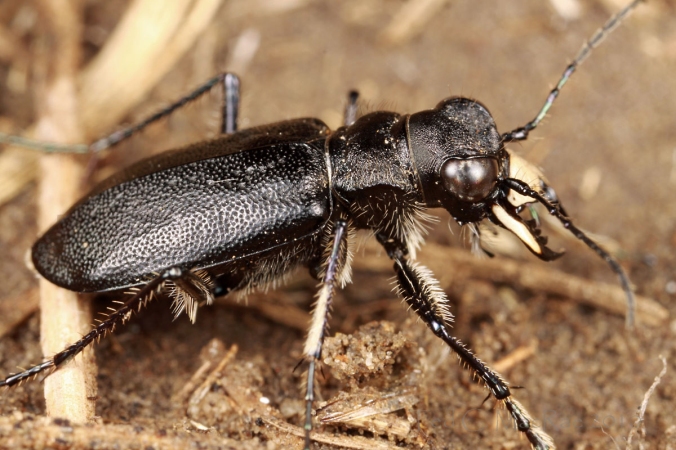
Cicindela nebraskana - the prairie long-lipped tiger beetle
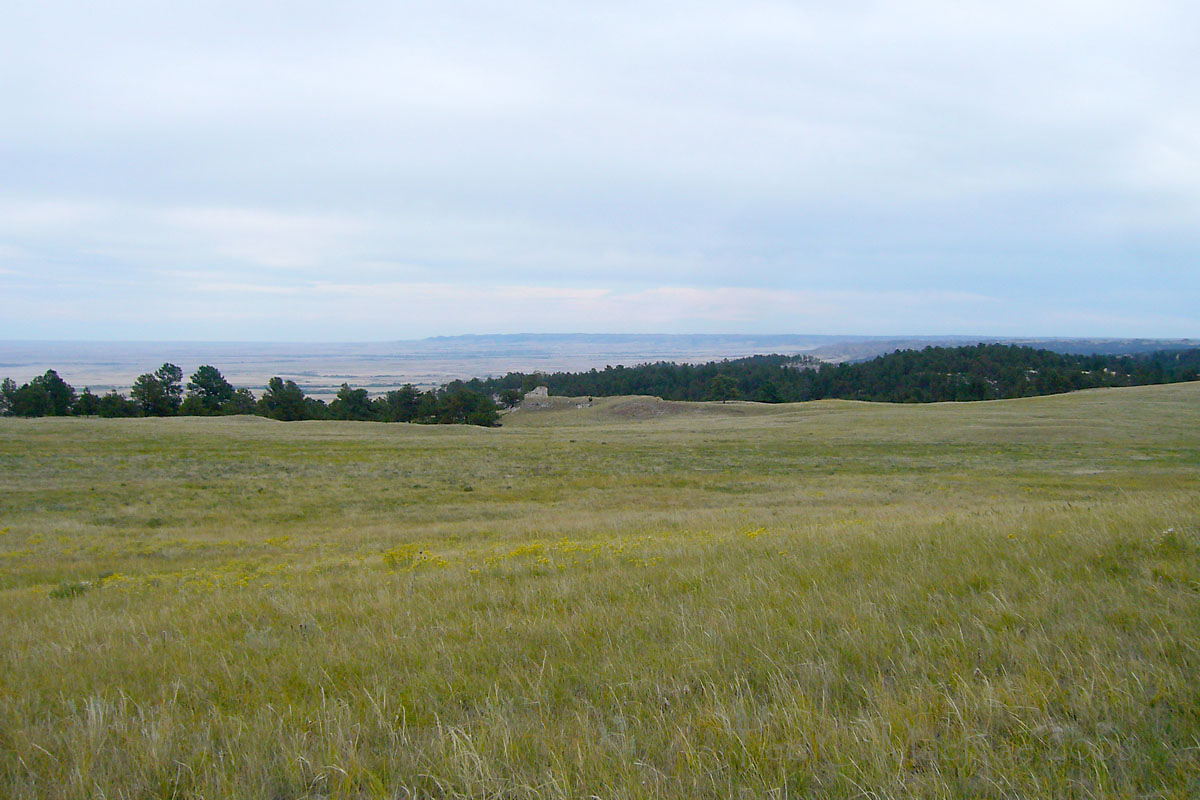
We were only halfway through Day #1 of five days in the field and had already achieved Goal #1 of the trip. Despite that, it took a few hours before Chris and I were ready to tear ourselves away from our first stop in Fall River Co., South Dakota, where we were treated to the sight of glittering, wine-red adults of Cicindela pulchra bejeweling the charcoal-colored shale slopes. However, the list of species that we wanted to see over the next several days was long, and eventually our pulchra-fever abated (barely) enough to head south to the Pine Ridge in Sioux Co., Nebraska to look for A-list Species #2 – Cicindela nebraskana. Sioux Co., Nebraska is the type locality for this species (thus the name), but in reality it is a more western species whose distribution just barely sneaks into the northwestern corner of Nebraska (Pearson et al. 2006, Spomer et al. 2008). I first saw this species at this very site two years ago, seeing only a handful of individuals and managing one harshly-sunlit, point-and-shoot image of one of them. To my knowledge, this remains the only known field photograph of this species.
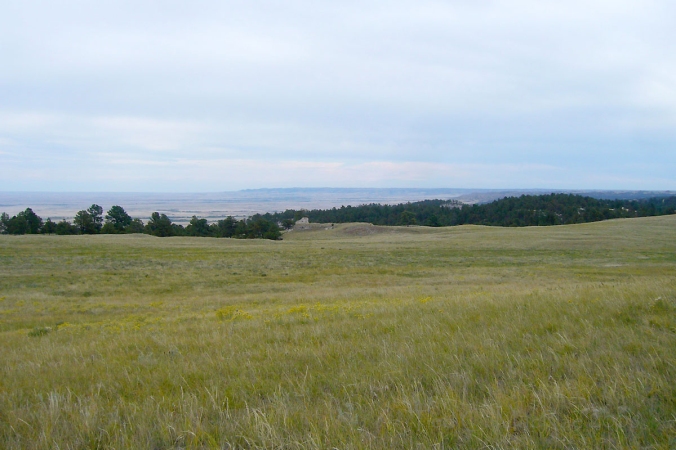
Shortgrass prairie atop the Pine Ridge, Sioux Co., Nebraska (photo taken September 2008).
This time, with a Canon 50D camera and 100mm macro lens in my backpack, I was much better equipped for vastly improved field photographs, but in contrast to the numerous individuals of C. pulchra that we saw earlier in the day, only a single C. nebraskana would turn up after intensive searching by Chris, Matt Brust, and myself in the vast shortgrass prairie sitting at the type locality atop the Pine Ridge. I didn’t find it – Matt did – and the general rule with rare tigers is to capture the first individual rather than try to photograph it. If no others are seen, photographing it later in a terrarium of native soil is better than trying to photograph it in the field and risk letting it escape. Matt gave it to Chris, and at the end of the day when we realized we were not going to see another one, we prepared a terrarium of native soil, taking care to keep the surface as intact as possible so that an accurate replication of the field situation could be created when we photographed it later.
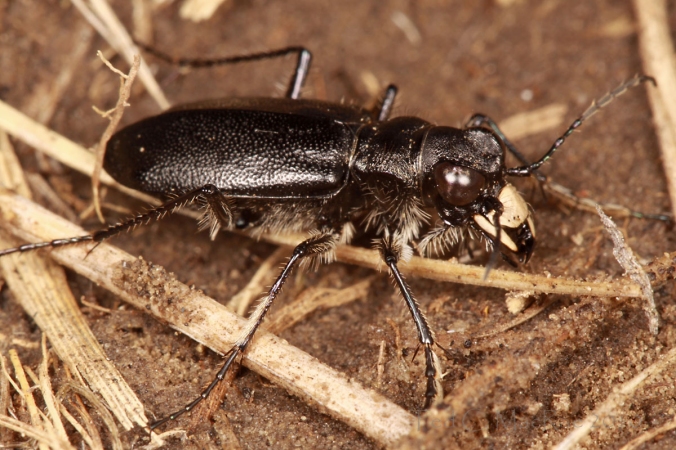
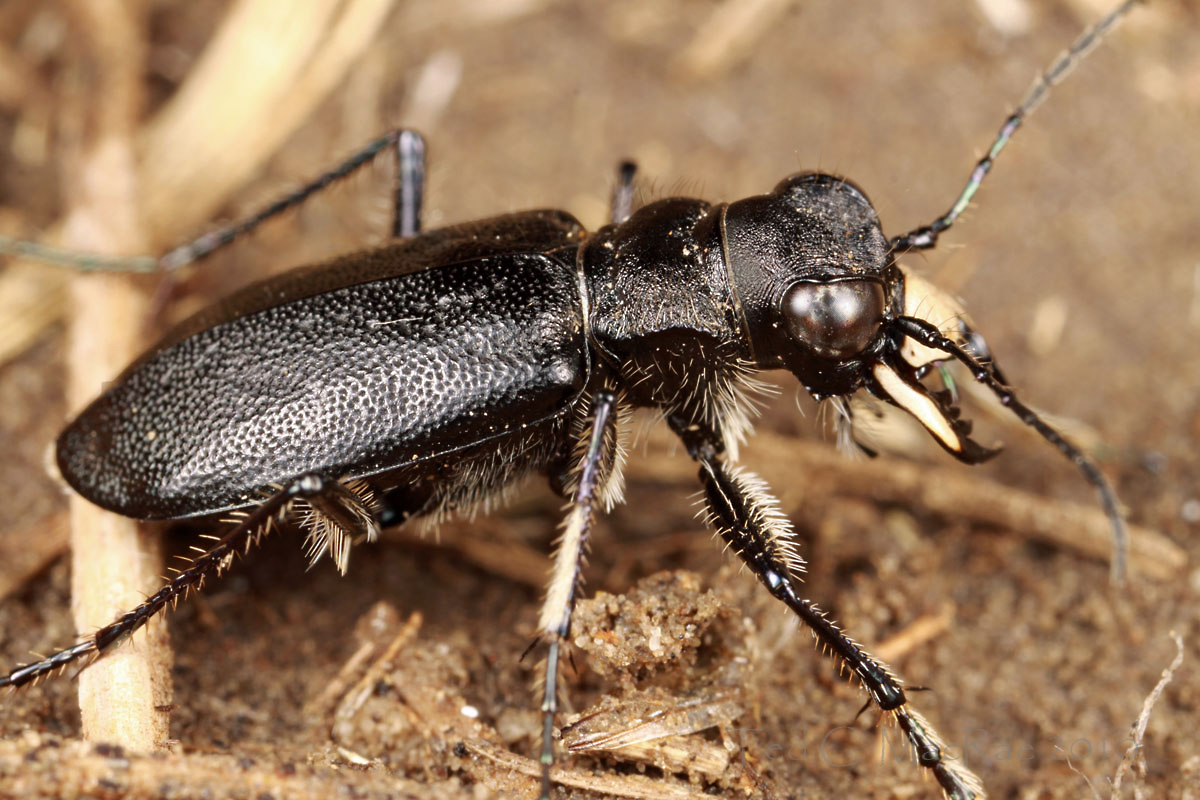
Tiger beetles "hunker down" when fatigued.
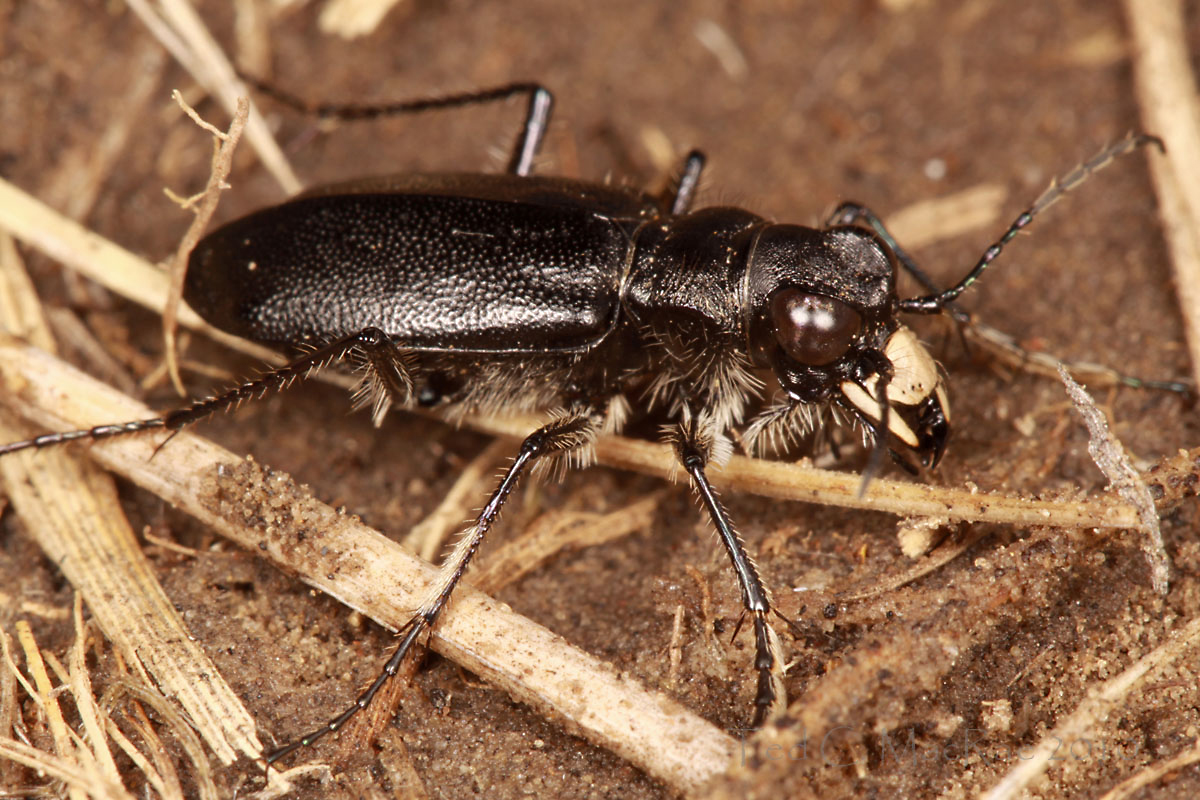
Although I prefer actual field photographs, the nice thing about photographing tiger beetles in confinement is… well, they don’t run away! That’s not to say it is easy. While they do settle down if left undisturbed for a while, once you start messing with them they quickly become agitated and start running in circles around the terrarium perimeter. Much finger prodding is necessary to get them away from the edge and into a good spot for photographs, and rarely do they stay put for long. When they finally do settle down, they tend to “hunker down” in a most unflattering pose (as above) – lacking the appearance of alertness that gives the true field photos their life.
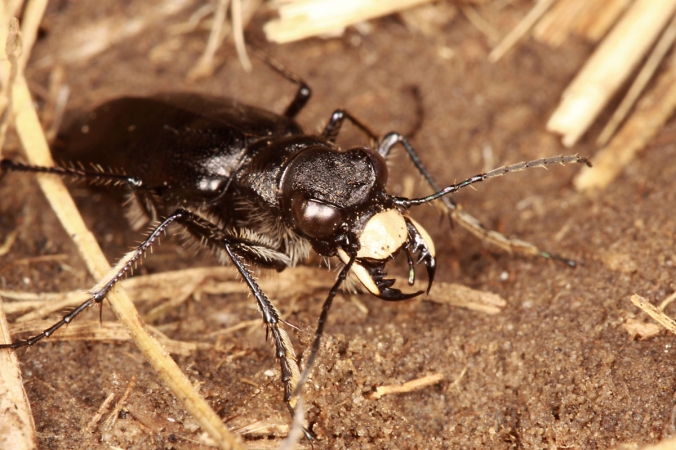
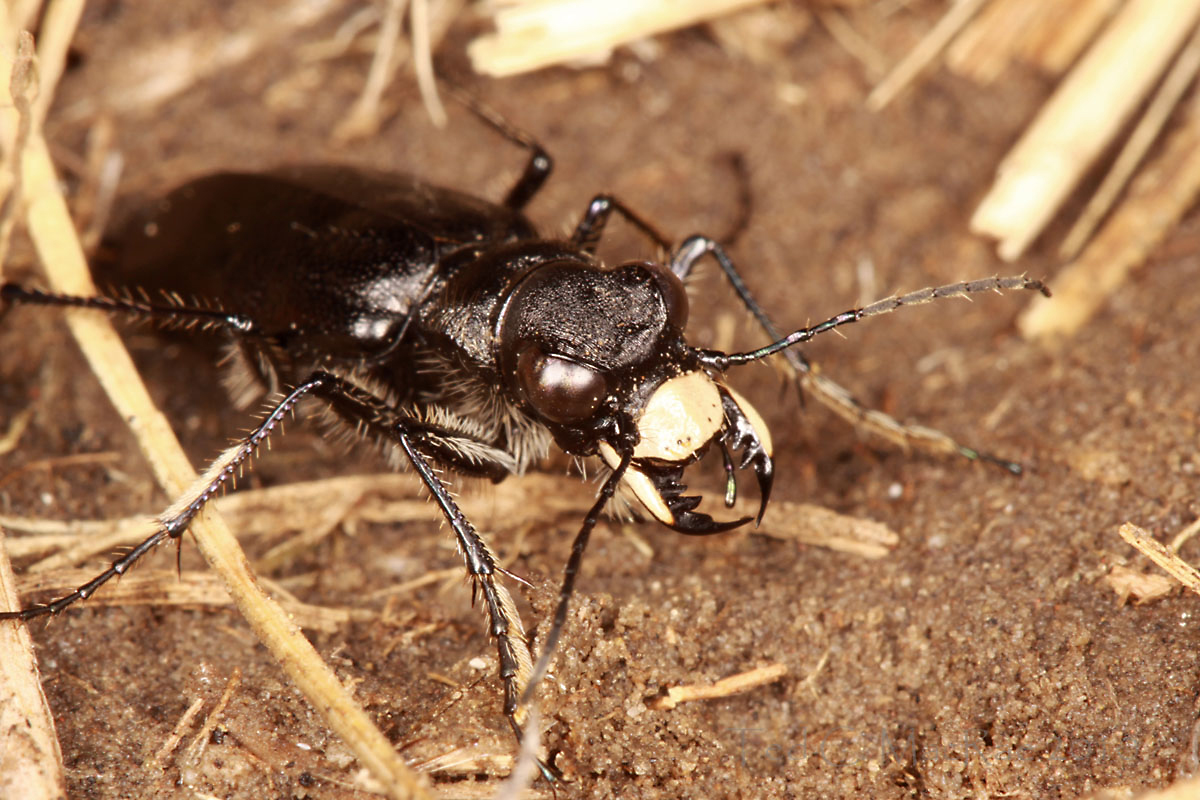
A ferocious pose is struck after judicious prodding of the face and touching of the antennae.
I’m a persistent (syn. stubborn) sort, however, and I’ve learned that I can wear them down and poke and prod them out of their hunker. Just a light poke at the face will often make them back up and lift their front slightly – poke again and they often open their jaws half-cocked – a light touch on the tip of one antennae and they’ll turn slightly. With practice and patience, hunkered down beetles can be coaxed into some remarkably aggressive-looking poses. I like the last of these photos in particular because the oblique, jaws half-cocked pose shows off two nice features of this species – the quite long labrum (upper lip) compared to most other tiger beetle species, and the bright white labrum and mandibles of the males of this species (in females they are partially or completely dark). The long labrum and jaws give this species a very long-faced appearance that distinguishes it immediately from the black morphs of Cicindela purpurea audubonii that occur with much greater frequency in the same habitats as C. nebraskana.
Photo Details:
1: Canon 50D w/ MP-E 65mm 1-5X macro lens (ISO 100, 1/250 sec, f/13), Canon MT-24EX flash w/ Sto-Fen + GFPuffer diffusers.
2: Panasonic DMC-FX3 (ISO 100, 1/400 sec, f/5.6), natural light.
3-4: Canon 50D w/ 100mm macro lens (ISO 100, 1/250 sec, f/16), Canon MT-24EX flash w/ Sto-Fen + GFPuffer diffusers.
All photos: Typical post-processing (levels, minor cropping, unsharp mask).
REFERENCES:
Pearson, D. L., C. B. Knisley and C. J. Kazilek. 2006. A Field Guide to the Tiger Beetles of the United States and Canada. Oxford University Press, New York, 227 pp.
Spomer, S. M., M. L. Brust, D. C. Backlund and S. Weins. 2008. Tiger Beetles of South Dakota & Nebraska.University of Nebraska, Department of Entomology, Lincoln, 60 pp.
Copyright © Ted C. MacRae 2010


 Beetles In The Bush