Botanizing (and entomologizing) w/ the WGNSS Botany Group at Little Lost Creek Conservation Area

March has been incredibly warm in the St. Louis area, particularly during the second half in which temperatures exceeded 80°F on seven of 12 days and 90°F twice! As one would expect, such unusually warm conditions played havoc with the first wave of early spring bloomers, particularly the conspicuously flowering understory trees that normally follow a predictable sequence of bloom beginning with Lindera benzoin (spicebush—family Lauraceae) in early to mid-March, Prunus mexicana/americana (Mexican/American plum—family Rosaceae) and Amelanchier arborea (common serviceberry—family Rosaceae) in mid- to late March, Sassafras albidum (sassafras —family Lauraceae) and Cercis canadensis (eastern redbud—family Fabaceae) in late March to early April, and — the zenith of native blooming understory trees — Cornus florida (flowering dogwood—family Cornaceae) in early to mid-April. Instead of a tightly choreographed sequence of mass blooms, we instead witnessed haphazard displays beginning earlier than normal and progressing sporadically throughout late March, with many trees knocked out of bloom by quite cold temperatures during several nights.

Nevertheless, it was not the disappointing displays of any of the above species that the group came to Little Lost Creek to see, but instead a much less commonly encountered understory tree with even less conspicuous blossoms—Dirca palustris (eastern leatherwood). One of only two Missouri representatives of the Family Thymelaeaceae, commonly called “stringbarks,” this species is found in scattered locations across the Missouri Ozarks and has been found reliably blooming in early April along Little Lost Creek.
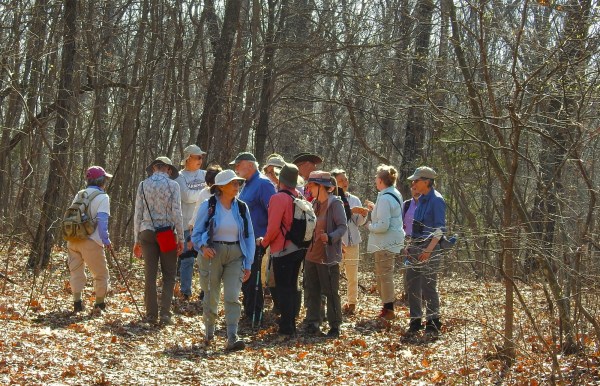
WGNSS Botany Group at Little Lost Creek. Photo by Kathy Bildner.

To get to the low, moist areas where D. palustris grows, however, we needed to hike the two-track across the old fields and rather disturbed adjacent forests where some of the more typical spring-flowering trees were seen. Sassafras was perhaps the least impacted by the crazy spring temperature, with most trees reliably in bloom.
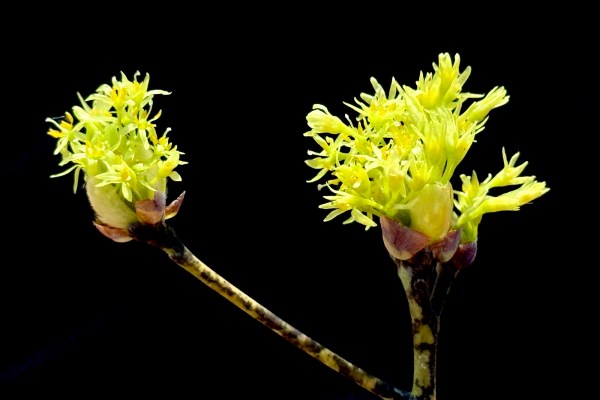
Sassafras albidum (sassafras). Photo by Ted MacRae.

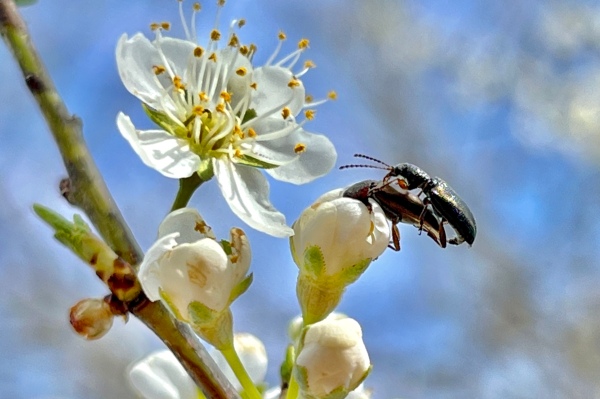
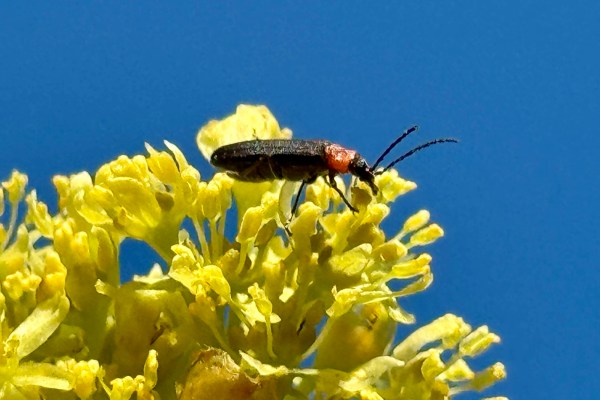
Ever the entomologist, I couldn’t help examining some of the flowers more closely in search of insects, eventually finding the aptly-named Ischnomera ruficollis (red-necked false blister beetle—family Oedemeridae), a frequent visitor to a variety of flowers.

Photo 3. Ischnomera ruficollis (red-necked false blister beetle) on flowers of Sassafras albidum (sassafras). Photo by Ted MacRae.

The patch of American plum along the two-track that I have seen blooming profusely in years past and had hope to photograph was, disappointingly, well past bloom. However, a fine specimen that I take to be Mexican plum was found blooming profusely along a fence line nearer to the beginning of the two-track. Mexican and American plums can be difficult to distinguish, but the former usually grows as anindividual tree while the latter tends to form clonal thickets with multiple stems arising from a single parental plant.
Prunus mexicana (Mexican plum). Photo by Ted MacRae.

Serviceberry also should have been in bloom across the upland understory but was limited instead to just a few scattered trees still bearing flowers. One fine specimen, however, was found near the patch of American plum that was covered in near-perfect blossoms that simply begged to be photographed.
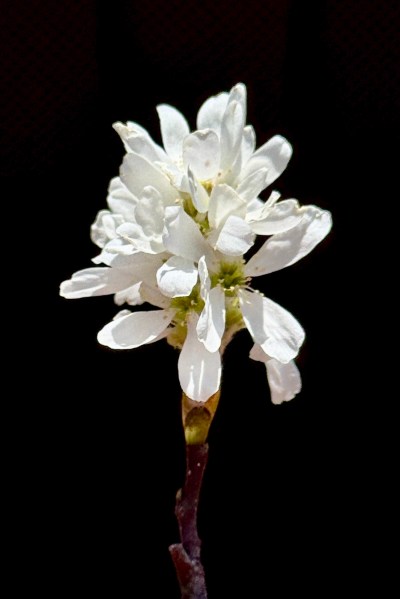
Amelanchier arborea (common serviceberry). Photo by Ted MacRae.

Veering into upland forests to approach the descent down into the valley, we saw some of the usual spring ephemerals and other plants that, despite not generally considered ephemerals, were nonetheless blooming quite early. Like the early-flowering trees, the spring ephemerals were impacted by the unusually warm March temperatures, with many of the species blooming far earlier than normal and now already fading despite the still-within-March date. Claytonia virginica (spring beauty—family Montiaceae, formerly Portulacaceae) is perhaps the best known ephemeral and, despite its commonness, is always a treat to see popping up in the woodlands after a long winter. The corolla color of this species is quite variable, with some being nearly white with barely perceptible venation, ranging to specimens with highly pronounced, vivid, pink venation.
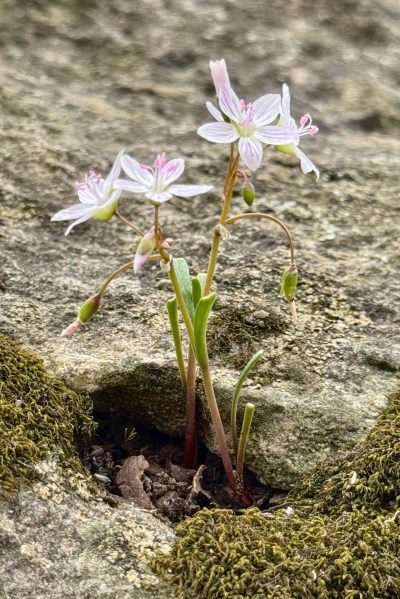
Claytonia virginica (spring beauty). Photo by Ted MacRae.

Antennaria parlinii (Parlin’s pussytoes—family Asteraceae), normally an April/May bloomer, also was in flower in the relatively dry, rocky forests before the descent into the valley. Missouri populations of this species were previously known as A. plantaginifolia, means “leaves of Plantain” and indeed the basal leaves do look like those of the genus Plantago—a character that distinguishes them from the single-veined leaves of Missouri’s only other species in the genus, A. neglecta (field pussytoes).
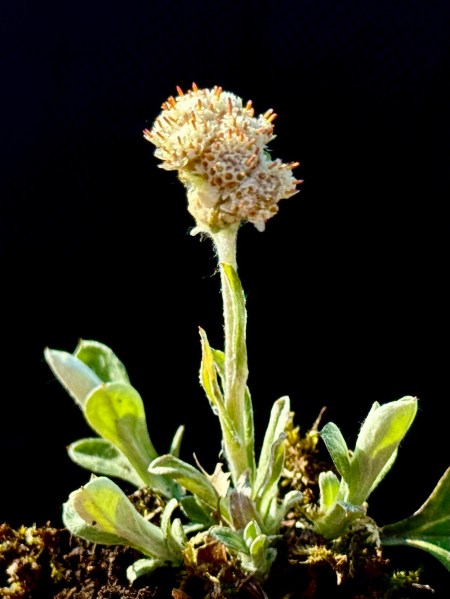
Antennaria parlinii (Parlin’s pussytoes). Photo by Ted MacRae.

The descent into the valley is rather steep and precarious, especially for those of us who are “getting long in tooth” and needed to pick our way slowly down the rocky trail. The effort, however, was worth it as even before reaching the valley we began seeing leatherwood trees in bloom in the increasingly moist woodlands approaching the valley. The plants were, if anything, slightly past peak bloom, but not to the point that it made it difficult to find fresh examples of the instantly-recognizable flowers in clusters of 2–4 accompanying newly emerging leaves. More unusual than conspicuous with its small pendulous flowers surrounded by rusty woolly bracts, the species is distinguished from its even rarer congener, D. decipiens (upland leatherwood) by the small but discernible stalks and moist rather than upland habitat.
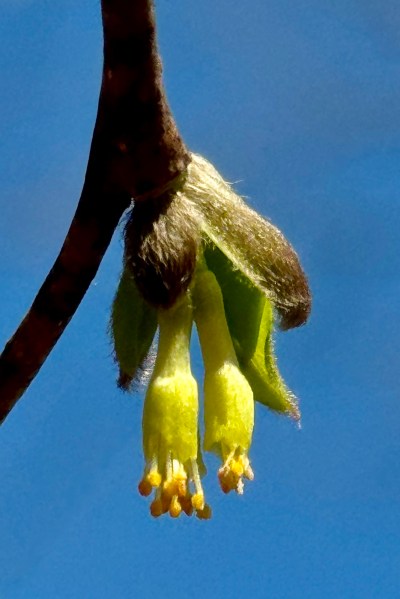
Dirca palustris (eastern leatherwood). Photo by Ted MacRae.

Several other botanical treasures awaited the group in the moist forests along Little Lost Creek besides leatherwood. One of these was very early blooming examples of Viola eriocarpa (smooth yellow violet—family Violaceae). This denizen of moist forests is often considered a smooth-leaved variety of V. pubescens (yellow violet) or even a synonym, and indeed the degree of “pubescentness” can be variable, making it sometimes difficult to distinguish a given plant.
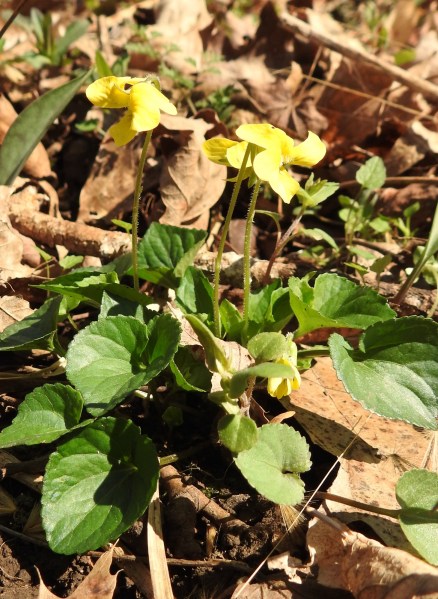
Viola eriocarpa (smooth yellow violet). Photo by Kathy Bildner.

Another deep, moist, rich woods resident the group saw was the always-charming-to-see Collinsia verna (spring blue-eyed Mary—family Plantaginaceae). Unusually, this bona fide spring ephemeral is one of the few Missouri wildflowers that is truly “blue.” Equally unusual, its distribution is mainly in the Upper Midwest but in Missouri is apparently concentrated across the middle latitudes of the state.
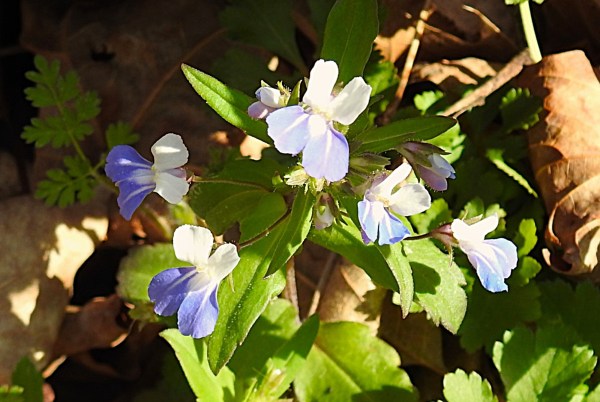
Collinsia verna (spring blue-eyed Mary). Photo by Kathy Bildner.

[Warning: entomological geekery ahead!]

I, myself, missed these botanical finds due to my discovery immediately upon reaching the valley of a large oak tree with a dark, wet stain of flowing sap on its trunk that was hosting a variety of insects (remember; it is still March here—not normally a time to observe insects). Numerous muscoid flies, expectedly, congregated at the flow and lapped up the sap, as did a couple of brightly colored Vanessa atalanta (red admiral butterfly—family Nymphalidae). These fast-flying butterflies overwinter as adults and, thus, were ready to take advantage of the sudden warming spell. They also could have been difficult to photograph had their sweet tooth not enticed them to pose nicely on the dark, sap-saturated bark.
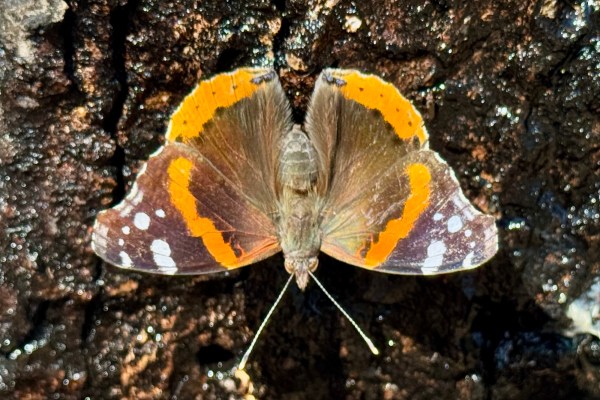
Vanessa atalanta (red admiral butterfly). Photo by Ted MacRae.

A closer look at the many insects congregating on the flow revealed the presence of two fireflies that proved to be Ellychnia corrusca (known as Photinus corruscus in some sources, e.g. iNaturalist) (winter firefly—family Lampyridae). Honestly, I didn’t recall ever having seen fireflies feeding on a sap flow, or for that matter any that were active in March—muggy summer nights are what I picture when I think of fireflies! The common name of this species, however, alludes to the fact that it can often be seen during warm days in winter, especially on tree trunks. Moreover, not only do adults become active in late winter, they mate at that time as well. The fact that these individuals were seen feeding on a sap flow is also unsurprising given that the species has been reported as a pest of sap buckets in the spring. There was one more surprise, however—as I was photographing the beetles, I noticed their all-dark abdomens, suggested they lack light-producing organs. This is surprisingly common among several groups of fireflies which have given up a crepuscular (i.e. active during dusk and/or dawn), luminescent lifestyle in favor of a diurnal (i.e., day active), non-luminescent existence. (We know that non- luminescent firefly species evolved from luminescent species—i.e., they used to be able to produce light and then lost the ability—rather than representing a lineage that evolved before other fireflies gained luminescent capabilities because their larvae do still posses light-producing organs.) Why did they do this? One possibility is the appearance of “femme fatale fireflies”—i.e., females of the genus Photuris that can that mimic the flash patterns of females in the genus Photinus to attract and eat Photinus males!
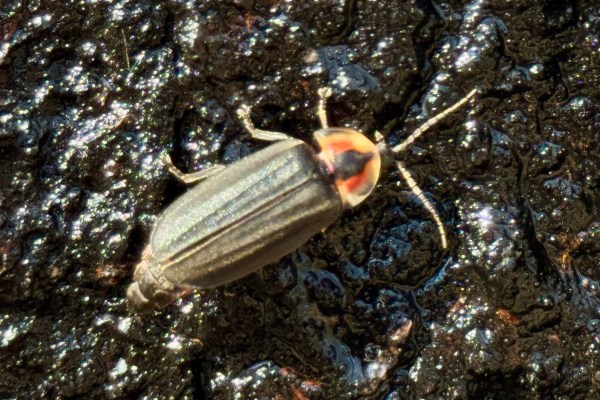
Ellychnia corrusca (winter firefly). Photo by Ted MacRae.

Non-luminescence as an antipredation strategy may be a good solution for femme fatales, but leading a diurnal existence still does not eliminate the risk of predation by other insects! One of the fireflies we saw on the sap flow had been attacked by a stink bug (family Pentatomidae) that came to the sap flow not for the sugary substance, but to prey on the other insects that it had attracted. For those of you who are asking “Aren’t stink bugs plant feeders?”, the answer is… mostly! While the majority of species use their piercing/sucking mouthparts to feed on developing seeds and fruits, there is one group of stinkbugs (the subfamily Asopinae) that has adapted its style of feeding to sucking the juices out of other insects rather than plants. This particular stinkbug was identified as Podisus maculiventris (spined soldier bug), and no amount of struggling by the firefly could release it from the stink bug, whose mouthparts had firmly impaled the firefly. Despite being predators, asopine stink bugs still lack chewing mouthparts and can only ingest liquid substances. This might be fine for sucking a juicy seed, but it falls short when trying to ingest another insect… unless it can digest the insect before it consumes it! This is called pre- or extra-oral digestion, whereby the stink bug injects its digestive enzyme-laden saliva into the prey and allows the enzymes to slowly liquify its innards. Once digested, the stink bug can then suck up thenutritious slurry, leaving only the shriveled external carcass of its hapless prey. Another such stink bug was seen elsewhere in the forest, this one preying on a fat, juicy caterpillar.
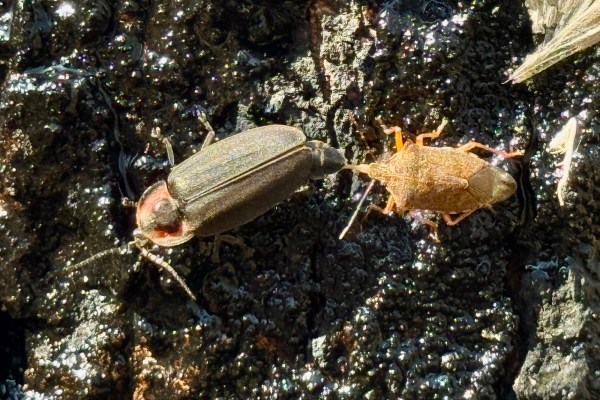
Podisus maculiventris (spined soldier bug) preying on Ellychnia corrusca (winter firefly). Photo by Ted MacRae.

For lunch, a smaller than usual crowd enjoyed authentic comida mexicana at Casa Tequila Cantina in nearby Warrenton.

For a complete listing of plants observed, notes, and short observations, see Little Lost Creek by Michael Laschober in the Monday Morning Botany Walks section at St. Louis Nature Students.

Participants: Brenda Adams, Gisela Baner, Prem Barton, Renee Benage, Kathy Bildner, Tina Cheung, Wayne Clark, Sally Fabbri, June Jeffries, Shari Langer, Michael Laschober, Ted MacRae, Len Meier, Burt Noll, John Oliver, David Steinmeyer, Kathy Thiele, Elaine Wolshock, Matthew Wolshock, Richard Wolshock, and Laura Yates.

©️ Ted C. MacRae 2026

Missouri Native Plant Society Spring 2022 Field Trip

For the past few years, I’ve been involved with the Missouri Native Plant Society (MONPS). To this point, however, my involvement has been limited to attending the monthly meetings of the St Louis Chapter—unfortunately, now only via Zoom since the beginning of the pandemic. I hope that soon we can return to in-person meetings (or, even better, a hybrid of the two, which allows person-to-person interaction without excluding participation by those who cannot attend in-person), but one activity that has resumed live are their periodic, multi-day field trips. The Spring 2022 Field Trip, held this past weekend in southwestern Missouri, was my first chance to participate in one of these events, and I looked forward to seeing the remnant prairies, limestone, dolomite, and sandstones glades, and chert woodland that were all on tap while rubbing elbows with some of the state’s best botanists and naturalists—some old friends and others new acquaintances!


Day 1 – Schuette Prairie
I wasn’t able to make it to the actual Day 1, so I left St. Louis early in the morning to meet the group at the first stop of the following day—Schuette Prairie in Polk Co. Named after my friend and former Cuivre River State Park naturalist, Bruce Schuette, this recently acquired limestone/dolomite prairie with a wet swale contains many plants more typical of glades such as Silphium terebinthinaceum (prairie dock), Echinacea paradoxa (yellow coneflower), and Rudbeckia missouriensis (Missouri coneflower). Of course, on this cold, overcast, early-April morning, it was far too early to see any of these highly charismatic plant species (although some of the more astute botanists were about to point them out by their barely emergent foliage, which was easy to find in the recently-burned northern half of the parcel). Abundantly in bloom, however, was the more subdued Erythronium mesochoreum (prairie fawn lily, midland fawnlily, prairie dogtooth violet). Distinguished from the similar E. albidum (white trout lily) that occurs abundantly further east by its narrower, folded, usually unmottled leaves, all but a few of which remained stubbornly closed against the stiff, cold wind.

Erythronium mesochoreum (prairie fawn lily midland fawnlily, prairie dogtooth violet).

Precious few other blooms were seen—I recall somebody mentioning they had seen Viola sororia (common violet), and I photographed this little clump of Fragaria virginica (wild strawberry) that will eventually provide food for one of the area’s many box turtles.

Fragaria virginica (wild strawberry).

Speaking of box turtles, I found this completely naked, bleached carapace and at first hoped that it might have been from an ornate box turtle (Terrapene ornata)—limited in Missouri to western prairies and a species I have not yet seen. However, the presence of a midline ridge and its relatively more domed shape suggest it is from a three-toed box turtle (Terrapene carolina triunguis).

Three-toed box turtle (Terrapene carolina triunguis) carapace.

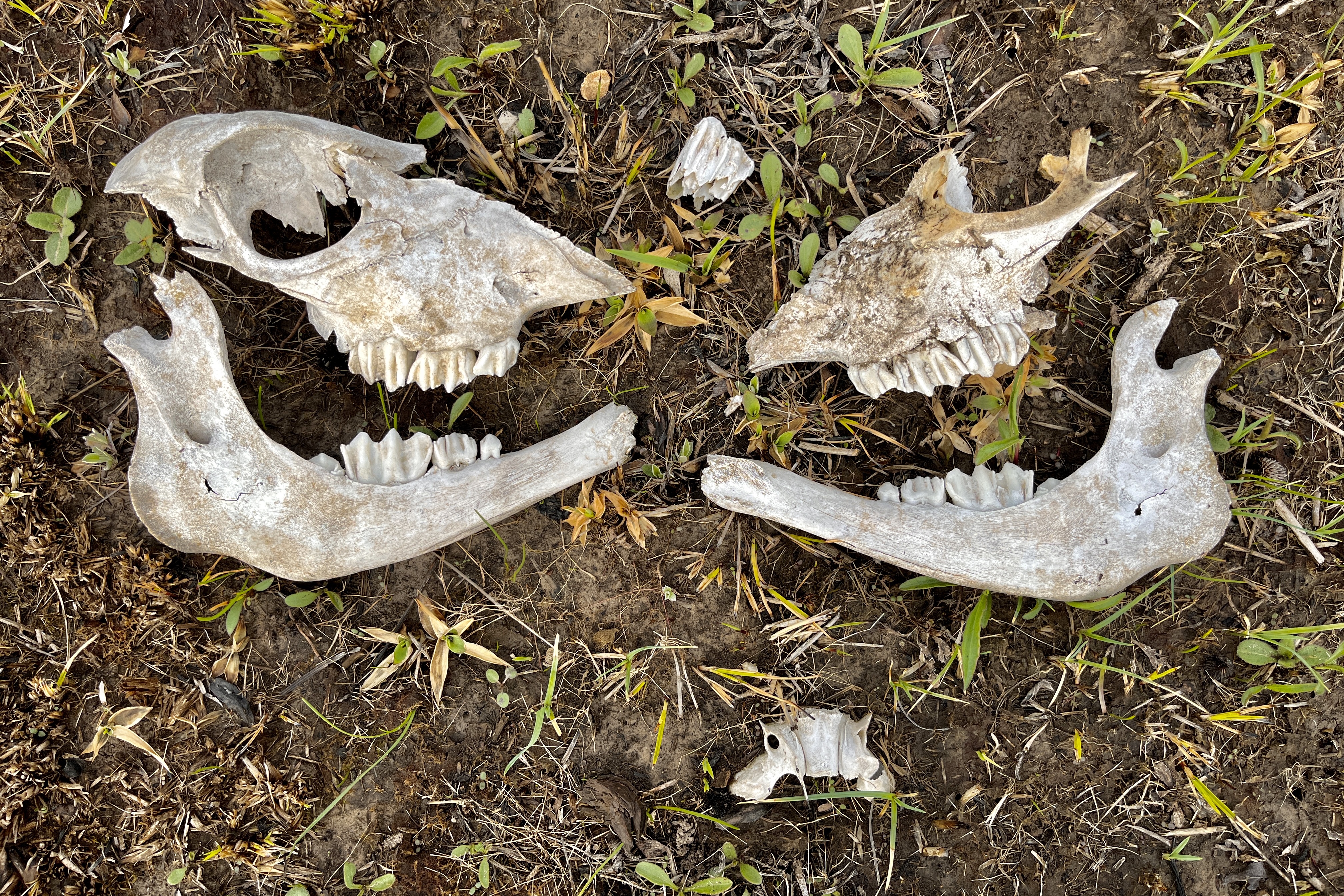
Many other carapaces were seen (though none in such good shape), and in fact bones of many types were easy to find in the burned portion of the prairie. This disarticulated skull from what appears to be a young calf (Bos taurus) was perhaps the most impressive bone find, but we did also find a dried skeleton of a smaller individual. Being the lone entomologist of the group, I just had to turn over the carcass and search for beetles and managed to capture a skin beetle (family Trogidae) and one other small unidentified beetle (but, unfortunately, no Necrobia rufipes [red-legged ham beetle]).

Disarticulated bovid skull – probably a young calf (Bos taurus).

Rocky Barrens Conservation Area
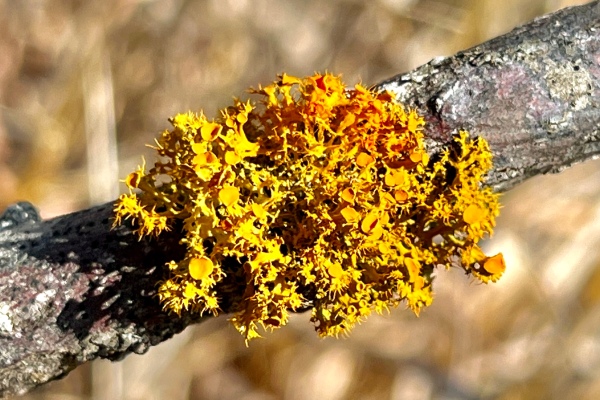
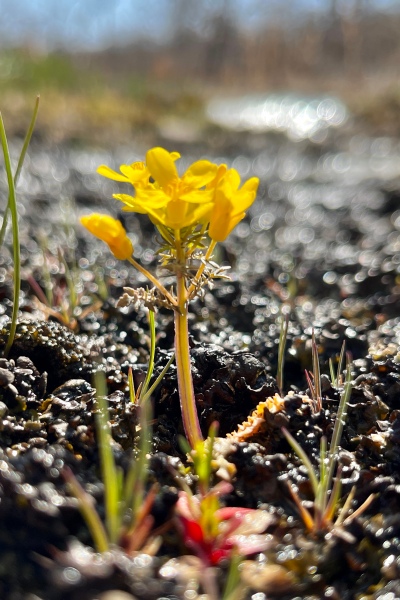
Later in the morning, the group caravaned to Rocky Barrens Conservation Area, a 281-acre area in Greene Co. featuring Mississippian limestone glades and site for the federally-endangered Physaria filiformis (Missouri bladder-pod). This plant, in the mustard family, is found only in four counties in southwest Missouri. The plants were readily found, but we were too early to see them in bloom—or anything else, for that matter. For me, however, the glade alone was still interesting, and I couldn’t help but take note of the similarities—and differences—between this limestone example and the dolomite glades south of St. Louis with which I am so much more familiar. Almost immediately, I noted the presence of Sideroxylon lanuginosum (gum bumelia), host for Plinthocoelium suaveolens (bumelia borer)—surely one of North America’s most beautiful longhorned beetles! I didn’t see any frass piles at the base of any of the trees, the presence of which would indicate larval activity, but I’m sure the beetle is here. It would be interesting to come back during the season and look for it. While I didn’t find any signs of the beetle, I couldn’t miss the bright orange-yellow gold-eye lichens (Teloschistes chrysophthalmus) colonizing it’s branches.

Teloschistes chrysophthalmus (gold-eye lichen) on branch of living Sideroxylon lanuginosum (gum bumelia).

Another tree that caught my interest was Celtis tenuifolia (dwarf hackberry). I see these small, gnarly versions of the genus in glades and other xeric habitats, and they always catch my interest because of the diversity of interesting woodboring beetles associated with it. As I looked at the trees, I noticed one small tree in particular that was the perfect stage of dead—branches brittle but bark mostly still intact with a little bit of peeling on the trunk revealing woodboring beetle larval galleries underneath! There were only a few emergence holes present—strong evidence that the tree was still infested and worth bringing back to put in an emergence box to trap the emerging adult beetles. With luck, I’ll be pinning a series of Agrilus ferrisi next winter!

Corry Flatrocks Conservation Area
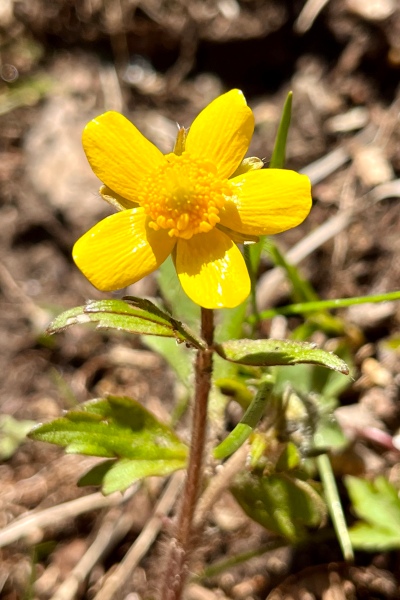
After lunch at a nearby city park, the group caravaned to Corry Flatrocks Consevation Area in Dade Co.—site of another federally-endangered plant, Mononeuria minima (formerly Geocarpon minima) (tiny-Tim, earth fruit). The sandstone glades at this site are among the largest in the area and, thus, host a large population of the plant. By this time of day, the sun had been out for awhile and the day had warmed considerably, so we hoped to see other flowering plants as well. Among the first that we encountered while walking towards the glade proper was Ranunculus fascicularis (early buttercup), distinguished from other “large-flowered buttercups” by its canescent (grayish due to hairiness) leaves with long and narrow lobes, their tips bluntly pointed or rounded. The dry, gladey habitat also distinguishes the species from the similar R. hispidus (hairy buttercup), which flowers at the same time but prefers moister habitats.

Ranunculus fascicularis (early buttercup).

On the glade proper, we quickly encountered tiny little saxifrages in bloom, which turned out to be Micranthes texana (Texas saxifrage), restricted in Missouri to this part of the state (and thus with a high CC value of 9) and distinguished from the more widespread M. virginiensis (early saxifrage) by its small, compact stature. These first individuals we encountered had especially reddish-tinged flowers.

Micranthes texana (Texas saxifrage).

As soon as we reached the more open part of the glade with large expanses Of exposed rock, the group dropped to their hands and knees to find the diminutive plants we were looking for.

MONPS Field Trip participants looking for Mononeuria minima (formerly Geocarpon minima) (tiny-Tim, earth fruit).

The plants were not uncommon, even abundant, in shallow, sand-filled depressions in the rock. Nevertheless, careful observation was still required to see and recognize them. Fortunately, the plants were already in bloom, their tiny styles barely visible to the naked eye within the green, not-much-bigger, petalless flowers. Photographing these plants, and especially those in bloom, proved to be a task almost beyond the capabilities of the smart phones that most in the group were using (me included).

Mononeuria minima (formerly Geocarpon minima) (tiny-Tim, earth fruit).

The glades stretched on for quite a distance, inviting further exploration. At the margins, white flowering trees were noticed, and moving closer they proved to be Amelanchier arborea (downy serviceberry, common serviceberry)—among the first we have seen open this spring. (I typically see the first blooms of these trees in the final days of March, at least around my home in east-central Missouri.) an even closer looked revealed tiny insects (also among the first insects I have seen active this spring) flying around and crawling about on the flowers. These proved to be parasitic hymenopterans—family ID is still pending, but I suspect they will prove to be a species in one of the many families of “microhymenopterans” that are egg parasitoids. I am not sure whether they were visiting the flowers as pollinators (which behavior I am not aware of) or in hopes of encountering other pollinators which could potentially serve as hosts—a subject with which I will need to follow up.

Amelanchier arborea (downy serviceberry, common serviceberry) with numerous tiny parasitic wasps (family undetermined).

Near the back end of the glade, we encountered a few more Micranthes texana (Texas saxifrage), these having more typical white flowers in perfect peak bloom.

Micranthes texana (Texas saxifrage) with white flowers.

Also in that part of the glade we found a few scattered individuals of Selenia aurea (golden selenia). While not quite as conservative as M. texana (CC value = 6), it has a similar range in the U.S. and in Missouri is also restricted to a handful of counties in the southwestern part of the state. The plant is known to occur in large colonies (which I have seen at nearby Corry Branch Glade)—its brilliant yellow flowers forming a spectacular display.

Selenia aurea (golden selenia).

To this point, the only insect I had seen besides the microhymenopterans was a skin beetle (family Trogidae), which I found when I kicked over some dried mammal scats. However, on the way back to the cars we finally encountered an insect large enough in size and striking enough in appearance to pique the interest of not just me but the group as a whole—a large caterpillar feeding on the foliage of Penstemon digitalis (smooth beard-tongue). It’s appearance—dark with longitudinal yellow stripes and blue spotting—immediately called to mind one of the tiger moths (formerly Arctiidae, now a subfamily in the Erebidae), specifically the genus Haploa (commonly called haploa moths). A little detective work on BugGuide comparing photos and recorded host plants narrowed the likely choice to H. confusa (confused haploa moth).

Haploa sp. prob. confusa (confused haploa moth) caterpillar feeding on foliage of Penstemon digitalis (smooth beard-tongue).

Day 2 – Lead Mines Conservation Area
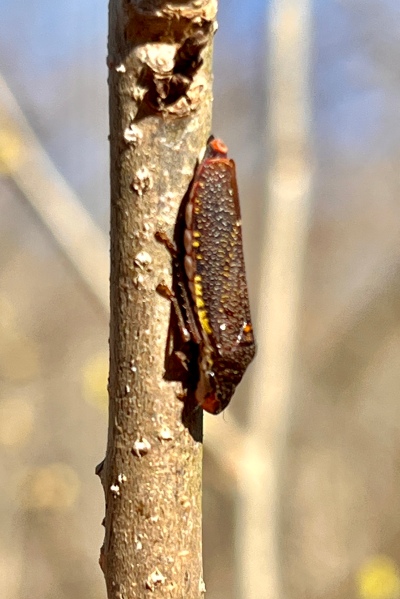
The final day of the MONPS Field Trip featured a morning trip to Lead Mine Conservation Area in Dallas Co. Of particular interest to the group were several parcels within the area designated as Niangua River Hills Natural Area and featuring a diversity of habitats including dolomite glades, chert woodlands, and calcareous wet meadows (fens). Most in the group visited the northern parcel to see the dolomite glades; however, a few of us—primarily from St. Louis and well-familiar with dolomite glades—opted to visit the smaller southern unit of the natural area to see the fen and riparian woodland we needs to pass through to get there. It was a much warmer morning than yesterday, though still chilly starting out, so blooms were sparse as we hiked the woodland trail searching for any hint of color. At one point, someone noticed a shrub a bit off the trail with large, reddish pink flowers—the color seeming a bit unexpected for the situation. Bushwhacking toward it, we realized it was Chaenomeles speciosa (common flowering quince), a common, ornamental non-native plant that rarely—but obviously sometimes—escapes cultivation. While the group looked at the plant, I saw my first insect of the day—Paraulacizes irrorata (speckled sharpshooter), one of our largest and most recognizable leafhoppers, sitting head-down on the stem of a small sapling.

Paraulacizes irrorata (speckled sharpshooter).

Among the first native blooms we saw was Ranunculus hispidus (hairy buttercup). Though similarly “large-flowered” as R. fascicularis (early buttercup), it differs by its sprawling growth habit, differently shaped-leaves, and preference for moist habitats. Buttercups are a favorite flower host for jewel beetles (family Buprestidae) in the genus Acmaeodera, and one species —A. tubulus—is among our earliest-emerging beetles in the spring, so I checked each buttercup flower that I saw hoping to see these little beetles signaling the beginning of insect activity for the season. Sadly, none were seen.

Ranunculus hispidus (hairy buttercup).

At last we reached the fen—a large open area on the toe-slopes of the adjacent hillside where water draining through the underlying strata emerged to the surface to maintain a continually wet environment. The fen here is special, as two species of Cyprepedium (lady’s slipper orchids) are know to occur in the fen (and in fact, all four of the state’s Cyprepedium spp. can be found with Lead Mine Conservation Area). At this early date, the orchids would not be anywhere close to blooming; however, the group looked for evidence of their presence, walking gingerly through the fen so as to avoid inadvertently stepping upon any emergent foliage. No putative clumps were found, but already in my mind I’m thinking a mid-May trip back to the fen might be warranted! Unlike the orchids, Castilleja coccinea (Indian paintbrush) was abundantly evident throughout the fen, with an occasional plant almost ready to burst forth their scarlet blooms. Senescent flower stems of composites, presumably Rudbeckia, were also seen throughout the glade, which, combined with the abundance of Castilleja, created the promise of a stunning early-summer display across the fen.

Castilleja coccinea (Indian paintbrush).

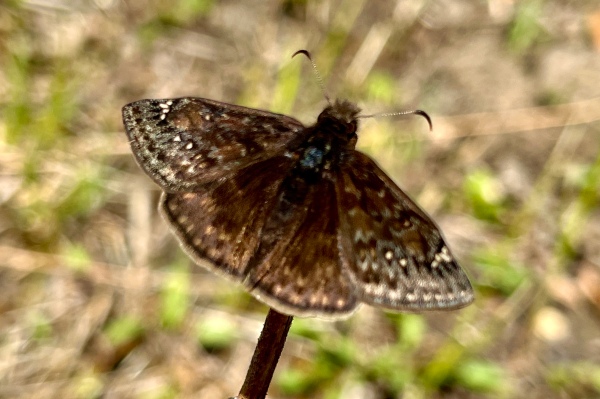
During our time in the fen, two species of butterflies were seen flitting about the herbaceous vegetation: tiny blue Celastrina ladon (spring azure), and one of the dustywing skippers in the genus Erynnis. The former were impossible to photograph due to their persistent flitting and skittish behavior, and the latter almost were as well. Only when I locked the focus on a preset 2x zoom and fired shots in rapid succession while moving the smartphone ever closer to the subject did I manage this one imperfect but passable photograph of the last one I tried. The genus Erynnis is diverse and notoriously difficult to identify, and my expertise with skippers and butterflies pales compared to my skills with beetles, so the ID will have to remain Erynnis sp. until a more authoritative opinion is offered. [Edit 4/6/22, 11:38 am: According to my lepidopterist friend Phillip Koenig, Erynnis horatius and E. juvenalis both fly in early spring, and they cannot be reliably separated from the dorsal side.  Erynnis juvenalis has one or two dots on the ventral hind wing that E. horatius lacks and only flies in the early spring, while E. horatius can be seen through the summer.  If only I could turn the picture over to see what it looks like on the ventral side!]

Erynnis horatio or E. juvenalis (Horatio’s or Junenale’s duskywing) in fen habitat.

Returning through the riparian woodlands after visiting the fen, the day had warmed considerably, and numerous flowers not seen earlier were suddenly in full bloom. These included Erythronium mesochorium (prairie fawn lily midland fawnlily, prairie dogtooth violet)—the same species we saw yesterday so reluctantly in bloom at Schuette Prairie. Most were of the familiar form with unmottled leaves; however, we found one individual with notably mottled leaves that resembled those of E. albidum (white dogtooth violet) (1st photo). Nevertheless, the leaves were still narrower than that species and folded, and the plant was growing a mere 12” from another individual with no trace of mottling (2nd photo).

Erythronium mesochorium (prairie fawn lily midland fawnlily, prairie dogtooth violet).

Claytonia virginca (spring beauty) was also blooming in abundance as we took the trail back. I am always amazed at the variability seen in the flowers of this species—from pure white to vividly pink-striped to pink at the tips. This especially vivid pink individual was about as pink as they come.

Claytonia virginca (spring beauty)—an especially vivid pink example.

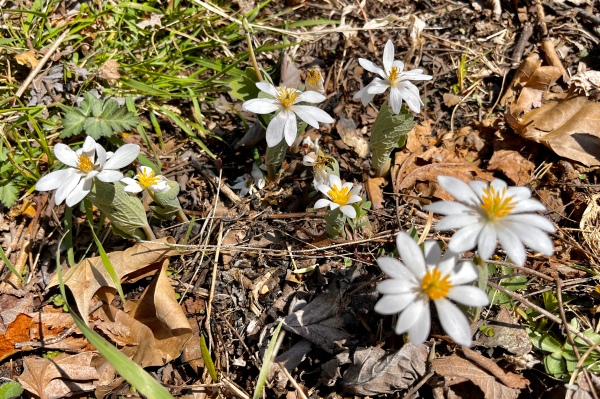
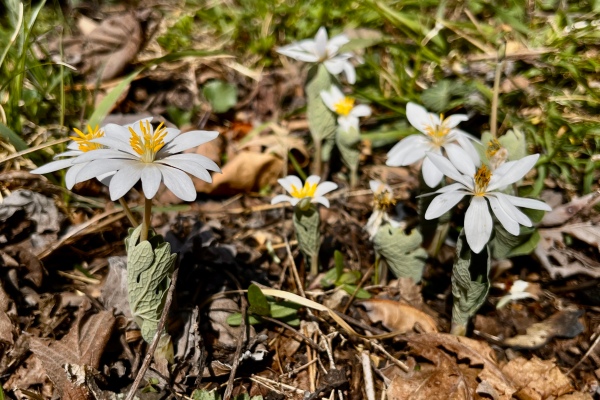
Sanguinaria canadensis (bloodroot) also was popping up regularly. We had seen isolated plants sitting the trailsides when we first part through—their flowers tightly folded in stubborn response to the chilly morning temperatures. By early afternoon, however, they were spread wide open as invitation to any of the flying insects that had surely also been awakened by the warmer temperatures of the afternoon. While most were seen as isolated individuals, a particularly idyllic clump captured our attention, almost begging “photograph me!”

Sanguinaria canadensis (bloodroot).

With that, we rejoined the main group to recount the days experiences and cement new relationships before heading back towards our respective home areas.

Long Ridge Conservation Area
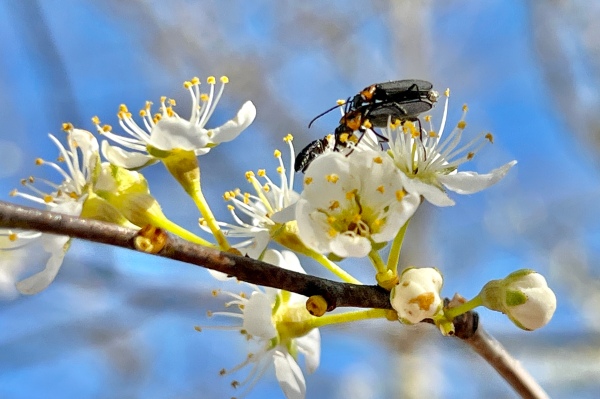
On the way back home, I decided to check out this conservation area in Franklin Co., which I’ve never visited before. The afternoon had gotten quite warm, so I reasoned that maybe today would be the day when insects start coming out in abundance. I was right! As soon as I pulled into the parking lot, I saw a Prunus mexicana (Mexican plum) in full bloom, and walking up to it I immediately saw an abundance of bees and small beetles all over the flowers. The latter turned out to be Orsodacne atra (a leaf beetle) and Ischnomera ruficollis (rednecked false blister beetles).

Orsodacne atra (leaf beetle) on flowers of Prunus mexicana (Mexican plum).
Orsodacne atra (leaf beetle) mating pair on flowers of Prunus mexicana (Mexican plum).
Ischnomera ruficollis (rednecked false blister beetle) mating pair on flowers of Prunus mexicana (Mexican plum).

Inside the woods along the Blue Trail, there were the usual suspects in bloom—Claytonia virginica (spring beauty), Cardamine concatenata (toothwort), Antennaria parlinii (Parlin’s pussytoes) and Ranunculus hispidus (hairy buttercups).

Antennaria parlinii (Parlin’s pussytoes).

Eventually I happened upon an Amelanchier arborea (downy serviceberry) in full bloom. There were more O. atra and I. ruficollis on the flowers (though not so many as on the Mexican plum), along with a Mecaphesa sp. crab spider that had caught and was feeding on a male Andrena carlini (Carlin’s mining bee)*.

Mecaphesa sp. crab spider with male Andrena carlini (Carlin’s mining bee) prey on flowers of Amelanchier arborea (downy serviceberry). *Bee ID by Mike Arduser.

On the back third of the trail, I found two fallen branches under a Quercus shumardii (Shumard’s oak) that had been pruned by longhorned beetles—presumably Anelaphus villosus. At the end of the trail I found a third such branch of the same species of oak. All three will be placed in an emergence box, and hopefully the culprits will emerge as adults.

Anelaphus villosus-pruned branches of Quercus shumardii (Shumard’s oak)—both collected under the same tree.

©️ Ted C. MacRae 2022