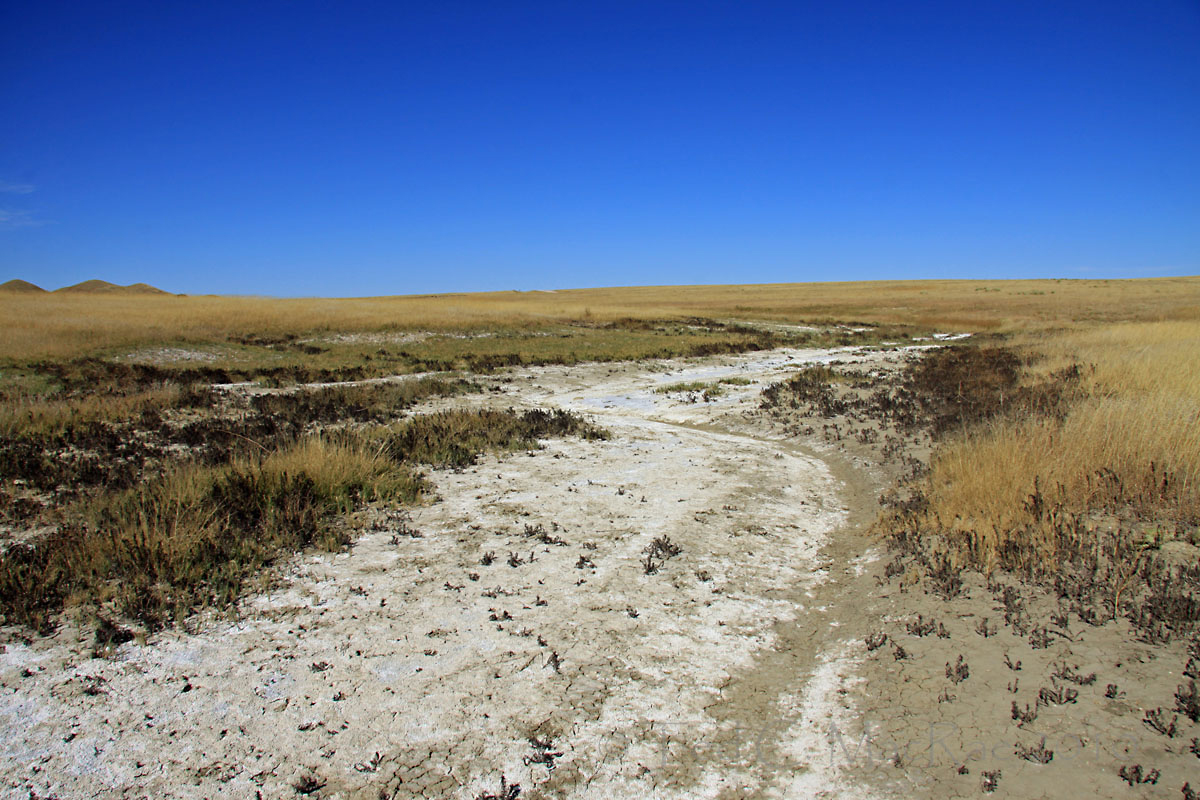
Dry alkaline creek in the Oglala National Grasslands, Sioux Co., Nebraska
At the northern edge of the Pine Ridge in northwestern Nebraska, the land drops precipitously from verdant High Plains to the eerie Badlands below. The sterile landscape of eroded slopes and irregularly shaped landforms is at once beautiful and harsh. Short grasses and silver sagebrush seem to be the only plants capable of living here, providing the meagerest of forage for the mule deer and pronghorn antelopes that dot the gently rolling hills. Dissecting these arid grasslands are a series of seasonally dry alkaline creeks that support a number of tiger beetle species. The most interesting of these is Cicindela fulgida fulgida (crimson saltflat tiger beetle), a beautifully colored little species that is restricted to wet, alkaline habitats. It was this species that I and colleagues Chris Brown and Matt Brust wanted to see when we stopped by one such creek after finishing up at the C. pulchra site in South Dakota (and still recovering from “pulchra-fever”).
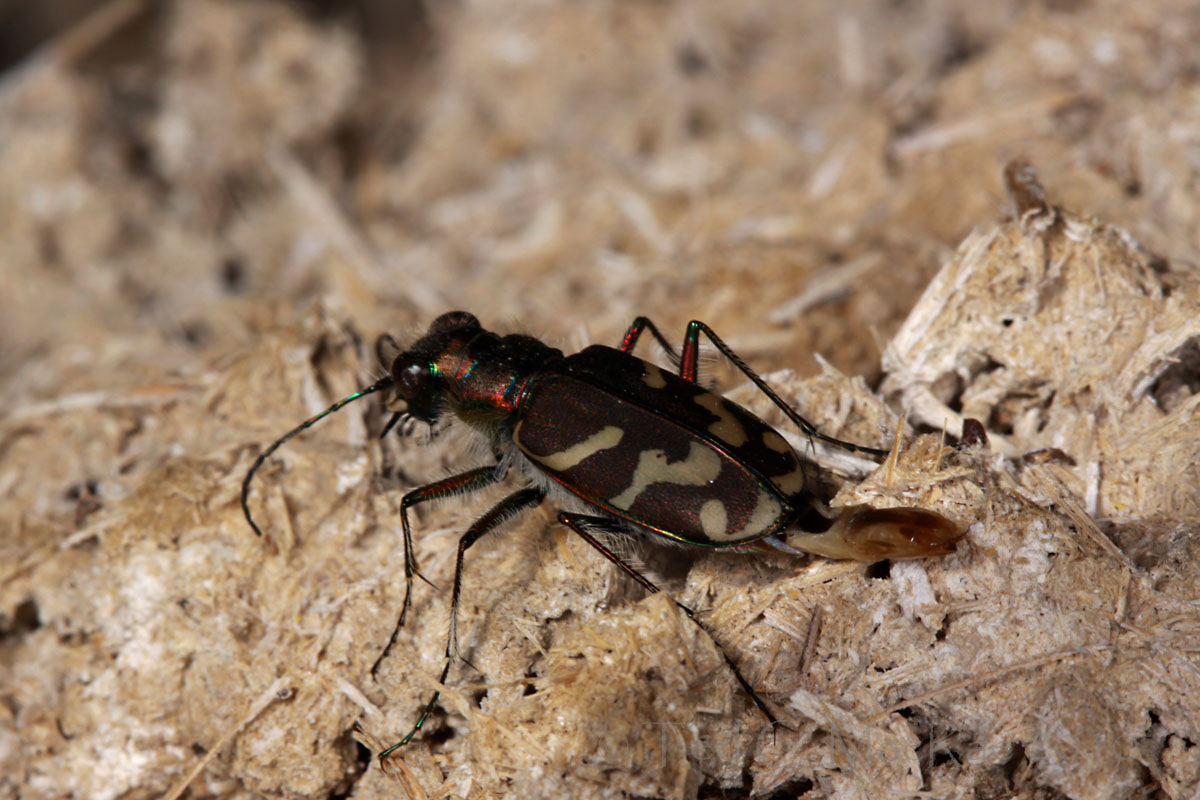
Cicindela tranquebarica kirbyi - Kirby's tiger beetle
I had been to this spot two years before and encountered a small number of C. fulgida along with much higher numbers of C. purpurea audubonii (Audubon’s tiger beetle) and C. tranquebarica kirbyi (Kirby’s tiger beetle). Our luck wasn’t any better this time, and in fact we would encounter only a single C. fulgida that day. This was Chris’ first opportunity to photograph this species, while I had already gotten some reasonably good field photos of the species during my 2009 visit to Salt Plains National Wildlife Refuge in northwestern Oklahoma. As he photographed the individual, I continuing scanning the bright, alkaline barrens. While I was not finding any C. fulgida, I was seeing a fair number of C. tranquebarica kirbyi, and it occurred to me that I still lacked good field photographs of this species. I began stalking different individuals, but in the heat of the day I found it impossible to get close enough to any of them to attempt any shots. It wasn’t until I encountered the individual shown above, apparently dragging something from its rear end, that I was able to close in for some shots. A closer look revealed the individual to be a male who had somehow gotten his genital capsule pulled out of his abdomen. Just the thought of how this might have happened makes me cringe. At any rate, the individual exhibits the relatively broader white maculations that distinguish this Great Plains/Rocky Mountain subspecies from the more eastern nominotypical subspecies.
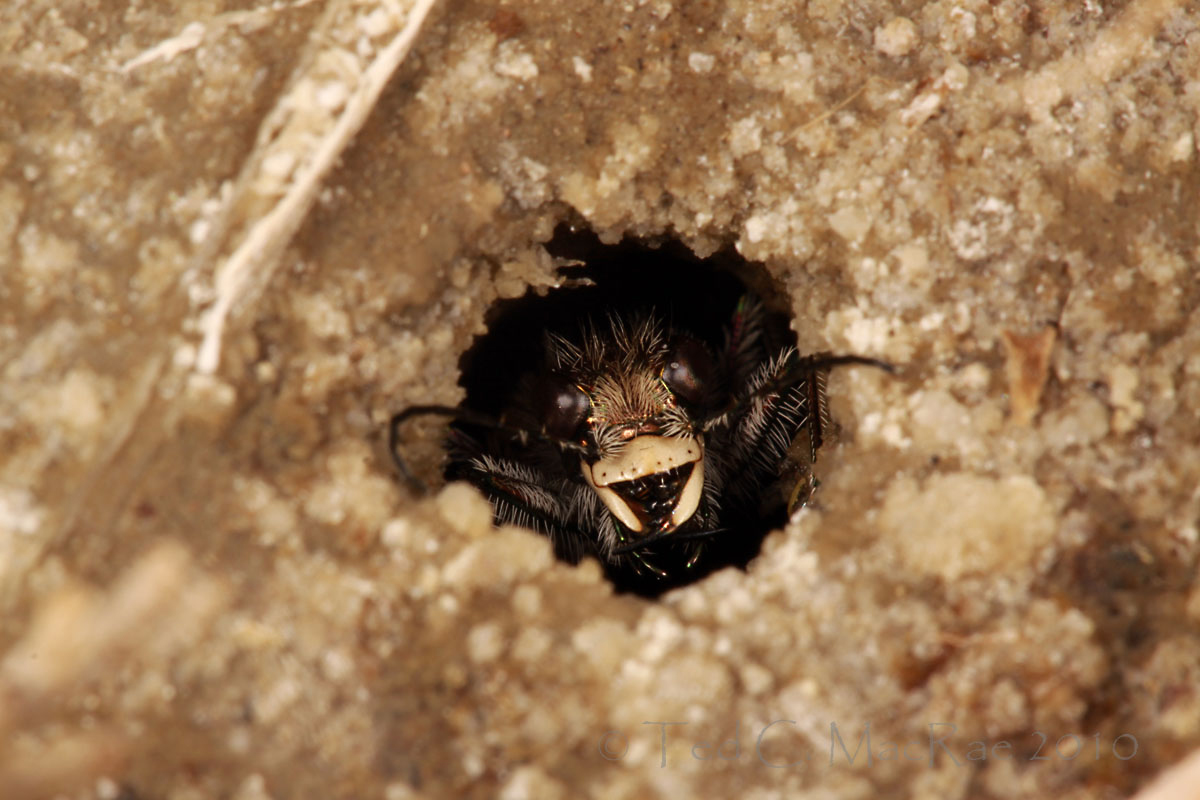
A newly emerged Kirby's tiger beetle sits at the entrance of his burrow.
As I continued scanning the soil, I noticed a number of larval burrows of what I took to be this species located up near the edge of the vegetated zone. One burrow in particular caught my attention – partly because of its slightly larger size and irregular outline, but also because there appeared to be something sitting within it. A closer look revealed an adult tiger beetle sitting just below the burrow entrance. Cicindela tranquebarica is a so-called “spring-fall” species that emerges initially in the fall as a sexually immature adult before digging back in for the winter and re-emerging in spring for mating and oviposition. I thus took this individual to be a newly emerged male that had not yet decided to leave its burrow and burst forth into a life of adulthood. The opportunity couldn’t be passed up – I took a few photos of him sitting there, then switched out the 100mm lens for the 65mm 1-5X lens. I had to get real close for this last shot, which caused him to retreat somewhat in his burrow. However, a knife thrust into the burrow below him, followed by careful twisting until it touched his rear, caused him to return to the burrow entrance and once again pause before embracing his new world.
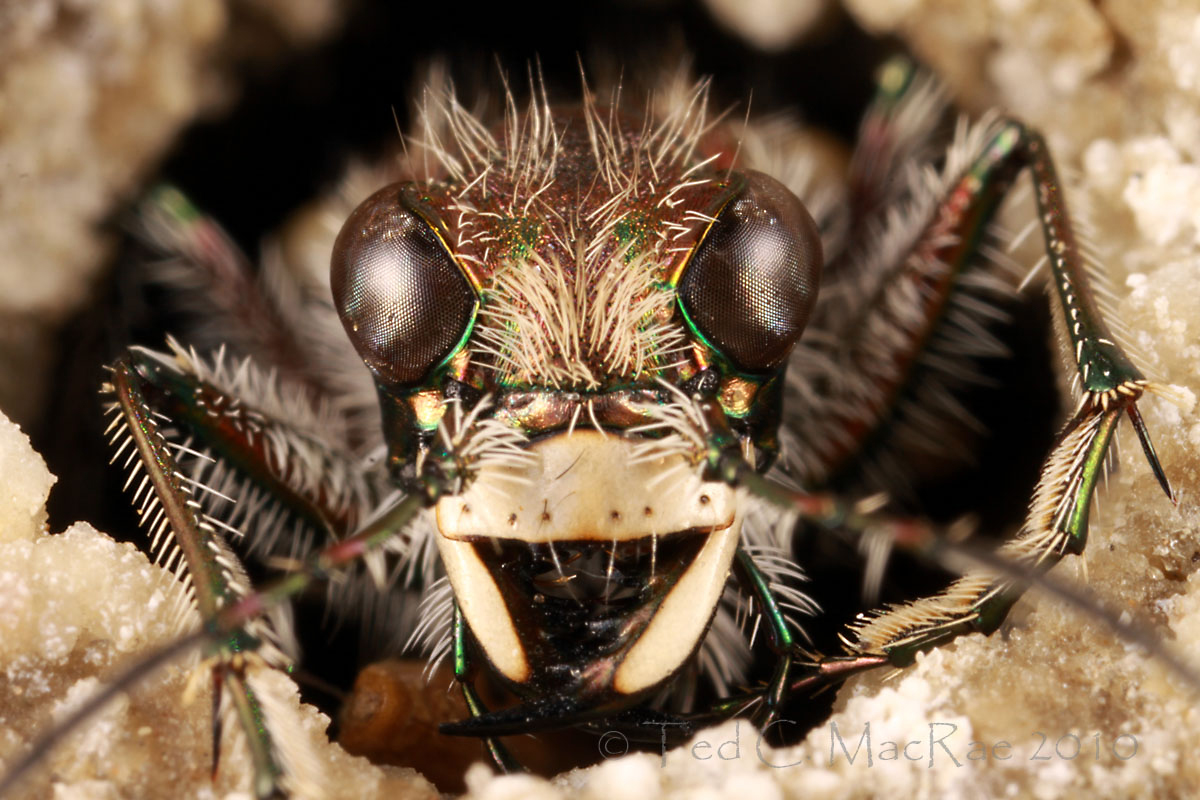
A male Kirby's tiger beetle prepares to leave his emergence burrow.
Copyright © Ted C. MacRae 2010
 Beetles In The Bush