Bicho palito, or “My longest post ever!”

The last day of my vacation week in Corrientes, Argentina got off to a bad start—heavy rain moved in during the morning, and I feared my last chance at looking for insects was about to be washed away. The weather radar, however, showed a curious, abrupt line between rain/no rain across the river in Chaco Province. At noon I decided it was do or die and played a hunch that one of my favorite spots ~50 km west might have been spared the downpour, and if not at least I tried. Yet another example of how it usually pays to play your hunches—while the skies were gray and the ground and foliage a little damp, there was plenty of insect activity afield (and perhaps even enhanced by the first significant moisture in almost two months).

Tetanorhynchus poss. n. sp. | Chaco Province, Argentina

No sooner than had I walked 20 feet from the car did I see an enormous stick insect in a low, spreading acacia tree. I don’t know why I saw it, as it’s camouflage was quite effective, but after so many years of doing this I think I’ve just developed an eye for seeing things often easily missed. This, of course, is not your normal, run-of-the-mill (at least to North Americans) walkingstick (order Phasmida), but rather a member of the curious and exclusively Neotropical grasshopper family Proscopiidae, referred to in English as “jumping sticks” and in Spanish as “bicho palito” (stick bug). I recognized the family instantly, as I had already seen one of these a number of years ago in Uruguay (though not so large as this one), and of course Alex Wild featured what has become one of his most famous photos of a species from Ecuador in one of his Monday Night Mystery posts.

The super elongate fastigium suggests this may be a new species.

Gleefully I set about taking photos, focusing almost exclusively on the head. One thing that immediately struck me was the super-elongate fastigium (frontal projection)—many proscopiids lack this elongate fastigium, and I had not recalled seeing any example as long as the one on this individual. When I saw the super-closeup I had taken of the eyes and antennal bases from the ventral view, I knew I had my own Super Crop Challenge. Of course, it was not until after I posted the challenge that I realized identifying this insect below the family level was more of a challenge than I had anticipated. How could I award points for genus when I wasn’t even sure of this myself? Eventually I enlisted the help of Alba Bentos-Pereira at São Paulo University—he and his doctoral student are perhaps the only two people in the world that are working on this family. I had suggested, based on its location in Chaco Province and consulting Orthoptera Species File Online, that it must be either Tetanorhynchus calamus or Cephalocoema daguerrei—both in the tribe Tetanorhynchini (Bentos-Pereira 2003). Alba kindly responded that it could be the former, it most definitely is not the latter, and perhaps most likely is that it represents an undescribed species (proscopiid taxonomy is still far from complete). He indicated that the presence of ventral spines on the metatibia would confirm membership in the tribe Tetanorhynchini (they are present), and provided several measurements from the male holotype of T. calamus that I could use to compare with my specimen. Although the absolute measurements might (and probably would) differ, their relative proportions should be the same as the type. Here are the results (measurements in mm):


Male type

Female

Ratio

Body

98

138

1.4

Head

18.5

32

1.7

Fastigium

9.5

19

2.0

Pronotum

20

25

1.3

Femur 1

14

17

1.2

Femur 3

28

38

1.4

Tibia 3

30

39

1.3

As can be seen, most of the measurements are consistently 1.2–1.4X that of the male type. The head, however, is proportionately longer (1.7X), primarily due to the much longer fastigium (2.0X). Is this difference significant, at least enough to consider it a different species? I am currently awaiting Alba’s opinion on that.

Like all proscopiids, the form of the face seems to be''smiling'.'

While only two species of Proscopiidae are described from Chaco Province, there are eleven species known from northeastern Argentina (which includes the provinces of Buenos Aires, Chaco, Córdoba, Corrientes, Entre Rios, Formosa, Missiones and Santa Fe)—these are shown in the following list with hyperlinks to their respective pages at Orthoptera Species File Online, along with notes on type localities for each (or synonyms) and the length of the fastigium relative to the body:  

Okay, in the title I indicated this was “My longest post ever!” Here’s why:


Congratulations to Sam Heads, whose work as a practicing orthopteran taxonomist and contributor to Orthoptera Species File Online set him up for the win with 17 points. Brady Richard takes 2nd place with 14 pts, while Chris Grinter and Dennis Haines share the final podium spot with 12 pts each. Congratulations to these folks, who jump out of the gate early in BitB Challenge Session #6.

REFERENCE:

Bentos-Pereira, A. 2003. The Tribe Tetanorhynchini, nov. (Orthoptera, Caelifera, Proscopiidae). Journal of Orthoptera Research 12(2):159–171.

Copyright © Ted C. MacRae 2012

The Ups and Downs of Bug Collecting

Recently The Geek In Question  posted an awesome graph to help visualize the stages of euphoria and despair she experiences while going through the manuscript process. Fellow grad students David Winter (The Atavism) and Morgan Jackson (Biodiversity in Focus) each took the bait and ran with their own version of the process. It has been far too many years since I was a grad student (moment of whimsy overtakes me), and I’ve gone through the manuscript process so many times now that I actually find the whole thing rather enjoyable. Presumably this results from my love of writing, combined with the sageness of having experienced most of the potential pitfalls and feeling confident in how to prevent or deal with them.

For my version of the Geek-Graph™, I thought I would take a broader look at the whole process of what it is to be a publishing Bug Collector. Here is my version:

I’ve been at this long enough to know what I like and what I don’t like, and it strikes me that I love the up front and the final product, but there are elements in between that I simply detest. I love time in the field—a bad day in the field is better than a good day of just about anything else. Some of my best field memories involved getting skunked on the collecting, just because the field experience itself was so weird, new, eventful, etc. I’ve spent days in the desert, it’s dry environs parched by drought, with nary a beetle to be had despite beating hundreds of tree branches. I hated it at the time, but I get euphoric recall of those days when I see something that reminds me of those trips. Even driving between localities, while not time “in the field,” is enjoyable for me as it’s a chance to see the landscapes. It’s only when I have to take time out to buy supplies mid-trip and, especially, hunt for hotels late in the day, that I stop enjoying my time completely.

After I’ve collected the specimens is where I hit the snag—pinning and labeling, ugh!!! It wasn’t always that way; in my younger days I rather enjoyed it. But in those days I was practicing my art and gaining skills. Now I’m as good at pinning/labeling as it gets, and my perfectionist tendencies don’t allow me to do anything less than perfect when I do do it. But it takes time—lots of time to do it perfectly, and especially when you collect the large numbers of specimens that I do. This is the point where I consistently question my decision not to pursue taxonomy as a career. I could have been enjoying the assistance of professional specimen preparators to take care of this for me, but nooo… I had to do it avocationally so I could “do my own thing”! Okay, a quick slap to the face and I’m back.

Once those specimens are pinned and labeled, it’s all fun from here on out.¹ Identifying specimens and adding my “Det. label” is enormously satisfying, even for routine, common species. Excitement mounts if the specimen turns out to be something rare, more so if it represents something I’ve not collected before. This is normal for all collectors, but for me there are additional chances for excitement if the specimens represent new information—e.g., a new state or host plant record, or (gulp!) a new species! Identified specimens also form the basis for manuscripts, and once I’m at that stage it’s pure happiness. I love writing the manuscripts. I even love revising them based on reviewers feedback (even when not very positive—hey, it makes for an improved paper). About the only negative is a little bit of post-publication depression when you realize that your paper is actually read by only a small number of specialists, and you haven’t really offered anything ground-breaking, but rather just an incremental increase in the vast, collective knowledge. But I usually don’t have time to let that get me down—by then I’m already out in the field collecting more bugs!

¹ I probably should make a confession here—sometimes I go ahead and include data in manuscripts from specimens that I haven’t even pinned and labeled yet. The siren call of the unwritten manuscript is far more irresistible than the grating nagging of the unprepared specimen!

Copyright Ted C. MacRae 2012

Super Crop Challenge #12

It’s time for a new BitB Challenge Session, and to begin the 6th edition we start off with a Super Crop Challenge. This is a combination challenge, with points on tap for naming the organism (order, family, genus) and visible structures. As always, standard challenge rules apply, including moderated comments, tie-breaker points for first correct answers, and possible bonus pts for additional relevant information at my discretion. Mr. Phidippus ran away with BitB Challenge Session #5, but Tim Eisele and Dennis Haines fought to the end for podium honors. Will one of them de-throne Mr. Phidippus, or will somebody else make a surprise run? Or, perhaps, 3-time champ Ben Coulter will return to stake his claim as the true BitB Challenge Session champion. Let’s get started!

Copyright © Ted C. MacRae 2012

Pseudomyrmex in Corrientes, Argentina

Early April is early autumn in northeastern Argentina, but seasons just south of the Tropic of Capricorn bear little resemblance to the well-defined spring, summer, fall and winter that we are accustomed to in eastern North America. Early fall here is not a riot of color, pungent smells, and sharp shadows cast from an oblique sun, but rather dull greens and browns, muted and dusty after eight months under a searing overhead sun with only the sparsest of rains for the past two. Such conditions are generally not conducive to insect life, and for the most part insects that live in warm, seasonally wet environments adapt by timing their adult activity (the time for reproduction) to the moist seasons—which in this part of Argentina means September through January. Thus, despite warm temperatures and a subtropical environment, early April is not the best time to be looking for insects here.

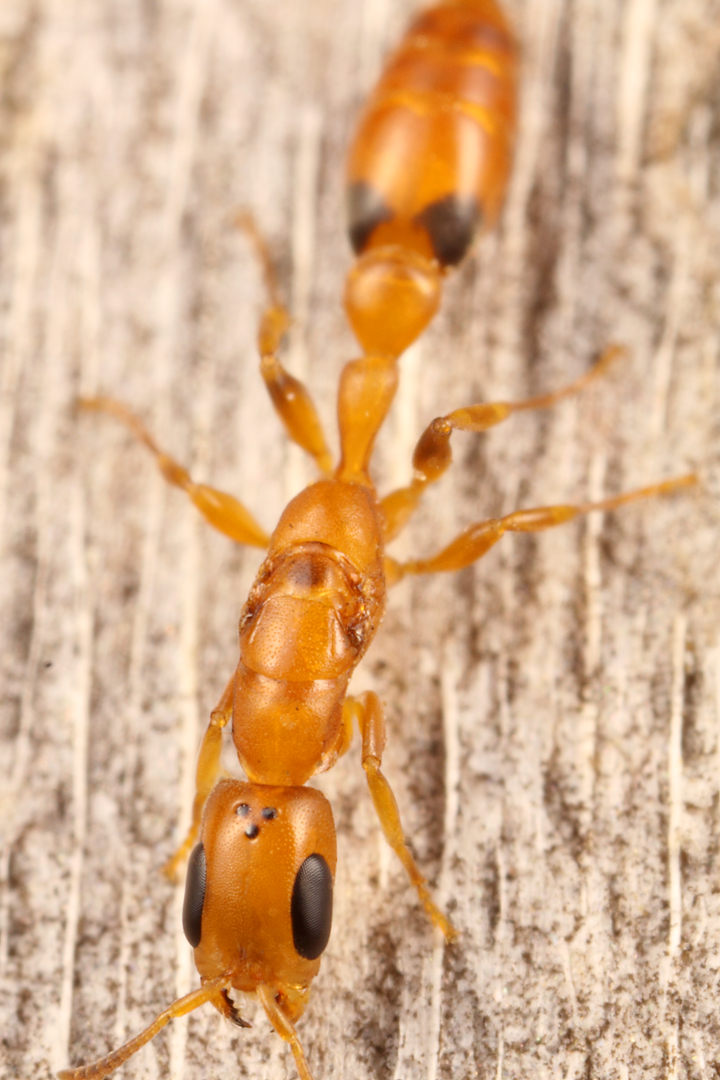
Pseudomyrmex sp. | Corrientes, Argentina

Nevertheless, not all insect groups respond in this fashion, and one in particular is as ubiquitous and diverse now as at any other time of year—ants! I had to trek into sand and mud along the Rio Paraná to find tiger beetles (a few), and it took some dedicated searching to ferret out a few stands of late-season blooming plants and fresh-cut woodpiles to encounter a small diversity of longhorned beetles. I think I may have even seen a single jewel beetle, a chrysobothrine of some type, as it landed on and then flash flew away from the same woodpile with which I had modest longhorned beetle success. The ants, however, have been everywhere—no tree, shrub, or square meter of ground is without them in astounding diversity of size and form.

At this point it appeared to be eating something it plucked from the bark.

I probably shouldn’t admit this, as I hear rumor there are a few myrmecologists that frequent this blog, but I have a hard time getting excited about ants. I know, their unique social structures and evolutionary history are among the most fascinating in the insect world, and watching their behaviors is a lesson in charisma beyond reproach. Still, however, for me there are just so many of them and their taxonomy so completely foreign to me that every time I try digging further I feel immediately overwhelmed. Coleopteran taxonomy may be an order of magnitude more diverse, but since I only pay attention to about 1.5% of the order, it’s as comfortable to me as an old shoe.

Close...

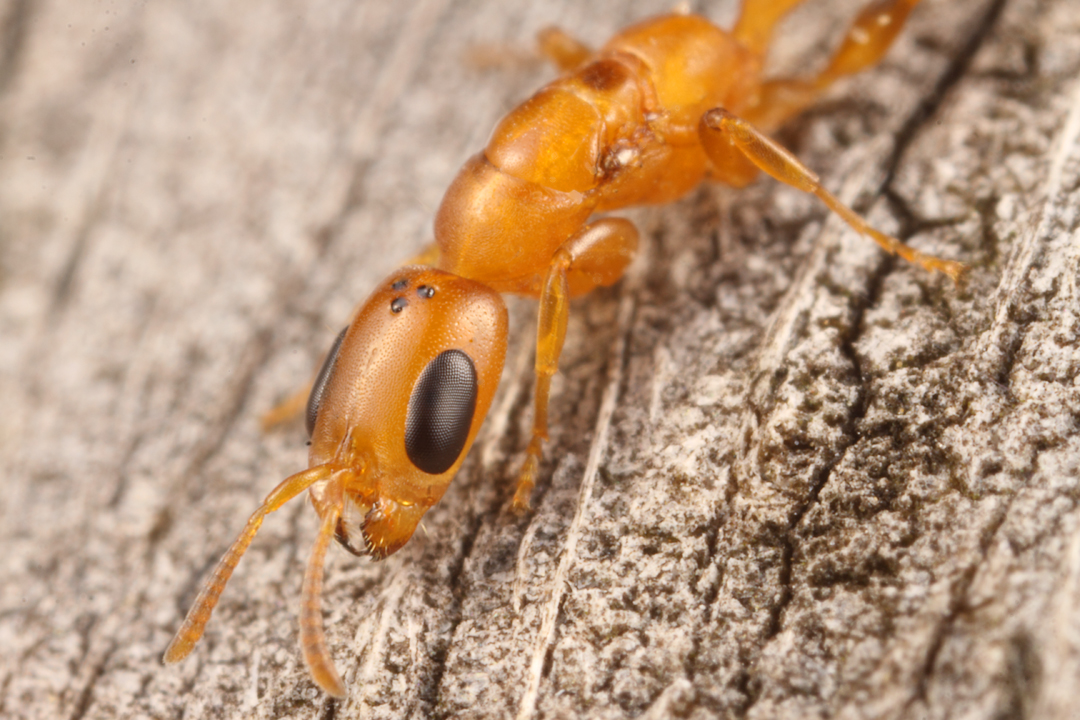
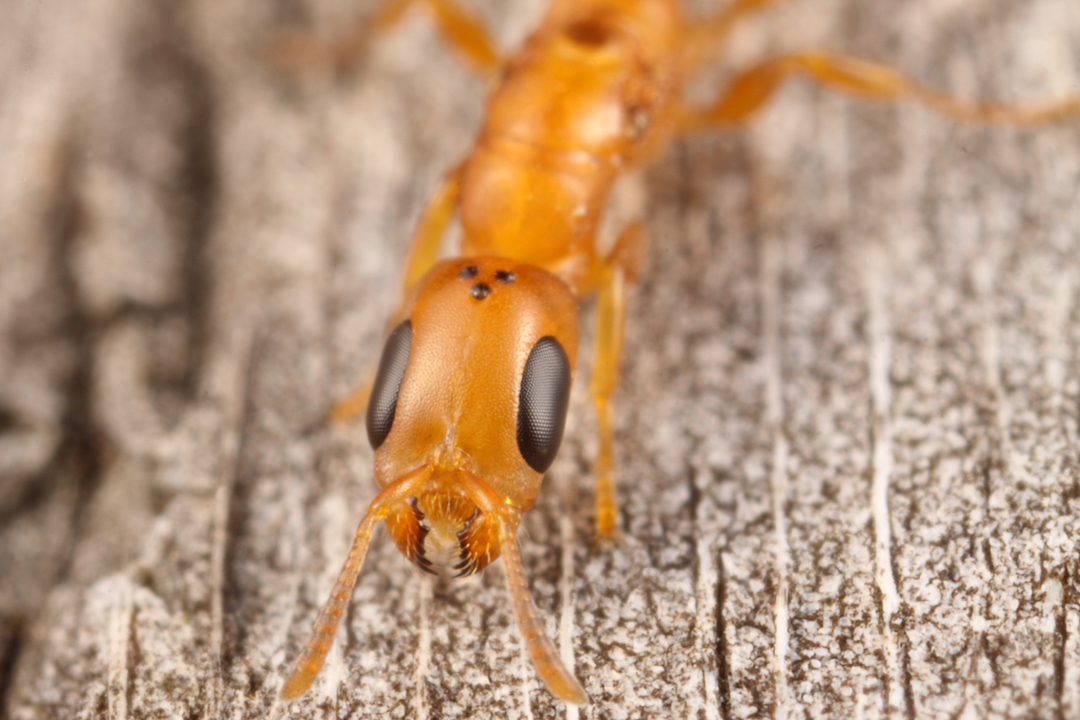
There is one group of ants that I do find endlessly fascinating—the genus Pseudomyrmex. I don’t know why that should be the case—there are plenty of other ant genera that seem to have the tools and structures that usually grab my attention (e.g., grossly oversized mandibles, sharp spines, heavy duty surface sculpturing, etc.). Pseudomyrmex spp. have none of these morphological gimmicks—just a simple, elongate, wasp-like form. Perhaps it’s their association with branches (like wood-boring beetles) rather than the ground—nope, tiger beetles are decidedly ground dwellers and I dig them (Get it? Heh!). No, it must be their super-sized eyes. Most ants have beady little eyes that make it hard to look into their soul. Pseudomyrmex eyes have charisma—you can see them looking at you (and almost read their thoughts).

closer...

Anyway, among the many ants that I’ve noted wandering the banks of the Rio Paraná here in Corrientes are these smallish, orangish Pseudomyrmex spp. This particular individual was the first one I saw, revealed when I happened to pull away a bark chip from trunk of the palm tree on which it was hiding. It wandered all over the palm trunk for the next 15 minutes or so as I chased after it with my 65mm lens. For such tenaciously crawling subjects I’ve found that simply firing off shot after shot as you track it in the view-finder rather than waiting for it to pause and trying to compose each shot is the best way to get some usable images. It’s simply a numbers game—the more shots you fire off, the better chance you have that at least some will be in-focus, nicely composed, and well-lit. These are the ones I was happiest with from the session. (And, OMG, did I really just give advice on how to photograph ants?)

Closest!

It goes without saying that a more specific ID, if possible, would be greatly appreciated (should any prominent myrmecologists happen across these photos). There are scads of species in this genus right across the river in Paraguay, and presumably the diversity in Argentina is similarly high.

Copyright © Ted C. MacRae 2012

“Is blogging dead?” – Another view

Yesterday Alex asked the question that has been on my mind for some time: Is Blogging Dead? He had some nice charts and graphs to illustrate the point, but in the end he thought not. Rather, he speculated, blogging provided an early social network structure that is now better served by Facebook and Google+. While some in blogging have left for these other platforms, there remains a dedicated contingent for whom blogging is the best platform to serve their needs.

There must have been a reason, however, that Alex asked the question in the first place, and in fact he is just the latest of many who have asked this same question with increasing frequency. The rise to pervasive dominance by Facebook (even better than sex) is an obvious factor, and although Google+ struggles to gain share, its better graphics-friendliness has cultivated a small but loyal following (hmm, sounds a little like another IBM vs. Mac). I don’t share Alex’s optimism about the future of blogging. I think social networks have not only pulled share from blogging platforms, but also made blogging irrelevant. The World Wide Web is now chock full of choices for information and entertainment, so much so that it is impossible to look at every site that might be of interest. Blogging takes too much time—why spend time reading long, prattling accounts of one person’s exploits when the short quips of 50 people can be read in the same amount of time? Limiting blogs to being primarily photo showcases doesn’t solve the problem—why spend time clicking through numerous individual sites to see photos that maybe you will like when all can be seen collated on a single page like Google+? Even the capability for interaction between the blogger and reader are better served by social networks—no logging in or word verification gauntlets; instead just a quick click of the “Like” button or, if the photo really struck a chord, a quick comment (“Cool photo!”). Gone are the long, interactive discussions following a post, having been replaced by greater reliance on use of the “Like” button for readers to indicate their approval. The sharp decline in appearance of new blogs and increasing dormancy of formerly active blogs (at least in the natural history realm) further illustrate the decline of blogging in the face of other online choices.

Where am I going with this? Obviously, as writer of ‘Beetles in the Bush’ I have a vested interest in the relevance of blogging. I’m beginning to feel, however, a little old school—like the Mom and Pop hardware store, offering an intimate, interactive experience to an increasingly hurried public that simply doesn’t have time for it. I’d like to know what your thoughts are? Is blogging really on the way out? Is Facebook-level quality for photos really just good enough, and if not is the showing of photos and exchange of ideas really better and more efficiently accomplished on Google+? Is all the extra information about natural history, learnings, etc. just an exercise in self-indulgence? I realize, of course, that any commentary received here will be skewed towards those still inclined to do such, and the thoughts of those who have already abandoned blogging for Facebook and Google+ will remain unknown—perhaps to the point that even this post was another exercise in self-indulgence. At any rate, I’ve been increasingly contemplating the future of individual blogs (and specifically natural history blogs, especially those by enthusiastic specialists) and what purpose they do/can/will/should serve. If everything I’ve said above is true, I personally don’t see how blogging per se can readily adapt to such realities—they essentially become a Facebook or Google+ stream of one!

p.s. These are expressions of an evolving thought process. Don’t expect any drastic changes here at BitB, at least in the near future!

Copyright © Ted C. MacRae 2012