Some recent publications

I’ve had a few papers published in recent months that may be of interest to some. After a string of papers in 2011 focused exclusively on tiger beetles (five in all), these latest three represent sort a return to my “roots”: taxonomy and biosystematics of woodboring beetles (Buprestidae and Cerambycidae). Summaries are provided below, and hyperlinks in the citations lead to downloadable PDFs for those wishing to see the gory details.

  • MacRae, T. C. & R. L. Westcott. 2012. Nomenclatural history of Melanophila drummondi ab. nicolayi Obenberger, 1944 (Coleoptera: Buprestidae), a change of authorship and synonymy under Phaenops drummondi (Kirby 1837), and a new distribution record and summary of larval hosts for the species. The Pan-Pacific Entomologist 88(1):87–91.
     
    This paper can be considered of the “taxonomic housekeeping” sort. It concerns an “aberration” of the common, widespread jewel beetle species Phaenops drummondi. The current version of the International Code of Zoological Nomenclature (ICZN 1999) considers aberrations and other infrasubspecific (rank lower than subspecies) taxa as unavailable names with no taxonomic standing. However, they may be considered valid depending on date of publication and how they were treated by subsequent authors. In the majority of cases the guidance is clear on whether a given aberration, variety, form, etc. is considered unavailable or valid. However, there are times when multiple, conflicting interpretations are possible. The case described in this paper is one example, and even though the taxon clearly falls within the range of variability exhibited by the parent species, careful study of multiple provisions of The Code were required to determine its proper status. In the end, a change of authorship followed by formal synonymy were deemed the best course of action. Updated information on the distribution of P. drummondi and a summary of known larval hosts are also provided.
     
  • MacRae, T. C., L. G. Bezark & I. Swift. 2012. Notes on distribution and host plants of Cerambycidae (Coleoptera) from southern México. The Pan-Pacific Entomologist 88(2):173–184.
     
    From 2004–2006 I made three collecting trips to México with my friend and colleague, Chuck Bellamy. Our main focus was the rich diversity of jewel beetles that occur in the relatively intact, dry, tropical thorn forests that stretch across the southern states of Guerrero, Michoacan, Oaxaca, and Puebla, and in this respect we were quite successful. I also have an interest in longhorned beetles, but I try to limit my scope in this family to the Nearctic fauna and didn’t specifically target these beetles during those trips. Still, many species were encountered during the course of beating potential jewel beetle host plants. As with jewel beetles, the longhorned beetle fauna of México is rich but very incompletely known, with distributional data below the country level and knowledge of host plants lacking or inadequate for most species. This paper presents specific distributional and host plant information for 78 species in 50 genera of longhorned beetles collected during those trips. Included within the data presented are 47 new state records, 47 new adult host records, and 60 new flower records.
     
  • Steury, B. W., T. C. MacRae & E. T. Oberg. 2012. Annotated list of the metallic wood-boring beetles (Insecta: Coleoptera: Buprestidae) of the George Washington Memorial Parkway, Fairfax County, Virginia.  Banisteria 39:71–75.
     
    Lead author Brent Steury of the U.S. National Park Service contacted me last year about identifying jewel beetles that had been collected at a number of units in the George Washington Memorial Parkway during recent BioBlitz surveys and as by-catch from studies targeting other arthropods. The surveys were worthy of reporting on, as 23 species in nine jewel beetle genera were represented in the material collected—including two species reported for the first time from Virginia: Paragrilus tenuis (LeConte) and Pachyschelus purpureus purpureus (Say). Information is also provided on the collecting methods used during the surveys, with Malaise traps, hand netting, and pan traps being the only ones successful in capturing jewel beetles (Lindgren funnel and pitfall traps did not capture any).

REFERENCE: 

International Commission on Zoological Nomenclature [ICZN]. 1999. International Code of Zoological Nomenclature, 4th Edition. The International Trust for Zoological Nomenclature, c/o Natural History Museum, London. xxix + 306 pp.

Copyright © Ted C. MacRae 2012
Wasp Wednesday—Not!

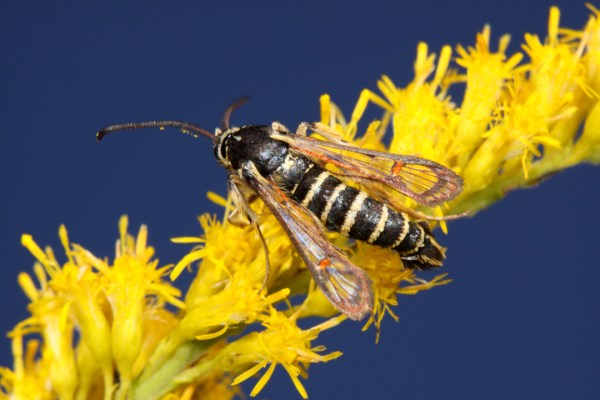
In early September, the agricultural landscape in the central U.S. awakens from its monotonous cloak of summer green and turns ablaze with a hundred shades of yellow, gold, and tawny. The “fall composites” as they are commonly called, a dazzling diversity of mostly yellow-flowered herbaceous plants in the family Asteraceae, are one of the chief contributors to this explosion of color, and among them none contribute more than goldenrod (Solidago sp.). Occupying nearly every fence row, drainage ditch, and fallow field, the bright yellow fronds of tiny flowers are not only pleasing to the eyes of humans, but a smorgasbord of pollen for all manner of flower-feeding insects. Bees, flies, wasps, beetles, and moths all flock to the bounty in numbers rarely seen during the dog days of summer. Spiders, ambush bugs, mantids, and other predators take up residence amongst the flowers as well—not to feed on the flowers, but rather the abundance of flower-feeding insects upon which they will prey. It is rare to find a goldenrod plant without at least a few insects upon it.

Synanthedon decipiens (oak gall borer) on Solidago sp. | Mississippi Co., Missouri

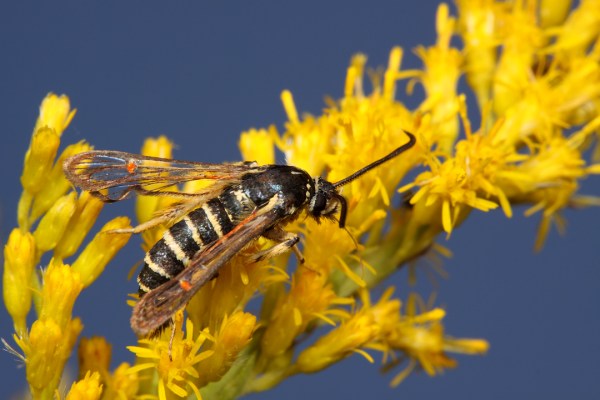
My favorite goldenrod insects are, of course, the longhorned beetles of the genus Megacyllene, and at least here in Missouri there are none finer than Megacyllene decora (see A classic fall ‘bycid). However, I keep an eye out for other insects as well, and when I first saw this “wasp” sitting on a flower head I had to do a bit of a double take—”something” just didn’t seem quite right about it. A little lean forward was all that was needed to confirm that this was indeed no wasp, but rather a clearwing moth (order Lepidoptera, family Sesiidae)¹. To my mind, of the many insects that try to mimic wasps, none do so more effectively than members of this family. From the elongate body to the yellow abdominal banding and narrow transparent wings, everything about this moth says “wasp”—well, almost everything or I wouldn’t have done a double take to begin with.

¹ I hope Eric Eaton, author of Bug Eric and its Wasp Wednesday series, will forgive my use of his title for this post.

Apparently a male, these moths use pheromones to locate females for mating.

I actually did a fair bit of work with this group in my early years with the Department of Agriculture. Females of most (all?) species emit species-specific pheromone blends that males can detect at incredibly low volumes (only a few molecules are needed to elicit a response by the male antenna). Components of these pheromones have been synthesized, and since a number of species have economic importance in landscape and nursery settings (larvae of most species are borers of woody or perennial plants), these synthetic pheromone blends are commonly employed in traps for survey and detection (e.g., Snow et al. 1985). I conducted surveys for several years during the mid 1980’s in east-central Missouri using these traps and, thus, developed a good eye for distinguishing these moths in flight from the wasps that they so effectively mimic. In fact, I used to keep a pheromone tag on my waist bag, which resulted in male moths frequently flying up to me and “searching” for the female. I never tired of seeing the faces of nursery growers—first showing concern as they were convinced I was under attack by a wasp, and then shock as I calmly reached out and grabbed the “wasp” in mid-flight with my bare hand! (And to be perfectly honest, it took me a while before I could bring myself to start grabbing them out of the air!) I even had one nursery grower continue insisting it was a wasp and could sting even after I had caught it (“Naw, them things sting—I seen ’em!)

The moth in these photos seems to best match Synanthdedon decipiens, widely distributed east of the Rockies and inhabiting the woody galls of cynipid wasps on oaks. In Georgia adults of this species exhibit a bimodal pattern of seasonal occurrence suggestive of two generations per year (Snow et al. 1985), so this September-occurring male might represent a second Missouri generation as well.

REFERENCES:

Snow, J. W., T. D. Eichlin & J. H. Tumlinson. 1985. Seasonal captures of clearwing moths (Sesiidae) in traps baited with various formulations of 3,13-0ctadecadienyl acetate and alcohol. Journal of Agricultural Research 2(1):73–84.

Copyright © Ted C. MacRae 2012

Consolation Crossidius

Rewind back to Day 2 of this year’s Annual Fall Tiger Beetle Trip at Gloss Mountain State Park in northwestern Oklahoma—these were actually the first non-Missouri beetles that I photographed on the trip. Crossidius pulchellus is a longhorned beetle (family Cerambycidae) that occurs commonly on flowers of broom snakeweed (Gutierrezia sarothrae) and relatives throughout the Great Plains and southern Rocky Mountains.

Crossidius pulchellus on flowers of Gutierrezia sarothrae | Major Co., Oklahoma. The dense vestiture (covering of hairs) of the beetles is made more conspicuous by backlighting the beetles with the sun.

I find it rather ironic that Crossidius pulchellus was the first western beetle that I encountered, since my original plans for this year’s late-season trip centered on looking specifically for longhorned beetles in the genus Crossidius (see last year’s Crossidius coralinus fulgidus for an extraordinarily beautiful representative of this genus). Unlike the vast majority of the family that develop as larvae in dead wood, species in this diverse, exclusively western North American genus bore through the roots living, perennial shrubs belonging to the genera Gutierrezia, Chrysothamnus/Ericameria, and Haplopappus (family Asteraceae)—the “goldenrods” of the west, they bloom in widespread, yellow-flowered profusion as summer turns to fall. A wide variety of insects are attracted to these blooms, most of which—bees, flies, wasps, moths, etc.—are opportunistic pollinators. Crossidius beetles, however, are intimately associated with the plants, seemingly spending their entire, brief adult lives either perched, feeding, or mating upon the flowers. Even at night, rather than leaving the plants to search for protected hiding spots, they simply bury themselves deeper amongst the flowers and await the next morning’s first, warming rays of sunlight.

Sampling the diversity of Crossidius that springs forth each year across the west requires carefully timed travel to multiple localities spread widely across rough terrain. As longhorned beetles go, the genus exhibits an astounding level of polytopism (geographically-based variation) that in many respects resembles that exhibited by North American tiger beetles. This has resulted in the description of a relatively large number of species, most of which can be further divided into numerous recognizable subspecies and even local morphs. The discontinuous distribution of their host plants across the broken western topography and resulting isolation of local populations have contributed to this variability, further complicated by hybridization among species occurring together in a given locality (Linsley & Chemsak 1961). I got a taste of the diversity of these beetles during last year’s fall tiger beetle trip as I looped through Colorado, Idaho, and Utah. Although my plans to look for them this year didn’t work out, my appetite remains whetted. There is always next year!

REFERENCE:

Linsley, E. G. & J. A. Chemsak. 1961. A distributional and taxonomic study of the genus Crossidius (Coleoptera, Cerambycidae). Miscellaneous Publications of the Entomological Society of America 3(2):26–64, 3 color plates.