Diffuser comparisons for 100mm macro lens

I really wish I could just buy three Canon Speedlite 580EX II flash units, mount one directly on the camera, run the other two wirelessly on each side as slaves, put a nice big soft box diffuser on each of them, and be done with it! I’m beginning to think that’s the only way I’m going to get the kind of full flash insect macro photographs that I want with larger subjects that require the use of my 100mm macro lens. You know what I mean—nice, even, diffuse, vibrant light that comes at the subject from multiple directions (eliminating those annoying specular highlights in the eyes that result from more unidirectional lighting) and with enough power to allow minimal flash pulse durations (resulting in maximum motion freeze). But I can’t—the money is not in the budget, and even if it was I’d have to think seriously about the logistics of carrying and setting up in the field three Speedlites every time I wanted to photograph an (often moving) insect.

Thus, I continue trying to come up with some kind of system that makes the most of my Canon MT-24EX twin flash unit. It’s not that I don’t like this flash unit—I love it because of its light weight (good for field use) and the front-of-the-lens mounting feature that, with its dual heads, gets the flash heads closer to the subject but avoids the “flat” lighting effect of typical ring flash units. In addition, for those shooting insect macro photographs with Canon’s shorter focal length MP-E65 macro lens, the twin flash unit is probably the best choice of all, since the lens is right on top of the subject and it is relatively easy to place diffusing materials between the subject and the flash heads—Alex (Myrmecos) with his tracing paper diffuser and Kurt (Up Close with Nature) with his concave foam diffuser are two of the more successful designs out there. I use my MP-E65 lens a lot, but I use my 100mm macro lens a lot more because many of the beetles I photograph are best photographed at magnification ranges between 0.5–1.0X and, thus, are a little too large for the 65mm lens. The longer lens-to-subject distance of the 100mm lens may be helpful for working with skittish subjects, but it also creates challenges for the MT-24EX because of its relatively low power (more light drop off) and small flash heads (more specular highlighting). For the past couple of years I’ve been using a large sheet of polypropylene foam jury-rigged to the front of the lens, and while it too has functioned fairly well, I keep thinking that if I can just get the flash heads closer to the subject—each fitted with a good diffuser—then it should be possible to achieve results similar to what can be done with the 65 mm lens.

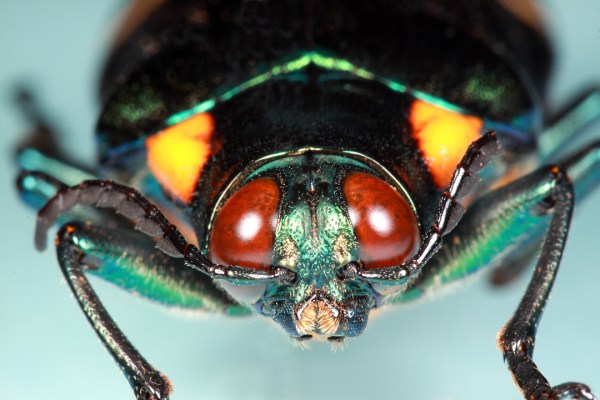
The photos below show the results of some of the ideas I’ve been working on. My main idea was to use extenders that would allow adjustable placement of the flash heads relatively close to the subject and diffuse the light from them with a modified version of the Sto-Fens+Puffers that I have tried in the past. Here is an example of the system mounted on my camera using cheap, flexible arms mounted on a plate attached to the bottom of the camera. If I decide to use this system in the field I would want to purchase much sturdier extenders (e.g. Really Right Stuff), but at only $25 these flexible arms are perfect for proof-of-concept testing. For the modified Sto-Fens+Puffers, I completed the modifications shown by Dalantech (No Cropping Zone) (I was planning to do this when I first tried the Sto-Fens+Puffers but soon found that I preferred the concave and tent designs by Kurt and Alex, at least for use with the 65mm lens). At any rate, to test the ideas I selected a very large (for long subject-to-lens distance), very shiny (for maximum specular highlighting potential) beetle from my collection (Megaloxantha bicolor palawanica, a stunning jewel beetle from Palawan, Philippines) and set it up for “face shots” that simulate my favorite pose for beetles in the field. Keep in mind that this was not intended to be a test of lighting for pinned specimens in the studio—that is not my interest, and there are much better approaches for doing that—but rather a proxy for the kind of lighting and diffusion I might achieve in the field. Here are the results:
IMG_2087_enh_1080x720

– flash heads mounted on lens, diffused by modified Sto-Fens+Puffers

The example above show the results obtained when using the modified Sto-Fens+Puffers with the flash heads mounted directly to the front of the lens. I didn’t try this shot without diffusers, but I doubt it would be much worse than this—specular highlighting is bad because of the small apparent light size, and overall the lighting is not very even with dark shadows and harsh highlights. This shot is a perfect example of the problems inherent in using the twin-flash with a long macro lens.
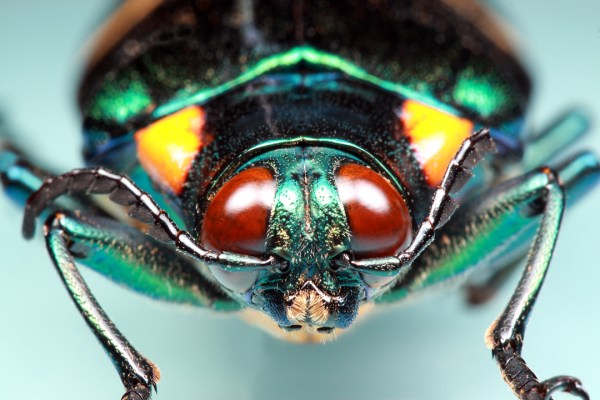
IMG_2082_enh_1080x720

– flash heads mounted on flexible arms, diffused by modified Sto-Fens+Puffers

This second shot shows the results when the modified Sto-Fens+Puffers are mounted on the flexible arm extenders and positioned as close to the subject as possible to maximize apparent light size. This was supposed to be the system that gave me the results I was looking for, but honestly I am not impressed. The highlights in the eyes are certainly larger than in the previous photo, and the overall lighting is not quite as uneven, but still the highlights are harsh and fairly sharply defined. Considering the greater difficulty in positioning the flash heads compared to lens-mounted, I have to consider the marginal improvement in lighting not worth the effort.
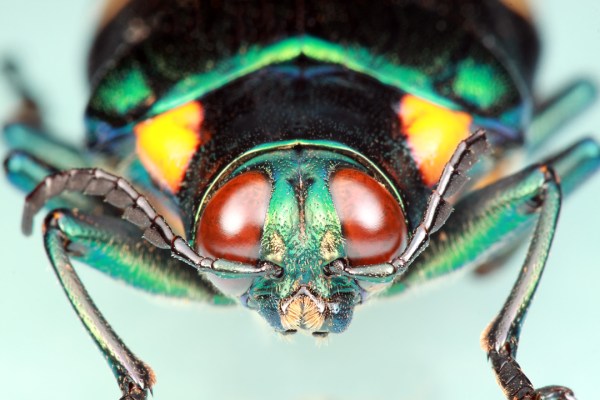
IMG_2090_enh_1080x720

– flash heads mounted on lens, diffused with modified Sto-Fens+ Puffers and concave diffuser (closed)

This third shot has the modified Sto-Fens+Puffers once again mounted on the lens, but also attached is my trusty concave diffuser. Honestly this combination of diffusers provides much better overall lighting and softening of the highlights compared to the previous shot, even though the flash heads are mounted on the lens rather than positioned close to the subject. Apparently the concave diffuser, though further away from the subject, still has larger apparent size and thus allows light to be transmitted to the subject from a larger apparent area. I have not normally used another diffuser between the flash heads and the concave diffuser, but my impression from this shot is that the modified Sto-Fens+Puffers do a good job of dispersing light before it hits the concave diffuser to soften the “hot spots” behind it and provide somewhat more even lighting across its surface.

IMG_2095_enh_1080x720

#4 – flash heads mounted on lens, diffused with modified Sto-Fens+ Puffers and concave diffuser (open)

When I use the concave diffuser, I normally pull the corners back and attach them to the tops of the flash heads with Velcro to minimize light blow back (although how effective it is I really don’t know). Just for kicks, I decided to try some shots with the concave diffuser not pulled back, but left open and extending out over the subject. I did this because that actually more closely approximates how smaller versions of concave diffusers are used with the 65mm lens. The effect was not only remarkable diffusion of light, with specular highlights and hot spots almost completely lacking, but also much better lighting behind rather than just on the front of the specimen. That said, the quality of the light lacks vibrancy and seems somewhat “dead,” perhaps because of the great distance between the flash heads and the diffuser and the MT-24EX units relatively limited power. The large diffuser extending far out in front of the lens might cause problems with bumping and skittish subjects, but I am intrigued enough by this result to continue with some field testing to see what I think.
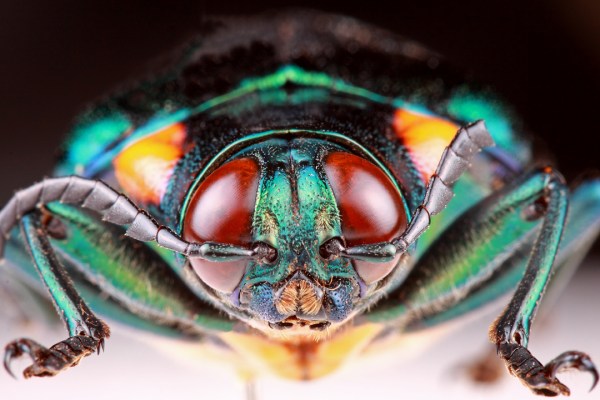
IMG_2113_enh_1080x720

#5 – flash heads mounted on flexible arms, diffused by SoftBoxes

The final shot shows the results of another promising setup—this one again uses the flash heads mounted on flexible arm extenders to get them close to the subject, but instead of the modified Sto-Fens+Puffers I fitted each flash head with a mini SoftBox. This was not easy, as the SoftBox is designed for much larger flash heads than those of the MT-24EX, so I took another set of Sto-Fen diffusers, cut off the face, then hot-glued the SoftBox to the open Sto-Fen. Thus modified it was a simple matter to “snap” the SoftBoxes in place over the flash heads. Despite the term ‘mini’ these Soft Boxes still provide a much larger area for light transmission than the modified Sto-Fens+Puffers, and this much larger apparent light size has a dramatic effect on the overall lighting and diffusion. I’m tempted to say I like this one best. However, I do have to consider ease of function in the field—the lens-mounted Sto-Fen+Puffers and concave diffuser, either open or closed, would certainly be easier and involve no further cost (for better extenders than the cheap flexible arms I now have), but if SoftBoxes on flash heads placed close to the subject gives better results than I may have to go with it.

Will you please help me decide? I setup this little poll so you can tell me which of the systems you thought gave the most pleasing result in terms of vibrant, evenly diffused light. I can’t (to my knowledge) tell who’s voting (and if there is a way don’t tell me because I don’t want to know), so don’t let privacy concerns prevent you from adding your vote—the more voters that participate, the better information I get to help me with my decision.

Copyright © Ted C. MacRae 2013
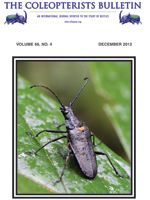
It’s always a happy day…

072_066_0400_cover…when the latest issue of The Coleopterists Bulletin arrives in my mailbox. On this occasion it was the December issue of Volume 66—nine papers and eight scientific notes filling 84 pages of beetle awesomeness. It’s pure elytral ecstasy! I presume I am like most subscribers—rapidly scanning the Table of Contents on the back cover to see if any deal directly with my preferred taxa. Yes! Two papers dealing with Buprestidae (jewel beetles), one on Cerambycidae (longhorned beetles), and one on Cicindelinae (tiger beetles)—a real bonanza. After that, a more cursory look through the rest of the Table of Contents to see what other papers look interesting enough to at least scan through.

For me the most interesting are the two Buprestidae papers, with Hansen et al. documenting new state records, larval hosts, and biological notes for 47 North American species and Westcott & Murray reporting the introduction into the U.S. of yet another Eurasian exotic (Trachys minutus) and its apparent establishment in Massachusetts. As the current “keeper” of distributional records and host plant associations for North American jewel beetles (along with Rick Westcott, Salem, Oregon), I will be busily updating my database over the next few days to reflect these new records. I am a great fan of “notes” papers such as these (and am, in fact, currently finishing a similar manuscript with co-author Joshua Basham, who is also a co-author on the Hansen et al. paper). However, I do have a few quibbles—Hansen et al. report Agrilus  quadriguttatatus as a new record for Tennessee, but it is already known from that state, and Cercis canadensis (eastern redbud) is reported as a new larval host for Anthaxia (Haplanthaxia) cyanella despite the prior records from that host by Knull (1920) and Hespenheide (1974). More puzzlingly, the authors record Agrilus lecontei celticola from locations in eastern Tennessee despite guidance from me on several occasions that this subspecies, while perhaps distinctive in Texas, transitions broadly across Louisiana and Mississippi  with the nominate subspecies. As such, material from eastern Tennessee cannot be regarded conclusively to represent this subspecies (and I remain unconvinced even that the subspecific distinction is warranted). Lastly, in recording Actenodes simi from Tennessee, the authors mention that the closest previous record is from Missouri with no specific locality mentioned (Fisher 1942), even though I recently recorded several specific locations for the species in eastern and southern Missouri (MacRae & Nelson 2003). The overall impression is that the authors are not fully versed in recent literature on Buprestidae and have instead relied exclusively on the recent Nelson et al. (2008) catalogue—known amongst buprestid workers to be incomplete and with errors—as the only source for determining the status of their records.

Among Cerambycidae, Raje et al. report the results of molecular analyses on two color forms of Sternidius alpha. This broadly distributed and highly variable species exhibits multiple color variants across its range, leading to the description of multiple subspecies that were eventually synonymized under the current name. Their analysis of the barcoding region of the cytochrome oxidase I gene, however, revealed three distinct clades among the two color forms, suggesting the potential for taxonomic significance. More work, of course, is needed from additional color morphs from different localities.

Finally, my friend Matt Brust and colleagues discuss the ovipositional behavior of numerous species of North American tiger beetles, unexpectedly finding that many oviposit only after digging some distance below the surface of the soil. This information is extremely valuable for those interested in rearing tiger beetles for description of larval stages, expanding the window of survey for species with limited temporal occurrence, and cross-breeding studies. To that end, and of greatest interest to me, they have included numerous observations from their own studies that have resulted in the development of successful protocols and rapid rearing of large numbers of larvae to adulthood.

cso 66-4Mco14.qxdActually, there is one more thing… For several years now the December issue, as a bonus, has been accompanied by the Patricia Vaurie Series Monograph as a supplement to that year’s volume. This year’s issue features a revision of the scarab genus Euphoria by Jesús Orozco, and although I have not studied it carefully it looks like a robust treatment of the group. Yes, I know that scarabs are not one of my primary interest groups, but show me a coleopterist that—regardless of the group they work on— does not stop and collect these gorgeous, colorful, flower-loving beetles whenever they encounter them and I’ll show you a coleopterist that is far too restrictive in their natural history interests! Based on examination of nearly 19,000 specimens from 67 collections, the work considers 59 valid species (ten of which are described as new) distributed throughout the Western Hemisphere. Complete with keys to species and, for each, synonymy, description, diagnosis, taxonomic history, natural history, temporal occurrence geographic distribution, and—of critical importance in my opinion—full data for all specimens examined, it is everything a good revision should be. Then there are the color plates—one full page for each species—with a large dorsal habitus view, closeups of the head, male genitalia, and color variants, a temporal distribution chart, and a map of its geographical distribution. Again, while I may not be a serious student of scarabs, you can bet that I’ll be going back through my holdings of Euphoria beetles and checking them to make sure they conform to this new standard of knowledge on the group.

REFERENCES:

Brust, M. L., C. B. Knisley, S. M. Spomer & K. Miwa. 2012. Observations of oviposition behavior among North American tiger beetle (Coleoptera: Carabidae: Cicindelinae) species and notes on mass rearing. The Coleopterists Bulletin 66(4):309–314.

Fisher, W. S. 1942. A revision of North American species of buprestid beetles belonging to the tribe Chrysobothrini. U. S. Department of Agriculture, Miscellaneous Publication 470, 1–275.

Hansen, J. A., J. P. Basham, J. B. Oliver, N. N. Youseef, W. E. Klingeman, J. K. Moulton & D. C. Fare. 2012. New state and host plant records for metallic woodboring beetles (Coleoptera: Buprestidae) in Tennessee, U.S.A. The Coleopterists Bulletin 66(4):337–343.

Hespenheide, H. A. 1974.  Notes on the ecology, distribution, and taxonomy of certain Buprestidae.  The Coleopterists Bulletin 27(4) [1973]:183–186.

Knull, J. N. 1920. Notes on Buprestidae with description of a new species (Coleop.). Entomological News 31(1):4–12.

MacRae, T. C. and G. H. Nelson. 2003. Distributional and biological notes on Buprestidae (Coleoptera) in North and Central America and the West Indies, with validation of one species. The Coleopterists Bulletin 57(1):57–70.

Nelson, G. H., G. C. Walters, Jr., R. D. Haines, & C. L. Bellamy.  2008.  A Catalogue and Bibliography of the Buprestoidea of America North of Mexico.  Coleopterists Society Special Publication No. 4, The Coleopterists Society, North Potomac, Maryland, 274 pp.

Orozco, J. 2012. Monographic revision of the American genus Euphoria Burmeister, 1842 (Coleoptera: Scarabaeidae: Cetoniinae). Coleopterists Society Monographs, Patricia Vaurie Series No. 11, 182 pp.

Raje, K. R., V. R. Ferris & J. D. Holland. 2012. Two color variants of Sternidius alpha (Say) (Coleoptera: Cerambycidae) show dissimilar cytochrome oxidase I genes. The Coleopterists Bulletin 66(4):333–336.

Westcott, R. L. & T. C. Murray. 2012. An exotic leafminer, Trachys minutus (L.) (Coleoptera: Buprestidae), found in Massachusetts, U.S.A. The Coleopterists Bulletin 66(4):360–361.

Copyright © Ted C. MacRae 2013

Mr. Phidippus gets his loot

Synoptic collection of tiger beetles

Synoptic collection of tiger beetles for Mr. Phidippus.

I’m sure by now Mr. Phidippus is wondering where his loot is. You see, some months ago Mr. Phidippus won BitB Challenge Session #5 with a solid string of 1st and 2nd place finishes in that session’s five ID and super crop challenges. The top three points earners at the end of each session are offered a variety of prizes, and among the choices offered Mr. Phidippus chose to receive a small collection of beetles from my collection. However, I’ve been remiss in my follow up, with only a heavy travel schedule and seemingly endless string of commitments when I am at home to offer as excuses for such.

At long last, however, I am making things right and have put together this small synoptic collection of tiger beetles that I hope Mr. Phidippus will find useful. Some of the species selected might be common in some areas, while others are certainly found very seldomly—and even then only by those who know what they are looking for. Nevertheless, one of the most fascinating features of tiger beetles is their extreme polytopism, so even commonly encountered species can look very different depending on what part of their range they come from. A perfect example of this is Cicindela scutellaris, represented in the box above by three individuals: one from Kansas (subspecies scutellaris), one from northeast Missouri (subspecies lecontei) and one from southeast Missouri (an unusual population representing an intergrade of subspecies lecontei and subspecies unicolor). Ranging from wine-red to blue-green to brilliant red and green, they are perhaps the best example of tiger beetle polytopism gone wild!

So, Mr. Phidippus this one is for you. Congratulations again on your win, and thank you for your patience!

Copyright © Ted C. MacRae 2013

Ovipositing Pigeon Horntail

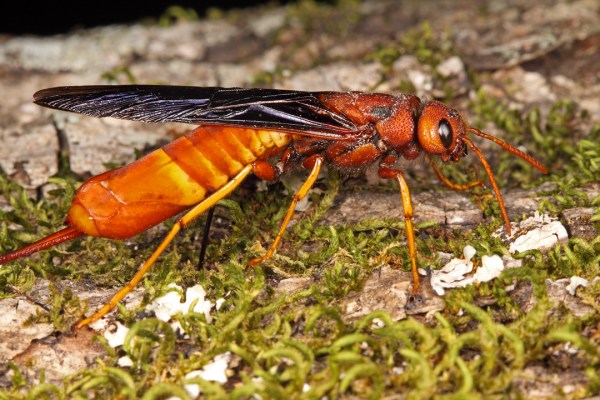
Tremex columba (pigeon horntail) | Wayne Co., Missouri

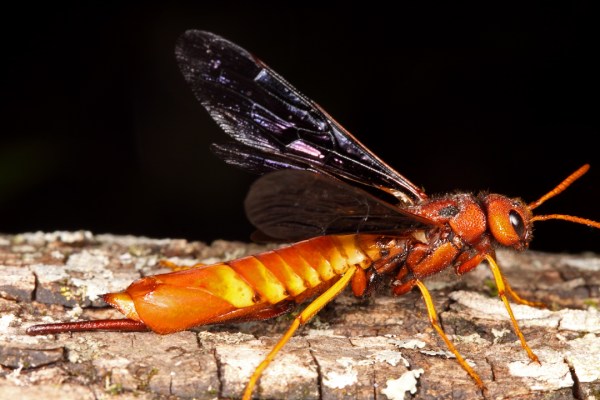
Tremex columba (pigeon horntail) | Wayne Co., Missouri

By early July, woodboring beetle activity is at its peak in southern Missouri. Even though many of the smaller species of jewel beetles (family Buprestidae) and longhorned beetles (family Cerambycidae) have already come and gone, bigger species in genera such as Buprestis, Acanthocinus, Enaphalodes, etc. are ripe for the picking. All one has to do is travel for hours to high-quality forest (upland or lowland—either is fine depending on what you wish to find), hike for additional hours through stifling mid summer heat and humidity, and carefully search the trunks and branches of any declining or recently downed tree (don’t forget to look along the undersides) while dodging deer flies (if ever a creature sprang from the pit of hell!) and slapping mosquitos! Sure, you can cheat and just drive along National Forest roads looking for recent logging operations—it’s a good way to get large series of common, widespread species; however, if you want to get the good stuff you’ve got to seek out the high-quality forests—those not managed for timber—and look for declining trees and natural wind-throws.

Of course, not all wood borers are beetles. Among the more spectacular non-beetle wood borers are the horntails (order Hymenoptera, family Siricidae), represented in this post by one of its more commonly encountered species, Tremex columba (pigeon horntail). That is not to say that they are frequently encountered, at least in my experience, but I do remember the first time I saw one of these as a boy. I knew in my heart that they were harmless—my already tattered copy of The Golden Guide to Insects said so; yet I could not bring myself to actually grab what would become the latest prize specimen in my insect collection with my bare fingers, instead sneaking a jar over it and sliding the lid underneath.  I’ve seen them a few times since, but until recently I had never seen what must be considered their most remarkable feature—the ability to thrust a needle-thin ovipositor several cm into solid wood! While hiking the Shut-Ins Trail at Sam A. Baker State Park last year, I spotted a large, recently wind-thrown tree off the trail and picked my way over to see what woodboring beetles I might find. As I approached the horntail in these photos took flight, but I stood still and watched her settle back onto the trunk and resume searching activities. Using all the stealth I could muster, I made my approach—hoping to get at least one good shot of this spectacular insect. I would have been happy if I had walked away with nothing more than the first photo in the sequence below. What happened next, however, was icing on the cake. As the remaining photo sequence shows, she suddenly arched her abdomen high and began probing the wood with the tip of her ovipositor, then bracing it at a precise 90° angle relative to the lower abdomen, slowly thrust it deep into the wood until her abdomen was completely level above the trunk.

I never cease to be amazed by insects, but sometimes their capabilities just seem incomprehensible. If you disagree, just imagine trying to insert an insect pin deep into solid wood with nothing but your bare hands (or, more precisely, pushing only with your butt) and see if you don’t change your mind!

T
T
T
T
T
T
Copyright © Ted C. MacRae 2013

The ultimate jaws on a longhorned beetle!

Some 23 years ago, I departed on my first ex-U.S. insect collecting trip. I was still a youngster—barely into my 30s—but had by then a well developed interest in woodboring beetles of the families Buprestidae and Cerambycidae. I had spent the previous eight years since graduate school collecting these beetles throughout Missouri, work that led to the publication of my faunal treatments of the two families for the state (MacRae 1991, 1994), and even begun collecting insects outside of Missouri in other states such as Texas, Arizona and Florida. Although I was still cutting my teeth as a collector, I yearned for the tropical experience, and in December 1989 to January 1990 I got the chance to spend three weeks in one of the most tropical localities I could imagine—Ecuador! I’ve collected in many countries since then, but that first tropical collecting trip remains one of my most cherished experiences.

Criodion rhinoceros Bates 1870 | Sucumbios Province, Ecuador (New Country Record)

Of course, being as young and green as I was, I didn’t really know what any of the insects I was collecting were beyond family level (if that!), and the numbers were so overwhelming compared to anything I had experienced previously that all I could do was collect as much as I could using the techniques I had figured out to that point, process them all when I got back, and then hold them for the future when I would either study them myself or make them available to other specialists. In the years since, Buprestidae have become the primary focus of my studies, relegating any non-Nearctic Cerambycidae in my collection to the sidelines. Since I don’t now and probably will never do serious work on Neotropical Cerambycidae, I’ve begun sending them to specialists who do work on them for identification or to be utilized as desired in their research. Much of the Cerambycidae were sent to Frank Hovore, an expert of Ecuadorian Cerambycidae who kindly identified them for me before tragically passing away while on a collecting trip to that very country. Some of the larger specimens were not sent, however, because I had used them to create an “Oh wow!” drawer (see photo on My Collection page). After Frank’s passing, I decided to try identifying the longhorned beetles in that drawer, most of which I was able to identify using Larry Bezark’s incredible website, A Photographic Catalogue of the Cerambycidae of the [New] World. There was one, however, that I was not able identify, despite the fact that it seemed to be the most easily identifiable of all due to remarkable horn-like processes arising from the top of the mandibles. I scanned repeatedly through the photos of species in all genera that looked even remotely similar. Criodion seemed most likely, but none of the species photographed sported such unique mandibular armature.

Males sport remarkable horn-like processes arising from the mandibles.

Stumped, I emailed the top photo to Brazilian coleopterist and cerambycid specialist Antonio Santos-Silva (Universidade de São Paulo) and asked for his opinion. He replied that it seemed to be a species of Criodion, noting that the only species of Criodion with this kind of mandible is C. rhinoceros—known only from the Brazilian state of Pará, and a species completely lacking in their collection. I sent him the other photos in this post to give him a better view of the mandibles, and Antonio replied back that both he and colleague Ubirajara Martins agree with the initial ID. My failure to match the specimen with this species in the photographic catalogue was understandable, as this was one of the few species for which no photographs were available. That situation has since been corrected, and the site now features photographs of both male and female specimens—the latter exhibiting quite chunky but not nearly as grossly developed mandibles as the former.

Another view of the male's remarkable mandibular armature

A lateral view of the head resembles that of a rhinoceros!

Bates’ (1870) original description, based only on the male, notes that the spines arise from the upper edge of the mandibles near the middle and incline towards each other, crossing at the apices and giving the head of the beetle, viewed in profile, the curious resemblance to that of a rhinoceros. Certainly no other species in the genus bears such extraordinary modifications of the mandibles, and if there are others in the family, I am not aware of them and they must be very few in number. One can only speculate on the function of such a modification, but since they are present only on the males a sexual or mating-related function could be considered likely. If any reader has information or thoughts about extreme mandibular modifications such as this and their possible functional significance please let me know.

Males sport remarkable horn-like processes arising from the base of the mandibles

And of course, the BitB face shot!

The collection of this species in Ecuador adds another species to that countrys’ already rich cerambycid fauna (Antonio confirmed that it is a new record for Ecuador). I’ve picked up a smattering of other Cerambycidae from South America over the past ten years, so I’m going to send them all to Antonio for ID and allow him to keep whatever is interesting for his research or the University’s collection. I will include this remarkable species in the package as a gift—considering its status as the only known voucher for the species in Ecuador, I think his institution’s collection will be a more appropriate repository for it than my “Oh wow!” drawer.

REFERENCE:

Bates, H. W. 1870. Contributions to an insect fauna of the Amazon Valley (Coleoptera, Cerambycidae). Transactions of the Entomological Society of London 1870:243–335, 391–444.

MacRae, T. C. 1991. The Buprestidae (Coleoptera) of Missouri.  Insecta Mundi 5(2):101–126.

MacRae, T. C. 1994. Annotated checklist of the longhorned beetles (Coleoptera: Cerambycidae and Disteniidae) known to occur in Missouri. Insecta Mundi 7(4) (1993):223–252.

Copyright © Ted C. MacRae 2013

Let’s make a deal!

buprestid

Image source unknown

I recently conducted a complete reorganization of the jewel beetles (superfamily Buprestoidea) in my collection (TCMC). The primary purpose of this was to bring the nomenclature and arrangement of the collection into agreement with the recently published World Catalogue of Buprestoidea (Bellamy 2008) and accurately document the taxa represented in the collection and their numbers. In the short term this will be helpful not only in visualizing what is represented but also what is missing (particularly in North America), while longer term it lays the groundwork for the eventual donation of my collection to a public institution.

In an active, working collection, no inventory is ever fully up-to-date. In my case, the inventory includes only completely curated material that has been incorporated into the main cabinets. I still have several years worth of material in various states of curation—i.e., unmounted, mounted but unlabeled, or labeled but unidentified. That said, the main collection now contains more than 23,000 specimens of Buprestoidea representing 1,500+ species worldwide. Of the species represented, 37% are Nearctic (U.S./Canada), 22% Palearctic (Europe, North Africa, temperate Asia), 19% Neotropical (Latin America), 10% Afrotropical (Subsaharan Africa), 7% Indomalayan (tropical Asia) and 6% Australian (Australia/New Zealand). The collection also contains 492 paratype specimens representing 77 species. The inventory has been converted to  PDF and uploaded for access by the link below. It lists all of the species represented, with nomenclature updated and taxa arranged according to Bellamy (2008) and number of specimens  indicated for each. Also indicated are higher taxa not yet represented in the collection (shown in gray rather than black text) so that the collection holdings can be placed in context of a complete higher classification for the superfamily.

 Click to see full inventory of TCMC Buprestoidea

Of course, as a North American, the Nearctic fauna is the primary focus of my taxonomic and biological studies. As a result, I am keen to have the Nearctic fauna represented as completely as possible in my collection. Currently I have 75% (595) of the 790 species and non-nominate subspecies currently recognized in North America. Obviously, by now I’ve picked most of the low-hanging fruit, and the last 25% will be much more difficult to get. Many of these are truly rare species that I may never find (some are known only by the holotype), while others are more common but occur in areas that I have limited opportunity to visit. These species are also indicated in the above inventory (again, in gray text) but are also listed below for easy reference. If you have any of the species on this list, please let me know and also what you might like to receive in exchange for them. I have not only many species of Buprestidae from around the world to offer, but also beetles in other families such as longhorned beetles (Cerambycidae), tiger beetles (Cicindelinae), scarabs (Scarabaeoidea), and even non-beetles such as treehoppers (Membracidae) and cicadas (Cicadoidea). Let’s make a deal!

REFERENCE:

Bellamy, C. L. 2008. World Catalogue and Bibliography of the Jewel Beetles (Coleoptera: Buprestoidea),  Volumes 1–5. Pensoft Series Faunistica, 3125 pp.

Copyright © Ted C. MacRae 2013


T.C.MacRae Collection Desiderata

Family SCHIZOPODIDAE LeConte 1859
Subfamily SCHIZOPODINAE LeConte 1859
Tribe SCHIZOPODINI LeConte 1859

Genus Schizopus LeConte 1858
sallei ssp. sallei Horn 1885
sallei ssp. nigricans Nelson 1991
Genus Dystaxia LeConte 1866
elegans Fall 1905

Family BUPRESTIDAE Leach 1815
Subfamily POLYCESTINAE Lacordaire 1857
Acmaeoderioid lineage sensu Volkovitsh 2001
Tribe HAPLOSTETHINI LeConte 1861

Genus Mastogenius Solier 1849
arizonicus Bellamy 2002
puncticollis Schaeffer 1919

Tribe ACMAEODERINI Kerremans 1893
Subtribe ACMAEODEROIDINA Cobos 1955

Genus Acmaeoderoides Van Dyke 1942
cazieri Nelson 1968
depressus Nelson 1968

Subtribe ACMAEODERINA Kerremans 1893

Genus Acmaeodera Eschscholtz 1829
— Subgenus Acmaeodera (s. str.)
audreyae Westcott & Barr 2007
bryanti Van Dyke 1953
comata LeConte 1858
consors Horn 1878
cubaecola Jaquelin du Val 1857
discalis Cazier 1940
dolorosa ssp. liberta Fall 1922
fattigi Knull 1953
flavosticta Horn 1878
horni Fall 1899
inyoensis Cazier 1940
laticollis Kerremans 1902
morbosa Fall 1899
pubiventris ssp. panocheae Westcott 2001
recticolloides Westcott 1971
starrae Knull 1966
subbalteata LeConte 1863
thoracata Knull 1974
tildenorum Nelson & Westcott 1995
wheeleri Van Dyke 1919

Genus Acmaeoderopsis Barr 1974
prosopis Davidson 2006
rockefelleri (Cazier 1951)
varipilis (Van Dyke 1934)

Genus Anambodera Barr 1974
nebulosa (Horn 1894)
santarosae (Knull 1960)

Polyctesioid lineage sensu Volkovitsh 2001
Chrysophana generic group [tribal level] sensu Volkovitsh 2001

Genus Beerellus Nelson 1982
taxodii Nelson 1982

Polycestioid lineage sensu Volkovitsh 2001
Tribe POLYCESTINI Lacordaire 1857

Genus Polycesta Dejean 1833
— Subgenus Polycesta (s. str.)
angulosa Jacquelin du Val 1857
— Subgenus Polycesta (Arizonica) Cobos 1981
arizonica ssp. acidota Cazier 1951
— Subgenus Polycesta (Tularensia) Nelson 1997
crypta Barr 1949

Tribe TYNDARINI Cobos 1955
Subtribe TYNDARINA Cobos 1955

Genus Paratyndaris Fisher 1919
— Subgenus Paratyndaris (s. str.)
anomalis Knull 1937
crandalli Knull 1941
grassmani Parker 1947
quadrinotata Knull 1938

Subfamily CHRYSOCHROINAE Laporte 1835
Chrysochroid lineage sensu Bellamy 2003
Nanularia generic group [tribal level] sensu Volkovitsh 2001

Genus Nanularia Casey 1909
cupreofusca Casey 1909
pygmaea (Knull 1941)

Tribe CHRYSOCHROINI Laporte 1835
Subtribe CHALCOPHORINA Lacordaire 1857
Texania generic group sensu Volkovitsh 2001

Genus Texania Casey 1909
langeri (Chevrolat 1853)

Tribe POECILONOTINI Jakobson 1913
Subtribe POECILONOTINA Jakobson 1913

Genus Poecilonota Eschscholtz 1829
ferrea (Melsheimer 1845)
montana Chamberlin 1922
viridicyanea Nelson1997

Dicercioid lineage sensu Bellamy 2003
Tribe DICERCINI Gistel 1848
Subtribe HIPPOMELANINA Holynski 1993

Genus Hippomelas Laporte & Gory 1837
martini Nelson 1996
parkeri Nelson 1996

Genus Gyascutus LeConte 1858
— Subgenus Gyascutus (s. str.)
jeanae (Nelson 1988)
pacificus (Chamberlin 1938)

Genus Barrellus Nelson & Bellamy 1996
femoratus (Knull 1941)

Subtribe DICERCINA Gistel 1848
Dicerca generic group sensu Volkovitsh 2001

Genus Dicerca Eschscholtz 1829
dumolini (Laporte & Gory 1837)
hornii nelsoni Beer 1974
lugubris LeConte 1860
mutica LeConte 1860
sexualis Crotch 1873
spreta (Gory 1841)
tuberculata (Laporte & Gory 1837)

Subfamily BUPRESTINAE Leach 1815
Buprestioid lineage sensu Volkovitsh 2001
Buprestinioid branch sensu Volkovitsh 2001
Tribe BUPRESTINI Leach 1815
Subtribe TRACHYKELINA Holynski 1988

Genus Trachykele Marseul 1865
fattigi Knull 1954
opulenta Fall 1906

Subtribe BUPRESTINA Leach 1815

Genus Buprestis Linnaeus 1758
— Subgenus Buprestis (Cypriacis) Casey 1909
intricata Casey 1909
prospera Casey 1909
— Subgenus Buprestis (Knulliobuprestis) Kurosawa 1988
fremontiae Burke 1924
— Subgenus Buprestis (Stereosa) Casey 1909
apricans Herbst 1801
decora Fabricius 1775

Anthaxioid lineage sensu Volkovitsh 2001
Anthaxiinioid branch sensu Volkovitsh 2001
Tribe ANTHAXIINI Gory et Laporte 1839

Genus Anthaxia Eschscholtz 1829
— Subgenus Anthaxia (Haplanthaxia) Reitter 1911
carya Wellso & Jackman 2006
caseyi ssp. sublaevis Van Dyke 1916
— Subgenus Anthaxia (Melanthaxia) Rikhter 1944
barri Bílý 1995
californica Obenberger 1914
cupriola Barr 1971
emarginata Barr 1971
embrikstrandella Obenberger 1936
exasperans Cobos 1958
furnissi Barr 1971
helferiana Bílý 1995
hurdi Cobos 1958
nanula Casey 1884
neofunerula Obenberger 1942
nevadensis Obenberger 1928
oregonensis Obenberger 1942
porella Barr 1971
sculpturata Barr 1971
serripennis Obenberger 1936
strigata LeConte 1859
subprasina Cobos 1959
tarsalis Barr 1971
wallowae Obenberger 1942

Tribe XENORHIPIDINI Cobos 1986
Subtribe XENORHIPIDINA Cobos 1986

Genus Hesperorhipis Fall 1930
hyperbola ssp. californica Knull 1947
jacumbae Knull 1954
mirabilis ssp. mirabilis Knull 1947

Chrysobothrioid lineage sensu Volkovitsh 2001
Melanophilinioid branch sensu Volkovitsh 2001
Tribe MELANOPHILINI Bedel 1921
Subtribe MELANOPHILINA Bedel 1921

Genus Phaenops Dejean 1833
carolina (Manee 1913)
caseyi (Obenberger 1944)
obenbergeri (Knull 1952)
vandykei Obenberger 1944

Chrysobothrinioid branch sensu Volkovitsh 2001
Tribe ACTENODINI Gistel 1848

Genus Actenodes Dejean 1833
arizonicus Knull 1927
mimicus Knull 1964

Tribe CHRYSOBOTHRINI Gory et Laporte 1838

Genus Chrysobothris Eschscholtz 1829
— Subgenus Chrysobothris (s. str.)
aeneola LeConte 1860
bacchari Van Dyke 1923
bicolor Horn 1894
bisinuata Chamberlin 1938
bispinosa Schaeffer 1909
boharti Van Dyke 1934
breviloboides Barr 1969
caurina Horn 1886
chamberliniana Fisher 1948
costifrons ssp. costifrons Waterhouse 1887
culbersoniana Knull 1943
cupressicona Barr & Westcott 1976
deserta Horn 1886
dolata Horn 1886
fragariae Fisher 1930
grindeliae Van Dyke 1937
helferi Fisher 1942
hidalgoensis Knull 1951
horningi Barr 1969
hubbardi Fisher 1942
idahoensis Barr 1969
kelloggi Knull 1937
knulli Nelson 1975
nelsoni Westcott & Alten 2006
oregona Chamberlin 1934
orono Frost 1920
paragrindeliae Knull 1943
potentillae Barr 1969
pseudacutipennis Obenberger 1940
pubilineata Vogt 1949
purpurata Bland 1864
roguensis Beer 1967
schaefferi Obenberger 1934
schistomorion Westcott & Davidson 2001
scitula Gory 1841
sexfasciata ssp. sexfasciata Schaeffer 1919
sloicola Manley & Wellso 1976
smaragdula Fall 1976
socialis ssp. apache Westcott & Barr 2007
speculifer Horn 1886
subopaca Schaeffer 1904
vivida Knull 1952
westcotti Barr 1969
wickhami Fisher 1942

Genus Knowltonia Fisher 1935
alleni (Cazier 1938)
atrifasciata (LeConte 1878)

Subfamily AGRILINAE Laporte 1835
Tribe AGRILINI Laporte 1835
Subtribe AGRILINA Laporte 1835

Genus Agrilus Curtis 1825
— Subgenus Agrilus (s. str.)
hazardi Knull 1966
— Subgenus Agrilus (Engyaulus) Waterhouse 1889
inhabilis ssp. cuprinus Nelson 1996
utahensis Westcott 1996
— Subgenus Agrilus (Quercagrilus) Alexeev 1998
derasofasciatus Boisduval & Lacordaire 1835
— Subgenus Agrilus (Uragrilus) Semenov-Tian-Shanskij 1935
granulatus ssp. mojavei Knull 1952
sayi Saunders 1871
— Subgenus undefined
amelanchieri Knull 1944
arizonus Knull 1934
audax Horn 1891
aurilaterus Waterhouse 1889
bespencus Barr 2008
burkei Fisher 1917
catalinae Knull 1940
cercidii Knull 1937
cochisei Knull 1948
criddlei Frost 1920
davisi Knull 1941
delicatulus Waterhouse 1889
dozieri Fisher 1918
exiguellus Fisher 1928
floridanus Crotch 1873
funestus Gory 1841
geronimoi Knull 1950
gillespiensis Knull 1947
hazardi Knull 1966
horni Kerremans 1900
jacobinus Horn 1891
langei Obenberger 1935
latifrons Waterhouse 1889
montosae Barr 2008
neabditus Knull 1935
nevadensis Horn 1891
nigricans Gory 1841
obscurilineatus Vogt 1949
olivaceoniger Fisher 1928
ometauhtli Fisher 1938
palmerleei Knull 1944
parabductus Knull 1954
pilosicollis Fisher 1928
pseudocoryli Fisher 1928
pubifrons Fisher 1928
restrictus Waterhouse 1889
shoemakeri Knull 1938
sierrae Van Dyke 1923
snowi Fall 1905
torquatus LeConte 1860
waltersi Nelson 1985
wenzeli Knull 1934

Tribe TRACHYINI Laporte 1835
Subtribe BRACHYINA Cobos 1979

Genus Taphrocerus Solier 1833
floridanus Obenberger 1934

Subtribe PACHYSCHELINA Böving et Craighead 1931

Genus Pachyschelus Solier 1833
fisheri Vogt 1949
schwartzi Kerremans 1892
vogti Hespenheide 2003