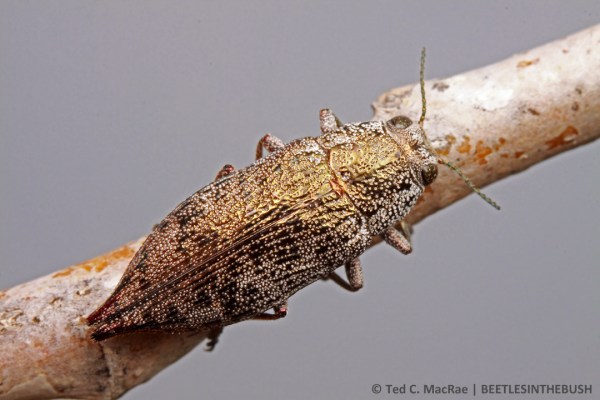
Poecilonota cyanipes (eastern poplar jewel beetle) | Beaver Dunes State Park, Oklahoma
This is the best known of the American species of Poecilonota, and the one most commonly collected east of the Rocky Mountain.—Evans (1957)
I’ve been interested in insects since I was a kid, but I didn’t really become a dedicated coleopterist until after I’d finished graduate school and started working as a field entomologist with the Missouri Department of Agriculture. It was a perfect job for a young entomologist with a bent for collecting—being outside all day inspecting nursery stock and driving the back roads checking insect traps. It wasn’t long before I found myself focusing on wood-boring beetles, due initially to their horticultural importance but eventually to their astounding diversity and intrinsic beauty. So began my formal survey of the families Buprestidae and Cerambycidae in Missouri, and I spent the next eight years collecting them in all corners of the state and examining every insect collection, public and private, that I could find that might contain Missouri representatives of these families. In the end, I documented a cool 350 species and subspecies in the two families combined, more than a fifth of which represented new state records (MacRae 1991, 1994).
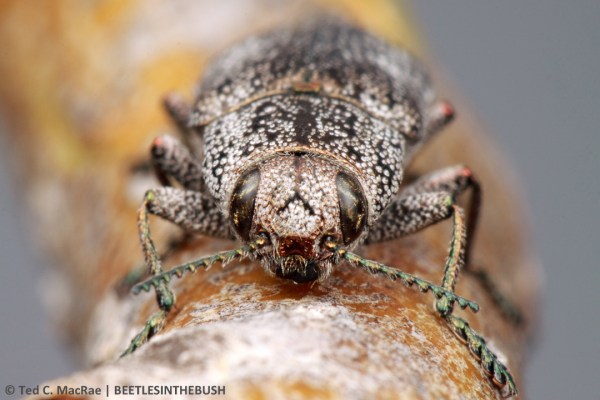
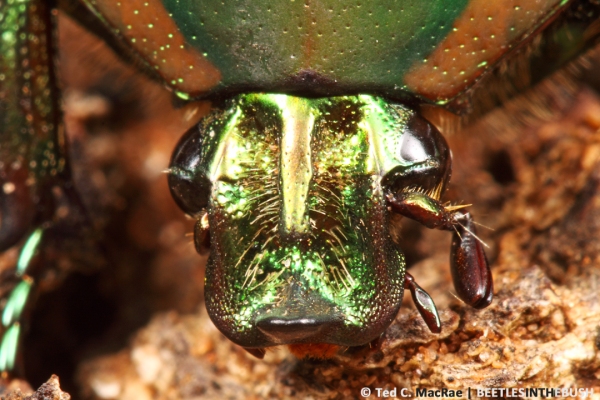
The specific epithet ‘cyanipes‘ refers to the blue feet
One species, however, that I had expected to find almost completely eluded me. This, despite the quote above by Evans (1957) in his revision of the genus Poecilonota in North America. Although it had been recorded from much of North America east of the Rocky Mountains in association with poplars (Populus spp.) and willows (Salix spp), I never actually encountered P. cyanipes in the field and found just two specimens labeled simply “Mo” in the insect collection at the University of Missouri in Columbia. This puzzled me, as I had beaten countless branches of cottonwood (Populus deltoides) and willow in search of this species and found many of the other known poplar/willow associates. I had even already collected two specimens of its much rarer congener, P. thureura, off of a redbud tree at the entrance to the Entomology Building on campus while still in graduate school!
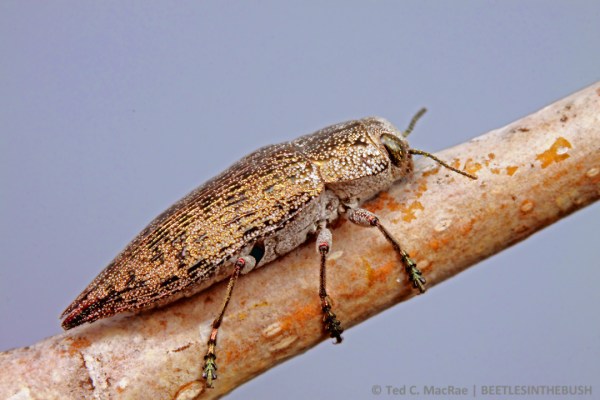
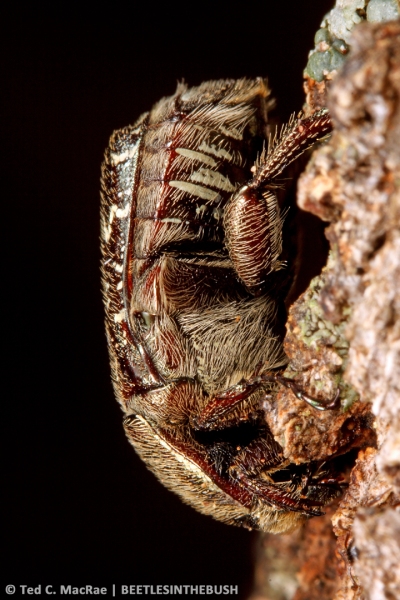
This species can be recognized by its coppery color and elongate, distinctly reddish elytral apices,
As is often the case, good comes to those who wait, and I’ve finally gotten my chance during the past two seasons to encounter this species in numbers—last year as prey taken from nest sites of the buprestid-specialist crabronid wasp, Cerceris fumipennis, and this past June on cottonwood trees in northwestern Oklahoma at Beaver Dunes State Park. The individual in these photos was the first one I found—beaten from the lower branch of a small, living cottonwood exhibiting significant branch dieback, and over the course of the next two days I managed to beat close to three dozen specimens from the small, stunted cottonwoods that dotted the park. I suspect that the combination of good timing—buprestids of many types were common on a number of woody plant species in the area—and susceptible hosts with abundant branch dieback due to protracted drought conditions over the past few years was the reason I was able to find so many of the beetles. A perfect storm for wood-boring beetles, so to speak!

The non-angulate pronotal sides distinguish this species from another eastern species, P. ferrea.
As suggested above, larvae of this species are associated exclusively with dead or dying branches of Populus and Salix (both in the family Salicaceae), often in association with galls made previously by other species of wood-boring beetles, e.g., Saperda concolor in poplar (Knull 1920) and Agrilus criddlei in willow (Wellso et al. 1976). In fact, with one exception (P. viridicyanea on Chilopsis linearis) all members of the genus seem to be associated exclusively with plants in these two genera. However, in addition to these plants, Nelson et al. (2008), in their catalogue of the Buprestidae of the U.S. and Canada, also included black locust (Robinia pseudoacacia) in the family Fabaceae as a larval host for P. cyanea. I am convinced that this record represents at best a mere incidental adult association, and there are other examples of such in the catalogue (the final preparation of which was completed after the untimely death of the senior author). This is unfortunate, since erroneous records in such ‘standard’ references tend to be propagated in subsequent literature, which already seems to have happened in the case of black locust as a larval host for P. cyanipes (Paiero et al. 2012).
REFERENCES:
Knull, J. N. 1920. Notes on Buprestidae with description of a new species (Coleop.). Entomological News 31(1):4–12 [BioStor].
MacRae, T. C. 1991. The Buprestidae (Coleoptera) of Missouri. Insecta Mundi5(2):101–126 [pdf].
MacRae, T. C. 1994. Annotated checklist of the longhorned beetles (Coleoptera: Cerambycidae and Disteniidae) known to occur in Missouri. Insecta Mundi 7(4) (1993):223–252 [pdf].
Nelson, G. H., G. C. Walters, Jr., R. D. Haines, & C. L. Bellamy. 2008. A Catalogue and Bibliography of the Buprestoidea of American North of Mexico. Coleopterists Society Special Publication No. 4, The Coleopterists Society, North Potomac, Maryland, 274 pp. [description].
Paiero, S. M., M. D. Jackson, A. Jewiss-Gaines, T. Kimoto, B. D. Gill & S. A. Marshall. 2012. Field Guide to the Jewel Beetles (Coleoptera: Buprestidae) of Northeastern North America. 1st Edition. Canadian Food Inspection Agency, 411 pp. [pdf].
Wellso, S. G., G. V. Manley & J. A. Jackman. 1976. Keys and notes on the Buprestidae (Coleoptera) of Michigan. The Great Lakes Entomologist 9(1):1–22.
Copyright © Ted C. MacRae 2013












 Beetles In The Bush