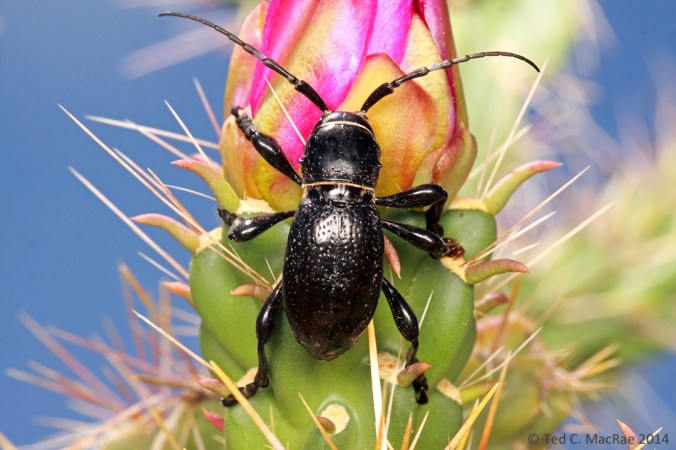
Moneilema armatum LeConte, 1853 | Vogel Canyon, Otero Co., Colorado
On my most recent Great Plains collecting trip, cactus dodger cicadas weren’t the only residents of the cholla cactus (Cylindropuntia imbricata) that studded the open grasslands in southeastern Colorado—cactus beetles (Moneilema spp.) also were found, though in lesser numbers than their frenetic, screeching neighbors (perhaps the reason for their scarcity?!). I’ve covered cactus beetles before, posing the question, “How do you photograph cactus beetles?” The answer was, of course, “Very carefully!” That is certainly true in most cases, but not all.

The clumsy, flightless adults rely on their host’s vicious spines for protection.
Cactus beetles are found almost exclusively on opuntioids (chollas and prickly pear cacti), and while most opuntioids are rather viciously spined the plants themselves vary tremendously in structure. Prickly pears (Opuntia spp.), on which I previously photographed these beetles, generally grow in low, dense clumps, their flattened pads often forming a tangle of well-armed hiding places for the beetles. Such is not the case with chollas, which are generally taller, more erect, and have a much more open structure of well spaced, cylindrical stems. The beetles on these plants still enjoy a great amount of protection by the long, barbed spines that cover the stems, but to entomologists/photographers like me they are still much more easily collected and photographed. In this particular case, no special techniques were needed to get nice close-up photos against a clear blue sky other than crouching down a bit and being careful not to lean too close to the plant. That is not to say, of course, that photographing insects on cholla is completely without risk, as this photo showing the spines impaled in my flash unit afterwards will attest (but better the flash unit than poking the lens!).

The hazards of photographing cactus beetles.
The cactus beetle in these photographs appears to be an armed cactus beetle, Moneilema armatum, by virtue of the small but distinct lateral spines on its pronotum, lack of pubescence on the elytra, and relatively smooth pronotum lacking large punctures except along the apical and basal margins. These shiny black beetles occur in the western Great Plains from Colorado and Kansas south through New Mexico, Oklahoma, and Texas into northern Mexico. Adults and larvae seem to prefer chollas over prickly pears—adults feeding on the surface and larvae tunneling within the stems. I suspect the adult feeding helps provide nutrition for egg maturation in addition to creating an oviposition site, and plants infested with larvae often appear unthrifty and exhibit black masses of hardened exudate along their stems (Woodruff 1966).
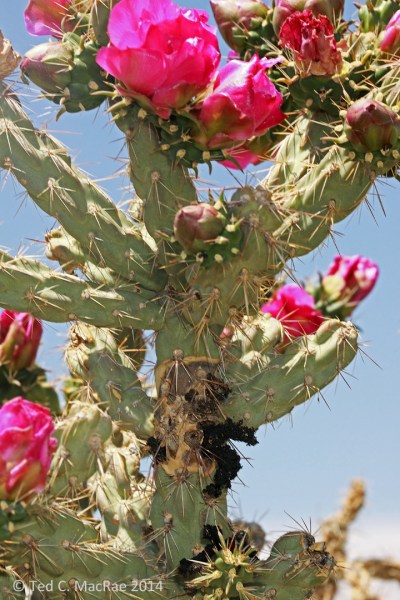
Hardened black masses of plant exudate indicate larval feeding within the stems.
REFERENCES:
Linsley, E. G. and J. A. Chemsak. 1984. The Cerambycidae of North America, Part VII, No. 1: Taxonomy and classification of the subfamily Lamiinae, tribes Parmenini through Acanthoderini. University of California Publications in Entomology 102:1–258 [preview].
Woodruff, R. E. 1966. A cactus beetle new to the eastern United States (Coleoptera: Cerambycidae). Florida Department of Agriculture, Division of Plant Industry, Entomology Circular No. 53, 2 pp. [pdf].
© Ted C. MacRae 2014
 Beetles In The Bush
I love the injured camera photo. I caught my very first Moneilema last year, two species in fact. One of the specimens had several cactus spines protruding from various body parts. Fortunately, I was warned ahead of time to bring along the biggest pair of forceps I had (the fiveceps!) to reduce injury to the collector.
Yes—”fiveceps” are a requirment for collecting these beetles! Did you get M. semipuncatum? I haven’t seen that one yet.
I haven’t caught that species yet, either. The two I got in 2013 were M. armatum in NM and M. gigas in AZ.
Oh, dang. I figured since you were in California that was one you went after. Well, you should go after that one!
Yes, I should. They’re a looong way from where I live, unfortunately.
I can give you a few contacts for localities/timng should you ever want to go look for them.
Sounds like a plan. I’m having to travel farther and farther to scare up new-to-me cerambycids so that could be a very productive trip for me.
Cactus Beetles eat the flowers growing on your Opuntia Basilaris (Prickly pear) cactus. I wait all year to see those beautiful flowers bloom, only to be saddened either by these flower devouring maniacs, or the White Tailed Squirrel eating not only the flower, but the entire bud right down to the leaf. This year I covered them all in chicken wire; it solved the squirrel issue,
but then came along these beetles, and started eating from dusk till dawn, then right into the daylight, and into the dusk again, until the entire family of all of my plants were flowerless. I now spray each new flower with my own “beetle killer” concoction, and so far so good. So you guys go photograph them. I’ve got better things to take pictures of.
PS: To all you bug lovers: I want you to know that I am one of Wikipedia’s major contributors of Bee photos pollinating plants. I don’t hate bugs, in fact just the opposite. I carry spiders, and every other species of insect out of my home, and send them on their way on a comfortable spot on my property. I respect all life. I am not a bug hater. When there was hundreds of these beetles devouring my cactus flowers, I tried to shake them off at first, but it was a losing battle, and in the morning all my flowers were in their stomachs. I hope eliminating them completely from the plants this year, spares me any further insect funerals. Enjoy your hobby folks…
Whatever ate your cactus flowers, it wasn’t the beetles featured in this post. From what you describe, I suspect they were a species of blister beetle (family Meloidae), which exhibit the congregating behavior that you describe and are quite fond of flowers.
Perhaps you are correct. They are more slender in appearance, and the adults certainly can fly. They look extremely similar to the beetle in this article and I was pretty upset at just discovering my plants were now flowerless. I started researching the culprit, and thought I had found him here. A long black beetle on a cactus flower, with his face buried in it, and not appearing to be pollinating. I’ve researched the the blister beetle (family Meloidae)… Wow… what a scary menace, with a serious flower addiction. My apologies if I was mistaken. Now, quite frankly, I don’t feel too badly about exterminating them. Along with their flower appetite, they also secrete a dangerous chemical harmful to humans. Thanks for the info Ted…