In late August, I made another trip out to northwestern Oklahoma to service “jug traps” and other insect traps placed at several locations throughout the area. The traps were set in mid-May (see “First insect collecting trip of the season”), checked for the first time in mid-June at the beginning of a 3-week long collecting trip to the southwestern U.S. (see “2023 Southwestern U.S. Collecting Trip iReport”), and checked again in late July (see “July “jug trap” run”). This post describes the third trip to service the traps—less about what the traps themselves had caught and more about other insects seen and collected at the locations where the traps have been set. The final trap run will be made in early October, and you can expect a post about that trip as well shortly afterwards.
Day 1 — 28 Aug 2023
Alabaster Caverns State Park
Woodward County, Oklahoma
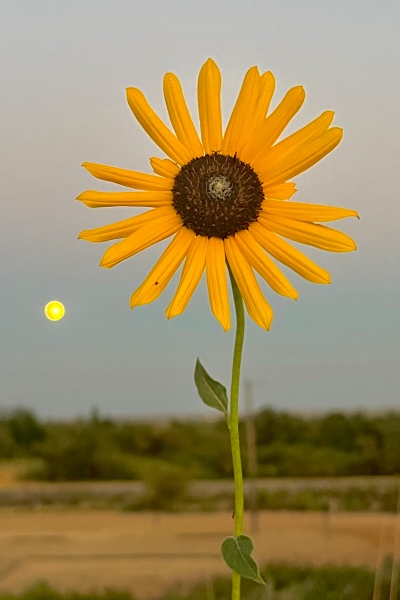
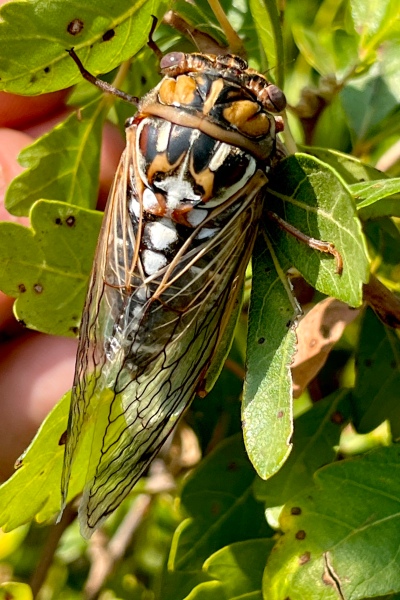
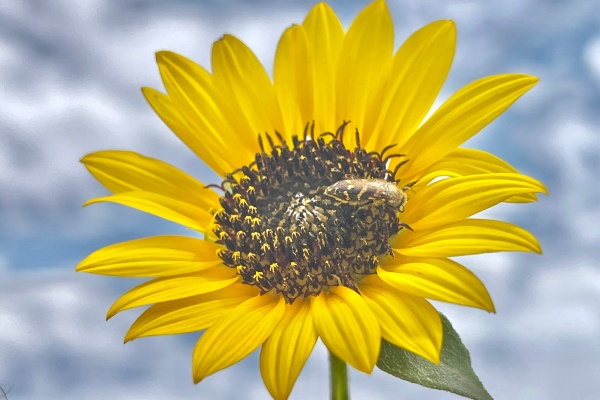
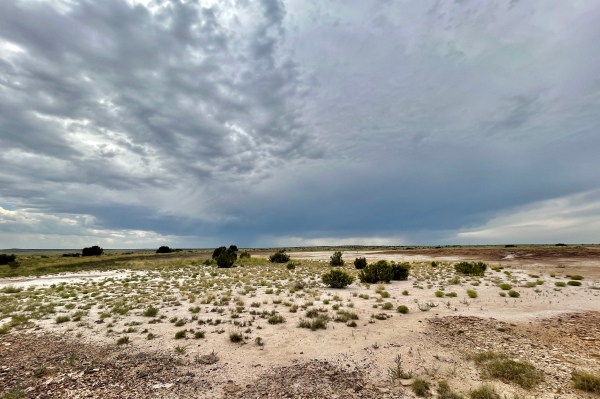
Finally a nice break in the weather. Rain moved through a few days ago and temperatures are decidedly lower than the mid-90 to low-100 temps that have dominated for the past few weeks. I started out in the shortgrass prairie along Raptors Roost Trail above the canyon. Last time I was here (5 weeks ago), the only cicadas I heard were Neotibicen superbus (superb dog-day cicada). This time I heard three different species: Neotibicen auriferus (plains dog-day cicada), Neotibicen pruinosus (scissors grinder dog-day cicada), and Megatibicen dorsatus (prairie cicada). I was able to snag one of the former but couldn’t get M. dorsatus—the one I really wanted. There were no Acmaeodera in the white bottle trap—just one Elateridae (and some bees for Mike). Robust patches of Helianthus annuus (annual sunflower) were in flower in the prairie—I checked the flowers hoping maybe some of the fall beetles I was interested in (Acmaeodera macra and Crossidius pulchellus) would be out by now, but all I saw on them were Epicauta sp. (blister beetles), Chauliognathus limbicollis (soldier beetles), and Atalopedes campestris (sachem skippers).
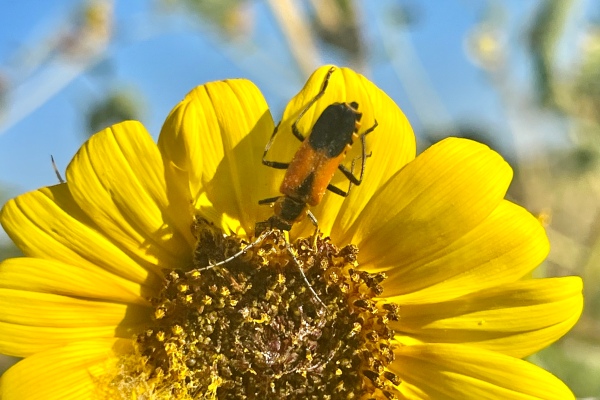
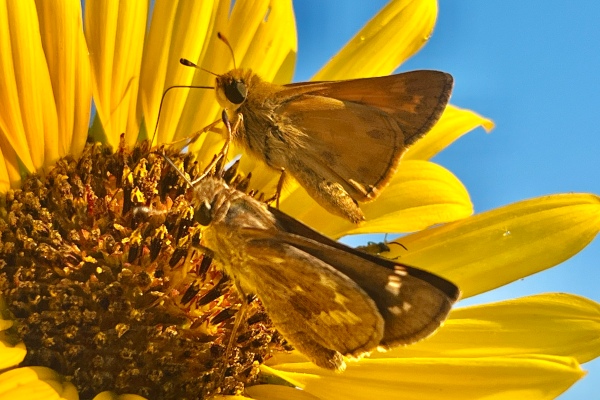
After that I went down into the canyon to check the traps. All of them were completely overloaded—primarily Elateridae and Cotinis nitida. Field counting was impossible, so I bagged for counting later (I did see a few specimens of Plinthocoelium suaveolens and Eburia quadrigeminata/haldemani in the morass) and went down to the campground to set up camp and cook some dinner.

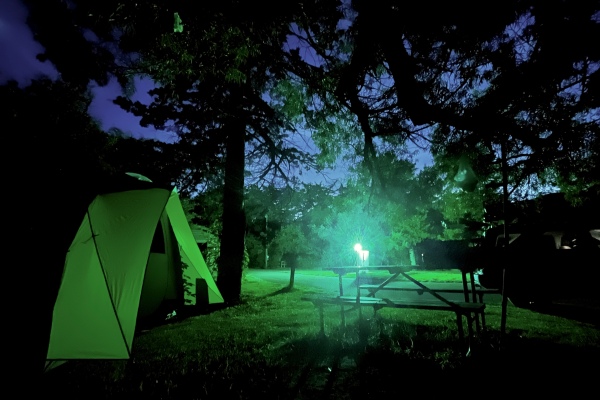
I debated whether to setup the lights (ultraviolet/mercury-vapor)—the moon is waxing towards full (which, by the way, will be the 3rd brightest full moon of the year), and though warm today (not hot) there was a tad of a cool crispness in the air down in the canyon as the evening progressed—good my my comfort but not so good for beetles! I set them up anyway (because that’s what I do), and for the first hour it was a steady accumulation of moths and a few crummy scarabs.
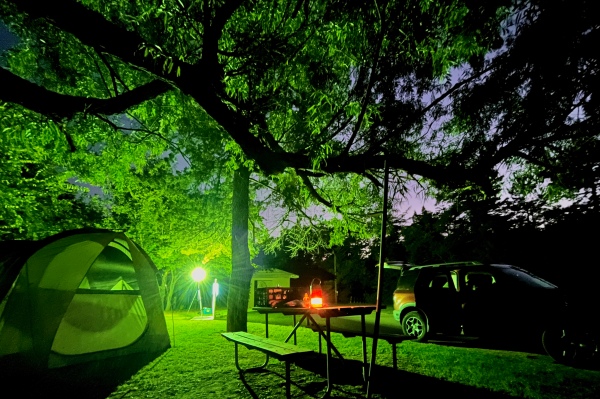
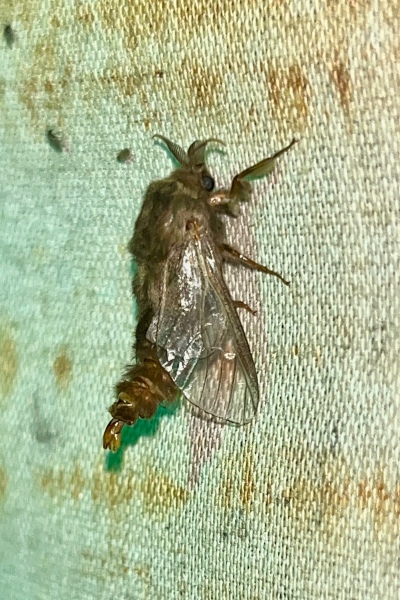
Eventually I ended up with a single alkali tiger beetle (Eunota togata globicollis—absent where I’m from but quite common in the Great Plains, but nothing else came after that and we’ll into full darkness. I did get a bonus—a dead male Neotibicen pruinosus lying on the picnic table on the campground.


Day 2 — 29 Aug 2023
Sleeping temps were really nice, but I was awoken at 3:40 am by light rain and had to get up and put on the rain fly. It dumped soon afterwards, but I slept nicely anyway. In the morning first thing I found a Epicauta conferta blister beetle—beautifully marked with red on black, and after breakfast and breaking camp I checked the Lindgren funnel trap. On the way to the trap, I came across about a dozen more E. conferta on the road—all feeding on the fallen fruits of Sideroxylon lanuginosum (gum bumelia).

Like the jug traps yesterday, the Lindgren funnel trap was overwhelmed by mostly click beetles but did also contain Eburia haldemani/quadrigeminata and Plinthocoelium suaveolens in the mix. The trap contents were bagged unsorted for counting later.
Gloss Mountain State Park
Major County, Oklahoma
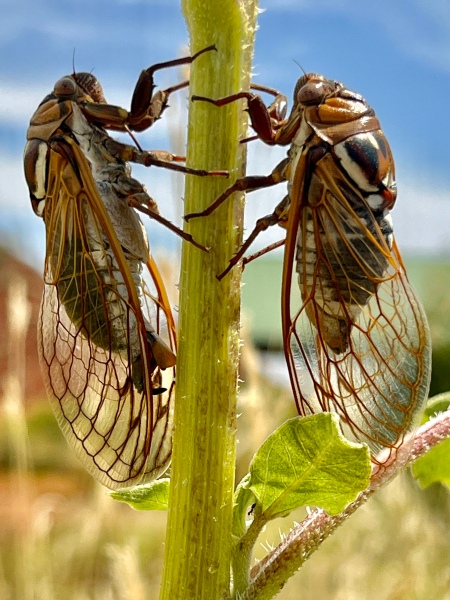
There was even more Helianthus annuus (annual sunflower) in bloom here than at Alabaster Caverns (I’ve not seen this here since I haven’t been here much during this time of season), it they were simply loaded with Megatibicen dorsatus (bush cicada). I collected a half dozen from a single clump (and there were four more that flew away while I was doing so) and recorded one male singing. As it sang, a female flew to the plant, and the male then slowly backed down the stem and positioned itself directly opposite from the female, allowing me to photograph the pair together (before the female then flew off abruptly—I guess she didn’t get the right “vibe” from the male).
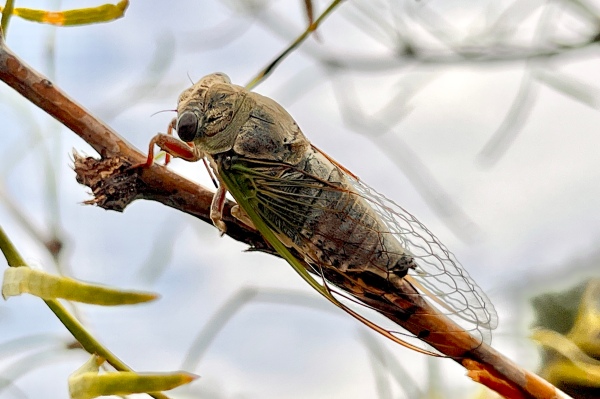
Right next to the patch of sunflowers i was working, I saw (and caught) a male Neotibicen auriferus singing in Prosopis glandulosa (honey mesquite. I would end up with about a half dozen and record one male singing over the next few hours.
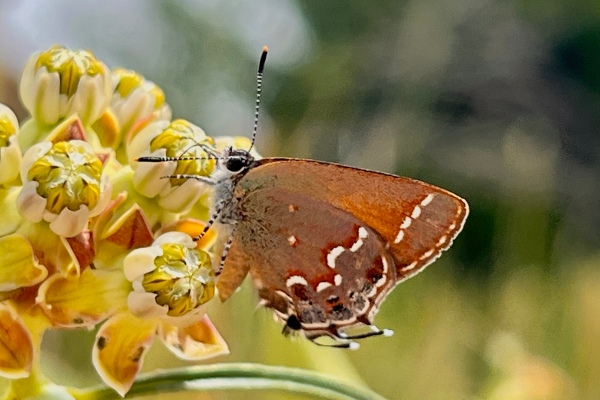
Walking the road into the park to check the lower traps, I encountered a few colonies of Vanduzeea segmentata on H. annuus being tended by ants.

The white bottle trap had a single Acmaeodera sp. and a few other miscellaneous beetles (and 5 bees for Mike), and, as at Alabaster Caverns yesterday, both the SRW and SRW/EtOH traps (the EtOH trap was removed last time) were overwhelmed with Elateridae and Cotinus nitidus beetles and were thus bagged for counting later. However, once again I did see a fair number of Plinthocoelium suaveolens, Eburia haldemani/quadrigeminata, and elaphidiines in the mix. Up on top of the mesa, the jug traps were again overwhelmed and the catch bagged for later counting, and the white bottle trap had no Acmaeodera but several miscellaneous other beetles and bees.
Woodward, Oklahoma
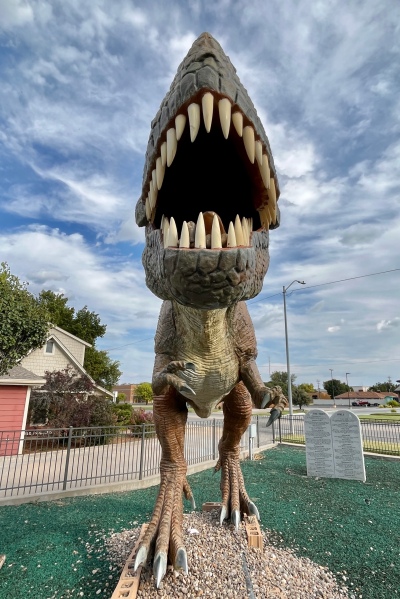
After leaving Gloss Mountain State Park and passing through Woodward, Oklahoma a short distance to the west, I couldn’t resist stopping at my favorite “Christian coffee shop”—sadly closed during my first trip to the area in May but open again under new ownership as a bakery during my July visit.
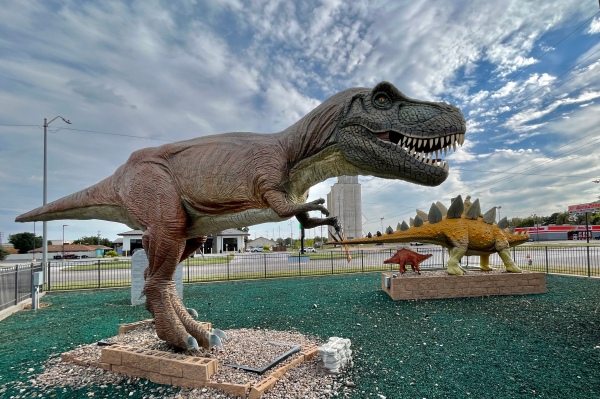
The coffee is undeniably good, but what I really love about this place is the life-sized dinosaurs in front of the shop, complete with signs giving the true “facts” about dinosaurs from a creationist viewpoint (see “2022 Oklahoma Insect Collecting Trip iReport”). As laughable as the “facts” are, the dinosaurs really are very nicely done (save the angel riding the Stegosaurus!).
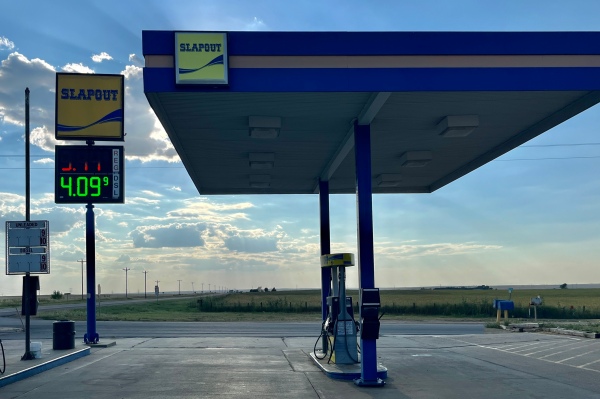
Slapout, Oklahoma
Another “must stop” on the way to Beaver Dunes Park is the Slapout Service Station in—you guessed it—Slapout, Oklahoma. The town is (literally!) little more than an intersection, but inside the store is a standup freezer filled with some of the tastiest cuts of packaged meats I’ve ever had. I stopped to pick up a nice filet for tomorrow night’s dinner in the campground at Black Mesa State Park tad a way to celebrate a (hopefully) successful end of the trip.

Beaver Dunes Park
Beaver County, Oklahoma
I got here with just enough daylight left to check the traps if I could be quick about it. At the previous spots the traps have been so full that field counting wasn’t feasible, and here was no exception. Although I will eventually have to count them at some point, it does make things go more quickly in the field. I first checked the white bottle trap, which contained a few Acmaeodera sp. and bees, and was able to service all the jug traps and bag their catches quickly with a little bit of time to spare searching the dunes as the sun set in the western sky.
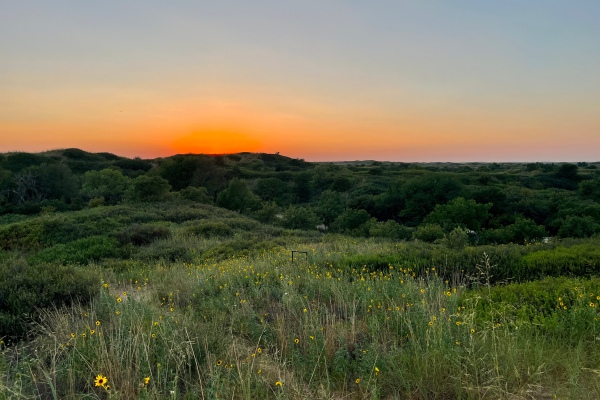
I was looking chiefly for Megatibicen tremulus (Cole’s bush cicada), which was unknown until relatively recently due to the great similarity of its appearance and song to the more common and widespread M. dorsatus (bush cicada) and one that I have not yet seen. This cicada is generally found in more sandy habitats, and there are some iNaturalist records from this area. It didn’t take long, as soon as I hit the 2-track leading into the dunes I saw a male on Helianthus petiolaris (prairie sunflower), and although it looked nearly identical to the M. dorsatus I was catching earlier in the day (at Gloss Mountain State Park) the black rather than brown tymbal covers strongly suggest it is M. tremulus. I saw two more males as I searched the dunes, but both were far too wary and bolted before I could get within net range.
Eventually the settling darkness became too much of an obstacle and I had to return to the car, but as a consolation prize I found a Plectrodera scalator (cottonwood borer) sitting on the upper stem of a sapling Populus deltoides (eastern cottonwood). Right next to the sapling was a much larger cottonwood in which several male Megatibicen dealbatus (plains cicadada) were singing—unfortunately none of which were within net reach (I can’t be too disappointed, as I did collect a couple of them at lights the last time I was here, and I’ve also collected the species in northern Texas).

Day 3 — 30 Aug 2023
No lighting last night—it was too cool and the moon at its brightest. It did make for comfortable sleeping, however (in the middle of the night I had to get into the heavy sleeping bag)! I decided to check out the dunes before heading on to Black Mesa since I had caught only a single Megatibicen tremulus (Cole’s bush cicada) yesterday and wanted to see if I could get a few more. The dunes were bright (and already hot!) in the morning sun.
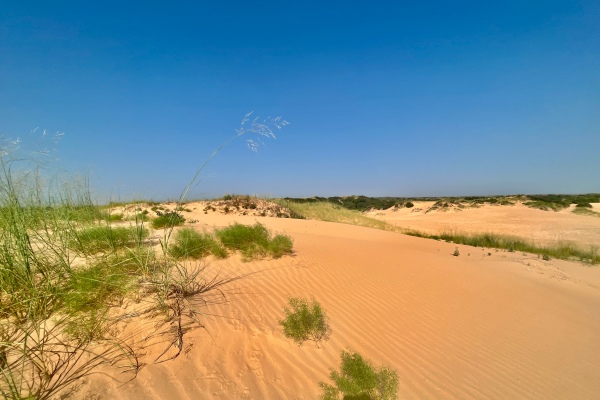
The cicadas proved to be common enough on the dunes (though not abundant as with M. dorsatus yesterday at Gloss Mountain), but unlike the latter, which were quite clumsy and easy to catch, these were incredibly wary and quick to fly. Less than half the individuals I approached I got within a net swing’s reach (and I have a telescoping long-handled net!), and most of those I could take a swipe at I missed. After more than an hour of trying, I had only two individuals to to show for it—both males singing from the branch tips of Rhus aromatica (fragrant sumac). I did manage to get photos of the one I caught yesterday, which I placed in sumac foliage for the photos, but in cruel turnabout, it got away from me before I could re-secure it! Life is just that unfair sometimes.😊
Even more frustratingly, right as I was swinging the net at one of the two that I caught, I saw right next to the cicada what must have been the large and charismatic buprestid, Lampetis drummondii—a species I have not seen since 1995 when I encountered them rather commonly in western Texas. The buprestid did not end up in the net, nor did I see another individual, so my memory (and this note) will have to remain the only record of the species from this place, at least for now.
1.4 mi E of Kenton
Cimarron County, Oklahoma
The jugs traps were not quite as overwhelmed as at the previous locations, and instead of Cotinus nitidus being the abundant scarab it was Euphoria inda. Elateridae were still numerous, but a cursory glance through the catch did not reveal the presence of any Cerambycidae. Nevertheless, the catch from each jug trap was bagged for sorting later. Walking back to the vehicle I encountered two Crossidius discoideus—one hanging out on a grass clump and another flying slowly above the ground nearby. I caught the latter and then tried to photograph the former, but it became quickly alarmed and I had to grab it. After I put it in the vial and went to get the other one out of the net, I discovered it had found its way out and escaped—good thing I had secured the first one! I scanned the plants on the way back to the car but never saw another one.

When I reached the car, I decided to keep searching the area—I had seen a Cicindelidia obsoleta (large grassland tiger beetle)—apparently all black in this area—when I first got here but missed it and wanted to see if I could find it again. It took a while, but eventually I did see another one and got it, and right afterwards I saw yet another one but it got away.

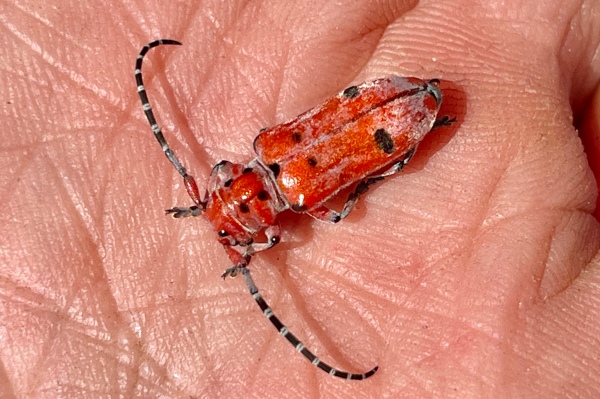
In the same general area as I was looking, I saw something red flying and ran to catch it. It was a Tetraopes femoratus, apparently having just flown from a nearby Asclepias latifolia (broadleaf milkweed).
These new captures induced to me to spend another 45 minutes or so at the site, but I didn’t see a single individual of any of the species I had already collected or any other species of interest. By then it was late enough that I had to leave in order to have enough time to check the final set of traps in nearby Black Mesa State Park.
Black Mesa State Park
Cimarron County, Oklahoma
I checked the canyon jug traps first—results were similar to the previous nearby site, with all traps loaded with Euphoria inda and Elateridae. I bagged them for processing later but did see a few Cerambycidae in the catch. The Lindgren funnel trap was also overwhelmed by the same, but since I’m not taking data from the trap I sorted through the catch and picked out 1 Enaphalodes sp., 1 Neoclytus acuminatus, and more than a dozen elaphidiine cerambycids comprising at least two species. While I was servicing the Lindgren funnel trap I found a Stenomorpha opaca crawling in the rocks, and nearby I found another one a short ways down the Overlook road.

The white bottle trap again had lots and lots of bees in it, but unlike last time it also had 8 Acmaeodera sp. plus 20 Meloidae and one Trichodes orestus along with tons of bees for Mike. I saw a few Megatibicen sp. males singing (presumably M. dorsatus rather than M. tremulus due to the non-sandy nature of the habitat) but couldn’t get close to them, and I heard several Megacicada dealbatus males singing in the tall cottonwoods down below by the creek. I think I’ve had my fill of chasing cicadas for now!
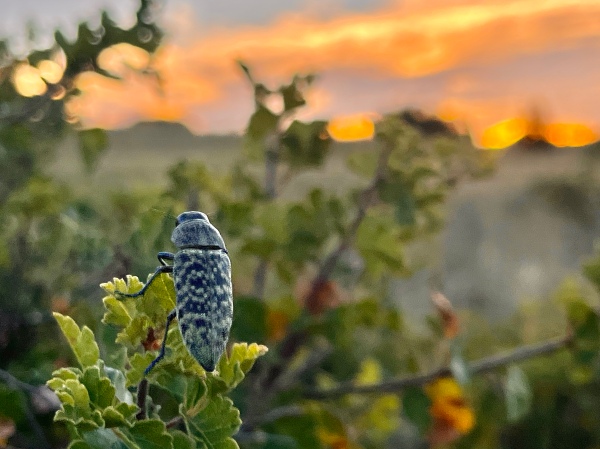
After finishing the last of the traps (26 in all at five locations!), I had about an hour of good daylight left and played a hunch that Lampetis drummoni (family Buprestidae) might be out now. I had seen one earlier in the day on Rhus aromatica (fragrant sumac) at Beaver Dunes but missed it, and I reasoned that I might find it in the same here. I took the Overlook Hiking Trail and had walked about half the loop—looking closely at R. aromatica patches along the way (and picking up another Stenomorpha opaca)—and was starting to think it might still be too early in the season (iNaturalist records from the area are all from September and October) when suddenly I saw one perched near the tip of a R. aromatica branch. It was not at all wary (likely due to the lateness of the hour, although my experience with this species in Texas is that they are not particularly zippy), and after taking a photo I was able to pick it easily with my fingers.
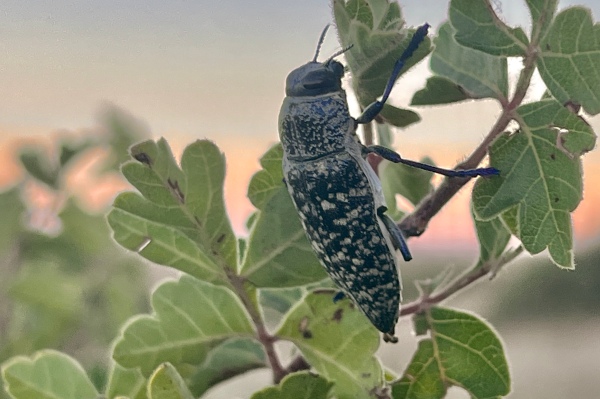
I checked the patch carefully and found another four—all perched in the same fashion and not at all inclined to fly off in alarm. I took another photo of the last one I found with a beautiful evening sky in the background, and those would be the only ones I would see for the rest of the hike.
©️ Ted C. MacRae 2023





 Beetles In The Bush