Today I joined the WGNSS Botany Group as we hiked a portion of the Whispering Pines Trail to look for a rare clubmoss, then bushwhacked back to the beginning and went off-trail to a nearby sandstone box canyon to look for rare ferns. We found the clubmoss—Diphasiastrum tristachyum (blue clubmoss)—growing in the shortleaf pine/scarlet oak forest atop a LaMotte Sandstone cliff. Though common in eastern North America and Eurasia, the area in and around Hawn State Park is the only known station for the plant in Missouri, and this population is highly distinct from the next nearest population in Tennessee.
Diphasiastrum tristachyum (blue clubmoss—family Lycopodiaceae) in shortleaf pine forest atop LaMotte Sandstone cliff.
Diphasiastrum tristachyum (blue clubmoss—family Lycopodiaceae) with an old strobilus (spore-bearing reproductive structure).
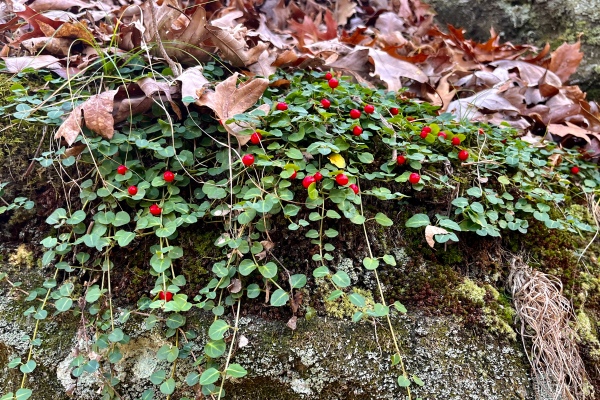
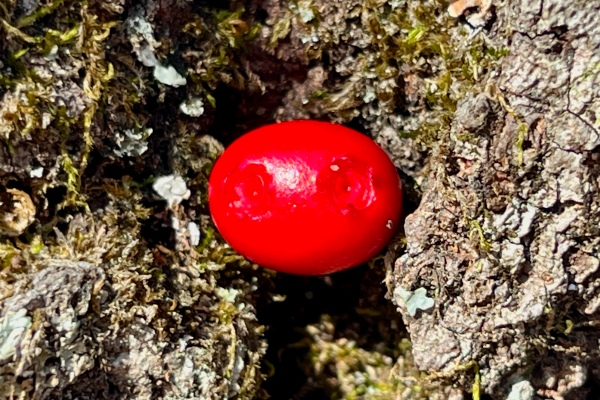
We also found the ferns in the box canyon along with Mitchella repens (partrideberry) growing on the moist sandstone bluff faces of the canyon. This plant is not as rare in Missouri as blue clubmoss, but it is still seldom encountered outside of the LaMotte Sandstone forests of Ste. Genevieve County. An interesting feature of the berries is that they require two flowers to be fertilized and then develop together into a single berry—if you look closely at the berry you can see two “dimples” representing the remnants of the two flowers.
Mitchella repens (partridgeberry—family Rubiaceae) in shortleaf pine/scarlet oak upland forest on LaMotte Sandstone.
Mitchella repens (partridgeberry—family Rubiaceae) in shortleaf pine/scarlet oak upland forest on LaMotte Sandstone.
Each Mitchella repens (partridgeberry—family Rubiaceae) berry exhibits two “dimples” belying its two-flower provenance.
As we hiked I paid attention to the grasses (family Poaceae), which were as diverse as anywhere I’ve been lately (at least, since I’ve started paying attention to such things). Many of them I can recognize easily—river oats (Chasmanthiumlatifolium), little bluestem (Schizachyrium scoparium), Broomsedge bluestem (Andropogon virginica), etc, but many more were new to me, including several species in the large and diverse genus Dichanthelium (rosette grasses). For most of them, rather than trying to identify in the field, I collected samples to look more closely at home with a microscope and my copy of “Steyermark’s Flora of Missouri.”
Dichanthelium sp. (rosette grass—family Poaceae) basal rosette in shortleaf pine/ scarlet oak upland forest atop LaMotte Sandstone.
One of them seems to be D. commutatum var. ashei (Ashe’s panic grass) [identified by Nathan Aaron via iNaturalist], which is distinguished by habitat (intact sandstone or chert woodlands), nodes not hairy, and small stature with leaves clustered towards the tip of the stem. We also saw (but I did not photograph) the common woodland D. boscii, which is larger and has massive spikelets and famously long-hairy nodes. I’ll share the full list here when I can, but it probably numbers around a dozen species.
Dichanthelium commutatum var. ashei (Ashe’s pacifist grass—family Poaceae) in shortleaf pine/scarlet oak upland forest on LaMotte Sandstone.
Insects were not numerous, despite the pleasant conditions, but I did see and manage to photograph a fiery skipper (Hylephila phyleus—family Hesperiidae).
Hylephila phyleus (fiery skipper—family Hesperiidae) in shortleaf pine/scarlet oak upland forest on LaMotte Sandstone.
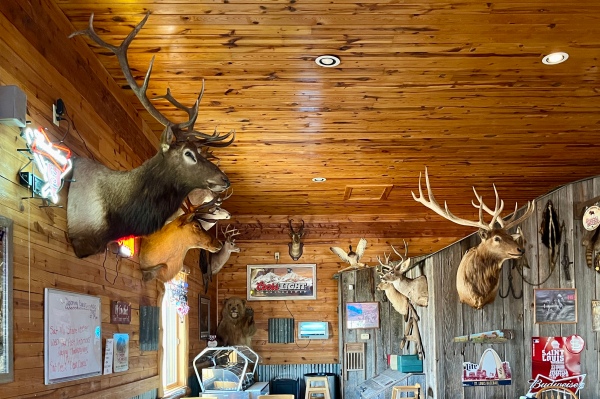
After the outing, several of us enjoyed lunch at the Midway Bar & Grill in Weingarten, Missouri. I had an elk burger, yum!
Midway Bar & Grill in Weingarten, Missouri. I had an elk burger—yum!
Last month I made the fifth and final trip to extreme northwestern Oklahoma as part of a trapping study conducted at several locations throughout the area. Recall the main part of the study involved “jug traps” baited with pure ethanol (EtOH), sweet red wine (SRW), or a 50:50 blend of both (SRW/EtOH) to evaluate their efficacy in capturing longhorned beetles (family Cerambycidae). The traps were set in mid-May with the help of my good friend and longtime collecting buddy Rich Thoma (see First insect collecting trip of the season) and checked at ~5-week intervals throughout the season—first in mid-June at the beginning of a 3-week long collecting trip to the southwestern U.S. with another good friend and longtime collecting buddy, Mike Arduser (see 2023 Southwestern U.S. Collecting Trip iReport), then again in late July (see July “jug trap” run) and late August (see August “jug trap” run), and, finally, this last trip in early/mid-October. The July and August trips were solo, but Rich joined me again for this last trip, which concludes two years of data collection for the study (last year traps were placed across extreme southern Missouri). I plan to begin preparing a manuscript this coming winter to analyze and discuss the findings. I hope you have enjoyed “tagging along” with me on these trips as much as I have enjoyed doing them!
Day 1 — 10 Oct 2023 Alabaster Caverns State Park Woodward County, Oklahoma
We got here right around 5:30, which left us only with a couple hours of daylight to get the traps taken down. The jug traps were choked full of Euphoria sepulchralis with some Cotinus nitidus—especially the SRW/EtOH trap, but I did see at least one Eburia sp. so hopefully there will be other longhorns as well. I bagged the trap contents from each of the traps for sorting and counting later (the SRW/EtOH trap was so full that my 1-qt bags weren’t big enough and I had to borrow a 1-G bag from Rich). After retrieving the traps we went back up on top to check the white bottle trap and look for beetles on flowers in the shortgrass prairie above the canyon. The bottle trap had been pulled by an animal, so nothing in it☹️, and the only beetles I saw were Chauliognathus longifolia and a variety of meloids on flowers of Guterrezia sarothrae.
Epicauta pensylvanica (black blister beetle, black aster bug—family Meloidae) on flower of Gutierrizia sarothrae (snakeweed) in shortgrass prairie.
Epicautaaspera (blister beetle—family Meloidae) on flower of Gutierrizia sarothrae (snakeweed) in shortgrass prairie.
Before long it started getting dark, so we headed down to the campground to set up camp, have a beer (or two), and cook some dinner (ballpark brats!).
Aphonopelma hentzi (Texas brown tarantula, Oklahoma brown tarantula, Missouri tarantula—family Theraphosidae) crossing sidewalk in gypsum/clay short grass prairie.
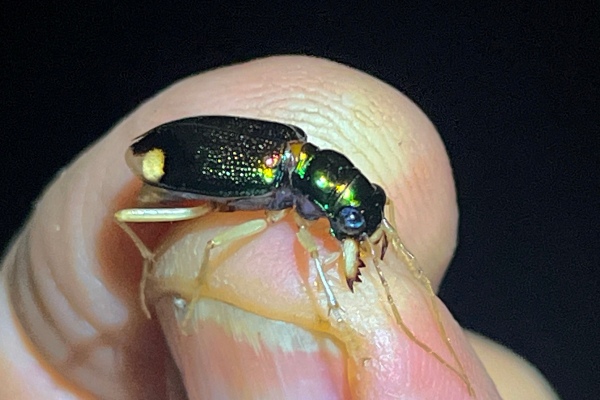
After setting up camp we got started on the fire by collected kindling and small branches, one of which was a dead branch I yanked off a small dead Celtis occidentalis. I could tell as I was pulling it off that it had been well infested by wood boring beetles, and as I broke apart the larger portion of the branch (~1” día.) I found a couple of unemerged Euderces pini adults inside their pupal chambers. After dinner we walked the road back up out of the canyon—immediately starting out I found a Tetracha carolina zigzagging crazily on the road, and up on top of the canyon I found two different species of tenebrionid beetles lumbering slowly on the ground in the shortgrass prairie.
Tetracha carolina (Carolina metallic tiger beetle—family Cicindelidae) at night in collapsed cavern hackberry/bumelia/juniper woodland.
Back at the campsite we found a nice Scolopendron polymorpha centipede—Rich collected it very carefully to avoid getting bitten! It was crazy windy up on top but very calm down in the canyon, and temperatures were Goldilocks for sleeping!
Scolopendra polymorpha (common desert centipede, tiger centipede, banded desert centipede, Sonoran Desert centipede—family Scolopendridae) at night in collapsed cavern hackberry/bumelia/juniper woodland.
Day 2 — 11 Oct 2023
Sleeping temps were again super nice, and after breakfast and breaking camp we retrieved the Lindgren funnel trap. Like the jug traps yesterday, it was inundated with Euphoria sepulchralis, but since I’m not taking data from this trap we sorted through and discarded them all , finding 5 Neoclytus mucronatus, 2 Elateridae, and 1 Sandalus sp.
Collapsed cavern in the morning light.
We went back up to the shortgrass prairie before leaving the park to check the snakeweed and camphorweed flowers again, hoping that Crossidius longhorned beetles and Acmaeodera jewel beetles might be active. I also wanted to see if I could find another of a meloid that escaped my attempts to photograph it yesterday. There was more activity on the flowers, but nothing of interest until I went to the next shelf down and found the meloid (Epicauta stuarti) on flowers of Gutierrezia sarothrae. I wasn’t able to photograph it on the flowers, but I did get a “finger-photo”. I’m glad I was able to find and photograph it, because it turned out to be a new eastern record for the species on iNaturalist, which contains relatively few records for what must be a rather uncommon species.
Epicauta stuarti (blister beetle—family Meloidae) on flower of Gutierrizia sarothrae (snakeweed) in shortgrass prairie.
Nearby I encountered a large, impressive Say’s grasshopper (Spharagemon equale), which I collected thinking Rich would really want it (he did!). Still, I hadn’t seen any Crossidius or Acmaeodera until I went back on top, and on the last clump of G. sarothrae available to check I found one C. pulchellus still embedded down inside the flowers and not yet active. I wonder how many others I missed!
The drive from Alabaster Caverns to Gloss Mountain takes about an hour, so we arrived right at noon. After a bit of lunch, we started out on top of the mesa to check the jug traps. As at Alabaster caverns, they were overwhelmed with Euphoria sepulchralis and lower numbers of Cotinus nitidus, but I did see a few elaphidiine longhorned beetles and elaterid click beetles. Unfortunately the third jug trap (EtOH-only) was broken and with no retrievable trap contents. Trap contents from jug traps A (SRW) and B (SRW/EtOH) were bagged for counting at a later date. The white bottle trap also had perhaps more than 100 E. sepulchralis (no vouchers) plus 1 Meloidae (and 1 wasp, 1 bee for Mike). There was lots of different flowers in bloom, giving me hope that insects, especially beetles, might be found on them. Some, like Polanisia dodecandra (redwhisker clammyweed) are not normally associated with beetles (at least not to my knowledge), but others such as camphorweed (Heterotheca subaxillaris), snakeweed (Gutierrezia sarothrae), and any number of Solidago spp. (goldenrods) are.
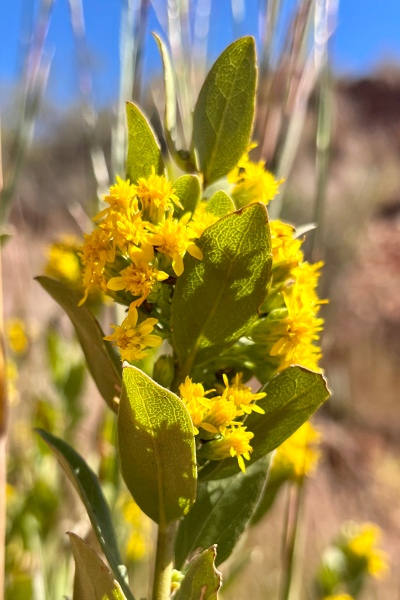
Solidago mollis (velvety goldenrod, soft goldenrod, Ashly goldenrod—family Asteraceae) on slope of gypsum caprock clay mesa.
I focused on camphorweed and snakeweed, by far the most abundant blooms out but also flowers in which I’ve found longhorned beetles and jewel beetles previously. No beetles were seen on them for some time, but eventually I found a single individual of Crossidius discoideus on the former and two C. pulchellus on the latter.
Crossidius discoideus (longhorned beetle—family Cerambycidae) on flower of Heterotheca subaxillaris (camphorweed) atop gypsum caprock clay mesa.
Crossidius pulchellus (longhorned beetle—family Cerambycidae) on flower of Gutierrezia sarothrae (snakeweed) atop gypsum caprock clay mesa.
Shortly afterwards I finally found Acmaeodera macra, first on the flower of H. subaxillaris and then on the flower of G. sarothrae—both times just a single individual.
Acmaeodera macra (jewel beetle—family Buprestidae) on flower of Heterotheca subaxillaris (camphorweed) atop gypsum caprock clay mesa.
Down below I continued checking the snakeweed and camphorweed flowers—to no avail, so I proceeded with checking the traps. The first jug trap (SRW) was broken and no trap contents recovered, but the SRW/EtOH trap was intact and overwhelmed by E. sepulchralis with many fewer C. nitidus and even a couple of Plinthocoelium suaveolens—trap contents were bagged for counting at a later date. The white bottle trap had about a dozen E. sepulchralis (no vouchers) and 1 meloid (plus 4 bees for Mike). I was disappointed that neither of the bottle traps caught any A. macra, which I’d just collected on top of the mesa and, thus, know they are here and active—perhaps their numbers are too low to effectively trap, or perhaps the beetles would prefer a yellow-colored trap to a white-colored one.
Once again there was only about an hour of daylight to work with by the time we got here, so I got to work quickly. I was hoping I would be outside the western limit of the range of Euphoria sepulchralis, which had overwhelmed the traps at Alabaster Caverns and Gloss Mountain State Parks, but such was not the case. Nevertheless, the first trap I checked (SRW) I saw a huge male Tragidion coquus—one of my highest priority target species—sitting on top of the beetles filling the jug! I grabbed it and secured it separately, then bagged the rest of the trap contents. There were other Cerambycidae in the trap, though I did not detect more T. coquus, and the same was also true in the SRW/EtOH and EtOH traps. The white bottle trap had 1 Acmaeodera sp. (prob. mixta) and 4 E. sepulchralis (plus 4 bees for Mike), and after retrieving all the traps and bagging the contents we hiked over to the dunes to watch the sun set in the western sky—we were a tad late, but it was still a beautiful sight.
Beaver Dunes at dusk.
Sporobolus arenicola (giant sandreed—family Poaceae) silhouetted by the setting sun.
We quickly headed to the campground to set up camp while we still had (some) light, cook a couple of burgers, and be mesmerized by the gorgeous night sky. While we were setting up camp, I found an emesiine reduviid—a freakish-looking, rail-thin assassin bug that I don’t ever recall seeing before—on the campsite picnic table.
Campfire a blazin’!
Later in the evening before turning in, I walked the roads—as is my custom—to see what beetles or other interesting critters I might come across. I only saw one tenebrionid, but I did encounter a fascinating case of cannibalism —a large Scolopendron polymorpha (desert centipede) that had captured and killed a smaller conspecific. The predator was a bit jittery and dragged its prey as it scurried away from my persistent attempts to look more closely at it but eventually settled down to allow me to see its venomous “claws” (modified first pair of legs) embedded within the body of its victim.
Scolopendra polymorpha (common desert centipede—family Scolopendridae) in hackberry woodland preying upon a smaller conspecific.
Venomous claws deeply embedded in the soft underbelly!
Day 3 — 12 Oct 2023
No lighting again last night, with cool temps and blustering winds that blasted all through the night. We slept comfortably though. We wanted to check the dunes before heading towards Black Mesa—me because I wanted to check the stands of Rhus aromatica (fragrant sumac), on which I had seen (but failed to collect) a single Lampetis drummondii, and Rich to look for fresh animal tracks in the sand. I did not see any Lampetis, but I did pick up a couple of Cicindela formosa and one C. scutellaris. I’d hoped to see more and get in situ photographs on the sand dunes, but it needed to warm up more before that would happen, and we were both itching to get started on our way to Black Mesa.
The first jug trap (SRW) was not very full, and most of what was in there was moths. There were a few Euphoria inda, which had been dominate last time, but once again picking through the catch revealed no Cerambycidae. It was a completely different story, however, with the next two traps. In the SRW/EtOH trap I immediately noticed Tragidion coquus, and picking through the catch revealed at least five individuals. It was the same with the EtOH trap, which had at least four individuals. I did not notice any other Cerambycidae, but since T. coquus was a primary goal for the trapping effort—on top of the one I already got yesterday—I was thoroughly satisfied. The catch from all three traps was bagged for counting at a later date. The white bottle trap had no Acmaeodera sp., one Euphoria inda, and lots of orthopterans that I gave to Rich (plus 105 bees & 6 wasps for Mike). After finishing the traps, we checked several Gutierrezia sarothrae plants in bloom in the flats below the outcrop and, for a while, did not see anything until I found a single Acmaeodera rubronotata on the flowers of one of the plants. I believe this is a new state record (NSR) for Oklahoma—the second NSR I’ve gotten this year and the third in the past two years! We continued checking the G. sarothrae flowers as we walked back up the back road, but no more were seen. I even went back down and rechecked all the plants in the flats below and back up along the road, all to no avail. After I got back up to the vehicle, I returned to the SRW trap to retrieve a dead branch from the Pinus cembroides tree that the trap was hanging in which appeared to be infested with wood boring beetles and was brought back for rearing. There is a decent chance that whatever I rear out of the branches might be a new state record for Oklahoma, since this is the only place in the state where western pines are found—surely the insects associated with them will also be western.
Tragidion coquus freshly pulled from SRW/EtOH-baited jug trap set in oak/pine/juniper woodland.
Acmaeodera rubronotata (jewel beetle—family Buprestidae) on inflorescence of Gutierrezia sarothrae (snakeweed) in oak/pine/juniper woodland.
Black Mesa State Park Cimarron County, Oklahoma
The results for the first two jug trap (SRW & SRW/EtOH) were again similar to the previous site nearby, containing mostly moths, very few E. inda, and almost no Elateridae. However, once again I saw multiple individuals of T. coquus in both of them—what a fantastic result for the final trapping period of the study! Curiously, the third trap (EtOH) had few moths and no Cerambycidae (that I could see), and it was loaded with E. inda. The catch from all three traps was bagged for counting at a later date. The white bottle trap had no Acmaeodera sp. and 10 Meloidae (plus 40 bees for Mike). After we finished the jug traps, but before retrieving the Lindgren funnel trap, we hiked up the Overlook Trail to see if we could again find Lampetis (Spinthoptera) drummondii on the Rhus aromatica bushes (as I’d done last time). Along the way I found a yucca weevil on the trail. Amazingly, in almost exactly the same place as I’d found L. drummondii last time, we found them again—I let Rich have the first one after we both photographed it, and though it took a while we eventually found two more which I collected. With temps dropping and the sun sinking, we hustled back to the car to put away the traps we’d retrieved and then went up to North Canyon to retrieve the Lindgren funnel trap. I did not see any Cerambycidae in it—just moths and a few click beetles and E. inda. This was a disappointing result, considering the jug traps had done so well attracting T. coquus, but I bagged the catch and will go through it more carefully at a later date.
View of Lake Carl Etling from Scenic Vista Overlook in Black Mesa State Park.
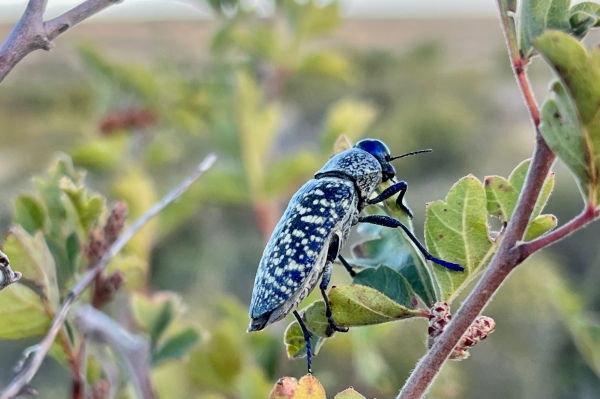
Lampetis (Spinthoptera) drummondi (family Buprestidae) perched on Rhus aromatica (fragrant sumac) at dusk in shortgrass prairie.
Sunset in the southern Great Plains.
Day 4 — 13 Oct 2023 Jct Hwy 64 & N1250 Rd Beaver County, Oklahoma
Last night was the coldest, windiest night of camping I’ve ever experienced! We were warm in our winter sleeping bags (although I did need to put my socks back on in the middle of the night), but the tent flapping awoke us frequently (and the one or two “necessary” exits from the tent in the middle of the night were not enjoyable!). When we did get up, the only thing we wanted to do was break camp and get in the car and out of the wind asap—breakfast and morning coffee would have to wait until we reached Boise City. All the traps had been checked, and while we had hoped to do a bit more collecting in the park before heading back to St. Louis, it wasn’t an option with temps in the mid-40s and biting north winds at 26 mph—nothing to do but start heading back. Along the way passing back through Beaver Co., we noticed lots of waterfowl in a large, shallow pond near the highway and pulled onto a nearby side road to get a better look at them. Even with binoculars we could only say for sure that they were ducks—they were too far away to identify beyond that. While we were there, I swept the extensive stand of sedges and rushes around the margin of the pond hoping to find Taphrocerus species—in this area I suspect T. chevrolati is the only species that would be encountered. None were found, even after quite a bit of sweeping—just a few flies and one 12-spotted cucumber beetle!
A rare wetland in a sea of dry prairie.
9.0 mi W Medicine Lodge on Hwy 160 Gypsym Hills Scenic Biway Info Kiosk Barber County, Kansas
We had thought about stopping at Salt Plain State Park in Woods County, which our route back to St. Louis took us right by, but I had a better idea as we were approaching Alva, which is only 15–20 miles south of Hardtner, Kansas where “Beetle Bill” lives. I last saw Bill in 2004 when I visited him with Jeff Huether, and I thought it’d be nice to stop by and say hey before checking out a spot in the Gypsum Hills just north of town where Cicindela pulchra—one of North America’s most beautiful tiger beetles (the name literally translates to “beautiful tiger beetle”)—has been reported. Sadly, Bill was not in town that day, so we left our regards and continued on to the site.
Temps had warmed up to the mid-60s—warm enough, we thought, that insects should be active, but the winds had not abated in the least (to the point where I eventually decided to leave my cap in the car rather than chase after it repeatedly). Unfortunately, scanning the sparsely vegetated red clay soil at the site revealed no tiger beetles, so I began searching the blossoms of Gutierrezia sarothrae for Crossidius. Most of the scattered plants were on the tail end of their bloom, so there were not a lot of fresh flowers, but eventually I did find three individuals of C. pulchellus on the plants. As I searched the area for additional plants, I encountered the dried out carcass of a black vulture (Coragyps atratus). I don’t normally collect carrion-feeding beetles, but there are a few beetle groups of interest that I’ve encountered on carrion (e.g., checkered beetles of the genus Necrobia and dung beetles of the genus Onthophagus). I brought the carcass to the roadside and slapped it against the road to see what might be dislodged and found two species of Dermestidae. I know people who study these beetles, so I went ahead and collected a series of each—mostly because the host association was sorta cool! No other insects were seen during the visit, but I did encounter a recently-died Celtis reticulata sapling with fresh-looking, frass-packed galleries made by a jewel beetle (prob. Chrysobothris) and, thus, collected it for rearing. By the time I got the wood bundled up and placed in the car, we were both so done with the wind that we decided we’d had our fill of collecting and embarked on the final 7½ hours of driving back to St. Louis.
Crossidius pulchellus (longhorned beetle—family Cerambycidae) on flower of Gutierrezia sarothrae (snakeweed) in red clay shortgrass prairie.
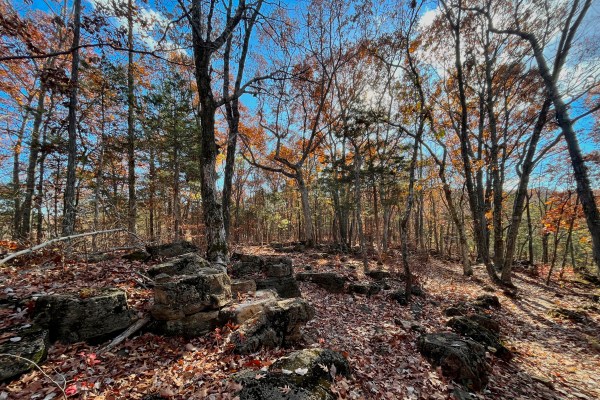
I’ve been taking advantage of my time off the bike to revisit some of my favorite local hiking spots, and today I returned to Young Conservation Area (formerly called Hilda J. Young Conservation Area) in the northwestern corner of Jefferson County. This is one of three conservation areas located within the LaBarque Creek watershed—by far the most ecologically diverse of the Meramec River’s 16 tributaries. The west side between the creek and the parking lot is a bit (okay, a lot) disturbed owing to its former days as a homestead, but the east side features high-quality forests ranging from riparian corridors and rich slopes of white oak to dry chert ridges of black oak and hickory and even a small semi-glade. The 6-mile LaBarque Hills Trail traverses all these habitats and provides some stunning vistas along its southernmost stretch.
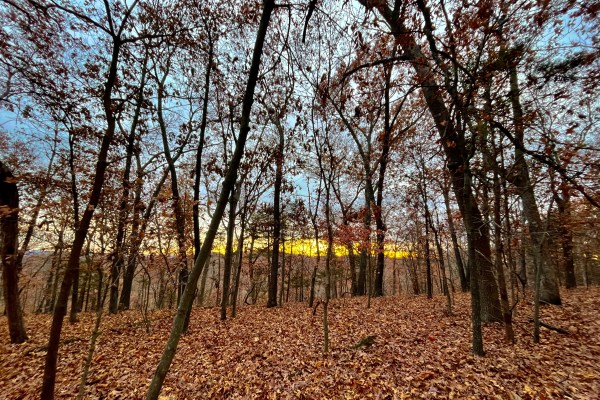
Spectacular setting sun vista from chert ridge along the backside of the trail.
For my part, other than the seclusion and exercise, I focused on continuing to learn my winter grasses. Indian grass (Sorghastrum nutans), big bluestem (Andropogon gerardii), and switchgrass (Panicum virgatum) were common in the open areas near the parking lot (none of which I saw on my previous hike at LaBarque Creek Natural Area), while river oats (Chasmanthium latifolium) was seen within the forest, especially in the lower, moister sections of the trail. Also, unlike that previous hike, I saw only a few plants of broomsedge bluestem (Andropogon virginicus) and no little bluestem (Schizachyrium scoparium) at all.
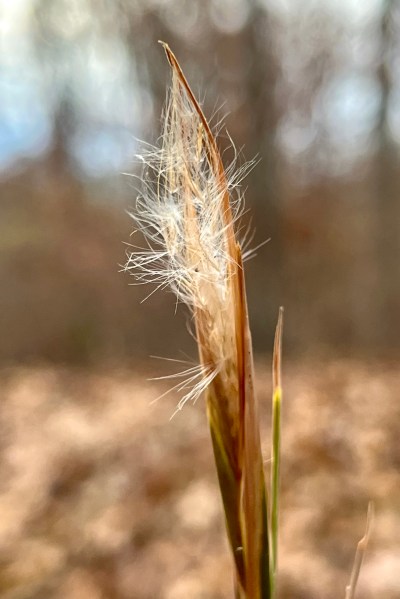
Broomsedge bluestem (Andropogon virginicus) growing in dry-mesic upland oak/hickory forest.
Bottlebrush grass (Elymus hystrix) occurred sporadically along the trail in the lower elevations within the forest, as well as two as yet undetermined species of wild rye (also in the genus Elymus)—one found along the trail inside the forest in moister areas (distinguished by its smaller, “hard-to-strip” seed-heads) and another found only in the much more open semi-glade (distinguished by its much more robust and “easy-to-strip” seed-heads). Nathan Aaron (via iNaturalist) identified the latter as Elymus glabriflorus (southeastern wildrye) based on habitat and season and suggested that the first one could be E. virginicus, which is distinguished by its inflorescence being barely (if at all) exerted from the sheath. Another grass, still undetermined, was found growing in patches in the riparian areas, its foliage still showing much more green than any of the other grasses and often growing intermixed with bottlebrush grass. I collected seed of all of them to sow in the back slope behind my house—the woodland species on the shadier side portions and the sun-loving species in the sunnier central area.
The appropriately-named “bottlebrush grass” (Elymus hystrix—family Poaceae) in mesic riparian deciduous forest.
Elymus glabriflorus (southeastern wild rye—family Poaceae), the more robust, “easy-to-strip” species growing in a sunny, semi-glade.
Unlike the lower areas, the upland stretches of trail were nearly devoid of grasses, or any ground layer for that matter other than a few lowbush blueberries (Vaccinium pallidum), but what they lacked in understory floral diversity they more than made up for in spectacular setting-sun vistas. I had to really hoof it during the last couple of miles to ensure that I reached the car before it got too dark, but it felt good to finish the hike with a nice effort. Now, time to jet out a key grasses and think about where I want to hike in the next couple of days.
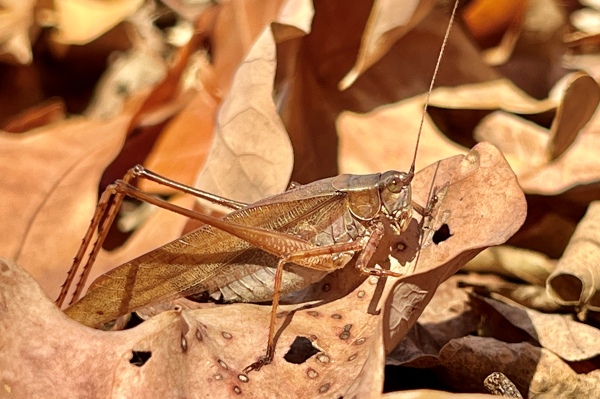
I haven’t been to LaBarque Creek for quite a while, so it was good to see it again, especially without encountering a single other person (the benefit of being able to hike during the week compared to a Sunday). It’s still much warmer than I prefer for a fall hike, but it was beautiful out and I did see one insect—an unusually pinkish-brown—colored bush katydid (Scudderia sp.).
Scudderia sp. (bush katydid—family Tettigoniidae) in dry-mesic upland oak/hickory forest.
This is, in my opinion, the most interesting of the three conservation/natural areas in the LaBarque Creek watershed—by far the most diverse of the seven main tributaries that feed into the Meramec River. More than likely this is a result of the diversity of bedrock—dolomite in the surrounding hillsides with underlying sandstone exposed by the erosive actions of LaBarque Creek. The “rock garden” along one of the high ridges is among my favorite spots in the area.
Dolomite “rock garden” in dry-mesic upland oak/hickory forest at LaBarque Creek Natural Area.
I was also very happy to see that the Department of Conservation has begun renovating the small sandstone glade remnants on the west side of the loop by cutting out much of the eastern red-cedar that has invaded the remnants over the past several decades.
Early-stage renovation of sandstone glade remnant—mechanical removal of eastern red-cedars (Juniperus virginianus).
It will be interesting to watch the vegetational succession that is sure to take place in them over the next decade or so as grasses like little bluestem and eastern broomsedge colonize the now exposed lichen ground layer that had developed beneath the junipers. It will also be an interesting place to look for insects next spring, as wood boring beetles are sure to be attracted to all the newly-available freshly-dead wood.
Sandstone glade remnant at LaBarque Creek Natural Area.
For the first time in many months I was able to join the WGNSS (Webster Groves Nature Study Society) Botany Group on their regular Monday field trip (my frenetic bug collecting schedule and travel w/ Madam during this past summer had made this all but impossible). I wish I could have joined the group this summer, as that is when all the good stuff to see is out, but off-season botany is still fun, and the chance to test my ID skills with other experts only adds to the fun (not to mention just socializing as a group). St. Joe State Park is one of my favorites, and the Farmington Trailhead is a hidden gem that gets us away from the traffic of the park’s more popular bike loop and especially the grating noise of the ORV area.
The weather today was spectacular—almost too warm (I prefer a crisp, cool, sunny day for fall hiking), but the warm temps did have a bonus: a wealth of insects, some of which are not commonly encountered and one that I’ve never seen before. But, this was a botany outing, so I spent much of the time reinforcing my winter identification skills of the native warm-season grasses that grow in abundance along the paved trail that slices through the dry-mesic oak/pine forest. Little bluestem (Schizachyrium scoparium), big bluestem (Andropogon gerardii), Indian grass (Sorghastrum nutans), and witch grass (Panicum capillare) were common, as expected, and although all three are common species it was good to see them together as a reminder of their distinguishing characters: little bluestem with its small, curved seed-heads exposed along the stem, big bluestem with its “turkey foot” terminal seed-heads, and Indian grass with its robust, solid terminal spike of a seed-head. However, a number of other grasses were present that tested our skills (good thing we had Alan with us to help us out). Broomsedge (Andropogon virginicus) was abundant along the trail, resembling little bluestem but with its seed-heads guarded by elongated bracts and a bit more “yellowish” rather than reddish in color. We also saw a few plants of a less common relative, Elliott’s bluestem (Andropogon gyrans), its exaggerated bracts surrounding the terminal seed-heads and resembling the inflorescence of a bird-of-paradise (I think this is a very attractive grass that would look nice in native plantings). In the lower areas we found river oats (Chasmanthium latifolium), their distinctive flattened seed-heads ripe brown on still green leafy stems, colonizing drainages along and inside the woodlands, and a single patch of rock muhly grass (Muhlenbergia sobolifera) was also seen inside the woodland.
Insects made their appearance early on this warm fall day—catching up with the group at the beginning of the hike (I was a few minutes late, led astray by Google maps!), I encountered a Blackburn’s earth-boring beetle (Geotrupes blackburnii) on the trail—fall seems to be the time of year when I encounter these and their close relative, the splendid earth-boring beetle (G. splendidus), most commonly, and on the return trip at the end of the hike I found another one in almost exactly the same spot!
In between, we found some rather fresh scats on the trail (likely coyote) that were covered with broad-headed bugs (family Alydidae). To the chagrin of the others, I poked and prodded the scats to reveal several tiny dung beetles (Onthophagus sp.) underneath [2023-110b], and there were a few more on the scats when we looked again on the return, as well as another Blackburn’s earth-boring beetle. As we continued near the furthest point of our trip along the trail, I spotted a large, standing, dead shortleaf pine (Pinus echinata) in the forest not far from the trail. I hiked over to it hoping to find Rhagium inquisitor longhorned beetles (family Cerambycidae), which by now should have molted to adults in preparation for hibernating through winter in their circular, frass-lined pupal cells beneath the bark. The bark was intact but loose—perfect conditions for finding the beetles, but peeling back the first piece revealed something else—two adult Microtomus purcis assassin bugs (family Reduviidae). They dropped immediately and scrambled to hide under the leaf litter, but I persisted in chasing one of them until it tired of the chase and let me take a few shots.
Microtomus purcis (assassin bug—family Reduviidae), originally found under loose bark of large, standing, dead Pinus echinata (shortleaf pine) in dry-mesic, upland oak/pine forest.
At our furthest point along the trail, we saw something truly remarkable—a stream of ants crossing through trail (not in itself remarkable), and among them was an obvious queen heavily flanked by a gaggle of workers. According to resident ant-expert James Trager, these are Neivamyrmex nigrescens, one of two army ant species in the state, relocating their colony (the first time I have ever witnessed such an event). In warmer months, they do this before dawn for about two weeks out of every month; however, at this time of year the emigrations become morning affairs when it’s warm enough and cease altogether when it gets reliably cold. I struggled to get a passingly acceptable photo of the queen and her swiftly moving gang of supporters, but the memory will remain with me nonetheless.
Neivamyrmex nigrescens queen and gaggle of workers, one of two army ant species in the state, relocating their colony.
At various points to and from, we also found the larvae of two species of longhorned beetles (family Cerambycidae)—one in the stem of a small dead shortleaf pine sapling (probably one of the pine associates in the tribe Acanthocinini, perhaps Astylopsis sexguttata), and a twig pruner (Anelaphus parallelus) that had just cut the distal portion of the oak stem within which it was boring. In both cases, we located the larvae inside the stems and discussed the ways to recognize their presence within them. Finally, we found a small common eastern bumble bee (Bombus impatiens) male torpidly walking on the trail. This is the latest-flying of our midwestern species, but according to resident bee-expert Mike Arduser, “this is REALLY late!” He suspected there may have been a nest nearby since the male was not too beat up despite the lateness of the season. Having gotten our fill of grasses and bugs, the group then partook in a favorite post-activity tradition—lunch at a local restaurant!
Bombus impatiens (common eastern bumble bee—family Apidae) male in mesic riparian oak/hickory forest.

















 Beetles In The Bush