Alternate title: “The importance of authoritative identification and voucher specimen information when documenting a new occurrence of an exotic species.”
For many years now (indeed, decades!), I have been assembling a “Catalogue of Buprestoidea of North America, Mexico, Central America, and the West Indies.” Still a work in progress, it serves as a personal database of literature citations for all species of Buprestoidea occurring in that region—both native and introduced, along with full synonymies, information on type specimens and repositories, distributions, host plants (larval, adult, and flower), natural enemies, and attractants, and comments on erroneous reports and taxonomic issues. The relatively recent appearance of two other catalogues for this superfamily—one by Nelson et al. (2008) for North America north of Mexico, the other by Bellamy (2008–2009) and worldwide in scope—might seem to render this effort duplicative. Nevertheless, both catalogues contain errors and omissions that should be corrected, and numerous additional papers on the taxonomy, nomenclature, and biology of species of Buprestoidea have been published in the years since the appearance of these catalogues. Additionally, my vision of the eventual published version of my catalogue includes full synonymies and more detail in the aforementioned sections. Don’t look for it to be published anytime soon, as it is nowhere close to ready—perhaps it will prove to be my final magnus opus, much as the Nelson et al. and Bellamy catalogues capped the careers of their respective authors.
Last December, while comparing provincial records in my database with the second edition of Checklist of Beetles (Coleoptera) of Canada and Alaska (Bousquet et al. 2013), I encountered in the latter an entry for the Palearctic (Europe and Asia) species Buprestis haemorrhoidalis in British Columbia. This was news to me, and I quickly checked the Nelson et al. and Bellamy catalogues, neither of which included North America in the reported distribution of this species (the Bellamy catalogue did report an introduction of the species to South America). The Bousquet et al. checklist post-dates the Nelson et al. and Bellamy catalogues by five years, so I assumed the supporting record would be found within one of the papers from within that time period that I had not yet databased; however, no such paper was found.
I then turned to my old friend Google and searched “Buprestis haemorrhoidalis British Columbia”, and the very first result was a placeholder page for the species at the popular insect website BugGuide (Belov 2017–2023). No North American observations had yet been posted to the page, but two references were cited—the aforementioned Bousquet et al. checklist, and a paper by Humble & Allen (2006). The link to the paper was nonfunctional, but I found a PDF at the Purdue University website (see link in citation below). In the paper, B. haemorrhoidalis was included in a list of invasive species reported to be “established” in Canada, giving 1992 as the date of introduction. No information regarding the source of the record or the existence of voucher specimen(s) was given, but the authors’ affiliation with the Pacific Forestry Centre in Victoria, British Columbia hinted at this being the basis of the listing in the Bousquet et al. catalogue. Neither the Nelson et al. nor Bellamy catalogues cited this reference, but its publication date (2006) is close enough to the two catalogues (2008) and the venue obscure enough (not an entomology journal) that the omission is not unexpected. A more exhaustive literature search turned up nothing but a single more recent summary listing of the record by Ruzzier et al. (2023), citing Humble & Allen (2006).
Unable to find anything online, I emailed the corresponding author (Leland Humble), but the message bounced back as undeliverable. This prompted me to reach out to several current buprestid workers, all of whom concurred with my presumption that this must—in the absence of any supporting evidence to the contrary—represent a non-established interception or a misidentification of a native species. One of them, Eduard “Edo” Jendek (Bratislava, Slovakia), an expert in invasive Buprestidae, contacted Jon Sweeney (Canadian Forest Service, Atlantic Forestry Centre), who informed him that Humble was deceased and suggested sending an inquiry to Meghan Noseworthy, currently research manager at the Pacific Forestry Centre arthropod reference collection (PFCARC). In response to my inquiry, Meghan informed me that a specimen under the name B. haemorrhoidalis was, indeed, listed in their collection database. She was able to locate the specimen and graciously arranged to have it sent to me on loan so I could examine it and confirm or correct its identity. When the shipment arrived, I opened the box and saw this:

Comparison of the specimen to a series of B. haemorrhoidalis in my collection quickly revealed it is not that species. This was no longer an ID confirmation, but an ID correction—almost surely a native North American species. Remarkably, the first clue to its true identity was found on the labels attached to the specimen itself—the initial identification label by “A.Davies” (undated) as “Buprestis haemorrhoidalis” had been repositioned upside-down on the pin, and a second identification label by “R.L.Westcott ‘07” as “Buprestis subornata (LeC.” [closing parenthesis missing] was placed beneath it. As expected, the specimen agrees in all respects with a series of B. subornata in my collection. While B. haemorrhoidalis superficially resembles B. subornata, it differs in its well-defined, serially punctate elytral intervals (B. subornata has poorly-defined, impunctate intervals) and its smoother, shinier elytral surface compared to the latter species. Indeed, the two are placed in separate subgenera—B. haemorrhoidalis in Ancylocheira, and B. subornata in Buprestis s. str.

Examination of the specimen labels leaves little doubt that this specimen is the basis of the Humble & Allen (2006) report of B. haemorrhoidalis in Canada—the specimen resides in the PFCARC (the institute with which L. Humble and E. Allen were affiliated), and the reported date of introduction (1992) matches the specimen date of collection. There also can be little doubt that this specimen is the basis of the Bousquet et al. (2013) report of B. haemorrhoidalis in British Columbia—the label indicates collection in “Kelowna B.C.”, and the initial identifier (A. Davies) is the author of the Buprestidae chapter in the first edition of the Canada checklist (Davies 1991) and a coauthor of the second edition.
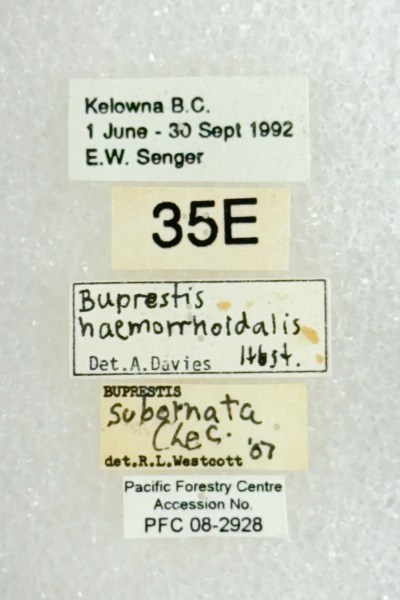
This examination refutes any notion that B. haemorrhoidalis has ever been introduced to or established within North America. However, it also highlights the problems that allowed a misidentification to not only be reported in the literature, but also accepted and propagated. The initial erroneous identification by Davies is puzzling—not so much because it happened (erroneous identifications happen all the time), but because it was identified as an exotic species with no known prior occurrence in North America. The identification of any exotic species for the first time is a significant finding that should raise alarms and be immediately confirmed by a recognized specialist with taxonomic expertise in the group to which it belongs. While this did eventually happen with Westcott’s corrected identification in 2007, it was not before the erroneous identification had already been introduced to the literature by Humble & Allen (2006).
The fact that the erroneous identification was even published at all is itself problematic—there was no prior, peer-reviewed publication to support its summary listing in a review article published in a non-entomology journal, nor was there any citation of specimen data or voucher location to address the absence of such. The use of the word “established” to characterize the presence of the species in Canada is also curious, although I note that the authors were mycologists, not entomologists, and may not have appreciated the significance of that term in the context of invasive exotic insects. (The more appropriate term, erroneous ID notwithstanding, would have been “apparently introduced or mislabeled”.)
The acceptance of the erroneous report by Bousquet et al. (2013) is yet another puzzle, as the identification had been corrected by Westcott—a recognized expert of Buprestidae—six years earlier. Obviously, the PFCARC neglected to correct the listing of the specimen under B. haemorrhoidalis—both in their collection database and in the collection itself—despite this correction (now 17 years ago!). I also note that the Canadian National Collection website lists a specimen (record #CNCCOLEO00091957) with identical label data, but again only the initial identification as B. haemorrhoidalis is mentioned—the corrected identification as B. subornata is not. Since Davies (a coauthor of the second edition) made the initial identification, perhaps the remaining authors had no reason to doubt it. Nonetheless, the reported occurrence of an exotic, apparently invasive species with no supporting reference documenting the circumstances of its collection should have triggered confirmatory follow-up before its inclusion in the updated version of the checklist.
Had any of the above circumstances been avoided, the erroneous report of an exotic invasive species established in North America would not have been propagated in subsequent literature (i.e., Ruzzier et al. 2023) or on a popular insect website (i.e. BugGuide). Let this serve as a cautionary tale to current and future entomologists, especially those with an interest in invasive species and cataloguing efforts. I have a (much shorter) corrective note about this in a soon-to-be-published paper that will likely set the record straight among most North American buprestid workers. However, the erroneous record could still be propagated by those not interested explicitly in Buprestidae (e.g., invasive species specialists) and, thus, may be unlikely to encounter my corrective note. As they say, it’s hard to unring the bell.
Literature Cited
Bellamy, C. L. 2008–2009. A World Catalogue and Bibliography of the Jewel Beetles (Coleoptera: Buprestoidea). Vols. 1–4 (2008), Vol. 5 (2009). Pensoft Series Faunistica No. 76. Pensoft Publishers, Sofia, Moscow, 3264 pp. [Description]
Belov, V. 2017–2023. BugGuide: Species Buprestis haemorrhoidalis. Available from https://bugguide.net/node/view/892238 [accessed 16 Dec 2023].
Bousquet Y., P. Bouchard, A. E. Davies & D. S. Sikes. 2013. Checklist of beetles (Coleoptera) of Canada and Alaska. Second edition. ZooKeys 360:1–402. [PDF of original work no longer available; see Introduction and Data Paper]
Davies, A. 1991. Family Buprestidae: metallic wood-boring beetles, pp. 160–168. In: Y. Bousquet (Ed.), Checklist of beetles of Canada and Alaska. Research Branch, Agriculture Canada, Publication 1861/E, 440 pp. [PDF]
Humble, L. M. & E. A. Allen. 2006. Forest biosecurity: alien invasive species and vectored organisms. Canadian Journal of Plant Pathology 28:S256–S269. [PDF]
Nelson, G. H., G. C. Walters, Jr., R. D. Haines & C. L. Bellamy. 2008. A Catalog and Bibliography of the Buprestoidea of America North of Mexico. The Coleopterists Society, Special Publication No. 4, iv + 274 pp. [PDF]
Ruzzier, E., R. A. Haack, G. Curletti, A. Roques, M. G. Volkovitsh & A. Battisti. 2023. Jewels on the go: exotic buprestids around the world (Coleoptera, Buprestidae). NeoBiota 84:107‒135. [Full text, PDF]
©️ Ted C. MacRae 2024
 Beetles In The Bush
Even the body shapes visibly differ in the both species. I compared 2 females, to be sure. In B. haemmorhoidalis, the both elytra width is almost the same in the humeral zone and in the posterior third; in B. subornata, the the elytra is visible wider in the humeral zone.
So many things went wrong here, but the initial misidentification is still, to me, the most baffling part of this whole story!