Last night the Webster Groves Nature Study Society (WGNSS) held its biennial nature photo contest, and I was fortunate to grab two placings with the following photographs.
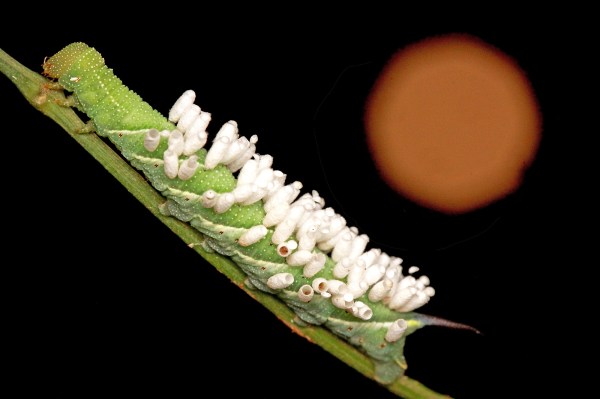
A tobacco hornworm (Manduca sexta) caterpillar that has been parasitized by braconid wasps (Cotesia sp.). The wasps developed inside the caterpillar as grubs, consuming all but the most vital of organs to avoid killing it before they completed their development. They then exited the caterpillar’s body and spun small white silken cocoons in which to pupate and eventually emerge as adults. The adult wasps have already emerged, and though the caterpillar is still alive, it will die before it can complete its development and become an adult moth. The caterpillar was photographed at night in front of a so-called “supermoon” rising in the eastern sky. This is a single exposure image—-not a composite photograph—with the camera focused on the caterpillar (illuminated by flash) but its settings adjusted to also detect ambient light from the distant moon. The moon is necessarily out of focus due to depth-of-field constraints. Photographed 11 Aug 2014 in Mississippi Co., Missouri at the Hwy 62 bridge over the Mississippi River.

A single blossom on the inflorescence of clasping milkweed (Asclepias amplexicaulis). This uncommon species is scattered throughout Missouri but is especially fond of habitats with dry sand substrates. It can be easily identified by its erect, glabrous stems, sessile, clasping leaves, and pinkish flowers. Photographed 23 April 2012 in Scott Co., Missouri at Sand Prairie Conservation Area.
©️ Ted C. MacRae 2025
 Beetles In The Bush