
The Webster Groves Nature Study Society (WGNSS) Entomology Group began its final outing of the 2025 field season when eight participants (Chris Brown, Nathalie de Rocquigny, “Ozark Bill” Duncan, Jack Hambene, Pete Kozich, Ted “BugMan” MacRae, Lisa Meihls, and David Seidensticker) met up in the parking lot at Hughes Mountain Natural Area. Tucked into the southeastern corner of Washington Co., this gem of a natural area features 1.5 billion year old Precambrian outcrops that are among the oldest continuously exposed rocks in North America. Once molten as a result of volcanic activity associated with the St. Francois Mountains, the now hardened and weather-resistant rhyolite that formed after it cooled lies still exposed at the summit and surrounding areas. To the geologist, the polygonal columnar pattern of cracking at the summit—resulting in a unique formation called the “Devil’s Honeycomb”—might be the area’s most interesting feature. To the botanist, the xeric grasslands that formed on the surrounding exposures—i .e., “igneous glades”—might instead take this honor. To the entomologist, however, the unique fauna of insects associated with this interesting natural community earns top billing.

On two previous visits, the group has been fortunate to see one of Missouri’s rarest and most beautiful longhorned beetles—Tragidion coquus. Velvety black with vivid orange elytra, this charismatic species is usually seen during fall, and we hoped to be fortunate enough to see it again. Two species of fall tiger beetles—Cicindela limbalis (claybank tiger beetle) and Cicindela splendida (splendid tiger beetle), both colored iridescent green and brick red—were additional possibilities. A clear consensus quickly became apparent, however, when most participants voiced a desire to see Trimerotropis saxatilis—the famously and colorfully cryptic lichen grasshopper! It didn’t take long to see the first ones as soon as we began reaching the swathes of exposed rhyolite with their coverings of green and black lichens. Sitting motionless on the lichen-encrusted rocks, the grasshoppers were almost impossible to see, so perfectly colored and patterned was their camouflage.
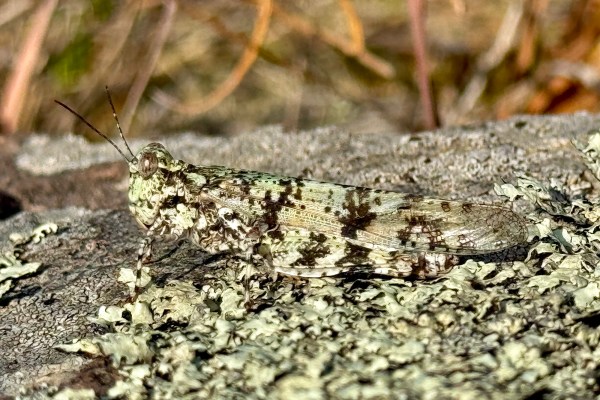
The abundance of lichen grasshoppers on the glades was somewhat expected, but what was not was the diversity of other grasshoppers also present at the margins of the glades and in the surrounding dry woodlands. Four such species were documented, including Hippiscus ocelete (wrinkled grasshopper), Melanoplus ponderosus (ponderous spur-throat grasshopper), Melanoplus rusticus (obovate-winged grasshopper), and Spharagemon bolli (Boll’s grasshopper)—all possessing their own forms of cryptic coloration that made relocating them after they jumped difficult.


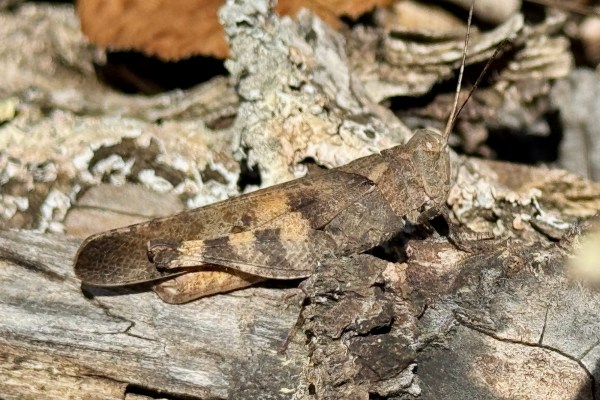
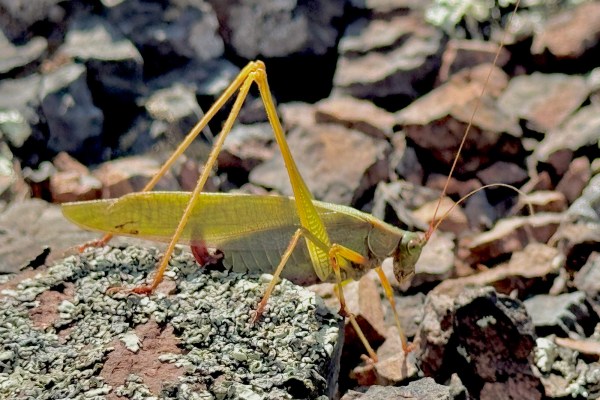
Two non-grasshopper orthopterans as well were found—several Scudderia furcata (fork-tailed bush katydid), ranging from green to tan to almost pinkish(!), were seen in the glades and woodlands, and an unusually cooperative Ceuthophilus sp. cave cricket (family Rhaphidophoridae) was also seen.

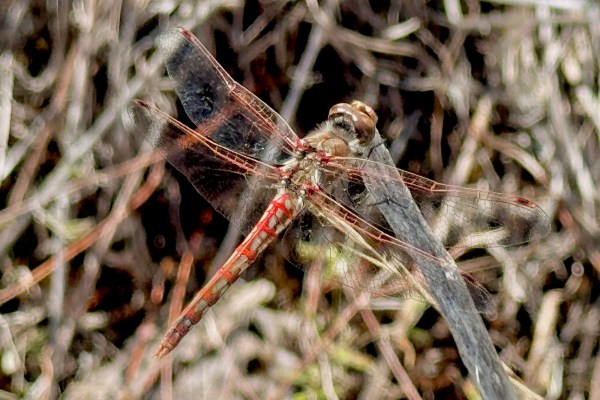
The group fanned out across the glades as they worked their way up towards the summit. Of special interest were flowers that might host pollinating insects (and possibly even T. coquus). Few flowers would be found, however—a consequence of abnormally dry conditions since late July, and we found ourselves looking for other targets. Ted managed to photograph a beautiful red-marked variegated meadowhawk dragonfly (Sympetrum corruptum), while David “captured” (through the viewfinder) a male black swallowtail butterfly (Papilio polyxenes).
Eventually the group reached the summit, where the “Devil’s Honeycomb” and a spectacular vista awaited us. An unexpected feature at the summit was white splotches on the tops of many of the projecting columns of rock, which the group surmised to indicate use of the summit as a roosting site by turkey vultures.

The group lingered to take in the crisp air, blue skies, and spectacular view created by 1200’ of elevation before turning back to begin the descent back down the mountain.

Descending the mountain, however, did not mean an end of things to see. Even before getting off the summit, Lisa noticed Chelinidea vittiger (cactus leaffooted bug) on pads of Opuntia cespitosa (eastern prickly pear). This species feeds and develops almost exclusively on the pads, fruits, and young growth of prickly pear cacti (Opuntia spp.), thus, its range coincides with the distribution of these cacti.

Further down the mountain, another “variegated” species was seen—this time a variegated fritillary (Euptoieta claudia) butterfly. This well-worn individual was only the third butterfly species seen on the day, the aforementioned black swallowtail and a particularly fresh common buckeye (Junonia coenia) being the other two. This one was probably making its way south to overwinter in the southern U.S., where the species is a year-round resident.


Along the way, the lichen grasshoppers continued to attract our attention due to their abundance and striking diversity of coloration. We were treated to a particularly obvious example of this when we encountered a mating pair with the much smaller male exhibiting shades of brown instead of the greens exhibited by the much larger female.
It had been a leisurely descent off the main glade, and once clearing the woodland to emerge into the last glade fragments before the final descent, Chris and Ted were further delayed by a trio of observations in rapid succession. A large, impressively marked Neoscona crucifera (spotted orbweaver) spider hunkered down on a twig first caught Chris’ attention. Photographing it turned into an adventure when an effort to manipulate the twig on which it was resting ended up alarming the spider and causing it to drop down to the ground. They returned the spider to the twig using other twigs and leaves, but invariably it dropped again. Eventually, they learned they could “reel” the spider back up to the twig by its silk line if they acted quickly enough, and with repeated efforts both succeeded in getting photographs of the spider back up on the twig.

While this was going on, the unmistakable droning buzz of Milesia virginiensis (yellowjacket hover fly or Virginia flower fly) caught their attention. The resemblance of the adults of this species to wasps is remarkable, and they are often seen hovering in midair, making erratic shifting movements, and then suddenly flying away. This particular fly, however, cooperated by landing on a rock (briefly) and allowing a few photographs before it abruptly departed.
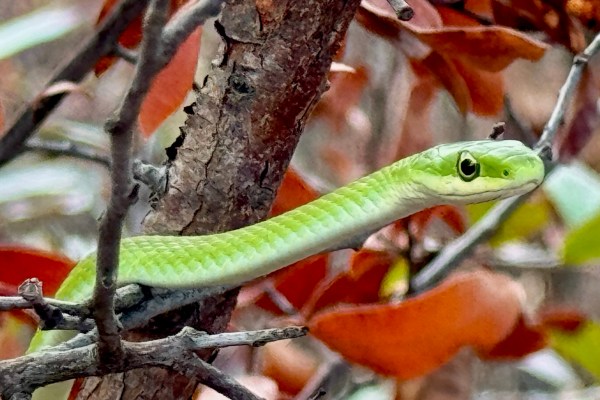
Spider and fly photographs in hand, Ted and Chris resumed their descent but took only a few steps before another sighting demanded photographs—a rough green tree snake (Opheodrys aestivus) peering quizzically from amongst the rust-red leaves of a stunted blackjack oak. The snake cooperated at first, allowing a few closeup photographs before making a run for it. Fortunately, this is a very docile species that rarely (if ever) bites when handled, so Chris and Ted were able to corral it for additional photos before returning it back to the tree from whence it came.
At last, they were able to complete the descent and join the rest of the group in the parking lot, but not before making one last interesting find—the bizarrely beautiful caterpillar of Isa textula (crown slug moth). Like many members of the family Limacodidae (slug moths), the pale green, flattened caterpillars bear stinging spines/-in this case on lobes that radiate out from around the edge of the body. The caterpillar was found on the ground (it is probably mature and was looking for a protected place to spin a cocoon in which to spend the winter) and coaxed onto a leaf to bring it to the parking lot so everyone could have a chance to photograph it (it looked particularly stunning when set on a bright red sumac leaf).

©️ Ted C. MacRae 2025






 Beetles In The Bush