🌿 Botanizing w/ the Webster Groves Nature Study Society (WGNSS) Botany Group at Rockwoods Reservation – 3 Nov 2025

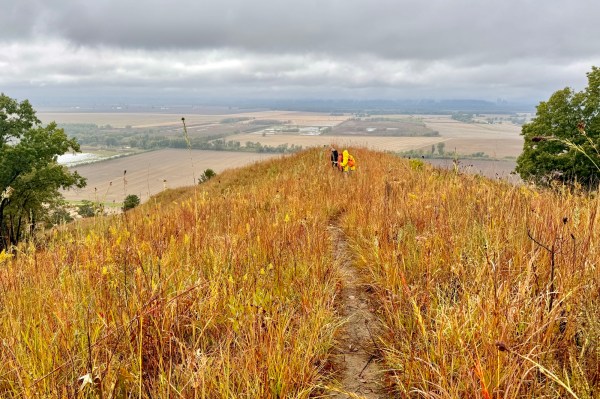
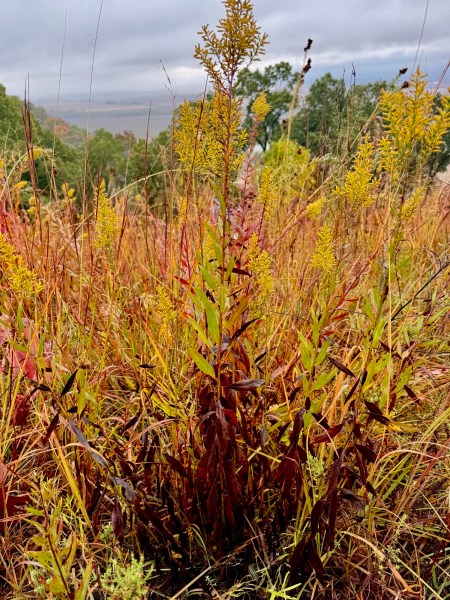
After several weeks of traveling to the outer reaches of the St. Louis area, the WGNSS Botany Group pinned their hopes on seeing good fall colors closer to home at Rockwoods Reservation in Wildwood. Despite its proximity to St. Louis, Rockwoods offers visitors a taste of the Ozarks with its mix of dry, rocky ridges, cool, moist ravines, and forested slopes featuring a variety of woodland types depending on substrate and exposure. Several trails are on offer, but the group chose the Rock Quarry Trail as the most likely to provide a diversity of plants and color.
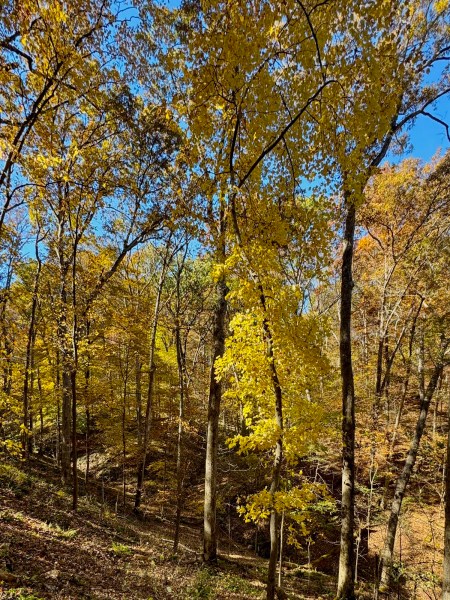
Hard maples ablaze!

A large (seemingly misplaced) Taxodium distichum (bald cypress) tree right at the trail entrance captured our attention, and numerous globular cones, still green at this point in the season could be seen within its crown. Bald cypress trees are often attacked by a small fly called the cypress twig gall midge (Taxodiomyia cupressiananassa—family Cecidomyiidae) which produces globular galls on the twigs that can be mistaken for immature cones, but despite thorough searching none were found.

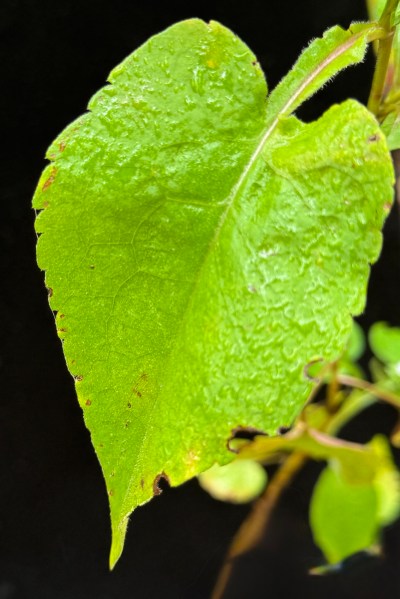
As we started up the rocky trail, John noticed several freshly fallen leaves on the ground under a large(ish) tree and picked one up for the day’s first “pop quiz.” Morus (mulberry) or Tilia (linden or basswood), two unrelated trees that bear similar-looking leaves, were the early guesses, but which? The shape of the leaf base—usually symmetrical in the former and asymmetrical in the latter—can be useful but is not consistent. A better way is to break the leaf petiole to check the color of the sap that exudes—milky in the former and clear in the latter. In this case, it was milky, identifying the tree as Morus rubra (red mulberry).

Our late summer and early fall this year was unusually dry with almost no rain from the beginning of August until near the end of October. This year’s fall floral display has suffered as a result, with many of the plants we are seeing in flower now looking rather pitiful compared to if they had grown under more favorable conditions. The recent rains may not have been enough to “save” the season, but the landscape has “perked up” a bit in their wake. By early November, Solidago (goldenrods) and Symphyotrichum (true asters) make up the bulk of the anticipated plants in flower, and we were fortunate to see blooms of several species in these two genera. These included not only some species that we have seen in the past weeks, such as Solidago ulmifolia (elm-leaved goldenrod), Symphyotrichum anomalum (many-rayed aster), Symphyotrichum patens (spreading aster), and Symphyotrichum lateriflorum (calico aster), but also a few that we have not.
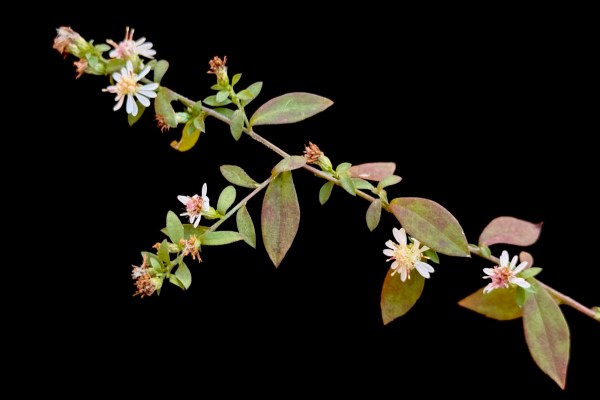
Symphyotrichum lateriflorum (calico aster—family Asteraceae).

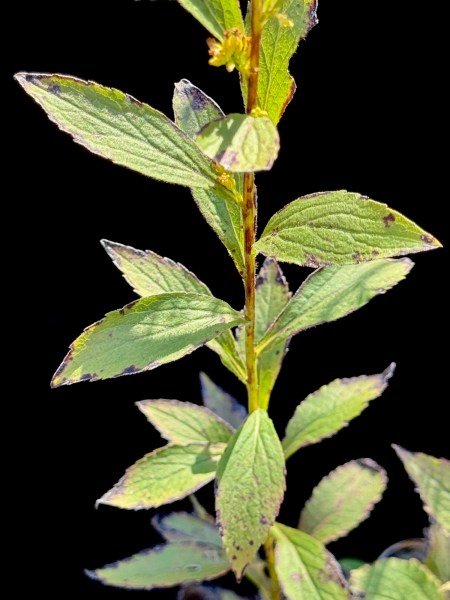
The bulk of these were located in or near a small “glade” on a southwest-facing not far from the trail entrance. The patch of xeric habitat is not a true glade, but rather a scar of past quarrying activity on the southwest-facing limestone slope that has resulted in a glade-like habitat. It was here that a few patches of Solidago rugosa (rough-leaved or wrinkle-leaved goldenrod) were found. This species is similar to S. ulmifolia but usually has multiple stems and sessile leaves with the margins not as coarsely toothed and the veins more deeply impressed, giving the leaf a rugose appearance (on which the species name is based).
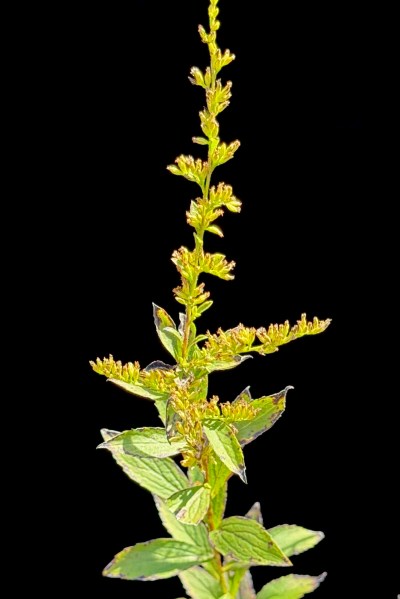
Solidago rugosa (wrinkleleaf or rough-stemmed goldenrod—family Asteraceae) inflorescence.
Solidago rugosa (wrinkleleaf or rough-stemmed goldenrod—family Asteraceae) leaves.

We have seen Symphyotrichum oblongifolium (aromatic aster) in true glades the past few weeks (at Victoria Glades and Fults Hill Prairie), and we saw it blooming in this “pseudo glade” as well. Amongst the several plants of this species, however, was a single blue-flowered aster that did not exhibit the same profusely branched and many-leaved growth. This turned out to be the slightly more conservative (CC = 7) Symphyotrichum laeve (smooth blue aster), identifiable by its smooth, completely hairless, narrowly elongate leaves that clasp the stem at the base.
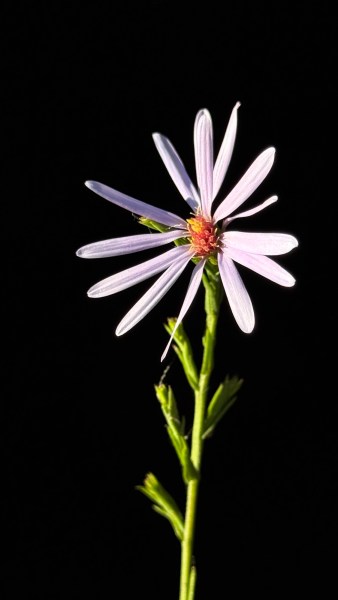
Symphyotrichum laeve (smooth blue aster—family Asteraceae) flower.
Symphyotrichum laeve (smooth blue aster—family Asteraceae) stem and leaves.

Just beyond the glade and reentering the dry woodland, a single white-flowered aster was seen and determined to represent Symphyotrichum urophyllum (arrowleaf aster) based on its leaves—heart-shaped at the base and gradually becoming more arrowhead-shaped and sessile to nearly sessile further up the stem—and dense, cylindrical cluster of white flowers at the top of the plant.

Symphyotrichum urophyllum (arrowleaf aster—family Asteraceae) inflorescence.
Symphyotrichum urophyllum (arrowleaf aster—family Asteraceae) stem and leaf.

Moving further along the trail, the substrate transitioned from limestone to chert, which was accompanied by the appearance of more acid-loving lichens, mosses, and plants such as Vaccineum pallidum (lowbush blueberry) and Cunila origanoides (American dittany), a few plants of the latter still exhibiting blooms in good shape. The finely divided leaves of Viola pedata (bird’s foot violet), a characteristic occupant of upland forest openings having dry, cherty soils, were common along the steep trailside bank in this area.
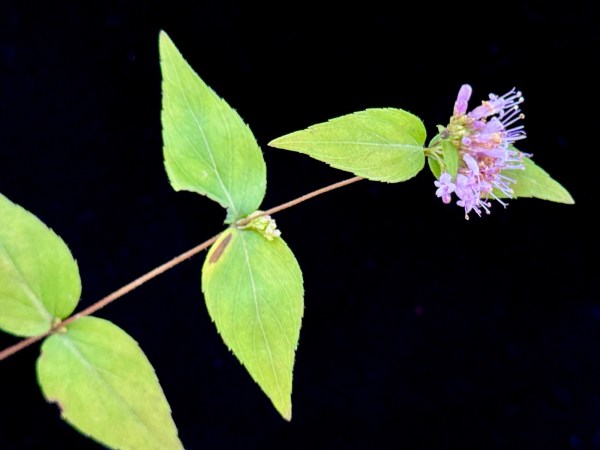
Cunila origanoides (American dittany—family Lamiaceae).

Further up the trail along the ridgetop, we saw a single plant representing yet another acidophile and first sighting for the season—Solidago hispida (hairy goldenrod). This species can be recognized by its single stem, erect, narrow cluster of yellow flowers at the top of the plant, distinctly hairy leaves and stems (especially at the base), and larger basal leaves. It typically inhabits dry, open, and rocky woodlands, especially those with acidic substrates.
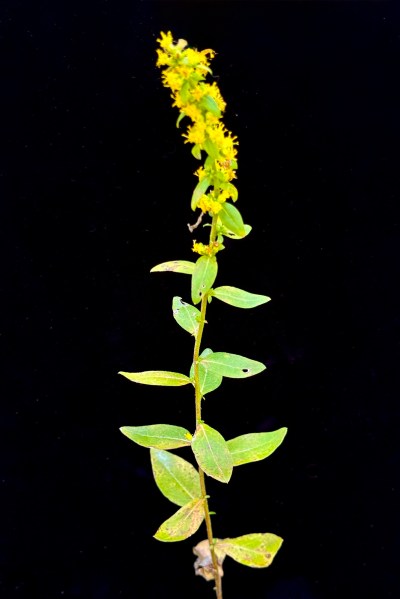
Solidago hispida (hairy goldenrod—family Asteraceae) upper stem leaves and inflorescence.
Solidago hispida (hairy goldenrod—family Asteraceae) lower stem.

A long gentle descent off the ridge top took the group gradually down into a deep ravine with a tall, dense canopy that contrasted distinctly with the dry, rocky, more open forests seen to that point. Muted browns and yellows of oaks and hickories gave way to vibrant golds, oranges, and reds of hard maples. Polystichum acrostichoides (Christmas fern) was abundant on the north-facing slopes, the darkened tips of their fertile fronds conspicuous against the much more green rest of the plant, and two other fern species were noticed as well: Adiantum pedatum (northern maidenhair fern), a deciduous species with its fronds just starting to senesce, and Asplenium rhizophyllum (walking fern), an evergreen species that spreads vegetatively (“walks”) by rooting to form new plantlets whenever the tips of its long, undivided leaves touch moist substrate. Lindera benzoin (spicebush) was also abundant in the more mesic habitat now being traversed, their just-formed flower buds now sufficiently developed to distinguish male (larger buds) from female (smaller flower buds) plants at a glance.
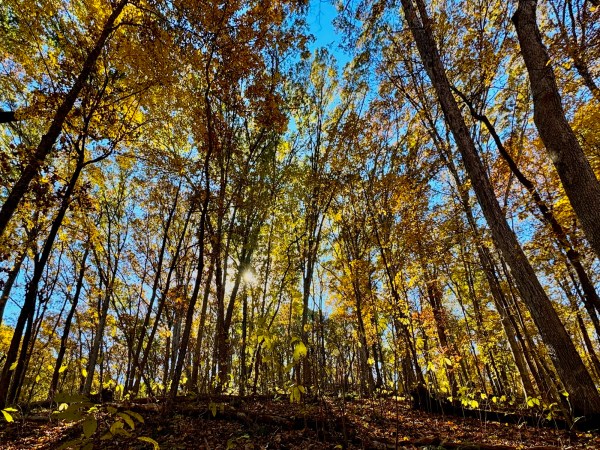
Backlit leaves of Asimina triloba (pawpaw) under a canopy of blazing yellow Acer saccharum (sugar maple).

The trail ends up the road a ways from its start, requiring a short roadside walk to return to the parking lot. Despite the presence of asphalt, the group remained on the lookout for plants of interest in the now riparian forest corridor paralleling the road. A fourth goldenrod—Solidago altissima (tall goldenrod)—was seen (its identity confirmed by rubbing its leaves with the fingers to feel its roughness), but the biggest attention getter was a spectacularly large Ilex decidua (deciduous holly or possumhaw) bearing a profusion of bright orange-red berries.

Ilex decidua (deciduous holly, possumhaw—family Aquifoliaceae).

For lunch afterwards, the group chose the ever-popular Clancy’s Irish Pub in nearby Ellisville.

©️ Ted C. MacRae 2025

🌿 Botanizing w/ the Webster Groves Nature Study Society (WGNSS) Botany Group at Fults Hill Prairie Nature Preserve — 27 Oct 2025

After visiting Salt Lick Point Land & Water Preserve a few weeks ago, the WGNSS Botany Group continued its exploration of the Mississippi River bluffs in southern Illinois by visiting Fults Hill Prairie, a 532-acre preserve 13 miles south of Salt Lick Point. In addition to upland forests and glades, Fults Hill Prairie features the largest complex of high-quality loess hill prairie still existing in the state. This diversity of habitats correlates with a rich diversity of plants, which at this time of year is exemplified by the classic fall genera Solidago (goldenrods) and Symphyotrichum (true asters). While late October is a bit past peak bloom and the persistent precipitation that only began a few days earlier after an extraordinarily dry previous three months further dampened expectations, a decent-sized group of intrepid explorers nevertheless defied the forecast, steep wooden stairway, and slippery final ascent (along with the subsequent descent) to explore the area’s diversity and admire its bluff-top views.

View of the Mississippi River valley from Fults Hill Prairie Nature Preserve.

Some of the same goldenrods and asters that the group saw a few weeks ago at Salt Lick Point were again seen during the initial ascent. Among the more conservative of these were Solidago buckleyi (Buckley’s goldenrod), Solidago drummondii (cliff goldenrod), and Symphyotrichum anomalum (many-rayed aster). Less conservative (i.e., more commonly encountered) counterparts also were seen such as Solidago ulmifolia (elm-leaved goldenrod) and Symphyotrichum patens (spreading aster). In all cases, the plants exhibited precious few pitiful flowers due to the combination of late season and the drought-compromised display, but this didn’t prevent the group from practicing their identification skills based on non-floral characters.

Ascending the steep rocky slopes, the canopy was dominated by Quercus muhlenbergii (chinquapin oak)—an indicator of the thin, rocky soils underfoot. As the group continued to ascend, Quercus alba (white oak) also began to appear and eventually replaced Q. muhlenbergii as the dominant oak, signaling the presence of deeper deposits of the wind-blown loess soils that characterize the hilltops. Further up, on the south- and west-facing slopes at the top, such soils are unable to hold sufficient moisture to support the growth of trees. As a result, despite the presence of deep soils, the forest gives way to the first of two large hilltop prairie remnants featured in the preserve. A lone, Quercus stellata (post oak) stood sentry atop the prairie, adding to the diversity of oaks seen and framing a gorgeous view from the prairie across the valley below.

A lone Quercus stellata (post oak—family Fagaceae) stands sentry atop a loess hill prairie.

Entering the woodlands along a remnant 2-track belying the past presence of a farm, the group encountered a third species of blue-flowered aster whose cordate, scabrous leaves, pubescent stems, and distinctly winged leaf petioles identified it as Symphyotrichum drummondii (Drummond’s aster). This and another more commonly encountered aster, Symphyotrichum lateriflorum (calico aster), were found scattered along the sides of the 2-track until the group began its descent down into the second large loess prairie remnant.

Symphyotrichum drummondii (Drummond’s aster—family Asteraceae) inflorescence.
Symphyotrichum drummondii (Drummond’s aster—family Asteraceae) leaf and petiole.

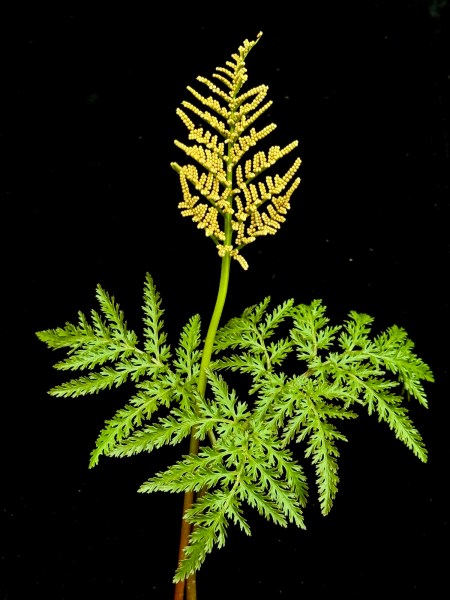
Also along the 2-track, but only in one small area, the group observed Sceptridium dissectum (cut-leaf grape fern, formerly Botrychium dissectum) in “flower” with mature fertile fronds. The finely divided leaves identified the plants as var. dissectum, which is a bit less common than var. obliquum.

Sceptridium dissectum var. dissectum (cutleaf grapefern—family Ophioglossaceae).

The diversity of oaks seen increased as the group traversed the forests along the 2-track, with Quercus velutina (black oak) becoming co-dominant with Q. alba. Numerous freshly-fallen twigs littered the 2-track due to the recent rains, and the shapes of some of the leaves seemed to suggest they might be from the more southerly Quercus falcata (southern red oak); however, careful examination of their lobes along with newly-formed buds and fully-developed acorns confirmed them, nevertheless, to be Q. velutina.

Quercus velutina (black oak—family Fagaceae) leaf.
Quercus velutina (black oak—family Fagaceae) buds.
Quercus velutina (black oak—family Fagaceae) acorn.

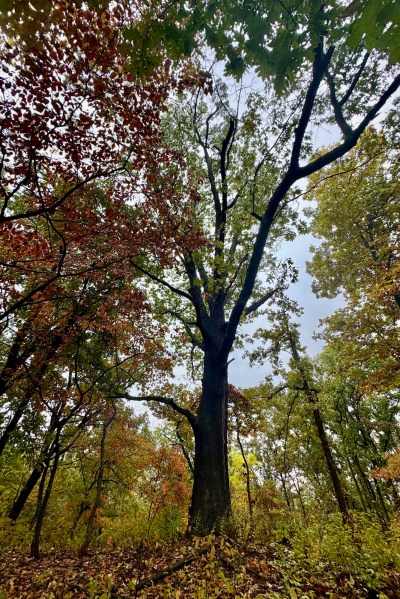
Still, the diversity observed oaks increased to five species when we began encountering Quercus shumardii (Shumard’s oak), including one particularly grand old tree whose spreading main branches and broadly-formed crown whispered stories about the more open conditions that must have occurred around it during its youth.

Quercus shumardii (Shumard’s oak—family Fagaceae).

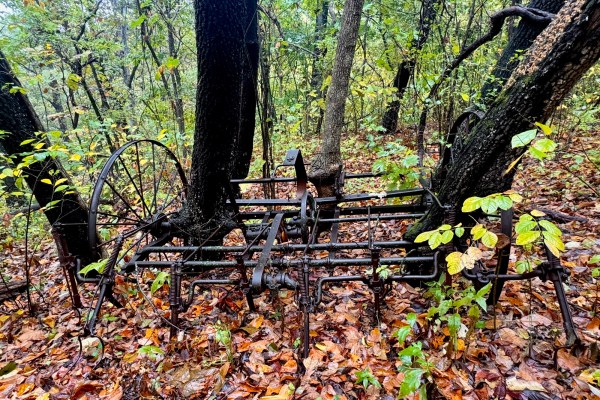
Nearby, a rusty farm implement, actively being engulfed by trees that sprouted after the last time it saw any movement, further attested to the area’s long-forgotten days as a farm.

Old farm implement taken over by trees.

The diversity of goldenrods seen also continued to tick upwards along the 2-track as we encountered what was either Solidago atltissima (tall goldenrod) or Solidago canadensis (Canadian goldenrod). These two species are difficult to distinguish, especially when the foliage is wet since leaf pubescence is a key distinguishing characteristic, but the upland habitat initially suggested the latter since S. altissima prefers more mesic habitats. A number of other more mesic-preferring plant species were also noticed in the area, however, perhaps a result of the underlying deep loess soils, so a final determination was not made. It was upon the final approach towards and down onto the second main loess prairie remnant, however, that the diversity of goldenrods and asters really began to skyrocket. Near the edge of the prairie but still in the forest, we saw Symphyotrichum oolentangiense (pronounced oh-OH-len-tang-ee-IN-say) (azure aster)—easily identifiable by its blue flowers and long, narrow, arrowhead-shaped lower leaves that are rough and sandpapery to the touch. At the prairie edge Symphyotrichum turbinellum (prairie aster), identifiable by its many-branched growth habit, elliptic leaves with tapered bases, and long vase-shaped involucres, began to appear. Symphyotrichum sericea (silky aster) further padded the diversity totals, a small patch of plants with their distinctive silvery leaves occupying the farthest (and possibly driest) extent of the loess prairie ridge before it began dropping precipitously towards the towering limestone blufftop.

Kathy, Michael, and John examine plants in a loess hill prairie.

The most dazzling addition to the diversity, however, was Solidago rigidiuscula (stiff-leaved showy goldenrod). Until recently considered to be a variety of Solidago speciosa (showy goldenrod), the large showy inflorescences of this species are every bit as attractive as the latter, but the plants feature narrower leaves, and while the flowers had largely faded by this late date, the lower foliage turning brilliant red provided stunning contrast with the still-green upper leaves and more muted colors of the surrounding vegetation.

Solidago rigidiuscula (stiff-leaved showy goldenrod—family Asteraceae).

The group then began its long, slow, careful descent off the prairie and through the lower woodlands back to the parking lot. Separating the two, however, is a limestone glade that features a slightly different flora of prairie-associated species than the hilltop prairie due to its thin, rocky versus deep loess soils, and it was in these glades where the group saw the day’s ninth and final species of aster—Symphyotrichum oblongifolium (aromatic aster), distinctive by its branched growth with numerous small leaves amongst normal-sized leaves (and if there is still any doubt, a quick crush-and-smell of the latter reveals its highly aromatic nature). A sixth and final goldenrod also was seen on the rocky slopes just below the glade—Solidago radula (rough goldenrod), its short, clump-like stature and densely numerous, heavily scabrous, serrate leaves confirming its identity.

As the lone entomologist in the group, I had been keeping my eye out for any insect activity—particularly Oncideres cingulata (twig girdler), a longhorned beetle (family Cerambycidae) that appears only during fall and “girdles” twigs of hickory and certain other trees before laying eggs in them. Numerous such twigs were seen, and I picked up several in hopes of finding females still upon them—unfortunately, to no avail. In fact, but a single insect was seen all day, and even it was not until I had returned to the parking lot—a nymph of the distinctively green Zelus luridus (pale green assassin bug).

Zelus luridus (pale green assassin bug—family Reduviidae) nymph.

©️ Ted C. MacRae 2025