Badges are up at AIF

Sidebar badges are now available at An Inordinate Fondness (AIF).  Several styles are offered, each available in three ready-to-use sizes plus the original if custom sizing is desired.  Help promote AIF by placing the badge of your choice in your blog sidebar—all available styles and sizes, as well as detailed instructions for use, can be found at AIF Badges.  Here is the one that I’m using:

All beetle images © Robert Perger, http://www.coleop-terra.com/

As a reminder, the first issue of AIF will appear at the homesite in mid-February.  The deadline for submissions is February 15, but submitting earlier is highly encouraged.  Also, we have hosts lined up for Issues #2 (March) and #4 (May) but not #4 in April.  If you would like to host the April issue—or any other future issue, please send an email indicating the month of your choice.

Copyright © Ted C. MacRae 2009

Add to FacebookAdd to DiggAdd to Del.icio.usAdd to StumbleuponAdd to RedditAdd to BlinklistAdd to TwitterAdd to TechnoratiAdd to Yahoo BuzzAdd to Newsvine

Email to a friend

The 12 Years of Christmas

This post first appeared on Beetles in the Bush on Christmas Day last year.  One year has passed, but the sentiment remains stronger than ever.  I reprint it here as BitB‘s first evergreen post. Merry Christmas!

p1020457_2

Merry Christmas - from our backyard to yours!

They came from completely different backgrounds. She had grown up in a middle class family, her father an educated professional, her mother a professional homemaker – “Ward and June”, as their now-grown children jokingly call them. He grew up on welfare, the family breaking up while he was still in elementary school. She was a popular student – cheerleader, debate team, gymnastics. He was the introverted science nerd, invisible to the popular, living quietly with his books. Religion was an important part of her life, growing up Catholic and remaining devoted to the church. He grew up Catholic but knew even as a child that religion would not provide the answers he was looking for, eventually finding a private spirituality in the Creation itself.

Despite these separate paths they found each other and fell in love, and despite their different lives they both wanted the same thing – a family. Such a simple desire, however, would prove to be difficult to achieve. When fertility drugs didn’t work, they turned to adoption. The first match failed. So did the second. They understood completely how the birth mothers could change their minds, but that didn’t ease their pain or calm their fears. Ultimately, they looked to Russia, a new democracy with old attitudes about orphans. In the fall of their 6th year of marriage, they learned that little Anastasia was waiting for them. They traveled to Russia before Christmas and became a family after New Years. In between, they visited little Anastasia every day – one hour at a time – and experienced the joy of being a parent, a feeling they had feared would ever elude them. On Christmas Day, they could not see little Anastasia, but in a small, gray apartment on the outskirts of Moscow, they celebrated her coming with their gracious host family. Ten days later, their family was born, and twelve months later they celebrated their first Christmas together at home.

Christmas meant little to me for much of my life. Yes, it was a time to relax and enjoy the company of family and friends, and the presents were nice. But my own approach to spirituality has little in common with traditional reflections of the season. Tonight, as I watched 12-year old Mollie Anastasia laughing with her cousins, hugging her nanny and papa, and teasing her uncle and his partner, I thought back to those cold, snowy days in Russia when my heart became warm for the first time. I recalled our second trip to Russia six years later, when she and little Madison Irina each met their sister for the first time. On this Christmas Day, as I have done for 12 years now, I thought about how lucky we are to have these two beautiful little girls that are unquestionably our own. Christmas means a lot to me now, and that is a gift that not even five golden rings could beat.

Copyright © Ted C. MacRae 2009

Add to FacebookAdd to NewsvineAdd to DiggAdd to Del.icio.usAdd to StumbleuponAdd to RedditAdd to BlinklistAdd to TwitterAdd to TechnoratiAdd to Furl

Tiger Beetles at Florida’s “Road to Nowhere”

(continued from the previous post, Tiger Beetles Agree—It’s Hot in Florida!)

During the time that I explored the pine sandhill habitat at Withlacoochee State Forest in Citrus County, I kept close watch for any individuals amongst the dozens and dozens of Cicindela abdominalis (Eastern Pinebarrens Tiger Beetle) that I encountered that might exhibit the deeply pitted rather than smooth elytral surface that would identify it as the closely related Florida-endemic, Cicindela scabrosa (Scabrous Tiger Beetle).  However, no such individuals would be seen (my first tiger beetle failure of the trip), and having already spent more than two hours at the site I decided it was time to move on the the “Road to Nowhere.”

"Road to Nowhere," 11.1 mi S Jena on Hwy 361, Dixie Co., Florida

The Road to Nowhere is a tidal marsh (also known as “coastal salt marsh”) near Steinhatchee in Dixie County (11.1 mi S Jena on Hwy 361).  Although I was not aware of it prior to my August visit, this locality has achieved legendary status among tiger beetle enthusiasts because of the great number of species that can be seen there—as many as 6–10 species in the right season.  Being a coastal wetland with moist, saline substrates, these would include such species as Cicindela trifasciata ascendens (Ascendent Tiger Beetle), Habroscelimorpha severa (Saltmarsh Tiger Beetle), the rarely collected H. striga (Elusive Tiger Beetle), and Eunota togata togata (White-cloaked Tiger Beetle), in addition to Ellipsoptera marginata (Margined Tiger Beetle) and E. hamata lacerata (Gulf Beach Tiger Beetle) which I had already found a few days earlier.  As I found the highway leading to the spot and begain to drive its upper reaches, I looked longingly at the barren sand exposures along the sides of the road thinking that C. scabrosa, already known from the area (Choate 2003) must be there.  However, it was well into the afternoon hours by then, and having already failed to find the species at Withlacoochee State Forest, I decided I should press on and see what the Road to Nowhere had to offer.

Cicindela (Cicindelidia) trifasciata ascendens—Ascendent Tiger Beetle

Almost immediately I began seeing tiger beetles.  The first species I saw was C. trifasciata ascendens—rather common on areas of the flats close to the water’s edge.  I recognized them instantly, as I had not only seen this species some years ago in south Texas, but also in southern Missouri as a lone vagrant (Brown and MacRae 2005).  The dark brown dorsal coloration and thin, sinuous, S-shaped middle maculation are diagnostic for the species (Pearson et al. 2006).  While it was by now late afternoon, the heat of the day had not yet begun to subside, and the beetles were extremely active and flighty.  The difficulty in approaching them closely enough for photographs was exacerbated by the wet, muddy substrate and incessant drone of tenacious mosquitoes intent on breaching my invisible shield of DEET.  Eventually, however, and only due to one decidedly more cooperative individual (above), I succeeded in getting a few shots with which I was happy. 

Habroscelimorpha severa—Saltmarsh Tiger Beetle

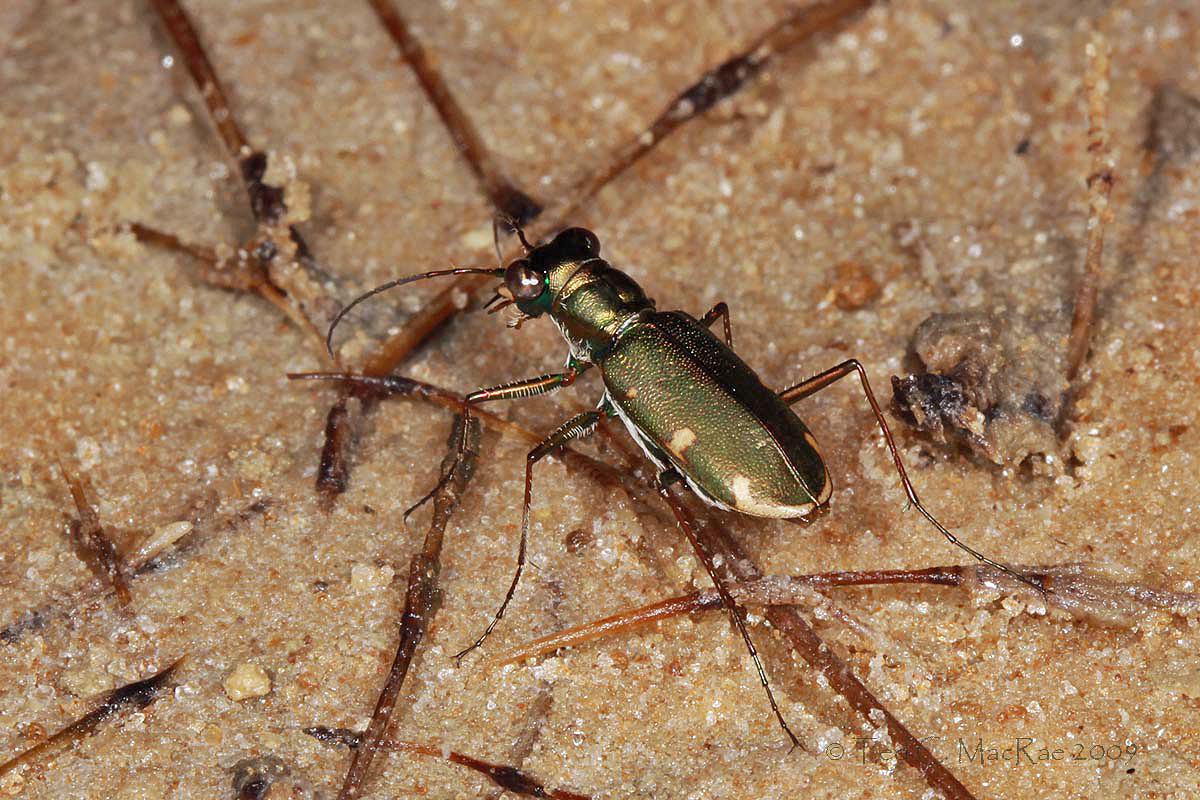
Far less common than C. trifasciata ascendens, but equally skittish, was the impressive H. severa.  I have also seen this species before in south Texas, though not in great numbers, and its shiny green surface with maculations reduced to small spots at the middle and rear of the elytra are unmistakealbe.  It was the hardest to approach of the species I saw, and the above (only slightly cropped) photograph is as close as I was able to get (it is also the only photograph from the field session that was good enough and close enough to keep).  This species tends to be most active in the morning and again in the evening, so most of my late-day efforts focused on this species—in fact, it was almost too dark to see by the time I finally quit my attempts at photographing the species.  I brought back one live individual and took some “studio” photographs after I returned home, but I’m still not any happier with them than this lone field shot.

Ellipsoptera hamata lacerata—Gulf Beach Tiger Beetle (reduced maculations)

When I first saw the species represented by the individual in the above photograph, I had not a clue as to its identity—the dark elytra with only a marginal band was unlike anything I would have expected to see.  Quickly thumbing through my “bible” (Pearson et al. 2006), I kept stopping at the plate containing Cicindela marginipennis (Cobblestone Tiger Beetle).  I knew this was impossible, as that species is restricted to several disjunct cobblestone habitats further north.  I collected the specimen for a voucher, keeping it alive for studio photographs, but it wasn’t long before I saw another similar-looking individual.  I decided I must be overlooking something, so after getting photographs and collecting the specimen for another voucher I went back through Pearson.  This time I focused only on the species that could possibly occur here, and realized that it was simply E. hamata lacerata with its normally diffuse middle elytral maculations highly reduced (traces of the middle band can be seen in the photograph).

Ellipsoptera marginata—Margined Tiger Beetle

Ellipsoptera marginata was the most abundant species at this location, and on this day I succeeded in getting a nice photograph of a female with her distinctively downbent elytral apices (see closeup photograph in this post).  This species is very similar to E. hamata, with which it co-occurs along the Gulf Coast of peninsular Florida, but can be immediately recognized by the bent elytral apices (female) or distinct tooth on the underside of the right mandible (male).  Both of these species are distinguished from all other species in the genus by the diffuse middle maculation of the elytra. 

At least two additional species occur at this site, one of which (E. togata) I saw but a single individual of and was unable to photograph, and the other (H. striga) which I did not see.  In fact, the Road to Nowhere is apparently “the” spot for finding the latter species, which occurs predominantly at night and is seen primarily by its attraction to ultraviolet lights.  While I would have liked to stay after dark and setup lights to see this species, I had neither the time nor the equipment to do this.  It may, after all, have been too late in the season anyway—since my visit I’ve heard stories from other tiger beetle aficionados who say the whole area can be filled with collectors from all over the country with their blacklights and bucket traps and someone yelling “striga!” every hour or so.  No such scene developed during my visit, so I suspect my visit was on the late side of the season and that the 5 species I did see represents a pretty good day regardless.  The long drive back to St. Petersburg marked the end of my tiger beetle exploits in Florida, at least for this year.

For another tiger beetling experience at Road to Nowhere, read this post by Doug Taron, who visited the site even later in the season (October).  Although he didn’t see as many tiger beetles, he does provide some interesting details regarding the shady origins of this place.

Photo Details: Canon EOS 50D, ISO 100, 1/250 sec.
Habitat: Canon 17-85mm zoom lens (landscape, 66mm), f/9, natural light.
Insects (except E. marginata): Canon 100mm macro lens (manual), f/22–25, MT-24EX flash w/ Sto-Fen diffusers.
E. marginata: Canon MP-E 65mm 1–5X macro lens (manual), f/16, MT-24EX flash w/ Sto-Fen diffusers.

REFERENCES:

Brown, C. R. and T. C. MacRae. 2005.  Occurrence of Cicindela (Cicindelidia) trifasciata ascendens (Coleoptera: Cicindelidae) in Missouri. Cicindela 37(1–2):17–19.

Choate, P. M., Jr. 2003. A Field Guide and Identification Manual for Florida and Eastern U.S. Tiger Beetles.  University Press of Florida, Gainesville, 224 pp.

Pearson, D. L., C. B. Knisley and C. J. Kazilek. 2006. A Field Guide to the Tiger Beetles of the United States and Canada. Oxford University Press, New York, 227 pp.

Copyright © Ted C. MacRae 2009

Add to FacebookAdd to DiggAdd to Del.icio.usAdd to StumbleuponAdd to RedditAdd to BlinklistAdd to TwitterAdd to TechnoratiAdd to Yahoo BuzzAdd to Newsvine

Email to a friend

Tiger Beetles Agree—It’s Hot in Florida!

Florida is known for its rich assemblage of tiger beetles—27 species in all, including four endemics (Choate 2003).  However, late summer is generally considered not the best time of year for seeing this diversity, since adult populations of most species begin to wane as the intensity of the summer heat reaches its peak.  I knew the timing of my family vacation in early August might be a bit off; however, considering I had never looked for tiger beetles in Florida before, I remained optimistic that I still might encounter some interesting species.  My optimism was quickly rewarded—in one afternoon of exploring the small coastal preserve just outside the back door of my sister-in-law’s condo, I found Ellipsoptera marginata (Margined Tiger Beetle), its sibling species E. hamata lacerata (Gulf Beach Tiger Beetle), and several 3rd-instar larvae in their burrows that proved to be the Florida endemic Tetracha floridana (Florida Metallic Tiger Beetle).  Good fortune would continue when I made a one-day trip to the interior highlands in a successful bid to find Florida’s rarest endemic, Cicindela highlandensis (Highlands Tiger Beetle), finding also as a bonus the splendidly camouflaged and also endemic Ellipsoptera hirtilabris (Moustached Tiger Beetle).  Five species, including three endemics, in just over a day of searching!  I had one more day to sneak off and do what I love most, and I wanted to make the most of it. 

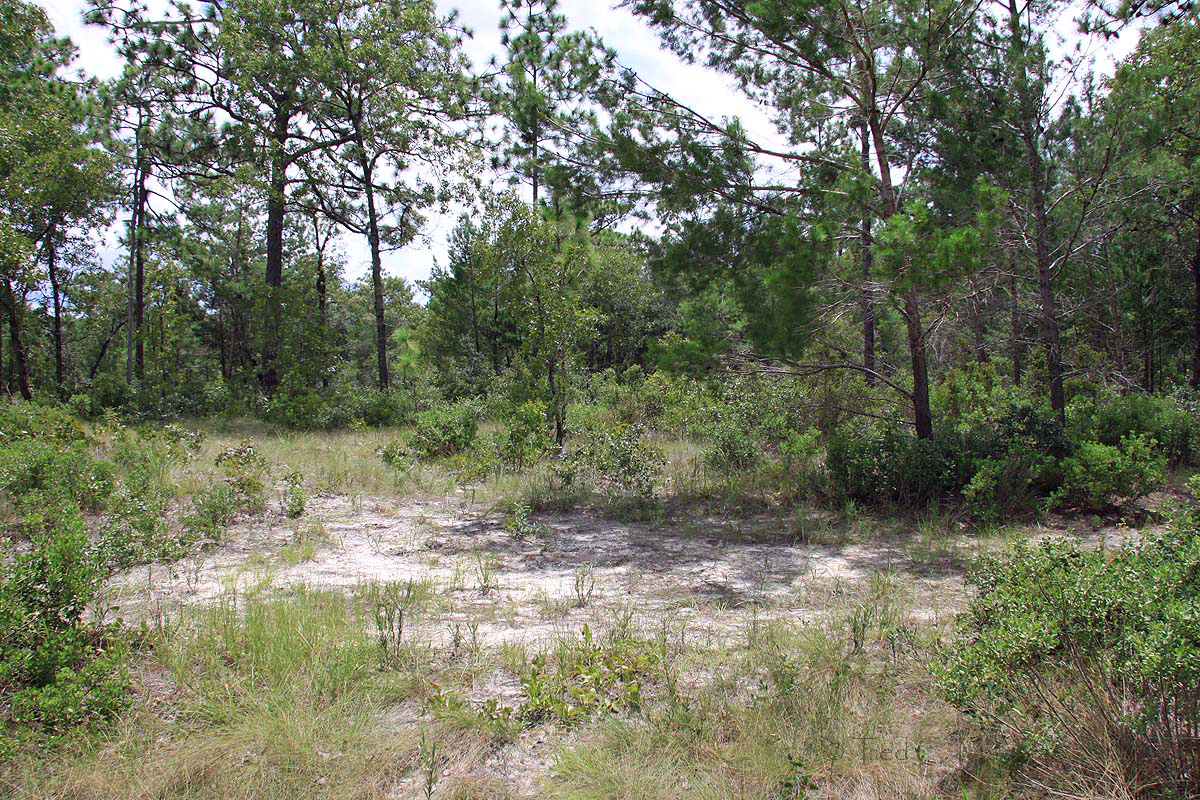
Pine sandhill habitat, Withlachoochee State Forest—Citrus Tract

Among the suggestions given to me by my colleagues, the most promising-sounding was the “end of the road,” a Gulf Coast salt marsh near Steinhatchee in Dixie County where I was told as many as 6-10 species of tiger beetles could be seen at once.  I didn’t know it at the time, but this particular location has achieved legendary status among tiger beetle enthusiasts (Doug Taron recently wrote about his experience, calling it the Road to Nowhere).  A 200+ mile drive from my base near St. Petersburg, it would take the better part of 5 hours to drive there, and not wanting to put all of my eggs in one basket, I looked for potential stops along the way.  About midway along the drive was Withlacoochee State Forest, where one of my colleagues had told me I might still find the fairly widespread Cicindela abdominalis (Eastern Pinebarrens Tiger Beetle) and its close relative, C. scabrosa (Scabrous Tiger Beetle)—the fourth Florida endemic.  My plan was to leave early in the morning and spend a few hours at Withlacoochee before driving the rest of the way to finish out the day at Steinhatchee. 

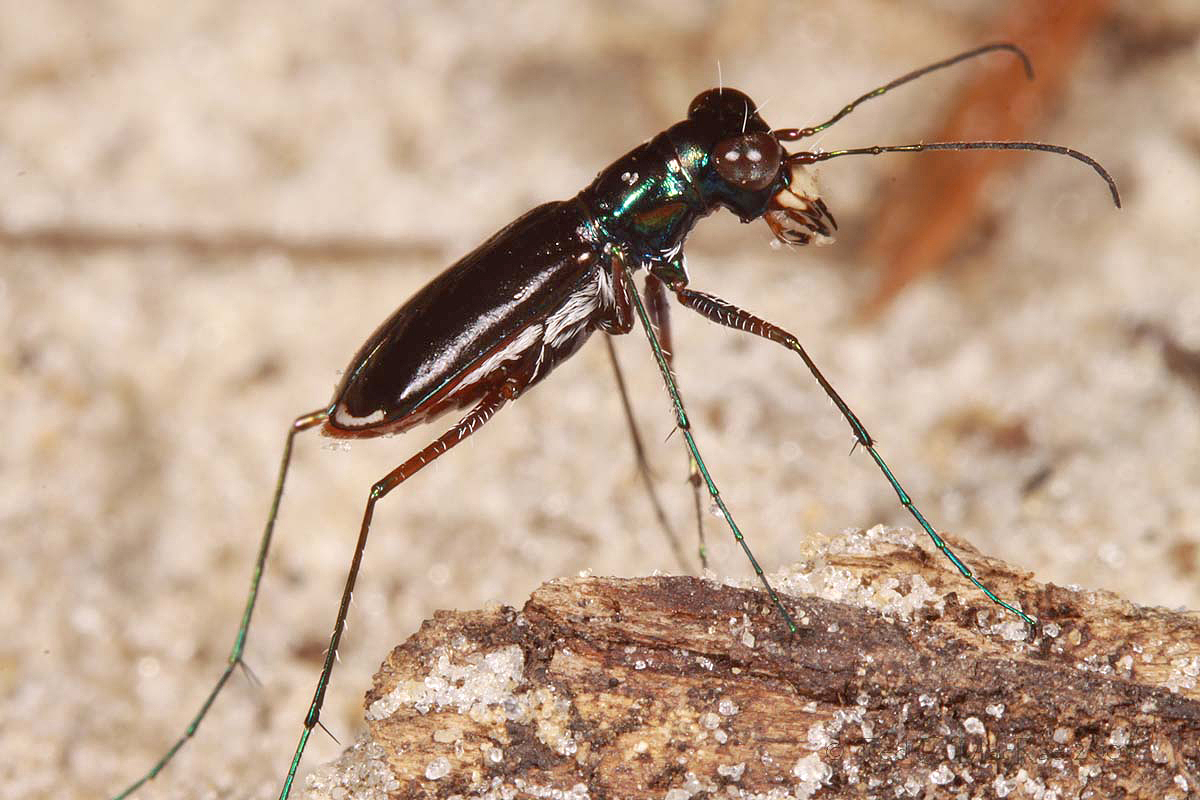
"Stilting" by Cicindela abdominalis (Eastern Pinebarrens Tiger Beetle)

It took some time to find my bearings upon arriving, but after some discussion with the decidedly forestry-oriented staff at the headquarters, it seemed that the Citrus Tract was where I wanted to be.  I was looking for the sand barren and pine sandhill habitats that these species require, and the staff’s description of the northern edge of the tract as having lots of sand and “not very good for growing trees” suggested this might be the place.  Pine sandhill (also called “high pine”) is a pyrophytic (fire-dependent) plant community characterized by sandy, well-drained soils, a widely-spaced longleaf pine (Pinus palustris) and turkey oak (Quercus laevis) canopy, and an herbaceous layer dominated by wiregrass (Aristida stricta).  I quickly found such habitat in the area suggested, and it wasn’t long before I found the first of the two species—C. abdominalis—rather commonly along a sandy 2-track leading through the area.  For those of you who see a distinct resemblance of this species to the rare C. highlandensis that I highlighted from my trip to the central highlands, this is no coincidence.  Cicindela abdominalis is very closely related to that species, the latter distinquished by an absence of flattened, white setae on the sides of the prothorax and the abdomen and by the highly reduced or absent elytral maculations (Choate 1984).  Dense white setae and distinct apical elytral maculations are clearly visible in the individuals shown in these photographs. 

Stilting is often accompanied by "sun-facing" for additional thermoregulation

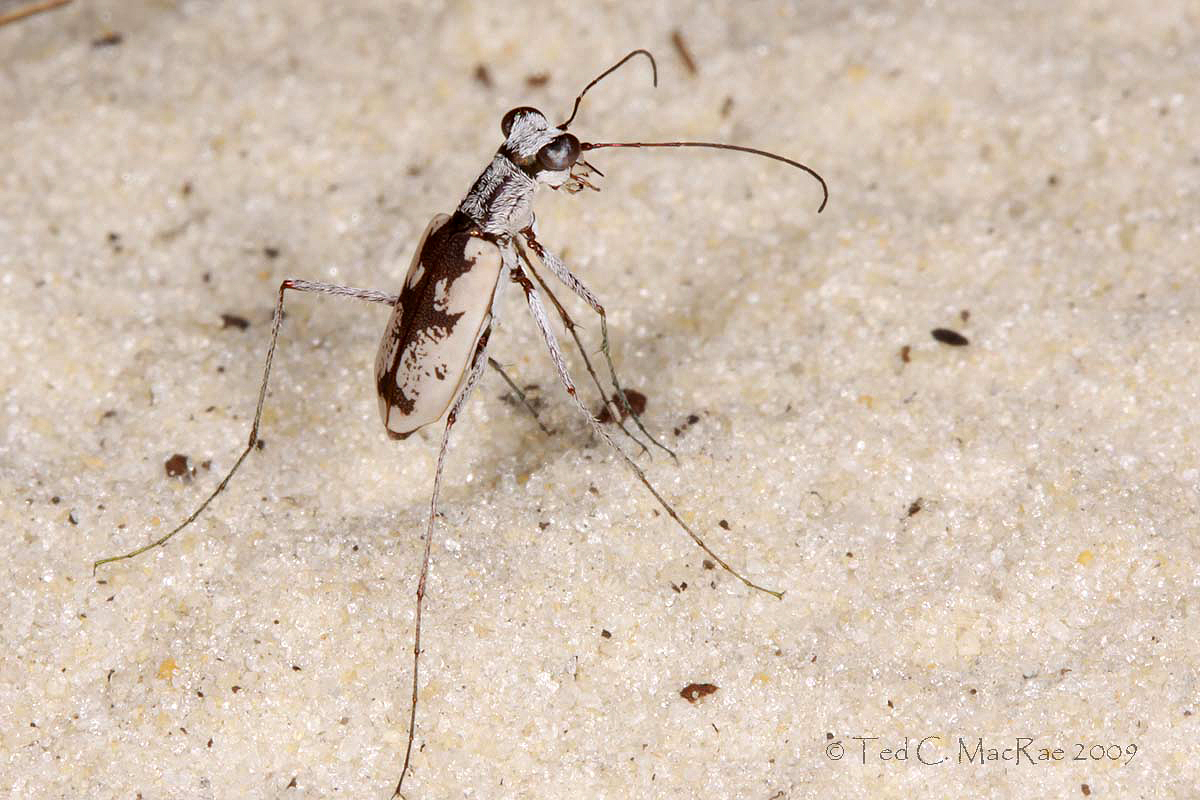
It was a blistering hot day (just as every other day on the trip had been so far), and it wasn’t only me who felt that way.  Tiger beetles, of course, are ectothermic and rely upon their environment for their body temperature.  Despite this, they are able to regulate body temperatures to some degree by using a range of behavioral adaptations intended to mitigate the effects of high surface temperatures and intense sunlight.  The photos above show one of these behaviors, known as stilting.  In this behavior, the adult stands tall on its long legs to elevate its body above the thin layer of hotter air right next to the soil surface and as far off the sand as possible (Pearson et al. 2006).  As the heat of the day intensifies and the zone of hot air at the soil surface broadens, stilting alone may be insufficient to prevent overheating. When this happens, the beetles combine stilting with sun-facing, a behavior in which the front part of the body is elevated with the head oriented towards the sun. This position exposes only the front of the head to the sun’s direct rays, thus minimizing the body surface area exposed to incident radiation.

Stilting and sun-facing by Ellipsoptera hirtilabris (Moustached Tiger Beetle)

I was also fortunate to have another chance at photographing the beautiful and marvelously-camouflaged Ellipsoptera hirtilabris (Moustached Tiger Beetle), which, in similar fashion to C. highlandensis, I found co-occurring with C. abdominalis in rather low numbers. As before, they were extremely wary and difficult to approach, especially in the extreme heat of the day, and all of my best efforts to get a good shot of the species in its “classic” pose were frustrated. The photo above was about as close as I could get to any of these beetles when they were out in the open before they would flee; however, it nicely demonstrates the use of stilting combined with sun-facing during the hottest part of the day.

"Shade seeking" is another behavioral response to intense heat.

Another behavioral response to extreme heat is shade-seeking—adults may either remain active, shuttling in and out of shaded areas, or avoid exposed areas altogether and become inactive.  One thermoregulatory behavior for extreme heat that I did not observe was daytime-burrowing, in which adults construct temporary shallow burrows during the hottest hours of the day. Although I did not observe this behavior by either species at Withlacoochee, I have seen it commonly among several species in sandy habitats here in Missouri and in the Sandhills of Nebraska (e.g., Cicindela formosa, Cicindela limbata, Cicindela repanda, Cicindela scutellaris, Cicindela tranquebarica, Ellipsoptera lepida).

There was one disappointment on the day—I did not see C. scabrosa.  However, I still had the “end of the road” to explore, so I remained happy with the now six species I had encountered and optimistic about finding additional species later in the day… 

Photo Details: Canon EOS 50D, ISO 100.
Habitat: Canon 17-85mm zoom lens (landscape, 17mm), 1/100 sec, f/10, natural light.
Insects: Canon 100mm macro lens (manual), 1/250 sec, f/16–18 (C. abdominalis) or f/20–22 (E. hirtilabris), MT-24EX flash w/ Sto-Fen diffusers.

REFERENCES: 

Choate, P. M., Jr.  1984.  A new species of Cicindela Linnaeus (Coleoptera: Cicindelidae) from Florida, and elevation of C. abdominalis scabrosa Shaupp to species level.  Entomological News 95:73–82.

Choate, P. M., Jr. 2003. A Field Guide and Identification Manual for Florida and Eastern U.S. Tiger Beetles.  University Press of Florida, Gainesville, 224 pp.

Pearson, D. L., C. B. Knisley and C. J. Kazilek. 2006. A Field Guide to the Tiger Beetles of the United States and Canada. Oxford University Press, New York, 227 pp.

Copyright © Ted C. MacRae 2009

Add to FacebookAdd to DiggAdd to Del.icio.usAdd to StumbleuponAdd to RedditAdd to BlinklistAdd to TwitterAdd to TechnoratiAdd to Yahoo BuzzAdd to Newsvine

Email to a friend

Do You Have “An Inordinate Fondness”?

Last week I mentioned that I had been thinking about starting a blog carnival devoted exclusively to beetles.  Actually, I’ve been thinking about it for some time now, but following up on the idea apparently needed a catalyst.  That catalyst came last week when Amber Coakley and Jason Hogle announced the debut of House of Herps—another specialty nature blog carnival, focusing on reptiles and amphibians.  I supported the idea of a herp carnival when Amber first mentioned it, and she responded to that support by actually going out and doing it!  Amber penned a guest post on Nature Blog Network called House of Herps: The Origin Story that described in fascinating detail the process that she and Jason went through in creating a new blog carnival.

Well, the story that Amber told and the details she provided were enough to convince me that I could do it, and the many comments I got on my post last week mentioning what I was thinking about convinced me that I should do it.  The screenshot above is a first peek at the home site of nature blogging’s newest carnival, An Inordinate Fondness (AIF)—the monthly blog carnival devoted to beetles.  The name honors J.B.S. Haldane’s perhaps apocryphal riposte when queried about what his studies of nature’s diversity had taught him about the Creator (a quote made even more famous by the breathtakingly beautiful An Inordinate Fondness for Beetles, written and illustrated by my friends and colleagues, Drs. Charles L. Bellamy and Arthur V. Evans).  Some of you may recall that the alternate name, “Beetle Bacchanalia,” also received strong support (even edging out AIF in raw vote count).  However, while both names imply unbridled passion, I eventually decided that AIF better described the nature of that passion and added historical context.

Even though the AIF website is up and running, the first issue is not scheduled to appear until mid-February.  The reasons for this are primarily personal—I’m already slated to host House of Herps #2 on Jan 18 and Circus of the Spineless #47 on Feb 1 (does this make me a carnival hosting slut?).  There are also still a few things I’d like to have in order before AIF debuts—primarily a badge.  Seabrooke Leckie has offered some help in this regard, and I’ve got a few ideas of my own, but please don’t hesitate to let me know if you’ve got ideas as well.  In addition, I’m hoping this will be the start of getting the word out so that by the time Feb 15 (first issue submission due date) rolls around there will be enough submissions on hand to make the inaugural edition a memorable one.  Lastly, I’m hoping to recruit volunteers for hosting future editions—AIF will be a migrating carnival, dependent upon a community of science and natural history bloggers to keep it going.

My deepest thanks to Amber, Jason, Seabrooke, and Mike Bergin for their very helfpul and supportive comments.

Copyright © Ted C. MacRae

Add to FacebookAdd to DiggAdd to Del.icio.usAdd to StumbleuponAdd to RedditAdd to BlinklistAdd to TwitterAdd to TechnoratiAdd to Yahoo BuzzAdd to Newsvine

Email to a friend

Creepy Crawly Spiders

Today’s post is another in a series of occasional guest essays by 10-year old Madison MacRae.  Madison is certainly the budding naturalist in our family, having accompanied me on recent collecting trips to the sand prairies of southeast Missouri and the White River Hills of southwest Missouri, as well as numerous hikes.  Her previous guest contributions to this blog include “Entumalejust” and “My favorite bettle”

For today’s post, Madison illustrates and discusses several different types of spiders, including the “Tranchala” (several of which she has owned as pets), Wolf spider (seen one day sprawled on the kitchen floor of our house-in-the-woods), “Snow spider” (likely recalling this experience), “Spring spider” (?), “Herry spider” (aren’t they all?), and Crab spider (she came up with this one on her own, honest!).

"Creepy Crawly Spiders" - by Madison MacRae

Copyright © Ted C. MacRae 2009

Add to FacebookAdd to DiggAdd to Del.icio.usAdd to StumbleuponAdd to RedditAdd to BlinklistAdd to TwitterAdd to TechnoratiAdd to Yahoo BuzzAdd to Newsvine

Email to a friend

Give the Gift of Green

The mission of The Nature Conservancy is to preserve the plants, animals and natural communities that represent the diversity of life on Earth by protecting the lands and waters they need to survive.

Blue jay, Oklahoma, USA. Photo © Harvey Payne.

One of my favorite conservation organizations is The Nature Conservancy.  It’s hard to argue with their success—more than 119 million acres of land, 5,000 miles of rivers, and 100 marine projects worldwide have received protection as a result of their efforts.  Even more important than the scale of their success is the manner in which it has been achieved using science and a decidedly non-confrontational focus on partnerships.  I have seen this approach in action in my own state of Missouri at Victoria Glade and at Four Canyon Preserve in Oklahoma, where prescribed burns, managed grazing, and removal of woody vegetation are restoring significant examples of our nation’s unique grasslands to their presettlement glory. 

Yangtze River, China. Photo © Dou Weiyang.

The intial focus of the Conservancy’s conservation efforts was simple: preserve wilderness by buying land. As environmental challenges have increased, the Conservancy has adopted a diversity of tactics to acheive sustainable conservation results.  The Conservancy relies heavily on membership to fund these conservation efforts, with 60% of revenues coming from individuals. A fun and creative way to support the work of the Conservancy during this Holiday Season is through their Green Gift Guide, which offers unique gifts that will go twice as far; pleasing the recipient while at the same time helping the Conservancy in their efforts to protect the world’s most precious habitats for future generations. Following are their Top 5 Green Holiday Gifts:     

  1. Adopt an Acre.  You can choose whether your gift protects unbroken swaths of Appalachians forest, mountain streams in the Rockies, meandering Southern bayous or miles of beautiful sandy beaches where US and Mexico border, or Adopt an Acre abroad in Africa, Australia or Costa Rica.
  2. Plant Trees in the Atlantic Forest. Part of the Conservancy’s Plant a Billion Trees campaign, each tree purchased will be planted in the Atlantic Forest, one of the world’s biggest and most endangered tropical forests.
  3. Adopt a Coral Reef. This unique gift will help protect the coral reefs and beautiful seascapes found in Palau, the Dominican Republic or Papua New Guinea.
  4. Help Save the Northern Jaguar (NEW THIS YEAR). Help to protect the large landscapes that northern jaguars need to flourish. Jaguars roam from as far south as Patagonia all the way to Arizona and New Mexico and your gift will help to provide the dense jungle and scrubland they enjoy.
  5. Give the Gift of Clean Water. Freshwater ecosystems water our crops, light our homes and bring us joy. Help to protect the flow and supply of fresh water and ensuring the well-being of our own species.

For additional eco-friendly holiday gift ideas, visit the Conservancy’s Green Gift Guide.  

Copyright © Ted C. MacRae 2009

Add to FacebookAdd to DiggAdd to Del.icio.usAdd to StumbleuponAdd to RedditAdd to BlinklistAdd to TwitterAdd to TechnoratiAdd to Yahoo BuzzAdd to Newsvine

  Email to a friend

Newest Blog Carnival: House of Herps

Invertebrates?  Check.
Moths?  Check.
Plants?  Check.
Trees?  Check.
Birds?  Check.
Marine life?  Check.
Reptiles and amphibians?… Um… Er…

Despite their popularity, charisma, and status as icons for global conservation, reptiles and amphibians have not enjoyed the same attention by blog carnivals that insects, birds, plants, and even ideas (e.g., evolution) have received.  House of Herps is about to change all that.  The brainchild of Amber Coakley and Jason Hogle, this newest of blog carnivals will fill the void in celebration of all things herpetological.  The inaugural issue is scheduled for the middle of this month, so here’s your chance to be a founding contributor:

So if you love herps—if you photograph them, write about them, sketch or paint artwork based on them, study them, or just happen to see one that you mention on your blog—we want to hear from you for House of Herps #1 coming in mid-December. We also want to hear from you if you’re interested in hosting the carnival.  Please visit the House of Herps site for contact information or send your submission links to us at submissions [at] houseofherps.com.

Submissions for the first issue are due by December 15, but if you miss the deadline don’t despair—I’ll be hosting HoH #2 in January 2010.

Hmm, this gives me an idea.  Moths have their own carnival, why not beetles?  After all, they are far and away the most diverse ordinal taxon on earth (22% of all described life forms are beetles).  What do you think?  Coleo-Carnival?  In Celebration of Elytra?  An Inordinate Fondness?  Beetle Bacchanal?

Copyright © Ted C. MacRae

Add to FacebookAdd to DiggAdd to Del.icio.usAdd to StumbleuponAdd to RedditAdd to BlinklistAdd to TwitterAdd to TechnoratiAdd to Yahoo BuzzAdd to Newsvine

Email to a friend