 In late June I visited Chalk Bluff Natural Area in northeastern Arkansas. Situated at the northeastern-most corner of the state, it is here where the St. Francis River enters Arkansas from Missouri, slicing through the loose Tertiary conglomerates of Crowley’s Ridge before settling into its lazy, meandering course between the two states in the Upper Mississippi Alluvial Plain. The site’s geological history, however, is not what attracted me to it, but rather its status as the state’s only known locality for Cylindera cursitans (ant-like tiger beetle). It was the existence of this population that convinced my colleagues Chris Brown and Kent Fothergill and I that the species must occur in southeast Missouri not only along the Mississippi River, but also along the St. Francis River some 50 miles to the west. Persistence eventually paid off last year when Kent captured a single individual on the Missouri side of the river at Chalk Bluff Access in Dunklin Co. (MacRae et al. 2011).
 Kent had to really work for that specimen, spending several hours crawling through the underbrush in wet, bottomland forests before eventually finding the lone individual. I was confident, however, that my search at the Arkansas site would require far less effort, as Kent had also observed this population during his attempts to locate the species on the Missouri side of the river, writing “I saw more cursitans in an hour than I have seen lifetime total!” The playground/picnic area where Kent had seen them sits right next to the parking lot and is as un-curitans a habitat as one can imagine—tidy and neat, with a nicely-mowed grass lawn under the shade of large oak trees rather than the sweltering, poison ivy choked understory habitats with their attendant swarms of mosquitoes and deer flies that we’ve braved in order to find the species in Missouri. Only the small, intermittent patches of barren sandy loam soil gave a clue that this might be good tiger beetle habitat, and even then one might expect only the more pedestrian species such as Cicindela punctulata and Tetracha virginica and not something as exciting as C. cursitans.
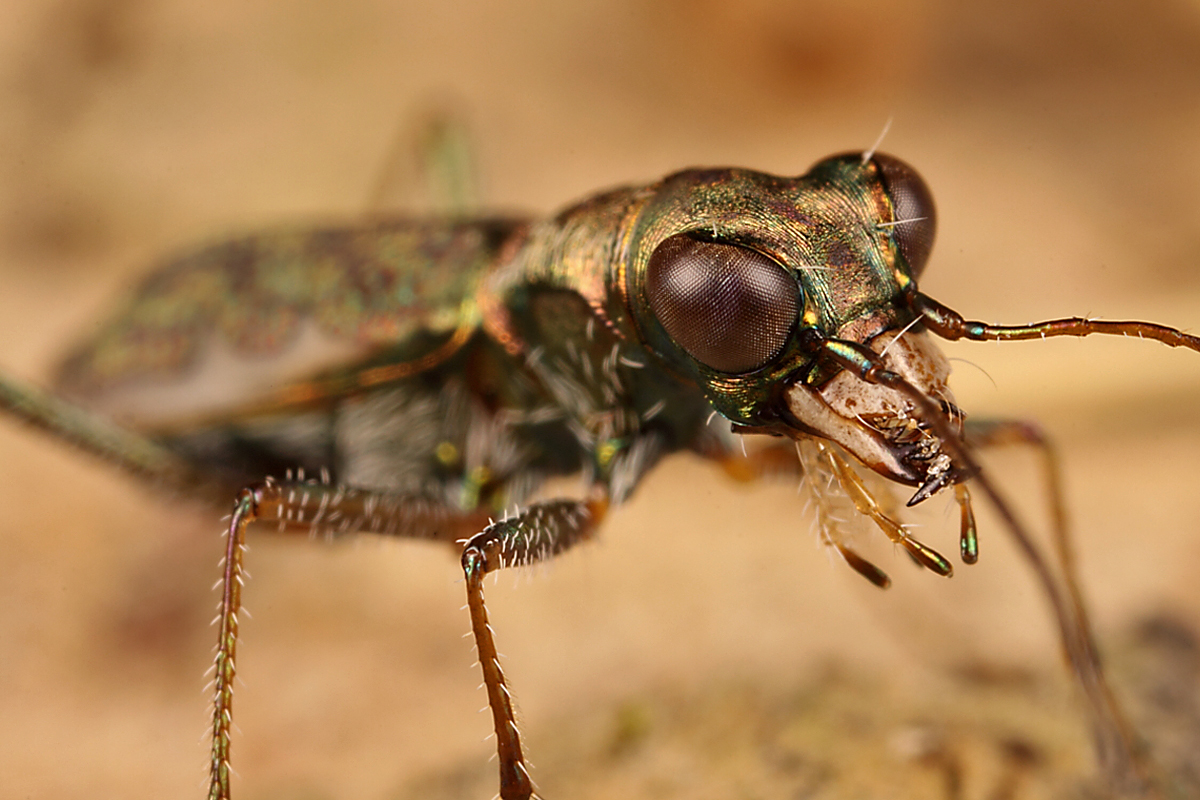 But occur there it does, and hardly a few steps had been taken from the parking lot before I saw that familiar “dash” of movement, looking for all intents and purposes at first like a small spider. A closer look confirmed its true identity, and during the next hour or so I would see countless such individuals—all scrambling rapidly for cover on my approach. I have seen a number of cursitans populations during the course of our surveys for this species in southeastern Missouri, and this population was as robust as any of them.
 Despite my earlier work with this species, I still lacked photographs I was completely happy with—i.e., field photographs of unconfined beetles taken with a true macro lens and flash to control lighting. All of my previous photographs were either taken with a small point-and-shoot camera or had to rely upon beetles confined in a terrarium. The species is not easy to photograph in the field—the small size of the adults (6–8 mm in length) and their cryptic coloration matching the soil surface makes them almost impossible to see until they move. They are also very skittish and are quick to flee when approached, necessitating very slow, deliberate movements in order to approach them closely enough for photographs. Oftentimes adults will run towards and hide up against the base of a clump of grass, where they are even more difficult to photograph, but sometimes they will hide beneath fallen leaves or other debris. Interestingly they do not flee immediately if the leaf/debris is very carefully lifted up and removed—almost as if they think they’re still hidden. I’ve found exposing adults hiding under leaves to be an easier way to get field photographs of the species, although I have noted that some individuals (but not others) seem eventually to adjust to my presence and resume normal activity despite having a camera lens hovering inches away from them.
 Once I had my fill of photographs, I walked the trail to the river and back but did not see any beetles along the trail within the forest (too much leaf litter) or along the river. Surely the beetles occur in these other areas and are not confined in the area just to that small, man-made habitat that is the picnic ground. Seeing this population gives me greater confidence that the species does indeed occur more broadly along the St. Francis River in Missouri than suggested by single individual caught on the Missouri side by Kent.
REFERENCE:
MacRae, T. C., C. R. Brown and K. Fothergill. 2011. Distribution, seasonal occurrence and conservation status of Cylindera (s. str.) cursitans (LeConte) (Coleoptera: Carabidae: Cicindelitae) in Missouri. Cicindela 43(3): in press.
Copyright © Ted C. MacRae 2011





 Beetles In The Bush