Friday Flower – “Palo Borracho”

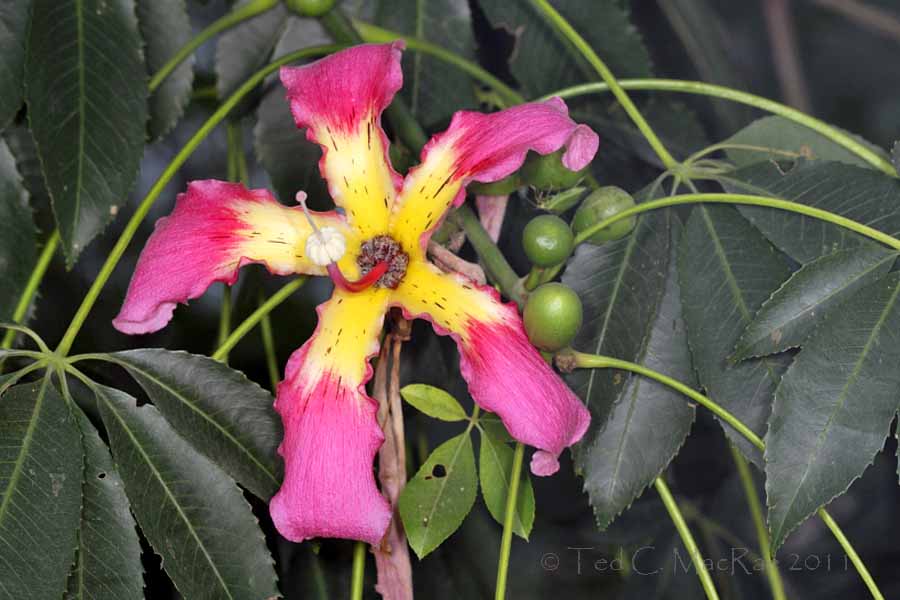
Ceibo may be Argentina’s national flower, but Ceiba is its most iconic flower.  That’s right—Ceibo and Ceiba are two, completely unrelated species!  Ceibo is the common name in Argentina for Erythrina crista-galli, a tree in the family Fabaceae, while Ceiba is a genus of flowering trees in the family Bombacaceae that includes the species pictured above—Ceiba speciosa (syn. Chorisia speciosa), known in Argentina as “Palo Borracho.”  This translates literally to “drunken stick”—a reference to the pot-bellied trunk with narrowed base that gives the tree the appearance of a wine bottle (Haene and Aparicio 2007).  Native to the dry forests of northeastern Argentina, C. speciosa has become an enormously popular street tree in the country due to their dazzling displays of hot pink blossoms, especially in Buenos Aires whose green spaces and wide boulevards are lined with grand old specimens.
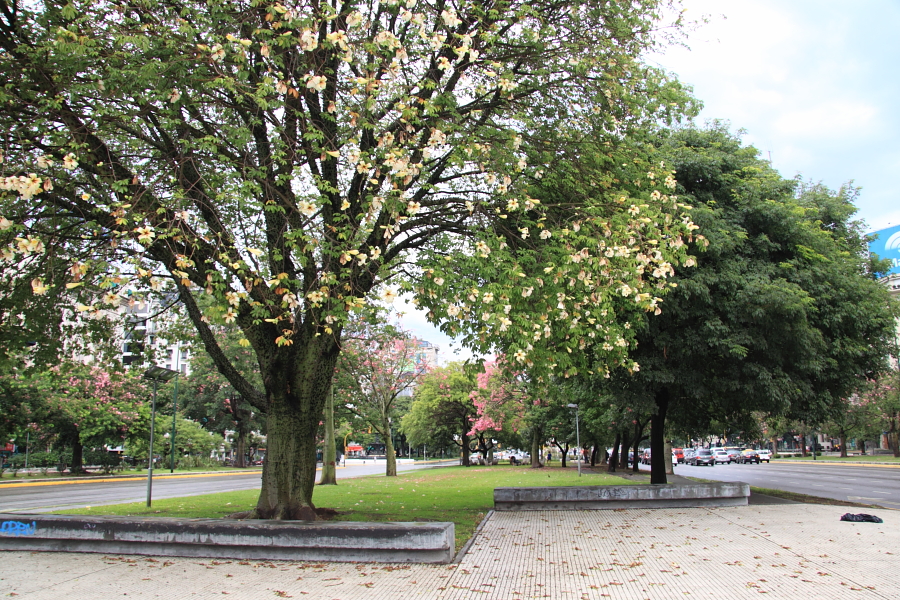
Interspersed amongst the pink flowering trees are occasional specimens with the flowers mostly white but otherwise looking much the same as C. speciosa.  These are the closely related species C. chodattii (syn. Chorisia insignis), or Yuchán.  This species is native to more western, even drier areas of northern Argentina than C. speciosa and has also become popular as an ornamental tree in urban areas, though it has been planted with less frequency than its hot pink-flowered congener.

Bombacaceae also contains the famously odd baobab and kapok trees—also distingished by bulging trunks that serve as an adaptation for water storage in seasonally dry environments.  The trunks of Ceiba trees exhibit an additional water conservation adaptation with thick, conical-shaped thorns that are also capable of water storage.  The young tree picture here was photographed in Campinas, Brazil and exhibits the green coloration typical of younger trees that functions to augment their photosynthetic capabilities. In fact, the dry forests in which Ceiba spp. evolved often contain a number of unrelated plants that also are thorny and have green bark.

REFERENCE:

Haene, E. and G. Aparicio.  2007.  100 Trees of Argentina. Editorial Albatros, Buenos Aires, República Argentina, 128 pp.

Copyright © Ted C. MacRae 2011

Feasting on the bounty

Brood XIX periodical cicadas were not the only insects appearing en masse last week at Sam A. Baker State Park in Missouri’s southeastern Ozark Highlands.  As I walked the upland trail, I thought I felt ‘raindrops’ for awhile before realizing that it was frass.  Little pieces of fresh young leaves littered the trail around me, and I realized that an outbreak of caterpillars was hammering the oak trees in this forest.  Unlike the cicadas, which were encountered primarily in the bottomland forest along Big Creek, the rain of poop was restricted to the uplands.  Not surprisingly, I saw caterpillar hunters, Calosoma spp. (family Carabidae—the real Carabidae, not the tiger beetle Carabidae that I’ve begrudgingly had to accept) about as abundantly as I’ve ever seen them.  At first I didn’t notice them until I would scare one up, then spend several frustrating minutes trying to photograph a beetle that just would not stop running.  I tried a few and gave up—after all, they’re just ground beetles (i.e., real ground beetles).  Eventually, I realized that if I noticed them before they noticed me, I could sneak up on them and have my way with them (photographically speaking, that is).  I even found that I could preen nearby leaves and sticks for composition if I did it carefully enough.  Here are a couple of my favorite shots on the day.

I would presume these to represent the fiery searcher, Calosoma scrutator, but apparently C. wilcoxi is similar in appearance.  According to comments by several BugGuide users, C. scrutator is larger (25mm or more in length), has more elongated mandibles and head, and the color of the central purple area of the pronotum is more intense.  Based on those comments, I would say the two individuals in these photographs are C. scrutator.  However, they also note some differences in temporal occurrence that don’t seem to support that.  Moreover, the many individuals I saw that day ranged in size from these larger individuals to some notably smaller ones.

Copyright © Ted C. MacRae 2011

Love is in the air!

My first tiger beetle photograph of the season. There’s nothing more adorable than Spring love!

Cicindela tranquebarica (oblique-lined tiger beetle) | St. Joe State Park, Missouri

Photo details: Canon 50D w/ 100mm f2.4 macro lens (ISO 160, 1/200 sec, f/16), Canon MT-24EX twin flash w/ DIY oversized concave diffuser.

Copyright © Ted C. MacRae 2011

“They’re baaaaack!”

The recent run of seemingly interminable rains and HF4 tornadoes may have delayed the Annual-Birthday-First-Bug-Collecting-Trip-of-the-Year™, but it could not cancel it.  On Thursday this week, for the first time since the same time last week, a strange ball of hot gas appeared in the sky, temperatures tickled the 70°F mark, and the only moisture we encountered was already on the ground.  The weatherman said several days ago it would happen, so I put my faith in his word and made plans with my dad to do what I had planned to do last week – officially open the 2011 bug collecting season.  It was a marvelous day in which many interesting stories unfolded, one of which I’ve heard (literally) a few times already.

One of our stops was Sam A. Baker State Park in southeastern Missouri.  My original reason for coming here involved dead wood retrieval (success) and rattlesnakes (failure, though with a consolation prize – more later).  As we were walking the trail in the bottomland forest along Big Creek, I noticed all these holes in ground.  At first I assumed a group of hikers wielding their fashionable trekking poles had gone before us and left their mark in the muddy, recently flooded soil, but the holes were just too numerous and not all perfectly round.  I had just commented to my dad, “What the heck caused all these holes?”, when I saw the culprit – a fully grown periodical cicada nymph crawling on the ground looking for a tree to climb and begin life as one of the noisiest insects on earth.  I looked around and saw another one, and another… they were everywhere!  Boy, are we gonna be in for it this year!

Missouri and several other Midwestern states will be hosting periodical cicada Brood XIX—the Great Southern Brood!  All four of the 13-year species (Magicidada tredecassini, M. tredecula, M. tredecim, and M. neotredecim) participate in this brood, the largest of the 13-year broods by geographical extent, and occur in Missouri in variously overlapping ranges.  Magicicada tredecim and M. neotredecim are the two most common species in the Ozark Highlands across the southern part of the state, so the nymphs shown here likely represent one or both of those species.

I remember well the previous two appearances of brood XIX in Missouri in 1998 and 1985, when beating for buprestids during May and June was an exercise in futility due to every tree branch literally dripping with these bumbling, screeching insects (too bad I never find buprestids dripping from tree branches like this).  Those that didn’t land flapping clumsily on the sheet ended up desperately clinging to my head or flying into my face.  If swatting at these flying bullets wasn’t maddening enough, the ceaseless, droning, omnipresent cacophony of their singing was almost enough to send me to the local psycho ward begging for admittance.

I think I’ll skip trying to use the beating sheet this year.

Copyright © Ted C. MacRae 2011

Bichos Argentinos #11 – Takes Two to Tango

Epilachna vigintioctopunctata (vaquita de las solanáceas) | Buenos Aires, Argentina

Another of the insects that I photographed at La Reserva Ecológica Costanera Sur, Buenos Aires, Argentina during my early March visit.  I found quite a few of these beetles feeding on the newly sprouting growth from cut stumps of a small, multi-stemmed tree.  At first I thought they were leaf beetles of the family Chrysomelidae because of the way they were actively feeding on the fresh, succulent growth; however, a closer look quickly revealed them to be members of the family Coccinellidae (ladybird beetles).  Their phytophagous, gregarious behavior immediately identified them as members of the subfamily Epilachninae, and in fact they bear a remarkable resemblance to Epilachna varivestis (Mexican bean beetle) and E. borealis (squash lady beetle) – the best known examples of this subfamily in North America.

Armed with confidence in at least a subfamilial placement, I looked for references on the group and quickly found a reasonably recent revision of the subfamily for the entire Western Hemisphere (Gordon 1975) – jackpot!  I reasoned an abundant species seen in the heart of the 3rd largest city in South America would likely show up on page one, but after several increasingly careful passes through the entire revision, it became clear that whatever species this was, it was not among the nearly 300 species (2/3 of them in the genus Epilachna) treated in that work. 

Now, the exuberant, young, not-very-sage entomologist that I was 30 years ago would have immediately gotten all excited that I had found a new species, but the older, battle-tested, more cautious entomologist that I am now instead started suspecting I was dealing with an introduced species.  After all, some of the insects and plants I’ve already featured from this man-made nature reserve are introduced.  I figured as abundant as the beetles were, the species had to be featured on some website, so I started with the obvious and Googled “Coccinellidae Argentina,” clicked on the very first result (appropriately titled Coccinellidae of Argentina), and found a seemingly authoritative site with links to the different subfamilies.  Clicking on Epilachninae and scanning the photos, there it was – Epilachna vigintioctopunctata (28-spotted ladybird beetle).  Native to India and southeastern Asia, this species is well known for its attacks on numerous solanaeous and cucurbitaceous crops (Richards 1983).  It made its first appearance in the Western Hemisphere in southern Brazil (Schroder et al. 1993) and in 1994 was observed on experimental eggplant plots at the School of Agronomy, University of Buenos Aires (Folcia et al. 1996).  Poetically, those initial specimens were sent to Robert Gordon at the U.S. National Museum (and author of the Western Hemisphere revision), who confirmed their identity.  It seems that Argentinians are not the only ones that like to tango!

REFERENCES:

Folcia A. M., S. M. Rodriguéz and S. Russo. 1996. Aspectos morfológicos, biológicos y de preferencia de Epilachna vigintioctopunctata Fabr. (Coleoptera Coccinellidae). Boletin de Sanidad Vegetal Plagas 22:773–780.

Gordon, R. D. 1975. A revision of the Epilachninae of the Western Hemisphere (Coleoptera: Coccinellidae). U. S. Department of Agriculture, Technical Bulletin No. 1493, ii+409 pp.

Richards, A. M.  1983.  The Epilachna vigintioctopunctata complex (Coleoptera: Coccinellidae).  International Journal of Entomology 25(1):11–41.

Schroder, R. F. W., M. M. Athanas and C. Pavan. 1993. Henosepilachna vigintioctopuctata (Coleoptera-Coccinelidae), new record for Western Hemisphere, with a review of host plants. Entomological News 104(2):111–112.

Copyright © Ted C. MacRae 2011

Itty bitty tiny little flies

Saturday was my birthday, and for most of my adult life it has been tradition to take the day off for the Annual-Birthday-First-Bug-Collecting-Trip-of-the-Year™.  At Missouri’s middlin’ latitudes, late April is normally a tad early—at least for the groups that interest me, but it’s less about serious bug collecting and more about kicking off the season in a bit of a special way.  Normally if my birthday falls on a weekend, as it did this year, I’ll take off the adjacent weekday instead (it’s not special if you can’t take off any time from work).  However, this year that wasn’t possible due to events at work far beyond my little sphere of influence (conspiracy #1), thus Saturday itself became the planned day.  My family and I celebrated Friday evening so I could have the whole day on Saturday, and as we ate we watched news reports of suspected tornadoes ripping through St. Louis just to our north and a little further south (conspiracy #2).  Forecasts called for rain continuing well into the following week (conspiracy #3), and for the first time in… well… ever, I had the feeling the ABFBCTOTY might be cancelled due to weather.  Waking the next morning, I turned on the television to see precipitation forecasts across the state (1″ in northwest Missouri to 6″ in southeast Missouri) amidst stunning chopper video footage of neighborhoods destroyed and lives turned upside down.

I stopped counting conspiracies and hugged my girls!

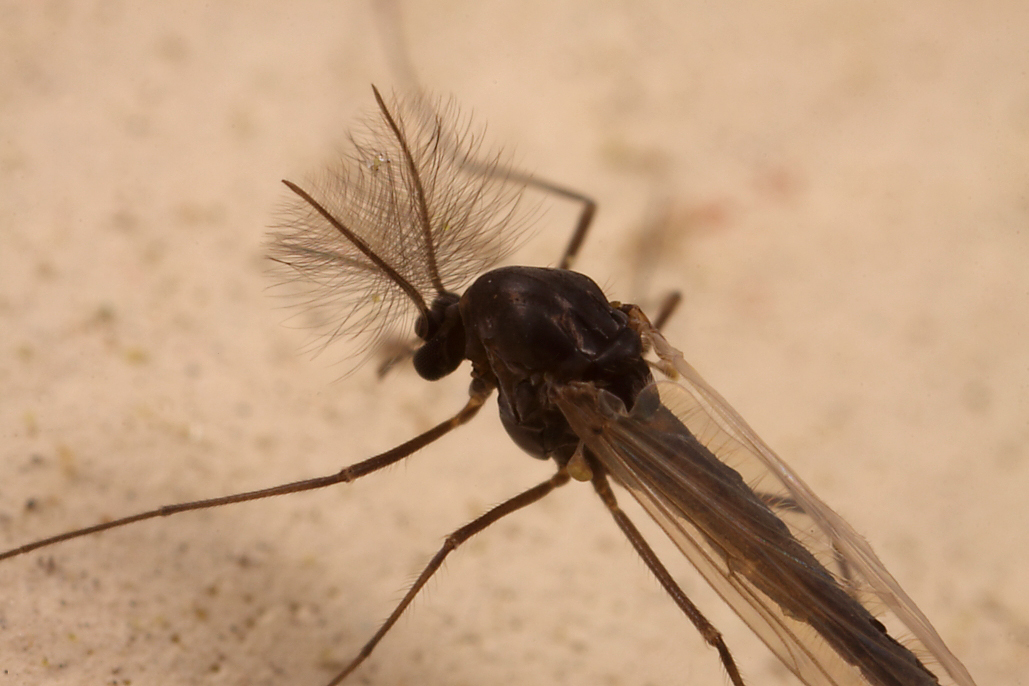
That evening, I turned on the mercury vapor lamp over the garage door for the first time since last year to see if anything might show up.  We live in a heavily wooded area of western St. Louis Co. featuring relatively intact mesic upland forest dominated by several oaks, hickories, and sugar maples that harbor a nice diversity of woodboring beetles and treehoppers (though I didn’t expect to see these on this night).  The night was cool and clammy—nothing but a few moths and flies showing up.  Some of the flies were quite small, and some were extraordinarily small—not more than 1 or 2 mm in length.  Tiny little specks of life!  I thought it might be fun to get in some practice time with the 65mm lens, and the sampling shown below represents a few of those taken with the lens maxed out at 5X (resulting in a frame width of ~5mm):

Male non-biting midge (Chironomidae) | St. Louis Co., Missouri

Female non-biting midge (Chironomidae) | St. Louis Co., Missouri

Moth fly (Psychodidae) | St. Louis Co., Missouri

Same individual as above, chased onto a finished wooden table to highlight its dense pilosity

Copyright © Ted C. MacRae 2011

Friday Flower – Hedychium coccineum

Distrito Joaquim Igidio is one of four “districts” surrounding Campinas, Brazil.  It is the most remote of the four, with farmsteads dating back more than a century interspersed amongst some of the most significant tracts of Atlantic forest still remaining in the area.  Many of the farmsteads have recently been converted to bars and restaurants featuring live music, making the area a popular weekend getaway for Campineros.  I joined my colleague and some of his friends on a visit to one of these—Bar do Cachoeira—over the weekend during my visit this past January.  After a sumputuous lunch of Brazilian cuisine (including tohesmo torresmo—my new favorite dish) and cerveja, I walked the grounds to look for insects to photograph.  Despite only having an hour or so to look around, the two species of treehoppers I found and photographed made it a successful little venture.  Coming back to rejoin my friends, I saw a few plants with these marvelously bizarre inflorescenses growing alongside a forested stream running through the grounds.  I could tell they were some type of monocot, but beyond that I had no idea.  Something inside me suspected, however, that this was likely not a native species—it just had that introduced, tropical ornamental look to it.  My suspicions were confirmed when I showed the photos to Dr. George Yatskievych, Curator at the Missouri Botanical Garden and Director of the Flora of Missouri Project.  George identified the plant as Hedychium in the Zingiberaceae (ginger family), likely one of the cultivars of Hedychium coccineum.  He added:

This species is native to tropical Asia, but is commonly cultivated in warm regions of the world. A number of cultivars and hybrids involving related species are sold, so it’s hard to be sure which one you photographed.  The most common cultivar seems to be cv. ‘Tara’ and that’s a possibility for your plant.

Known by a number of common names (red gingerlilly, orange gingerlily, scarlet gingerlily, orange bottlebrush ginger, etc.), H. coccineum hails from the eastern Himalyas, where it grows along forest edges and in mountain grasslands.  This herbaceous perennial can reach one to two metres in height and, in some places, has become somewhat invasive.  The existence of rhizomes and bulbs can make control particularly difficult.

An interesting feature of the plant is the long, exserted stamens and stigmas of the flowers.  This feature is suggestive of an interesting pollination mechanism that relies on pollen attachment to the wings rather than the main body of its moth and butterfly pollinators. Pollen transfer is effected as the lepidopterans move from flower to flower seeking nectar, brushing their wings against the floral parts in the process and thus pollinating the flowers (Zomlefer 1994).

REFERENCE:

Zomlefer, W. B. 1994. Guide to flowering plant families. University of North Carolina Press, Chapel Hill, 430 pp.

Copyright © Ted C. MacRae 2011

Bichos Argentinos #11 – I’m out’a here!

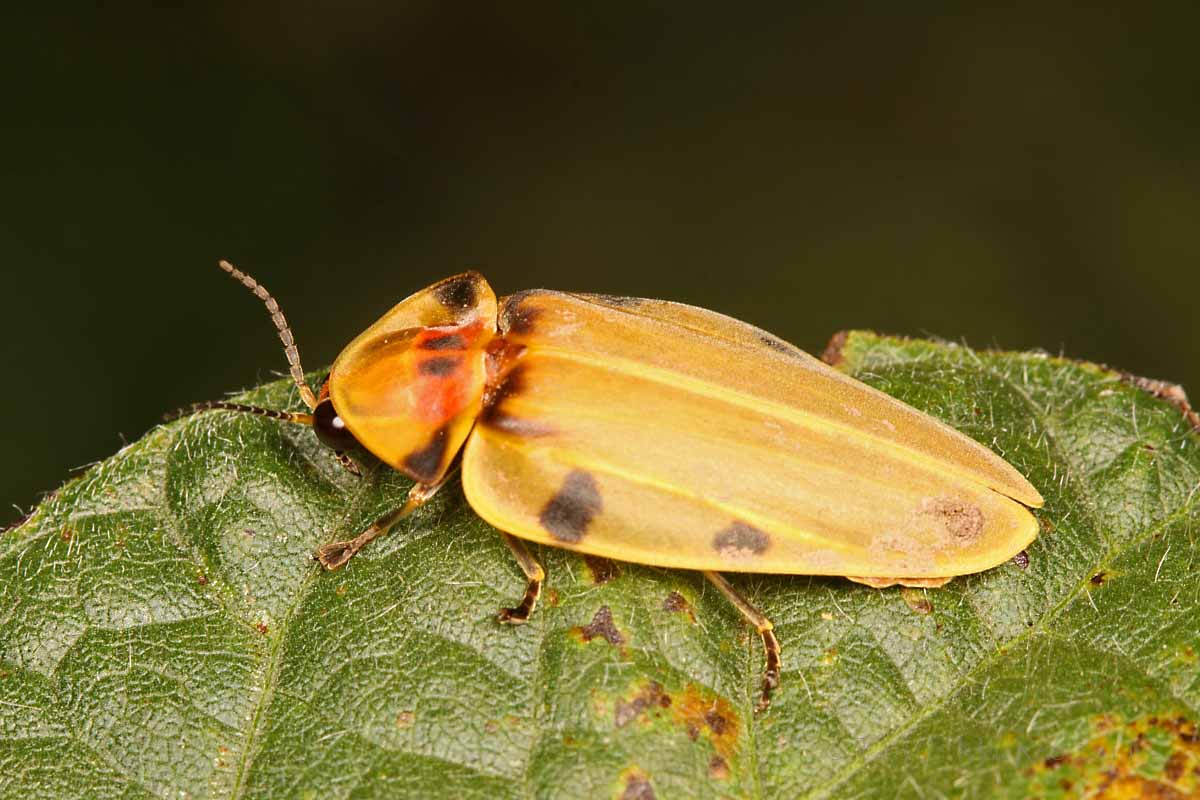
Neither of these photos are very good, but it’s the firefly’s fault.  I saw it last month in a soybean field in Buenos Aires Province, Argentina. I got off the first shot, but the flash disturbed it and it started walking around. I quickly set up for another shot, got it framed, fired the shot, and saw the second photo on the screen!

Everything about this firefly seems backwards – most fireflies are black with yellow, orange or red markings – this one is yellow with small black markings.  The terminal segments of the abdomen are dark while the rest are light – opposite of most other fireflies.  This one was out and about during the day, while most others are crepuscular or nocturnal.  Maybe it’s a result of being in the Southern Hemisphere – opposite of most other fireflies I’ve seen.

Copyright © Ted C. MacRae 2011