Four-humped Longhorned Beetle

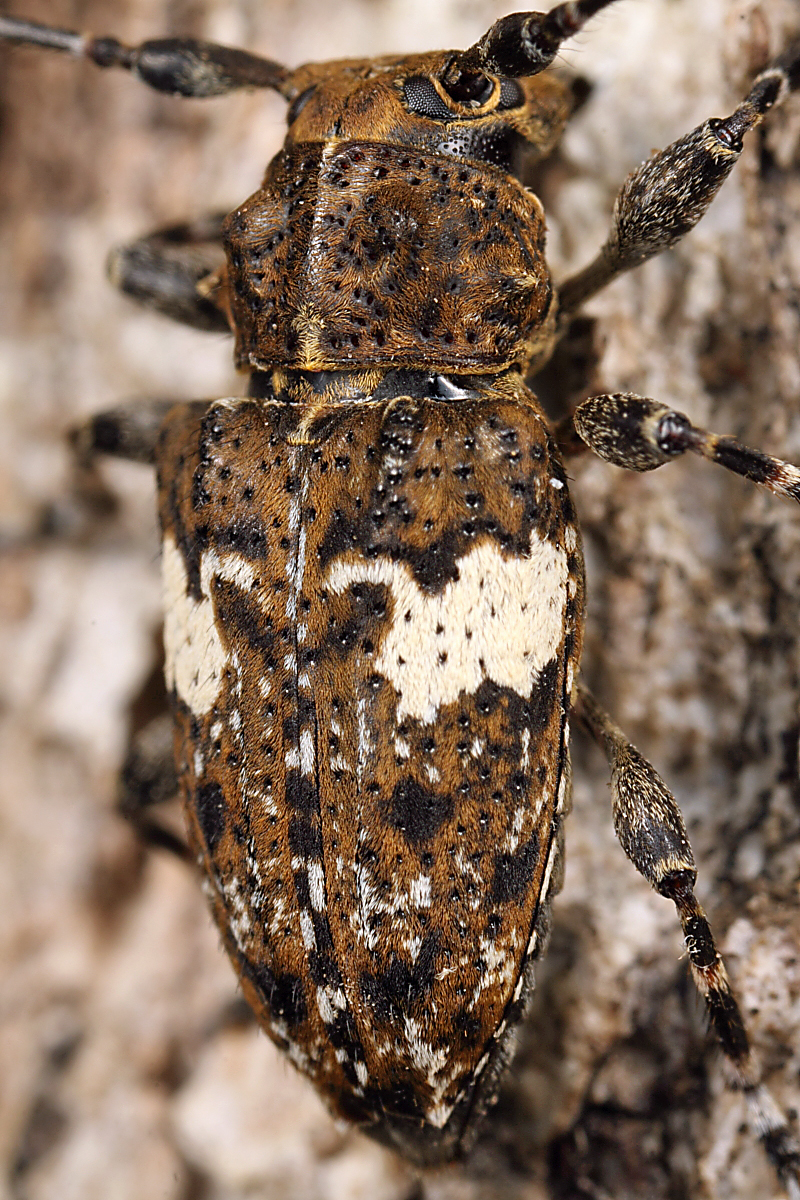
Acanthoderes quadrigibba | Chalk Bluff Natural Area, Arkansas.

On a recent collecting trip, I went over to Chalk Bluffs Natural Area in the Mississippi Alluvial Plain of northeastern Arkansas.  My quarry was a population of Cylindera cursitans (ant-like tiger beetle) that has been reported from the site—one of the only known sites for the species in Arkansas.  While I was there, I noticed some movement on the trunk of a tree, and a closer look revealed that what appeared to be a piece of bark was actually a beetle—a longhorned beetle to be precise.  The elevated gibbosities of the pronotum and white, transverse fasciae of the elytra immediately identify it as Acanthoderes quadrigibba, a not uncommon species in the eastern U.S., but one that I still get excited about whenever I encounter it.

Note the four pronotal ''humps'' in this dorsolateral profile view.

Judging by the number and diversity of plant genera that have been recorded as larval hosts for this species—Linsley and Chemsak (1984) recorded Acer, Betula, Carya, Castanea, Celtis, Cercis, Fagus, Ficus, Quercus, Salix, Tilia, and Ulmus—you could be forgiven for thinking that this is one of the most common and abundant species of longhorned beetle in North America.  I have not found this to be the case, and I don’t think it is because I’m simply missing it due to its cryptic appearance.  Longhorned beetles in the tribe Acanthoderini are, like many species in the family, quite attracted to lights at night, and I’ve done plenty of lighting over the years.  What I have noticed is that nearly all of my encounters with this species have been in the Mississippi Alluvial Plain—an area rich with wet, bottomland forests that contrast markedly from the dry to dry-mesic upland forests that cover much of the southern two-thirds of Missouri.  I’ve also reared the species a few times from Salix, one of the host genera recorded by Linsley and Chemsak (1984).  In both cases, the wood was not freshly dead (as is commonly preferred by many other longhorned beetles), but a little past its prime and starting to get somewhat moist and punky.  In the case of this beetle, I suspect that the nature of the host wood may be more important than the species, the preference being for longer dead wood in moister environments.  Of course, observations by another collector in another state may completely obliterate my idea, but for now it sounds good.

A closeup photograph of the elytral markings of this beetle was the subject of ID Challenge #9, to which a record 18 participants responded (thanks to all who played!).  Troy Bartlett takes the win with 12 points (and attention to detail), while Dennis Haines, Max Barclay, Mr. Phidippus, and Josh Basham all score double-digit points.  Troy’s win moves him into the top spot in the overall standings of the current BitB Challenge Session with 23 pts, but Dave is breathing down his neck with a deficit of just a single point.  Tim Eisele and Max Barclay have also moved to within easy striking distance with 19 and 18 points, respectively, and several others could make a surprise move if the leaders falter.  I think I’ll have one more challenge in the current session before deciding the overall winner—look for it in the near future. 

REFERENCE:

Linsley, E. G. and J. A. Chemsak. 1984. The Cerambycidae of North America, Part VII, No. 1: Taxonomy and classification of the subfamily Lamiinae, tribes Parmenini through Acanthoderini. University of California Publications in Entomology 102:1–258.

Copyright © Ted C. MacRae 2011

Tracking Tetraopes texanus with Terry

Last month I traveled to Starkville, Mississippi to meet with an academic cooperator at Mississippi State University.  While arranging the trip, I contacted Terry Schiefer (no, not the fashion jewelry designer, but curator at the Mississippi Entomological Museum) to let him know I would be visiting.  Considering that late May should be pretty good insect collecting in that area, I wanted to see if he might be interested in doing a little beetle collecting after I finished up with my meetings.  Terry also specializes in Coleoptera and shares with me an interest in the taxonomy and faunistics of Cerambycidae and Cicindelinae.  I first met Terry some 13 years ago during my previous visit to MSU; I remember ogling at an impressive series of Aegomorphus morrisii, a spectacular species of longhorn beetle that was known at that time by precious few specimens and that he had recently found in Mississippi.  We hadn’t seen each other since but managed to keep in contact with occasional correspondence during the course of our longhorn studies.

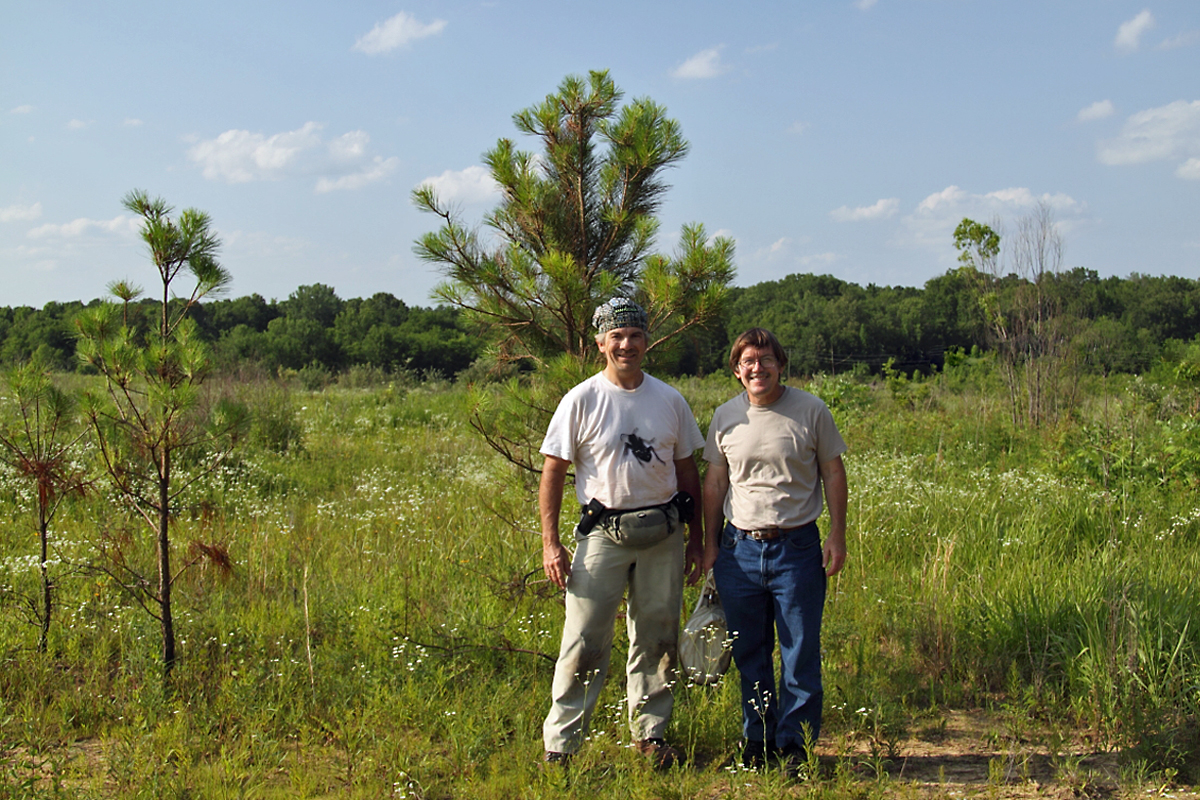
Me & Terry Schiefer | Noxubee National Wildlife Refuge, May 2011.

Terry was more than happy to go beetle collecting with me, and among the possibilities that he mentioned when I arrived at the museum was nearby Noxubee National Wildlife Refuge.  I had done a little collecting there on my last visit, but I was especially intrigued when he mentioned the local population of an uncommon milkweed beetle species, Tetraopes texanus, that he had reported in one of the refuge’s prairie remnants (Schiefer 1998).  I have only seen this species once, up here in in east-central Missouri and which I reported as the species’ northernmost known population (MacRae 1994).  My more recent attempts to find this species have not been successful, so I was excited at the chance to see this longhorned species once again.

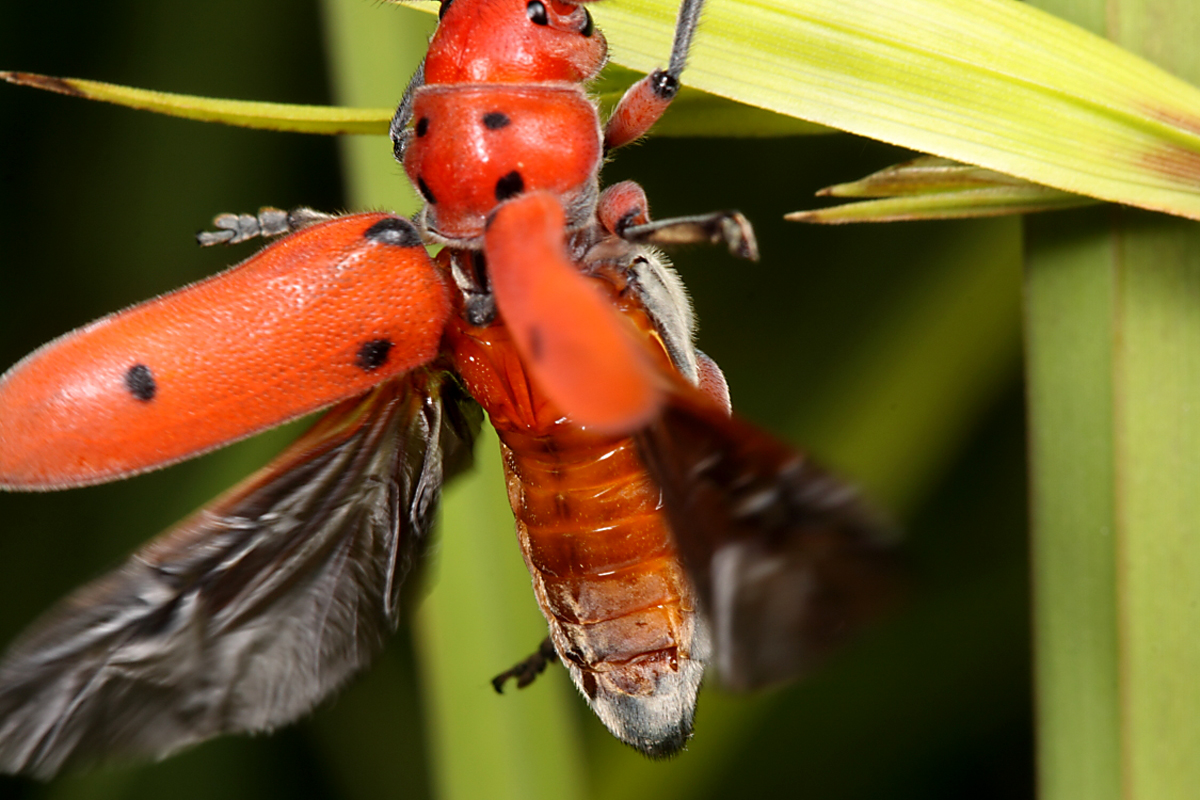
We arrived at the prairie with plenty of daylight to spare and began walking through the area where Asclepias viridis (its presumed host in Mississippi; in Missouri I found it on Asclepias viridiflora) was growing.  Typically milkweed beetles are quite approachable, having nothing to fear from predators by virtue of the cardiac glycosides that they sequester in their bodies from their milkweed foodplants and advertise so conspicuously with their bright red and black coloration.  Thus, we were looking for beetles sitting brazenly on the plants, but none were seen.  Eventually, Terry saw one in flight, and then I saw one in flight as well.  For some time, this was the only way we were seeing the beetles, and only by slowing down and scanning the prairie vegetation more carefully and deliberately did we begin to see the adults sitting on vegetation.  Interestingly, very few of them were seen actually sitting on milkweed plants.  Rather, they were on all manner of other plants, and they were very quick to take flight on our approach.  This was playing havoc with my desire to get field photographs of the beetles, especially field photographs on the host.  I decided that any photograph—host plant or not—was better than none, so I began attempting some shots.  My first one didn’t work out so well:


Finally I was able to get one of the beetle sitting on a plant, but the dorsal characters can’t be seen, nor is there anything about the photo that allows the species to be distinguished as T. texanus (the abruptly attenuate last antennomere distinguishes it from similar-appearing species):


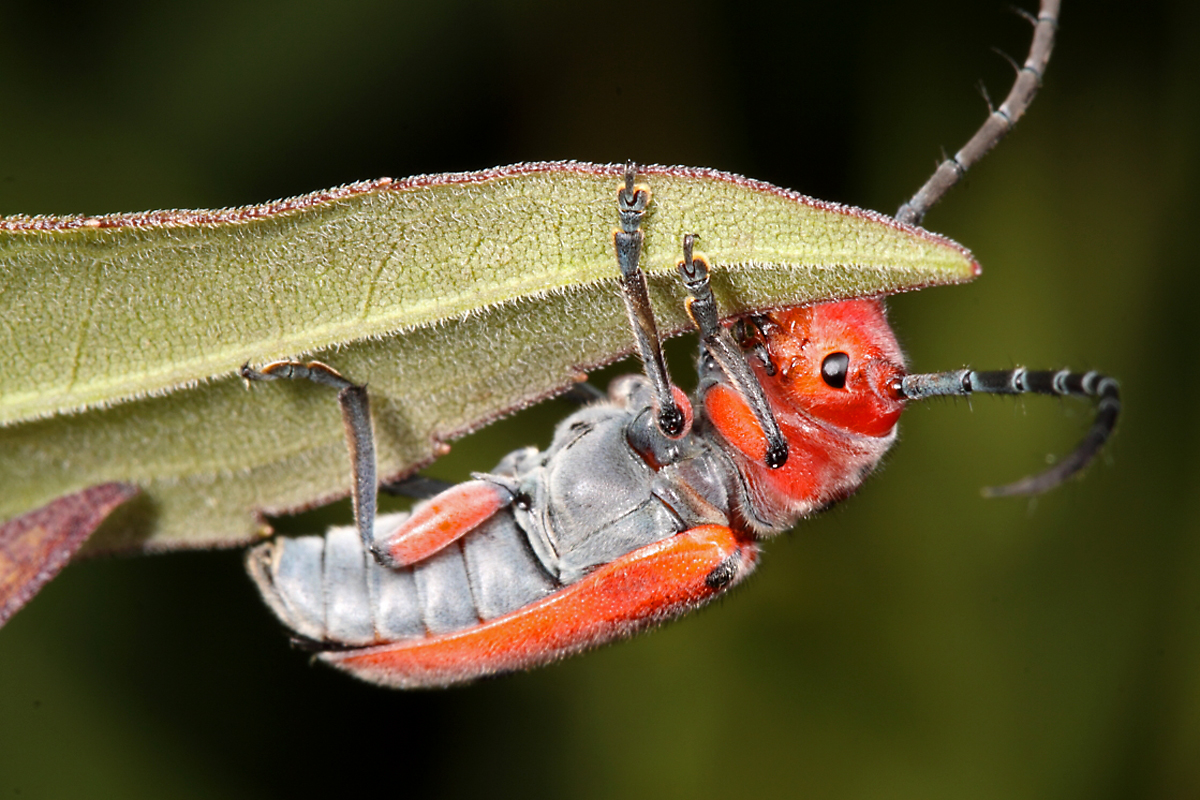
Progress—more of the dorsal surface can be seen in the photo below, and the beetle is actually sitting on a milkweed plant.  However, the antennal tips are still frustratingly out of focus.  Note the completely divided upper and lower lobes of the eye—Tetraopes beetles give new meaning to the term “four-eyes”:


I chased beetle after beetle in flight, endlessly zigzagging across the prairie in what had to be a spectacle to any unknown observer.  Eventually, we found a beetle sitting on its host plant, and it remained calm during my deliberate approach.  I circled around for a good view of the dorsal surface and snapped off an apparent winner—everything in focus, good composition… but arghh, the antennal tips were clipped!


I kept at it and was about to back off a bit on the magnification and switch to landscape mode so I could get the full antennae in the frame when the beetle turned in a most fortuitous manner—nicely positioning its distinctive antennal tip right in front of a bright green leaf for contrast.  My friends, I present Tetraopes texanus on its presumed host plant, Asclepias viridis!


Terry and I were both puzzled by the flighty, nervous behavior that the beetles were exhibiting.  Neither of us had seen such behavior with milkweed beetles before, and I’m not sure I can offer any explanation for such.  I’d be interested in hearing any ideas you might have.

My thanks to Terry for showing me a few of his favorite spots (allowing me to collect a few choice species of longhorns), and to my co-worker/colleague Jeff Haines for indulging my desire mix a little beetle collecting into the business trip.  I hope they enjoyed it as much as I did.

REFERENCES:

MacRae, T.C. 1994. Annotated checklist of the longhorned beetles (Coleoptera: Cerambycidae and Disteniidae) occurring in Missouri. Insecta Mundi 7(4) (1993):223–252.

Schiefer, T.L. 1998. Disjunct distribution of Cerambycidae (Coleoptera) in the black belt prairie and Jackson prairie in Mississippi and Alabama. The Coleopterists Bulletin 52(3):278–284.

Copyright © Ted C. MacRae 2011

Recent literature – The Coleopterists Bulletin

Volume 64, No. 4 - December 2010

I returned to the office this week after spending two weeks in Brazil to find the December 2010 of The Coleopterists Bulletin in my inbox.  I don’t think there is another journal that I look forward to more eagerly than this one (with the possible exception of CICINDELA) – with each issue, I know that regardless of whether it contains any papers in my priority groups of interest (jewel beetles, longhorned beetles, and tiger beetles), it will nevertheless contain well-written articles presenting results of high-quality research on nothing but beetles – pure elytral ecstasy!  This latest issue, however, is a real keeper.  Gracing the cover is a stunning image of the South African jewel beetle species Julodis viridipes, photographed by my good friend and world jewel beetle expert Chuck Bellamy, and inside are three tiger beetle papers and two longhorned beetle papers – it’s almost as if the issue were produced just for me.

Friend and colleague Mathew Brust takes credit for two of the three tiger beetle papers.  In the first (Brust et al. 2010), he compares the efficiency of the three main methods for collecting tiger beetle larvae: fishing, stab-and-grab, and excavation. They found fishing to be the most efficient and least damaging of the three methods, an important finding for tiger beetle conservation where the availability of efficient, non-lethal survey methods is critical.  (What are “fishing” and “stab-and-grab” you ask?  Read the paper.)  In the second paper (Brust and Hoback 2010), Matt teams up with University of Nebraska entomologist Wyatt Hoback to provide new distributional records and larval descriptions of Nebraska’s tiger beetle, Cicindela nebraskana.  Ironically, this species is quite rare in it’s namesake state, and their findings give clues about the habitats in which it is most likely to occur (I had the good fortune to contribute a small amount of data).  In the third tiger beetle paper, Robert Richardson (2010) notes an overwhelming preponderance of left-superior mandibles in two species of Omus and speculates on the selective pressures that might operate on different tiger beetle clades to produce such a finding – a truly interesting read.

As for longhorned beetles, Sánchez-Martínez et al. (2010) report the utilization of living oaks by an apparently disjunct population of the marvelously beautiful Crioprosopus magnificus in central Mexico, complete with photographs of the larval workings and detailed emergence data.  (I am also reminded that I have a post on this very species that I need to put up).  Closer to home, Terence Schiefer and Patricia Newell (2010) independently recognized the existence of an undescribed subspecies of the red-edged saperda, Saperda lateralis, in the lower Mississippi Delta Region of the southeastern U.S., which together they describe as S. lateralis rileyi (named for Edward Riley, indefatigable collector of beetles, and collector of much of the type material).  Okay, I know what you’re thinking – “A new subspecies of S. lateralis? No way!”  Well, I was skeptical also when I first saw the title – several untenable and no longer recognized subspecies have already been described for this broadly distributed and variable species.  However, after noting the nature of the diagnostic characters, seeing the photographs, and studying their partially allopatric distributions, I was convinced.

In addition to the above papers, there were also a number of interesting book reviews in the issue, including The Chiasognathinae of the Andes, reviewed by M. J. Paulsen, A Field Guide of the Dynastidae Family of the South of South Americano access, reviewed by Ronald M. Young, and three book reviews by our beloved Art Evans: Illustrated Identification Guide to Adults and Larvae of Northeastern North American Ground Beetles (Coleoptera: Carabidae) [including tiger beetles]; The African Dung Beetle Genera; and Weevils of South Carolina (Coleoptera: Nemonychidae, Attelabidae, Brentidae, Ithyceridae, Curculionidae)no access.

REFERENCES:

Brust, M. L. and W. W. Hoback. 2010. Larval description and new Nebraska distribution records for Nebraska’s tiger beetle, Cicindela nebraskana Casey (Coleoptera: Carabidae). The Coleopterists Bulletin 64(4):341-346.

Brust, M. L., W. W. Hoback, and J. J. Johnson. 2010. Fishing for tigers: A method for collecting tiger beetle larvae holds useful applications for biology and conservation. The Coleopterists Bulletin 64(4):313-318.

Richardson, R. K. 2010. Mandibular chirality in tiger beetles (Carabidae: Cicindelinae). The Coleopterists Bulletin 64(4):386-387.

Sánchez-Martínez, G., O. Moreno-Rico, and M. E. Siqueiros-Delgado. 2010. Crioprosopus magnificus Leconte (Coleoptera: Cerambycidae) in Aguascalientes, Mexico: Biological observations and geographical distribution. The Coleopterists Bulletin 64(4):319-328.

Schiefer, T. L. and P. Newell. 2010. A distinctive new subspecies of Saperda lateralis F. (Coleoptera: Cerambycidae) from the southeastern United States. The Coleopterists Bulletin 64(4):329-336.

Copyright © Ted C. MacRae 2011

BitB Top 10 of 2010

Welcome to the 3rd Annual BitB Top 10, where I pick my 10 (more or less) favorite photographs of the year.  My goal for 2010 was to continue the progress that I began the previous year in my quest to become a bona fide insect macrophotographer.  I’m not in the big leagues yet, but I have gotten more comfortable with using my equipment for in situ field photographs and am gaining a better understanding of lighting and the use of flash.  I also began experimenting with different lighting techniques (e.g. white box) and diffusers and am putting more effort into post-processing techniques to enhance the final appearance of my photographs.  I invite you to judge for yourself how successful I’ve been toward those goals by comparing the following selections with those from 2009 and 2008 – constructive feedback is always welcome:


Best Tiger Beetle

Cicindela denverensis - green claybank tiger beetle

From ID Challenge #1 (posted December 23).  With numerous species photographed during the year and several of these dramatic “face on” shots, this was a hard choice.  I chose this one because of the metallic colors, good focus throughout the face, and evenly blurred “halo” of hair in a relatively uncluttered background.


Best Jewel Beetle

Buprestis rufipes - red-legged buprestis

From Special Delivery (posted July 13).  I didn’t have that many jewel beetles photos to choose from, but this one would have risen to the top no matter how many others I had.  The use of a white box shows off the brilliant (and difficult-to-photograph) metallic colors well, and I like the animated look of the slightly cocked head.


Best Longhorned Beetle

Desmocerus palliatus - elderberry borer

From Desmocerus palliatus – elderberry borer (posted November 18).  I like the mix of colors in this photograph, and even though it’s a straight dorsal view from the top, the partial dark background adds depth to the photo to prevent it from looking “flat.”


Best “Other” Beetle

Enoclerus ichneumoneus - orange-banded checkered beetle

From Orange-banded checkered beetle (posted April 22).  The even gray background compliments the colors of the beetle and highlights its fuzziness.  It was achieved entirely by accident – the trunk of the large, downed hickory tree on which I found this beetle happened to be a couple of feet behind the twig on which it was resting.


Best Non-Beetle Insect

Euhagenia nebraskae - a clearwing moth

From Euhagena nebraskae… again (posted October 21).  I photographed this species once before, but those photos failed to capture the boldness of color and detail of the scales that can be seen in this photo.


Best “Posed” Insect

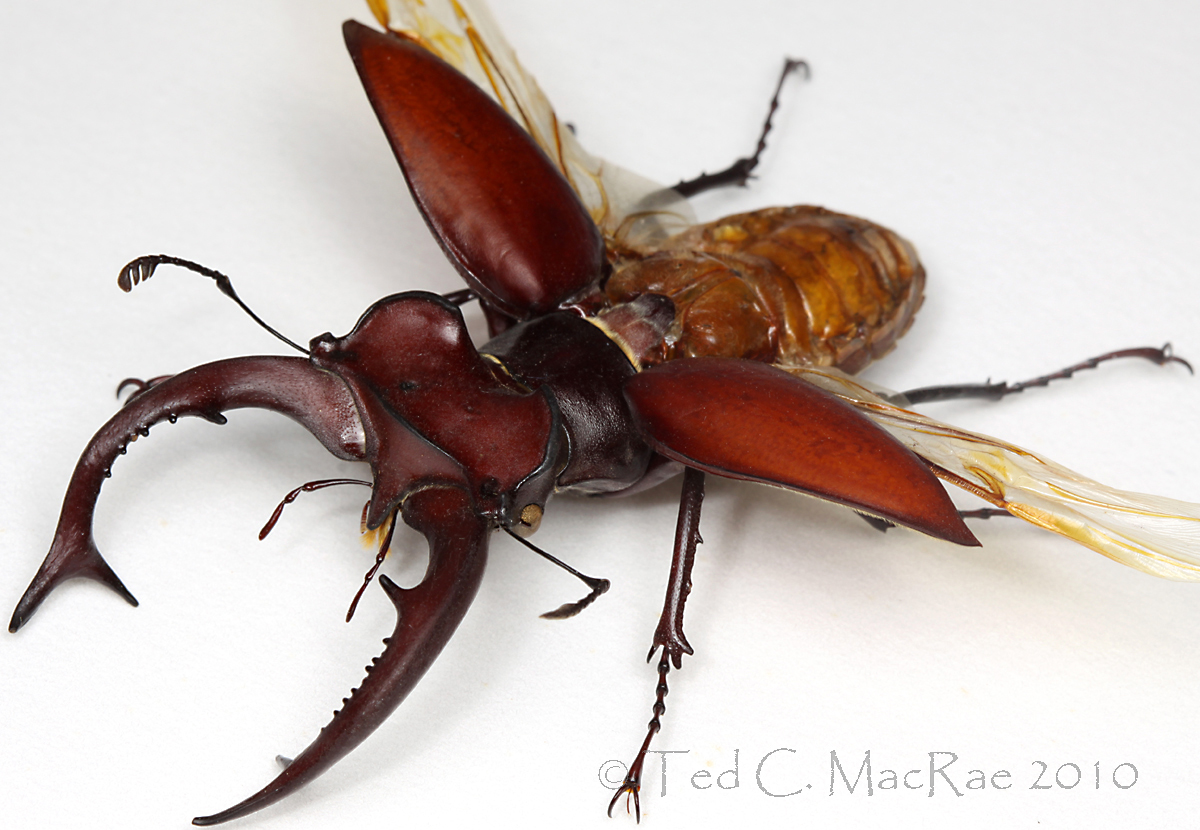
Lucanus elaphus - giant stag beetle

From North America’s largest stag beetle (posted December 30).  I’ve just started experimenting with photographing posed, preserved specimens, and in fact this male giant stag beetle represents only my second attempt.  It’s hard to imagine, however, a more perfect subject than this impressively stunning species.


Best Non-Insect Arthropod

Scolopendra heros - giant desert centipede

From North America’s largest centipede (posted September 7).  Centipedes are notoriously difficult to photograph due to their elongate, narrow form and highly active manner.  The use of a glass bowl and white box allowed me to capture this nicely composed image of North America’s most spectacular centipede species.


Best Wildflower

Hamamelis vernalis - Ozark witch hazel

From Friday Flower – Ozark Witch Hazel (posted March 26).  The bizarre form and striking contrast of colors with the dark background make this my favorite wildflower photograph for the year.


Best Non-Arthropod

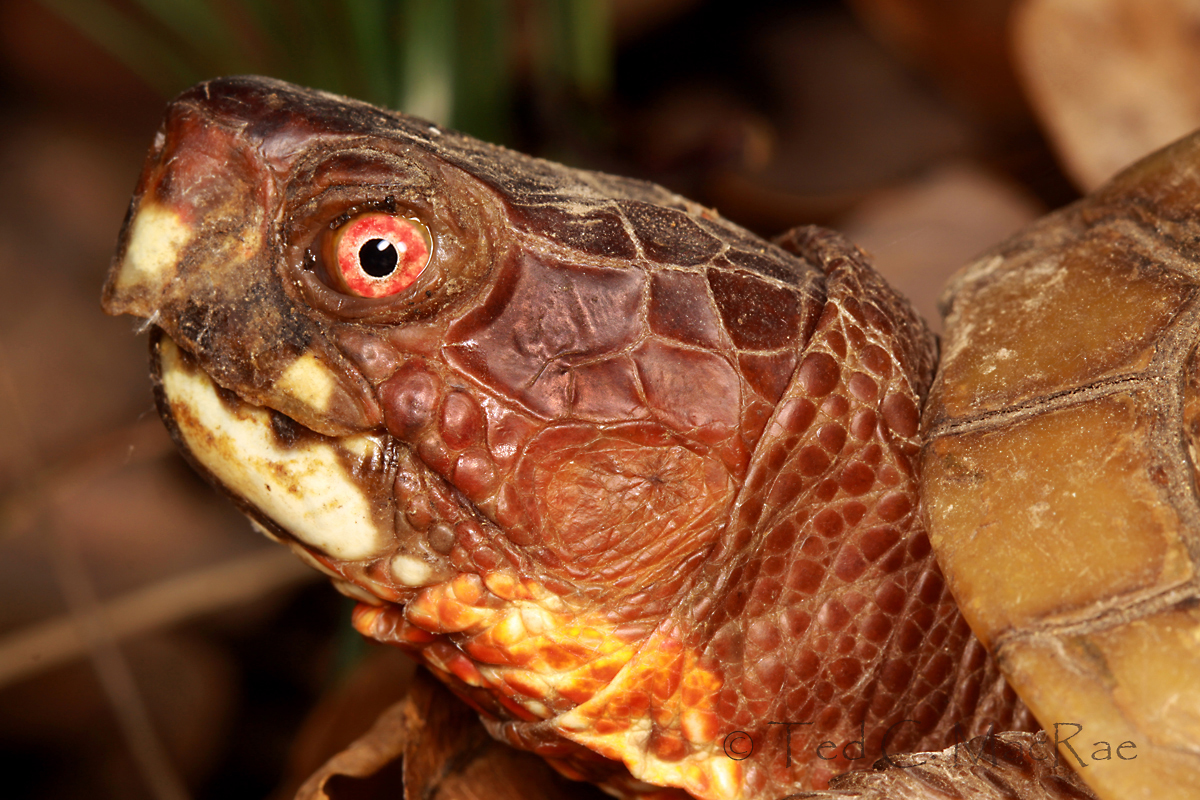
Terrapene carolina triunguis - three-toed box turtle

From Eye of the Turtle (posted December 10).  I had a hard time deciding on this category, but the striking red eye in an otherwise elegantly simple photograph won me over.  It was also one of two BitB posts featured this past year on Freshly Pressed.


Best “Super Macro”

Phidippus apacheanus - a jumping spider

From Jeepers Creepers, where’d ya get those multilayered retinae? (posted October 5).  I’m not anywhere close to Thomas Shahan (yet!), but this super close-up of the diminutive and delightfully colored Phidippus apacheanus is my best jumping spider attempt to date.  A new diffuser system and increasing comfort with using the MP-E lens in the field at higher magnification levels should allow even better photos this coming season.


Copyright © Ted C. MacRae 2011

Desmocerus palliatus – elderberry borer

Desmocerus palliatus (elderberry borer), Squaw Creek Natl. Wildlife Refuge, Missouri.

Last June I made two trips to the Loess Hills in northwestern Missouri to survey additional sites for Cylindera celeripes (swift tiger beetle), which my colleague Chris Brown and I had discovered in some of the area’s few remaining loess hilltop prairie remnants the previous year. One of these potential new sites was  Squaw Creek National Wildlife Refuge, where a few tiny slivers of hilltop prairie can still be found on the fingers of loess bluffs that border the refuge’s several thousand acres of restored wetlands that famously host large concentrations of snow geese and bald eagles during the fall and spring migrations.  On the first visit, I had arranged to meet with Corey Kudrna, Refuge Operations Specialist, who was kind enough to take several hours out of his day to personally guide me to each of the site’s loess hilltop prairie remnants. 

As we crossed the highway right-of-way at the base of the bluffs on our way to the one of the remnants, we passed through a large patch of common elderberry, Sambucus nigra ssp. canadensis.  Anytime I see patches of this plant, especially in June, I immediately think of Desmocerus palliatus (elderberry borer) – a spectacularly colored longhorned beetle (family Cerambycidae) that breeds exclusively in the living stems and roots of this plant.  It is not a particularly rare species, but for some reason I have not had much success in finding this species.  In my close to three decades of collecting beetles, I had encountered perhaps a half dozen individuals – never more than two at the same time.  Still, when I get the chance to look at elderberry I look for this beetle, and when I did so this time I was delighted to see one within a few moments of entering the patch.  I was ecstatic when I saw another one almost immediately after the first, and I was stunned when I realized that they were all around me!  Good fortune continued on my subsequent visit two weeks later, when I was able to spend a little more time trying to get a good field photograph.  Wind was a problem, the beetles were easily alarmed, and their tendency to rest in the upper reaches of the plant made it difficult to brace myself and the camera while shooting, making this a rather difficult subject to get a good photograph of.  The photo shown here is literally the last of around two dozen that I took and is the only one that I really like.

Many cerambycid beetles are mimics of other more noxious species, mostly ants and wasps.  However, elderberry borers appear to be the exception in that they are themselves noxious.  The cobalt blue and bright orange coloration of the adults screams aposematic (warning) coloration, and it is reasonable to assume that they accumulate in their bodies for defensive purposes the cyanogenic glucosides produced by elderberry plants (Huxel 2000).  Even their movements are those of a chemically protected model – lumbering and clumsy, without the alert evasiveness usually seen with other flower longhorn species.  Presumably this species participates in a Müllerian mimicry complex involving netwinged beetles (family Lycidae, particularly species in the genus Calopteron) and perhaps Pyromorpha dimidiata (orange-patched smoky moth, family Zygaenidae) as well, and it may serve as a Batesian model for the equally colorful but completely innocuous Lycomorpha pholus (black-and-yellow lichen moth, family Arctiidae).

Photo Details: Canon 50D w/ 100mm macro lens (ISO 100, 1/250 sec, f/10), Canon MT-24EX flash w/ Sto-Fen diffusers.

REFERENCE:

Huxel, G. R.  2000.  The effect of the Argentine ant on the threatened valley elderberry longhorn beetle.  Biological Invasions 2:81–85.

Copyright © Ted C. MacRae 2010

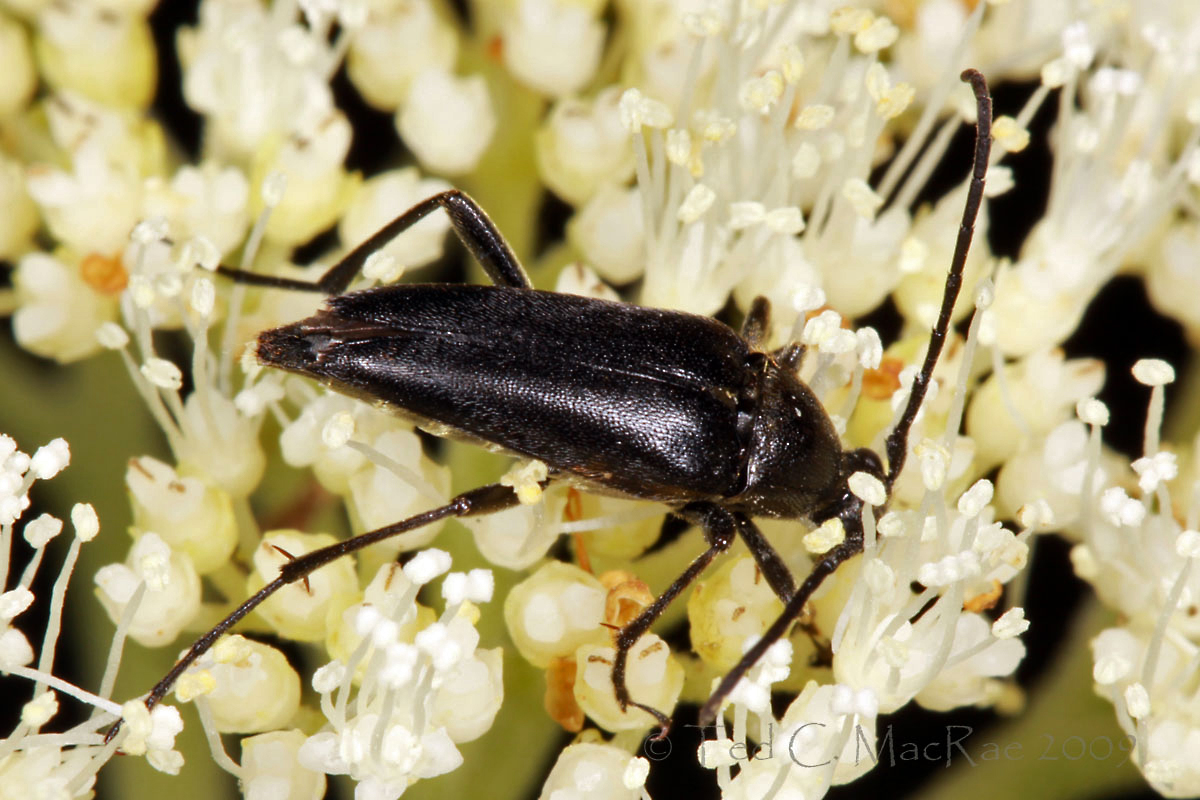
Typocerus lugubris

Typocerus lugubris on Hydrangea arborescens, Trail of Tears State Park, Missouri.

Members of the genus Typocerus are among the more commonly encountered species of the so-called “flower longhorns” (family Cerambycidae, subfamily Lepturinae) in eastern North America. In addition to the narrow-necked, broad-shouldered appearance characteristic for the subfamily, species in this genus are recognizable by their strongly tapering elytra, strongly basally depressed prothorax, and apically produced antennal segments with distinct poriferous areas (Linsley and Chemsak 1976).

Eight of the 15 species known from North America occur in Missouri, where they are commonly encountered on a variety of flowers during the months of June and July. Some of these species can be difficult to distinguish from each other – in fact, Missouri’s rarest species (Typocerus deceptus) is almost identical in appearance to one of Missouri’s commonest species (Typocerus velutinus), and several other species resemble them closely enough to require careful attention details of coloration when attempting identification.

Typocerus lugubris is not one of those species, its all-black coloration making it quite distinctive within the genus. Two other species in Missouri are mostly black, but unlike T. lugubris they always bear yellow blotches in the basal area of the elytra (T. lunulatus) or exhibit yellow transverse bands (T. zebra). Typocerus confluens also is a rather uncommon species in Missouri that varies from chestnut brown to nearly all black, but it is much more robust than T. lugubris (and also bears erect hairs on the pronotum and lacks poriferous areas on antennomere 6). The remaining species tend to be chestnut colored, at least in the basal area of the elytra, with more or less distinct transverse yellow banding.

Photo Details: Canon 50D (ISO 100, 1/250 sec, f/18), Canon 100mm macro lens, Canon MT-24EX flash (1/4 ratio) w/ Sto-Fen diffusers. Post-processing: levels, minimal crop, unsharp mask.

REFERENCES:

Linsley, E. G. and J. A. Chemsak.  1976. The Cerambycidae of North America.  Part VI, No. 2.  Taxonomy and classification of the subfamily Lepturinae. University of California Publications in Entomology 80:ix + 1–186.

Copyright © Ted C. MacRae 2010

Add to FacebookAdd to DiggAdd to Del.icio.usAdd to StumbleuponAdd to RedditAdd to BlinklistAdd to TwitterAdd to TechnoratiAdd to Yahoo BuzzAdd to Newsvine

Email to a friend

Nomenclatural changes in Phymatodes

ResearchBlogging.orgI’ve mentioned before the considerable taxonomic challenges facing students of the family Buprestidae (jewel beetles) in North America, owing largely to fact that more than half of its species are assigned to one of just three hyper-diverse genera (Acmaeodera, Agrilus, and Chrysobothris). New species continue to be described, but the most recent comprehensive treatments of these three genera were published more than 60 to 100 years ago (Fall 1899, Fisher 1928, Fisher 1945)! The situation is not as dire in the “other” major woodboring beetle family – the Cerambycidae (longhorned beetles), thanks in great part to the efforts of Gorton Linsley and John Chemsak and their monographic series of the family’s North American species (Linsley 1961-1964, Linsely and Chemsak 1972-1997). Although somewhat more speciose in North American than the Buprestidae, diversity in the Cerambycidae is more apparent at the generic level (1000+ species in 325 genera, compared to 787 species in only 54 buprestid genera). This does not mean, however, that the Cerambycidae lacks problematic, speciose genera, and in a recently published paper, Ian Swift and Ann Ray (2010) tackle one of these – the genus Phymatodes. While no new species are described, their treatment does propose numerous nomenclatural changes based on examination of type specimens that affect several North American species, including correcting misapplied names and recognizing multiple synonymies. These problems resulted from the practice of many earlier authors who did not examine type specimens when describing new species, relying instead only on written descriptions to compare taxa.

  • Phymatodes blandus is no longer divided into subspecies, with P. blandus concolor now being recognized as a full species.
  • The name Phymatodes decussatus has been used for the wrong species, which is actually P. obliquus. It is distinct from true P. decussatus, which has until now been called P. juglandis. The subspecies formerly placed under P. decussatus are also synonymized under P. obliquus.  Linsley (1964) confused things by applying the name decussatus to this common, oak-associated species and the name juglandis to the species associated with walnut. The type of decussatus, however, matches the walnut species and, since it is the older name, takes priority. The common oak species is thus left without a name, and obliquus is the oldest of the many synonyms created by Thomas Casey.
  • Phymatodes hirtellus is no longer divided into subspecies.
  • Phymatodes lecontei is synonymized under P. grandis.
  • Phymatodes mojavensis is synonymized under P. nitidus.
  • Phymatodes oregonensis is synonymized under P. nigrescens.
  • Phymatodes ursae is synonymized under P. hirtellus.

While this paper is not a full revision of the genus, it does include diagnostic and comparative notes, full color dorsal habitus photographs (example plate below), and an updated key to all of the species found in North America.

PLATE 1. 1) Phymatodes aeneus, male; 2) P. aereus, female; 3) P. amoenus, female; 4) P. amoenus, female ventral; 5) P. ater, female; 6) P. ater, female; 7) P. blandus, male; 8 ) P. concolor, male; 9) P. decussatus, male. © Swift & Ray 2010.

The genus Phymatodes is most diverse in the western states and provinces – I haven’t spent as much time out there as in other areas of North America, so representation of this genus in my collection is rather weak at only 10 of the 26 species currently recognized in North America. Missing from my cabinet are the following – if anyone is able to help me out with these I would be most grateful:

  • Phymatodes aeneus LeConte, 1854
  • Phymatodes ater LeConte, 1884
  • Phymatodes concolor Linsley, 1934
  • Phymatodes decussatus (LeConte, 1857)
  • Phymatodes fulgidus Hopping, 1928
  • Phymatodes infuscatus (LeConte, 1859)
  • Phymatodes lengi Joutel, 1911
  • Phymatodes lividus (Rossi, 1794) – introduced to eastern U.S.
  • Phymatodes maculicollis LeConte, 1878
  • Phymatodes nigerrimus Van Dyke, 1920
  • Phymatodes nigrescens Hardy & Preece, 1927
  • Phymatodes obliquus Casey, 1891
  • Phymatodes rainieri Van Dyke, 1937
  • Phymatodes shareeae Cope, 1984
  • Phymatodes tysoni Chemsak & Linsley, 1984
  • Phymatodes vulneratus LeConte, 1857

REFERENCES:

Fall, H. C.  1899. Synonpsis of the species of Acmaeodera of America, north of Mexico. Journal of the New York Entomological Society 7(1):1–37 [scroll to “Journal of the New York Entomological Society”, “v. 7 1899”, “Seq 12”].

Fisher, W. S.  1928. A revision of the North American species of buprestid beetles belonging to the genus AgrilusU. S. National Museum 145, 347 pp.

Fisher, W. S.  1942. A revision of North American species of buprestid beetles belonging to the tribe Chrysobothrini.  U. S. Department of Agriculture, Miscellaneous Publication 470, 275 pp.

Linsley, E. G.  1961. The Cerambycidae of North America.  Part I.  Introduction.  University of California Publications in Entomology 18:1–97.

Linsley, E. G.  1962. The Cerambycidae of North America.  Part II.  Taxonomy and classification of the Parandrinae, Prioninae, Spondylinae and Aseminae.  University of California Publications in Entomology 19:1–102.

Linsley, E. G.  1962. The Cerambycidae of North America.  Part III.  Taxonomy and classification of the subfamily Cerambycinae, tribes Opsimini through Megaderini.  University of California Publications in Entomology 20:1–188.

Linsley, E. G.  1963. The Cerambycidae of North America.  Part IV.  Taxonomy and classification of the subfamily Cerambycinae, tribes Elaphidionini through Rhinotragini.  University of California Publications in Entomology 21:1–165.

Linsley, E. G.  1964. The Cerambycidae of North America.  Part V.  Taxonomy and classification of the subfamily Cerambycinae, tribes Callichromini through Ancylocerini.  University of California Publications in Entomology 22:1–197.

Linsley, E. G. and J. A. Chemsak.  1972. The Cerambycidae of North America.  Part VI, No. 1.  Taxonomy and classification of the subfamily Lepturinae.  University of California Publications in Entomology 69:viii + 1–138.

Linsley, E. G. and J. A. Chemsak.  1976. The Cerambycidae of North America.  Part VI, No. 2.  Taxonomy and classification of the subfamily Lepturinae.  University of California Publications in Entomology 80:ix + 1–186.

Linsley, E. G. and J. A. Chemsak.  1984. The Cerambycidae of North America, Part VII, No. 1: taxonomy and classification of the subfamily Lamiinae, tribes Parmenini through Acanthoderini.  University of California Publications in Entomology 102:ix + 1–258.

Linsley, E. G. and J. A. Chemsak.  1995. The Cerambycidae of North America, Part VII, No. 2: taxonomy and classification of the subfamily Lamiinae, tribes Acanthocinini through Hemilophini.  University of California Publications in Entomology 114:xi + 1–292.

Linsley, E. G. and J. A. Chemsak.  1997. The Cerambycidae of North America, Part VIII: bibliography, index, and host plant index.  University of California Publications in Entomology 117:ix + 1–534..

Swift, I. P. & A. M. Ray. 2010. Nomenclatural changes in North American Phymatodes Mulsant (Coleoptera: Cerambycidae). Zootaxa 2448:35–52.

Copyright © Ted C. MacRae 2010

Add to FacebookAdd to DiggAdd to Del.icio.usAdd to StumbleuponAdd to RedditAdd to BlinklistAdd to TwitterAdd to TechnoratiAdd to Yahoo BuzzAdd to Newsvine

Email to a friend

When is a locust borer not a locust borer?

…when it is a hickory borer!

Hickory borer (Megacyllene caryae) mating pair on trunk of fallen mockernut hickory (Carya alba).

The hickory borer, Megacyllene caryae, is perhaps the most frequently misidentified beetle in eastern North America due to its almost perfect resemblance to the closely related locust borer, M. robiniae.  Unlike the latter species, however, which is encountered abundantly during the fall on flowers of goldenrod (Solidago spp.) and attacks living black locust (Robinia pseudoacacia), the hickory borer is active only during the spring and breeds in the dead wood of hickories (Carya spp.).  Adults emerge from the wood as soon as temperatures begin to warm in early spring, a fact which causes it to be most frequently encountered during winter when it emerges indoors from firewood brought in from outdoors.  Many times this causes the alarmed homeowner to post a photo of the insect on BugGuide and ask if it will cause damage to their home.  So close is its resemblance to the locust borer that novice insect enthusiasts often identify it as such based on comparison to photos and refuse to believe it is not that species, even when told otherwise.

Of course, there are distinguishing characters that, with a little practice, become quite obvious – the legs of the hickory borer are often distinctly reddish (as seen in the above photo), and the bands of the elytra will many times show an alternating pattern of yellow and white (not quite so apparent in the above photo).  The elytral bands are also slightly narrower and often broken and incomplete in this species, while in the locust borer they are wider and nearly always extend completely across the elytra.  Lastly, the pronotum of the locust borer is narrowly margined with yellow on the anterior edge, while in the hickory borer the anterior margin is black.  That’s a tough character to see without magnification, and all of these characters really are only necessary when examining specimens in a collection (and even then only if there is no date on the collection label).  Season is the easiest distinguishing character – if it occurs during spring it is the hickory borer, and if it occurs during fall it is the locust borer.  There are several other species in the genus that can be confused with these two, but they do not occur in eastern parts of North America.

This mating pair was encountered on the trunk of a recently wind-thrown mockernut hickory (Carya alba) during our early April hike of the lower Wappapello Section of the Ozark Trail.

Photo Details: Canon 50D (ISO 100, 1/250 sec, f/14), Canon 100mm macro lens, Canon MT-24EX flash (1/4 ratio) w/ Sto-Fen diffusers. Typical post-processing (levels, unsharp mask).

Copyright © Ted C. MacRae 2010

Add to FacebookAdd to DiggAdd to Del.icio.usAdd to StumbleuponAdd to RedditAdd to BlinklistAdd to TwitterAdd to TechnoratiAdd to Yahoo BuzzAdd to Newsvine

Email to a friend