Beetle botanists

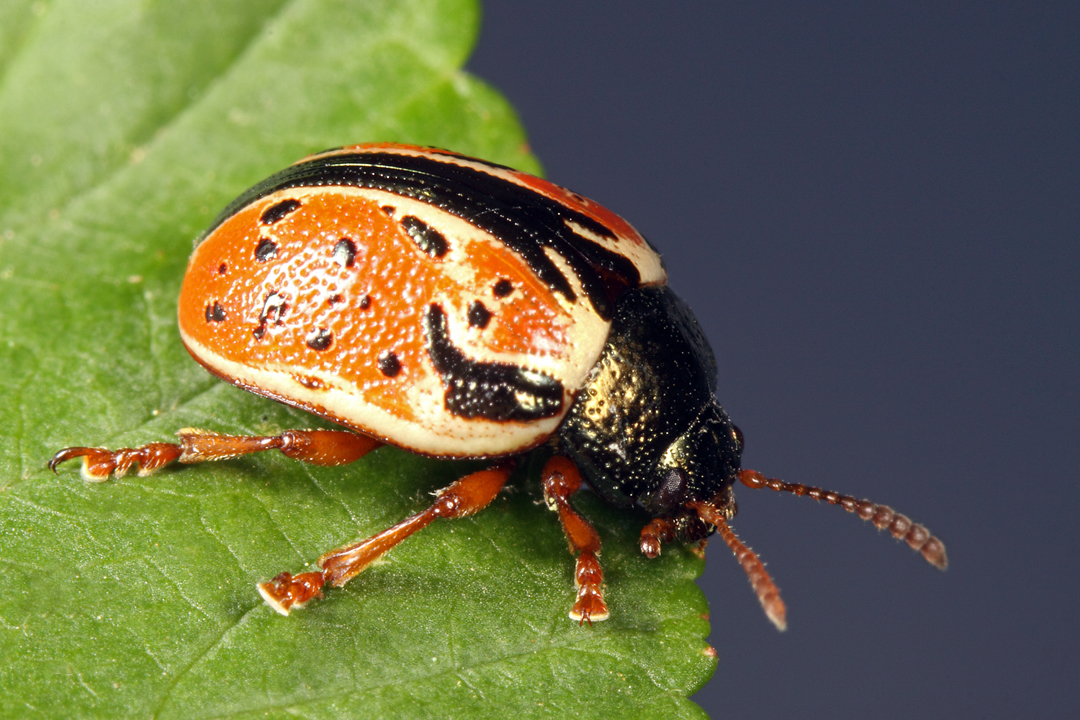
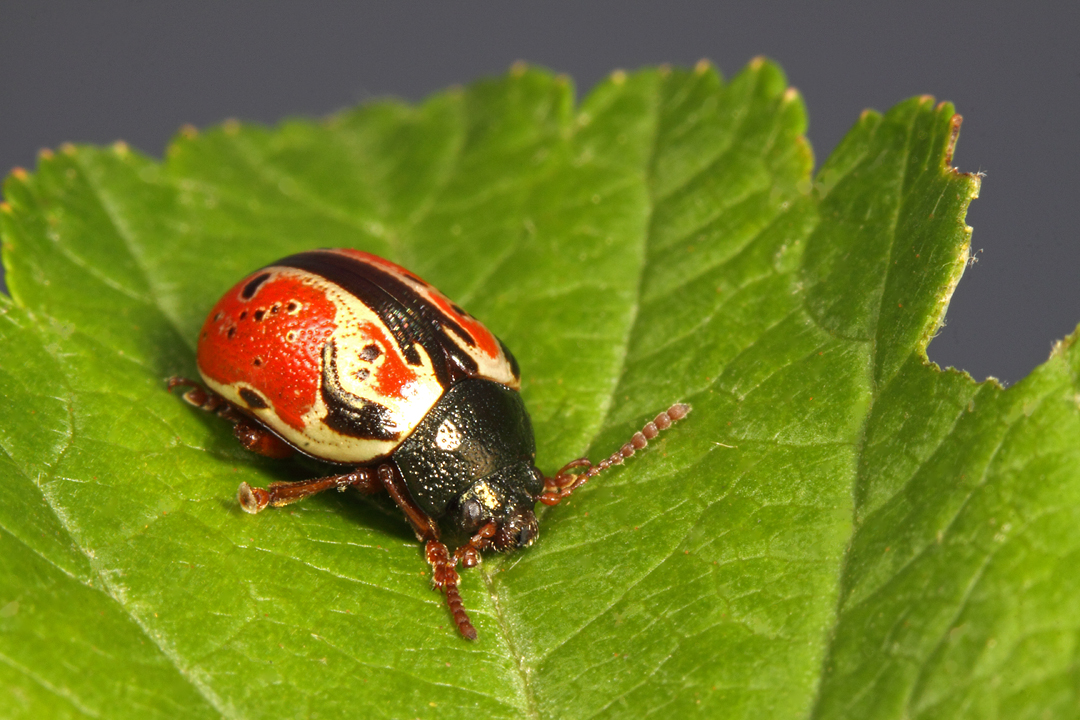
Calligrapha spiraeae on Physocarpus opulifolius | Jefferson Co., Missouri

While Dicerca pugionata (family Buprestidae) is, for me, the most exciting beetle species that I’ve found in Missouri associated with ninebark (Physocarpus opulifolius). it is not the only one. The beetles in these photographs represent Calligrapha spiraeae, the ninebark leaf beetle (family Chrysomelidae). Unlike D. pugionata, however, I almost never fail to find C. spiraeae on ninebark, no matter when or where I look, and whereas D. pugionata has been recorded in the literature associated with a few other host plants like alder (Alnus spp.) and witch-hazel (Hamamelis virginiana), C. spiraeae is not known to utilize any other plant besides ninebark as its host.

Beetles in the genus Calligrapha are among the most host-specific of all phytophagous beetles, with most of the 38 species in this largely northeastern North American genus relying upon a single plant genus as hosts (Gómez-Zurita 2005). The genus as a whole is fairly recognizable by its dome-like shape and black and white or red coloration, with the black markings on the elytra varying from coalesced to completely broken into small spots. The species, however, are another matter, with several groups of species that are quite difficult to distinguish morphologically. Fortunately most of them can be easily distinguished by their host plant (although such information is rarely recorded on labels attached to museum specimens). Calligrapha spiraeae, for example, with its reddish coloration and small black spots, looks very much like two other species in the genus—C. rhoda and C. rowena. Those latter species, however, are restricted to hazel (Corylus spp.) and dogwood (Cornus spp.); as long as the host is known, the species can be readily identified in the field.

At this point you may be wondering why the species name refers to the plant genus Spiraea rather than Physocarpus. In fact, ninebark was already known as the host plant when Say (1826) described the species, but the name spiraeae was given because at the time ninebark was included in the genus Spiraea (Wheeler & Hoebeke 1979).

REFERENCE:

Gómez-Zurita, J. 2005. New distribution records and biogeography of Calligrapha species (leaf beetles), in North America (Coleoptera: Chrysomelidae, Chrysomelinae). Canadian Field-Naturalist 119(1): 88–100.

Say, T. 1826. Descriptions of new species of coleopterous insects of North America. Journal of the Academy of Natural Sciences of Philadelphia 5:293–304.

Wheeler, A. G., & E. R. Hoebeke. 1979. Biology and seasonal history of Calligrapha spiraeae (Say) (Coleoptera: Chrysomelidae), with descriptions of the immature stages. The Coleopterists Bulletin 33:257–267. 

Copyright © Ted C. MacRae 2012

A tortoise beetle gift

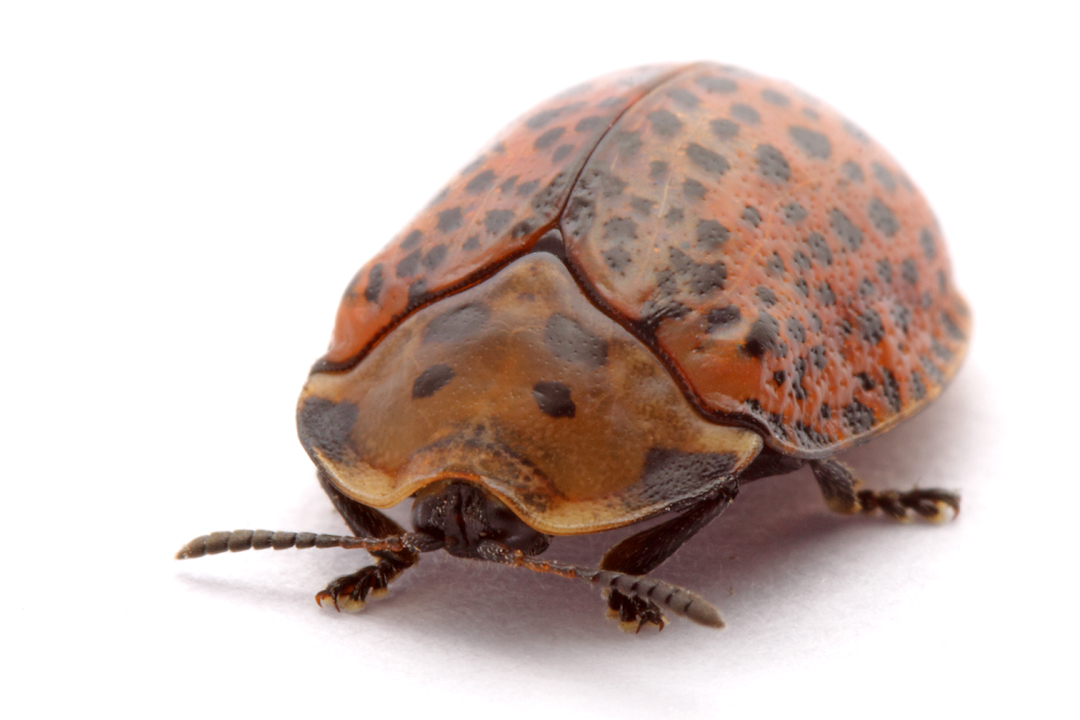
Chelymorpha varians | northwestern Buenos Aires Province, Argentina

A few days after returning from travel through northern Argentina, I found a jar on my desk with this beetle in it. One of my colleagues has seen it in the field while I was away and figured I would be interested in seeing it. Although I’m half-a-world away from home, I immediately thought of our North American species Chelymorpha cassidea when I saw it. Armed with this hunch, I typed “Chelymorpha Argentina” into Google, and the first result that came up was a paper by Hamity & Neder de Román (2008) about the species Chelymorpha varians in Argentina and its potential as a biocontrol agent for the widespread weed Convolvulus arvensis. Included in the paper was a plate showing variability of coloration and maculation in the adults, and my individual was a dead ringer for the species. Still, getting a species ID on the very first hit of the very first search attempt just seemed too easy, so I consulted the wonderfully comprehensive Cassidinae of the world – an interactive manual. This site, too, contained multiple images of Chelymorpha varians showing an extraordinary range of variability in color (from yellow to red) and degree of maculation (from immaculate to heavily maculated). A quick perusal of other species indicated as similar or also occurring in Argentina turned up nothing nearly as similar and convinced me that I had, indeed, arrived at a correct ID.

As the name suggests, markings are highly variable in shape and degree of development.

As indicated in the above cited paper, and like our own C. cassidea, species in the genus Chelymorpha are associated almost exclusively with plants in the genus Convolvulus. I would have preferred to photograph the beetle on foliage of this plant, but not knowing precisely where I might find it I decided to do white box instead. I got some printer paper and was looking for a cardboard box to line the inside with it when I spotted a styrofoam cooler of just the right size.

The scientific name translates literally to ''variable turtle-body''

These are okay white box photos, but I’ve decided if I want to do white box right I need to get a larger flash unit that is a little easier to work with off the camera. Right now I have only the small twin-flash heads from my MT-24EX—their small size makes them difficult to manipulate off the camera, and leaving them attached to their bracket limits the directions in which they can be oriented relative to the subject. As a result, I had to use more heavy-handed post-processing in these photos than I normally like to do in order to get the levels right. Hmm, I have a birthday coming up in about a month…

REFERENCE:

Hamity, V. C. & L. E. Neder de Román. 2008. Aspectos bioecológicos de Chelymorpha varians Blanchard (Coleoptera: Chrysomelidae, Cassidinae) defoliador de convolvuláceas. Idesia 26(2):69–73.

Copyright © Ted C. MacRae 2012

Pollen Bath

Spintherophyta (?) sp. in flower of Abutilon pauciflorum | Buenos Aires, Argentina

One of the smallest insects I saw during my latest visit to  (Buenos Aires, Argentina) was this tiny leaf beetle (family Chrysomelidae) feeding in the flower of a malvaceous plant that I take to be Abutilon pauciflorum. At only ~4 mm in length, it could have easily gone unnoticed had I not noticed there were several feeding in flowers in a small, localized area. The best I could come up with for an ID was subfamily Chrysomelinae due to their globular shape, although the small size didn’t seem right. Turns out I’d forgotten to consider the Eumolpinae, which also contains globular species that are usually much smaller than those in the Chrysomelinae, and according to leaf beetle specialists Shawn Clark and Ed Riley this is likely a member Spintherophyta or a closely related genus.

Covered with tasty, sticky pollen!

Although there are only four species of Spintherophyta in North America (Schultz 1976), and of those only S. globosa is widespread and commonly encountered, the diversity of the genus explodes in the Neotropics (Blackwelder 1946 lists 71 species). Accordingly, neither Shawn nor Ed were brave enough to venture a guess as to which species this might represent. I should probably defer to their good sense, but part of me wonders if that coppery pronotum might suggest S. cupricollis—one of only two species in the genus listed by Blackwelder (1946) for Argentina.

REFERENCE:

Blackwelder, R.E. 1946. Checklist of the coleopterous insects of Mexico, Central America, the West Indies, and South America. Bulletin of the U. S. National Museum 185:551-1492.

Schultz, W. T. 1976. Review of the genus Spintherophyta (Coleoptera: Chrysomelidae) in North America north of Mexico. Annals of the Entomological Society of America 69(5):877–881.

Copyright © Ted C. MacRae 2012

A Modest Model for Mimicry

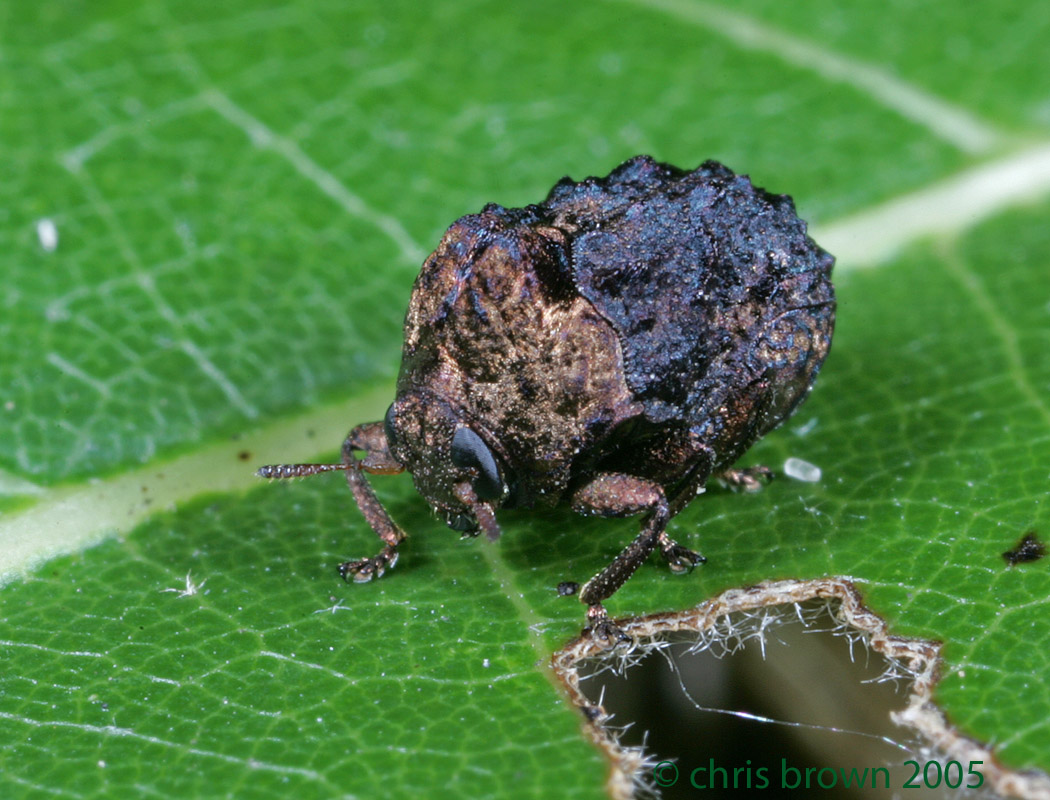
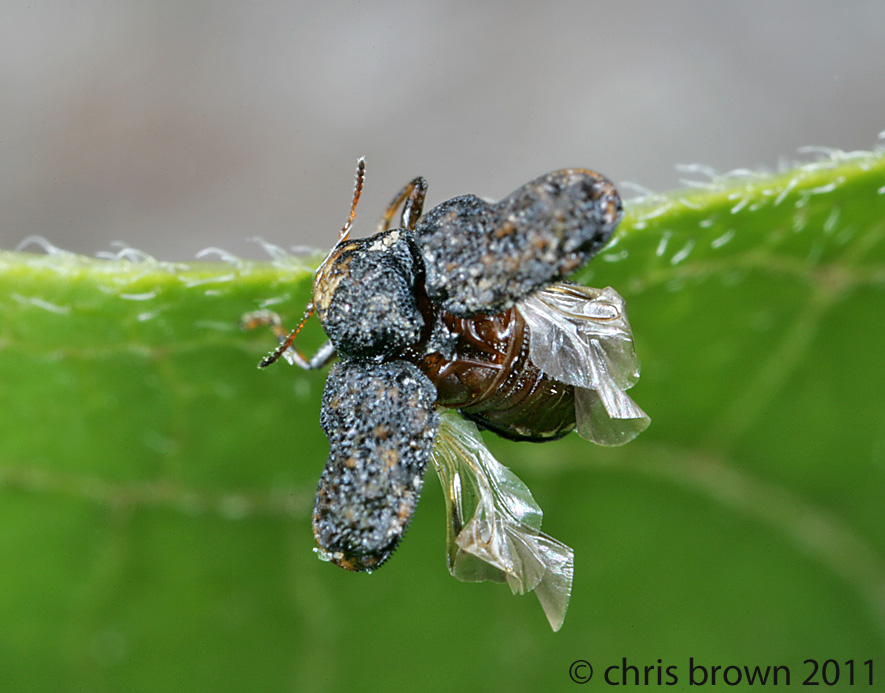
Spring is still a long way off but it’s times like these that I draw on past experiences so I can continue to be thrilled by insect natural history even during the coldest of months.  In this case I am thinking back seven years ago to my first encounter with a warty leaf beetle.  These beetles are certainly unremarkable for their size or coloration but the “set-up” shot below attempts to illustrate what is amazing about warty leaf beetles.  Can you pick out the single individual warty leaf beetle (Exema sp.) among caterpillar frass (aka caterpillar poop)? 

Figure 1. Set-up shot with Exema sp. and caterpillar frass

If you had trouble finding the beetle in the above image then check out the next image and you’ll see the beetle has “sprouted” a head, legs, and antennae.

Figure 2. Set-up shot with Exema sp. and caterpillar frass

I don’t know what caught my eye the first time I encountered a warty leaf beetle on the foliage of a small shingle oak while exploring a woodland edge in Perry Co., MO.  It probably helped that it was one of the larger species of the genus Neochlamisus but it still only measured about 3-4 mm.  One thing I do remember about the encounter, though, is that there was something about it that made me do a double take.  My first thought was exactly what the beetle might have hoped, that it was caterpillar frass.  But this frass had legs (Figs. 3 and 4)!  I was at first incredulous but soon became enthralled as I beheld something that I had never noted while flipping through field guides.  I had once again stumbled across something that I would never have imagined—a beetle that mimics caterpillar poop!

Figure 3. Neochlamisus sp. on shingle oak

Figure 4. Neochlamisus from the perspective of a short distance away

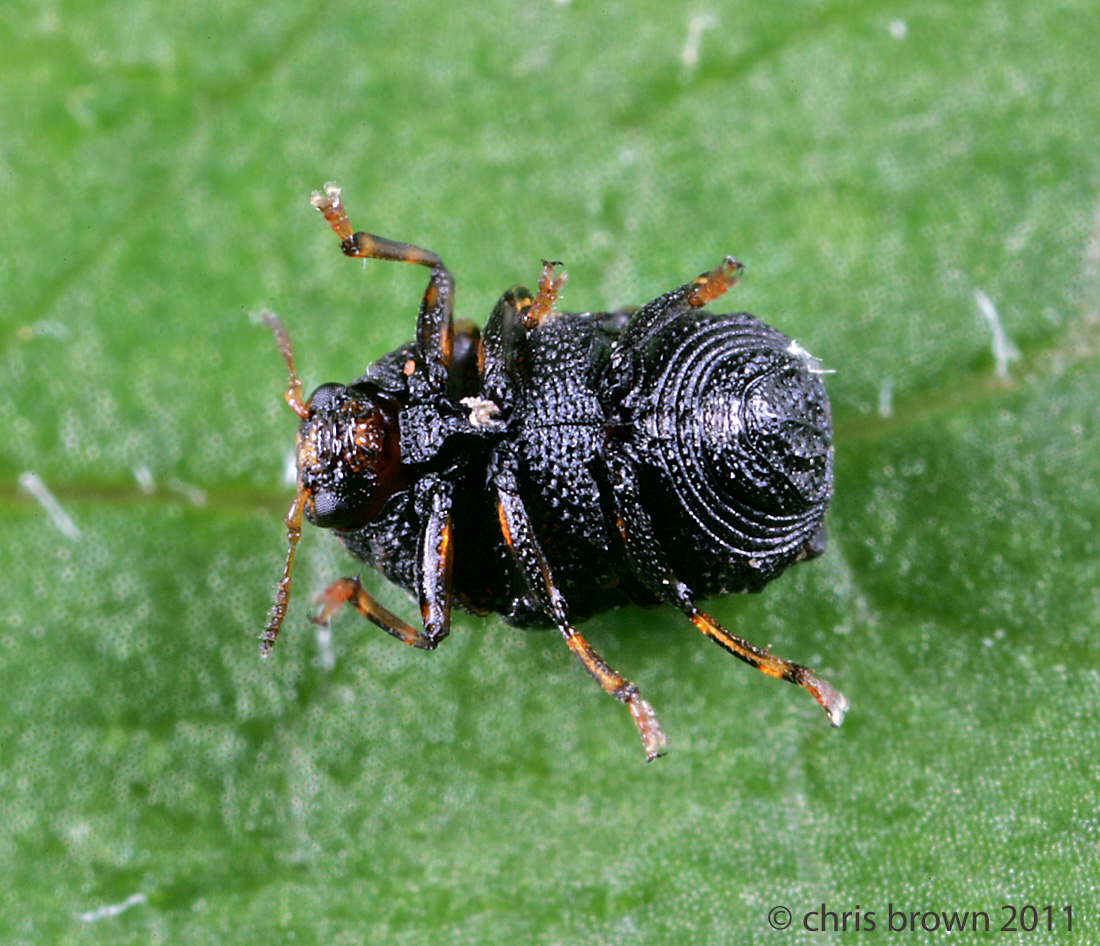
The beetles in the tribe Chlamasini were apparently not at the table the day decisions were made on what model they would mimic.  These guys at best mimic small bits of debris but are dead ringers for the frass of lepidopteran larvae (i.e., caterpillars).  Then as if to add insult to injury, we dubbed the tribe the warty leaf beetles!  The Chlamasini may humbly mimic excreta but what they lack in a flashy model they make up for with absolutely superb mimicry.  The Chlamasini are remarkably similar to the frass of lepidopteran larvae in size, shape, texture, and color but the aspect that really completes the mimicry is that, upon disturbance, the head is retracted and the legs and antennae are neatly folded into precisely matched grooves leaving no indication that this was once a beetle (Figs. 5 and 6).  Even the finer details of coloration were not overlooked as some warty leaf beetle species are variably colored, including an almost metallic sheen in some places that closely resembles the coloration of some caterpillar frass.  In fact the mimicry of warty leaf beetles is so convincing that I recently dropped a piece of suspect frass in a vial in hopes that it might sprout legs and represent a new species of warty leaf beetle for me.

Figure 5. Exema sp. with appendages extended

Figure 6. Exema sp. with appendages retracted

If the disturbance is sufficient to cause the beetle to completely retract these appendages, they will likely roll off the leaf and fall out of harms way.  Though these beetles can be relatively common, occurring even in my suburban St. Louis yard, the small size [Exema is only 2-3 mm (Figs. 7 and 8) while Neochlamisus is slightly larger at 3-4 mm] and resemblance to something unremarkable ensures that these beetles often times go unnoticed.  When I have happened to notice these beetles I found Neochlamisus associated with shingle oak, Quercus imbricaria, and Exema associated with Asteraceae, including gray-headed coneflower, Ratibida pinnata, and sweet coneflower, Rudbeckia subtomentosa.

Figure 7. Exema sp. on sweet coneflower, Rudbeckia subtomentosa

Figure 8. Exema sp. ready for flight

The Chlamasini are in the subfamily Cryptocephalinae within the leaf beetle family (Chrysomelidae).  The Chlamisini can be found worldwide but are most diverse in the Neotropics.   We have 6 genera in North America, two of which are shown here.  Interestingly, the excreta theme doesn’t stop at frass-mimicry.  Like other members of Crytocephalinae, warty leaf beetle larvae are “case-bearing”; that is they are housed in a case which in this instance is made out of… you guessed it, their own feces (Fig. 9).  You would think that most moms would frown on such a practices but mothers in the Cryptocephalinae actually instigate the practice when they equip each egg laid with a cap of feces that serves as starting material for the case and likely also serves to dissuade would be predators.

Figure 9. Chlamasini larva, likely that of Exema sp. on sweet coneflower, Rudbeckia subtomentosa

My experiences with Neoclamisus seven years ago captures perfectly why I am so drawn to explore for insects— there is always something new to find and every once in a while something comes out of the wood work that is beyond what I could have imagined.

REFERENCE:

Lourdes Chamorro-Lacayo, M. & A. Konstantinov. 2009. Synopsis of warty leaf beetle genera of the world (Coleoptera, Chrysomelidae, Cryptocephalinae, Chlamisini). ZooKeys 8:63–88.

Copyright © Chris Brown 2012

Cycloalexy in tortoise beetle larvae

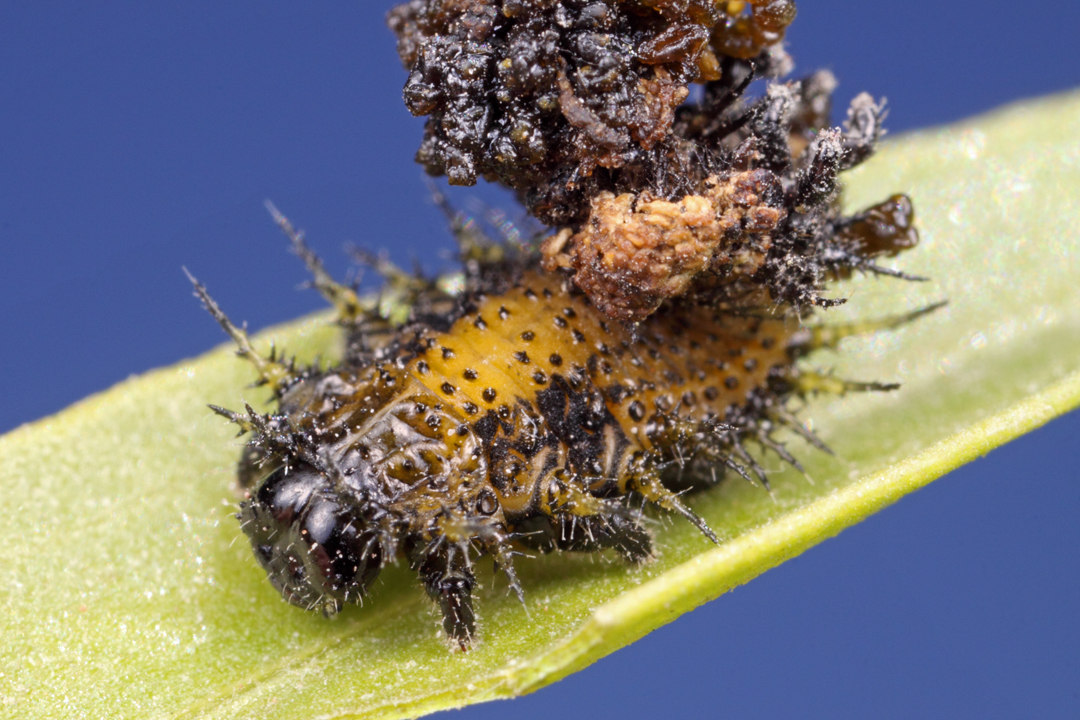
One of the first insects I encountered during my visit this past November to  in Buenos Aires, Argentina were these tiny beetle larvae grouped together on a single leaf of an unidentified shrub.  The presence of fringed lateral appendages and exuvial-fecal debris masses held by caudal appendages immediately identifies them as larvae in the leaf beetle subfamily Cassidinae, known commonly in North America as “tortoise beetles” due to the appearance of the adults.  With nearly 3,000 species distributed throughout the world, tortoise beetles are easily recognizable as a group; however, species identifications can be much more difficult, especially in the Neotropics where the group reaches its greatest diversity (Borowiec and Świętojańska 2002–2011). Identification of larvae can be even more challenging, as the larvae of many species remain unknown, and I was unable to find adults in association with the larvae to aid my identification.

Anacassis sp. (poss. exarata) early-instar larvae on Baccharis salicifolia | Buenos Aires, Argentina

Nevertheless, host plant can be an important clue to leaf beetle identity, as most species in the family limit their feeding to a single plant genus or group of related plant genera. The shrub on which the beetles were feeding looked familiar to me, and while perusing a list of plants that have been recorded from the Reserve (Burgueño 2005) I had an “Aha!” moment when I spotted the asteraceous genus Baccharis. I decided the plant must represent Baccharis salicifolia because of its narrowly lanceolate, willow-like leaves with fine apical serrations (Cuatrecasas 1968) (see first photo). The only tortoise beetles known to feed on Baccharis are species in the genus Anacassis (McFadyen 1987), several species of which are known from Argentina, and one (Anacassis exarata) looking very much like the larvae in these photos.

Note the circular, heads-directed-inward orientation of all larvae around the periphery

The manner in which these early-instar (perhaps even newly hatched) larvae were feeding as a group while working their way down the length of the leaf towards its base is not something I had observed before. Larvae of most tortoise beetles are solitary feeders (Borowiec and Świętojańska 2002–2011), and I was further intrigued by the deliberate circular formation that the larvae had assumed.  The larvae around the periphery were all facing inward, tightly packed against each other and with their exuvial-fecal debris masses directed outward. Additional larvae were seen inside the circular formation. As I manipulated the leaf for photographs, the larvae would occasionally raise their debris masses up and outward, presumably a defensive reaction to disturbance and a perceived threat. It was clear to me that the larvae had deliberately “circled their wagons” for defensive purposes.

Close body contact allows exuvial-fecal debris masses to form a protective barrier against predators

In fact, this type of defensive strategy has been reported in a number of South American cassidines, as summarized by Jolivet et al. (1990), who coined the term “cycloalexy” (from the Greek κύκλος = circle, and αλεξω = defend) to describe such strategies. Cycloalexy can either be “heads in, tails out” or vice versa and is usually associated with other repellent activities such as coordinated threat movements, regurgitation, or biting. The strategy is intended to provide protection from predators such as ants and true bugs and parasitioid wasps, although some parasitoids seem to have thwarted the strategy by depositing their eggs where they can be ingested (thus avoiding direct confrontation with the prey). Cycloalexy has been described primarily among chrysomelid beetles and tenthredinoid hymenopterans (sawflies); however, examples from a few other insect orders (e.g., Diptera, Neuroptera, Lepidoptera) are known as well (Jolivet 2008).  All known cycloalexic insects are subsocial in the larval stage and often also exhibit maternal protection of eggs or newly hatched larvae.

This and several other older larvae had become solitary, presumably protected in part by greater size

In addition to this single group of early instar larvae, I noted also a few larger individuals—all of whom were feeding on the plant in a more solitary fashion. Presumably as the larvae grow larger they are more able to defend themselves, or perhaps larger larvae simply demand more “elbow room” because of the larger amounts of leaf tissue they require for feeding. If cycloalexy is beneficial for small cassidine larvae but less so for larger larvae, perhaps this behavior is actually more common than is currently realized.

REFERENCES:

Borowiec, L., and J. Świętojańska. 2002–2011. Cassidinae of the world – an interactive manual (Coleoptera: Chrysomelidae). http://www.biol.uni.wroc.pl/cassidae/katalog%20internetowy/index.htm [accessed 3 Dec 2011].

Burgueño, G. 2005. Manejo de la vetación en reservas naturales urbanas de la region metopolitana de Buenos Aires. Aves Argentinas, Asociación Ornitológica del Plata, Proyecto Reservas Naturales Urbanas, 16 pp.

Cuatrecasas, J. 1968. Notas adicionales, taxonómicas y corológicas, sobre Baccharis. Revista de la Academia Colombiana de Ciencias Exactas, Físicas y Naturales 13(50):201–226.

Jolivet, P. 2008. Cycloalexy. In: J. L. Capinera [Ed.], Encyclopedia of Entomology, Springer Science+Business Media B.V.

Jolivet, P., Vasconcellos-Neto, J., and Weinstein, P. 1991. Cycloalexy: A new concept in the larval defense of insects. Insecta Mundi 4(1–4) (1990):133–141.

McFadyen, P. J. 1987. Host-specificity of five Anacassis species [Col.: Chrysomelidae] introduced into Australia for the biological control of Baccharis halimifolia [Compositae]. Entomophaga 32(4):377–379.

Copyright © Ted C. MacRae 2011
Zygogramma Desmogramma leaf beetles in Argentina


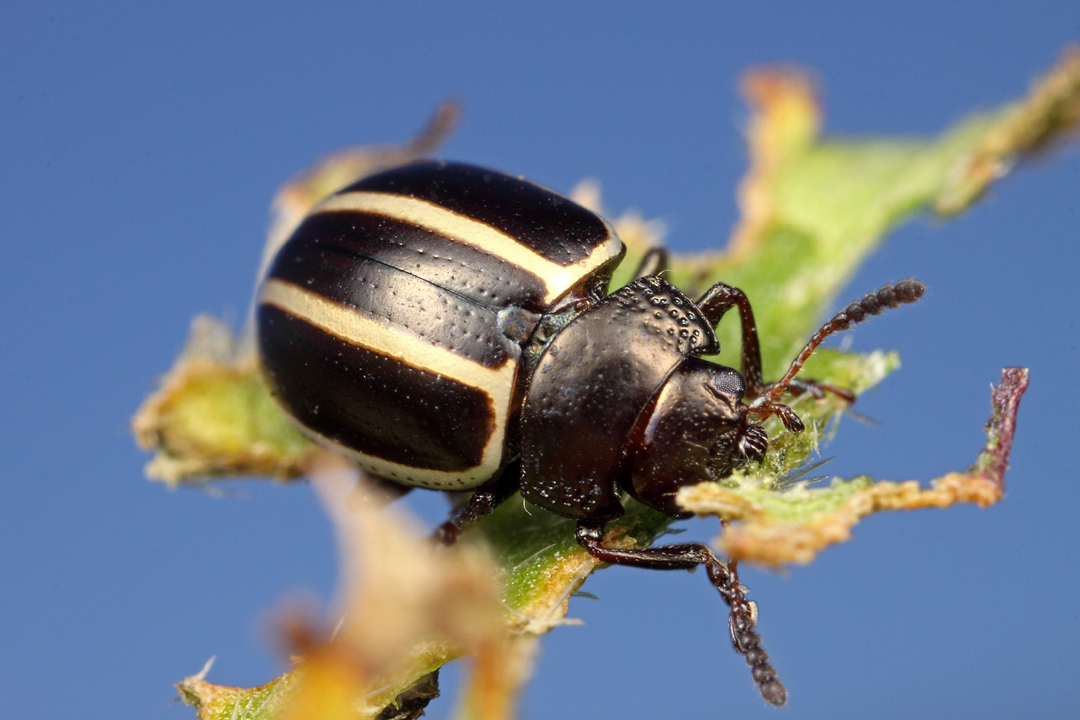
The east end of  in Buenos Aires offers a quiet contrast to the more populated central and western areas. Few people leave the levee-trail system that surrounds the famous wetlands and pampas grass stands in those latter areas; however, those that do find in the east a mosaic of pastures and young woodlands that offer a greater diversity of sights and invite a more leisurely pace. November is spring in Buenos Aires, and as such there were a number of plants beginning to bloom in the Reserve. One plant I found blooming in abundance in one small part of the east area was a member of the family Malvaceae that I take to be Abutilon pauciflorum, a few of which were being devoured by these leaf beetles (family Chrysomelidae).


These beetles are clearly members of the subtribe Doryphorina within the nominate subfamily, looking very similar to the North American species Zygogramma suturalis (ragweed leaf beetle) or the vittate species of Calligrapha (subgenus Bidensomela), e.g. Calligrapha bidenticola. Both of these genera are represented in Argentina, and at first I was inclined to believe the beetles belonged to the latter genus since its Central and South American members are associated almost exclusively with malvaceous plants (North American species of Calligrapha have adapted to plants in several other families). However, a view of the tarsus in the last photo suggests that the claws are joined at the base, a character that immediately separates members of the genus Zygogramma from the genus Calligrapha (species of Doryphora also have fused tarsal claws but exhibit a completely different gestalt). Eight species of Zygogramma have been recorded from Argentina, but I wasn’t able to find photographs of any that look reasonably similar to the individuals in these photos.  The identification will have to remain, frustratingly, non-specific.

Update 12/6/11: I just received an email from Shawn Clark (Brigham Young University, Provo, Utah) saying that he suspects the beetles belong to the genus Desmogramma. This genus is distinguished from both Zygogramma and Calligrapha by having the prosternum sharply angled upward anterior to fore coxae or mesosternum with a distinct horn directed anteriorly (Flowers 2004) and the claws widely separated and unarmed. Unfortunately, neither character is visible in these photos. Three species of Desmogramma are recorded from Argentina, and the coloration of these individuals resembles that described by Stål (1862) for D. striatipennis (D. semifulva and D. nigripes have the 3rd, 5th and 9th elytral interstices light).


These photographs represent continued efforts with the so-called ‘blue sky background’ technique that I’ve been trying to perfect as an alternative to the black background one typically gets in insect macrophotography with full-flash illumination of the subject. All of these photos were taken at ISO 640 using an MP-E 65mm lens at f/13 with 1/160 sec (1st photo) or 1/125 sec (2nd and 3rd photos) exposure and F.E.C. -1. These are similar settings to those used in my previous and not as satisfactory attempt, but this time the results were much better. Not only is the color of the sky spot-on blue, but these photos have much better detail than the previous. In this case, I believe “locking'” the subject relative to the lens to prevent motion blur was the key—I used my left hand to hold the leaf with the beetle towards the bluest area of the sky, rested the camera lens on my left wrist, used my fingers to fine tune the leaf position as I looked through the viewfinder, and held my breath!

REFERENCE:

Flowers, R. W. 2004. The genera of Chrysomelinae (Coleoptera: Chrysomelidae) in Costa Rica. Revista de Biología Tropical 52(1):77–83.

Stål, C. 1862. Monographie des Chrysomélides l’Amérique. C. A. Leffler, Upsal, 365 pp.

Copyright © Ted C. MacRae 2011

Brazil Bugs #14 – Fusquinha


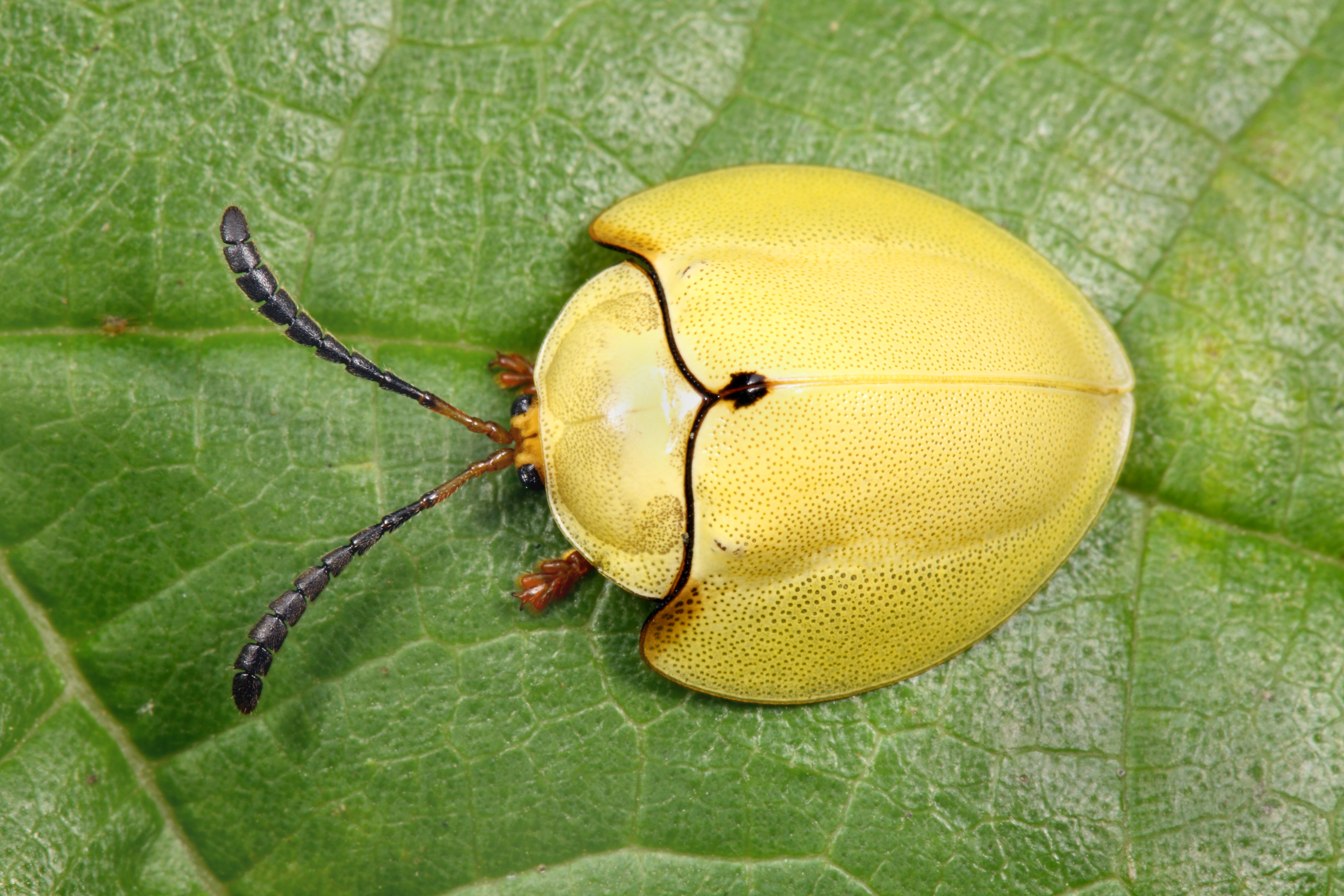
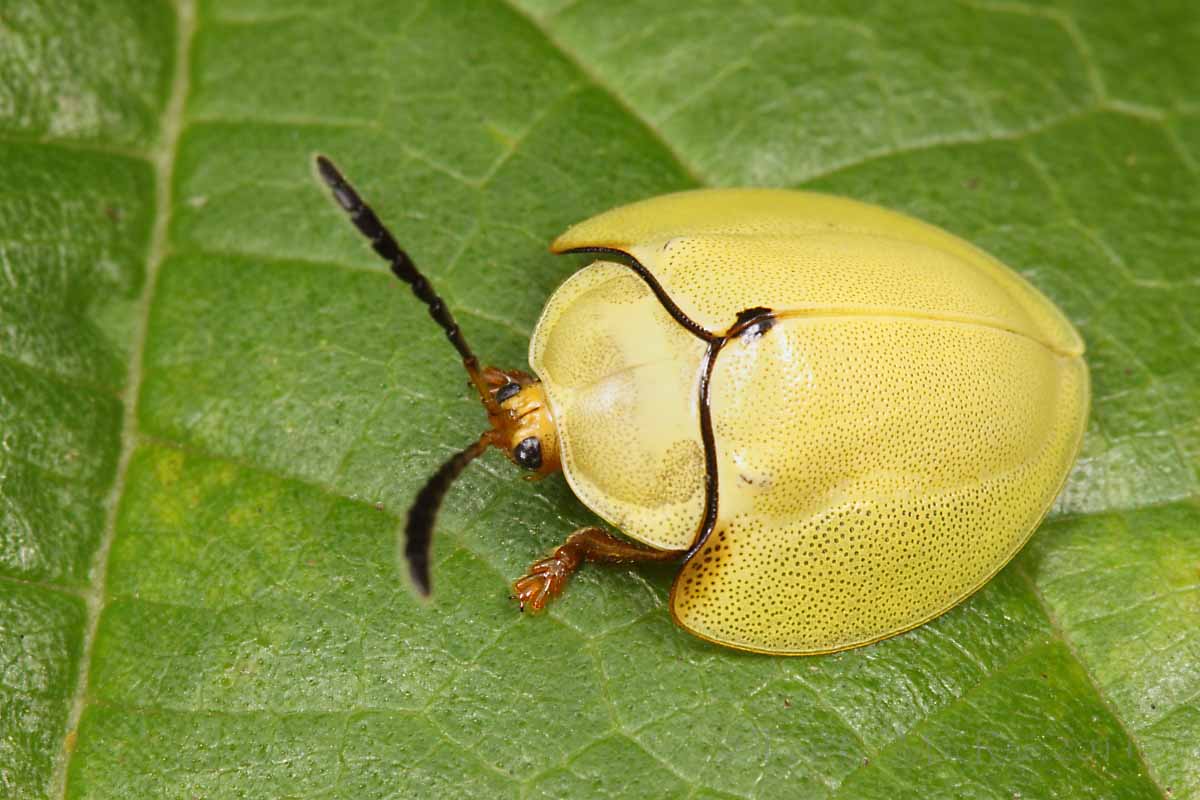
Despite their hyperdiversity, leaf beetles (family Chrysomelidae) as a group are for the most part among the most easily recognized of all beetle families, and within the family none are more recognizable than the tortoise beetles (subfamily Cassidinae).  Named for their distinctively armoured elytra and prothorax and associated behavior of drawing the head and legs under them when threatened, they are worldwide in distribution and especially diverse in the New World tropics.  Even though I know little about the group (chrysomelids as a whole are far too intimidatingly diverse a group for me to add to my already burgeoning list of interests), I can’t resist collecting them whenever I encounter them.  Having traveled to Mexico and South America many times over the years, I’ve accumulated almost a full Schmidt box of these beauties – most of which remained unidentified, save for the well-known representatives from our relatively depauperate North American fauna.


Thus, when I encountered this striking example on a leaf in the Barão Geraldo District near Campinas, Brazil, I figured the photos I took would go into one of those “Brazil Bugs” posts featuring a variety of pleasing to look at but otherwise unidentified insects.  Still, after having had success identifying some other Brazilian insects using Google, Flickr, and carefully selected search terms, I figured I should at least give this one a try.  It didn’t take long – searching on nothing more than “Cassidinae” in Flickr yielded a very similar looking beetle on page 6 from Panama identified by Rob Westerduijn as Paraselenis tersa.  While not likely the same species, it seemed almost certain to represent the same genus, so further searching on the genus name eventually led me to the cassidine mother lode: Cassidinae of the World: An Interactive Manual.  This web page, authored by Lech Borowiec, features species lists, identification keys and images of a large number of specimens, including nearly all of the 29 species currently placed in this exclusively Neotropical genus (you can bet I’m bookmarking this site – perhaps my Schmidt box of specimens will finally get some attention!).  A quick perusal through the images yielded an ID: Paraselenis (Spaethiechoma) flava, recorded broadly across South America.  Everything fit – the black scutellar marking, the elytra broader than the prothorax, the bicolored antennae, the thin black anterior elytral marginal band, and – appropriate for the species name – the even yellow coloration.  My ID was confirmed when I found a key to all the species of Paraselenis (Borowiec 2003).  I surmise this is a female based on the more rounded humeral elytral projections, which seem to be more strongly and angularly produced in the males based on the photos I looked at.


Interestingly, this particular species is considered a pest of sweet potato and commonly referred to as “fusquinha”¹ (Montes and Raga 2010).  Many species of tortoise beetles, in fact, utilize as host plants members of the sweet potato family (Convolvulaceae).  This individual was not on a convolvulaceous plant, but a small tree.  I looked for additional individuals but didn’t find any, nor did I find larvae or any evidence of feeding, so this must have been a wayward individual – probably searching for a suitable host on which to oviposit.

¹ “Fusquinha” is the Brazilian Portuguese word for “Volkswagon Beetle”!

References

Borowiec, L.  2003.  Two new species of the genus Paraselenis Spaeth, 1913 (Coleoptera: Chrysomelidae: Cassidinae).  Genus 14 (3): 403-411.

Montes, S. M. N. M. and A. Raga. 2010. “Fusquinha” Paraselenis flava (L. 1758) praga da batata-doce. Instituto Biológico – APTA, Documento Técnico 004, 8 pp..

Copyright © Ted C. MacRae 2011

Guest Blogger: Dogbane for Dinner

Our guest blogger for today is Anne McCormack. I have known Anne (or known of her) for more than 25 years now, first as a long-time editor of Nature Notes, the journal of the Webster Groves Nature Study Society, and more recently on a personal basis as I, myself, have followed in her editorial footsteps. Anne is an astute naturalist whose breadth of knowledge spans not only botany but also entomology and ornithology, all of which she write about in her own blog at Gardening with Binoculars.


I planted Common Dogbane (Apocynum cannibinum) because some of my butterfly-watching friends reported numbers of juniper hairstreak butterflies on the patch of dogbane at Powder Valley Nature Center in Kirkwood. I assumed incorrectly that dogbane was a host plant for hairstreaks, and believing it to be little more than caterpillar food, I placed it in a hot, dry, narrow strip along the driveway. Ragged, caterpillar-chewed leaves wouldn’t be noticed there, and I forgot about it. After a few seasons, it was still a modest-sized clump, but the leaves were in great shape. In fact, it had grown into an attractive bush of airy, elegant lime-green foliage, wine-red stems, and tiny white flowers. It’s quite a contrast to its relative, Common Milkweed, growing next to it, which looks as if it were designed by Dr. Seuss—even before it gets chewed to bits. At this point I decided it was time to look it up and see why it had failed to support hordes of munching caterpillars. As you have already guessed, gentle reader, the Juniper Hairstreak’s host plant is juniper, not dogbane, but good old Common Dogbane is a great nectar plant. Now that Dogbane and I understand each other better, I can appreciate the amount of traffic its tiny white blooms bring in, like this Peck’s Skipper butterfly. Ants, butterflies, tiny native bees, honeybees, and this mason wasp are busy there all day long.

Along with several species of moth, it is the host plant for the Dogbane Beetle, which spends its larval stage devouring the roots and its adulthood dining on the leaves of Dogbane, and nothing but Dogbane. Dogbane Beetle can be confused with Japanese Beetle by beginners like myself, but unlike its fellow Coleopteran, Dogbane Beetle is harmless. That makes its iridescence all the more gorgeous, as shown in this wonderful photo by Courtnay Janiak. It’s a native insect that has shared a long evolutionary history with this under-appreciated native plant. American Indians valued it for its bark, which is tough but peels off in long strips. They plaited it for bowstrings and anything that called for twine; hence, its other common name, Indian Hemp. Don and Lillian Stokes, in their 2002 PBS show about bird watching, demonstrated how birds seek out the dry stems of this perennial, pulling off strips for nests in early spring. Nesting material can be hard to come by for birds in the tidy suburbs, so I don’t clean up the stems after frost. “Bane” in the name refers to the toxin cymarin in the plant’s leaves, though the plant would have to be covered in braunschweiger before my dog would be interested. Edgar Denison, in Missouri Wildflowers, translates the genus name Apocynum as “away dog.” The species name cannibinum refers to hemp. Its seedpods remind me of French green beans. These split at the end of the season, and the seeds fly away on fibers similar to milkweed seeds. Collect some and try this plant in your butterfly or native plant garden. Give it a spot where it’s easy to watch the colorful visitors.

Dogbane beetle (Chrysochus auratus) - Copyright © Courtnay Janiak

Copyright © Anne McCormack 2010

Add to FacebookAdd to DiggAdd to Del.icio.usAdd to StumbleuponAdd to RedditAdd to BlinklistAdd to TwitterAdd to TechnoratiAdd to Yahoo BuzzAdd to Newsvine

Email to a friend