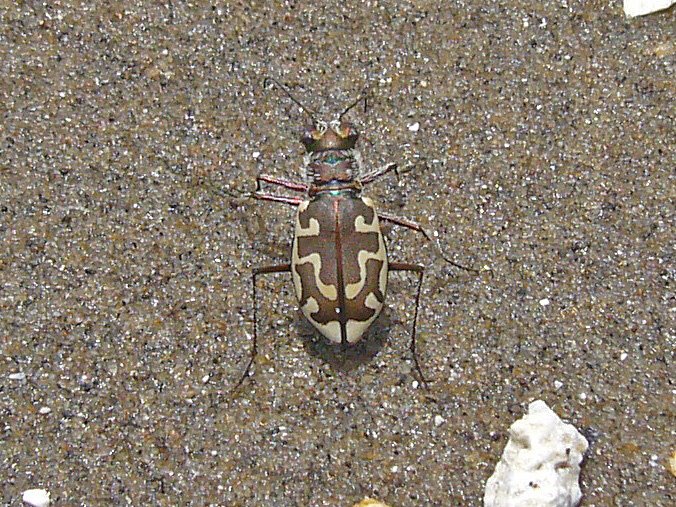
Cicindela cursitans in Missouri

For several weeks now my colleagues and I have been immersed in surveys for selected tiger beetle species in Missouri. We placed 50 pitfall traps in western Missouri and 75 in the southeastern lowlands in mid-June and have been checking them weekly for several weeks now. It’s been a frenetic schedule for all of us – working regular jobs all week and covering two different parts of the state during weekends. Add to that spouses, children, and the desire to watch television coverage of two little sporting events called Wimbledon and the Tour de France, and you have the makings of a severe case of sleep deprivation.

Even with such a focused, dedicated effort success is not assured. Our previous work over the past several years has generated copious data on the more common, widespread species of tiger beetles occurring in the state. The distributions and habitats of these species are well documented now – the low hanging fruit has been picked. We’re now focusing on those few, rare species that I talked about in a previous post – the critically imperiled Cicindela circumpicta johnsonii, found in the equally critically imperiled saline spring habitats of central Missouri; Cicindela pruinina in western Missouri, normally associated with grasslands habitats further west; and the enigmatic Cicindela cursitans, until last year known in Missouri from just a single specimen collected somewhere “nr. Portageville” in the Mississippi lowlands of extreme southeast Missouri.

While our survey efforts are still ongoing for the season, I’m happy to report that robust populations of Cicindela cursitans have been located at several spots along the Mississippi River. Many dozens of individuals were observed at two locations in Mississippi County, and another new population was located further south in New Madrid County. Combined with the sites discovered last year, this gives five confirmed sites for the species within the state. All of these sites share similar features – bottomland forest immediately adjacent to the Mississippi River, with an open understory dominated by poison ivy (Toxicodendron radicans) and trumpet creeper (Campsis radicans) (a ‘radical’ understory to say the least) on a ridge and swale topography of sandy loam soil. The beetles favor the relatively drier, more openly vegetated ridges but avoid areas of excessive sand. None were seen in the wetter sand beach areas leading down to the water’s edge, nor were any observed on the relatively sand-free soils found further away from the river. Unusual for tiger beetles, adults were never found in open sunny areas, being entirely restricted to forest habitats where they darted through the open understory from one poison ivy plant to another. This is in distinct contrast to the wet meadow habitats reported by Brust et al. (2005) for populations of this species in Nebraska. Their small size and rapid running capabilities made them quite difficult to capture or even to notice at first – appearing more like ants or small spiders.

Of equal interest are the sites where the species was not observed, which include sites along the St. Francois River (western side of the Mississippi lowlands) and along the Arkansas border in between the two river systems. All of these sites offered similar bottomland forest, open understory, and ridge and swale soil topography, but they differ from the sites along the Mississippi River where the species was observed in that the soils are a heavy clay and contain no sand. It’s difficult to say conclusively that the species does not occur in these habitats, but the abundance with which we have observed it in the Mississippi River habitats is strongly suggestive.

The Mississippi Lowlands of Missouri, once a vast assemblage of bald cypress (Taxodium distichum) and tupelo gum (Nyssa aquatica) swamps and mixed deciduous bottomland forest, have been almost completely drained, cleared, and converted to agriculture. Only small remnants of natural forest and swamp remain amongst the fields of soybean, wheat, corn, rice and cotton. Despite this, the ribbons of forest that occupy the narrow corridor between the Mississippi River and the levees that confine it seem to offer much potential habitat for Cicindela cursitans. Combined with their confirmed occurrence and abundance at several sites within this habitat, it appears that this species is secure within the state and will not require any special conservation measures to assure its continued presence. In celebration, I share with you some photographs of the adults, taken in their natural habitat at one of the Mississippi County sites, along with a few additional photos of some other tiger beetle species I observed on the wet sand beaches closer to the river’s edge. These latter three species are common in Missouri along the Mississippi and Missouri Rivers: Cicindela repanda (bronzed tiger beetle), Cicindela cuprascens (coppery tiger beetle), and Cicindela hirticollis shelfordi (hairy-necked tiger beetle). After taking pictures of these latter three species along the river bank amidst puzzled looks from a few of the locals, I had an amusing conversation with one of the more ‘colorful’ of them, who had come to the baffling conclusion that I could only have been taking pictures of rocks. I cleared up the confusion and showed him a few of the beetles, and we both returned to doing what we both love – drinking beer and looking for beetles (respectively, that is!).
Saving Missouri’s tigers

For several years now, my friend and colleague, Chris Brown, and I have been studying the tiger beetles (family Cicindelidae) of Missouri in an attempt to characterize the faunal composition and in-state distributions of the included species. Our studies have relied on examination of specimens in museum collections along with several seasons of field work across the state. The data we’ve gathered so far have revealed a fauna that reflects the ecotonal position of Missouri, comprised of elements from the eastern deciduous forest, the southeastern mixed hardwood forests and pinelands, and the western grasslands. These beetles are most frequently associated with disturbed habitats containing sparse vegetation, such as sandbars and erosion cuts, but they also live in other habitats such as along muddy banks, on glades and in forest litter. Since European settlement of Missouri, drastic alterations have occurred in the abundance and distribution of these habitats across the state, and tiger beetle populations have been affected as a result. Dredging and straightening of natural water courses have impacted species that prefer the water’s edge, while fire suppression has impacted those that need dry, open habitats. Grazing has had a profound impact on species associated with sensitive, saline habitats. Conversely, some anthropogenic changes have benefited certain species – road, borrow sand pit and pond construction have increased habitat for species able to utilize such habitats. To date, our surveys have confirmed the presence of 23 species in Missouri (16% of the North American fauna). Some species are common and widespread, such as Cicindela sexguttata (six-spotted tiger beetle) (above, photo taken in a mature white oak forest in Warren Co.). Others have more specific habitat requirements, but their status within the state remains secure. A few are rare and highly localized, primarily representing species at or near the northern or western edge of their distributions that exist in the state as small, disjunct populations. Special conservation efforts may be warrented for these to ensure their continued survival within the state.

One species of potential conservation concern is C. pruinina (loamy-ground tiger beetle), a grassland species normally found in Kansas, Oklahoma, and Texas (left, photo by Chris Brown). This beetle is sometimes treated as a synonym or subspecies of C. belfragei but was most recently considered a valid species by Spomer et al. (2008). When we began our studies, the species was known from Missouri only by a small series of specimens collected in one of the western counties and deposited in the collection of Ron Huber. An additional specimen in the Huber collection labeled “Columbia, Mo.” is considered to likely represent student mislabeling. Several attempts at relocating the western Missouri population were required before we found it, and intensive surveys to determine the extent of its distribution in Missouri were conducted during 2006 using a combination of pitfall traps and direct observation. Those surveys succeeded in detecting the beetle only along one 2.5-mile stretch of county road in Johnson Co. The beetle seems to be restricted to red clay embankments occurring in a small localized area of the county. This season we plan to refine our survey by focusing tightly on promising habitats in this area near the sites identified in 2006 to more precisely define the distributional limits of this population. Regardless of what we find, the flightless nature of the species, its highly localized Missouri occurrence, and the disjunct nature of such suggest that special conservation status is warranted for the species to ensure its continued presence in the state. Despite the relatively low numbers of individuals we have seen, the protected status of the land on which this beetle lives leaves us optimistic about its future.

A Missouri species about which we are far less optimistic is C. circumpicta johnsonii (saline springs tiger beetle) (right, photo by Chris Brown), long known from saline spring habitats in the central part of the state. The Missouri population is highly disjunct from the main population further west and exhibits a uniform blue-green coloration rather than the mix of blue, green, and red colors exhibited by the main population. These features suggest that separate subspecies status might be warranted for the Missouri population. Numerous historical collection records exist from a handful of sites in Howard and Cooper Counties; however, surveys conducted by us during recent years revealed that the populations had suffered severe declines. This appears to be largely due to cattle disturbance and vegetational encroachment of the sensitive saline spring habitats upon which the beetle depends, especially at sites located on private land. Ron Huber, in a letter to me listing the collecting records he had for this species, reported seeing “hundreds of the wary little buggers” at one locality on private land, but in our visit to the site not a single individual was seen around the spring – badly trampled and overgrown with the exotic pasture grass tall fescue (Festuca arundinacea). In all, we were successful in finding the beetle at only one of the historical localities and at one new site located nearby. While both of these sites are located on state protected land, we concluded that the longterm viability of the C. circumpicta johnsonii population in Missouri was in serious jeopardy. Based on our recommendation, the species was placed on the Missouri Species of Conservation Concern Checklist with a ranking of S1 (critically emperiled). While this affords the species legal protection under the Wildlife Code of Missouri, the benefit may be minimal since the Wildlife Code does not address the main threat to this beetle’s survival – habitat degradation. We have not surveyed for this beetle since but plan to make field observations this summer (no trapping!) to check on its status. I sincerely hope we will not have to hang our heads with the realization that we have succeeded in extirpating yet another beautiful and irreplaceable gem.

Last year we finally succeeded in locating C. cursitans (ant-like tiger beetle) in Missouri (left, photo by Chris Brown). Adults are flightless, and at less than 1 cm in length, are among the smallest of North American tiger beetles. The species has been recorded broadly but sporadically between the Appalachians and Great Plains – a distribution that is probably underestimated due to its small size and general resemblance to ants. A significant distributional gap exists between the eastern and Great Plains records, which Ron Huber believes may be indicative of two disjunct forms and potentially two species. Missouri falls within this gap, and although the species has not yet been formally recorded from the state, a single specimen collected in 1991 “nr. Portageville” is deposited in the Enns Entomology Museum, University of Missouri, Columbia. We had made several attempts over the past few years to locate this species by searching what we thought were promising habitats along the Mississippi River near Portageville, but the species was not located until last year, when I relayed this information to Portageville biologist and tiger beetle enthusiast Kent Fothergill. Kent not only located the beetle at the location I suggested, but quickly found another population on a nearby parcel of land managed by the Missouri Department of Conservation. Hurriedly, we visited the first site and observed a few additional individuals at a nearby location just to the south. The bottomland forest habitat within which all of these individuals were observed is fairly extensive along the Mississippi River in the southeastern lowlands of Missouri, but at this point we can only speculate whether C. cursitans occurs throughout this habitat. Other habitats have been reported for this species, including mesic and wet prairies and meadows (Brust et al. 2005). Such habitats are also found in the southeastern lowlands, and while C. cursitans has not been seen through cursory examinations in such areas, it is possible that the small size, cryptic habits, and narrow temporal occurrence of C. cursitans have allowed it to escape detection. Kent will be helping us this season with additional trapping and direct observation at several selected sites along the Mississippi and St. Francois Rivers to determine whether the beetle occurs more broadly in the southeastern lowlands and whether it utilizes these other habitats in addition to bottomland forests.

I would be most interested in any additional reports of these rare tiger beetles in Missouri (contact me at the email address shown in the left sidebar copyright statement). Remember, C. circumpicta johnsonii is critically emperiled in Missouri – please do not collect it.

Ozark Trail – Marble Creek Section

If you know wilderness in the way that you know love, you would be unwilling to let it go…. This is the story of our past and it will be the story of our future. – Terry Tempest Williams


During the past several years that Rich and I have been hiking the Ozark Trail, most of our hikes have taken place in the fall and winter months. From a hiker’s perspective, I really enjoy these off-season hikes – the foliage-free canopy affords unobstructed views of the terrain and vistas, the cool (even cold) temperatures are more comfortable under exertion (provided one has properly layered), and there are no mosquitos to swat, ticks to pick, or gnats to incessantly annoy. I also enjoy them as a naturalist, for the world is quiet and still, allowing me to focus on things I may not notice amidst the cacophany of life during the warmer months. By the end of winter, however, the biologist in me yearns to once again see bugs and flowers and the great interplay of life. Unfortunately, this makes something as simple as hiking from point A to point B rather difficult – too many distractions! Nevertheless, each spring Rich and I try to hike a small leg of the Ozark Trail before the crush of summer activities fills our calenders. Last week, we chose the Marble Creek Section, an orphan stretch (for the time being) in the rugged St. Francois Mountains that eventually will connect to the famed Taum Sauk Section. It would be our first return visit to the St. Francois Mountains since we first embarked on our goal to hike the entirety of the Ozark Trail.

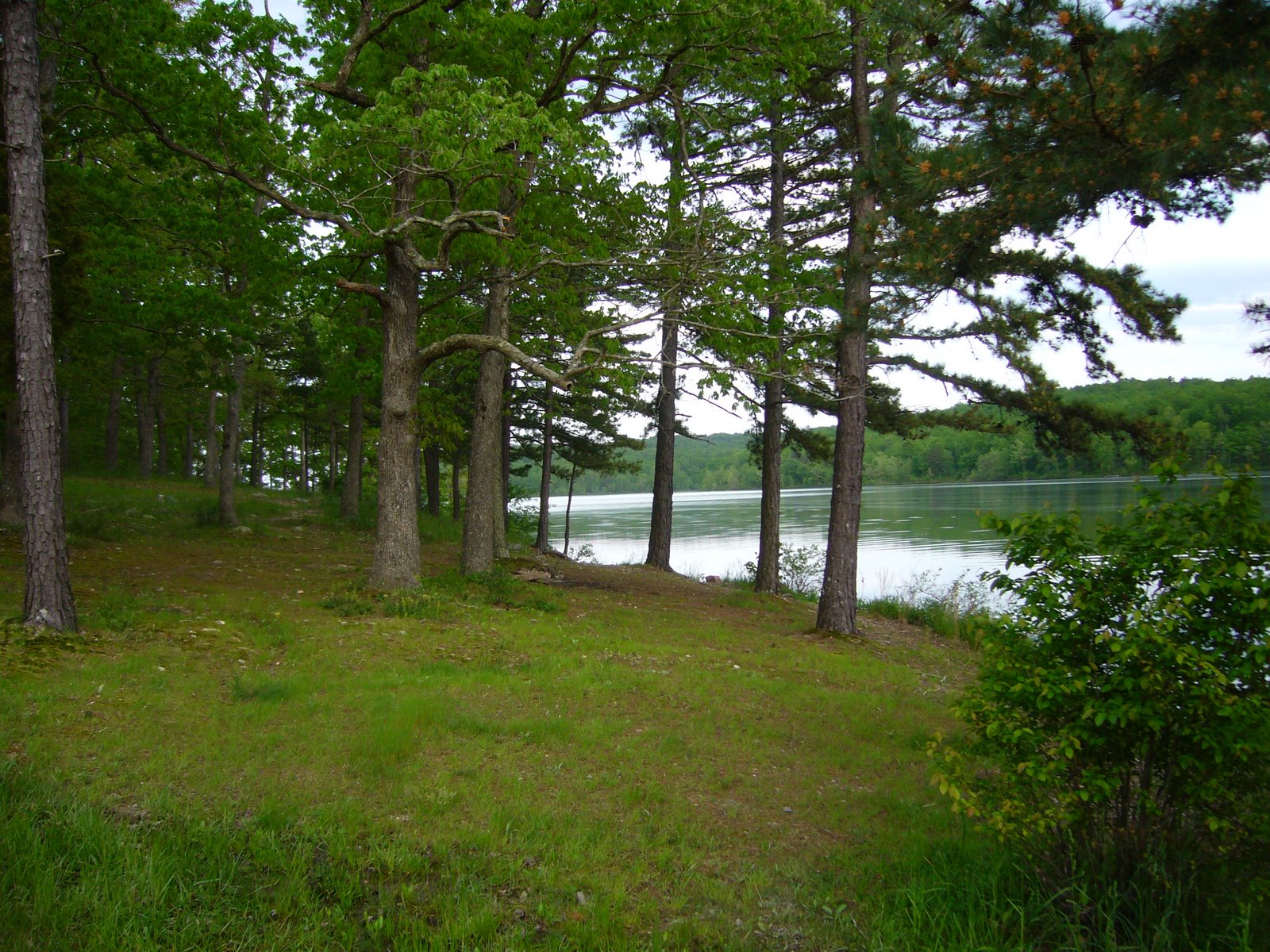
The St. Francois Mountains are the geologic heart of the Ozark Highlands. Since their primordial birth 1.5 billion years ago, recurring cycles of erosion and deposition have worn them down and covered them up, only to see them reemerge once again as the younger rocks covering them were themselves stripped away. The Ozarks are an ancient landscape with ancient hills, and none are older than those of the St. Francois Mountains. It’s as if the Earth itself began in these mountains. We began our hike at Crane Lake, a clear, blue 100-acre lake built in the 1970s by the Youth Conservation Corps. The trail surrounding the lake was built in 1975 and is, in its own right, a National Recreation Trail. It meanders along the lakeshore and through hillside igneous glades and descends into a deep ravine below the dam where Crane Pond Creek cascades through spectacular rhyolite shut-ins. East of the lake the trail connects to the Ozark Trail proper and continues to Marble Creek campground. All told, we would be hiking a 9-mile stretch.

I knew we were in a special place almost from the beginning when I noticed a small flowering plant growing next to the trail under the mixed pine/oak canopy. I’m not a very good botanist, but I instantly recognized the plant as dwarf spiderwort (Tradescantia longipes), an Ozark endemic known from only a handful of counties in Missouri and Arkansas. I knew this only because I had just the night before read about this wonderful plant on Ozark Highlands of Missouri, a superb natural history blog focused on my beloved Ozarks. Reading about this lovely, diminutive member of the genus, I wondered if I might encounter it on my own hike the next day. As we searched off the trail and near the lakeshore we encountered dozens of the plants, each with one or two exquisite blue flowers. Our excitement at seeing a true Ozark endemic increased with each plant we encountered, giving us confidence that its future, at least in this area, appears secure. Of the numerous photographs I took, I share two that show its short, squat habit and filament-covered stamens. Eventually we decided we needed to move on – we had spent 20 minutes and only hiked 100 ft!

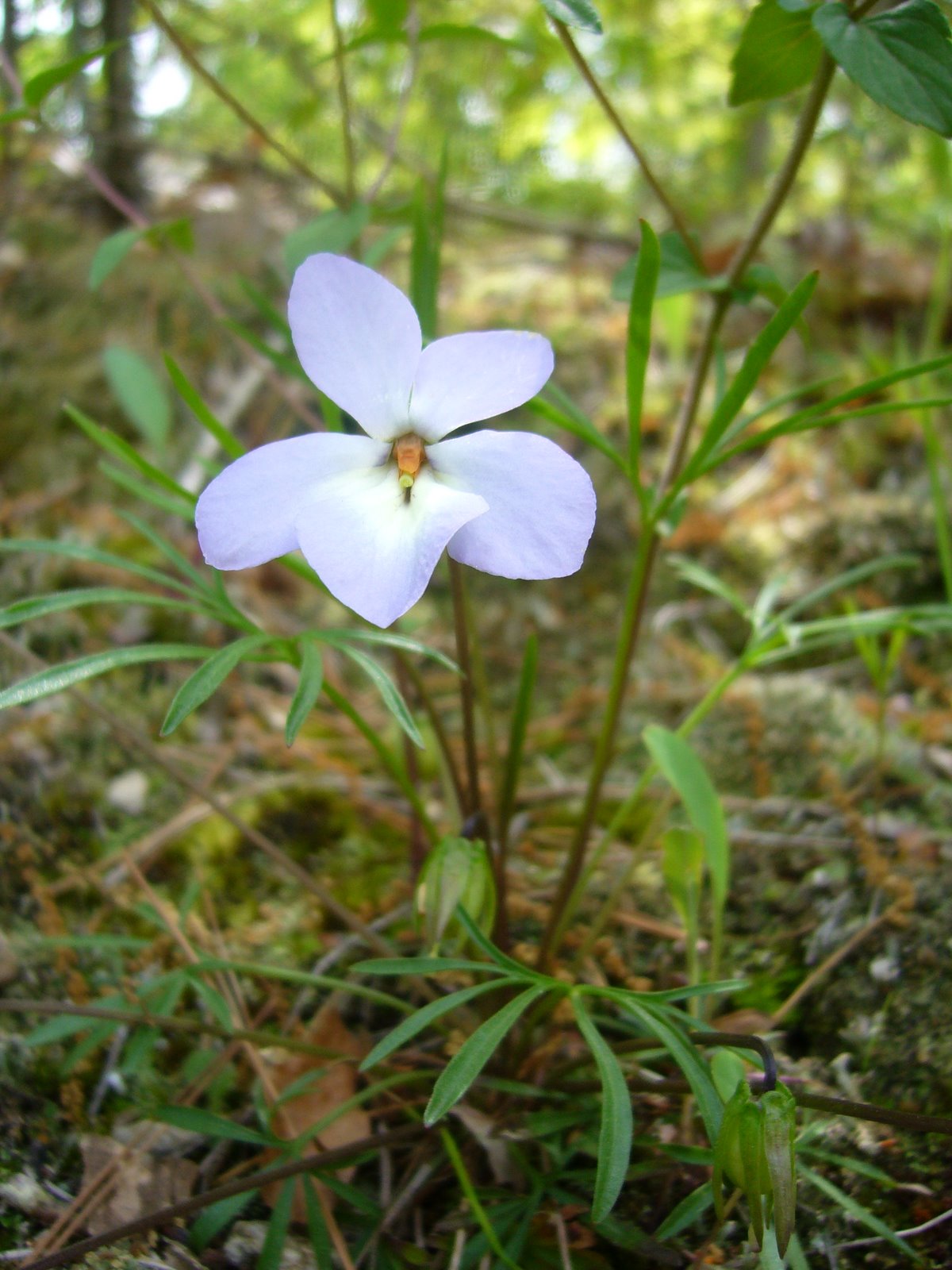
Looping around the south side of the lake, the trail traversed mesic to dry-mesic upland forest and afforded spectacular views of the lake and rugged north shore. The spring ephemerals had already come and gone, replaced by such classic woodland denizens as birdfoot violet (Viola pedata, pictured), fire pink (Silene virginica), cream wild indigo (Baptisia leucophaea), four-leaved milkweed (Asclepias quadrifolia), Pursh’s phacelia (Phacelia purshii), and shooting star (Dodecatheon meadia). Insect life was abundant, however, the only species seen in one of my chosen specialties, metallic wood boring beetles (family Buprestidae), were early spring species of Acmaeodera – pictured here is A. ornata on a dewberry (Rubus sp.) flower. This pretty little beetle occurs throughout eastern North America in early spring on a variety of flowers, where adults feed on pollen and mate. Eggs are laid on dead branches of certain hardwood trees, through which the larvae tunnel as they develop. Dry, dead wood contains little nutritional value, and the larvae cannot digest the cellulose. As a result, they eat considerable volumes of wood, extracting whatever nutrients they can for growth and ejecting the bulk as sawdust, which they pack tightly in their tunnels behind them. A year or more might be required before they have grown sufficiently to transform into the adult and emerge from the wood. A smaller relative, Acmaeodera tubulus, was also seen on flowers of native dwarf dandelion (Krigia biflora).

We stopped for lunch on a little point extending out towards the lake. The forest overstory was dominated by an open mixture of white oak (Quercus alba) and shortleaf pine (Pinus echinata). Thickets of highbush huckleberry (Vaccinium stramineum) and carpets of reindeer moss in the open areas belied the acidic nature of the igneous substrate. Stands of bastard toad flax (Comandra richardsiana) in full bloom were found at the tip’s dry, rocky tip. These interesting plants feed parasitically on neighboring plants, attaching to the roots of their hosts by means of their long, thin rhizomes. Resuming our hike, we descended down into a shaded, moist draw feeding the lake and saw a huge royal fern (Osmunda regalis var. spectabilis) bush. I had never seen this aptly named fern before, but it was immediately recognizeable by its large size (~5 ft in height) and presence of distinctive, fertile leaflets on some of its upper branches – a very striking and handsome fern, indeed. Nearby was a smaller, but no less attractive species of fern that I take to be marginal sheild fern (Dryopteris marginalis) – another species I have not seen before (or at least made the effort to notice).

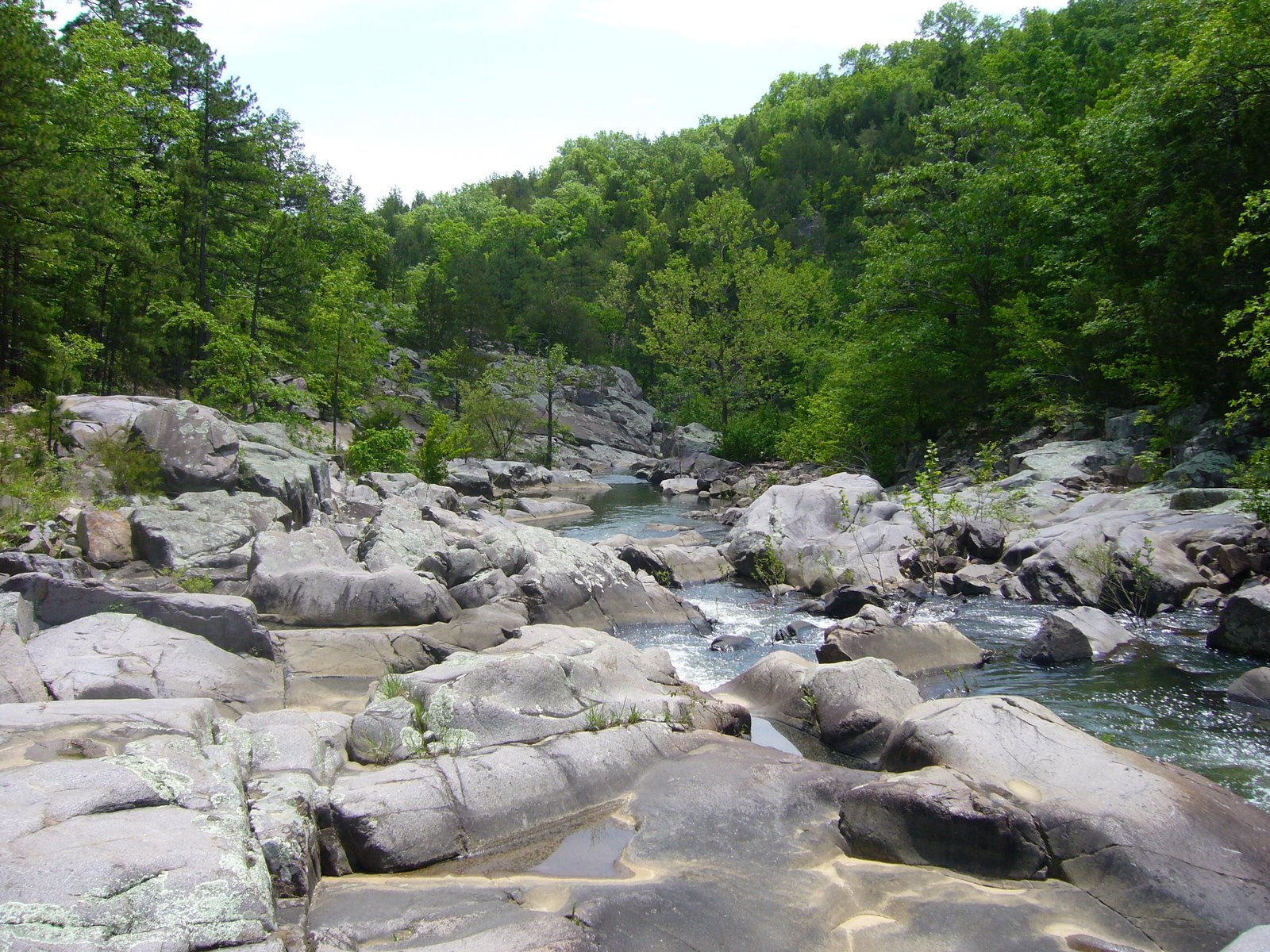
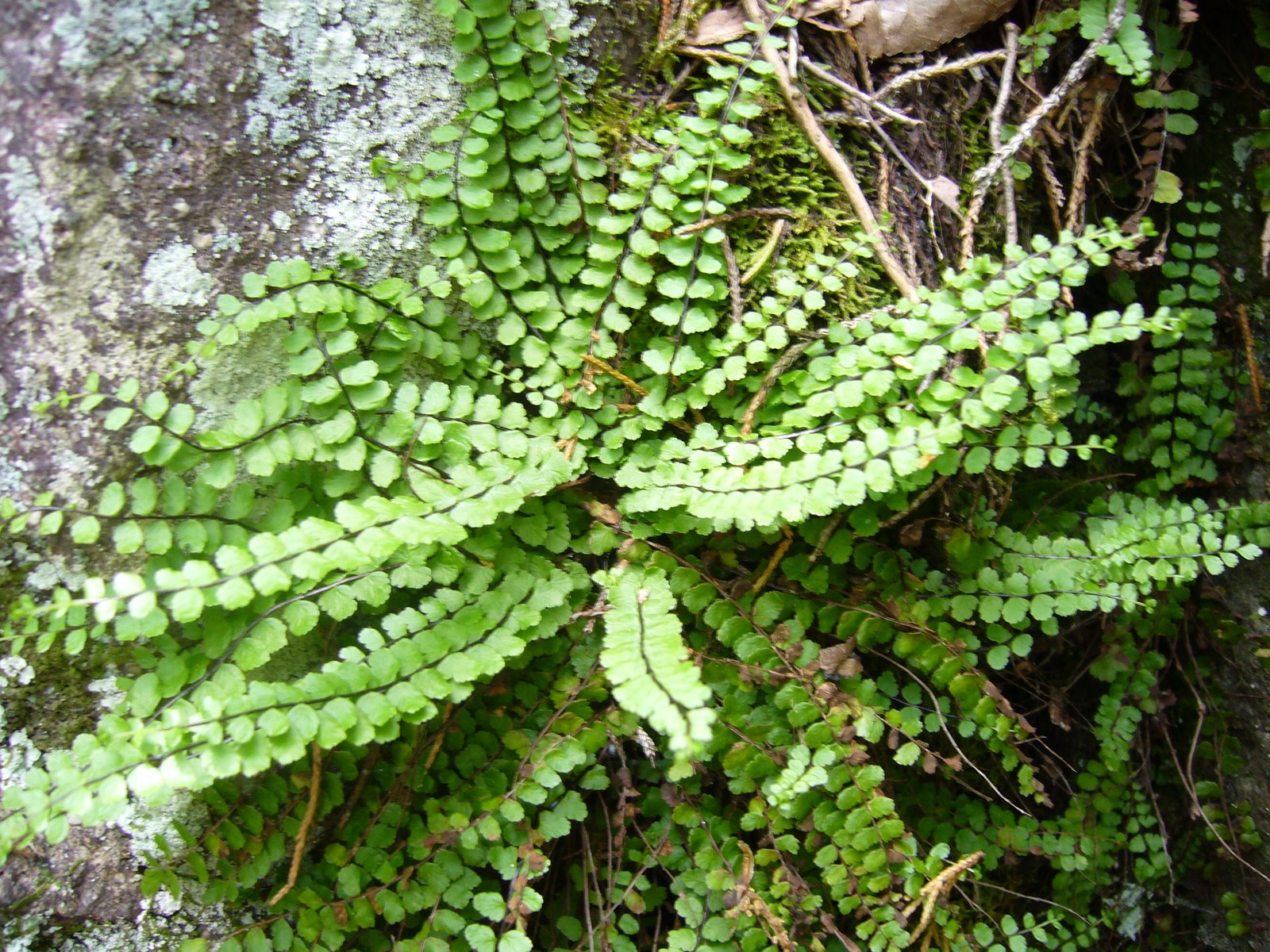
Soon, we reached the dam and for the first time saw the spectacular rhyolite shut-ins. While perhaps not quite as impressive as the nearby and much more famous Johnson’s Shut-Ins, Rich and I nonetheless watched entranced as the water roared over the smooth igneous rock exposure, forming elegant cascades, rushing through narrow chutes, and swirling into small pools. Steep canyon walls rose sharply on each side of the shut-ins, as if standing guard. Clambering amidst the pines and cedars that cloaked them, we found this maidenhair spleenwort (Asplenium trichomanes) nestled within a crack on a vertical rock face under continuous deep shade. Reaching the top of the bluffs, we were greated by one of my favorite of all Ozark habitats – the igneous glade. Glades are natural island communities surrounded by a sea of forest. Their shallow, dry, rocky soil conditions support plants and animals more adapted to prairie or desert habitats. Specific communities are influenced by the type of rock below – igneous and sandstone substrates support lichens, mosses, and other acid soil-loving plants, while limestone and dolomite substrates support a more calcareous flora. The photo here shows the massive boulder outcroppings typical of igneous glades and their weather-resistant bedrock. We hoped to see a collared lizard (Crotaphytus collaris), perhaps Missouri’s finest saurian reptile, but today was not the day. We did, however, see adults of the beautiful and aptly named splendid tiger beetle (Cicindela splendida) sunning themselves on the bare rock surfaces – flashing brilliant green and clay-red. The adults we saw had spent the winter deep inside tunnels dug into the rocky soil the previous fall and were now looking for mates. Male tiger beetles grab females by the neck, their jagged, toothy jaws fitting precisely in grooves on the female neck designed specifically for such. As I looked upon this prairie island within the forest, I thought about how the St. Francois Mountains were once themselves islands. I realized the landscape we were exploring today was itself a fossil – with rhyolitic ‘islands’ amidst a ‘sea’ of cherty dolomite laid down a half billion years ago in the warm, tropical, Cambrian waters that surrounded the St. Francois Islands, by then already a billion years old themselves. Yes, the Earth itself seems to have begun here.

Leaving the glade and once again entering the acid pine forest, we came upon one of the most striking floral displays that either of us have ever witnessed – wild azalea (Rhododendron prinophyllum) in the midst of full bloom! I have known about several colonies of this plant for many years now but had only seen them at the very end of the bloom period, with just a few, pitiful, limply hanging flowers still attached. Today, the plants were absolutely dazzling. The blossoms were not only visually attractive, a deep pink color, but also unexpectedly fragrant. We stood amongst several specimen plants as tall as ourselves, taking picture after picture amidst the clovelike aroma wafting around us.

We checked our watches – we were now 3 hours into our hike and had traversed just 2 miles. Clearly, this was not a sustainable pace, so we put our heads down and focused on covering ground. Once leaving the vicinity of Crane Lake, the trail became rather difficult to follow – it obviously receives little use, and in one stretch some logging activities had obliterated the trail completely. Were it not for the sporadic pieces of orange flagging tape tied just within sight of the previous, we would not have know where to go. At one point, we got completely off-track and had to backtrack a full half mile before we found the proper trail. The day put our contour map reading skills to their greatest test yet. It was difficult and strenuous terrain, with steep up and down grades and few long ridgetop stretches until (thankfully) the final 2 miles, which terminated in a long descent (more thankfully) to Marble Creek Campground. Despite the difficulties in following the trail and our not bringing enough water, I would have to rank this section a close second to the Taum Sauk stretch for its ruggedness, spectacular vistas, and unique plant communities. Yes, the St. Francois Mountains are truly the heart of the Ozarks.