Field photographs of insects can be deceiving

My previous post featured several photos of Cicindela formosa generosa (Eastern Big Sand Tiger Beetle). This gorgeous beetle is said to occur in open, dry sand habitats throughout the Great Plains and more sporadically across the north-central and northeastern U.S. Like most other existing photos of this species, they show adults on barren sand with not so much as a sprig of vegetation to be seen. As a result, one might presume that adult beetles prefer the most open and barren areas of the habitats in which they occur.

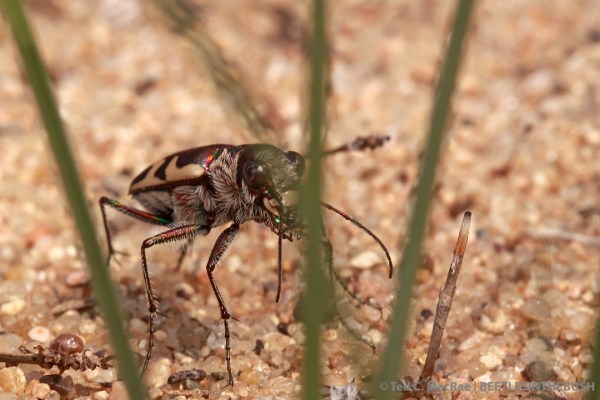
"You don't see me, but I see  you!"

“You don’t see me, but I see you!”

Consider the above photo—taken the same day as those in the previous post but annoyingly cluttered with vegetation that partially obstructs the view of the beetle. This was actually the first photograph that I took that day, and while the foliage may be considered an aesthetic distraction, it nevertheless provides valuable information about the natural history of the beetle. My impression from the past few years of observation is that adult beetles actually spend more time foraging in the sparsely vegetated areas surrounding these more open areas. I presume they are more likely to encounter prey in areas where some vegetation exists, and also the vegetation provides opportunities for shade, which the adults actively seek out during the hottest parts of the day. Most collectors and photographers do not notice beetles foraging amongst the vegetation, but instead see them only after their approach has caused the beetle to flee out into the more open areas—where they are then collected/photographed.

© Ted C. MacRae 2013

Big, Bold and Beautiful—Redux

Cicindela formosa generosa | Scott Co., Missouri

Cicindela formosa generosa (Eastern Big Sand Tiger Beetle) | Scott Co., Missouri

Strange as it may seem to residents of the western U.S. or coastal areas in the east, one of my favorite sights in Missouri is dry sand! It’s a true rarity in our limestone/dolomite dominated state, a result of nearly continuously exposed land for the past several hundred million years. Only along the state’s bigger rivers, where relatively recent alluvial events have yet to be completely eroded by the passage of time, can significant sand deposits be found. It is in these habitats that one of my favorite of Missouri’s tiger beetles, Cicindela formosa generosa (Eastern Big Sand Tiger Beetle), can be found. In much of the state, tiny slivers of sand dry enough to support populations of these beetles occur sporadically along the Missouri and Mississippi Rivers and their larger tributaries. More extensive deposits, however, are found in several wide, low ridges of sand in the southeastern lowlands of the state—relatively recent alluvial deposits from the last glacial maximum. Sadly, in a region originally blanketed by tupelo/gum/cypress swamp, such relatively dry areas were the first to fall to the plow, and subsequent drainage of the surrounding swamps further promoted a near complete  conversion of the entire region to agriculture.

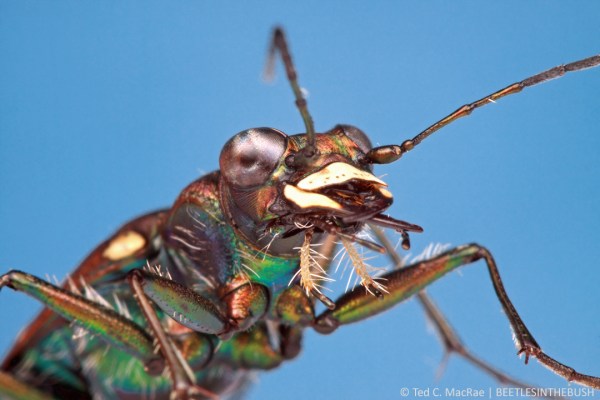
She's got legs up to her neck!

She’s got legs up to her neck!

Still, tiny remnants of original habitat remain—generally parcels of land that were either too dry and sandy or persistently undrainable. Such parcels now form the basis of Missouri’s system of preserves in southeast Missouri. As tiny as they are and representing only a few percent of their original extent, these parcels now serve a critical role in preserving some of Missouri’s most endangered natural communities. Among these is Sand Prairie Conservation Area in Scott Co., featured several times now on this blog (). The sand here is extraordinarily dry, due not only to its depth but also the low organic content—factors that made the land unfarmable and, ultimately, allowed it to escape the conversion that befell the surrounding areas and eventually become a preserve. I have visited Sand Prairie many times in recent years, and although I now know its plants and animals well, there are some that I never tire of seeing—plants like clasping milkweed (Asclepias amplexicaulis), one of my favorite of Missouri’s milkweeds, and animals like C. formosa generosa!

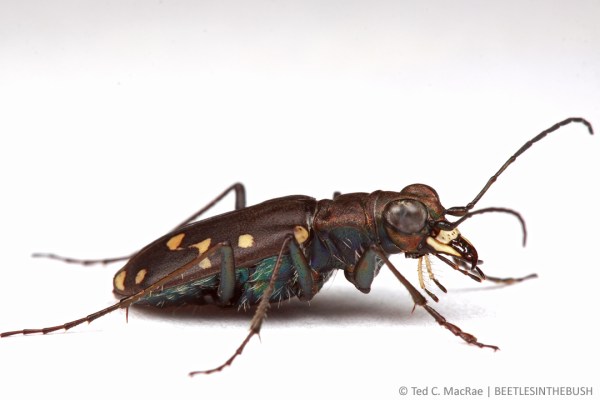
Bold white markings and a chunky body make this one of Missouri's most distinctive tiger beetles.

Bold white markings and a chunky body make this one of Missouri’s most distinctive tiger beetles.

Last weekend I visited Sand Prairie once again, and I was happy to see C. formosa generosa as plentiful as I have ever seen it. I have photographed this species on several occasions, most recently two years ago at a site very near my house. Those last photographs are probably as good as I can ever expect (and in fact one of them even made this year’s ESA calendar), so barring some unusual color form or interesting natural history observation I have little reason to continue taking photographs of it. Nevertheless, I’m trying out a new diffuser, which was all the excuse I needed to try my hand again with this big, beautiful species. I was once again reminded of why of I love this tiger beetle so much—their bulk, their bulging eyes, their long, looping escape flights that end with a comical bounce and tumble, only to end up on their feet and facing their pursuer. These beetles are loaded with personality and behavioral charisma. It was an unseasonably warm and humid day, so my opportunities to photograph them were limited. I hope these few that I present here impart some of that personality.

Individuals from Missouri often show a hint of the red coloration that characterizes populations further west.

Missouri individuals often show a hint of the red coloration that characterizes populations further west.

Copyright © Ted C. MacRae 2013

And the results are in…

I recently entered my first photo contest, a local competition sponsored by the Webster Groves Nature Study Society (of which I have been a member for ~30 years), and although the competition was limited to its few hundred members there were some serious cash prizes on offer. Being a noob at photo contests and a still relative newcomer to photography in general, I wasn’t sure what to expect. I thought my photos might be good enough to compete, but I also knew I would be going up against some long-time and very skilled nature photographers. The basic rules were a maximum of two submissions in no more than three of the following categories:

  • Botany
  • Entomology
  • Ornithology
  • Landscapes/habitats

Since I’ve only photographed two birds ever, I decided to submit entries to each of the other three categories. It was an interesting competition—the judges (each category had a panel of three consisting of a WNGSS board member, a natural history expert, and a photography expert) had a chance to see all of the photographs prior to the event (held last night) and select the top ten from each category, but the rest of the judging was done live at the event. Eventually, from each category a 1st place, 2nd place, and 3rd place photo was selected. The 12 winning photographs were then displayed in a continuous loop, and everybody attending the event was allowed to vote for one grand prize winner. The grand prize winner had to receive more than 50% of the vote, so a few runoff rounds were required to decide the final winner.

How did it go for me? I had a pretty good night, with three winning photographs:

Entomology—3rd place

Cicindela repanda (Bronze Tiger Beetle) | St. Louis Co., Missouri

Cicindela repanda (Bronze Tiger Beetle) | St. Louis Co., Missouri

Botany—2nd place

Hamammelis vernalis (Ozark witch hazel) | Iron Co., Missouri

Hamammelis vernalis (Ozark witch hazel) | Iron Co., Missouri

Entomology—1st place

Arctosa littoralis (beach wolf spider) | Lewis Co., Missouri

It was a thrill for me to learn that, out of the six photographs I submitted (and I really didn’t think my two landscape submissions were competitive to begin with), three were among the 12 final prize winners. That also made them eligible for the grand prize, but in this case I didn’t really expect the larger membership (which has a lot of birders) would really take to my closeup insect photographs. To my surprise, the first round of voting produced four finalists—two of which were my insect photos! The first runoff vote eliminated one photo—but not either of mine, and the second runoff eliminated one more photo—but again neither of mine. I had won the grand prize without yet knowing which photo would be the winner! In the end, the tiger beetle took the top prize. Personally, I was happy about that, because even though the photo took only 3rd place in the entomology competition, I thought it was the stronger of the two photos based on composition, the time and effort it took to work the beetle to finally “get the shot” (not that the wolf spider photo didn’t also take a lot of effort to get that close), and the natural history behavior that it captured (stilting and sun-facing for thermoregulation). I know blog commenting is becoming passé, but if you have any particular thoughts about these photos, good or bad, I would love to hear from you.

Overall I would have to say that, winner or not, participating in a photo competition was an extraordinary learning opportunity for me as I try to hone my craft. Listening to the comments of the judges in all of the categories, both on the natural history and the technical aspects of the photographs, gave me a lot of insight into how I might further improve my technique and take photographs that can be appreciated on both technical and artistic grounds. More importantly, the cash was nice, but the motivation to keep trying that I got out of the experience was priceless!

Copyright © Ted C. MacRae 2013

Featured Guest Photo: A Spectacular Case of Mimicry

On occasion I receive photos from readers that are so remarkable I simply must share them (with the owner’s permission, of course). Recently I received a note from Len de Beer in Maputo, Mozambique, who was looking for help identifying a tiger beetle he had photographed on the beaches of the Maputo elephant reserve. My knowledge of Afrotropical tiger beetles is rudimentary, so I had to tap the expertise of fellow cicindelophile Dave Brzoska for the ID (many thanks, Dave), but in the ensuing correspondence Len sent me the following photograph that he took of another tiger beetle species while living in Madagascar:

The mimic: Peridexia hilaris

The mimic: Peridexia hilaris | Anzojorobe, Madagascar (photo © Len de Beer) 

A spectacular species to be sure, but the story behind its appearance is even more remarkable. This tiger beetle is one of two species in the Madagascan-endemic genus Peridexia, both of which exhibit color patterns that are a near-perfect match for that of the local pompilid wasp, Pogonius venustipennis (see photo below). According to Pearson & Vogler (2001), not only do these tiger beetles share the wasp’s bright yellow and black color pattern, but they also run in constant small circles (rather than the distinct, straight-line sprints that are more typical of tiger beetles) and fly readily when frightened, only to land again on the forest floor. These running and flying behaviors more closely resemble the foraging movements of the wasp than the movements of a typical tiger beetle, resulting in mimicry so effective that even tiger beetle collectors have been fooled and stung on the fingers when they attempted to collect their first Peridexia!

The model: Pogonius venustipennis

The model: Pogonius venustipennis (photo © Len de Beer)

Camouflage is the most widely observed predator avoidance mechanism in tiger beetles, with numerous species known whose color patterns closely resemble or otherwise allow them to blend in with the color and texture of the soils found in their preferred habitats. Nevertheless, mimicry is common enough (although anecdotal evidence still far outweighs true experimental evidence). Pearson & Volgler (2001) list examples of tiger beetles resembling mutillid wasps (commonly called “velvet ants”) from North and South America, as well as India, and also mention a South American tiger beetle species, Ctenostoma regium, that is the same size and shape as Paraponera clavata (or “bullet ant”), a large solitary species that is purported to pack the most painful of all insect stings (that this is true, I am inclined to agree). Tiger beetles can also serve as models—there is a katydid in Borneo whose immatures bear a remarkable resemblance to arboreal species of tiger beetles in the genus Tricondyla (Pearson & Vogler 2001, Plates 26 and 27). It has also been suggested that mimicry in tiger beetles might not be restricted to Batesian associations (unprotected mimic and harmful model) but may also include Müllerian associations (both model and mimic are distasteful or harmful).

My sincere thanks to Len de Beer for allowing me to post his photographs of this remarkable tiger beetle and the wasp it mimics.

REFERENCE:

Pearson, D. L. & A. P. Vogler.  2001. Tiger Beetles: The Evolution, Ecology, and Diversity of the Cicindelids.  Cornell University Press, Ithaca, New York, xiii + 333 pp.

Copyright © Ted C. MacRae 2013 (text)

How to collect larvae of Amblycheila cylindriformis

Amblycheila cylindriformis larval burrow | Major Co., Oklahoma

Amblycheila cylindriformis larval burrow | Major Co., Oklahoma

Step 1. Go to your favorite grassland habitat in the western half of the Great Plains anywhere from Texas north to South Dakota and look for barren soil amongst the vegetation. Clay banks near streams or in ravines and even vertical clay bluff faces are also good (although I have not myself observed the latter). “My” spot is in the Glass Mountains of northwestern Oklahoma, where talus slopes in mixed-grass prairie beneath flat-topped mesas and the ravines that cut through them provide just enough slope for this species’ liking.

Burrow diameter of ~8mm identifies this as a 3rd instar larva.

Burrow diameter of ~8mm identifies this as a 3rd instar larva.

Step 2. Look for large, almost perfectly round burrow entrances that go straight down from the surface. By large, I mean approximately 6–8 mm in diameter—as large a burrow as any tiger beetle in North America will make. Many other insects create burrows, but tiger beetle burrows are generally recognizable by their almost perfectly circular shape and clean, beveled edge. Look closely, and the burrow will be seen to actually be slightly D-shaped to match the shape of the tiger beetle larva’s head—the large, sickle-shaped, upward-facing jaws resting against the flat part of the D. In the case of this species, they tend to be found in clusters of several burrows in close proximity to each other. The burrow in these photos was found at the upper edge of a drainage ravine on the upper part of the talus slopes (see diagram in this post).

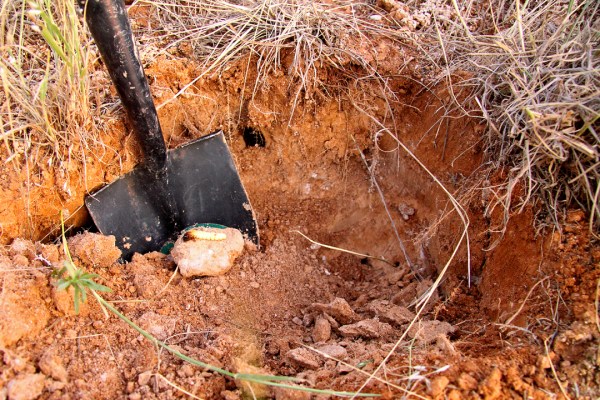
Dig around the burrow, carefully excavating along the grass stem, until the larva is reached.

Dig around the burrow, carefully excavating along the grass stem, until the larva is reached.

Step 3. Try this first—chew the end of a long, narrow grass stem (frayed and sticky will be easier for the larva to grab hold of) and stick it down the burrow until it hits bottom, tap lightly a few times to entice a bite, then yank (and I mean yank!) the stem out. With luck, the larva will come flying out of the burrow and land somewhere on the ground in front of you. (By the way, if you have never done this, you are missing one of the greatest treats that insect collecting has to offer. If you have done it, you owe it to yourself to show this to somebody else who has not ever seen it—their shocked reaction at the sight of the flying larva is beyond priceless!) Larvae are not always in the mood to bite, however, so if the so-called “fishing” technique does not work then you will have to dig. Stick the grass stem back down the burrow and begin excavating around the burrow, carefully prying away the soil adjacent to the burrow to prevent it from falling into and obscuring the burrow. Keep excavating as you follow the grass stem down until, at least, you reach the larva. In the photo above you can see in the lower right-center area the burrow with the grass stem protruding from it and the larva placed on a clump of soil in front of the shovel (for sense of scale). It seems I had an easy time of it with this larva, as literature sources report larval burrows extending down to depths of a meter or more.

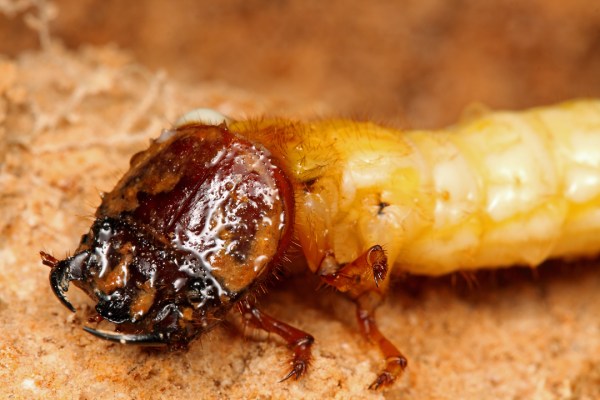
Amblycheila cylindriformis 3rd instar larva.

Amblycheila cylindriformis 3rd instar larva.

Step 4. Behold the beast! There is nothing more that can be said—these larvae are ginormous! This particular larva measured a full 62 mm from the tips of its mandibles to the tip of its abdomen—that’s 2½ inches! No other tiger beetle larva in North America reaches this size, except perhaps the related A. hoversoni (South Texas Giant Tiger Beetle).

The distinctly smaller 2nd pair of eyes confirm this is not Tetracha or Cicindela (sensu lato)...

The distinctly smaller 2nd pair of eyes confirm this is not Tetracha or Cicindela (sensu lato)…

Step 5. If size alone isn’t enough, you can confirm that the larvae does indeed belong to the genus Amblycheila by looking at its eyes—their are two pairs, and the 1st pair (closest to the mandibles) are distinctly larger than the 2nd pair. This isn’t clearly visible in the photo above because I doused the larva with water to remove the mud and dirt that encrusted it upon removal from its burrow.

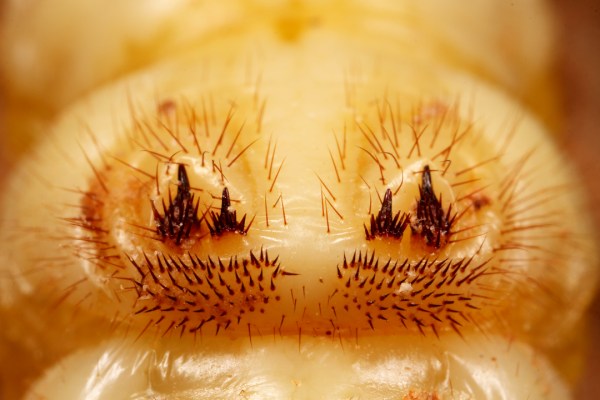
...and the well-separated hooks on the 5th abdominal segment confirm it is Amblycheila.

…and the distinctly separated hooks on the 5th abdominal segment confirm it is Amblycheila.

Step 6. Another way to distinguish larvae of the genus Amblycheila is by looking at the hooks on the hump of the 5th abdominal segment, best done with a hand lens (or, even better, with an MP-E65 lens!). All tiger beetle larvae have several pairs of large hooks that the larva uses to brace itself against the wall of its burrow when capturing prey to prevent the struggling prey from pulling the tiger beetle larva out of its burrow. Larvae in the genus Omus, restricted to the Pacific region of North America, have three pairs of hooks (referred to as the outer, middle, and inner hooks), while all other North American tiger beetle genera have two (having lost the outer pair). In Amblycheila and Tetracha the hooks are simple and thornlike, while larvae of all other North American genera have much longer middle hooks that are curved and sickle-shaped (e.g., Cylindera celeripes in this post). Amblycheila larvae can be distinguished from Tetracha larvae by the middle and inner hooks on each side being distinctly separated rather than touching at the base (e.g., Tetracha floridana in this post). There is also a cluster of short, stout hairs around the base of each hook in Amblycheila that is missing in Tetracha (e.g., Tetracha virginica in this post).

The numerous stout setae are also characteristic of the genus.

The numerous stout setae are also characteristic of the genus.

Step 7. Lastly, don’t forget to look at the hump in lateral profile—it is as alien a structure as any in the insect world. In the case of Amblycheila larvae, the bed of hairs posterior to the hooks is comprised of much shorter, stouter, and more densely placed hairs than larvae of Tetracha.

Copyright © Ted C. MacRae 2013
Cicindela 44(3–4) is issued

Cicindela_44(3-4)

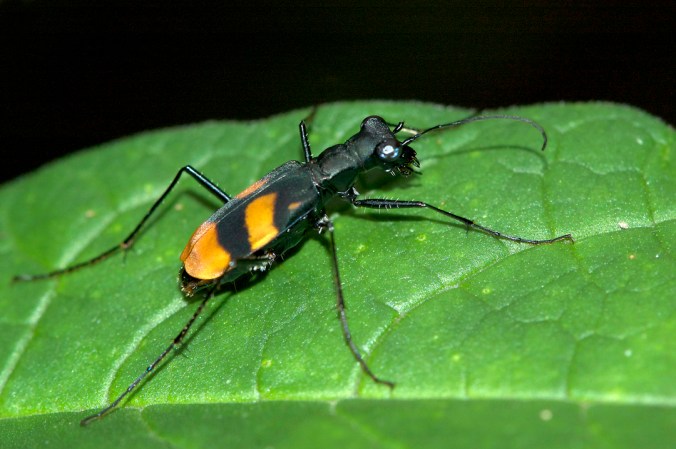
The latest issue of the journal Cicindela arrived in my mailbox yesterday, and it’s safe to say that I’ve got the issue “covered.” The issue features three papers, one of which documents my recent encounter with Cicindelidia ocellata rectilatera (Reticulated Tiger Beetle) in Arkansas (MacRae 2012), the first confirmed occurrence of the subspecies in that state and a northeastern extension of its known range. (This paper is an expansion of my post Just repanda… er, wait a minute…) Normally restricted to (though abundant in) Texas and New Mexico (Pearson et al. 2006), the only previous records of this subspecies east of Texas are at two localities near the eastern side of the Sabine River dividing Texas and Louisiana (Graves & Pearson 1973). More recently, however, the subspecies was also recorded just north of Texas in southwestern Oklahoma Schmidt 2004). Whether these recent extensions to its known range reflect an expanding distribution or are merely artifacts of sampling is unknown; however, one of the Arkansas localities has been visited frequently by tiger beetle enthusiasts over the years, as it is a known locality for the very attractive Cicindela formosa pigmentosignata (Reddish-green Sand Tiger Beetle), lending some support to the range expansion hypothesis.

In addition to the paper, one of the photographs that I took of C. ocellata rectilatera in Arkansas graces the cover of the issue.

Two other papers are also contained in the issue, one documenting an additional occurrence of Opisthencentrus dentipennis in Brazil by Ron Huber (2012), and another by Kristi Ellingsen featuring photographs and habitat description for the first tiger beetle to be found in Tasmania, Australia (Ellingsen 2012). A truly international journal!

Lastly, please consider subscribing to Cicindela. Subscription rates are only $10 in the U.S. and $13 outside of the U.S., amounts that even the most casually interested can justify! Also, if you have a more serious interest in tiger beetles, I hope you’ll consider submitting a manuscript for consideration. Subscription information and editorial policy can be found inside the front cover of a recent issue or at this post.

REFERENCES:

Ellingsen, K. 2012. Discovery of the first tiger beetle found on the island of Tasmania, Australia. Cicindela 44(3–4):55–57.

Graves, R. C. & D. L. Pearson. 1973. The tiger beetles of Arkansas, Louisiana, and Mississippi (Coleoptera: Cicindelidae). Transactions of the American Entomological Society 99(2):157–203.

Huber, R. L. 2012. Another locality record for Opisthencentrus dentipennis (Germar) in Brazil. Cicindela 44(3–4):55–57.

MacRae, T. C. 2012. Occurrence of Cicindelidia ocellata rectilatera (Chaudoir) (Coleoptera: Cicindelidae) in Arkansas. Cicindela 44(3–4):49–54.

Pearson, D. L., C. B. Knisley and C. J. Kazilek. 2006. A Field Guide to the Tiger Beetles of the United States and Canada. Oxford University Press, New York, 227 pp.

Schmidt, J. P. 2004. Tiger beetles of Fort Sill, Comanche County, Oklahoma, with a new state record for Cicindela ocellata rectilatera Chaudoir. Cicindela 36:1–16.

Copyright © Ted C. MacRae 2013