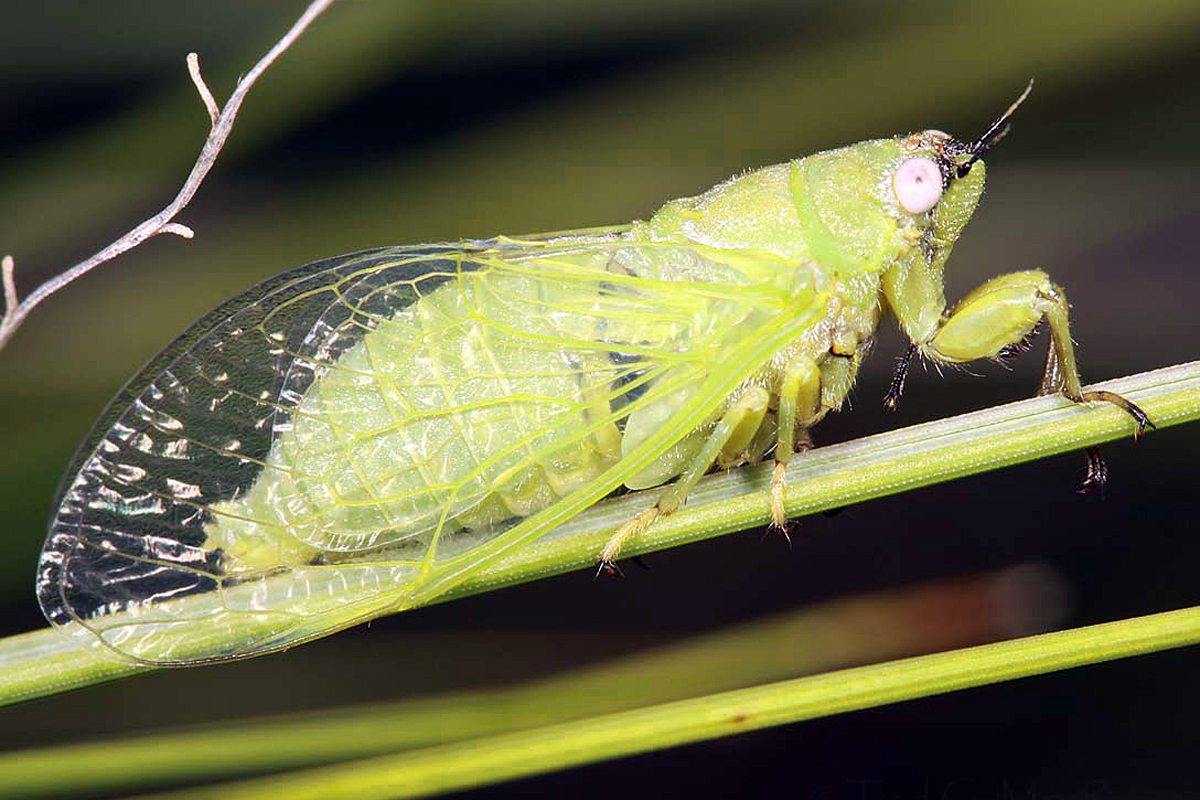
Photo details: Canon 100mm macro lens on Canon EOS 50D, ISO 100, 1/250 sec, f/14, MT-24EX flash 1/4 power w/ Sto-Fen diffusers.
Another of the insects that I saw this past June at Four Canyon Preserve in northwestern Oklahoma was this small cicada, Cicadetta kansa. Though not as small as the diminutive Beameria venosa (see North America’s smallest cicada), their barely audible call – a soft buzz – makes them even more difficult to notice. I only realized what they were after noticing something odd about the small, green “grasshoppers” that flitted in front of me as I walked through the mixed shortgrass prairie. They didn’t quite fly “right” and landed delicately within the grass rather than crashing into it clumsily. Even after realizing that they weren’t grasshoppers, it was difficult to say what they were at first due to their wariness and lime green coloration that helped them blend marvelously into their grassy surroundings. A few sweeps of the net solved that problem, and I discovered what was at the time the smallest and most beautiful cicada I had seen to that point (Beameria venosa took both honors later that month in the Loess Hills of northwestern Missouri).
Despite being the only world-wide genus of cicadas, Cicadetta is represented in the U.S. by only two species—C. kansa and C. calliope. In addition to its pale green coloration, C. kansa is distinguished from C. calliope by having only 4 or 5 apical cells in the hind wing (6 in C. calliope). Cicadetta kansa occurs from Texas north to South Dakota, while C. calliope is found from Texas to Florida and northwards to Iowa, Ohio and New Jersey. Little is known about the biology of Cicadetta kansa; however, presumably it is similar to that of C. calliope, which emerges and lays eggs in late spring. Eggs hatch by late summer, at which time the nymphs burrow into the ground again begin feeding on the roots of grasses. This feature of their biology protects them from the negative impacts of managed spring and fall burns, and indeed C. calliope is known to increase in prairies that are managed by such burns. This is in contrast to other prairie cicadas (genus Tibicen), which overwinter as eggs in the above-ground portion of grasses and, thus, are negatively impacted by fall and spring burns.
A number of websites are dedicated to these charismatic insects; however, Cicada by Andy Hamilton at the Canadian National Collection of Insects, Arachnids and Nematodes is the most informative and comprehensive that I’ve found.
Copyright © Ted C. MacRae


 Beetles In The Bush