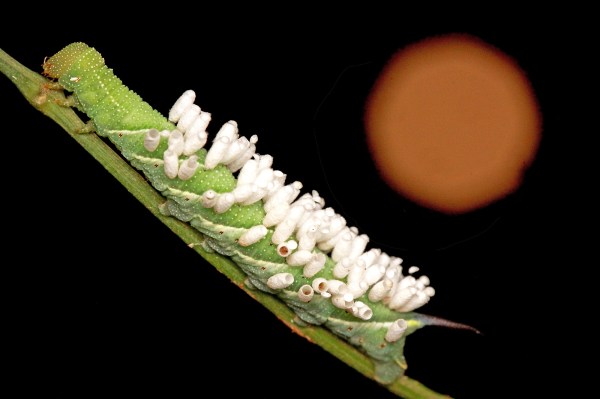
A tobacco hornworm (Manduca sexta) caterpillar that has been parasitized by braconid wasps (Cotesia sp.). The wasps developed inside the caterpillar as grubs, consuming all but the most vital of organs to avoid killing it before they completed their development. They then exited the caterpillar’s body and spun small white silken cocoons in which to pupate and eventually emerge as adults. The adult wasps have already emerged, and though the caterpillar is still alive, it will die before it can complete its development and become an adult moth. The caterpillar was photographed at night in front of a so-called “supermoon” rising in the eastern sky. This is a single exposure image—-not a composite photograph—with the camera focused on the caterpillar (illuminated by flash) but its settings adjusted to also detect ambient light from the distant moon. The moon is necessarily out of focus due to depth-of-field constraints. Photographed 11 Aug 2014 in Mississippi Co., Missouri at the Hwy 62 bridge over the Mississippi River.
Honorable Mention (Plants and Fungi)
A single blossom on the inflorescence of clasping milkweed (Asclepias amplexicaulis). This uncommon species is scattered throughout Missouri but is especially fond of habitats with dry sand substrates. It can be easily identified by its erect, glabrous stems, sessile, clasping leaves, and pinkish flowers. Photographed 23 April 2012 in Scott Co., Missouri at Sand Prairie Conservation Area.
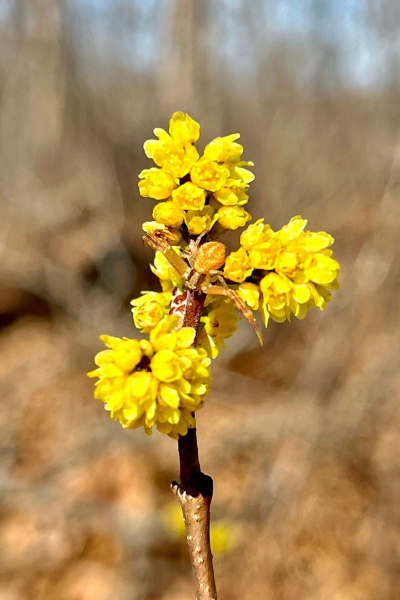
Today the WGNSS Botany Group visited Little Lost Creek Conservation Area to see Dirca palustris (eastern leatherwood) in bloom. Leatherwood is a distinctive, slow-growing shrub that occurs sporadically in primarily the Ozark and Ozark Border region of Missouri. Like the much more Lindera benzoin (common spicebush), the flowers open in spring before the foliage appears, during which time the planta are easily identified by the pendulous blooms surrounded by wooly bracts. The species has toxic properties and was used by First Americans as an emetic, and it has been cultivated for many years despite its sporadic natural occurrence. As the name implies (palustris means “growing in a swamp”), the plant grows in moist (though not necessarily swampy) habitats, and as such we would have to hike across the dry-mesic upland deciduous forest and down into the riparian forests along Little Lost Creek where the plant can be found.
With sharply warmer temperatures arriving yesterday after a rather protracted cool period, the early-flowering trees and shrubs were ready and waiting, seemingly popping open before our very eyes. A patch of Prunus americana (American plum) in a more open area along the trail caught our attention, it’s blooms just beginning to open. We based our identification on the shrubby growth habit and apparently clonal nature of the stand of plants, which distinguishes P. americana from the closely related P. mexicana (Mexican plum), which generally grows as more tree-like individual plants.
Prunus americana (American plum).
Also in the more open areas along the trail was Rhus aromatica (fragrant sumac) in full bloom. I stopped to examine one particular individual with especially dense clusters of inflorescences and noticed movement on the flowers. Closer examination revealed a crab spider (family Thomisidae) which I took to be Mecaphesa asperata (northern crab spider)—perfectly camouflaged on the bright yellow flowers and awaiting the arrival of an unsuspecting bee or other pollinator.
Mecaphesa asperata (northern crab spider) on on flower of Rhus aromatica (fragrant sumac).
As the trail veered directly into the forest, I noticed several butterfly species—a Vanessa atalanta (red admiral) that paused briefly on the trail before bolting erratically into the distance, several Eurytides marcellus (zebra swallowtail), presumably males patrolling for females among stands of the still leafless Asimina triloba (pawpaw) which it utilizes as a larval host, and—most interesting for me—several Anthocharis midea (falcate orangetip) which, for the time being, frustratingly refused to perch and allow even an attempt at a photograph.
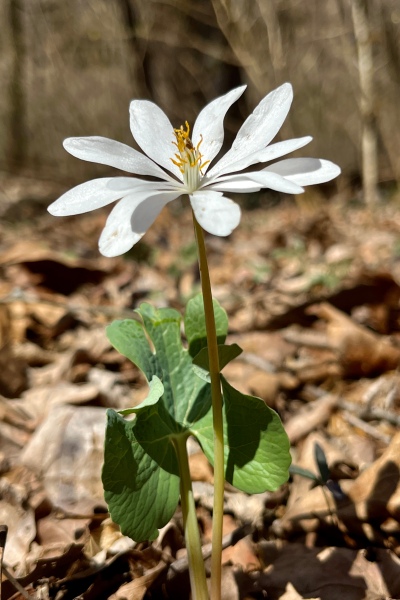
As the trail began the long descent into the valley and the forest became increasingly mesic, spring ephemerals began appearing on the forest floor in abundance. Most abundant was Claytonia virginica (spring beauty) and Cardamine concatenata (cutleaf toothwort), which have been in bloom for some time now, but finally making their appearance as well were Sanguinaria canadensis (bloodroot)—the first seen being a charming little patch nestled against a rock—a single blooming plant among the stands of Erythronium albidum (white trout lily), and several still-unblooming Trillium sp. (wakerobin).
Sanguinaria canadensis (bloodroot).
Erythronium albidum (white trout lily).
Trillium sp. (wakerobin).
At last we reached the valley floor, and immediately the leatherwood plants were seen in abundance and in full bloom. Leatherwood plants in bloom are not among the showiest of blooming shrubs, but the distinctiveness of their flowers, sporadic occurrence, and lack of close relatives provided ample botanical interest that resulted in me spending a fair bit of time observing and photographing them.
Dirca palustris (eastern leatherwood).
Dirca palustris (eastern leatherwood).
As I looked at the leatherhood, I encountered a an unusual cocoon-like structure at the tip of one of its branches. Closer examination revealed it to be “packed” white tiny, white, grub-like larvae, at which time I noticed the cadaver of a moth caterpillar also clinging to the branch tip. I knew then that the grubs were the mature larvae of a parasitic wasp in the family Braconidae, likely in the subfamily Microgastrinae, that had just exited their host and were spinning cocoons nearby in communal fashion. (Many people have seen one of these wasps in the form of cocoons on the backs of tomato hornworm caterpillars.) Braconid wasps are often quite host specific, but a more specific identification is difficult since the identity of the caterpillar itself or whether it was utilizing Dirca as a host plant are also unknown.
Braconid larvae, possibly subfamily Microgastrinae, spinning communal cocoons after exiting unidentified lepidopteran caterpillar on Dirca palustris.
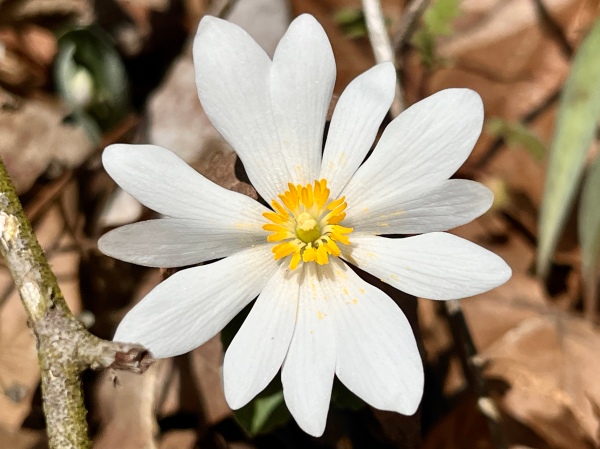
If the spring ephemerals were abundant during the descent, they were overwhelming in the valley proper. A few blooming plants of Collinsia verna (blue-eyed Mary), a winter annual were seen, their distinctive bicolored white and blue flowers a pleasant contrast to the mostly white to pinkish color of the majority of the ephemerals. Some especially large-flowered individuals of bloodroot were seen underneath a patch of blooming leatherwoods, prompting me to spend a bit more time photographing them. As I was doing so, I found it ironically humorous that I was crouched on the ground photographing what is by all measures a rather common plant while surrounded by a much less frequently encountered plant.
Collinsia verna (blue-eyed Mary).
Sanguinaria canadensis (bloodroot).
Sanguinaria canadensis (bloodroot).
The hike back up out of the valley was long and deliberate, the pitch in some stretches reaching as steep as I ever encounter on trails in the state, but the slow pace allowed an opportunity to look for things missed on the way down. At one point I picked up a fallen oak branch that looked like it might have been pruned by a twig pruner (Anelaphus sp.), a type of longhorned beetle (family Cerambycidae) whose larvae feed within living branches of deciduous trees—primarily oak—and then cut the branch internally before pupation. The cut end is distinctive, and I checked the base of the branch to see if it demonstrated this distinctive cut pattern. It did not, but I explained what I was looking for to a curious member of our group. Just as I finished the explanation, I saw another oak branch laying on the trail, picked it up to examine the base, and, sure enough, it exhibited the cut. I believe the branch is that of black oak (Quercus velutina), and I kept the branch to place within a rearing box so I can see the adult when it emerges later this spring.
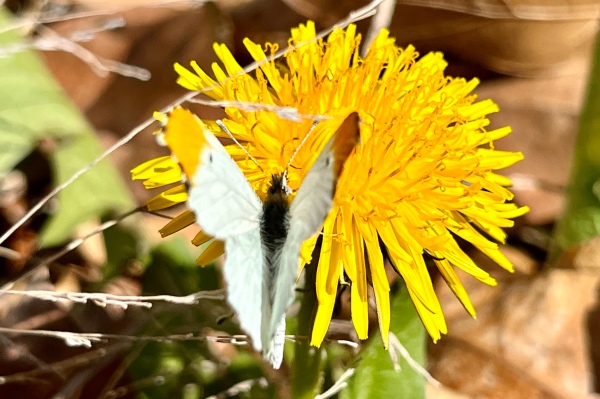
Along the final stretch back to the parking lot, the falcate orangetip butterflies continued to torment me with their erratic, never-ending flight. I watched a few after reaching the parking lot, hoping one would alight and give a chance to photograph it, but no such luck. At the edge of the parking lot I noticed some Taraxacum sp. (dandelion) flowers with small insects on them, which turned out to be Acmaeodera tubulus—usually the first jewel beetles (family Buprestidae) to appear in the spring and commonly found on dandelions. I crouched to take a few photographs, and as I was doing so a falcate orangetip butterfly landed on the dandelion flower right next to the one with the beetles I was photographing. I managed to get one shot of the butterfly, it’s wings not well spread out but the orange tips still easily visible, before it took flight again—a nice punctuation to end the outing with.
Acmaeodera tubulus on on flower of Taraxacum sp. (dandelion).
Anthocharis midea (falcate orangetip)on flower of Taraxacum sp. (dandelion).
The sun shall be turned to darkness and the moon to blood, before the day of the Lord comes, the great and magnificent day.
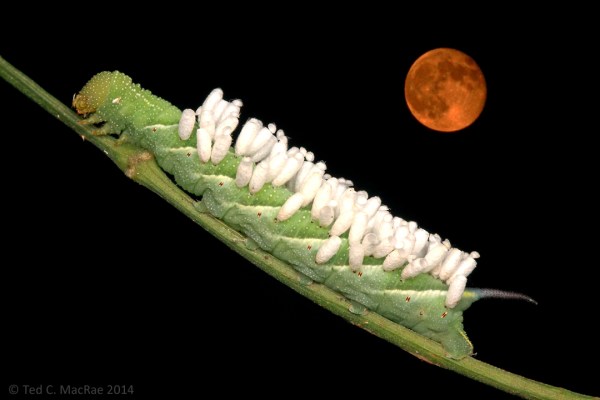
A “super moon” watches over a parasitized hornworm caterpillar.
I’m not normally one to quote Bible passages, but this line from Acts 2:20 seems appropriately ominous for the predicament of this poor hornworm caterpillar. The white objects on its back are the cocoons of tiny parasitic wasps in the family Braconidae who spent their entire lives inside the body of the growing caterpillar slowly eating away the inner tissues of the caterpillar, eventually consuming all but the most essential of its internal organs before exiting the skin and spinning their tiny, silken cocoons. Inside the cocoons the tiny grubs transformed into adult wasps, chewed their way out through the tip of the cocoon, and flew off to mate and find more hornworm caterpillars to parasitize. Its unwelcome guests now gone, this poor caterpillar has nothing to do but to sit and await its inevitable demise (which I suspect the caterpillar will not regard as such a “great and magnificent day”).
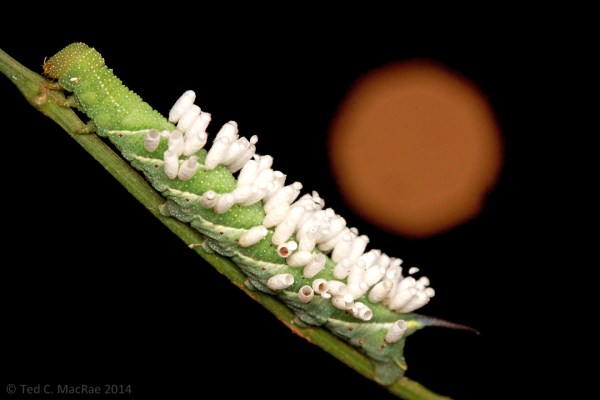
I found this caterpillar resting on a vine climbing a tree along the Mississippi River in southeast Missouri after setting up an ultraviolet light nearby and noticing the softly glowing cocoons. I was going to photograph it in situ, but I’ve learned that choice of background can have a dramatic effect on insect photographs, and the jumble of weeds and tree bark that would have comprised the background had I photographed the caterpillar where it sat seemed decidedly boring. I looked up and saw the blood red moon (a so called “super moon”) rising above the river in the eastern sky and decided to give it a try. The above photograph is actually a composite of two photographs—one of the caterpillar taken with flash and fairly normal camera settings, and another of the moon itself with aperture, shutter speed, and ISO all adjusted for very low light conditions (at least to the extent possible without a tripod). While this may not qualify in some people’s minds as a “real” photograph, it is nevertheless a true representation of what I actually saw, as I also made a number of attempts to capture both the insect and the moon in a single exposure. Since it is impossible to have both the insect (very close) and the moon (very far) in focus at the same time, the resulting photograph has a different, though still striking, effect, as shown in the photograph below:
A more surrealistic version of the above photograph, with both caterpillar and moon captured in a single exposure.
This second photograph is actually much harder to take, as the moon does not appear in the viewfinder as the small, discrete, fuzzy-edged object resulting in the image, but rather as a large, blinding light that is difficult to place within the composition and know exactly where it will end up (at least, without a lot of trial and error). Add to that the fact that my camera image and histogram display panel is, at the moment, not functional, forcing me to “guess” if I had the right settings (in a situation where I’m well outside of my ‘normal’ settings for flash macrophotography). I’m a little surprised that I ended up with any usable photographs at all!
In keeping with the parasitic theme I established in my last twoposts, I happened upon this brief video promotion for a National Geographic special called In the Womb: Extreme Animals which will air this Sunday (May 10). The video features the offspring of a parasitic wasp (Cotesia glomerata) that has injected her eggs into a caterpillar — and now they’re ready to emerge! It’s a fascinating study of parasitoid-host relationships, filmed incredibly from inside the caterpillar! Watch the whole video for the wicked, surprising ending.
Viewing tips: after beginning play, click on “HQ” in the lower right corner to view the video in high quality. Or, click on the video itself to be taken to YouTube, where you have the option to watch the video in HQ and in full screen mode (2nd button from the lower right corner). You will be amazed!







 Beetles In The Bush