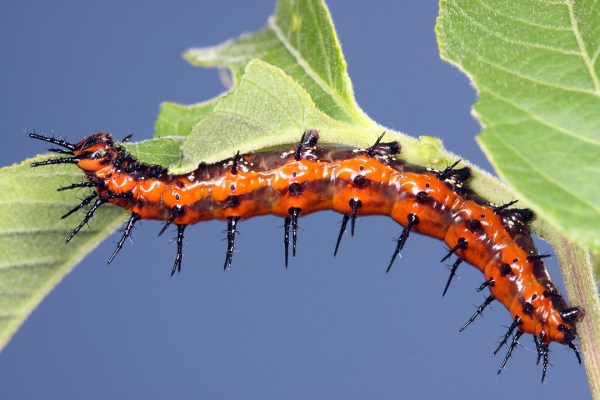
Gulf Fritillary in southern Missouri

Gulf Fritillary (Agraulis vanillae) | Mississippi Co., Missouri

I’m not sure, but I think this might be the first time I’ve photographed a butterfly caterpillar. Not a bad subject to start with, as few butterflies have caterpillars that are more colorful than the Gulf Fritillary, Agraulis vanillae. A common resident in the southern states and further south, this member of the nymphalid subfamily Heliconiinae is less commonly encountered in Missouri—in fact, I had never seen (or at least noticed) these caterpillars before encountering a few feeding hungrily on the foliage of maypop (Passiflora incarnata) growing in a city park in Missouri’s southeastern lowlands. While the stunning colors of these caterpillars are a delight to human eyes, their function, as in most butterfly caterpillars, is to advertise the unpalatability of their toxin-laced bodies. In the case of this species, the toxins include cyanogenic glycosides that the larvae sequester from the tissues of their host plants (ironically these compounds are supposed to serve the same protective function for the plant that produces them, but butterflies have become master specialists at evolving mechanisms to sidestep toxic impacts).
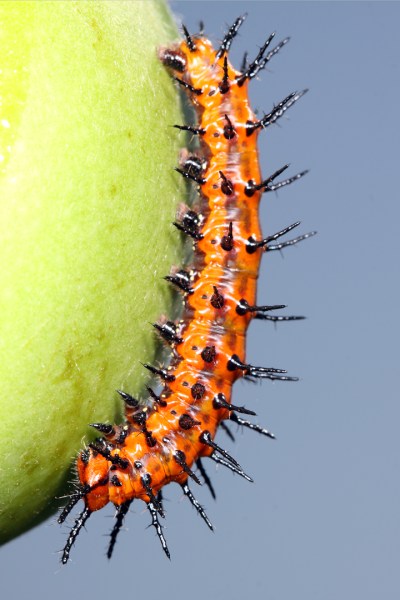
According to my friends Richard & Joan Heitzman, long-time students of Missouri Lepidoptera, this species is a sporadic migrant that occasionally forms summer colonies in Missouri, especially in the western half of the state, until the first hard freeze destroys the colony (Heitzman & Heitzman 1987).

REFERENCE:

Heitzman, J. R. & J. E. Heitzman. 1987. Butterflies and Moths of Missouri. Missouri Department of Conservation, Jefferson City, 385 pp.

Copyright © Ted C. MacRae 2012

Return to La Reserva Ecológica Costanera Sur

Last March I discovered —a gem of natural beauty in the heart of Buenos Aires, Argentina.  Though its origins are semi-artificial, its biota a mix of native and introduced species, and its pathways continually choked with pedestrians and cyclists, for me it is a refuge—a place where I can spend an entire day looking for insects without ever retracing my footsteps.  Last Sunday after arriving in Buenos Aires, I couldn’t check into my hotel and change into my “bug collecting clothes” fast enough before making a beeline to the Reserve just a few blocks away.  I “discovered” a huge area on the east side of the Preserve that I hadn’t found during my last visit that was devoid of paved paths—and thus people—and spent the next several hours rummaging through the brush looking for insects to photograph.  Early November is early spring in Buenos Aires, and insect activity was still just beginning.  I did find a number of insects to photograph, though not as many as I had found during my early March visit.

This butterfly, which I regard as Actinote carycina (Yellow Lazy), was common around stands of a purple-flowered plant.  I watched this particular individual flit endlessly back and forth in front of one particular stand, rarely pausing long enough to allow a shot or two before resuming its patrols.  Vigorous aerial battles ensued every time another individual approached the stand, and although I can’t say for sure that it was this individual that always won, the same patrolling flight pattern resumed as soon as one of the contestants flew away.

Beetles were scarce, but I saw this particular species of Melyridae (presumably in the genus Astylus, and thus a close relative of Astylus atromaculatus or “spotted maize beetle”).  I don’t normally do random “bug-on-a-flower” photos, but I’ve recently become enamored with the use of “blue sky technique” for insect macrophotography and thought the red and black color of the beetle against the yellow flower it was feeding on was well suited for a blue background.  The beetle was quite small (only ~6 mm in length), thus requiring the 65mm 1–5X lens and full-flash illumination.  Normally this would result in a black background unless something is placed behind the subject, and I suppose I could just carry around a colored cards for placing behind subjects to get whatever color background I want.  However, there is something appealing to me in having the ability to achieve a blue sky by actually using the sky, despite the trickiness of the technique.  In this case, I  played with ISO settings of 400–640 and shutter speeds of 1/100 to 1/125 sec (settling at the high end of each range for this photo) to get the color of the sky true, then used low F.E.C. settings (-1 2/3 in this case) to temper the illumination of the subject.  I’m still not completely happy with the results—there is more motion blur in the photo than I would like, and I burned the yellows a little too much as well.  I think ISO800 and F.E.C. -2 or even lower would have given better results.  At any rate, this photo was the best of the bunch, and it will have to do.

Copyright © Ted C. MacRae 2011