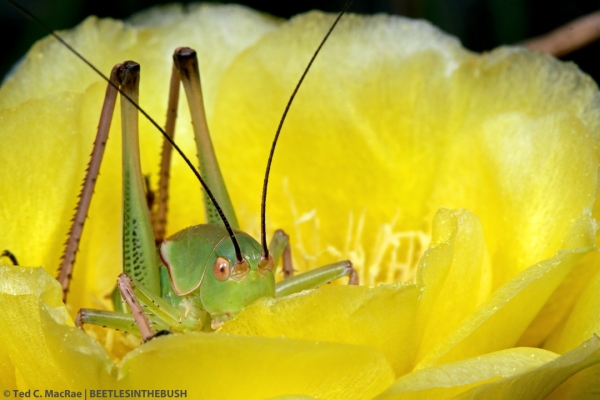
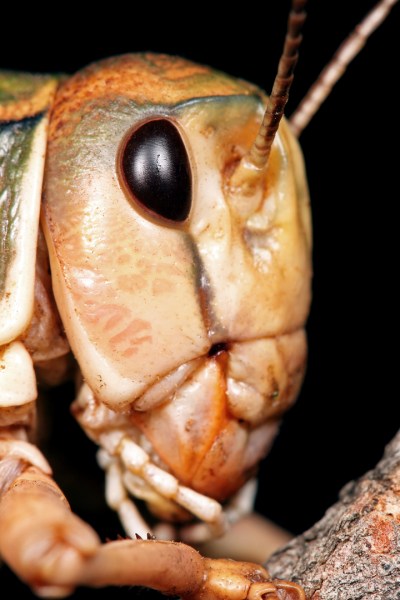
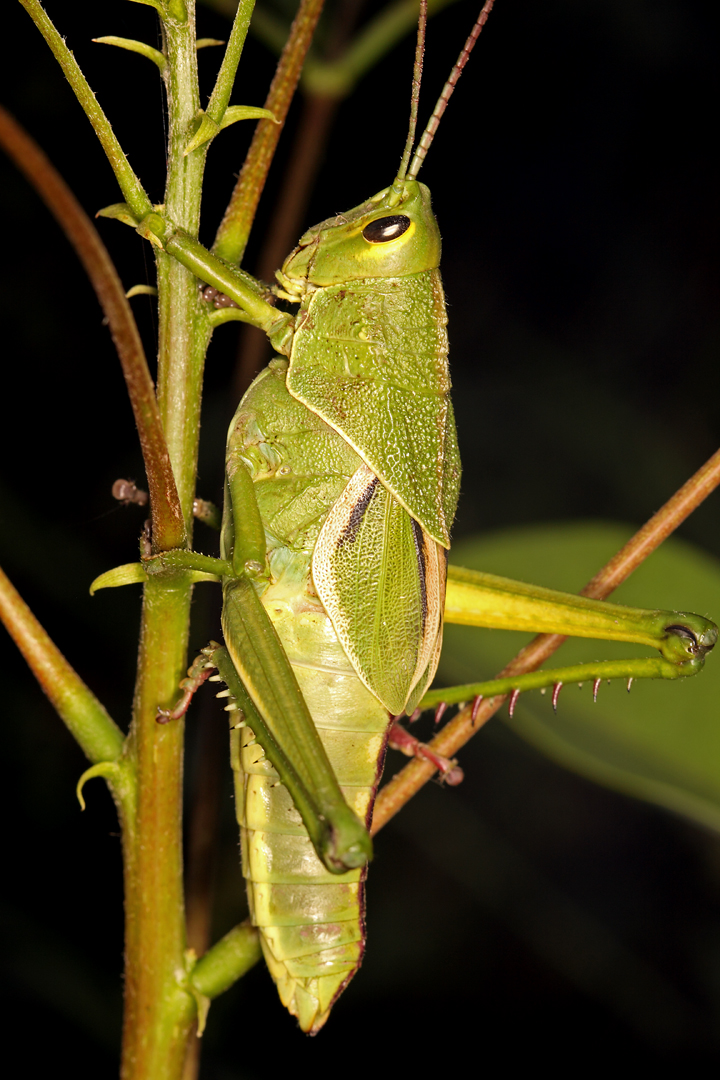
Haldeman’s shieldback katydid (Pediodectes haldemani)

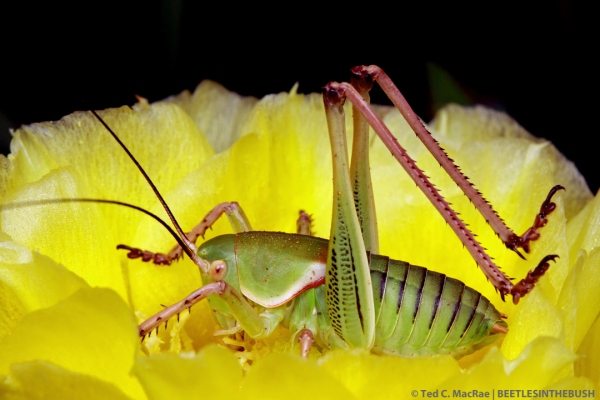
During my visit to Gloss Mountain State Park (Woodward Co., Oklahoma) this past June, I found an area of prickly pear cactus (Opuntia macrorhiza) on the west flats below the main mesa. A few days earlier I had seen cactus beetles in the genus Moneilema (family Cerambycidae) associated with these plants at another nearby location, so I began checking the plants to look for any sign of these beetles. Sadly I did not find any, but the plants were in full bloom and were being visited by flower longhorns in the genus Typocerus (mostly just T. octonotatus). After having collected a small series, I approached one particular cactus plant and found this enormous katydid sitting inside the flower. Katydids normally secrete themselves in a more cryptic manner, using foliage backdrops with which they can blend owing to their green coloration. This particular katydid, however, not only lacked the leaf-like wings that many species possess but also exhibited rather strikingly contrasting dark red markings over its body that made it quite conspicuous as it sat in the yellow flower. I approached carefully so as not to spook it and took a few photographs, but as I did so it became apparent to me that it did not find my actions alarming and would allow me to take whatever photographs I wished.

Pediodectes haldemani in flower of Opuntia phaecantha | Gloss Mountains State Park, Woodward Co., Oklahoma

Pediodectes haldemani on Opuntia macrorhiza | Gloss Mountain State Park, Woodward Co., Oklahoma

Almost whatever photographs, that is. I really wanted to get a super-close, full-frontal shot of the face, but it sat unbudgingly in the flower with its face buried in the stamens and masked by the inner petals of the flower. I could have tried peeling away the petal, but I was sure that fiddling my fingers that close to its face would spook it, and even if I did manage to peel back the petal then I would still have stamens blocking the view that I wanted. In the end, I decided that this slightly more distant shot of the whole body was a pleasing enough composition.

Pediodectes haldemani

Peek-a-boo!

I presume this individual represents Haldeman’s shieldback katydid (Pediodectes haldemani) in the family Tettigoniidae. This is not surprising, since the type locality of the species (Barber Co., Kansas) is just a few miles to the north and right smack dab in the middle of the Great Plains distribution of the species. BugGuide mentions that species identification from photos alone can be difficult in the genus Pediodectes, as color patterns vary individually and with age, and also since adults are wingless it can be difficult to tell if an individual is a nymph or adult. Nevertheless, distribution maps in Singing Insects of North America show three species that can potentially occur in this part of Oklahoma, and the photos shown here are a dead ringer for P. haldemani. I am also apparently not the first person to photograph this species at Gloss Mountain State Park.

Copyright © Ted C. MacRae 2013

2013 Oklahoma Collecting Trip iReport

I’m back home after my week-long collecting trip to western Oklahoma, and at the risk of sounding hyperbolous I can only describe it as one of the most successful collecting trips I’ve ever had. Seriously! These kinds of trips don’t happen all that often for a variety of reasons—timing is off, rains didn’t happen, weather was uncooperative, etc. etc. Once in a while, though, everything comes together, and this was one of those times. The trip was also a return to my roots so to speak—I’ve been rather distracted in recent years with tiger beetles, but jewel beetles (family Buprestidae) and, to a lesser extent longhorned beetles (family Cerambycidae), are really the primary focus of my taxonomic studies. It had been several years since I’d had a good “jewel beetle trip,” so that was the focus of this trip. In planning the trip, I recalled seeing jewel beetle workings in several woody plant species in the same area during last September’s trip, and the occurrence of May rains seemed to bode well for my early June timing.

Gloss Mountains State Park, Major Co., Oklahoma

Gloss Mountains State Park, Major Co., Oklahoma

My instincts proved to be justified—in seven days in the field I collected an estimated 1000–1500 specimens representing at least two dozen species of Buprestidae and a dozen or more Cerambycidae. More important than the numbers, I collected a number of species in good series that I have either not or only rarely collected before, and in fact the second beetle that I collected turned out to be a new state record! Of course, I also brought along my full-sized camera and associated gear and photographed many of the species that I collected. I will feature these photos in future posts, but for this post I thought it might be fun to give a high level view of the trip illustrated only with photos taken with my iPhone (which I also carry religiously in the field with me). The iPhone is great for quick snaps of scenery and miscellaneous plants and animals for which I don’t feel like breaking out the big camera, or as a prelude to the big camera for something I’d like to share right away on Facebook. Moreover, there are some types of photos (landscapes and wide-angles) that iPhones actually do quite well (as long as there is sufficient light!).

Gloss Mountains State Park, Major Co., Oklahoma

Atop the main mesa at Gloss Mountains State Park, Major Co., Oklahoma

My first destination was Gloss Mountains State Park (Major Co.), a stunning system of gypsum-capped, red-clay mesas. I’ve already found a number of rare tiger beetles here such as Cylindera celeripes (Swift Tiger Beetle), Amblycheila cylindriformis (Great Plains Giant Tiger Beetle) and Dromochorus pruinina (Frosted Dromo Tiger Beetle), and in the past two falls I’ve found two interesting jewel beetle records: Chrysobothris octocola as a new state record, and Acmaeodera macra as a northern range extension. On this trip, I started out beating the mesquite  (Prosopis glandulosa) and immediately got the longhorned beetle Plionoma suturalis—a new state record! They were super abundant on the mesquite, and I collected several dozen specimens along with numerous C. octocola as well. I then moved over to the red-cedar (Juniperus virginiana), which was showing a high incidence of branch dieback, and collected nice series of several buprestids, including what I believe to be Chrysobothis ignicollis and C. texanus. Up on top of the mesa there are small stands of hackberry (Celtis laevigata) and soapberry (Sapindus saponaria), both of which are very good hosts for Buprestidae. Not much was on the soapberry, but I beat large series of several Buprestidae from the hackberry, including what I believe to be Chrysobothris caddo and—the real prize—Paratyndaris prosopis! My old friend C. celeripes was also out in abundance, so I collected a series to add to my previous vouchers from this site. Back down below, I marveled at a juvenile western diamondback rattlesnake (Crotalus atrox) in the area where I found some more A. cylindriformis larval burrows. Daylight ran out before I could dig them up, and after 11 hours in the field I was exhausted, so I returned the next morning and got one 1st- and two 3rd-instar larvae and went back up on top of the mesa and beat several more P. prosopis from the hackberry.
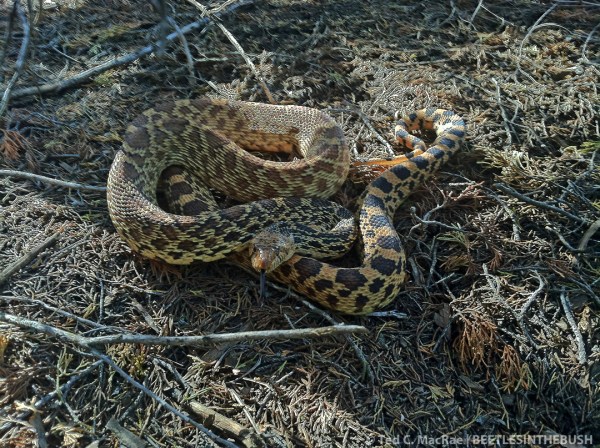
Bullsnake (Pituophis catenifer sayi) | Alabaster Cavern State Park, Woodward Co., Oklahoma

Bullsnake (Pituophis catenifer sayi) | Alabaster Cavern State Park, Woodward Co., Oklahoma

My second stop was at Alabaster Cavern State Park (Woodward Co.), where C. celeripes was again abundant on the gypsum-clay exposures surrounding an impressive gorge thought to be a collapsed cave complex. I focused on beating hackberry because of the success with buprestids on this plant at Gloss Mountains SP, and although they were not quite as abundant here as at Gloss Mountains I still managed to end up with good series of C. caddo and several species of Agrilus. Because I had spent the morning at Gloss Mountains, I had only a partial day to explore Alabaster Caverns and, still getting used to the weight of the camera bag on my back, decided to leave the big camera in the car. This was a mistake, as I encountered my first ever bullsnake (Pituophis catenifer sayi) and had to settle for iPhone photos of this species—the photo above being the best of the bunch. An approaching storm put an end to my second day after another 10 hours in the field, and I drove an hour to Woodward.

Moneilema sp. on Opuntia phaecantha | Alabaster Cavern State Park, Woodward Co., Oklahoma

Moneilema sp. on Opuntia macrorhiza | Alabaster Cavern State Park, Woodward Co., Oklahoma

My third day started out at nearby Boiling Springs State Park, a riparian oasis on sandy alluvium alongside the nearby Cimarron River. The woodlands are dominated by hackberry and American elm, and although a few buprestids were beaten from hackberry and honey locust (Gleditisia triacanthos), the numbers and diversity were not enough to hold my interest in the spot. After lunch, I decided to return to Alabaster Caverns SP and explore some other areas I had not had a chance to explore during the previous partial day. It’s a good thing that I did, as I ended up finding a nice population of longhorned cactus beetles in the genus Moneilema associated with prickly pear cactus (Opuntia macrorhiza). I collected a nice series of adults and also learned a few lessons in how to photograph these beetles on their viciously protective host plants. The photo above gives a taste of what will come in the photos that I took with the big camera. After eight hours in the field and darkness falling, I drove two hours to Forgan in Beaver Co.

Beaver Dunes State Park, Beaver Co., Oklahoma

Beaver Dunes State Park, Beaver Co., Oklahoma

Day 4 in the field started out cold and ominous, having stormed heavily during the previous night and with thick clouds still hanging in the sky. I feared the day might be a wash but decided to venture to Beaver Dunes State Park anyway and take my chances (beating can still be productive even in cold weather as long as the foliage is not wet). It’s a good thing that I did, as the buprestids were as numerous as I’ve ever seen them. The park’s central feature is a system of barren sand dunes that are frequented by ORV enthusiasts and surrounded by hackberry woodlands. The park also has a reservoir and campground, around which are growing a number of cottonwoods (Populus deltoides).

Hackberry Bend Campground, Beaver Dunes State Park, Beaver Co., Oklahoma

Hackberry Bend Campground, Beaver Dunes State Park, Beaver Co., Oklahoma

These hackberrys and cottonwoods proved to be extraordinarily productive. On the former I collected large series of several species of Chrysobothris and Agrilus, and while I collected fewer Buprestidae on the latter, these included Agrilus quadriguttatus and Poecilonota cyanipes! The latter species I had never collected until last year (from Cerceris fumipennis wasps), and beating the lower branches of the declining cottonwoods produced a series of about a dozen specimens. I also got one specimen on black willow (Salix nigra), along with a few Chrysobothris sp. and what I take to be Agrilus politus. Also in a low branch of one of the cottonwoods was a bird’s nest with a single egg that, according to Facebook comments, either represents the American Robin or a Gray Catbird. (I returned the next day and saw two eggs in the same nest.)
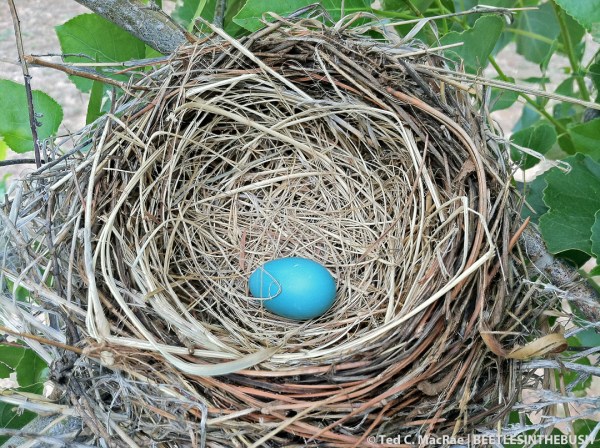
American Robin or Gray Catbird nest w/ egg | Beaver Dunes State Park, Beaver Co., Oklahoma

American Robin or Gray Catbird nest w/ egg | Beaver Dunes State Park, Beaver Co., Oklahoma

As the day drew to a close, I found two interesting longhorned beetle species at the edge of the dunes: one large, powdery gray Tetraopes sp. on milkweed (Asclepias sp.), and huge numbers of Batyle ignicollis evidently perched on the yellow spiked inflorescence of an as yet undetermined plant. I have seen this species on many occasions, but always in low numbers, yet here were literally hundreds of individuals on the plants, all having assumed a characteristic pose on the inflorescence suggesting that they had bedded down for the night. I only spent eight hours in the field on this day because of the late start, and as darkness approached I began the two-hour drive to Boise City.

Black Mesa landscape

Sculpted sandstone landscape in the vicinity of Black Mesa State Park, Cimarron Co., Oklahoma

The final two days in the field were supposed to be spent exploring the area around Black Mesa in the extreme northwest corner of Oklahoma, and another hour of driving was needed to get to the area from Boise City. I first went to Black Mesa State Park, and while the landscape was stunning (see above) the area was extremely dry. I feared the collecting would not be at all productive in this area but wanted to give the area a good effort before making a call. As I approached the entrance to the park, I saw a jeep parked by the side of the road with a license plate that read “Schinia,” which I recognized as a genus of noctuid moths that are very popular with collectors. I pulled over and talked to the driver, who was indeed a lepidopterist from Denver and had just arrived himself. We talked and exchanged contact information, and learning of my interest in beetles he directed me to a small stand of Gambel oak (Quercus gambelii) and one-seed juniper (Juniperus monosperma) on a sculpted sandstone escarpment not far from the park. I found the spot, and although I beat three Chrysobothris sp. from the first juniper tree that I whacked, another hour of beating produced only one more beetle from the juniper and nothing from the oak. I returned to the spot where we had met and encountered him again on his way out! We stopped and chatted again and found a few specimens of what I take to be Typocerus confluens on the yellow asters, but by then I was having my doubts about staying in the area. I told him I was going to check out a ravine in the park and then decide.

Petrified forest | Black Mesa State Park, Cimarron Co., Oklahoma

Petrified forest | Black Mesa State Park, Cimarron Co., Oklahoma

The petrified forest ended up being the only interesting thing I found in the ravine—the area was so dry that I think even the real trees were almost petrified! At any rate, it was clear that I was not going to have much success in this area. I looked at my watch, knowing that it would take three hours to drive back to Beaver Dunes, and estimated that if I left now I could get in about three hours of collecting at Beaver Dunes where I’d had so much success the previous day. Thus, I did what I rarely do on a collecting trip—drive during the afternoon!
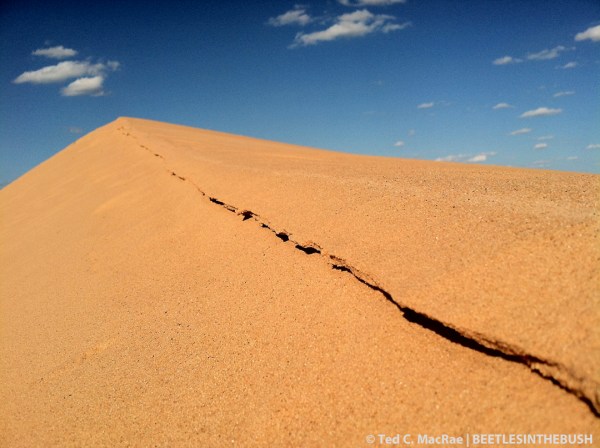
Beaver Dune

The main dune at Beaver Dunes State Park, Beaver Co., Oklahoma.

A chunky grasshopper nymph inhabiting the dune

A chunky grasshopper nymph inhabiting the main dune.

I arrived back at Beaver Dunes with several hours of daylight still remaining, so I decided to take a look around the main dunes before heading towards the woody plants. I’ve actually visited Beaver Dunes previously, on the tail end of a fall tiger beetle trip in 2011. At that time I had seen only the rather common and widespread species Cicindela formosa (Big Sand Tiger Beetle) and C. scutellaris (Festive Tiger Beetle), but I thought there could still be a chance to see the much less common C. lengi (Blowout Tiger Beetle). Early June, however, is a little late to see the spring tigers, and in fact I saw only a single C. formosa. Nevertheless, I find dune habitats irresistible—alien habitats occupied by strange plants and animals, and I spent a bit of time exploring the main dune before heading back towards where I had collected so many Buprestidae the previous day.

Low water levels in the reservoir at Beaver Dunes are a result of three years of drought.

Low water levels in the reservoir at Beaver Dunes are a result of three years of drought.

Western Oklahoma, like many parts of the central U.S., has suffered rather severe drought conditions for the past several years. This was evident not only in the large amount of branch dieback seen in the woody vegetation of the area (and probably a contributor to my success at collecting Buprestidae) but also the very low water level in the park reservoir. In the photo above the small cottonwood saplings in the foreground and large cottonwood trees in the left background indicate the normal water level. Cottonwoods, of course, like to keep their feet wet, and the trees around this reservoir—left high and dry by the drought—have responded with major branch dieback and lots of subsequent adventitious sprouting at the bases of the main branches. It was from this adventitious growth that I had beaten most of the Poecilonota cyanipes that I collected the previous day, so I repeated the cottonwood circuit in the hopes of collecting more. Not only did I collect more, but I collected twice as many as the previous day, so I ended up with a very nice series of more than two dozen individuals of the species from the two days collecting. I also did a little more beating of the hackberry trees which had produced well the previous day and collected several more Chrysobothris caddoC. purpureovittata, and Agrilus spp. such as A. leconteiA. paracelti, and perhaps others. When I arrived I was unsure whether I would stay here the following day, but eventually I decided I had sampled the area about as well as I could and that I would go back to the Gloss Mountains for my last day in Oklahoma. Thus, as the day began to wane I began hiking back to the car and spent the next two hours driving back to Woodward to spend the night.

Steep slope below the main mesa | Gloss Mountains State Park, Major Co., Oklahoma

Steep slope below the main mesa | Gloss Mountains State Park, Major Co., Oklahoma

Echinocereus sp. | Gloss Mountains State Park, Major Co., Oklahoma

Echinocereus sp. | Gloss Mountains State Park, Major Co., Oklahoma

Arriving at the Gloss Mountains the next morning was like coming home! I’ve spent so much time at this place and found so many great insects, yet every time I come here I find something new. Today, however, my goals were more modest—I wanted to improve on my series of Paratyndaris prosopis and Chrysobothris texanus, so I focused most of my time beating the hackberry and juniper on top of the mesa and continued beating the juniper down below as well. Success! I collected four more Paratyndaris off of the hackberry, but the C. texanus were far more abundant on this day than they were earlier in the week—I probably got another two dozen individuals of this species. Of course, I also got distracted taking photographs of a number of things, so the day went far more quickly than I realized. I wanted to leave around 6 pm and get in about three hours of driving so that I would have time to make it into Missouri the next morning and have a nice chunk of time to collect before finishing the drive and arriving home on Saturday night. It was actually closer to 7:30 pm before I hit the road, the reason for the delay being the subject of a future post (I will say that BioQuip’s extendable net handle comes in handy for much more than collecting tiger beetles!).
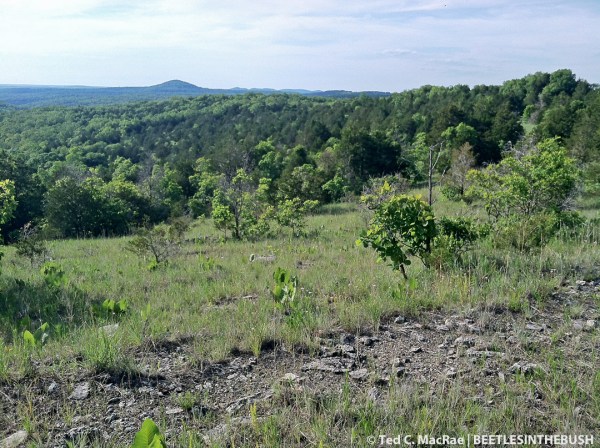
Dolomite glades | Hercules Glades Wilderness, Taney Co., Missouri

Dolomite glades | Hercules Glades Wilderness, Taney Co., Missouri

Long Creek | Hercules Glades Wilderness, Taney Co., Missouri

Long Creek | Hercules Glades Wilderness, Taney Co., Missouri

For my last day of collecting, I decided to stop by at one of my favorite spots in the White River Hills of extreme southwestern Missouri—Hercules Glades Wilderness in the Mark Twain National Forest. I’ve been to this place a number of times over the years, but in recent years my visits have usually been late in the season to look for the always thrilling to see Cicindelidia obsoleta vulturina (Prairie Tiger Beetle). It had actually been about 25 years since I’d visited these glades during the spring, and because of the success I’d had collecting in Oklahoma I was really optimistic that I would find the same here. Sadly (and inexplicably), insect activity was very low, and it didn’t take long for this to become apparent as branch after branch that I beat along the trail through the dry-mesic forest down to Long Creek yielded nothing. By the time I got to the creek I still had not collected a single beetle. A consolation prize was found along the creek, as beating the ninebark (Physocarpos opulifolius) produced a few specimens of the pretty little Dicerca pugionata, and a couple more consolation prizes were found further up the trail approaching the main glade when I saw a Cylindera unipunctata (One-spotted Tiger Beetle) run across the trail and then beat a single Agrilus fuscipennis from a small persimmon (Diospyros virginiana) tree at the edge of the glades. It had been about 25 years since I last collected the latter species, so I was very happy to see it, but no more were seen despite beating every persimmon tree that I saw during the rest of the day. At the end of the day, I had hiked seven miles and collected only six beetles—a rather inauspicious ending to what was otherwise a wonderfully successful trip.

A rare ''selfie''

The author takes a rare ”selfie” at Gloss Mountains State Park.

Arriving back at the car at the end of the day on the last day of an extended collecting trip is always a little depressing—despite the vagaries of travel, cheap hotel beds, meals on the go, and general exhaustion, I’m never happier than I am when I am in the field. Still, the success that I’d had during this trip did much to ease my depression, and arriving home late that night and seeing my girls again (who waited up for me!) finished off any remaining depression.

© Ted C. MacRae 2013
Another autumn oedipodine

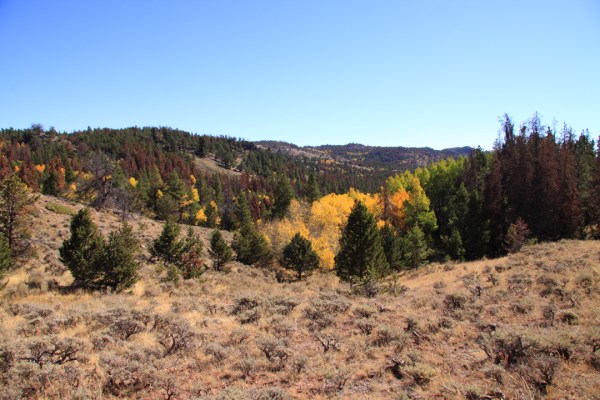
Shortgrass/sage brushland habitat in Medicine Bow Natl. Forest, Wyoming

In September 2010, Chris Brown and I explored shortgrass/sage brushland habitat atop the Laramie Mountains in southeastern Wyoming’s Medicine Bow National Forest (location “J” on this map). We were entering the final days of our 7th Annual Fall Tiger Beetle Trip™ and, to that point, had found every tiger beetle species we had set out to look for. This day, however, was the official “skunk” day of the trip, for although we did see one Cicindela limbalis (Common Claybank Tiger Beetle)—collected live to become the subject of one of the crappiest tiger beetle photos I’ve ever taken—we did not see the tiger beetle that we were there to see; Cicindela longilabris (Boreal Long-lipped Tiger Beetle). Of course, I rarely have trouble finding consolation on a skunk day, and during fall this is even easier—the deep blue sky, crisp fall air, and vivid colors of a morphing landscape are enough to make even a bad day of insect collecting better than a good day of just about anything else. And then there are the band-winged grasshoppers (family Acrididae, subfamily Oedipodinae)!  When there are no tiger beetles to be had, there are almost always members of this group around, and other than tiger beetles I don’t think there is another group of insects that I enjoy photographing more.

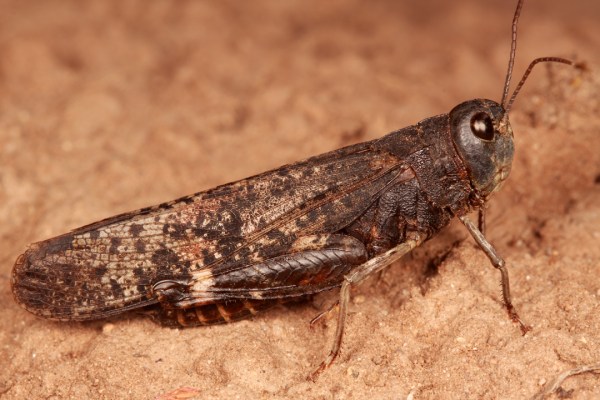
Arphia pseudonietana (red-winged grasshopper) | Medicine Bow Natl. Forest, Wyoming

As we walked the trails not finding tiger beetles, I noticed these very dark grasshoppers every once in a while. They flew with a particularly noisy crackling sound that exposed bright red hind wings before dropping to the ground and instantaneously becoming almost completely invisible. Once I accepted that tiger beetle photography just wasn’t gonna happen that day, I began paying attention to these grasshoppers and, after working a few individuals, finally found one who was willing to let me get close enough for some photos. I’m not terribly fond of this first photo—the perspective is still too high as I had not yet learned by that time to get down flat on my belly for photographing anything on the ground (remember, this was two years ago). Nevertheless, it is the only one that I have that shows the entire body of the grasshopper. Since this location isn’t too far west of the Nebraska border, I figured an identification should be possible using the Nebraska grasshopper guide (Brust et al. 2008)—based on that work and subsequent examination of photos at BugGuide, I surmise this individual represents Arphia pseudonietana (red-winged grasshopper). There are other species of Arphia in Nebraska, some of which are easily confused with A. pseudonietana; however, most of these are more common further east. The only other species in the genus that occurs west into Wyoming is A. conspersa (speckle-winged grasshopper), and although it is similar in appearance and may have red hind wings (though more commonly orange to yellowish), adults are most common during spring and early summer. Arphia pseudonietana adults, on the other hand, are most active during mid-summer through fall.

The pronotum bears a single notch just in front of the middle.

Grasshoppers, particularly in the western states, tend to be loathed by ranchers who see them as competitors with cattle for meager forage resources, especially in dry years. This species does feed preferentially on a variety of grasses such as western wheatgrass (Pascopyrum smithii), buffalograss (Buchloe dactyloides) and blue grama (Bouteloua gracilis); however, it doesn’t seem to occur at economically important levels except in association with other, more numerous grasshopper species. I’m glad to know this, because for some reason I just don’t want anybody regarding band-winged grasshoppers of any kind as a pest. Other grasshoppers, fine—just not my beloved bandwings!

I presume this 5th instar nymph also represents A. pseudonietana

Later in the day I came across this presumed 5th-instar grasshopper nymph, and although it was quite skittish I eventually managed to get this single photograph before it resumed its frenetic hopping and I gave up in frustration. This is one of the better “one-shots” that I’ve managed to take—my only criticism being that the focus was just a tad too deep to catch the front metafemoral face. I really didn’t have much time to setup for this shot—once I got the critter reasonably in-frame I fired! Anyway, I’m inclined to think this also represents A. pseudonietana, although I’m less confident in that ID than I am for the adult as I wasn’t able to find a real good comparative photograph. Nymphs of A. pseudonietana are apparently most common from mid-spring to mid summer, so the seasonality is a bit off. I would be grateful to any acridophile who stumbles across this post and can provide an ID confirmation or correction (for either the nymph or the adult). Until then, I leave you with a shot that shows why I love fall regardless of whether I’m finding insects!

Quaking aspen glows under the late September sun.

REFERENCE:

Brust, M. L., W. W. Hoback and R. J. Wright.  2008. The Grasshoppers (Orthoptera: Acrididae and Romaleidae) of Nebraska.  University of Nebraksa-Lincoln Extension, 138 pp.

Copyright © Ted C. MacRae 2012

Monster in the Night

Stumbling through mixed-grass prairie in the middle of the night can be a little unnerving. The headlamp illuminates nicely the path in front of you, but the area outside the tunnel of light is rendered even blacker. It is there where the prairie rattlesnakes lie, just waiting to ambush any passing human with psychotic, venomous fury! Okay, maybe that’s a little hyperbolic, but ever since my encounter with these malevolent creatures in the Black Hills, it’s been hard for me to suppress recollection of that terrifying buzz whenever I don’t have a clear, unobstructed view of the entire ground in a 10′ radius around me. I haven’t encountered one since, but the damage is done—I can’t wander the prairie and not think about them—especially at night. Still, I wander the prairie, especially at night, because there are good bugs in the prairie… especially at night. On this particular night, I had found a small beetle ovipositing on a dead branch while holding its elytra outstretched in a most curious manner. I had become completely absorbed in photographing this unusual display when my peripheral vision detected movement by something so large it just had to be dangerous. The flush of fear, however, turned to absolute fascination when I shone the headlamp in the direction of the movement and saw this behemoth of a grasshopper sitting in the very same bush as the beetle I was photographing:

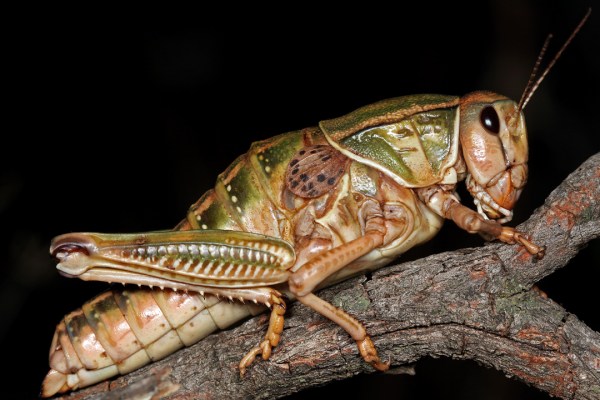
Brachystola magna (Plains lubber grasshopper) | Major Co., Oklahoma

Well over 50 mm long, it wasn’t so much its length as its girth that made this truly the most ginormous grasshopper I’d ever seen. Grasshopper diversity in the Great Plains is high, with more than 100 species in Nebraska alone (Brust et al. 2008), and while I have limited familiarity with the species, the large, robust body and tiny, little wings told me this must be one of the lubber grasshoppers in the acridid subfamily Romaleinae. As an example of how technology has changed our lives, a quick iPhone snapshot posted on Facebook yielded within minutes an identification by Matt Brust as Brachystola magna, the Plains lubber grasshopper.

The ”quintessential” generalized insect head!

The grasshopper didn’t seem alarmed by my presence as it clambered slowly on the branch, so I returned to photographing the beetle. Good thing I did, as it turned out to be the ripiphorid Toposcopus wrightii, currently recorded in the literature only from Arizona, New Mexico, and Texas. Thus, my photos document not only an unusual northern record but also the first tangible evidence that members of the basal subfamily to which it belongs parasitize woodboring beetle larvae. Once I finished photographing that species, I returned my attentions to the lumbering beast, snapped a few photos, and then placed her in a critter carrier to bring home as a gift for my daughter (yes, she really likes when I bring home “pets” for her!).

REFERENCE:

Brust, M. L., W. W. Hoback and R. J. Wright.  2008. The Grasshoppers (Orthoptera: Acrididae and Romaleidae) of Nebraska.  University of Nebraksa-Lincoln Extension, 138 pp.

Copyright © Ted C. MacRae 2012

2013 ESA World of Insects Calendar Selection

Today I received word from Richard Levine at the Entomological Society of America that one of my photos had been selected for the 2013 version of their famed World of Insects Calendar!

Excuse me for a moment please… (pumps fist, stirs the pot, does a very bad moon walk…)

Okay, I’m back. Honestly, this is an honor that I did not expect—at least not yet. Historically dominated by such giants in the world of insect macrophotography as Piotr Naskrecki,  Thomas Myers, and others, competition for ESA’s World of Insects Calendar is fierce. Last year more than 500 photographs were submitted for 13 slots (12 months and an introductory page) by 98 photographers from around the world. I was one of those photographers, though not selected (no surprise as I was a first-time submitter). However, I took great pleasure in seeing fellow bug blogger Adrian Thysse nab two of the 2012 slots, and I increased my resolve to try again for next year with a selection of eight mostly newer photographs.

At the suggestion of Dave Stone, I present each of those photos below along with a short description of why I submitted it. However, I’m not going to tell you which photo ultimately was selected—I thought it might be fun to see which photo you think was selected and why. As added incentive for guessing, I’m going to award 10 BitB Challenge points to each person who correctly picks the selected photograph. BitB Challenge Session #6 is coming down to the wire, so this could have a big impact on the overall standings.

The 2013 Calendar will become available for sale later this year (probably October) at the ESA website—last year’s version cost only $12 (discounted to $8 for ESA members, and free for those attending the annual meeting [which I will be attending this year]).


Megaphasma denticrus (Phasmida: Diapheromeridae) – giant walkingstick

From North America’s longest insect (21 Aug 2009).  This is one of my earlier super-closeup attempts. I liked the combination of blue and brown colors on the black background.


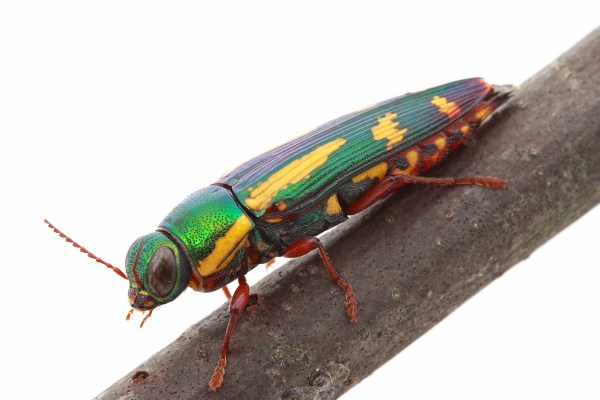
Buprestis rufipes (Coleoptera: Buprestidae) – redbellied Buprestis

From Special Delivery (13 July 2010).  The use of a white box shows off the brilliant (and difficult-to-photograph) metallic colors well, and I like the animated look of the slightly cocked head.


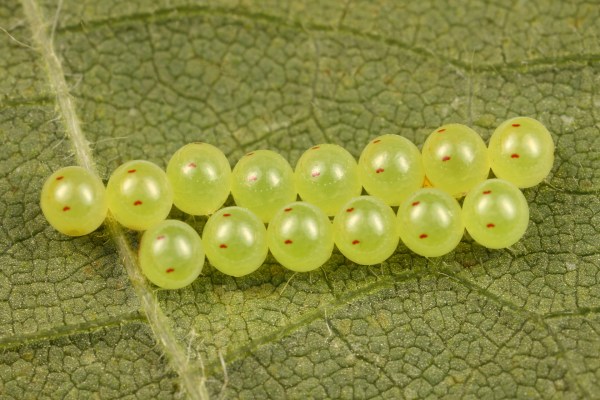
Edessa meditabunda (Hemiptera: Pentatomidae) – alquiche chico

From  (18 May 2011). I found these Edessa meditabunda stink bug eggs on the underside of a soybean leaf in Argentina almost ready to hatch. The developing eye spots in each egg gives the photo a “cute” factor rarely seen in such super close-ups.


Cicindela formosa generosa (Coleoptera: Carabidae: Cicindelinae) – eastern big sand tiger beetle

From  (10 May 2011). I like this slightly panned out view because of the sense of scale and landscape created by the inclusion of the plantlets and the view over the small rise.


Trimerotropis saxatilis (Orthoptera: Acrididae) – lichen grasshopper

From  (15 July 2011). Some of my favorite insect photos are not only those that show the bug in all its glory, but also tell a story about its natural history. This nymph is almost invisible when sitting on the lichens that cover the sandstone exposures in its preferred glade habitat. 


Tetracha floridana (Coleoptera: Carabidae: Cicindelinae) – Florida metallic tiger beetle

From  (23 August 2011). I used extension tubes to improve the quality of flash lighting (decreased lens to subject distance results in greater apparent light size), and I like the symmetry of the composition.


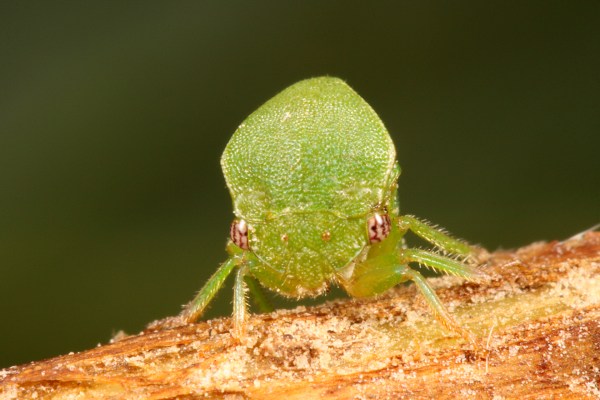
Spissistilus festinus (Hemiptera: Membracidae) – threecornered alfalfa hopper

From  (17 September 2011). Even though both the insect and the background are green, there is sufficient value contrast to create a pleasing composition, punctuated by the bizarre zig-zag pattern of the eyes.


Crossidius coralinus fulgidus (Coleoptera: Cerambycidae) – a rabbitbrush longhorned beetle

From  (4 October 2011). The blue sky background provides a pleasing contrast with the colors of this particular beetle and flowers.

Copyright © Ted C. MacRae 2012

One-Shot Wednesday: two-striped grasshopper nymph

Melanoplus bivittatus (Two-striped Grasshopper) nymph | Jerseyville, Illinois

As the heat of summer solidifies its chokehold over the middle and southern latitudes of North America, grasshopper nymphs will begin to ramp up their development. I see grasshoppers commonly in my soybean field trials, where their feeding presents more of an annoyance to me than an actual threat to yields.

I photographed this particular individual on almost this same date last year in one of my Illinois soybean trials, not knowing for sure which species it represented. There was no particular reason for only taking this one single photograph, other than it was perched nicely when I saw it and that I did not feel like taking the time to chase it into another good pose after my first shot disturbed it.

Later in the season I saw numerous adults representing Melanoplus differentialis (differential grasshopper), a common species in this area, and assumed this was its nymph. However, a closer look at the photo suggests it represents the closely related M. bivittatus (two-striped grasshopper). While adults of these two species are easily distinguished based on coloration, the nymphs can look very similar (especially in their earlier instars) and are distinguished on the basis of the black femoral marking—more or less solid in M. bivittatus and broken into chevrons that create a “herringbone” pattern in M. differentialis.

Wing pad size and relative body proportions suggest this is a fourth-instar nymph.

Copyright © Ted C. MacRae 2012

Bicho palito, or “My longest post ever!”

The last day of my vacation week in Corrientes, Argentina got off to a bad start—heavy rain moved in during the morning, and I feared my last chance at looking for insects was about to be washed away. The weather radar, however, showed a curious, abrupt line between rain/no rain across the river in Chaco Province. At noon I decided it was do or die and played a hunch that one of my favorite spots ~50 km west might have been spared the downpour, and if not at least I tried. Yet another example of how it usually pays to play your hunches—while the skies were gray and the ground and foliage a little damp, there was plenty of insect activity afield (and perhaps even enhanced by the first significant moisture in almost two months).

Tetanorhynchus poss. n. sp. | Chaco Province, Argentina

No sooner than had I walked 20 feet from the car did I see an enormous stick insect in a low, spreading acacia tree. I don’t know why I saw it, as it’s camouflage was quite effective, but after so many years of doing this I think I’ve just developed an eye for seeing things often easily missed. This, of course, is not your normal, run-of-the-mill (at least to North Americans) walkingstick (order Phasmida), but rather a member of the curious and exclusively Neotropical grasshopper family Proscopiidae, referred to in English as “jumping sticks” and in Spanish as “bicho palito” (stick bug). I recognized the family instantly, as I had already seen one of these a number of years ago in Uruguay (though not so large as this one), and of course Alex Wild featured what has become one of his most famous photos of a species from Ecuador in one of his Monday Night Mystery posts.

The super elongate fastigium suggests this may be a new species.

Gleefully I set about taking photos, focusing almost exclusively on the head. One thing that immediately struck me was the super-elongate fastigium (frontal projection)—many proscopiids lack this elongate fastigium, and I had not recalled seeing any example as long as the one on this individual. When I saw the super-closeup I had taken of the eyes and antennal bases from the ventral view, I knew I had my own Super Crop Challenge. Of course, it was not until after I posted the challenge that I realized identifying this insect below the family level was more of a challenge than I had anticipated. How could I award points for genus when I wasn’t even sure of this myself? Eventually I enlisted the help of Alba Bentos-Pereira at São Paulo University—he and his doctoral student are perhaps the only two people in the world that are working on this family. I had suggested, based on its location in Chaco Province and consulting Orthoptera Species File Online, that it must be either Tetanorhynchus calamus or Cephalocoema daguerrei—both in the tribe Tetanorhynchini (Bentos-Pereira 2003). Alba kindly responded that it could be the former, it most definitely is not the latter, and perhaps most likely is that it represents an undescribed species (proscopiid taxonomy is still far from complete). He indicated that the presence of ventral spines on the metatibia would confirm membership in the tribe Tetanorhynchini (they are present), and provided several measurements from the male holotype of T. calamus that I could use to compare with my specimen. Although the absolute measurements might (and probably would) differ, their relative proportions should be the same as the type. Here are the results (measurements in mm):


Male type

Female

Ratio

Body

98

138

1.4

Head

18.5

32

1.7

Fastigium

9.5

19

2.0

Pronotum

20

25

1.3

Femur 1

14

17

1.2

Femur 3

28

38

1.4

Tibia 3

30

39

1.3

As can be seen, most of the measurements are consistently 1.2–1.4X that of the male type. The head, however, is proportionately longer (1.7X), primarily due to the much longer fastigium (2.0X). Is this difference significant, at least enough to consider it a different species? I am currently awaiting Alba’s opinion on that.

Like all proscopiids, the form of the face seems to be''smiling'.'

While only two species of Proscopiidae are described from Chaco Province, there are eleven species known from northeastern Argentina (which includes the provinces of Buenos Aires, Chaco, Córdoba, Corrientes, Entre Rios, Formosa, Missiones and Santa Fe)—these are shown in the following list with hyperlinks to their respective pages at Orthoptera Species File Online, along with notes on type localities for each (or synonyms) and the length of the fastigium relative to the body:  

Okay, in the title I indicated this was “My longest post ever!” Here’s why:


Congratulations to Sam Heads, whose work as a practicing orthopteran taxonomist and contributor to Orthoptera Species File Online set him up for the win with 17 points. Brady Richard takes 2nd place with 14 pts, while Chris Grinter and Dennis Haines share the final podium spot with 12 pts each. Congratulations to these folks, who jump out of the gate early in BitB Challenge Session #6.

REFERENCE:

Bentos-Pereira, A. 2003. The Tribe Tetanorhynchini, nov. (Orthoptera, Caelifera, Proscopiidae). Journal of Orthoptera Research 12(2):159–171.

Copyright © Ted C. MacRae 2012

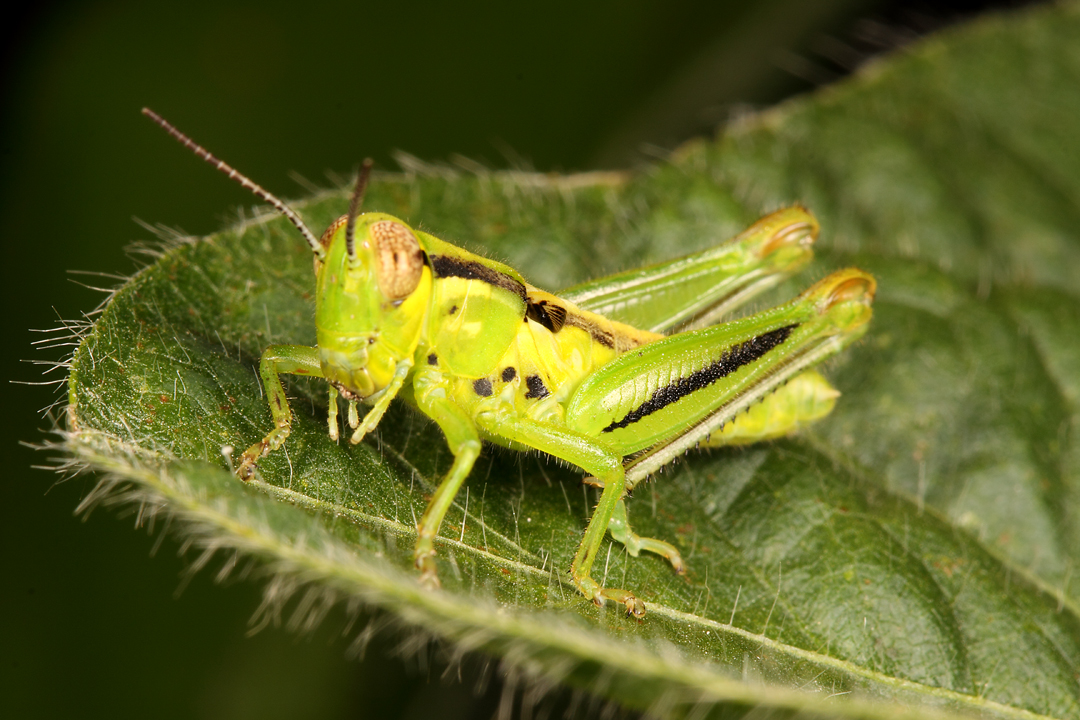
Tucuras, langostas, y saltamontes

Staleochlora viridicata | Cordoba Province, Argentina (March 2011)

Tucuras, langostas, and saltamontes are names in Argentina for what we in North America call grasshoppers (order Orthoptera, superfamily Acridoidea). Argentina certainly has its share of species, some of which can only be described as “gigantes”! During my first week out in the field at my home base here in western Buenos Aires Province, I encountered the hefty-bodied female in the photo below and was immediately reminded of a similar-looking individual I had photographed in neighboring Córodoba Province during my March 2011 visit. Both had short but well-developed wing pads that at first suggested they might be mature nymphs of an incredibly large species. However, when I noted both were females I decided they likely represented adults of some type of lubber grasshopper (family Romaleidae), many of which—especially the females—are brachypterous (short-winged) and heavy-bodied as adults. A little searching revealed that both belong to the genus Elaeochlora, each looking very much like the species pictured on an Argentine postal stamp and identified as E. viridis (update 9 Mar 2012 – Sam Heads has identified these as Staleochlora viridicata).

Staleochlora viridicata| Buenos Aires Province, Argentina (March 2012)

Getting at least a genus name for these individuals then prompted me to go back to photographs I had taken last year of other types of grasshoppers. One of these, Eutropidacris cristata, is truly one of the largest grasshoppers I have ever seen (update 9 Mar 12 – Sam Heads notes that Eutropidacris is now a synonym of Tropidacris). This individual was seen in a soybean field in the northern Argentina province of Chaco. These insects, known in Argentina as “La tucura quebrachera,” apparently occur in outbreak numbers periodically and, understandably owing to their monstrous size, generate a lot of attention. In Brazil the sepcies is known as “gafanhoto-do-coqueiro” (coconut tree grasshopper),

Tropidacris cristata | Chaco Province, Argentina (March 2011)

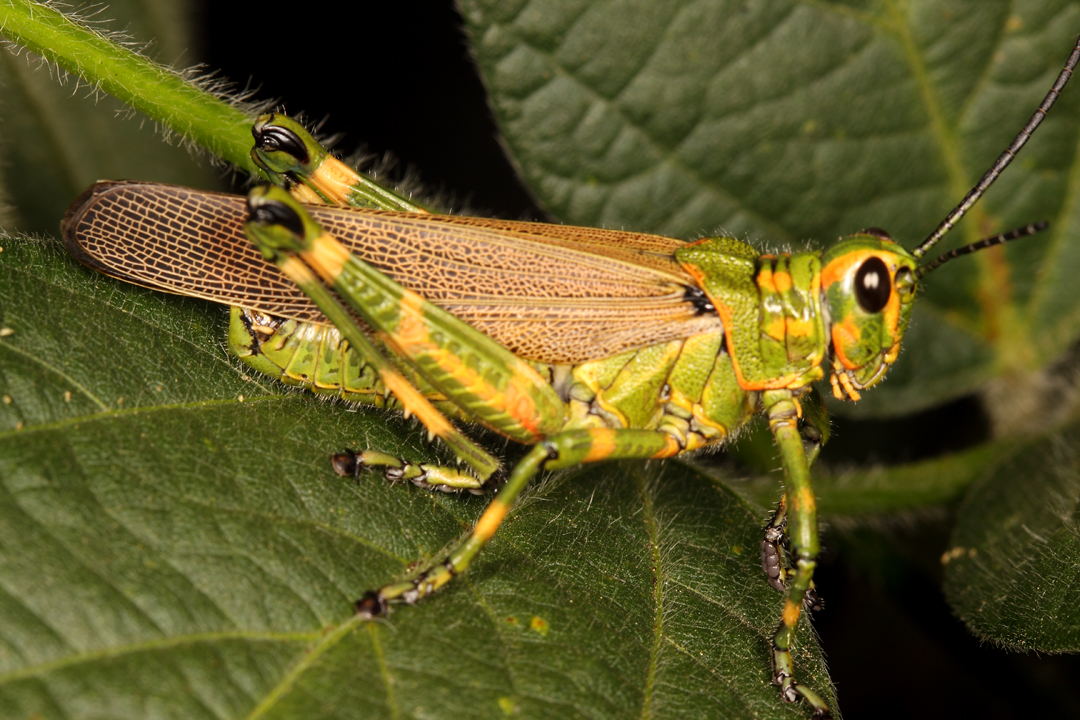
One of the more colorful grasshoppers I have seen in Argentina is Chromacris speciosa. The individual below was photographed last March in eastern Córdoba Province, also on soybean. It’s tempting to presume that the green and yellow coloration has a cryptic function, but apparently the nymphs of this species are brightly colored red and black and have the habit of aggregating on foliage. This is classic aposematism (warning coloration) to indicate chemical protection from predation, so perhaps there is a similar function to the adult coloration as well.

Chromacris speciosa | Cordoba Province, Argentina (March 2011)

Copyright © Ted C. MacRae 2012