2014 Great Plains Collecting Trip iReport

During the past year or so I’ve followed up my longer (one week or more) insect collecting trips with a synoptic “iReport”—so named because they are illustrated exclusively with iPhone photographs. It may come as a surprise to some, but iPhones actually take pretty good pictures (especially if you pay attention to their strengths and weaknesses), and their small, compact size makes it easy to take lots of photos while trying to use time in the field wisely. I find the iPhone to be a great tool for documenting the general flavor of a trip and for taking quick photos of subjects before getting out the big rig. I will, of course, feature photographs taken with the ‘real’ camera in future posts.

For this trip, I teamed up with Jeff Huether for the third time since 2012. Our quarry for this trip was longhorned beetles (family Cerambycidae) in the genus Prionus. Larvae of these beetles are subterranean, with some species feeding on roots of woody plants and others on roots of grasses and other herbaceous plants. Among the latter are an array of species occurring in the Great Plains, many of which have been very uncommonly collected. However, in recent years lures have been produced that are impregnated with prionic acid—the principal component of sex pheromones emitted by females in the genus. Originally produced for use in commercial orchards (which are sometimes attacked by P. laticollis in the east and P. californicus in the west), these lures are proving themselves to be useful for us taxonomist-types who wish to augment the limited amount of available material of other, non-economic species in the genus. While Prionus was our main goal, rest assured that I did not pass on the opportunity to find and photograph other beetles of interest.

I began the trip by driving from St. Louis to Wichita, Kansas to meet up with Jeff, who had flown there from his home in upstate New York. Our plan was to visit sites in southeastern Colorado and northeastern New Mexico, where several of the Prionus spp. that we were looking for were known to occur. Before doing this, however, we stopped in Hardtner, Kansas to see “Beetle Bill” Smith and tour his amazing natural history tribute, Bill and Janet’s Nature Museum.

"Beetle" Bill Smith, founder of Bill & Janet's Nature Museum, Hardtner, Kansas.

“Beetle Bill” Smith, founder of Bill & Janet’s Nature Museum, Hardtner, Kansas.

After the tour (and a delicious lunch at his house of fried crappie prepared by his wife Janet), we headed west of town and then south just across the state line into Oklahoma to a spot where Bill had found a blister beetle (family Meloidae) that Jeff was interested in finding. During lunch I mentioned a jewel beetle (family Buprestidae) that I had looked for in the area several times, but which had so far eluded me—Buprestis confluenta. Emerald green with a dense splattering of bright yellow flecks on the elytra, it is one of North America’s most striking jewel beetles and is known to breed in the trunks of dead cottonwoods (Populus deltoides). Bill mentioned that he had collected this species at the very spot where we were going, and when we arrived I was enticed by the sight of a cottonwood grove containing several large, dead standing trunks—perfect for B. confluenta.

Buprestis spp. love large, dead, barkless cottonwood trunks.

Buprestis spp. love large, dead, barkless cottonwood trunks.

I searched for more than one hour without seeing the species, though I did find a few individuals of the related (and equally striking) B. rufipes on the trunks of the large, dead trees. Once that amount of time passes I’m no longer really expecting to see what I’m looking for, but suddenly there it was in all of its unmistakable glory! It would be the only individual seen despite another hour of searching, but it still felt good for the first beetle of the trip to be one I’d been looking for more than 30 years!
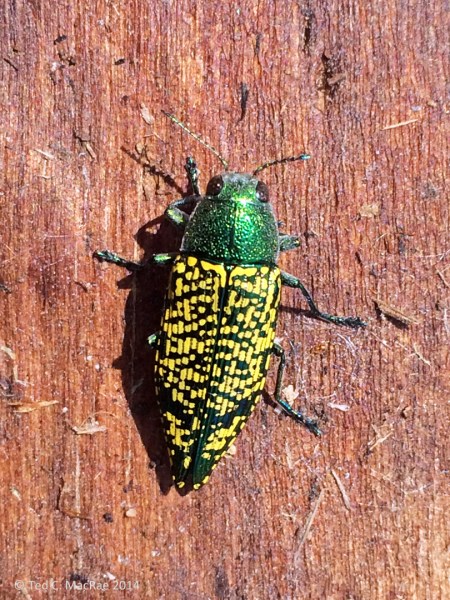
Buprestis (Knulliobuprestis) confluenta, on large, dead Populus deltoides trunk | Woods Col., Oklahoma| USA: Oklahoma

Buprestis confluenta, on the trunk of a large, dead cottonwood (Populus deltoides) | Woods Col., Oklahoma| USA: Oklahoma

I usually wait until near the end of a collecting trip to take the requisite selfie, but on this trip I was sporting new headgear and anxious to document its maiden voyage. My previous headgear of choice, a vintage Mambosok (impossible to get now), finally disintegrated after 20 years of field use, and on the way out-of-town I picked up a genuine Buff® do-rag. I know many collectors prefer a brim, but I don’t like they way brims limit my field of vision or get in the way when I’m using a camera. Besides, I’m usually looking down on the ground or on vegetation, so sun on my face is not a big issue. And do I be stylin’ or wut?

A "selfie" makes the trip official.

A “selfie” makes the trip official.

We made it to our first locality in southeast Colorado by noon the next day—the vast, dry grasslands north of Las Animas. Jeff had collected a blister beetle of interest here on an earlier trip, but as I looked out across the desolate landscape I wondered what on Earth I could find here that would be even remotely interesting to me.
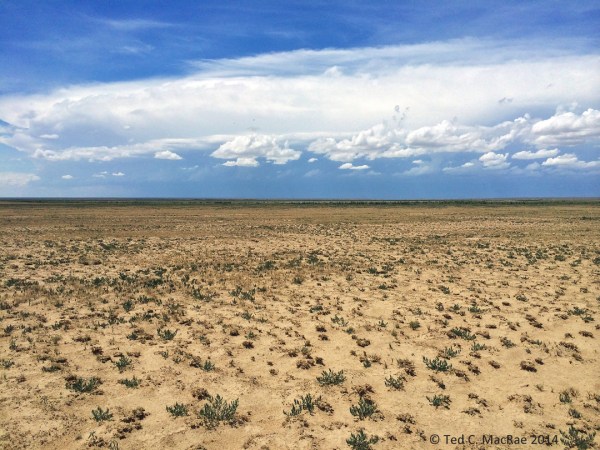
Shortgrass prairie habitat for Prionus integer.

Shortgrass prairie habitat for Prionus integer.

Letting Jeff have some time to look for his blister beetle, I started down the roadside and after a short time found a live female Prionus sp. (later determined to represent P. integer). The only female Prionus I had ever collected before was P. heroicus, a giant species out in Arizona, and that was almost 30 years ago, so I wasn’t immediately sure what it was. Eventually I decided it must be Prionus, and a quick stop to kick the dirt while Jeff looked for his beetle turned into an intense search for more Prionus that surely were there. I did find two male carcasses shortly thereafter, and then nothing more was seen for the next hour or so.

Prionus integer male | Bent Co., Colorado

Prionus integer male (found dead) | Bent Co., Colorado

During the time that I was searching, however, I started noticing strange burrows in the ground. I excavated a few—they were shallow but contained nothing. Nevertheless, they matched the size of the beetles perfectly—surely there was a connection?
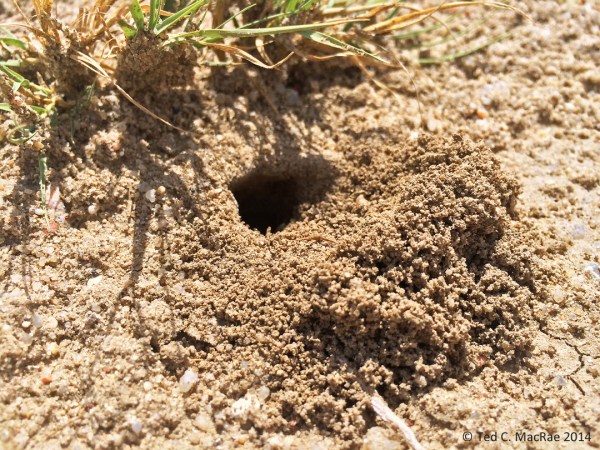
Prionus integer adult burrow.

Prionus integer adult burrow.

I wondered if Jeff knew about the beetles occurring here, but when I showed him what I had found the surprised look on his face told me this was not the case. I showed him the burrows, and we both agreed they had to be connected. I got the shovel out of the truck and walked back to the area where I had seen the live female, then sunk the shovel deep into the ground next to one of the burrows and pried up a chuck of the soil containing the burrow in its entirety. As we broke apart the soil another female was revealed, and we immediately decided to set out some traps baited with prionic acid lures. We expected the beetles to become active during dusk, so we went into town to get something to eat and then check out another nearby locality before returning to the site at dusk. While we were gone it rained heavily at the site, so we weren’t sure if or how this would affect beetle activity and their possible attraction to the traps. However, as we approached the site (slipping and sliding on the muddy 2-track), we could actually see beetles crawling on the road from afar. What we found when we got out of the car was nothing short of mind-blowing—the beetles were everywhere, crawling on the road, crawling through the grass, and overflowing in the flooded traps! The vast majority were males, as expected, but we also found a fair number of the much more rarely collected females. This was significant, as the chance to observe mating and oviposition behavior made the encounter far more informative than if we had only found and collected the much more numerous males.

Prionus integer mating pair.

Prionus integer mating pair.

The following day we headed south into northeastern New Mexico to look at some shortgrass prairie sites near Gladstone (Union Co.) where two species of Prionus had been collected in recent years: P. fissicornis (the lone member of the subgenus Antennalia) and P. emarginatus (one of eight species in the poorly known subgenus Homaesthesis, found primarily in the Great Plains and Rocky Mountains). Fresh off of our experience the previous day, we were on the lookout for any suspicious looking “burrows” as we checked the roadsides at several spots in the area but found nothing, and while a few blister beetles piqued the interest of Jeff at one site, the complete absence of woody vegetation or flowering plants in general in the stark grassland landscape made the chances of me finding any other woodboring beetles remote. Eventually I became distracted by the lizards that darted through the vegetation around us, including this lesser earless lizard (Holbrookia maculata) and a collared lizard (better photos of both forthcoming).

Holbrookia maculata (lesser earless lizard) | Union Co., New Mexico.

Holbrookia maculata (lesser earless lizard) | Union Co., New Mexico.

Despite no clues to suggest that Prionus beetles were active in the area, we set out some traps at two sites with soil exposures that seemed similar to those seen the day before. As Jeff set the last pair of traps in place, my distraction with saurian subjects continued with a dusty hognose snake (Heterodon nasicus gloydi). While photographing the animal I looked down to my side, and what did I see but a male Prionus fissicornis crawling through the vegetation! I called out to Jeff, and for the next half an hour or so we scoured the surrounding area in a failed attempt to find more. We would not be back until the next morning to check the traps, so our curiosity about how abundant the beetles might be would have to wait another 18 hours. We cast an eye towards the north and watched late afternoon thunderstorms roll across the expansive landscape and decided to check out the habitat in nearby Mills Rim.

Thunderstorms over shortgrass prairie.

Thunderstorms over shortgrass prairie.

The rocky terrain with oak/pine/juniper woodlands at Mills Rim was a dramatic contrast to the gently rolling grasslands of the surrounding areas. We came here mostly out of curiosity, without any specific goal, but almost immediately after getting out of the car a huge Prionus male flew up to us—almost surely attracted by the scent of the lures we were carrying. Within a few minutes another male flew in, and then another. Because of their huge size and occurrence within oak woodland habitat, we concluded they must represent P. heroicus, more commonly encountered in the “Sky Islands” of southeastern Arizona. We stuck around to collect a few more, but as dusk approached we returned to the surrounding grasslands to set out some lures to see if we could attract other Prionus species. The frontal system that had waved across the landscape during the afternoon had left in its wake textured layers of clouds, producing spectacular colors as the sun sank inexorably below the horizon.

Sunset over shortgrass prairie.

Sunset over shortgrass prairie.

This attempt to collect grassland Prionus beetles would not be successful, and as dusk progressed we became distracted collecting cactus beetles (Moneilema sp., family Cerambycidae) from prickly pear cactus plants (Opuntia sp.) before darkness ended our day’s efforts. This did not mean, however, that all of our efforts were done—there are still night active insects, and in the Great Plains what better nocturnal insect to look for than North America’s largest tiger beetle, the Great Plains giant tiger beetle (Amblycheila cylindriformis, family Cicindelidae—or subfamily Cicindelinae—or supertribe Cicindelitae, depending on who you talk to)?! We kept our eyes on the headlamp illuminated 2-track as we drove back to the highway and then turned down another road that led into promising looking habitat. Within a half-mile of the highway we saw one, so I got out to pick it up and then started walking. I walked another half-mile or so on the road but didn’t see anything except a few Eleodes darkling beetles (family Tenebrionidae), then turned around and walked the habitat alongside the road on the way back. As I walked, tiny little rodents—looking like a cross between a mouse and a vole—flashed in and out of my headlight beam as they hopped and scurried through the vegetation in front of me. Most fled frantically in response to my attempted approach, but one, for some reason, froze long enough under my lamp to allow me this one photo. When I posted the photo on my Facebook page, opinions on its identity ranged from kangaroo rat (Dipodomys sp.) silky pocket mouse (Perognathus flavus) to jumping mouse (Zapus sp.). Beats me.
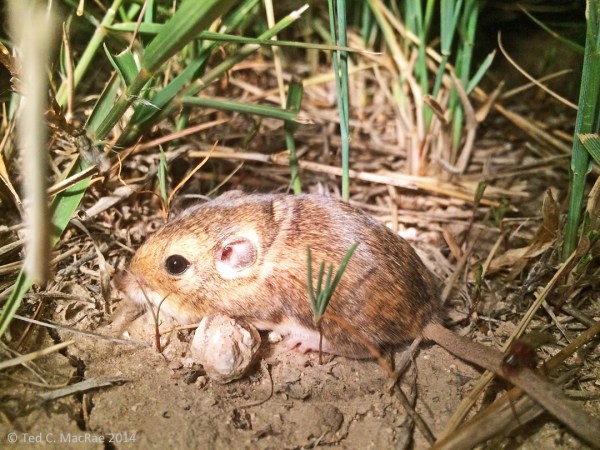
silky pocket mouse? Zapus sp., jumping mouse? | Union Co., New Mexico.

Kangaroo rat? Silky pocket mouse? Jumping mouse? | Union Co., New Mexico.

Almost as if by command, it rained during the early evening hours where we had set the traps, and the following morning we were rewarded with traps brimming with Prionus fissicornis males. Not only were the traps full, but males were still running around in the vicinity, and we even found a few females, one of which was in the act of ovipositing into the soil at the base of a plant.

Prionic acid-bated traps w/ Prionus fissicornis males.
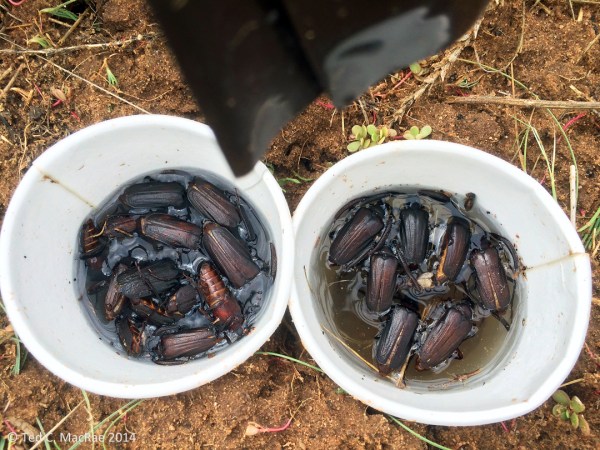
Prionic acid-bated traps w/ Prionus fissicornis males.
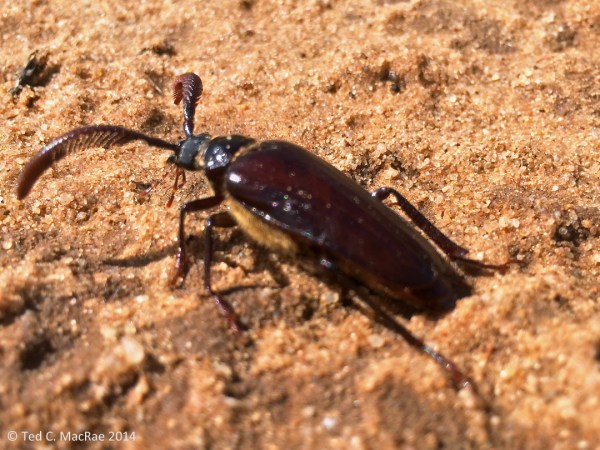
Prionic acid-bated traps w/ Prionus fissicornis males.

Prionic acid-bated traps w/ Prionus fissicornis males.

Prionus fissicornis male | Harding Co., New Mexico.

Prionus fissicornis male | Harding Co., New Mexico.

Prionus fissicornis oviposition hole.

Prionus fissicornis oviposition hole.

Eventually P. fissicornis activity subsided, and we decided to go back to the area around Mills Rim to see what beetles we might find in the woodland habitats. We also still were not sure about the Prionus beetles we had collected there the previous day and whether they truly represented P. heroicus. The scrubby oaks and conifers screamed “Beat me!”, and doing so proved extraordinarily productive, with at least a half-dozen species of jewel beetles collected—including a nice series of a rather large Chrysobothris sp. from the oaks that I do not recognize and a single specimen of the uncommonly collected Phaenops piniedulis off of the pines.
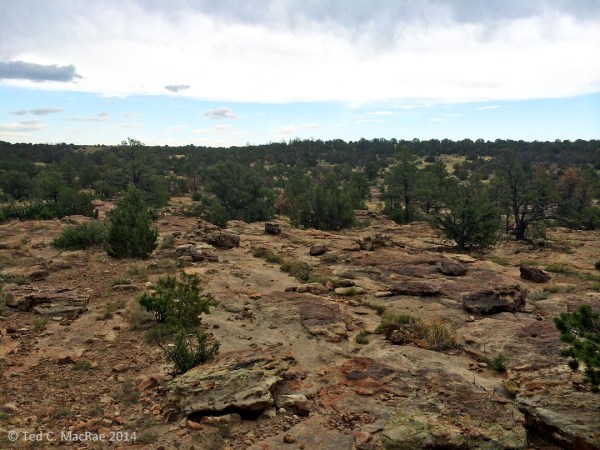
Oak/juniper woodland at Mills Canyon, habitat for Prionus heroicus.

Oak/juniper woodland at Mills Canyon, habitat for Prionus heroicus.

Not only is the scenery at Mills Rim Campground beyond spectacular, it also boasts some of the most adoringly cute reptiles known to man—such as this delightfully spiky horned lizard (I prefer the more colloquial name “horny toad”!). I’m probably going to regret not having photographed this fine specimen with the big camera.
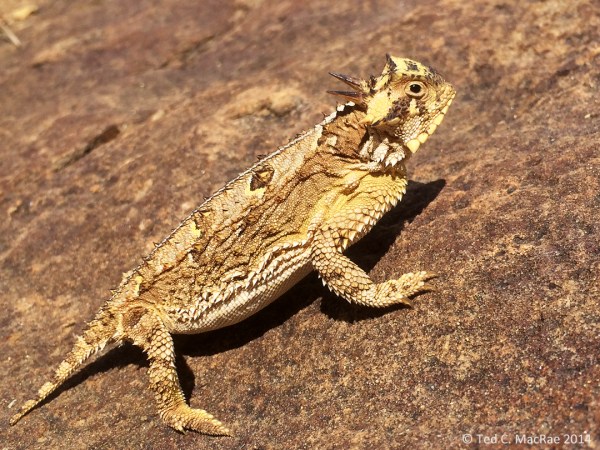
Phrynosoma cornutum (Texas horned lizard) | Harding Co., New Mexico.

Phrynosoma cornutum (Texas horned lizard) | Harding Co., New Mexico.

Fresh diggings beside a rock always invite a peek inside. You never know who might be peeking out.
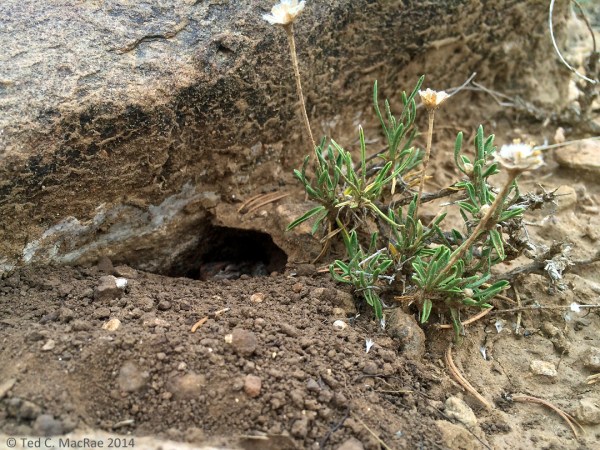
Who's home?

Who’s home?

Peek-a-boo!

Peek-a-boo!

The trip having reached the halfway point, we debated whether to continue further south to the sand dunes of southern New Mexico (with its consequential solid two-day drive back to Wichita) or turn back north and have the ability to collect our way back. We chose the latter, primarily because we had not yet had a chance to explore the area around Vogel Canyon south of Las Animas, Colorado. We had actually planned to visit this area on the day we encountered P. integer in the shortgrass prairie north of town, and a quick visit before going back to check the traps that evening showed that the area had apparently experienced good rains as shown by the cholla cactus (Cylindropuntia imbricata) in full bloom.

Cylindropuntia imbricata | Otero Co., Colorado.

Cylindropuntia imbricata | Otero Co., Colorado.

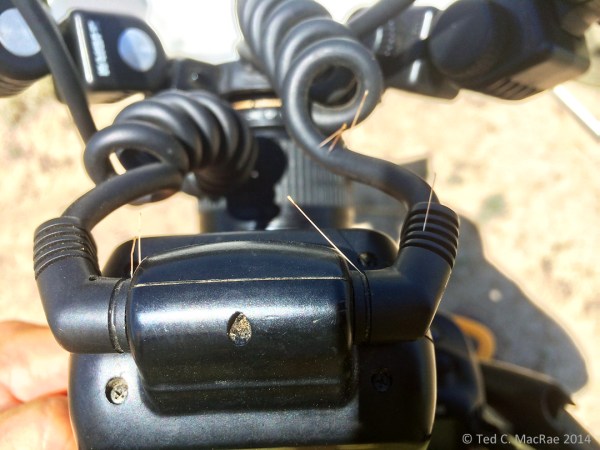
Whenever I see cholla plants I can’t help myself—I have to look for cactus beetles (Moneilema spp.). It had rained even more since our previous visit a few days ago, and accordingly insects were much more abundant. Several Moneilema adults were seen on the cholla, one of which I spent a good bit of time photographing. The iPhone photo below is just a preview of the photos I got with the big camera (which also included some very impressive-sized cicadas—both singing males and ovipositing females). The cactus spines impaled in the camera’s flash control unit serve as a fitting testament to the hazards of photographing cactus insects!
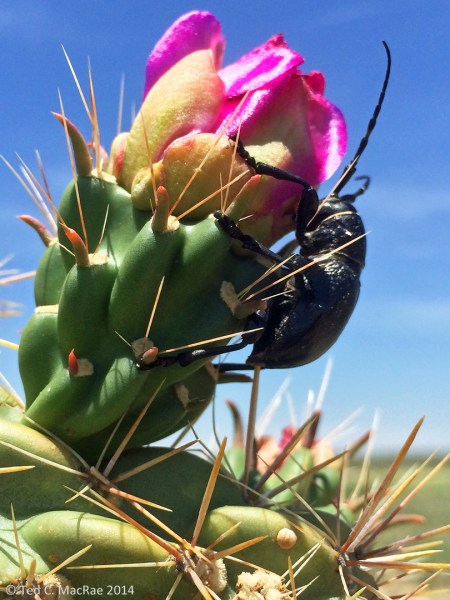
Moneilema sp. on Cylindropuntia imbracata } Otero Co., Colorado.
Moneilema sp. on Cylindropuntia imbracata } Otero Co., Colorado.

The hazards of photographing cactus beetles.

The hazards of photographing cactus beetles.

Later in the afternoon we hiked down into the canyon itself, and while insects were active we didn’t find much out of the ordinary. We did observe some petroglyphs on the sandstone walls of the canyon dating from the 1200s to the 1700s—all, sadly, defaced by vandals. Despite the rather uninspiring collecting, we stayed in the area for two reasons: 1) Jeff wanted to setup blacklights at the canyon head in hopes of collecting a blister beetle that had been caught there on an earlier trip, and 2) I had noted numerous Amblycheila larval burrows in the area (and even fished out a very large larva from one of them) and wanted to search the area at night to see if I could find adults. Jeff was not successful in his goal, and for a time I thought I would also not succeed in mine until we closed up shop and started driving the road out of the canyon. By then it was after 11 p.m. and we managed to find about a half-dozen A. cylindriformis adults. This was now the third time that I’ve found adults of this species, and interestingly all three times I’ve not seen any beetles despite intense searching until after 11 p.m and up until around midnight.

Lithographs on canyon wall | Mills Canyon, Colorado.

Lithographs on canyon wall | Mills Canyon, Colorado.

The next morning we found ourselves with two days left in the trip but several hundred miles west of Wichita, where I needed to drop Jeff off for his flight back home before I continued on home to St. Louis. I had hoped we could make it to the Glass Mountains just east of the Oklahoma panhandle to see what Prionus species might be living in the shortgrass prairies there (and also to show Jeff this remarkable place where I’ve found several new state records over the past few years). As we headed in that direction, I realized our path would take us near Black Mesa at the western tip of the Oklahoma pandhandle, and having been skunked on my first visit to the area last year due to dry conditions but nevertheless intrigued by its very un-Oklahoma terrain and habitat I suggested we stop by the area and have a look around before continuing on to the Glass Mountains. We arrived in the area mid-afternoon and headed straight for a rock outcropping colonized by scrub oak (Quercus sp.) and pinyon pine (Pinus sp.)—very unusual for western Oklahoma—that I had found during my previous trip.

The author looks pensively out over the Black Mesa landscape.

The area around Black Mesa couldn’t be more unlike the perception that most people have of Oklahoma.

I wanted to beat the oaks for buprestids—surely there would be a state record or two just sitting there waiting for me to find them, but as I started walking from the car towards the oaks the approach of a loud buzz caught my attention. I turned around to see—would you believe—a large Prionus beetle circling the air around me and was fortunate to net it despite its fast and agile flight. I hurried back to the car to show Jeff what I had found; we looked at each other and said, “Let’s collect here for a while.” The beetle had apparently been attracted to the lures in the car, so we got them out, set them up with some traps, and went about beating the oaks and watching for beetles to fly to the lure. Sadly, no  jewel beetles were collected on the oaks, although I did find evidence of their larval workings in some dead branches (which were promptly collected for rearing). Every once in a while, however, a Prionus beetle would fly in, apparently attracted to the lure but, curiously, never flying directly to it and falling into the trap. Many times they would land nearby and crawl through the vegetation as if searching but never actually find the trap. However, just as often they would approach the trap in flight and not land, but rather continue circling around in the air for a short time and before suddenly turning and flying away (forcing me to watch forlornly as they disappeared in the distance). Based on their very large size, blackish coloration and broad pronotum, we surmised (and later confirmed) these must also be P. heroicus, despite thinking (and later confirming) that the species was not known as far east as Oklahoma. Not only had we found a new state record, but we had also recorded a significant eastern range extension for the species. And to think that we only came to Black Mesa because I wanted to beat the oaks!

Prionus heroicus male

Prionus heroicus male

Bite from Prionus heroicus male.

Proof that Prionus heroicus males can bite hard enough to draw blood!

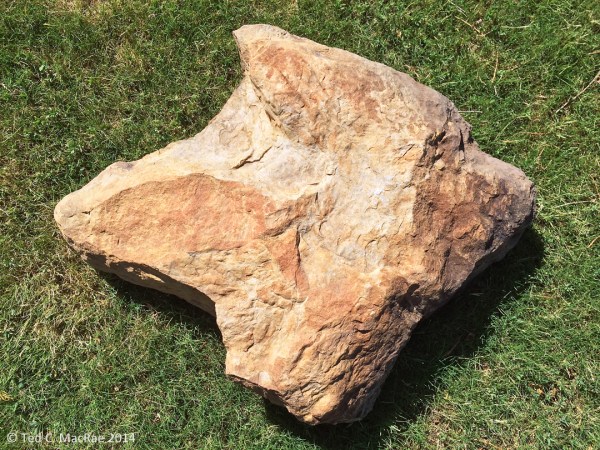
We each collected a nice series of the beetles, and despite never witnessing the beetles actually going to the traps a few more were found in the traps the next morning after spending the night in a local bed & breakfast. I also found a dove’s nest with two eggs hidden in the vegetation, and as we were arranging for our room at the bed & breakfast a fellow drove up and dropped off a freshly quarried dinosaur footprint (the sandstone, mudstone, and shale deposits around Black Mesa are the same dinosaur fossil bearing deposits made more famous at places like Utah’s Dinosaur National Monument).

Dove's nest w/ eggs.

Dove’s nest w/ eggs.

Dinosaur fossil footprint

Freshly quarried dinosaur fossil footprint

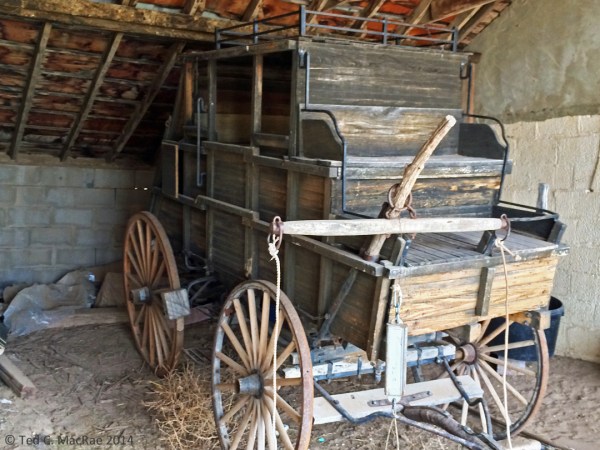
By the way, if you ever visit the area, the Hitching Post at Black Mesa is a great place to stay. A longhorn skull on the barn above an authentic 1882 stagecoach give a hint at the ambiance, and breakfast was almost as good as what my wife Lynne can do (almost! 🙂 ).

Longhorn skull on barn at our Bead and Breakfast.
Longhorn skull on barn at our Bead and Breakfast.

132-year-old stagecoach - model!

132-year-old stagecoach – model!

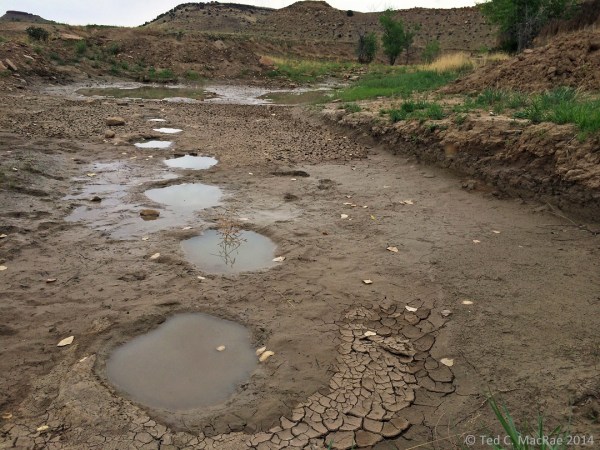
After breakfast we contemplated the long drive that lay between us and our arrival in Wichita that evening—our longer than expected stay in the area had virtually eliminated the possibility to collect in the Glass Mountains. Nevertheless, there was one more thing that I wanted to see before we left—the dinosaur footprints laying in a trackway along Carrizo Creek north of the mesa. I only knew they were in the area based on a note on a map, but as there were no signs our attempt to find them the previous day was not successful. Armed with detailed directions from the B&B owners, however, we decided to give it one more shot. Again, even after we found the site I didn’t see them immediately, I suppose because I was expecting to see distinct depressions in dry, solid rock. Only after the reflections of light from an alternating series of small puddles—each measuring a good 10–12″ in diameter—did I realize we had found them. Recent rains had left the normally dry creek bed filled with mud, with the footprints themselves still filled with water.

Dinosaur tracks | vic. Black Mesa, Oklahoma.

Dinosaur tracks | vic. Black Mesa, Oklahoma.

It is not surprising that I would be so excited to find the tracks, but what did surprise me was the effect they had on me. Seeing the actual signs of near mythical beasts that lived an incomprehensible 100 million years ago invites contemplation and reminds us that our time here on Earth has, indeed, been short!
Dinosaur tracks | vic. Black Mesa, Oklahoma.

Dinosaur tracks | vic. Black Mesa, Oklahoma.

By this time, we had no choice but to succumb to the long drive ahead. We did manage to carve out a short stop at the very first locality of the trip in an effort to find more Buprestis confluens (finding only a few more B. rufipes), but otherwise the day was spent adhering to our goal of reaching Wichita before nightfall. Jeff was home and sipping tea before lunchtime the next day, while I endured one more solid day of driving before making it back to St. Louis in time for dinner with the family. At that point, the trip already could have been considered a success, but how successful it ultimately ends up being depends on what beetles emerge during the next season or two from these batches of infested wood that I collected at the various spots we visited.
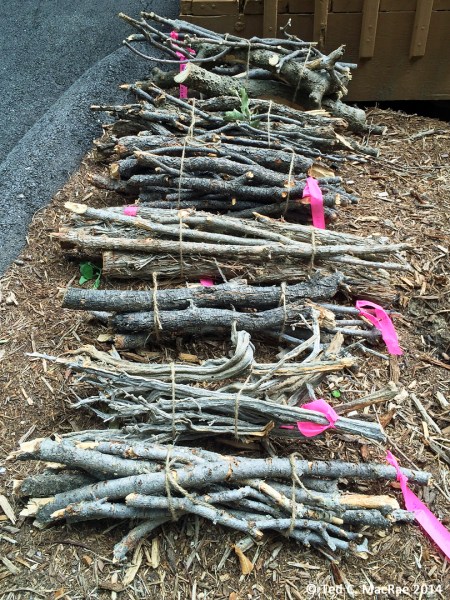
Wood collected for rearing wood-boring beetles.

Wood collected for rearing wood-boring beetles.

If you like this Collecting Trip iReport, you might also like the iReports that I posted for my 2013 Oklahoma and 2013 Great Basin collecting trips as well.

© Ted C. MacRae 2014

Sunset beetles

Acmaeodera immaculata? | vic. Vogel Canyon, Colorado.

Acmaeodera immaculata? (family Buprestidae) | vic. Vogel Canyon, Colorado.

Regular readers of this blog know that I am fond of natural sky backgrounds for insects found during the day on flowers and foliage. Not only does the sky provide a clean, uncluttered background that allows the subject to stand out, it also gives the photo a more appropriate temporal flavor—i.e., photographs of diurnal insects should look like they were taken during the day. It’s a little bit tricky setting the camera to allow flash illumination of the subject while still allowing the sky to register as well, but I find such photographs more pleasing and interesting than those with a jet-black background, typical in flash macrophotography, and far more pleasing than those with a jumble of sticks and weeds cluttered behind the subject. These days my daytime insect photos almost always incorporate a blue-sky background (examples here and here) unless: 1) I actually photographed the subject at night (examples here and here); or 2) I wish to highlight an intensely white or delicately structured subject (examples here and here).

Aulicus sp. | vic. Black Mesa, Oklahoma

Trichodes oresterus? (family Cleridae) | vic. Black Mesa, Oklahoma

But what about in between day and night—specifically, sunset? Incorporating a sunset sky into a flash-illuminated macrophotograph is even trickier than incorporating a blue midday sky because the central problem—low light levels—is magnified. Blue sky photographs challenge the fast shutter speeds and high f-stops usually needed for macrophotographs, but relatively minor adjustments to ISO, shutter speed, and f-stop are usually sufficient to allow the sky to register while still being able to maintain depth of field and minimize motion blur. At sunset, however, because there is much less illumination of the sky, more aggressive settings are often required to allow the sky to register on the camera sensor—settings that can sometimes result in too much motion blur or insufficient depth of field. These problems can be mitigated to some degree with the use of a tripod (and very cooperative subjects), but for dedicated “hand-held” enthusiasts like myself this is not an option. Why bother? Because the results can be spectacular! The setting sun often creates stunning colors not seen at other times of the day and offer a change of pace from blue skies, which, like black backgrounds, can start looking rather monotonous if used exclusively in one’s portfolio.

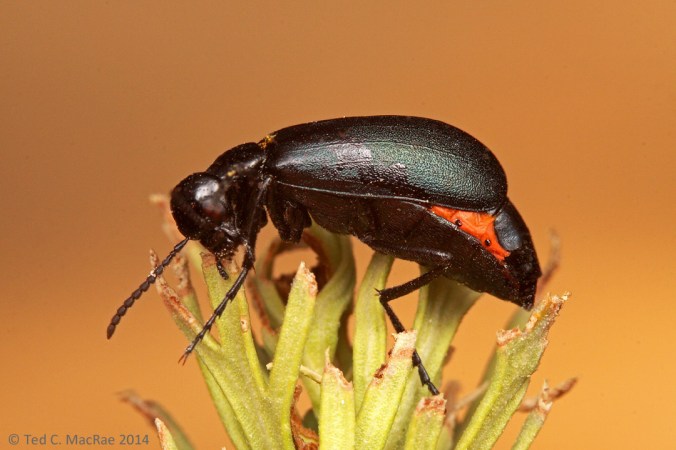
Linsleya convexa | vic. Vogel Canyon, Colorado

Linsleya convexa (family Meloidae) | vic. Vogel Canyon, Colorado

The photos featured in this post were taken during several sunsets on a trip earlier this past summer through Colorado and Oklahoma. I especially like the jewel beetle (Acmaeodera immaculata?) photograph—technically it has good focus and depth of field and a pleasing composition, but I really like the color coordination between the beetle, flower, and sky. The checkered beetle (Trichodes oresterus?) photograph is also very pleasing, especially the detail on the beetle, although the color of the sky is only somewhat different than a more typical daytime blue. The blister beetle (Linsleya convexa) photograph is probably the most problematic technically due to slight motion blur and being slightly off-focus at the eye—not surprising since of the three this photo had the lowest light conditions. However, the color contrast between the sky and subject make this a nevertheless striking image.

If you have experience with ambient light backgrounds in flash macrophotography, your comments on approaches you’ve taken to deal with reduced light situations will be most welcome.

© Ted C. MacRae 2014

The lesser of two jewels

Chrysobothris dentipes on exposed root of Pinus virginiana | South Cumberland State Park, Tennessee

Chrysobothris dentipes on exposed root of Pinus virginiana | South Cumberland State Park, Tennessee

A couple of months ago I wrote a post about Chrysobothris orono, a magnificent jewel beetle that I had the opportunity to see earlier in the year. Fellow buprestophile Joshua Basham and his colleague Nadeer Youssef had managed to find this very uncommonly encountered species breeding in exposed roots of Virginia pine (Pinus virginiana) on the edges of high bluff tops in South Cumberland State Park, Tennessee. I traveled to the site with them this past May and was rewarded with one specimen of the species, two Buprestis species that I’d not collected before (B. striata and B. salisburyensis), several photographs of each, and numerous memories. Chrysobothris orono was not, however, the only species in the genus seen that day. We also encountered numerous individuals of another species, Chrysobothris dentipes, on the same Virginia pines that were hosting C. orono, B. striata, and B. salisburyensis. Like C. orono, nearly all of the individuals seen were not on the trunks and branches of the pines, but on dead, exposed roots of the pines.

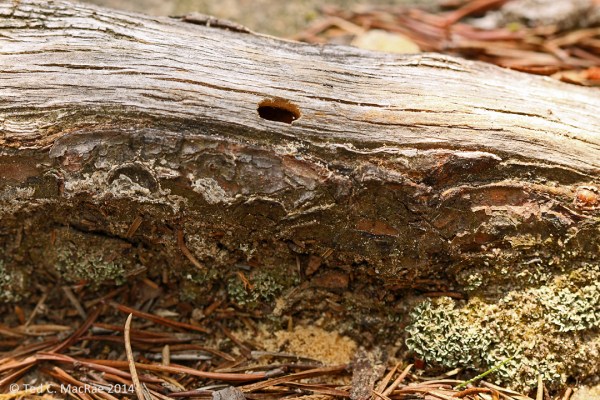
Presumed Chrysobothris dentipes adult emergence hole in exposed root of Virginia pine.

Presumed Chrysobothris dentipes adult emergence hole in exposed root of Virginia pine. Note pile of frass on the ground below the hole, suggesting that the adult emerged shortly before this photo was taken.

Unlike C. orono, however, which has only been recorded from a handful of states/provinces along the eastern seaboard and around the Great Lakes (and, now, Tennessee—MacRae & Basham 2013), C. dentipes is one of the widest ranging species in the genus, occurring throughout much of the U.S. & Canada and even the West Indies and northern Mexico (Fisher 1942). Throughout this expansive range, C. dentipes larvae develop in dead pine wood, although they have been reared also from tamarack (Larix laricina) and balsam fir (Abies balsamea) (Fisher 1942, Dearborn & Donahue 1993). I remember my excitement at collecting this species for the first time back in the 1980s in Missouri on log piles and slash from logging operations in the shortleaf pine (Pinus echinata) forests of southern Missouri. Eventually I realized how common and widespread a species it is, as it was the one species I could almost always count on seeing whenever I examined recently dead pines wherever I went.

The flattened body, dull coppery color, and partly yellow antennal segments make this a distinctive eastern U.S. species.

The flattened body and partly yellow antennal segments make this a distinctive species in the field.

The specific epithet (“denti-” meaning tooth, and “pes” meaning foot) apparently refers to the large spine on the front femora, although many species of Chrysobothris exhibit this character. This was one of the earliest described species in the genus, so perhaps other species with spined femora hadn’t been seen yet, or maybe the name refers to the toothed outer margin of the femoral spine rather than the spine itself. In any case, the species is rather distinctive and easy to identify in the field by its moderately large size, somewhat flattened body, and overall matte appearance. The clincher are the antennae, which may not be easy to see in the field but, unlike any but a few other very dissimilar species, have the outer segments partly brownish-yellow in color. Like most Chrysobothris species, adults are very “zippy” and alert in the field, the males running rapidly in short bursts when searching logs for females and both sexes quick to take flight when approached. While the adults in these photos are fairly conspicuous on the wood on which they are sitting, their coloration and surface sculpturing actually serve a cryptic function and make them very difficult to spot on rough pine bark where they are normally encountered.

REFERENCES:

Dearborn, R. G. & C. P. Donahue. 1993. An annotated list of insects collected and recorded by the Maine Forest Service, order Coleoptera, beetles. Maine Forest Service, Department of Conservation, Insect and Disease Division No. 32, 102 pp.

Fisher, W. S. 1928. A revision of the North American species of buprestid beetles belonging to the genus AgrilusU. S. National Museum 145, 347 pp.

MacRae, T. C. & J. P. Basham. 2013. Distributional, biological, and nomenclatural notes on Buprestidae (Coleoptera) occurring in the U.S. and Canada. The Pan-Pacific Entomologist 89(3):125–142 [pdf].

© Ted C. MacRae 2014

A striking mallow caterpillar

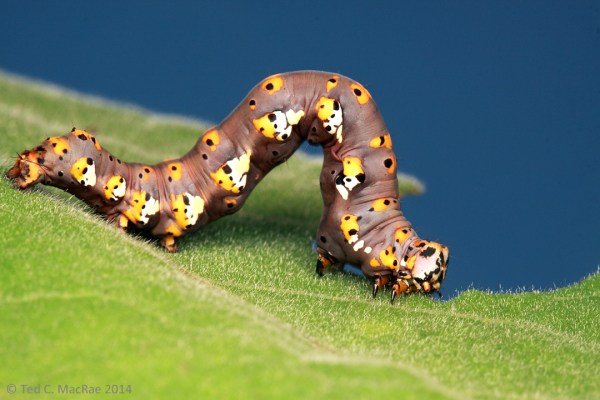
Tarache delecta ("mallow caterpillar") on Hibiscus lasiocarpus | Hickman Co., Kentucky

Tarache delecta (“mallow caterpillar”) on Hibiscus lasiocarpus | Hickman Co., Kentucky

Last month while searching stands of Hibiscus lasiocarpus (hairy rose mallow) in western Kentucky, I encountered this rather large caterpillar feeding on the foliage. I presumed that something as large and striking in appearance as this should be a cinch to identify by scanning through photos on BugGuide, and not surprisingly I found photographs (here, here and here) of two very similar looking caterpillars from Oklahoma posted by Charles Schurch Lewallen. None of the photos, however, had an identification associated with them other than subfamily Acontiinae (family Noctuidae). The contributor mentioned in one of the photos that he had found nothing similar in the Wagner (2005) “bible” (a book that I do not yet own but hope to soon). Armed with this scant information (but definitive knowledge of its host plant), I searched Noctuidae of North America and settled on Tarache delecta as a good possibility. According to that site, T. delecta is the only member of the Acontiinae that feeds on plants in the genus Hibiscus. The site references Crumb (1956) for a larval description, but more useful was a plate of black & white photos that I found in Weiss (1919) and that seemed to be a good match for the species I had photographed. Weiss (1919) refers to the larva as the “mallow caterpillar” and notes that full grown larvae are 34–36 mm in length and dark purple with black spots edged with orange—consistent with the caterpillar shown here.

Apparently this species has been considered a pest of ornamental mallows. Weiss (1919) notes that the larvae feed on the upper and lower leaf surfaces usually near the margins, making large holes in the leaves and sometime devouring parts of the bracts around the buds. I will also note that, in recommending control of the caterpillars, he states that “there does not seem to be any reason why spraying with arsenate of lead should not be successful.” My, how times have changed!

REFERENCE:

Crumb, S. E. 1956. The larvae of the Phalaenidae. U. S. Department of Agriculture, Technical Bulletin 1135, 356 pp. + 10 plates [Google Books].

Wagner, D. L. 2005. Caterpillars of Eastern North America: A Guide to Identification and Natural History. Princeton University Press, Princeton, New Jersey, 512 pp. [Amazon].

Weiss, H. B. 1919. The more important insect enemies of the rose-mallow in New Jersey. New Jersey Department of Agriculture, Bureau of Statistics and Inspection Circular 25, 9 pp. + 4 plates [Google Books].

© Ted C. MacRae 2014

Not quite adult

For the past few years I’ve had research plots in northwestern Tennessee. Each summer, once a month or so, I make the 5-hour drive to the site and spend the afternoon taking data. Any normal person would then check in to their hotel room in town, watch television, and make the drive back to St. Louis the next morning. Of course—I’m not normal, I’m an entomologist! The southeastern lowlands of Missouri, where over the years I’ve found (and continue to find) a number of good spots for collecting insects, are tantalizing close. Instead of retiring immediately to my hotel room, I’d rather head back to the lowlands and find a good spot for setting up a blacklight. It might be midnight before I finally get to a hotel room, but it’s all worth it. Some of the most interesting insects that I’ve featured here during the past few years have come to blacklights on one of these trips, including the primitive longhorned beetles Parandra glabra and Mallodon dasystomus and adult male bagworms, Thyridopteryx ephemeraeformis.

Subadult female, poss. Maccaffertium sp. | Mississippi Co., Missouri

Subadult female mayfly (prob. Maccaffertium sp.) | Mississippi Co., Missouri

Most of the spots I’ve found are located along the Mississippi River, a downside of which is the overwhelming abundance of aquatic insects that are often attracted to the lights. Caddisflies (order Trichoptera) are the worst, sometimes swarming the lights with such frenetic abundance that to check the sheets one must button the collar, hold the breath, dash in quickly to look at the sheet, and retreat just as quickly lest the fluttering hordes find their way up the nostrils, down the ear canals, and into the eyes. Mayflies (order Ephemeroptera) also can be attracted in great numbers, although they tend to be, fortunately, much calmer and better behaved on the sheet than their trichopteran counterparts. Normally, I pay little attention to these insects other than what is required to avoid breathing them—their abundance almost makes them unnoticeable. On one particular night in early August, however, my eyes caught the soft glow of a ghostly-white insect sitting on the underside of a leaf some yards away from the light. I looked closer to see it was a mayfly, and so pale was its coloration that I knew it would make for a striking photograph against the black night sky.

The reason for its milky-white coloration is due to a unique aspect of mayfly developmental biology—they are the only insects to develop fully functional wings before their final molt to adulthood. This stage, called the sub-adult or subimago, emerges from the water where it spent the past year as a nymph (also called a naiad) and flies to nearby vegetation, but it is still not mature. One additional molt is required, wings and all, before the insect finally reaches adulthood and can spend the few remaining hours of its life in single-minded pursuit of a mate. Sub-adult mayflies are distinguished from their adult counterparts by their paler coloration and opaque rather than clear wings. We can also tell that this individual is a female because no claspers are visible at the tip of the abdomen (which males possess for mating) and its relatively small eyes (the eyes of males almost completely cover their head).

My thanks to Dr. Robert Sites, who initially suggested this might be a species in the family Heptageniidae, and to Roger Rohrbeck for confirming my subsequent identification as probably belonging to the genus Maccaffertium.

© Ted C. MacRae 2014

One-shot Wednesday: swamp milkweed leaf beetle

Labidomera clivicollis on Asclepias incarnata | Hickman Co., Kentucky

Labidomera clivicollis on Asclepias incarnata | Hickman Co., Kentucky

Technically this photograph of Labidomera clivicollis (swamp milkweed leaf beetle) doesn’t qualify as a “one-shot”, as I did take a few other shots as well. However, this was the only shot out of the handful that I didn’t throw away. It’s not perfect—the right front and left rear legs are raised awkwardly, and the lighting is a bit harsh. However, the important parts of the beetle are in focus, the composition is acceptable (with all parts of the beetle within the frame), and there is pleasing value contrast between the orange and black body of the beetle, the green plant on which it sits, and the clear blue sky in the background. The plant’s flowers have even added a smidgen of pink. All of the other photos lacked either focus or composition, neither of which are easily “fixable” in post-processing. The difficulty in getting a better photo is a result of the beetle’s refusal to settle down and stop walking and my lack of desire to spend an inordinate amount of time waiting for this to happen as opposed to finding the insect I was really looking for (more on that in a future post).

I found this beetle on swamp milkweed (Asclepias incarnata) in Hickman Co., Kentucky. As the common name suggests, swamp milkweed is one of the main hosts for this rather large beetle (at least, by leaf beetle standards). However, they can and do feed and develop on other milkweeds, especially common milkweed (A. syriaca), and even related genera such as swallow-wort (Cynanchum) and twinevine (Funastrum) (all belonging the family Asclepiadaceae).

Labidomera clivicollis is part of the orange and black milkweed mimicry complex, which includes monarch butterfly (Danaus plexippus), red milkweed beetles (Tetraopes spp.), large milkweed bug (Oncopeltus fasciatus), small milkweed bug (Lygaeus kalmii), milkweed assassin bug (Zelus longipes), and others. Most of these insects have evolved mechanisms for avoiding or detoxifying cardenolides (produced by milkweed as a defense against herbivores) and sequestering them within their bodies for their own defense against predators. This represents a classic example of a Müllerian mimicry ring, in which multiple insect species—sometimes from different families and even different orders—share a common warning color. Predators learn to avoid these colors and, thus, avoid all of the species within the mimicry ring.

© Ted C. MacRae 2014

My, what busy palps you have!

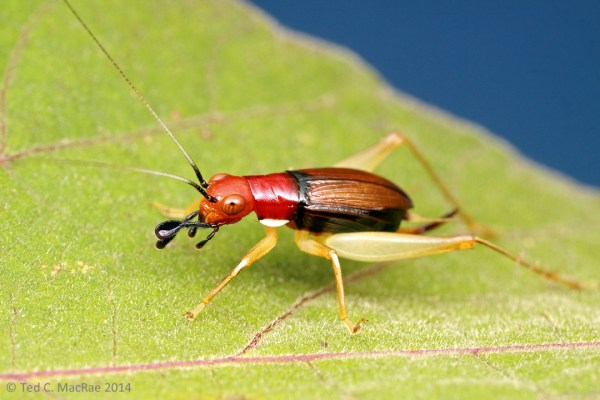
In mid- to late summer, the swamps of southeast Missouri and adjacent areas along the Mississippi River become awash in color as stands of hairy rose mallow (Hibiscus lasiocarpus) put forth their conspicuous, white and pink blooms. I’ve been waiting for the mallows to bloom this year, as there is one particular beetle associated with plants in this genus that I have been keen to photograph since I first picked up a real camera a few years ago, to this point without success. My first attempt this year came in early August as I noted the tell-tale blooms while passing through extreme western Kentucky. I was foiled again (but would succeed the next day—more on this in a future post), but as I tiptoed over the soggy ground searching through the lush foliage, I saw a small, brightly colored cricket with curiously enlarged mouthparts. Even more interesting was the constant, almost frenetic manner in which the insect was moving these mouthparts. My first attempts to detach the leaf on which it was moving spooked it, and it jumped to another leaf, but I persisted and finally succeeded in detaching the leaf with the critter still upon it and maneuvering it up towards the sky for a few photographs.

Phyllopalpus pulchellus (red-headed bush cricket) | Hickman Co., Kentucky

Phyllopalpus pulchellus (red-headed bush cricket or “handsome trig”) | Hickman Co., Kentucky

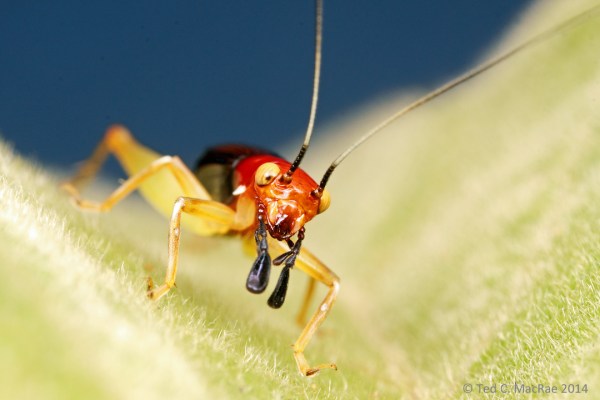
It didn’t take long to identify the cricket as Phyllopalpus pulchellus, or “red-headed bush cricket” (family Gryllidae). This species, also known as the “handsome trig” on account of its stunning appearance and membership in the subfamily Trigonidiinae, is distinctive among all North American orthopterans by its red head and thorax, pale legs, dark wings, and—as already noted—highly modified maxillary palpi with the greatly expanded and paddle-like terminal segment. According to Capinera et al. (2004), adults appear during mid- to late summer near streams and marshes on vegetation about one meter above the ground—precisely as this individual was found. Surely it represents one of our most photographed cricket species (208 BugGuide photos and counting).

The greatly expanded palps are thought to mimic beetle mandibles or spider pedipalps.

The greatly expanded palps are said to mimic beetle mandibles or spider pedipalps.

The obvious question to anyone who sees this species is, “Why the curiously enlarged palps?” Both males and females exhibit this character (even as juveniles), so it seems clear that there is no special sexual or hypersensory function. One idea mentioned on BugGuide (perhaps originating from this EOL post by Patrick Coin) suggests that the crickets are Batesian mimics of chemically-defended ground beetles (family Carabidae) such as bombardier beetles (genus Brachinus). This thought is based on their similar coloration, the convex and shiny (and, thus, beetle-like) forewings of the females, and some resemblance of the enlarged palpi to the mandibles of the beetles. I am not completely satisfied with this idea, since bombardier beetles are generally found on the ground rather than foliage. Moreover, males lack the convex, shiny forewings exhibited by females, and resemblance of the palps to beetle mandibles doesn’t explain their curiously constant movement (ground beetles don’t constantly move their mandibles). Another idea suggested by orthopterist (and insect macrophotographer extraordinaire!) Piotr Naskrecki is a mimetic association with another group of arthropods, noting that the busy movements of the palps is very similar to the way jumping spiders (family Salticidae) move their pedipalps. This suggestion also is not completely satisfying, as it leaves one wondering why the crickets are so boldly and conspicuously colored. While some jumping spiders are brightly colored, I’m not aware of any in eastern North America with similar coloration (indeed, many jumping spiders can be considered ‘drab’). Perhaps the crickets have adopted mimetic strategies using multiple models in their efforts to avoid predation?

The brown wings and long, sickle-shaped ovipositor identify this individual as a female.

The brown wings and sickle-shaped ovipositor identify this individual as a female.

The individual in these photos can be identified as a female due to the presence of the sickle-shaped ovipositor and, as mentioned above, the convex, shiny forewings. Males possess more typically cricket-like forewings, perhaps constrained to such shape by the sound producing function they must serve. The males do, however, exhibit an interesting dimorphism of the forewings, with one wing being clear and the other one black. Fellow St. Louisan and singing insect enthusiast James C. Trager notes this dimorphism has been mentioned in the literature but not explained and suggests it may have something to do with the adaptive physics of sound production.

Congratulations to Ben Coulter, who wins Super Crop Challenge #16, which featured a cropped close-up of the enlarged maxillary palpi of this insect. His 12 pts increase his lead in the overall standings for BitB Challenge Session #7 to an almost insurmountable 59 pts. Morgan Jackson and Troy Bartlett round out the podium with 10 and 9 pts, respectively—Troy’s points being enough to move him into 2nd place in the overalls with 23 pts. Third place in the overalls is still up for grabs, since none of the people occupying the 3rd through 6th places has played for awhile—realistically any number of people behind them could jump onto the podium (or even grab 2nd place!) in the next (and probably last) Session #7 challenge.

REFERENCE:

Capinera, J. L., R. D. Scott & T. J. Walker. 2004. Field Guide To Grasshoppers, Katydids, And Crickets Of The United States. Cornell University Press, Ithaca, New York, 249 pp. [Amazon].

© Ted C. MacRae 2014

Southern armyworm feeding on soybean

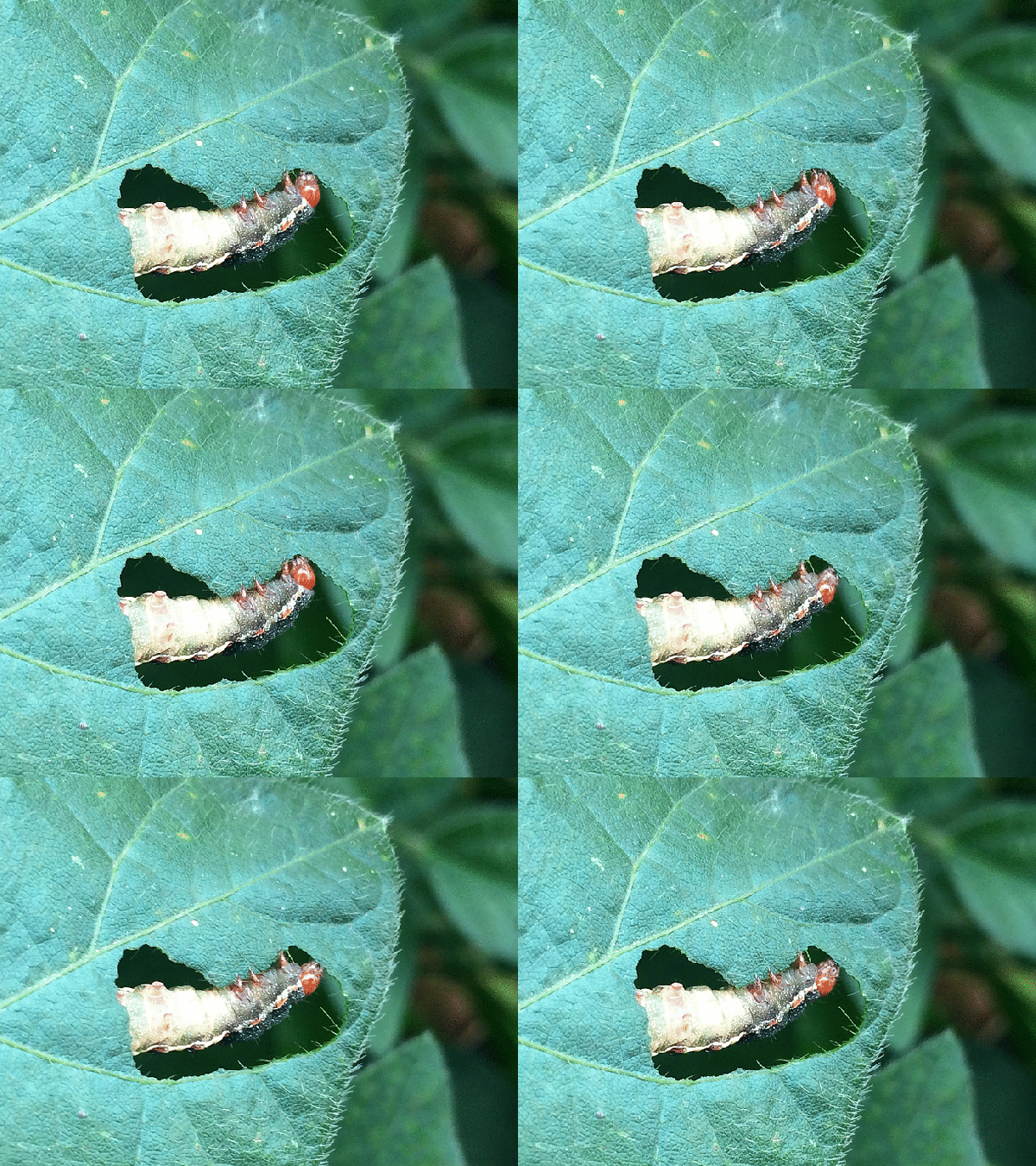
Southern armyworm (Spodoptera eridania) late-instar larva feeding on soybean.

Southern armyworm (Spodoptera eridania) late-instar larva feeding on soybean.

Here is another animated gif that I made recently, this one showing a late-instar larva of southern armyworm (Spodoptera eridania) feeding on soybean (Glycine max). This polyphagous species is widely distributed from the southern U.S. through the northern half of South America and feeds on a variety of weeds, especially pigweed (Amaranthus spp.) and pokeweed (Phytolacca americana). It also occasionally attacks vegetable, fruit, and ornamental crops; however, in recent years it has become increasingly important on cultivated soybean in Brazil and Argentina, especially in regions where cotton is also cultivated. As a result, they have become one of the insects that I deal with regularly in my own research. More information on this and other armyworm species that affect soybean can be found in my earlier post, Quick Guide to Armyworms on Soybean.

Like many other lepidopteran caterpillars that feed on foliage, late-instar larvae become “feeding machines” that remain active both day and night as they try to cram as much nutrition into their expanding bag of a body as possible in preparation for an adult life focused solely on finding mates and laying eggs. Large larvae actively feeding during the day can be rather conspicuous, and as a result they often secrete themselves on the undersides of the leaves while feeding to make themselves less visible to predators. As they feed, however, a “window” opens up that gradually eliminates their cover. Rather than remaining in the same spot and feeding until they are completely exposed, however, larvae will move when the feeding hole reaches a certain size and find another place to conceal themselves before resuming feeding. Different caterpillar species have different exposure tolerances, and as a result, this combines with slight differences also in preferred tissue types to create recognizable differences in the damage patterns resulting from feeding by different species.

For those interested, making these animated gifs is really simple and allows those of us without expensive macro-video gear to simulate short videos of insect behavior. I make my animated gifs at GIFMaker.me—all you do is take a series of photos, touch them up in photo editing software (I use Photoshop Elements to adjust levels, color and sharpness), upload them to the site in the sequence desired, and click “Create Now”. It couldn’t be easier! You don’t even need a “real” camera—I took the photos for this gif with my iPhone using the “burst” function to take a rapid sequence of photos (all you do is hold your finger down on the shutter button for the desired length of time).

© Ted C. MacRae