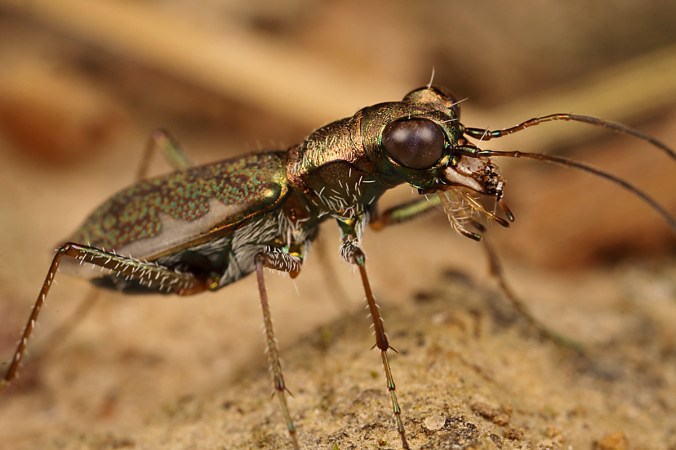
Charming Couple

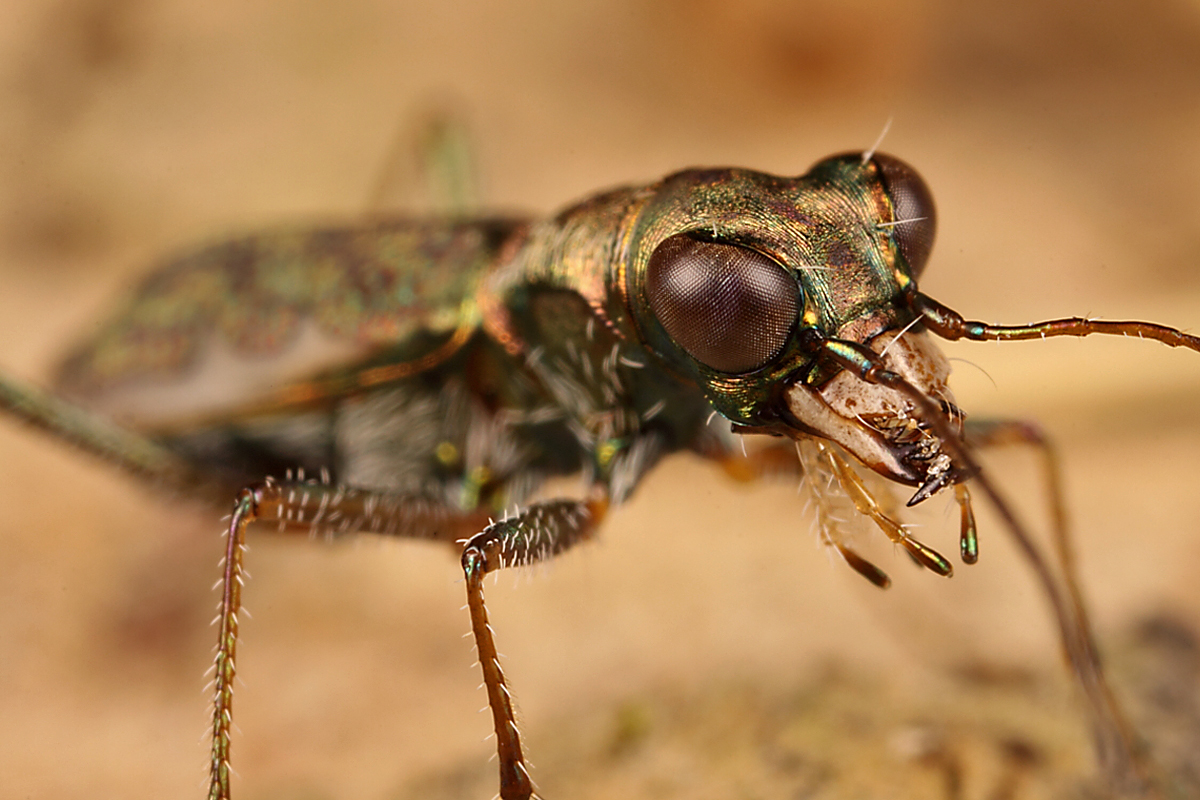
You may have noticed a longer than normal interval since the last post (or not)—the result of a family vacation to Florida.  I’m not much of a beach bum, so while the girls found inordinate pleasure laying on the hot sand and doing absolutely nothing while being baked to a crisp by the almost tropical Florida sun, I took the opportunity to look for some of Florida’s gorgeous and often endemic tiger beetles.  I visited a diversity of habitats to both the north and south of my base near St. Petersburg ranging from white sand beach to salt marsh to oak/pine sand scrub to pine rockland.  I photographed tiger beetles both at night and during the day (laying on the hot sand while being baked to a crisp by the almost tropical Florida sun!).  In total I encountered eleven tiger beetle species—five of them true Florida endemics.  We’re on our way back now, and photos are just now getting downloaded and processed, so I’m not quite ready yet to begin sharing stories in earnest.  Until then, here is a photograph of a mating pair of one of Florida’s classic coastal tiger beetle species, Ellipsoptera hamata lacerata (Gulf Beach Tiger Beetle).

Ellipsoptera hamata lacerata (Gulf Beach Tiger Beetle) | Seminole, Florida

Photo Details: Canon 50D (ISO 160, 1/200 sec, f/16) w/ 100mm macro lens + Kenko DG extension tubes (68 mm), Canon MT-24EX flash w/ DIY oversized concave diffuser. Post-processing to adjust levels and apply unsharp mask.

Copyright © Ted C. MacRae 2011

Cylindera cursitans (Ant-like Tiger Beetle) in Arkansas

In late June I visited Chalk Bluff Natural Area in northeastern Arkansas.  Situated at the northeastern-most corner of the state, it is here where the St. Francis River enters Arkansas from Missouri, slicing through the loose Tertiary conglomerates of Crowley’s Ridge before settling into its lazy, meandering course between the two states in the Upper Mississippi Alluvial Plain.  The site’s geological history, however, is not what attracted me to it, but rather its status as the state’s only known locality for Cylindera cursitans (ant-like tiger beetle).  It was the existence of this population that convinced my colleagues Chris Brown and Kent Fothergill and I that the species must occur in southeast Missouri not only along the Mississippi River, but also along the St. Francis River some 50 miles to the west.  Persistence eventually paid off last year when Kent captured a single individual on the Missouri side of the river at Chalk Bluff Access in Dunklin Co. (MacRae et al. 2011).

Kent had to really work for that specimen, spending several hours crawling through the underbrush in wet, bottomland forests before eventually finding the lone individual.  I was confident, however, that my search at the Arkansas site would require far less effort, as Kent had also observed this population during his attempts to locate the species on the Missouri side of the river, writing “I saw more cursitans in an hour than I have seen lifetime total!” The playground/picnic area where Kent had seen them sits right next to the parking lot and is as un-curitans a habitat as one can imagine—tidy and neat, with a nicely-mowed grass lawn under the shade of large oak trees rather than the sweltering, poison ivy choked understory habitats with their attendant swarms of mosquitoes and deer flies that we’ve braved in order to find the species in Missouri.  Only the small, intermittent patches of barren sandy loam soil gave a clue that this might be good tiger beetle habitat, and even then one might expect only the more pedestrian species such as Cicindela punctulata and Tetracha virginica and not something as exciting as C. cursitans.

But occur there it does, and hardly a few steps had been taken from the parking lot before I saw that familiar “dash” of movement, looking for all intents and purposes at first like a small spider.  A closer look confirmed its true identity, and during the next hour or so I would see countless such individuals—all scrambling rapidly for cover on my approach.  I have seen a number of cursitans populations during the course of our surveys for this species in southeastern Missouri, and this population was as robust as any of them.

Despite my earlier work with this species, I still lacked photographs I was completely happy with—i.e., field photographs of unconfined beetles taken with a true macro lens and flash to control lighting.  All of my previous photographs were either taken with a small point-and-shoot camera or had to rely upon beetles confined in a terrarium.  The species is not easy to photograph in the field—the small size of the adults (6–8 mm in length) and their cryptic coloration matching the soil surface makes them almost impossible to see until they move.  They are also very skittish and are quick to flee when approached, necessitating very slow, deliberate movements in order to approach them closely enough for photographs.  Oftentimes adults will run towards and hide up against the base of a clump of grass, where they are even more difficult to photograph, but sometimes they will hide beneath fallen leaves or other debris.  Interestingly they do not flee immediately if the leaf/debris is very carefully lifted up and removed—almost as if they think they’re still hidden.  I’ve found exposing adults hiding under leaves to be an easier way to get field photographs of the species, although I have noted that some individuals (but not others) seem eventually to adjust to my presence and resume normal activity despite having a camera lens hovering inches away from them.

Once I had my fill of photographs, I walked the trail to the river and back but did not see any beetles along the trail within the forest (too much leaf litter) or along the river.  Surely the beetles occur in these other areas and are not confined in the area just to that small, man-made habitat that is the picnic ground.  Seeing this population gives me greater confidence that the species does indeed occur more broadly along the St. Francis River in Missouri than suggested by single individual caught on the Missouri side by Kent.

REFERENCE:

MacRae, T. C., C. R. Brown and K. Fothergill. 2011. Distribution, seasonal occurrence and conservation status of Cylindera (s. str.) cursitans (LeConte) (Coleoptera: Carabidae: Cicindelitae) in Missouri. Cicindela 43(3): in press.

Copyright © Ted C. MacRae 2011
Speaking of Graphisurus

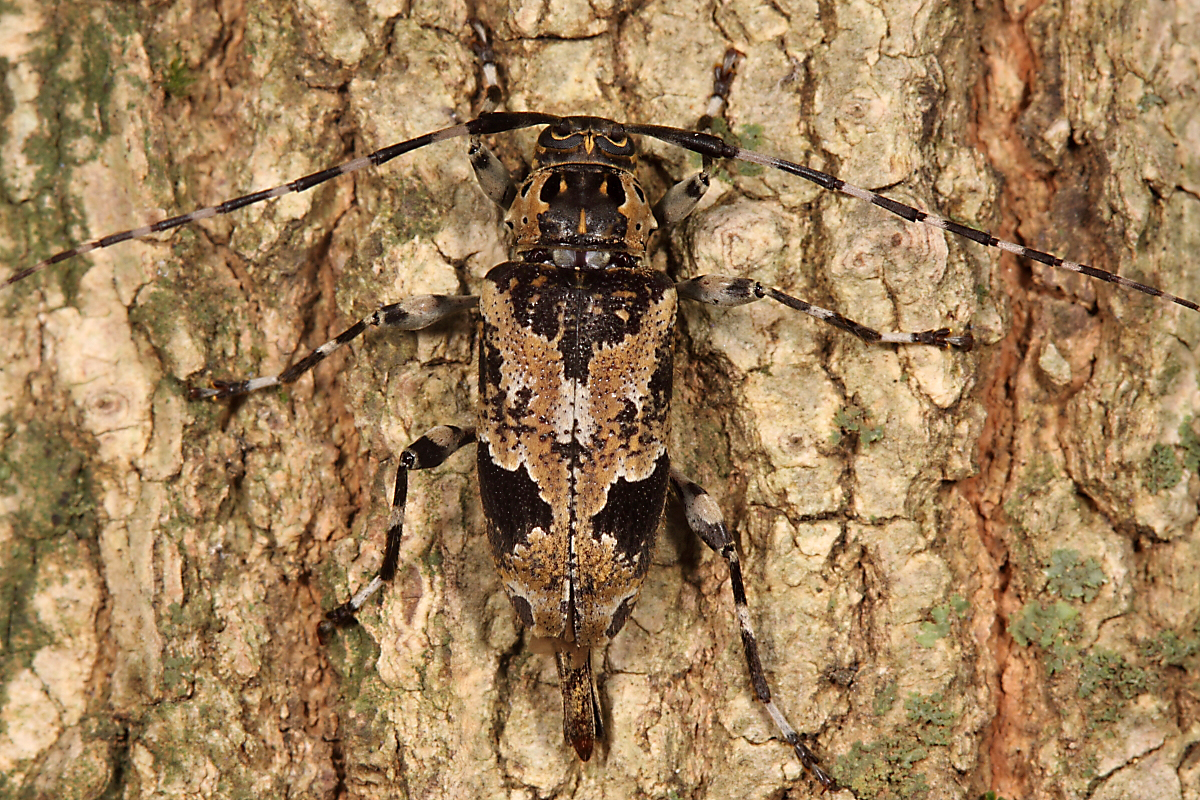
Graphisurus fasciatus | Sam A. Baker State Park, Missouri.

Graphisurus fasciatus is the commonest of the three species in this North American genus. It is easily distinguished from  by its smaller, narrower form, more mottled coloration, and lack of distinctive triangular-shaped black markings on the elytra. However, it can easily be confused with the third species in the genus G. despectus, which is nearly identical in size and coloration. From this latter species, G. fasciatus may be distinguished by the slightly darker ground color of the elytra (in G. despectus the elytra are more uniformly grayish) with the post-median dark marking of the elytra not very conspicuous (in G. despectus this marking and contrasts distinctly with the grayish elytra). Also, the tips of the elytra are distinctly emarginate (concave) in G. fasciatus but more subtruncate in G. despectus, and the scutellum in the former is pubescent (hairy) but glabrous (lacking hairs) in the latter.

Host plant is also a clue as to the identity of this individual (a male, as distinguished by its very long antennae and lack of distinctly elongate ovipositor extending from the tip of the abdomen), as it was found on the trunk of a very large, recently wind-thrown black oak (Quercus velutina)—its preferred host genus.  Graphisurus despectus, in contrast, appears to be associated almost exclusively with hickory (genus Carya).  Both species, despite their relatively modest size (generally 10–15mm in length, excluding the female ovipositor), seem to prefer dead wood from the trunk and main branches of larger trees for larval development, mining just beneath the bark rather than in the wood itself.

Copyright © Ted C. MacRae 2011

Graphisurus triangulifer in Missouri

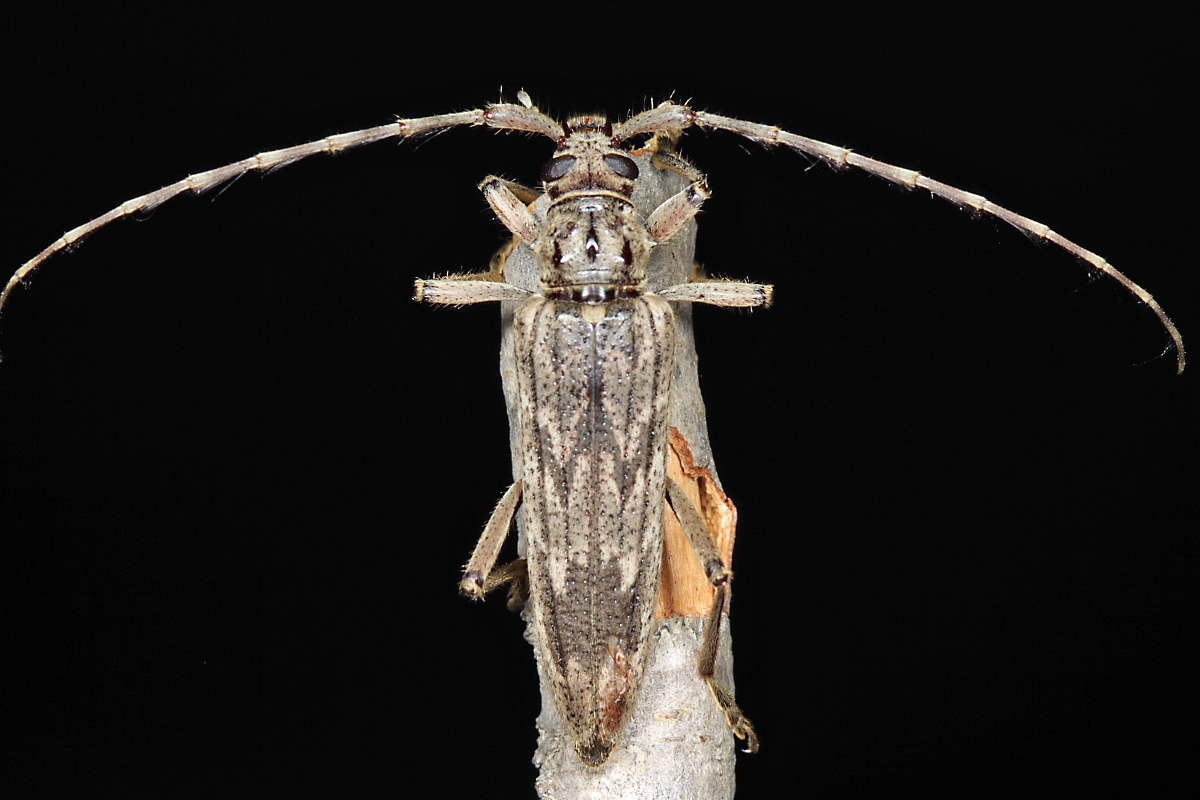
Graphisurus triangulifer | Sam A. Baker State Park, Missouri

Of the three species of the genus Graphisurus occurring in Missouri, G. triangulifer is both the most attractive and the least commonly encountered.  Back when I surveyed the Cerambycidae of Missouri (MacRae 1994), I examined only 45 specimens of this species in the major public and private collections of the state, compared to slightly more of the equally uncommon G. despectus and a whopping 271 of the übercommon G. fasciatus.  Nearly all of the specimens I examined of this species were encountered at lights, and it has been in this manner almost exclusively that I have seen the species for myself.

The species is named for the dark triangular markings on the elytra.

The individual in these photos was seen at Sam A. Baker State Park in the southeastern Ozark Highlands of Missouri during early July, and—like most of the others I have seen—it was attracted to my blacklight. I really don’t like photographing insects directly on the white landing sheet that I use for blacklighting, so I moved the beetle to the trunk of a nearby boxelder tree (Acer negundo) for a more natural looking background. There are a few reports of the species utilizing Acer for larval development (Lingafelter 2007), so this could be a very natural setting; however, I have not seen any actual records of the species being reared from that host. More often the species has been recorded breeding in dead sugarberry (Celtis laevigata). While I have conducted many rearings from Celtis, I’ve not yet succeeded in rearing this species—I suspect it probably breeds in larger diameter branches given its relatively large size (12–17 mm in length).  This idea is bolstered by the fact that the one adult that I did not encounter at lights was found on the trunk of a large, dead sugarberry near San Antonio, Texas.  Hoffman et al. (2002) noted that the species exhibits a southern, lowland distribution extending from Long Island to central Georgia, thence west to Texas and northward in the interior as far north as Ohio and Indiana (it has also been recorded from Kansas and, of course, Missouri).  This distribution pattern agrees largely with that of Celtis laevigata in the eastern U.S., suggesting that this plant may indeed be its primary host.  A fairly restricted host range for G. triangulifer would not be unexpected, since each of the other two species in the genus also exhibits a fair degree of host fidelity—G. despectus breeds almost exclusively in hickory (Carya spp.), while G. fasciatus breeds primarily in oak (Quercus spp.).

REFERENCES:

Hoffman, R. L., S. M. Roble, and W. E. Steiner, Jr. 2002. Thirteen additions to the known beetle fauna of Virginia (Coleoptera: Scirtidae, Bothrideridae, Cleridae, Tenebrionidae, Melyridae, Callirhipidae, Cerambycidae, Chrysomelidae). Banisteria 20:53–61.

Lingafelter, S. W. 2007. Illustrated Key to the Longhorned Woodboring Beetles of the Eastern United States. Coleopterists Society Miscellaneous Publications, Special Publication No. 3, 206 pp.

MacRae, T. C. 1994. Annotated checklist of the longhorned beetles (Coleoptera: Cerambycidae and Disteniidae) known to occur in Missouri. Insecta Mundi 7(4) (1993):223–252.

Copyright © Ted C. MacRae 2011

Elytrimitatrix at my window


This evening as I was sitting in my comfy chair, I noticed Stitch (one of the cats) pawing at the window. We live in the woods, so it is common for insects to land on the outsides of the windows after dark, attracted to the lights from within our home. Stitch was especially interested in a rather large beetle crawling frantically on the window, which I recognized quickly as the cerambycid beetle, Orthosoma brunneum. This big brown beetle is a member of the root-boring subfamily Prioninae, and although it is perhaps one of the commonest longhorned beetles in our area during July and August, I’ve not yet photographed it. As I debated whether to do so, I noticed the distinctive silhouette of another cerambycid beetle sitting quietly lower down on the window—smaller than O. brunneum but still decent-sized. I opened the window a crack (to keep all the other insects from rushing in), reached my hand through the crack, grabbed the beetle and in pulled it inside. It was a fine specimen of what is now known as Elytrimitatrix undata. I forgot all about the Orthosoma beetle and decided to photograph Elytrimitatrix instead.

While a member of the longhorned beetle family Cerambycidae, the group to which this species belongs (subfamily Disteniinae) has long been treated as sort of the “red-headed stepchild” of the family due to disagreement about its affinities to other cerambycid groups. It has at times been considered a tribe of the subfamily Lepturinae, a tribe of the subfamily Cerambycinae, a subfamily of its own, and even a separate family. Much of this disagreement focuses on details of its morphology despite the great superficial resemblance of the adults to other cerambycids. For now, it seems most workers are satisfied to regard the group as a distinct subfamily within the Cerambycidae, even though its exact relationships to other subfamilies still remain unclear.

Despite numerous representatives in the Neotropics, E. undata is the only member of the subfamily in the U.S., occurring broadly across the eastern and central states. For many years it was known as “Disteniaundata but was recently split out of that genus by Santos-Silva & Hovore (2007). Larvae have been recorded breeding in the dead wood of a variety of hardwoods as well as pine (the ultimate generalist), and adults are regular visitors at lights during the warm, muggy months of summer. I have also taken the species in numbers in traps baited with fermenting liquid (1 part molasses, 1 part beer, 8 parts water, and a packet of dry yeast) (MacRae 1994).

REFERENCE:

MacRae, T. C. 1994. Annotated checklist of the longhorned beetles (Coleoptera: Cerambycidae and Disteniidae) known to occur in Missouri. Insecta Mundi 7(4) (1993):223–252.

Santos-Silva, A. & F.T. Hovore. 2007. Divisão do gênero Distenia Lepeletier & Audinet-Serville, notas sobre a venação alar em Disteniini, homonímias, sinonímia e redescrições (Coleoptera, Cerambycidae, Disteniinae). Papéis Avulsos de Zoologia 47:1–29.

Hook-faced Conehead – Pyrgocorypha uncinata

Pyrgocorypha uncinata at UV lite | Lake Norfork, Arkansas

I had high hopes as I setup the blacklights in the pine/oak-hickory forest at Jordan Recreation Area on Lake Norfork in north-central Arkansas. The late June timing  and warm, humid conditions with no moon were perfect for wood boring beetles, and as dusk settled in I awaited their expected arrival.  But the beetles never came, and as dusk waned to full darkness I knew it was going to be one of those inexplicably mediocre nights.  If I’d had a hotel room waiting for me, I would’ve closed up shop as soon as this became apparent and headed on back.  This night, however, I was camping so there was really nothing else to do but see what else came to the lights anyway.  One of the more interesting was this conehead katydid, whose bizarre hook-shaped cone immediately identify it as the hook-faced conehead, Pyrgocorypha uncinata.  There are a number of coneheads in the eastern U.S., but I couldn’t recall ever seeing one with such a bizarre-shaped cone before.  There is good reason for this, as Singing Insects of North America shows this southeastern U.S. species to be at the limit of its distribution in northern Arkansas.

Looking at the above photo at home, I couldn’t help but notice the “face” formed by the eyes and cone, with the gap between the cone and the rest of the frons forming the “mouth” and the cone itself the “nose”—it looked to me like some weird, garrishly grinning fish!  Thus was born Super Crop Challenge #7, and since four participants correctly identified the individual in the photo down to species this challenge was decided on bonus points.  Max Barclay (Natural History Museum) earned the most (11) to win the challenge, while Patrick Coin and Sam Heads each earned 10 to round out the podium with a 2nd-place tie.  This was the last challenge of the BitB Challenge Session #3, so we can now crown a winner.  Today’s win vaults Max Barclay from 4th place in the overalls to the top spot with 29 pts—congratulations (and contact me for your loot).  Tim Eisele‘s 5 points in this challenge gave him a total of 24 pts, which was just enough to edge out former front-runner Troy Bartlett for 2nd place by a single point.  Troy keeps a foot on the final podium ahead of Dave with 23 points, also by a single point.

My thanks to the record 27 participants who took part in BitB Challenge Session #3.  The final overall standings are shown below, and look for the first challenge of BitB Challenge Session #4 coming up.

Place Participant IDC #8 SSC #5 SSC #6 IDC #9 Bonus 7/9 SSC #7 Total
1 Max Barclay 8     10   11 29
2 Tim Eisele 3 6 6 4   5 24
3 Troy Bartlett     11 12     23
4 Dave   11 3 8     22
5 Mr. Phidippus       11   4 15
6 Patrick Coin         2 10 12
7 Dennis Haines        11     11
8 Josh Basham       10     10
  Sam Heads           10 10
10 Alex Wild 9           9
  James Trager    4     9
  Brady Richards       9     9
13 Roy     5 3     8
  FlaPack           8 8
15 Traci       6     6
16 Johnson Sau       5     5
17 Annie Ray       4     4
  The Ozarkian       1   3 4
19 David Winter 3           3
  Ani       3     3
  Laurie Knight       2   1 3
22 Bob Cochran   2         2
  dragonflywoman     2       2
  Chris Grintter       2     2
25 David Rentz 1           1
  Anne McCormack   1         1
  Mike       1     1

IDC = ID Challenge; SCC = Super Crop Challenge.

Copyright © Ted C. MacRae 2011

T.G.I.Flyday – Triorla interrupta

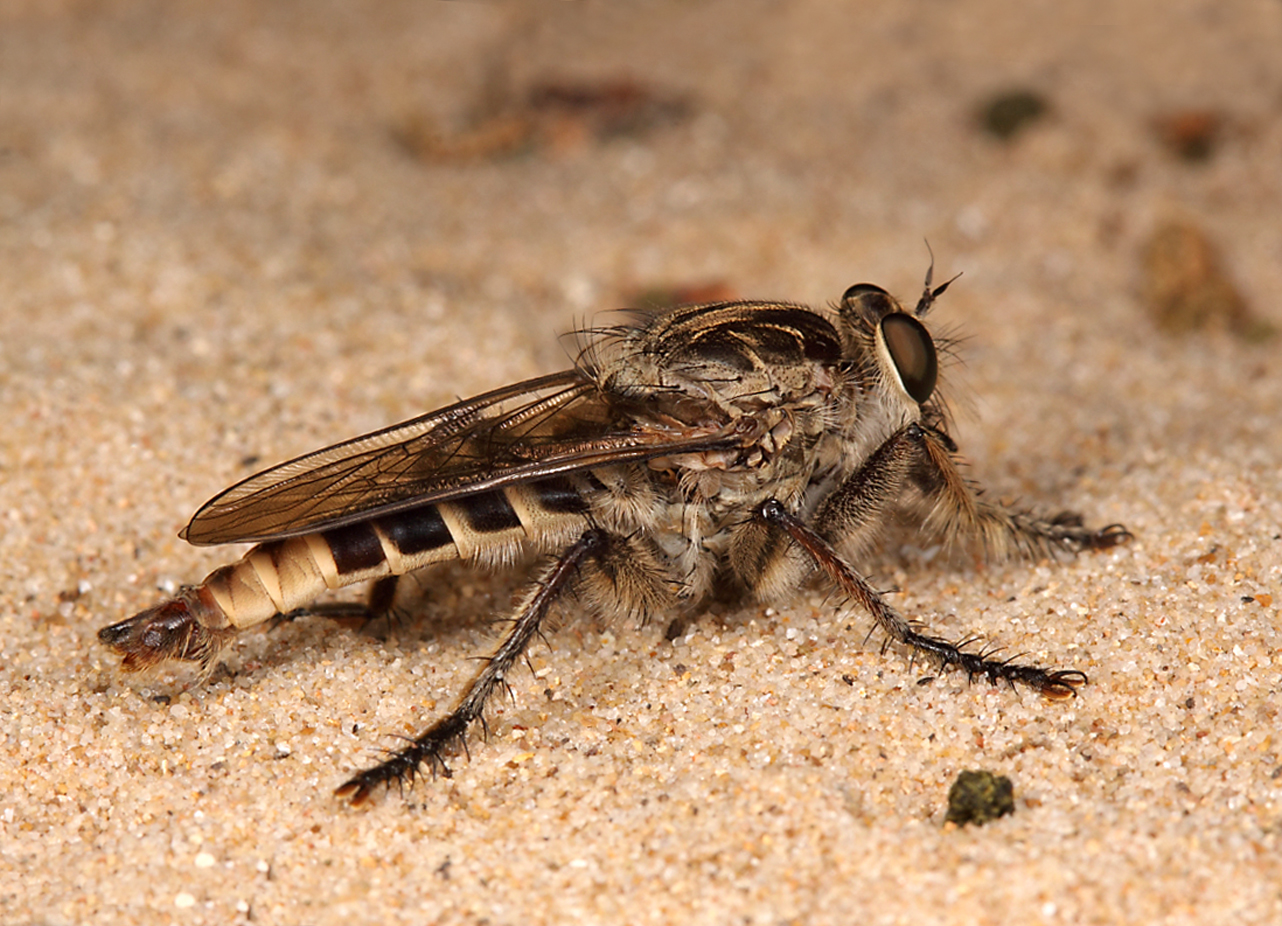
Triorla interrupta (male) | Calico Rock, Arkansas

While I was visiting the glades near Calico Rock, Arkansas this past June, I went into town to look along the White River.  With the amount of sandstone bedrock in the area, I thought there I might find sandy loam deposits along the river of the type preferred by Cylindera cursitans (ant-like tiger beetle).  While I didn’t find any of the beetles, I did see this robber fly (managing only this single shot before it flew off), which I take to be the male of Triorla interrupta based on the pattern of abdominal coloration (the first two segments partially black, followed by two almost wholly black segments).  According to BugGuide, this is the only North American species of the genus (a second occurring from Panama to Argentina), and Herschel Raney considers it to be the most common robber fly in Arkansas.

Copyright © Ted C. MacRae 2011

Lined Jewel Beetle

Buprestis lineata mating pair on lower trunk of Pinus echinata | vic. Calico Rock, Arkansas

Here is another of the several wood-boring beetle species that I encountered during my June trips to the sandstone glade complex near Calico Rock in north-central Arkansas.  Shortleaf pines (Pinus echinata), the only native pine in this region, are common on and around the glades due to their acidic soils, and this mating pair of Buprestis lineata (family Buprestidae) was found near the base of the trunk of one of the larger trees.  These were actually the first of a number of different wood-boring beetles that I found on this particular tree, others being Xylotrechus sagittatus, Chalcophora virginiensis, and the sumptuously beautiful Acanthocinus nodosus.  All of these species are classic pine-associates in the southeastern U.S.  After photographing this couple, I observed numerous other individuals flying to the tree, landing on its trunk and searching nervously for mates, then fleeing if I approached too close (except the unfortunate early few that I conscripted as ‘vouchers’).  The tree was a veritable singles bar for wood-boring beetles!

Despite their abundance in the area, the pines do not grow well on the glades due to the thinness of the soils (that is, where there is soil!).  Not only do the trees grow slowly, but they suffer reduced longevity and high turnover, producing an abundance of stressed and dying trees that wood-boring beetles in the families Buprestidae and Cerambycidae are only too happy to utilize.  Most species in these families (with notable exceptions such as the emerald ash borer, Agrilus planipennis) prefer dead or dying trees for larval development, largely because healthy trees are quite capable of fending off attacks by bleeding and overwhelming newly hatched larvae as they attempt to bore into the tree.  Adults are able to detect these stressed trees through chemoreception of host plant volatiles, thus, the presence of numerous wood boring beetle adults on an otherwise healthy-looking tree is a clue that the tree’s days are numbered.  I don’t know what it was about the tree that caught my attention and made me go over to take a look at it—perhaps just its large size, but it proved to be a fruitful detour.

Copyright © Ted C. MacRae 2011