Mrs. Monday Jumper

Phidippus princeps female | Howell Co., Missouri

Phidippus princeps female | Howell Co., Missouri

In my previous post, Monday Jumper, I featured a photo of a strikingly colored jumping spider (family Salticidae) that apparently represents an adult male Phidippus princeps. Far too skittish to attempt photographing in the field, I placed him in a vial and photographed him later in the hotel room but still only got one photo that was good enough to post. Shortly after gathering him up, I came across another jumping spider that proved far more cooperative for field shots. This was no doubt due in large part to the fact that she had just captured a fat, juicy caterpillar. I find predaceous insects to be far less skittish when they are involved in the act of consuming prey. This not only makes them easier to approach and photograph, but also adds a desirable natural history element to photos that is sometimes missing in “portrait-only” photographs.

Somber coloration, large abdomen, and small carapace contrast distinctly with the male

Somber coloration, large abdomen, and small carapace contrast distinctly with the male

I say “she” because of the classic female characters exhibited—relatively large and rounded abdomen (males tend to have a smaller and more tapered abdomen), smaller carapace, somber coloration, and absence of a “boxing glove” aspect to the pedipalps. Like the male I had just collected, she was on the foliage of an oak sapling, and as I began taking photographs I noticed in the preview screen the brilliant, metallic blue chelicerae that are a hallmark of the large salticid genus Phidippus. I had also presumed the male I had just collected belonged to this same genus based on gestalt, but I could have never imagined that the two individuals actually represented male and female of the very same species. Such appears to be the case, however, as a thorough perusal of the salticid galleries at BugGuide leads me to believe that the individual featured here is the adult female of Phidippus princeps.

Check out those metallic blue chelicerae!

Check out those metallic blue chelicerae!

These photos still may not approach the technical and aesthetic perfection exhibited by master salticid portraitist Thomas Shahan, but I think they do represent an improvement over my first attempt at photographing a feeding female. The first two photos are fine, but the third suffers from the focus being a little too “deep”, which seems to be my most frequent macrophotography mistake on higher mag shots. If you have any tips on how to overcome this particular problem I am all ears!

© Ted C. MacRae 2014

Monday Jumper

Phidippus pinceps, adult male | Howell Co., Missouri (studio shot).

Phidippus princeps, adult male | Howell Co., Missouri (studio shot).

A couple of weeks ago, shortly after my friend Rich and I began hiking a 9-mile stretch of the North Fork Section of the Ozark Trail in the far southern reaches of Missouri, we encountered this colorful jumping spider (family Salticidae) on the foliage of an oak sapling. He was not at all in the mood to be photographed—dashing persistently from one side of the leaf to the other and finally dropping to the ground as I tried to close in for some shots. So active was the little guy, that even had I managed to get him within the camera’s field of view it would have been nearly impossible to get him properly focused, much less achieve a nice composition. Hoping he would be a little easier to work with in the confines of a hotel “studio”, we coaxed him into a vial with a sprig of foliage and then got him out and placed him on a branch of dogwood flowers (Cornus florida) that evening once we were in our room. Yes—he was easier to work with, but only by the fact that being in a hotel room made it more difficult for him to escape! He was just as active as in the field, darting from flower to flower in his persistent efforts to elude the large glass eye that kept trying to look at him. For many subjects, I would have given up rather than spend an inordinate amount of time trying to get photographs that likely would not turn out to be what I wanted. But this spider was just so attractive—red and black and white with flashy blue chelicerae! I persisted in my efforts, got about two dozen shots off before he finally did escape, then promptly deleted all but five immediately after seeing them on the computer. The photo shown here is the only “keeper” that I can actually bring myself to post—the focus is a bit too deep, but not so much that it detracts greatly from what is otherwise a fairly decent composition. The more I shoot jumping spiders, the more I am amazed at the portraits that Thomas Shahan achieves with these delightful little arachnids.

After browsing through the salticid galleries at BugGuide, I am inclined to believe this is the species Phidippus princeps, with the coloration and white-stripes on the pedipalps suggesting it is an adult male. ID correction welcome.

© Ted C. MacRae 2014

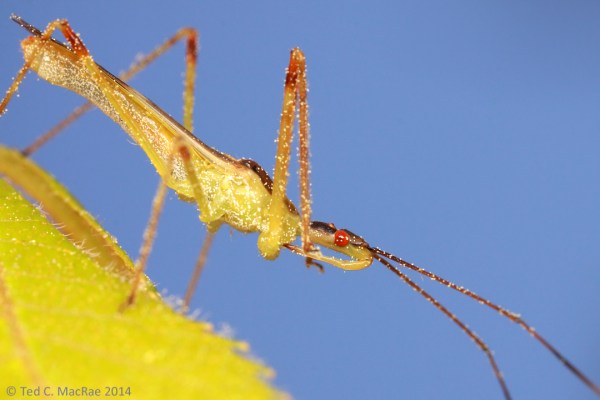
One-shot Wednesday: pale green assassin bug

Zelus luridus (pale green assassin bug) | Howell Co., Missouri.

Zelus luridus (pale green assassin bug) | Howell Co., Missouri.

As my friend Rich and I set out a week ago Sunday on the final stretch in our quest to hike the 350-mile Ozark Trail in its entirety, I saw this slender, green assassin bug (family Reduviidae) sitting on a tender young leaf of an oak sapling. I already had my camera out but had outfitted with the 65-mm, 1–5× macro lens in anticipation of small beetles that I wanted to photograph on dogwood flowers. Nevertheless, it was still a bit on the cool side, making me think I might yet succeed in getting off some super-closeup shots of this delicate predator. I managed to carefully snip the leaf from the sapling and move the bug up close to the camera for a nice, blue-sky background shot, but one shot is all I got—as soon as the shutter clicked the bug took flight and left me with this single photo. As I have observed to usually be the case, the body of this individual is thickly covered with debris, which I take to be pollen from the abundant oaks at the height of their flowering period.

I’ve seen this species regularly over the years during my springtime forays in upland, oak-hickory Ozark forests. I presume the species is Zelus luridus, based on an online synopsis of the genus Zelus in eastern North America. As true bugs go, assassin bugs are undeniably cool—sometimes large, often colorful, and pure predators! Interestingly, these bugs have adopted a rather diverse array of strategies to assist their predaceous habits, mostly involving modifications of the front legs. Some involve a more typical raptorial design (similar to mantids) with chelate surfaces or even spines on the femora and tibiae, while others have developed flexible, cushion-like structures on the tips of the tibiae to aid in prey handling (Weirauch 2006). Gross morphological modifications, however, are not the only strategy employed by assassin bugs—some groups use secretions either to paralyze or immobilize their prey. Species in the genus Zelus employ the latter strategy—essentially using their front legs as “sticky traps”. The sticky substance is derived from glands on the front legs and is used to coat numerous, microscopically branched setae on the legs called “sundew setae” in reference to the similarity of appearance and function with insectivorous sundew plants. Interestingly, sundew setae have also been found on other parts of the body, at least in first-instar Z. luridus nymphs, leading to speculation that they may also serve some other function besides prey capture. Perhaps these setae explain why most individuals I see are so debris-covered, as with the pollen-laden individual above.

REFERENCE:

Weirauch, C. 2006. Observations on the sticky trap predator Zelus luridus Stål (Heteroptera, Reduviidae, Harpactorinae), with the description of a novel gland associated with the female genitalia. Denisia 19, zugleich Kataloge der OÖ. Landesmuseen
Neue Serie 50:1169–1180 [pdf].

© Ted C. MacRae 2014

“Picudo negro” (black weevil) on soybean in Argentina

During my recent tour of soybean fields in Argentina, I traveled north to Tucumán Province and met with entomologists at the Estación Experimental Agroindustrial Obispo Columbre (“Obispo Columbre Agricultural Experiment Station”). This provincial station, established more than 100 years ago (1909), conducts research on agricultural and production technology for the Tucumán agricultural region. Focus crops include sugarcane, citrus, and grain—primarily soybean, corn, wheat, and dry beans, with research activities ranging from basic biological studies on emerging pests (such as Rhyssomatus subtilis, featured here) and Helicoverpa armigera (recently discovered in Brazil and now in northern Argentina) to resistance monitoring for transgenic crop target pests such as Spodoptera frugiperda, Helicoverpa zea, and Diatraea saccharalis.

Rhysommatus subtilis is a significant regional pest of soybean in Tucumán Province.

Figure 1. Rhysommatus subtilis is a significant regional pest of soybean in Tucumán Province.

In recent years the laboratory has had a dedicated effort to characterize the biology and economic impact of R. subtilis on soybean (Fig. 1). Although practically limited to soybean growing regions in Tucumán Province, this insect has increased greatly in importance within that area in recent years along with two other weevils: Sternechus subsignatus (picudo grande, or “big weevil”) and Promecops carinicollis (picudo chico, or “little weevil”) (Casmús et al. 2010). Of the three species, S. subsignatus is perhaps the most serious because of its stem boring habit that can result in stand loss, while P. carinicollis is the least because its feeding is largely limited to leaves. Rhyssomatus subtilis is intermediate in importance, primarily due to larval feeding within developing pods.

Adults feed by clipping leaf petioles. The impact is minor, but it is a characteristic sign of adult presence.

Figure 2. Adults feed by clipping leaf petioles. The impact is minor but signals adult presence.

I have not yet seen S. subsignatus in soybean fields in the area, but I saw P. carinicollis during last year’s tour (see this post) and encountered R. subtilis at several locations during this year’s tour. Rhyssomatus subtilis presence in soybean can be detected even before the adults are noticed by the occurrence of clipped leaflets (Fig. 2), which is caused by adults feeding on leaf petioles.

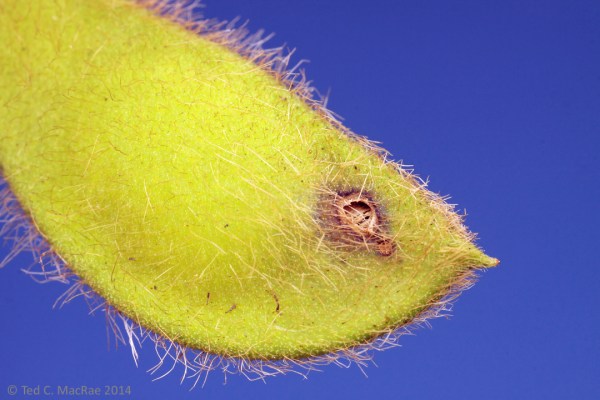
Adult females chew a small hole into the wall of the developing pod, not to feed but for oviposition

Figure 3. Adult females chew small holes into developing pods, not to feed but for oviposition.

Leaf feeding has little if any impact on the crop; however, as the crop enters pod development stages of growth adult females begin chewing small holes in the pod walls (Fig. 3), not for feeding but for oviposition. Eggs are laid singly in the pod (Fig. 4), with larvae (Fig. 5) feeding on the developing seeds within.

Eggs are laid singly inside the pod.

Figure 4. Eggs are laid singly inside the pod.

This manner of feeding by the larva not only directly impacts yield but also hampers efforts to control active infestations by preventing contact with foliar-applied insecticides. Eventually the larvae mature, exit the pod, and drop to the soil where they burrow, pupate, and emerge as adults during the next cropping season while plants are still in early to mid-vegetative stages of growth.

This neonate larva has just hatched and will feed within the pod on developing seeds.

Figure 5. This neonate larva has just hatched and will feed within the pod on developing seeds.

Management techniques include rotation with grass crops to reduce populations (the weevil is oligophagous on soybean and dry beans), use of insecticide seed treatments to control adults during early vegetative stages of growth, and subsequent use of foliar insecticide applications if adults remain after the effect of seed treatments begins to diminish.

REFERENCE:

Casmús, A., M. G. Socías, L. Cazado, G. Gastaminza, C. Prado, E. Escobar, A. Rovati, E. Willink, M. Devani & R. Avila. 2010. El picudo negro de la vaina de soja en el NOA. Estación Experimental Agroindustrial Obispo Columbre, Tucumán, Argentina, 8 pp.

Copyright © Ted C. MacRae 2014

An arboreal fishing spider

Last week was my birthday, and as is my usual custom I took the day off in favor of the season’s first “official” bug collecting trip. Falling in late April as it does, my birthday usually coincides nicely with insect activity beginning in earnest here in Missouri, and for this year’s edition I decided to look for Cicindela scutellaris lecontei (Leconte’s Tiger Beetle) on sand prairies in the extreme northeastern corner of the state. Sadly, this year’s unusually protracted spring had resulted in a mostly still-sleeping landscape, and whatever hopes I had of seeing the earliest emerging adults were dashed as thick, gray clouds hung stubbornly in the sky and temperatures refused to edge much above 60°F. Still, a bad day of collecting is better than a good day of just about anything else, and in such situations there are still wintertime collecting methods—peeling bark, cutting wood, breaking stems, etc.—at my disposal.

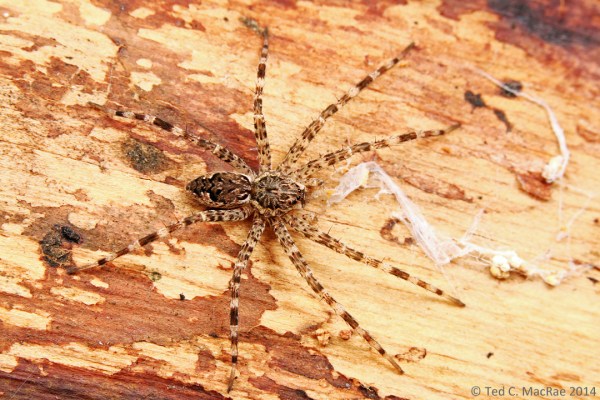
The "W"-shaped markings on the abdomen with interrupted white borders distinguish this species from the otherwise similar D. scriptus (xxx fishing spider).

Dolomedes tenebrosus (dark fishing spider) | Frost Island Conservation Area, Clark Co., Missouri.

While exploring a sand prairie at Frost Island Conservation Area (Clark Co.), I found a large, dead willow in one of the draws that had apparently been killed by recent prescribed burning activities, and when I peeled back a section of the trunk bark I found this medium-sized spider (leg spread ~40 mm) sitting underneath. Based on general appearance I first thought it was some type of wolf spider, although it struck me odd that it would be under the bark of a tree rather than on the ground where wolf spiders are normally encountered. However, after consulting BugGuide and not finding it among the wolfies, I decided to widen the net and quickly stumbled onto the fishing spiders (genus Dolomedes, family Pisauridae). I’ve seen fishing spiders before—normally they are found at water’s edge and periodically demonstrate a remarkable ability to dash across the surface of the water to grab an errant insect, using the same surface tension for support that had trapped its hapless prey. As odd as it would have been to find a wolf spider high up in a tree, it seemed even more unlikely that I would find a fishing spider in such a dry, arboreal habitat. Things became clearer, however, after I settled on the species D. tenebrosus (dark fishing spider)—distinguished from other fishing spiders by the interrupted white borders behind the “W”-shaped markings on the abdomen (see BugGuide). According to Jacobs (2002) this species is frequently found far away from water, usually in wooded settings, and hibernates as an immature adult (penultimate instar) under—you guessed it—loose bark (also stones). Barnes (2003) also provides a good discussion of this spider along with diagnostic photos and references for further reading.

Dolomedes tenebrosus (dark fishing spider) | Clark Co., Missouri

The “W”-shaped markings on the abdomen with interrupted white borders distinguish this species.

Based on this information, I’m guessing this individual is a still hibernating subadult, presumably a female based on the small pedipalps (the little “legs” next to the mouth). The spider moved slowly across the exposed wood as I took these photographs, wandering onto sections of different color as she did. I like the two photos for different reasons—the first (light background) seems to better show the shape and silhouette of the spider, while the second (dark background) highlights the spider’s beautifully intricate markings.

REFERENCES:

Barnes, J. K. 2003. Dark fishing spider. University of Arkansas Arthropod Museum Notes 15 [full text].

Jacobs, S. 2002. Fishing spider, Dolomedes tenebrosus. PennState College of Agricultural Sciences Insect Fact Sheet [full text].

Copyright © Ted C. MacRae 2014

The importance of post-processing

One of the most frustrating realizations I had when I began photographing insects was the fact that photographs didn’t come out of the camera “ready-to-go”—i.e., they still needed to be processed to some degree to make them look good. Even worse, this required processing is to large degree subjective based on the taste of the individual photographer, and as such a “quick manual” describing the exact process in a way that beginners can understand doesn’t exist. Essentially, I didn’t know that when I decided to become an insect photographer, that I would also have to become proficient at photo processing. This frustrates me a lot less now because I’ve finally worked out a process for doing this that works for me and that I am comfortable with, and having done so I also realize that every photographer has to go through this process for themselves to make their photographs look the way they want them to look. That said, I wish I’d had access to some easy tutorials when I was trying to figure out the process that could have saved me some stumbling time before arriving at a process I liked. With that in mind, I thought I would share a quick overview of how I deal with post-processing in the hopes that somebody else mind find a useful tip or two here as they try to figure out their own process. This is not meant to be an exhaustive description of all the post-processing tools that I might use, but rather the typical adjustments that are needed for almost all of the photographs that I take. To illustrate the process, I use a rather basic shot of a cricket that I photographed last week in northeastern Missouri. You can click on each photo to access a larger and better see the issues discussed and resulting enhancements.

Straight from the camera (JPG converted from original RAW file).

The photo above is basically how the shot came out of the camera. These days I shoot only in RAW format, as this allows the maximum amount of data to be retained regardless of how many times the file is accessed. The image above is a JPG converted directly from the unaltered RAW file, and you can see that it looks rather flat and could benefit from levels and color adjustments as well as sharpening and some general “cleaning up” of sensor dust artifacts and debris on the subject. Since I use a Canon body, I have the Digital Photo Professional software that came with the camera, and I also have Photoshop Elements. For my purposes, I’ve found it most convenient to do certain enhancements directly to the RAW file in DPP, generate a TIFF format version of the file from the edited RAW file, and then do the final enhancements to the TIFF file. Since TIFF is also a “loss-less” format, I can then use the enhanced TIFF to generate JPGs of whatever size and resolution on an as-needed basis without worrying about data loss in the full-sized, fully enhanced version of the photo. I think this is preferable to shooting JPGs directly or generating them directly from the RAW file because JPGs are not loss-less files, and as a result every time a JPG is accessed or modified there is a loss of data. Sure, you can go back to the original RAW file and generate a new JPG, but any enhancements made after the first conversion will have to be repeated. Another advantage to making adjustments in DPP is that they are reversable—the original, unaltered RAW file can always be recovered without the need to create multiple backups representing different stages of enhancement.

After initial processing (JPG converted from edited RAW file).

So, what enhancements do I do in DPP? First I open the tool palette and adjust the white balance—in this case it was a full flash photo, so I select “Flash” from the drop-down menu. Then I select the RGB tab and adjust the upper and lower levels on the histogram. The general approach is to cut off data-lacking areas at either extreme, but there is also a lot of subjectivity in deciding what “looks right”. I then open the Stamp Tool (I find cloning adjustments easier and more effective in DPP than in PS) and clone out dust marks in the background (I know, I need to clean my sensor) and debris on the subject. On that last point, there are purists who will argue that this is an “unnatural” alteration. I take a much less conservative position on such alterations, since in my opinion the entire photograph itself is the result of interpretation—not just of the photographer, but of the equipment used and settings chosen. If debris on the subject is an important aspect of the subject’s natural history, then it should remain. However, in most cases, dirt flecks on the subject are not an important part of the story and provide an unnecessary detraction from the aesthetic appearance of the photo. If any cropping is necessary I prefer to do this also in DPP since this is reversible should I change my mind at some point in the future. The second photo above shows what the image looks like after this initial round of post-processing in DPP. At this point, the RAW file is ready to be converted to TIFF format for final post-processing in PS.

After additional processing in Photoshop (jpg converted from edited TIFF).

After additional processing in Photoshop (jpg converted from edited TIFF).

Because I’ve done much of the levels adjustment and cloned out any flaws in DPP, the original TIFF needs only minor adjustments. I generally like to start with “Autocorrect” and see what it does, as this function usually does a good job of toning down highlights and shadows and especially giving a more natural color to blue sky backgrounds such as in this photo. If I don’t like the result from Autocorrect, I hit Ctrl+Z and adjust levels and color manually until I like the result. I find that most photos still benefit from a little bit of brightening and increased contrast (usually ~10% each), and this often also serves to add a little color saturation that is generally sufficient but can sometimes be too much. If the latter occurs, it’s an easy matter to adjust the saturation back down a little bit. After the levels and color are fully adjusted the only thing left to do is apply unsharp mask to sharpen up the photo and bring out the detail—remember to zoom the image to 100% to get the best view of how the settings affect the appearance of the photo, as the settings that you will need depend greatly on the size of the image. Once these adjustments are made, I save a new version of the file (I like to append the file name with “_enh”). The third photo above represents the final enhanced version, and it is this file that I will use to generate JPGs of whatever size I need on an as-needed basis. The original TIFF can be retained if desired, but since an identical version can always be generated anew from the enhanced RAW file this is not essential.

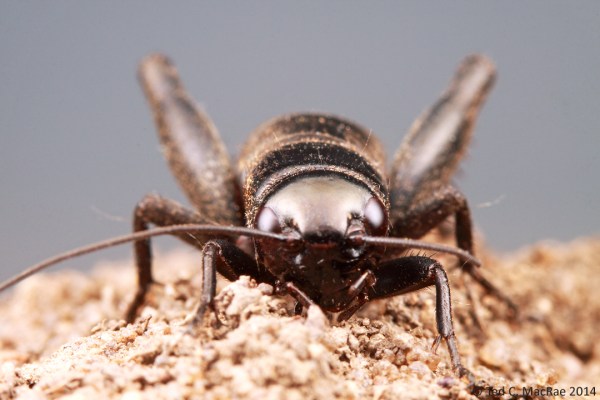
The head slightly narrower than the pronotum and early spring occurrence of this large nymph make me think this is the northern woods cricket (Gryllus vernalis).

The head slightly narrower than the pronotum and early spring occurrence of this large nymph in northeastern Missouri make me think this is the northern wood cricket (Gryllus vernalis).

I hope you’ve found one or tips of use in this little tutorial, which I end with the above frontal portrait of the subject shown in the previous photos. Based on its all black color, the head slight narrower than the pronotum, and its early spring occurrence as a late-instar nymph in northern Missouri, I take this to be a northern wood cricket, Gryllus vernalis, but of course I am open to being corrected by somebody more knowledgeable about crickets than I.

Copyright © Ted C. MacRae 2014

Not all soybean caterpillars are ‘ugly’!

Although photographs of beetles dominate this site (they are my true love, after all), I am nevertheless an agricultural entomologist by day and, as such, find occasion to post photos of the insects I encounter in my area of expertise—soybean. I think by and large those soybean insects—especially the caterpillars—don’t generate as much interest as the beetles that I feature. I guess this is understandable—caterpillars of the agricultural pest variety seem generally unable to compete with the visual and behavioral charisma exhibited by jewel beetles, tiger beetles, tortoise beetles, etc. Here, however, is an example of a soybean caterpillar that is as beautiful as any beetle you will find—the larva of the silver-spotted skipper, Epargyreus clarus (Lepidoptera: Hesperiidae). Not only are the colors to die for, but that comically big head makes for a truly laughable frontal portrait!

Epargyreus clarus (silver-spotted skipper) late-instar larva on soybean | Baton Rouge, Louisiana

Epargyreus clarus (silver-spotted skipper) late-instar larva on soybean | Baton Rouge, Louisiana

This particular individual was found last September in a soybean field near Baton Rouge, Louisiana (amazingly, this is the first insect I have featured from Louisiana). Silver-spotted skippers feed on a wide variety of plants in the family Fabaceae (of which soybean is a member), but their occurrence on soybean rarely reaches levels that cause any economic impact. Normally the caterpillars hide during the day in a silken nest constructed by folding over a leaflet or tying adjacent leaflets together, emerging only at night to feed.

What a pretty face!

What a pretty face!

I suppose the orange spots on the head are intended to serve as false eye spots—for some reason the larger the eyes the more a potential predator seems to take pause before deciding to eat something. The actual eyes can be seen along the outer edge of the orange spot as a row of simple ocelli—incapable of forming sharp images and serving as little more than light and motion detectors. I can’t even begin to speculate on the function of the curious asperate/rugose texture of the head!

Copyright © Ted C. MacRae 2014

Tortoise beetles on the job

Back in late February and early March I did my annual tour through the soybean growing regions of central and northern Argentina to look at insect efficacy trials (pretty amazing to me still when I think about it—I actually get paid to spend time in Argentina looking for insects!). Normally on such trips there is no shortage of soybean insects to occupy my attentions—of all the large-acre row crops, soybean probably has the greatest diversity of insect associates, and in South America it is rare for any soybean field to not experience pressure from at least one of them. Soybeans, however, are not the only plants that occur in soybean fields—there are also weeds, many of which also have their own suite of insect associates. Sometimes these weed-associated insects can be even more interesting than the soybean insects I’m look for.

Botanochara angulata?

Botanochara angulata? mating pair | Córdoba Prov., Argentina

On this particular day, as I walked through a soybean field in central Córdoba Province I noticed distinctive red and black tortoise beetles (family Chrysomelidae, subfamily Cassidinae) on some of the plants. I thought it odd that tortoise beetles would be on soybean, as I’m not aware of any soybean associates in the group. A closer look, however, quickly revealed that the beetles were not on the soybean plants themselves, but rather on vines that were weaving their way through the plants. The plant was akin to bindweed and obviously a member of the same plant family (Convolvulaceae), but none of my field mates knew which of the many weedy species of the family that occur in Argentina that this particular plant represented. Species of Convolvulaceae are, of course, fed upon by a great diversity of tortoise beetles—always a treat for this coleopterist to see, and it was all I could do to concentrate on the task at hand and finish doing what I needed to do so I could turn my attention to finding and photographing some of these beetles. Once I began photographing them I found them surprisingly uncooperative (not my normal experience with tortoise beetles), but I soon found a mating pair that was a little more cooperative (probably because they were mating), with the above photo being my favorite of the bunch.

Paraselenis tersa?

Paraselenis tersa? female guarding her eggs | Córdoba Prov., Argentina

As I was searching for beetles to photograph, I encountered some yellow tortoise beetles associated with the same plant but that I had not noticed earlier. Unlike the conspicuously red and black colored species (which seems to best match Botanochara angulata according to Cassidinae of the World), the yellow species (which I presume represents Paraselenis tersa, also ID’d using the same site) seemed almost cryptically colored. When I finished taking photographs of B. angulata, I began searching for a P. tersa to photograph and encountered the female in the above photograph guarding her eggs—score!

Undetermined cassidine larvae.

A single tortoise beetle larva was encountered.

Tortoise beetle larvae are always a delight to see as well—their dinosaurian armature and fecal adornments, both obviously designed to dissuade potential predators, form one of the most ironic defensive combinations one can find. If additional tactics become necessary, they are among the few insects that are known to actually “circle the wagons” (the technical term for this being “cycloalexy“). While I only found a single larvae (of which species I don’t know), its presence seems to further suggest that at least one of the species represented an actively developing population and that the adults I found were not just hangers-on putzing around until winter (such as it is in central Argentina) forced them to shut down for the season.

Undetermined cassidine larva.

Spiky spines and a pile of poop make formidable defenses.

My impression is that tortoise beetles are by-and-large noxious to predators, thus explaining why so many species in the group exhibit aposematic coloration. However, the apparent cryptic coloration of Paraselenis makes me wonder if this is not universally true. It seems especially odd for two species to feed on the exact same species of plant but only one of the species to be noxious, which leads me to even more questions about how two species feeding on the same plant at the same time avoid direct competition with each other. I wondered if perhaps one species was on the wax while the other was on the wane (late February is well along into the latter part of the season in central Argentina), but the fact that both species were involved in reproductive activities (mating in Botanochara and egg guarding in Paraselenis) suggests this was not the case.

Ted MacRae photographing tortoise beetles.

A candid photo of me photographing tortoise beetles (and revealing my technique for getting “blue sky” background photographs).

© Ted C. MacRae 2014