Brachys on oak

Although the beetles I photographed for my springtime Acmaeodera post are among the smaller buprestids occurring in Missouri, they are by no means the smallest. That honor belongs to the curious little genus Mastogenius, measuring only around 2 mm in length and, thus, looking for all intents and purposes like little black dots.  Slightly larger, but still smaller than our smallest Acmaeodera, are members of the tribe Trachyini.  Adults in this group exhibit a highly derived morphology compared to other groups of jewel beetles – flat, compact, and wedge-shaped rather than the elongate, cylindrical form more commonly associated with the family.  This seems in part due to their unique larval habits – mining within the leaves of their host plants rather than boring through the wood.  Three genera in this tribe occur in the U.S.¹, all of which are found in Missouri.  These include: 1) Taphrocerus, which mine the leaves of sedges (family Cyperaceae); 2) Pachyschelus, which mine the leaves of herbaceous plants in several families – primarily Fabaceae; and 3) Brachys, which mine the leaves of hardwoods, chiefly oaks (Quercus).  It was two species in this latter genus (out of three that occur in Missouri) that I encountered a couple weekends ago at Reifsnider State Forest in Warren County (noted for its high quality example of a mature white oak forest).

¹ A species in the Old World genus Trachys was introduced to North America from Europe and is established in New Jersey.
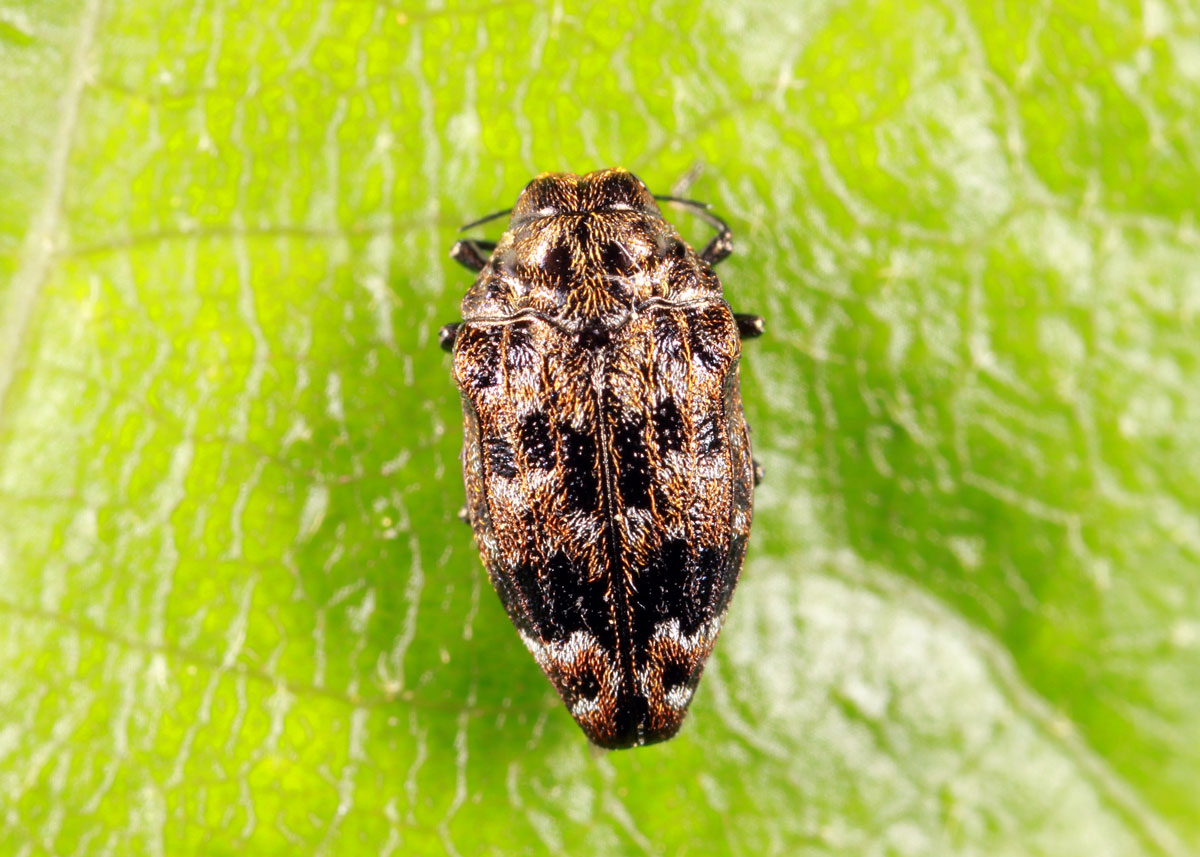
Brachys_ovatus_IMG_0193_enh2

Photo details: Canon MP-E 65mm 1-5X macro lens on a Canon EOS 50D, ISO 100, 1/200 sec, f/10, MT-24EX flash 1/8 power through diffuser caps

Brachys ovatus is the largest of the three species, usually measuring a little more than 5 mm in length. In addition to size, it can also be distinguished from Missouri’s two other species of Brachys by the dense row of long hairs occurring along the apex of the last abdominal sternum. For those of you who prefer not to have to look at the underside of its butt, the white-margined band of bronze pubescence before the apex of the elytra and longitudinal rows of bronze setae in the basal half of the elytra are usually sufficient for distinguishing this species.  Brachys ovatus is a common associate of oaks throughout Missouri during spring – I have collected it on ten of Missouri’s 21 oak species, including both ‘white oaks’ and ‘red oaks’. Despite its common occurrence on oak and the frequent reference to it in the literature as a leaf-miner of oaks, few reliable rearing records exist to document the range of hosts it actually utilizes.  There are older reports of this species mining the leaves of other hardwoods such as beech (Fagus), elm (Ulmus), hickory (Carya), and hornbeam (Carpinus); however, the veracity of these reports is questionable, and they may refer only to incidental adult associations.

Brachys_aerosus_IMG_0165_enh2

Photo details: Canon EF 100mm f/2.4 Macro Lens with Kenco extensions on a Canon EOS 50D, ISO 100, 1/200 sec, f/11, MT-24EX flash 1/8 power through diffuser caps

Brachys aerosus is another commonly encountered species.  This is a highly variable and hard-to-define species, but in general it can be recognized by the basal region of the elytra largely lacking pubesence and with a purple, blue, or green luster, and by the predominantly gold to bronze pubescence covering the apical area of the elytra.  Adult length is generally from 3 to 5 mm – somewhat smaller than B. ovatus, and differing also in that it is commonly associated with a variety of hardwoods besides oak.  In Missouri, I have primarily collected it on oaks and elms.  Literature reports – mostly old and unreliable – record as larval hosts many other hardwood genera such as chesnut (Castanea), beech, hazel (Corylus), hickory, hornbeam, linden (Tilia), poplar (Populus), and even such unlikely genera as huckleberry (Vaccinium) and grape (Vitis).  Because of its variability and the broad diversity of hosts with which it has been associated, this species is suspected of acutally being a species complex.  The late George Vogt spent many years making careful observations with reared material in an effort to determine species boundaries and their host associations. Unfortunately, Vogt passed away before publishing his observations, and his eccentric record keeping with cryptic notes (Anderson et al. 1991) makes it unlikely that they ever will be published. It will take some enthusiastic sole to repeat his work and publish it before we can ever know the true identity of the species hiding under this name.

A third species in the genus, Brachys aeruginosus, is smaller than either of the two above species – generally measuring only 3 to 4 mm in length.  This rather uncommonly encountered species is most similar to B. aerosus in appearance but can be distinguished, in addition to its generally smaller size, by the predominantly light gold to silver setae that cover the apical area of the elytra.  As with the two above species, it is most often associated with oaks but is occasionally collected on other hardwoods as well.  Whether it utilizes species beside oak for larval development is unknown.  I hope to find and photograph this species in the near future.

REFERENCE:

Anderson, D., C. L. Bellamy, H. A. Howden, and C. Quimby. 1991. George Britton Vogt (1920–1990). The Coleopterists Bulletin 45(1):93–95.

Copyright © Ted C. MacRae 2009

Add to FacebookAdd to NewsvineAdd to DiggAdd to Del.icio.usAdd to StumbleuponAdd to RedditAdd to BlinklistAdd to Ma.gnoliaAdd to TechnoratiAdd to Furl


Goldenrod Leaf Miner

Microrhopala_vittata_IMG_0183_enh2

Photo details: Canon MP-E 65mm macro lens on a Canon EOS 50D, ISO 100, 1/200 sec, f/16, MT-24EX flash 1/8 power through diffuser caps

While photographing Acmaeodera tubulus and A. ornata a couple of weekends ago (see Springtime Acmaeodera), I came across this leaf beetle (family Chrysomelidae) of the genus Microrhopala¹.  When I took Systematic Entomology (so many moons ago), beetles in this and related genera were placed in the subfamily Hispinae.  That taxon has since been subsumed by a more broadly defined Cassidinae (Staines 2002), which also includes the delightfully odd tortoise beetles.  There are several species of Microrhopala in North America – this individual can be diagnosed as M. vittata by means of its dull reddish elytral stripes, eight-segmented antennae, and smooth (not serrate or toothed) elytral margins (Clark 1983). 

¹ Derived from the Greek micr (small) and rhopal (a club) – presumably a reference to its small-clubbed antennae.

Many leaf beetles are expert botanists, restricted to and able to discriminate a single plant species or group of closely related species for hosts.  Microrhopala vittata is no exception, specializing on true goldenrods (Solidago spp.) and flat-topped goldenrod (Euthamia graminifolia) (family Asteraceae).  Adults feed on leaves in the upper part of the plant, leaving numerous small holes, but it is the larvae that have the biggest impact on their host by mining within the leaves between the upper and lower surfaces.  Larval mining eventually causes the leaves to turn brown and shrivel up. 

This species has been widely studied by ecologists interested in understanding the impacts of herbivorous insects on their host plants and associated changes to plant communities that result from their feeding.  While population densities of M. vittata are normally low, they occasionally reach densities that result in severe damage to their host plants.  Such effects are not limited to the host plants themselves – Carson and Root (2000) found that outbreaks of this species on stands of tall goldenrod (Solidago altissima) in an old field dramatically reduced the biomass, density, height, survivorship, and reproduction of tall goldenrod, resulting in higher abundance, species richness, and flowering shoot production among other plant species as a result of increased light penetration.  Conversely, in experimental plots where the beetles were removed, tall goldenrod developed dense stands that inhibited the growth of many other plants.  These effects lasted for several years after the outbreak.  Thus, the beetle can act as a keystone species² in old field communities, indirectly promoting woody plant invasion and speeding the transition of the old field to a tree-dominated community.

² A keystone species is one whose impacts on its community or ecosystem are large and greater than would be expected from its relative abundance or total biomass (Paine 1969).  Popular examples include the beaver, which transforms stream communities to ponds or swamps, and elephants, which prevent grasslands from converting to woodlands through destructive tree removal.  In contrast, trees, giant kelp, prairie grasses, and reef-building corals all have impacts that are large but not disproportionate to their also large total biomass and, thus, are not considered keystone species.

REFERENCES:

Carson, W. P. and R. B. Root.  2000.  Herbivory and plant species coexistence: Community regulation by an outbreaking phytophagous insect.  Ecological Monographs 70(1):73-99.

Clark, S. M. 1983. A revision of the genus Microrhopala (Coleoptera: Chrysomelidae) in America north of Mexico. The Great Basin Naturalist 43(4):597-617.

Paine, R. T. 1969. A note on trophic complexity and community stability. The American Naturalist 103(929):91–93.

Staines, C. L. 2002. The New World tribes and genera of hispines (Coleoptera: Chrysomelidae: Cassidinae). Proceedings of the Entomological Society of Washington 104(3): 721-784.

Copyright © Ted C. MacRae 2009

Add to FacebookAdd to NewsvineAdd to DiggAdd to Del.icio.usAdd to StumbleuponAdd to RedditAdd to BlinklistAdd to Ma.gnoliaAdd to TechnoratiAdd to Furl

Springtime Acmaeodera

Last weekend I mustered up the courage to begin experimenting with the 1-5X macro lens with my new camera. I had played around with it a little, trying to get a feel for finding the subject (it seemed hard) and the working distance (it seemed close). Really though, no amount of fiddling around could take the place of taking it out into the field and using it. I found some ideal subjects to experiment with – springtime Acmaeodera. With more than 150 species, this is one of the largest genera of jewel beetles (family Buprestidae) in North America. This genus is in terrible need of revision – new species continue to be recognized on a regular basis from the desert southwest and Mexico, where the group reaches its greatest diversity. Only a handful of species, however, are found in the eastern part of the U.S.

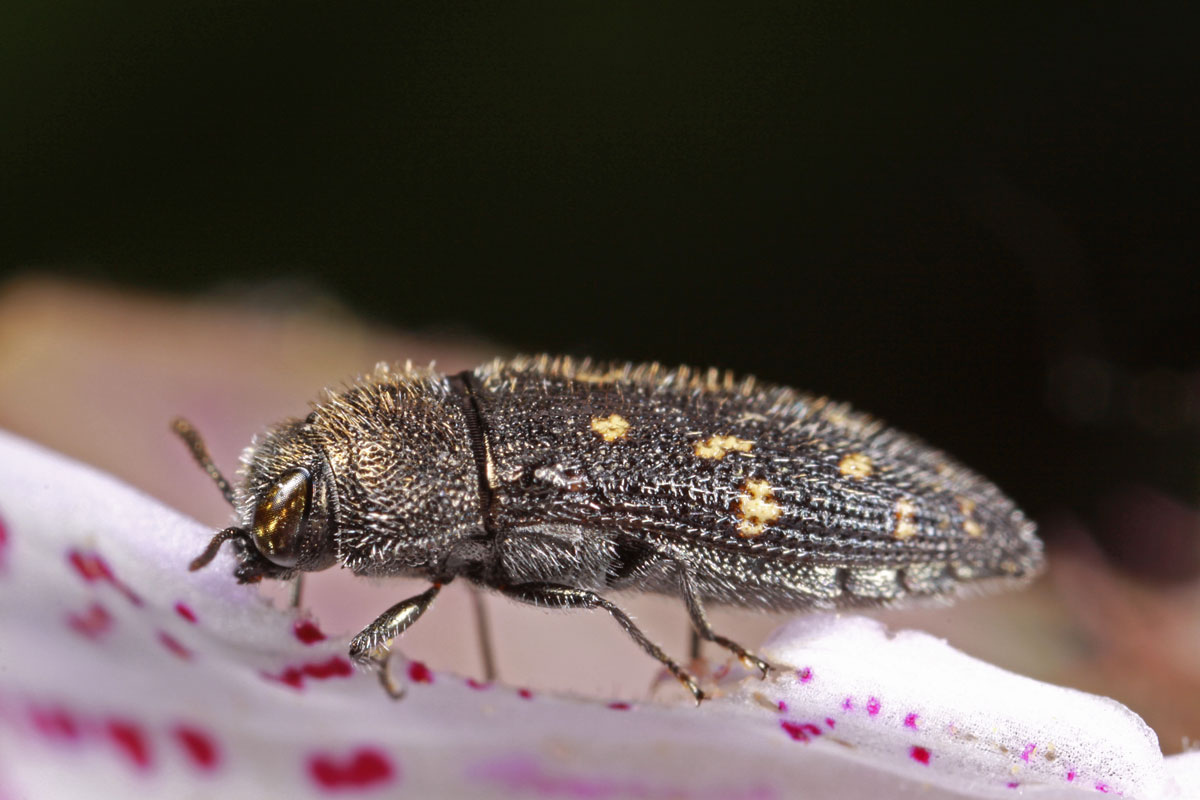
Acmaeodera_tubulus_IMG_0110_enh2

Photo details: Canon MP-E 65mm macro lens on a Canon EOS 50D, ISO 100, 1/200 sec, f/11, MT-24EX flash 1/8 power through diffuser caps

One of the most abundant and widespread of these is Acmaeodera tubulus (first two photos). Measuring only 5-7mm in length, it is among the smallest members of the genus and can be recognized by its black color with bronzy sheen and 8 (usually) small, yellow spots forming two longitudinal rows on each elytron. Adults of this species feed on the petals of a great variety of flowers – this individual was feeding on the petals of eastern beebalm (Monarda bradburiana). The larvae of this species are wood borers in twigs and small branches of various hardwood trees – I myself have reared it from dead branches of green hawthorn (Crataegus viridis), several species of hickory (Carya spp.), hackberry (Celtis occidentalis), honey locust (Gleditsia triacanthos), walnut (Juglans nigra), eastern hophornbeam (Ostrya virginiana), willow (Salix sp.), and slippery elm (Ulmus rubra).

Acmaeodera_tubulus_IMG_0123_enh2

Photo details: Canon MP-E 65mm macro lens on a Canon EOS 50D, ISO 100, 1/200 sec, f/11, MT-24EX flash 1/8 power through diffuser caps

While not apparent from these photos, adults in flight have the appearance of small bees. The elytra of all Acmaeodera are fused and do not separate during flight as in most other beetles, which in this small species results in a profile during flight similar to that of a small halictid (sweat bee). There is another species in Missouri (A. neglecta) that closely resembles A. tubulus but which can be distinguished by its larger punctures, duller surface, and the yellow spots of the elytra often longitudinally coalesced into irregular “C”-shaped markings on each side. Acmaeodera neglecta occurs primarily in the south-central U.S., and in Missouri I have found it most often in glade habitats.

Acmaeodera_ornata_IMG_0155_enh2

Photo details: Canon EF 100mm macro lens on a Canon EOS 50D, ISO 100, 1/200 sec, f/11, MT-24EX flash 1/8 power through diffuser caps

Another common (though much less so than A. tubulus), springtime Acmaeodera in the eastern U.S. is Acmaeodera ornata (last photo). This handsome species is distinctly larger than A. tubulus, usually around 8-11mm in length, and has a broader, more flattened appearance with a distinct triangular depression on the pronotum. The elytra have a bluish cast rather than the bronzy sheen of A. tubulus, and the spots on the elytra are smaller, more numerous, and more of a creamy rather than yellow color. No other species in the eastern U.S. can be confused with it, although there is a very similar species (A. ornatoides) that occurs in Oklahoma and Texas.

This species, too, is fond of a great variety of flowers – especially asteraceous species, with this individual photographed on the widespread (but unfortunately exotic) ox-eye daisy (Leucanthemum vulgare). The body is covered with numerous long, thin hairs which may function in pollination – enlarge the photo to see the large amount of pollen that has become trapped among the hairs of this individual. Despite its widespread occurrence across the eatern U.S., larval host records are almost non-existent for this species – limited to some very old (and not entirely reliable) reports of it breeding in hickory and black locust (Robinina pseudoacacia). I have not managed to rear this species yet, despite the large number of rearings I’ve done from a wide variety of woody species in Missouri.

Copyright © Ted C. MacRae 2009

Add to FacebookAdd to NewsvineAdd to DiggAdd to Del.icio.usAdd to StumbleuponAdd to RedditAdd to BlinklistAdd to Ma.gnoliaAdd to TechnoratiAdd to Furl

A new look at an old friend

Chris Wirth just wrote a nice post summarizing the use of digital SLR camera systems for insect macrophotography.  Having just gone through the process of upgrading to a dSLR system from a point-and-shoot myself, I can relate to much of what he discusses.  The advantages are clear – higher image quality, far greater magnification capabilities, and control over lighting, shutter speed, aperture, etc.  He also discusses the disadvantages – chiefly co$t, weight, and initial learning curve.  He ends with this recommendation:

…if you are serious about insect photography and have the monetary resources, a DSLR is your only choice. Again, as of yet, nothing else provides similar quality or control.

Although I dabbled in insect photography many years ago with an Olympus OM-10 SLR film camera and a Zeiko 50mm macro lens, it wasn’t until I started this blog 18 months ago that I started making a real effort to photograph insects, using a Panasonic Lumix DMC-FX3 point-and-shoot that my dad had given to me for my birthday earlier that year. At first, I was amazed at the macro capabilities of this little camera – point, autofocus, and shoot! Yes, the photo needed to be cropped, and the reliance on natural light was not only limiting but often resulted in deep shadows – but nothing a little Photoshop couldn’t fix! It wasn’t long, however, before I began to see the limitations – not just on size, with tiger beetles being near the lower end of the size of subject I could photograph, but also with the quality of the images themselves. The perfectionist in me started envisioning what I could do if only I had the equipment. Mind you, I’m proud of the photographs I’ve acquired over the past months, given what I had to work with. But now that I have the equipment to do it right, I see a conflict on the horizon – do I attempt to go back and re-photograph all of those species that I’ve already photographed, or do I move on and and not look back? Perhaps a little of both is the best approach.

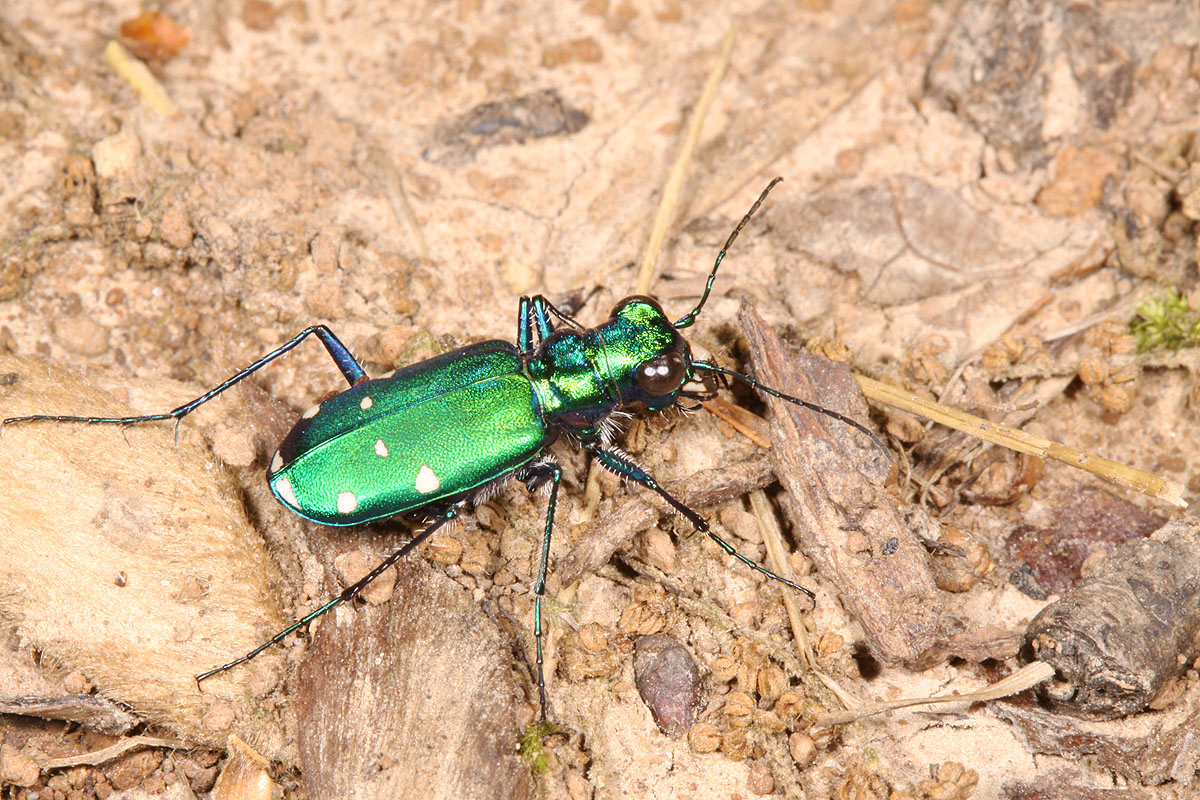
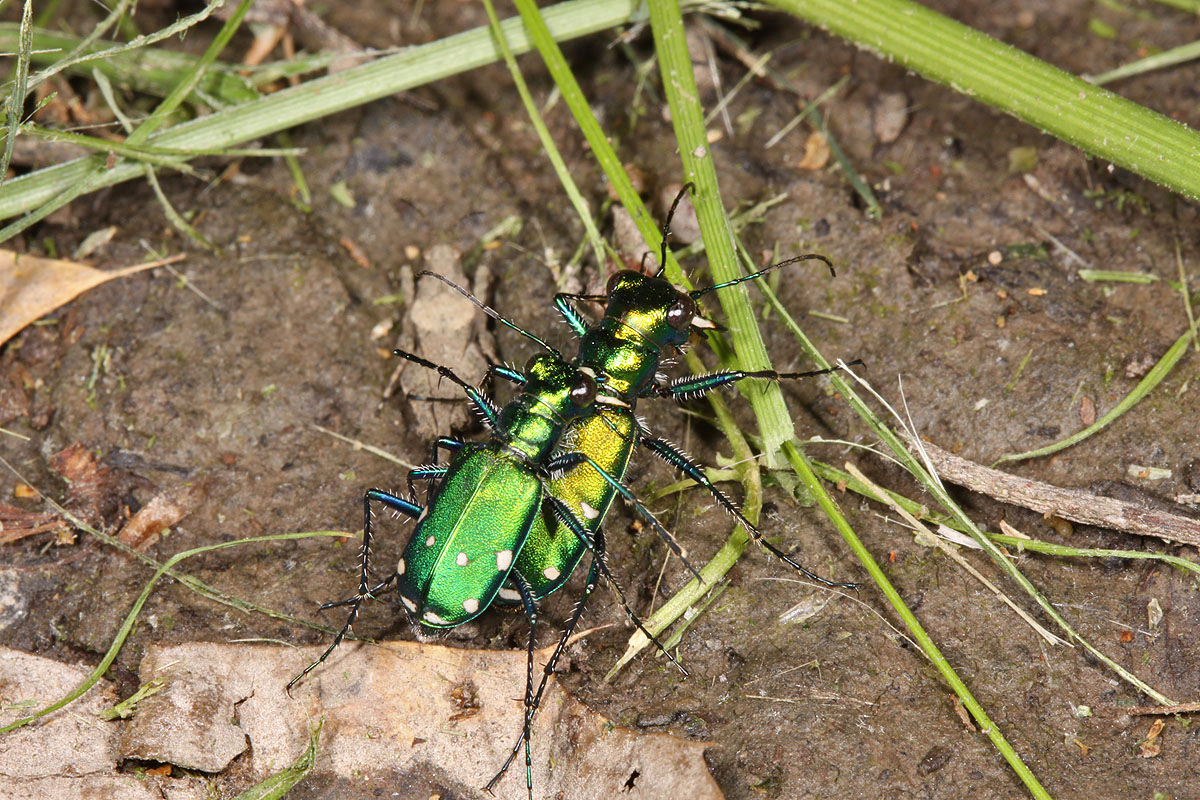
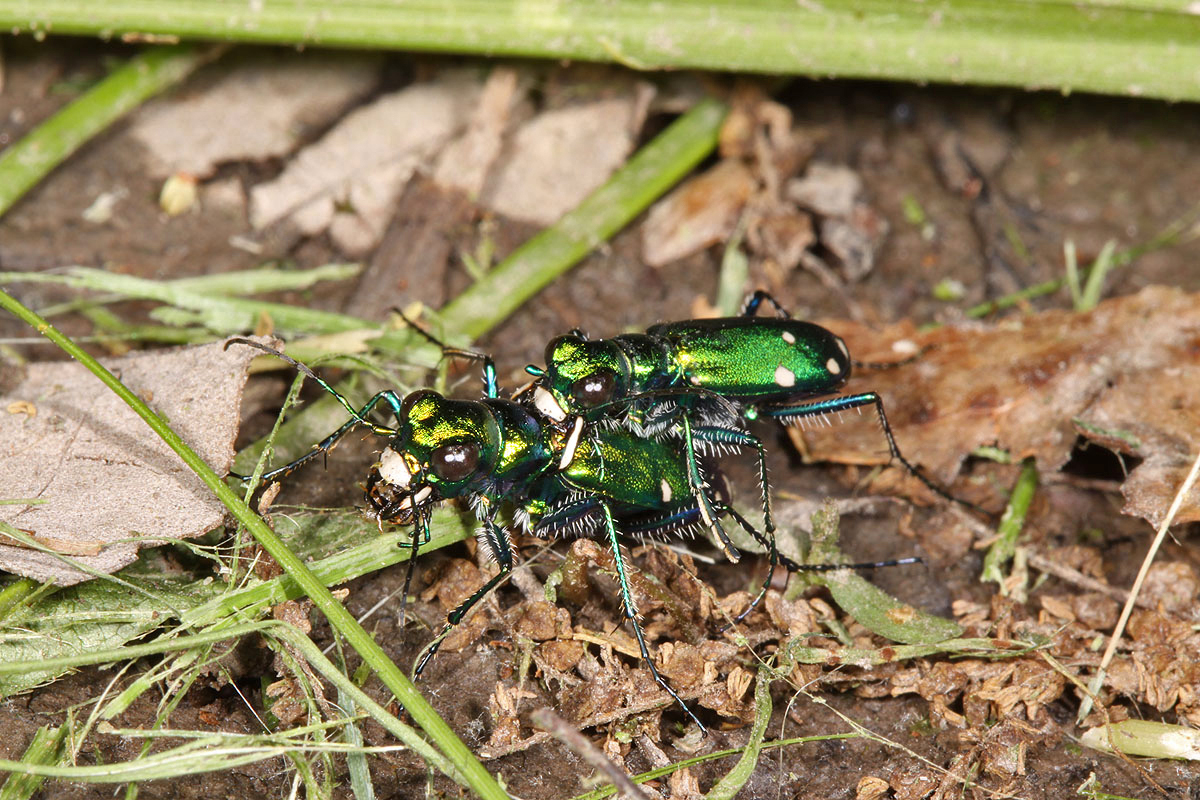
Cicindela sexguttataIn the meantime, I’ve got to learn how to use this camera. The first weekend I had it, I accompanied my friend and colleague, Chris Brown, to nearby Shaw Nature Reserve, where Chris had previously noted good populations of the very uncommon Cicindela unipunctata (one-spotted tiger beetle) [now Cylindera unipunctata, fide Erwin & Pearson 2008 – more on this in a future post] – what a fantastic species for my first photo shoot with the new setup. Unfortunately, we did not find this species (although I will eventually). Instead, I focused on the very prolific population of Cicindela sexguttata (six-spotted tiger beetle) that we found at this site. Cicindela sexguttata is the one tiger beetle that is, more than any other North American species, known by entomologists and non-entomologists alike. Cicindela sexguttataAnyone who has ever taken a walk in the eastern forests during spring has encountered this beetle – flashing brilliant green in the dappled sunlight, always a few yards ahead on the path. While belonging to the “spring/fall” group of species, adults of this species break ranks and stay put in their burrows during fall while other spring/fall species come out and explore for a bit before digging back in for the winter (Pearson et al. 2006). While many individuals do show the six white spots on the elytra that give the species its common name, this character is actually quite variable, with some northern populations completely lacking spots.

Cicindela sexguttataAs tiger beetles go, it’s one of the more difficult to photograph because of its shiny, metallic coloration (as opposed to the flat, dull coloration of Cyl. unipunctata). This was probably a good thing in terms of starting the learning process. I limited myself during this session to the 100mm macro lens (leaving the 1-5x beast for another day), with the photographs shown here being some of the better ones. While I like them, I also see a few things I did wrong. First was the flash – I set the flash units to 1/4 power and didn’t use any kind of diffusers, and as a result the lighting turned out harsh – especially for this brilliantly-colored, metallic species. Cicindela sexguttata I’ve softened the highlights a little bit in Photoshop, but the results are still not as good as if I had used a lower power and diffused the light, and ultimately my goal is to achieve well lit photographs that do not need post-processing to make them look right. Other than that, the day was mostly about getting used to handling the camera and learning how to judge f-stop based on my manual settings for exposure (1/200 sec) and ISO (100). The single individuals (above) were taken in full sunlight, and in that situation my f-stops tended to be too low (resulting in overexposure), while the mating pair was in shade where my f-stops tended too high (underexposed). Next time, I’ll try the diffusers I bought, use less flash power, and do more f-stop bracketing until I get a good feel for what I need in a given situation.

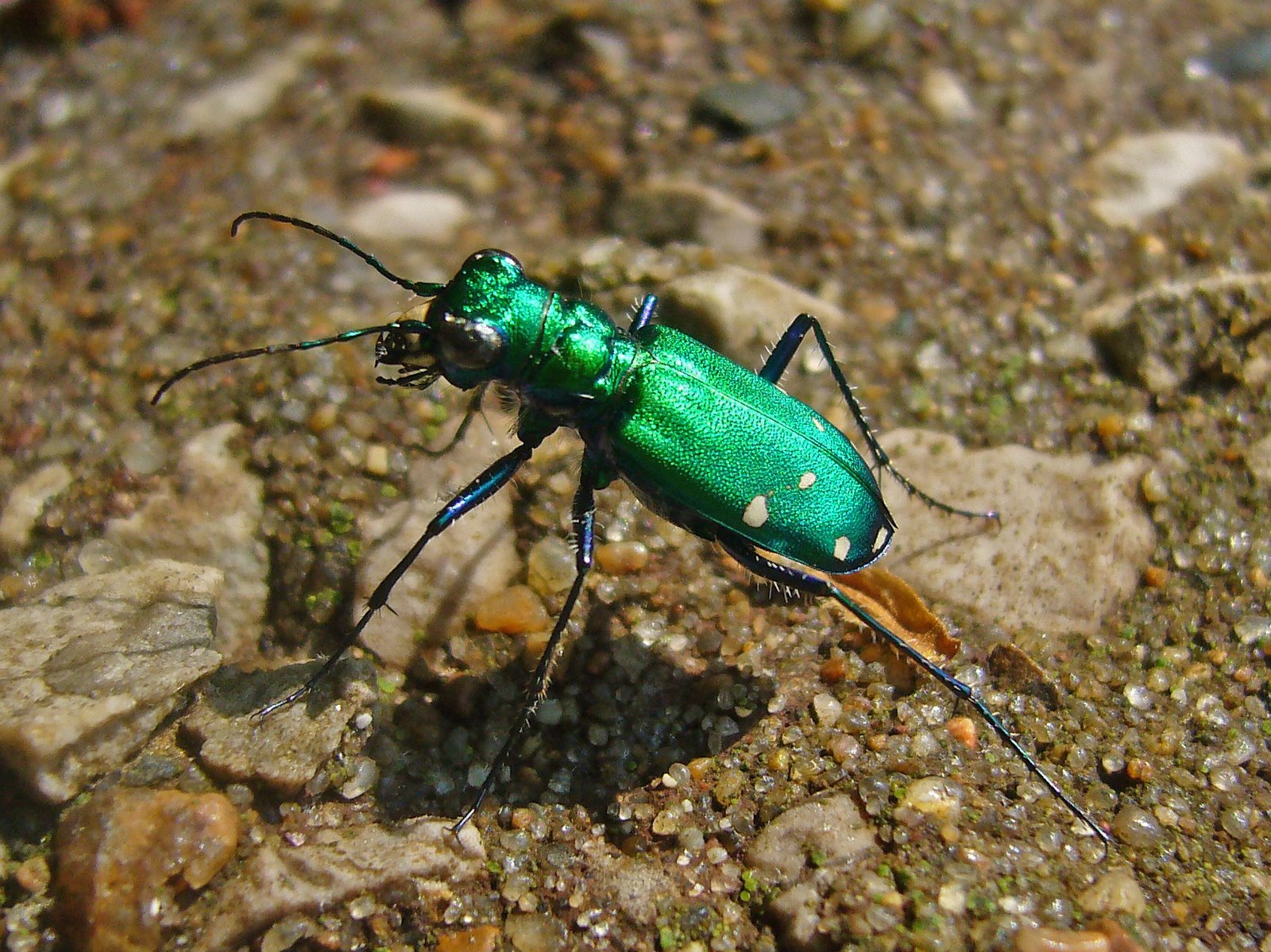
For comparison, here is the one C. sexguttata photograph I took with the point-and-shoot last year. This is about as good a photograph as I could get of this species using that camera. Besides being heavily cropped, it differs by being not very well exposed (despite post brightening), showing heavy shadows (despite post lightening), and lacking detail.
Cicindela sexguttata

REFERENCES:

Erwin, T. L. and D. L. Pearson. 2008. A treatise on the Western Hemisphere Caraboidea (Coleoptera). Their classification, distributions, and ways of life. Volume II (Carabidae-Nebriiformes 2-Cicindelitae). Pensoft Series Faunistica 84. Pensoft Publishers, Sofia, 400 pp. + 33 color plates.

Pearson, D. L., C. B. Knisley and C. J. Kazilek. 2006. A Field Guide to the Tiger Beetles of the United States and Canada. Oxford University Press, New York, 227 pp.

Copyright © Ted C. MacRae 2009

Add to FacebookAdd to NewsvineAdd to DiggAdd to Del.icio.usAdd to StumbleuponAdd to RedditAdd to BlinklistAdd to TwitterAdd to TechnoratiAdd to Furl

Do the Doodlebug Flip

I’ve been on a doodlebug kick ever since I finally figured out how to find the little buggers on my trip down to southeast Missouri.  I even found one in one of the tiger beetle terraria that I setup with native soil brought back from that trip, so I’ll get the chance to try to rear one out.  Shortly after finding those first antlion larvae, I traveled to Rock Island, Illinois to attend the Second Illinois Hill Prairie Conference as a panelist for the insects discussion group.  During a field trip to a nearby hilltop prairie, I spotted a pit in a bed of sawdust that had the unmistakeable look of an antlion pit.  I can’t say that I’ve ever seen an antlion pit in anything but sand, so I dug up the larva to confirm that that was, indeed, what it was.  The larval pit site must have been selected by the adult female who laid the egg, so apparently the loose sawdust had the appropriate texture to induce oviposition.  The larva was fat and happy, suggesting it was feeding well in its sawdust pit.

Antlions flick sand with their head and elongated mandibles to create the pit, and they also flick it on prey that has fallen in their pit to thwart their escape.  Watch how this one also use its head flicking ability to right itself in a most humerous manner after being flipped over:

Copyright © Ted C. MacRae 2009

Add to FacebookAdd to NewsvineAdd to DiggAdd to Del.icio.usAdd to StumbleuponAdd to RedditAdd to BlinklistAdd to Ma.gnoliaAdd to TechnoratiAdd to Furl

BitB Goes dSLR

That’s right, I’ve finally acquired a bona fide digital SLR camera system and am taking the plunge into real insect macrophotography. I’ve been playing with my little point-and-shoot over the past 18 months or so, and the more I used it to take photographs of tiger beetles and other insects, the more I realized what I could do if I had a true macro system.  I made the decision several months ago and got lots of good advice on what kind of system I should put together from my colleague, field companion, and insect macrophotographer-extraordinaire Chris Brown, as well as from Adrian Thysse over at Voyages Around My Camera. For a time, I was trying to design a system on a rather tight budget, and Adrian graciously wrote an excellent post (Basic DSLR Macro System on a Budget) in response to my query.  The problem was, I could get the macro lens that I wanted but would have to really skimp on the flash and the camera body.  Or, I could get both the lens and the flash that I wanted, but then I’d have no money for a camera (kind of hard to take photographs with a lens and flash only).  I was thinking that maybe I could come up with a cheap body somewhere that I could live with for awhile, but in the end I realized that if I was going to do this I had to do it for real and find some way to scrape up the funds for a real system.  I decided to sell all of my bike racing equipment, keeping just my one really nice carbon road bike and a backup.  Happily, my equipment sold for a lot more than I thought it would, and I ended up raising enough funds not only to purchase a real system, but to purchase the system of my dreams.  I present to you the new BitB (Beetles in the Bush) insect macrophotography system¹:

Canon_P1020977_2

¹ It is ironically amusing that I had to take this photograph with my old point-and-shoot camera!

The system includes:

  • Canon EOS 50D Camera
  • Canon EF 100mm f/2.4 Macro Lens
  • Canon MP-E 65 mm 1-5X Macro Lens
  • Canon EF-S 17-85mm Zoom Lens
  • Canon MT-24EX Macro Twin Lite Flash
  • Kenco extension tubes (12mm, 20mm, 36mm)

At this point, I feel like I have just jumped into the ocean after having taken one introductory swim class at the YMCA.  I really have no experience with SLR photography since putting away my old Olympus OM-10 with a Zeiko 50mm macro lens some 20 years ago (pulling it out briefly for my trip to South Africa almost 10 years ago), and my digital experience has been limited to the Panasonic Lumix DMC-FX3 I’ve been using since I started this blog.  However, I’m a smart fellow and am reading everything I can right now, and I have the able tutelage of my colleague Chris, who has been more than willing to help show me the ropes with insect macrophotography in much the same way that I helped him get up to speed on our state’s fascinating tiger beetle fauna.

I suspect I’ll use mostly the 100mm out in the field, as most tiger beetles require slightly less than 1:1 magnification.  The extension tubes will also be useful in the field when I need to get a little more than 1:1 but don’t want to pull out the 1-5X beast.  Above 1.5, which I’ll need for many of the smaller buprestids (that the rest of the insect macrophotography world has overlooked to this point), I’ve got no choice – I’ll have to pull out the 1-5X.  I’m a little fearful of this lens (see Alex‘s fine review), which seems to have a steep learning curve (I haven’t even taken a shot with it yet), but I’ll just have to deal with it if I want to get the kind of photos I’m looking for with our beautiful, but small, jewel beetles.  Perhaps someday I’ll earn a listing under people’s “Insect Macrophotographers” blogrolls, but I doubt I’ll be posing much competition to the likes of Alex, Adrian, Chris, Kolby, Dalantech, and Mark for the time being.

For now, I present to you the very first tiger beetle photograph taken with my new system, the common spring woodland species, Cicindela sexguttata (six-spotted tiger beetle).  It’s not real close up, but it is tiger beetle photograph number one!

Cicindela sexguttata

Photo details: Canon EF 100mm macro lens on a Canon EOS 50D, ISO 100, 1/200 sec, f/18, flash at 1/4 power

Copyright © Ted C. MacRae 2009

Add to FacebookAdd to NewsvineAdd to DiggAdd to Del.icio.usAdd to StumbleuponAdd to RedditAdd to BlinklistAdd to Ma.gnoliaAdd to TechnoratiAdd to Furl

Tiger Beetle Rearing

I recently found an interesting website called Tiger Beetle Rearing.  This website by doctoral candidate Rodger Gwiazdowski in the Joseph S. Elkinton lab, University of Massachusetts, Amherst contains a wealth of information and photographs covering equipment, techniques, and methods for rearing tiger beetles from egg to adult, with a primary focus on rearing endangered and threatened species of tiger beetles for conservation and re-release into the wild.  The lab has reared a number of tiger beetle species but is particularly interested in the Puritan tiger beetle (Cicindela puritana), threatened in the northeastern U.S.  After the first year of rearing, 90 2nd and 3rd instar C. puritana larvae were obtained and, as of the last update, were overwintering in individual tubes.  You’ll need to register with the site with a username and password to access the site, but this is accomplished quickly and easily.

Welcome to the Hotel Cicindela!

Welcome to the Hotel Cicindela!

I found this website of great interest as I begin my own efforts at rearing these beetles in the laboratory.  My primary interest is in rearing larvae that I collect in the field to adulthood – adults are much more easily identified than larvae (indeed, the larvae of many species remain undescribed), and rearing field-collected larvae is one way to get around the often limited temporal occurrence that many tiger beetle species exhibit as adults.  My operation isn’t nearly as sophisticated as the one developed in the Elkinton lab, but then I’m just a working stiff trying to do this (and a million other things) on the side. Despite this, I have had my first success, rearing to adulthood a larva I collected during the summer last year (see my post It’s a girl!).  In addition, I currently have a number of larvae collected last fall in Nebraska and South Dakota, which I put in terraria of native soil and kept in a cold incubator during the winter.  I pulled them out earlier this spring, and soon afterwards a number of larvae opened up their burrows and have been feasting on fall armyworm and corn earworm caterpillars every 2-3 days or so.  The larvae were collected from a variety of habitats and soil types, including sand, alkaline seeps, and red clay banks, so I’m hopeful that the ensuing adults will represent a variety of interesting species – perhaps some that I did not encounter in the field during that trip.

Cicindela_scutellaris_rearing_P1020931_2Beyond this, however, I am also interested in trying my hand at cross-breeding experiments – particularly with Missouri’s unique population of Cicindela scutellaris (festive tiger beetle).  I’ll need to wait until fall for this, however, since adults that are active in the field right now are sexually mature and have presumably already mated.  In the fall, a new generation of sexually-immature adults will emerge and feed for a time before burrowing back in for the winter and re-emerging the following spring ready to mate.  I would like to cross individuals from southeastern Missouri – representing an intergrade between the northern subspecies lecontei and the southern subspecies unicolor – with individuals from the northern part of the state that are clearly assignable to subspecies lecontei.  If possible, I would also like to obtain individuals from even further south that are clearly assignable to subspecies unicolor and cross them with both the southern and northern Missouri populations.  These crossing experiments may provide some insight into which of the subspecies the intergrade population is more closely related to, and it will be interesting to see how closely the progeny from the lecontei x unicolor cross resemble individuals from the intergrade population and the range of variation that they exhibit.  I should mention that Matt Brust (Chadron State College, Nebraska) has done a number of these inter-subspecific crosses with C. scutellaris, with some very interesting results among the progeny.

What I can do right now is work on techniques to make sure I can get females to lay eggs and then rear the larvae all the way through to adulthood.  For this, I brought back 9-10 live individuals from two localities of the intergrade population encountered on my recent trip to the southeastern lowlands.  Adults imbibing moisture from polymer gelI put equal numbers of males and females from each locality into separate terraria – each filled with native soil and a hydrophilic polymer gel made of anionic polyacrylamide. The beetles, who normally obtain moisture from their food or by “chewing” moist soil, chew instead on the gel. This eliminates the need to maintain a water dish or cotton batting that must be changed daily in order to prevent the growth of mold and bacteria. A few of the adults in each terrarium died shortly afterwards, possibly a result of stress or dehydration during transport (the photo right shows how eagerly they imbibed moisture from the polymer gel after being placed in the terrarium), but the remainder have lived for four weeks now and have been digging burrows and feeding whenever food is offered.  According to Matt Brust, C. scutellaris does not lay eggs on the surface of the soil (as does C. celeripes), but rather lays them about 1.5 to 2 inches below the surface.  It takes 2-3 weeks before the eggs start hatching, so I am expecting to see larval burrows appearing anytime now.  Matt tells me the key to getting eggs is to feed the adults “big-time” – thus, I have been offering fat, juicy fall armyworm or corn earworm larvae to the adults whenever they are out of their burrows.  Watch this entertaining video of one adult having lunch:

Copyright © Ted C. MacRae 2009
Add to FacebookAdd to NewsvineAdd to DiggAdd to Del.icio.usAdd to StumbleuponAdd to RedditAdd to BlinklistAdd to Ma.gnoliaAdd to TechnoratiAdd to Furl

Trilogy of Terror

Last week, Alex at myrmecos tagged me with a fun new meme called These are a few of my favorite stings…. It’s simple – list the things which have stung you (biting doesn’t count), and tag three others for their tales of envenomization. Of course, being the dedicated myrmecologist that he is, Alex leads off with a most impressive list of venomous arthropods, and he selected worthy competition in buzzybeegirl and bugeric.  But me?  I have, for the most part, succeeded in avoiding stings by focusing on a group of insects (beetles) that never evolved such structures.  My domestic list is short and mundane – honey bees, paper wasps, sweat bees, fire ants – and even those not very often.  Alex, however, suspected I might have some tales from exotic lands – thus, I offer the following trilogy and tag Art, Doug, and Kolby.

Tale 1
When I made my first Neotropical collecting excursion some 20 years ago to Ecuador, I was warned by my guide about large, black ants that he called “Congas.” I later learned the species to be what many people call the bullet ant (Paraponera clavata). Now, I’m not an expert on which arthropod truly has the most painful sting, but many people knowledgeable about such matters say it is this species – and I believe them! We were camped out in Sucumbios Province east of Nueva Loja (also called “Lago Agrio”) at an Amazon forest site where recent construction had left rows of month-old slash lining both sides of a 2-km stretch of new road through the forest – can you say woodboring beetles? I roamed up and down that stretch of road, picking a wonderful diversity of longhorned beetles (Cerambycidae) and jewel beetles (Buprestidae) off the slash. At one point, I encountered a whole tree crown laying by the side of the road that required some clambering to get at the beetles crawling on its inner branches. At one point, I braced myself with my arm against a branch and immediately felt an excruciating pain. I looked at my arm and saw one of these large ants clamped onto my arm and quickly slapped it off. I really don’t think words can describe how painful that sting was, and not only did it throb for the rest of the day, but I actually felt sick for the next several days (though I still managed to keep roaming the slash rows). I don’t know if the bullet ant I captured right afterwards was the one that stung me, but I still took great delight in impaling a #2 insect pin through its thorax after I returned home.

Tale 2
Alex mentioned one plant – stinging nettle (Urtica dioica, which also lines one of my favorite mountain bike trails), but I’ve also had a run-in with a much more formidable plant in Mexico. Mala mujer (Cnidoscolus angustidens), which translates as “bad woman” in Spanish, deserves all the respect you can give it. Reported to be one of the most painful stinging nettle-type plants known, it grows commonly from the arid southwest down into the dry, tropical thorn forests of southern Mexico where my colleague Chuck Bellamy and I have made several trips in recent years to search for jewel beetles. One quickly learns to recognize this distinctive euphorbiaceous plant by its green palmate leaves with white veins and thick covering of yellow, stinging trichomes. Unfortunately, in my zeal for beating buprestids from Leucaena diversifolia (netting several of the rare Pelycothorax tylauchenioides and a now paratypical series of what was then an undescribed species of Agrilus), I forgot to maintain my lookout for this common understory plant and got a swipe across the knuckles. Not only did the extreme pain last for hours, but my ring finger began swelling so worrysomely that we stopped in a hospital looking for somebody to cut the ring off. My poor Spanish brought me no sympathy (or service), but fortunately the swelling began subsiding that evening and I didn’t lose my finger. I did, however, live with a rash for the next several days that developed into a hard, purple skin discoloration for the next several weeks.  Bad woman, indeed!

Tale 3
I debated whether to include this experience, but the terror was real so here it is. I wrote about it recently in an article called “Dungers and Chafers – a Trip to South Africa” that appeared in the December 2008 issue of SCARABS Newsletter. Enjoy this excerpt:

After arriving at the park [Borakalalo National Park, North West Province], I could hardly contain myself – I was so anxious to start collecting… We drove through the park for a little bit looking for a good spot to pull over and begin the hunt. After finding such a spot, I grabbed my trusty beating sheet and began doing what I have done so many times before – walking up to a tree, giving a branch a whack with the handle of my net, and hoping to see some prized buprestid laying on the beating sheet. The habitat was ideal for this – dominated by low, spreading acacias such as Acacia tortilis and A. karoo. Buprestids love acacias! I had already learned this in my travels through the American desert southwest and down into Mexico and South America – surely it was the same in South Africa. The first whack yielded nothing – typical. Even when collecting is good, buprestids are never “dripping from the trees,” and often one must literally beat dozens and dozens of trees to really get a good idea of the diversity and abundance of buprestid species that are active in a given area. I whacked a few more trees, with similar results. I then spotted one particularly large acacia tree – something about it said, “beat me!” I walked over to it and gave a branch a whack. All at once, it seemed as though the world was exploding! The air was suddenly abuzz with dozens of large, flying insects, whirring and swirling all around me. My first thought in that initial moment of terror was that I had whacked a hornet’s nest – who knew what kinds of deadly, venomous wasps one might encounter in Africa? Instinctively I ducked and started running, but within a few moments I realized that I was not being chased. Cautiously, I sneaked back towards the tree (after stuffing my heart back down my throat) and realized that they were not hornets after all, but instead beetles. I looked more closely and saw that the tree was literally alive with dozens and dozens of large, green cetoniines resembling our own green June beetle, Cotinis nitida (L.), which seemed to be attracted to the small, white blooms that covered the tree in profusion. I netted a few of the beetles, which I would later determine to represent the common savannah species Dischista cincta (de Geer) (Photo 2). Such was my welcome to Africa, where it seemed the trees literally are ‘dripping’ with beetles!

Disticha cincta (de Geer)

Photo 2. Disticha cincta (de Geer)

Copyright © Ted C. MacRae 2009

Add to FacebookAdd to NewsvineAdd to DiggAdd to Del.icio.usAdd to StumbleuponAdd to RedditAdd to BlinklistAdd to Ma.gnoliaAdd to TechnoratiAdd to Furl