March moths, herps, and beetles

Nature blog carnival time used to be restricted to the beginning of each month – a mensual fix of inverts, birds, berrys, and trees.  Those stalwarts still greet each new month in rough synchrony, but lately a new crop of upstart nature blog carnivals has appeared, all vying to fill that former mid-month lull.  Covering mothsherps, and beetles, they cater to a more specialized audience (despite their subject matter being as diverse as any of the original carnivals).   New editions of these mid-month carnivals are hot off the press, just in time to stock up on fresh reading material for the weekend.

Jason Hogle is my hero!  Intellect, perspective, and artistic talent combine at xenogere to produce some of the most visually and spiritually compelling nature writing available.  In The Moth and Me #9 – the wingless one, Jason unleashes his considerable talents on 15 contributions, weaving them seamlessly into a beautiful story about a wingless moth and its place in The Creation.  Read it and be spellbound, then (after getting over your jealousy of his writing talents) visit the posts for more lepidopterous prose.

John from Kind Of Curious got the lucky draw by hosting House of Herps #4 – St. Patrick’s Edition on St. Patrick’s Day. John notes the ophiological connection to St. Patrick – famed for driving the snakes out Ireland (today seen as an allegory for his conversion of many of the Irish to Christianity) – and then provides scientific reasons for the lack of snakes in Ireland. Nine other contributions round out a menagerie of posts covering snakes, turtles, salamaders, frogs, and toads.

For An Inordinate Fondness (AIF) #2, Amber and AJ at Birder’s Lounge have cleverly adopted a musical theme to honor the coleopterological origin behind the name of the music group, “The Beatles” – complete with song snippets and the irreverent perspective that we have come to expect and adore in their writings. Buzz on over, listen to the music, and let their prose whet your appetites before visiting this month’s eleven contributions.

Copyright © Ted C. MacRae 2010

Add to FacebookAdd to DiggAdd to Del.icio.usAdd to StumbleuponAdd to RedditAdd to BlinklistAdd to TwitterAdd to TechnoratiAdd to Yahoo BuzzAdd to Newsvine

Email to a friend

BitB on NBN

Nature Blog NetworkI’m sure all of you have by now heard of Nature Blog Network. At more than 1,000 member blogs, it is THE nexus for the nature blog community. Consisting of a toplist that ranks websites based on pageviews (including separate toplists for each subject, like invertebrates) and a blog that keeps members up-to-date on the art and science of nature blogging, Nature Blog Network is a portal through which bloggers and readers alike can find what they’re looking for.

One of their regular blog items is the Featured Blog – an in-depth look at one of their member blog sites, and I’m thrilled that BitB has been chosen for this week’s edition.  Check it out for a peek inside the brain behind the beetles at BitB (and don’t forget to tip the waiter).

Copyright © Ted C. MacRae 2010

Add to FacebookAdd to DiggAdd to Del.icio.usAdd to StumbleuponAdd to RedditAdd to BlinklistAdd to TwitterAdd to TechnoratiAdd to Yahoo BuzzAdd to Newsvine

Email to a friend

March Carnivalia

It’s a new month, and that means a new crop of blog carnival issues. I have my favorites that I follow, and since I’m not hosting anything this month (for once!) I thought I’d give you my take on these newest editions.

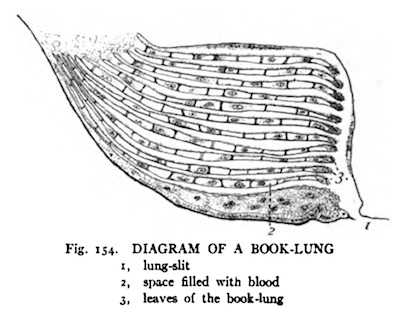
Circus of the Spineless is the undisputed king of invertebrate blog carnivals as it approaches its semi-centennial issue, and Matt Sarver at The Modern Naturalist introduces each contribution in Circus of the Spineless 48: Cabinet of Curiosity with a quote or image dusted off from the cabinet of scientific curiosity. Book lungs, honey pots, crusty love, hairstreaks, hot tigers (beetles, that is!), giant snails, monarchs, caterpillars, and shocked crayfish top the bill this month.

…botanical carnivals are like a box of chocolates: You never know what you’re going to get, but it’s bound to be delicious!

I have a fond spot in my heart for Berry Go Round, as it was the first blog carnival that I ever hosted. This month, Sally White at Foothills Fancies offers a delicious assortment of botanical treats with Valentines for Plant Lovers (BGR #25). My favorite are the white orchids (of course), but the stunning Arisaema photographs and two very interesting fossil plant posts also piqued my interest.

I don’t have a contribution of my own in this month’s Festival of the Trees, but I promote it anyway because it always offers such an exquisite blend of botanical learnings and passionate, almost spiritual writing. Trees evoke something deep in the human psyche, and this reverance is on full display in the quotes used by Jeremy at The Voltage Gate to introduce the posts in Festival of the Trees #45: Voice. Don’t believe it? How about this teaser?

If you were living just across and if I were a tree
In that yard,
I’d delight you with fruit,
I’ll be watered with your glimpse,
just look at me in ardor,
I’d bear the sweetest fruit for you.

…or this one?

I can’t imagine what it must be like to be tree-bereft, or tree-oblivious. I’m sure I’ve not been as open-hearted as I could be with trees, but I’m learning, and they are great teachers.

I’ve often considered Carnival of Evolution to be the most erudite of the blog carnivals that I follow, and Carnival of Evolution #21: The Superstar Edition by Kelsey at Mauka to Makai proves it. Eight of the issue’s contributors are finalists for Research Blogging Awards and one is an award-winning journalist. See what some of the best science bloggers have to say about biology’s biggest superstar (Darwin, of course) and all manner of terminal branches on his tree of life – from bacteria to fish to birds to mammals. I’ll be trying my own hand at the cerebral challenge of hosting this carnival’s next edition on or about April 1st – it would appear I have a tough act to follow.

Don’t forget – An Inordinate Fondness (my favorite carnival!) will make its first journey away from the homesite this month, with issue #2 to be hosted by Amber Coakley at Birder’s Lounge.  Submissions are due by March 15.  Issue #4 of House of Herps is also scheduled for mid-March but apparently still needs a host.  If you’ve never hosted a blog carnival before, why not give this one a try (every blog carnival host was once a newbie)?  If you have hosted a carnival before, you already know how to do it – why not help?  Submissions for this one are also due by March 15, and you can send them to the home site.

Copyright © Ted C. MacRae 2010

Add to FacebookAdd to DiggAdd to Del.icio.usAdd to StumbleuponAdd to RedditAdd to BlinklistAdd to TwitterAdd to TechnoratiAdd to Yahoo BuzzAdd to Newsvine

Email to a friend

Beetle Love

An Inordinate FondnessIt seems like it has been a long time coming, but the Inaugural Issue of An Inordinate Fondness, the monthly blog carnival for the world’s most diverse group of animals (um… beetles), has finally made its debut! I can’t tell you how much pondering, pleading, fretting, and tweaking went into bringing this newest of blog carnivals to fruition, but it was all worth it. My sincerest thanks to everyone who helped me along the way (especially Seabrooke, Amber, Jason, and Mike) and to all who contributed for this first issue. I hope you’ll take a moment to stop by and check out the many fine contributions. If you love beetles, you’ll love this issue. If beetles haven’t exactly turned you on before, maybe you’ll find a new appreciation for them after experiencing the collective passion of the contributors. If you’ve written a post about beetles, perhaps you’ll consider participating in AIF #2 to be hosted by Amber at Birder’s Lounge. I recommend this handy submission form, or contact Amber directly if you prefer. The submission deadline for issue #2 is March 15, 2010.

House of HerpsAlso, Jason over at xenogere has just released House of Herps #3- The Time Machine. Jason has shown himself to be a natural talent at blog carnival hosting, and this edition is no exception. In his unique, singular style, Jason guides you on a trip through time to visit reptiles and amphibians of the past, present, and future.

In celebration of the debut of An Inordinate Fondness, I close with this preview of a feature that CBS did on Christopher Marley for the program “Sunday Morning.” Here is a man who not only shows the same passion for these fascinating animals that many of us feel (though I’m not sure I would characterize Titanus giganteus as “dangerous”), but also has the talent to channel his passion into exquisite works of art (sorry about the commercials!).

Vodpod videos no longer available.
More about “Sunday Morning – Preview: Beetle Art“, posted with vodpod

Okay, after hosting three blog carnivals in the past 4 weeks, I think I’ll go hibernate for awhile!

Copyright © Ted C. MacRae 2010

Add to FacebookAdd to DiggAdd to Del.icio.usAdd to StumbleuponAdd to RedditAdd to BlinklistAdd to TwitterAdd to TechnoratiAdd to Yahoo BuzzAdd to Newsvine

Email to a friend

Hawn State Park – Winter Hiking at its Finest

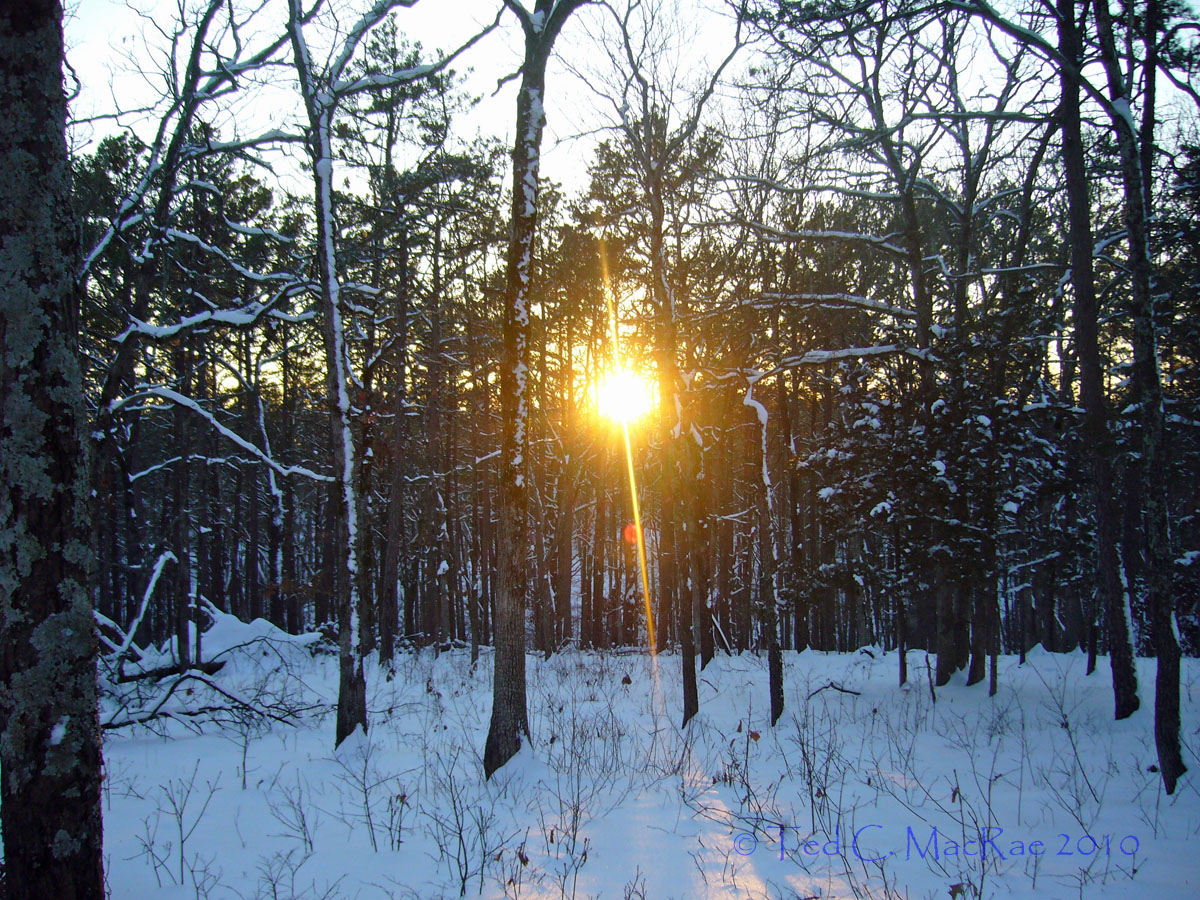
Two weekends ago we received another wave in what has been an unusually frequent series of snow events. I’m sure my northern (and Patagonian) friends are not impressed, but at our middlin’ latitudes snow falls rather infrequently and rarely sticks around for long when it does. This winter has been different, with snowfall almost every week, it seems like, and temperatures that have remained cold enough to keep it around for awhile. While this latest snowfall measured only a modest 1-2 inches here in the St. Louis area, a 7-inch blanket (as measured by my hiking stick) fell in the Ozark Highlands just south of here. Coming as it did at the start of the weekend, I welcomed the opportunity to go for a hike — among my favorite wintertime activities — in a landscape that is rarely seen covered in deep, newly-fallen snow. My daughter Madison loves hiking as much as I do (even in deep snow), so the two of us headed off to perhaps my favorite of Missouri’s public areas, Hawn State Park.  I have long adored Hawn for its premier hiking, facinating geology, and unusual flora, and everytime I visit Hawn I find something new to love about it.  

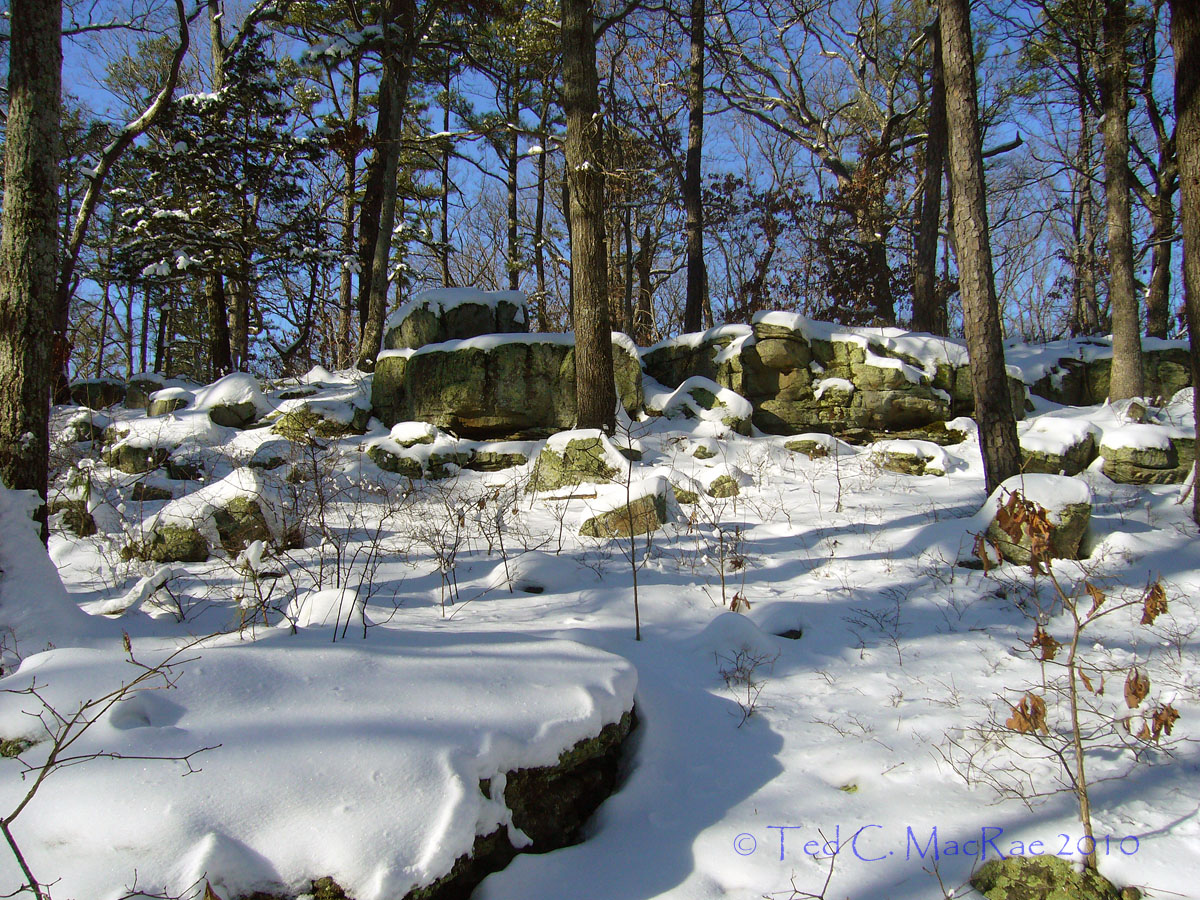
Lamotte sandstone outcrops on the White Oaks Trail


Such was the case on this visit, when Madison and I decided to explore the White Oaks Trail, a newer trail that I had not yet hiked.  I was a little concered whether we would even be able to get to the park, as the road leading into it had only been partially plowed (and we had already seen one car off the road, causing me to reach down and switch on the 4-wheel drive).  Most of the park was snowed in, but we were able to reach the uppermost parking area, leaving our snow-covered trail-finding abilities as the last obstacle to overcome.  After studying the trail map and looking at different route options, I asked Madison if she wanted to hike 2 miles, 4 miles, or 6 miles.  She immediately blurted out “6 miles!”, so off we went.  I was disappointed to see that we were not the first persons to have the idea, as we entered the trail only to find two sets of footprints (one human, one canid) leading off in front of us.  It did, however, make following the trail easier, and in fact I’ve had enough experience finding trails through the Ozark Highlands that I never felt like I needed the footprints in front of us to point the direction.  
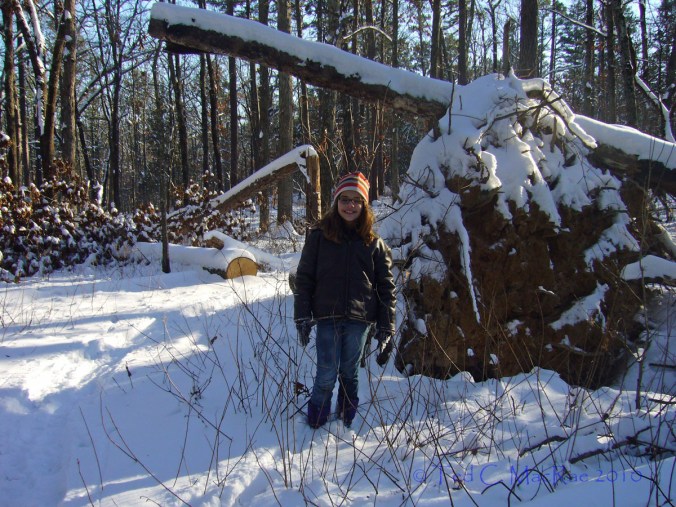
Madison next to the root wad of an 83-yr old wind-thrown oak tree.


The White Oaks Trail followed nicely up-and-down terrain through mature white oak (Querucs alba) (appropriately) upland forest dissected by small riparian valleys before settling into relatively mild terrain through monotonous black oak forest.  Just when I thought the trail wouldn’t match the splendor of Hawn’s Whispering Pines and Pickle Creek Trails, it wrapped around to the south at the far end and passed by a beautiful hoo-doo complex of Lamotte sandstone outcroppingss supporting majestic, widely-spaced, mature shortleaf pines (Pinus echinata).  The rock outcrops provided a perfect spot to break for lunch while looking out on the deep, snow-covered valley in front of us.  
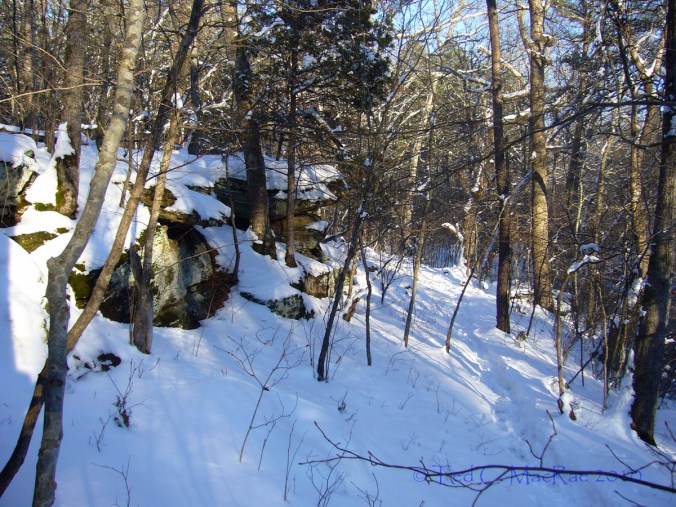
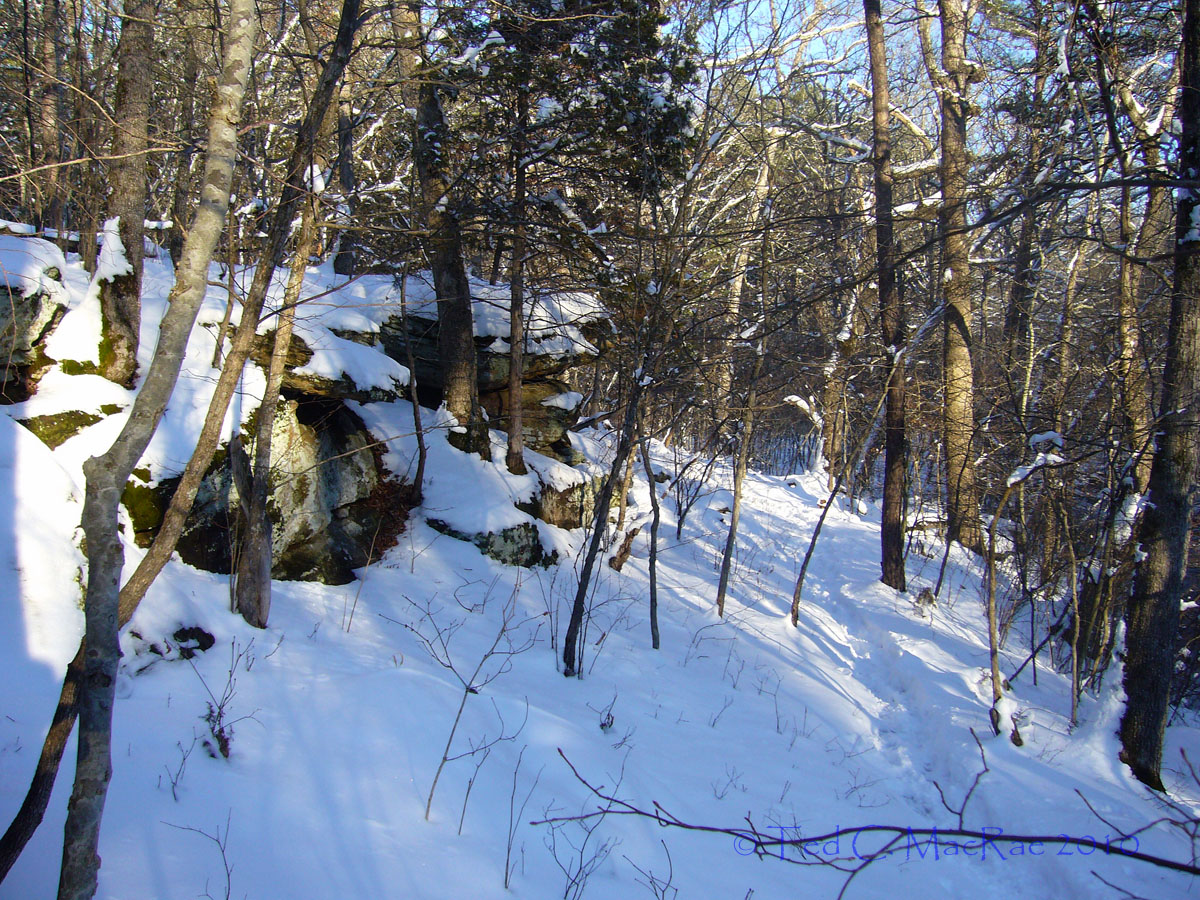
More Lamotte sandstone exposures along Pickle Creek, Whispering Pines Trail.


After counting a cut, wind-thrown black oak (Quercus velutinus) and determining a lifespan of 83 years, we took a connector trail down to the Whispering Pines Trail where it ran alonside the incomparably beautiful Pickle Creek.  Our hope was to hike down to the igneous shut-ins, where hard, pink rhyolites channeled the creek’s clear, spring-fed waters through narrow chutes and miniature gorges.  Upstream from the shut-ins, Pickle Creek runs lazily through the softer Lamotte sandstones that overlay those ancient rhyolites, combining with the snow cover to create a scene as peaceful and serene as any I’ve ever witnessed.

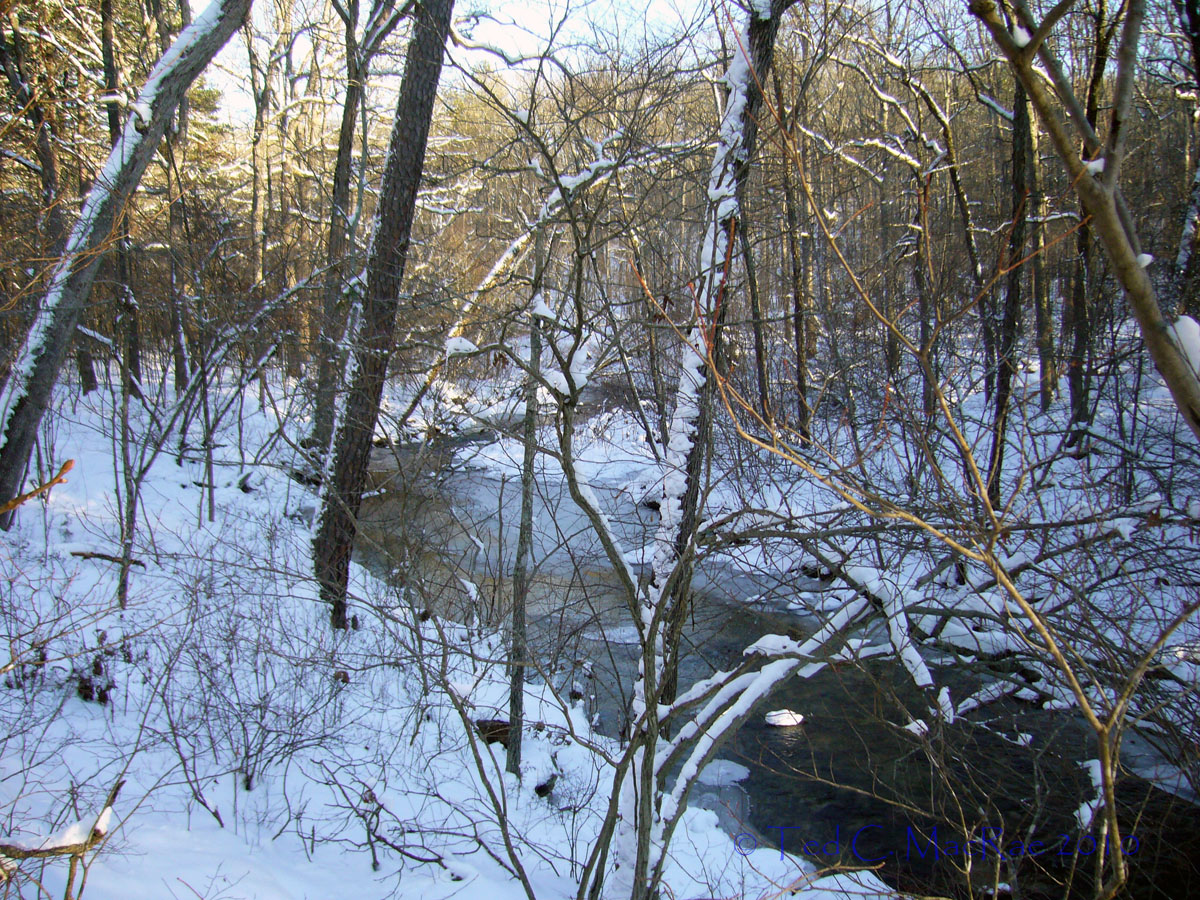
Pickle Creek meanders lazily through Whispering Pines Wild Area.

  
Just above the shut-ins, Pickle Creek bends to the west, carving deeply into the soft sandstone.  The porous nature of the rock allows moisture to trickle through and between the strata from the hillside above, creating seep zones that weaken underlying layers and lead to their collapse.  The abundant moisture this winter and continuous cycles of daytime thawing and nighttime freezes have resulted in extraordinary ice formations along the bluff face and underneath the overhanging layers, the likes of which are rarely seen in our normally more open winters.  Compare the scene in the first photo below with that in the second, taken at almost exactly the same spot one year ago in February 2009.  

Icicle formations along Pickle Creek, Whispering Pines Trail.


Same place as above in February 2009.


Ice rarely forms over the small ponds and lakes that dot the Ozark Highlands, much less its creeks and other moving waters.   The scene below of Pickle Creek as it exits the sandstone gorge is a testament to the slowness of its movements and the unusually consistent cold temperatures experienced during the past several weeks.  Only a short distance downstream, however, these lazy waters reach the bottommost layers of the erodable sandstones and encounter the hard rhyolites below.  These half-a-billion year old layers of igneous rock are much more resistant to the wearing action of water, which rushes noisily through narrowly-carved chutes before fanning out in broad sheets over smooth, steep slopes below.  

Pickle Creek along Whispering Pines Trail.


Sadly, there would not be time to visit the shut-ins.  The short February day conspired with our snow-slowed pace to leave us with a too-low-sun by the time we reached the fork in the trail that led to the shut-ins, a mile in one direction, and our car, a mile in the other.  Although we (both) had thought to carry flashlights (just in case), the last thing I really wanted to do was find myself stumbling over snow-covered trails through the dark with my 10-yr old daughter. Even had we survived the nighttime winter woods, I might not have survived the inevitable maternal reaction to such an escapade.

Arriving back at White Oaks Trailhead with a few minutes to spare.


Copyright © Ted C. MacRae 2010  

Add to FacebookAdd to DiggAdd to Del.icio.usAdd to StumbleuponAdd to RedditAdd to BlinklistAdd to TwitterAdd to TechnoratiAdd to Yahoo BuzzAdd to Newsvine  

Email to a friend

BitB’s Newest Contributor

Those of you who have followed this blog for any length of time have likely noticed fairly regular participation in the comments sections by one James C. Trager.  Occasionally irreverent and always articulate, his informed quips are among those that I have enjoyed the most.  One can surmise from James’ comments that he knows a thing or two about entomology himself, but to say this would be an understatement!  Like me, James is a passionate entomologist whose scientific interests take him deep into many related fields of natural history study.  Unlike me, James is a formally trained insect taxonomist, specializing in ants (family Formicidae).  He has conducted numerous biogeographical and systematic studies on this group, much of it in the southeastern U.S. (list of publications), and is the current project leader for the Missouri Ants and Illinois Ants pages at AntWeb.org (whose ambitious goal is to provide information and high quality color images for each of the ~10,000 known ant species).  James’ deep knowledge of this single taxon, however, does not limit his interest in other insects — singing insects in particular are among his favorites. It is, thus, with great pleasure that I introduce James as the newest BitB contributor.
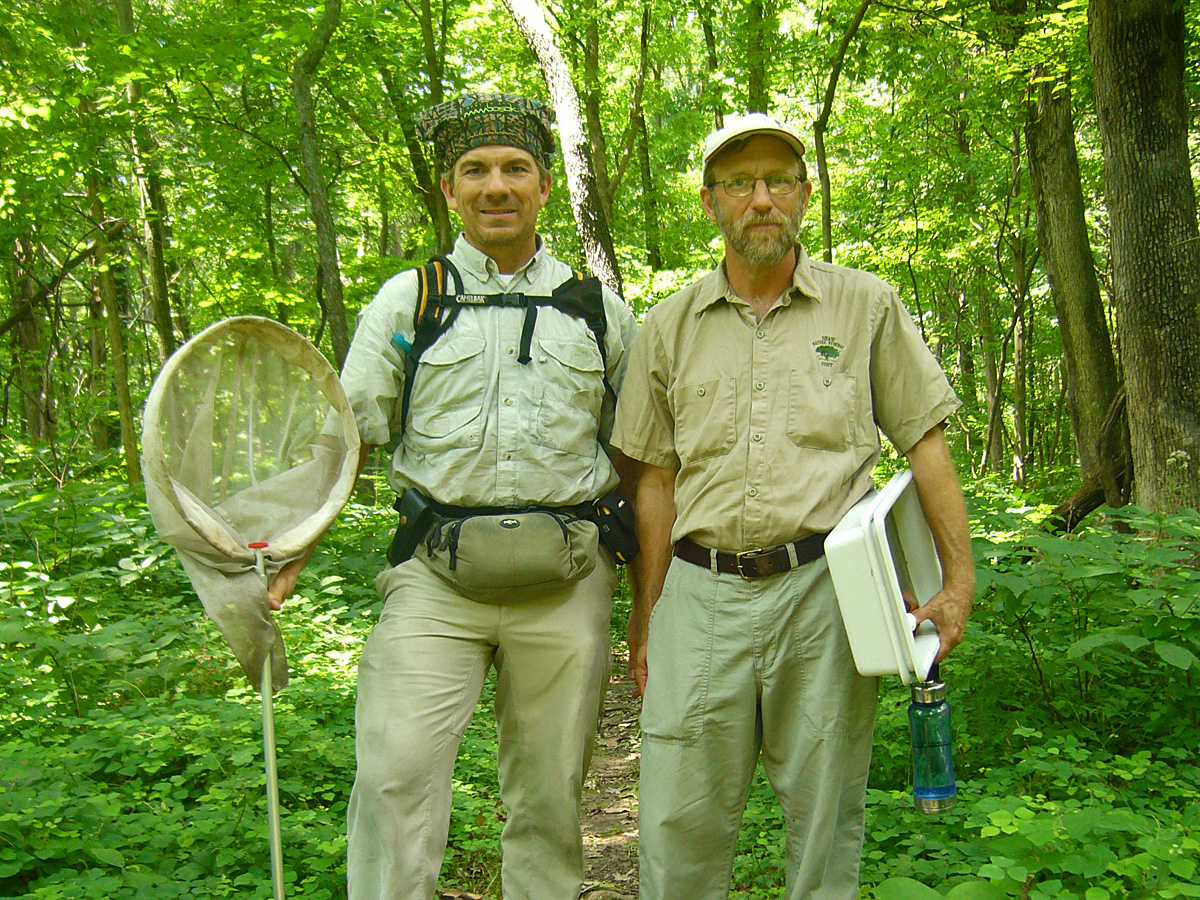
In fact, James and I have known each other for many years, as we are both based in the St. Louis area.  James is a restoration ecologist at Shaw Nature Reserve, a 2,500-acre ecological preserve located in the Ozark foothills (and just 15 miles from my house).  Originally established by the Missouri Botanical Garden for managed plant collections, its recent focus has shifted to environmental education and ecological research, and James has played a key role in their many ongoing wetland, woodland, prairie and glade (xeric limestone prairie) restoration efforts.  This experience combines with his entomological expertise and extensive travel within the U.S. and abroad (e.g., Ecuador) to give him a breadth of knowledge and perspective achieved by few, and I think you will find his writings most enjoyable.  Look for his first post to appear in the next day or so.

Ted & James in restored woodland at Shaw Nature Reserve. Photo by Madison MacRae.

Copyright © Ted C. MacRae 2010

Add to FacebookAdd to DiggAdd to Del.icio.usAdd to StumbleuponAdd to RedditAdd to BlinklistAdd to TwitterAdd to TechnoratiAdd to Yahoo BuzzAdd to Newsvine

Email to a friend

Publications Available

Just a quick note for those of you that have been waiting with baited breath—my Publications page has been completed, with papers previously not in electronic format now available as scanned PDFs.  These include some of my earliest papers (I know everyone is dying to read about leafhopper life histories), as well as more recent papers published in journals that, as yet, have not transitioned into the electronic era.  Of these, the Biography and Memories of my mentor and friend, Gayle Nelson, is perhaps the most useful and will provide the greatest degree of interesting reading.  Also interesting, I think, will be a number of newsletter articles that I wrote in 2004-2006 for Nature Notes (the Journal of the Webster Groves Nature Study Society) that chronicle some of my earlier entomological exploits (before starting this blog as an outlet for such).  Read about:

You may notice my more recent Nature Notes articles contain familiar titles.  The tables have now been turned, with BitB now providing a source of articles for Nature Notes.  These articles are essentially as they appeared on this site (condensed in a few cases).

For those who like antiquities, actual reprints of most refereed journal articles are still available—just ask.

Another website feature that I’ve added is a complete Bibliography containing citations and, if available, links to online sources for all of the books and papers that I’ve cited in my posts.  A link is found on the Contents page, and I’ll make an effort to keep it up-to-date.

Copyright © Ted C. MacRae 2010

Add to FacebookAdd to DiggAdd to Del.icio.usAdd to StumbleuponAdd to RedditAdd to BlinklistAdd to TwitterAdd to TechnoratiAdd to Yahoo BuzzAdd to Newsvine

Email to a friend

geological history

Sunday Matinée: Buzzed Creep Cockroaches

Credit goes to dreptungeek from Romania for finding this.

In other news, the New Year has brought with it a plethora of natural history-focused blog carnivals, including several of my favorites:

  • Circus of the Spineless #46 is up at Kate’s Adventures of a Free Range Urban Primate.  A fine selection of invertebrate posts is featured, including tool-using octopi, deep-sea pelagics, tiny isopods, lotsa bugs (real and colloquial), and, of course, one really impressive fly!  I’ll be hosting the next issue right here at BitB—send me an email with a link to your submission by January 30 if you’d like to participate.
  • Jason Hogle at xenogere has followed up his first blog carnival hosting effort (I and the Bird #115) with the equally impressive Festival of the Trees #43: The Celebration Tree Grove.  Jason deftly weaves the submitted posts into a celebration of trees as providers of sustenance, beacons of spirituality, and victims of our own shortsightedness.  I, sadly, had nothing to contribute to this issue, but I guarantee you will be mesmerized by its meandering passages.
  • The natural history feast continues with Carnival of Evolution #19 at Christie Lynn’s Observations of a Nerd.  Evolutionary tales run the gamut, from tiny orchids to giant caterpillars to really big-headed tiger beetles.  Go take a look.
  • Jeremy at Agricultural Biodiversity Weblog has been on holiday break, but he should be back any day with the 23rd issue of Berry Go Round.  I know for a fact that a stunning terrestrial native orchid will be featured, and I look forward to seeing what other botanical treasures he will have included in this issue.

A final note—don’t forget to check back here on or about January 18 for House of Herps #2 (yes, I’m hosting two blog carnivals this month!).  Send your submissions to House of Herps or directly to me by January 15 if you wish to get in on this new carnival.

Copyright © Ted C. MacRae 2010

Add to FacebookAdd to DiggAdd to Del.icio.usAdd to StumbleuponAdd to RedditAdd to BlinklistAdd to TwitterAdd to TechnoratiAdd to Yahoo BuzzAdd to Newsvine

Email to a friend