To the readership of Beetles in the Bush:
Merry Christmas—may 2014 be filled with good health and fascinating natural history!

Copyright © Ted C. MacRae 2013
No specific plants or animals are discussed in posts within this category.
To the readership of Beetles in the Bush:
Merry Christmas—may 2014 be filled with good health and fascinating natural history!
Copyright © Ted C. MacRae 2013
During my recent Great Basin collecting trip, we stopped briefly at one of my favorite places in the world—Mono Lake in eastern California. My last visit was almost 20 years ago, so it was a thrill for me to see the strange tufa moonscape once again after so many years.
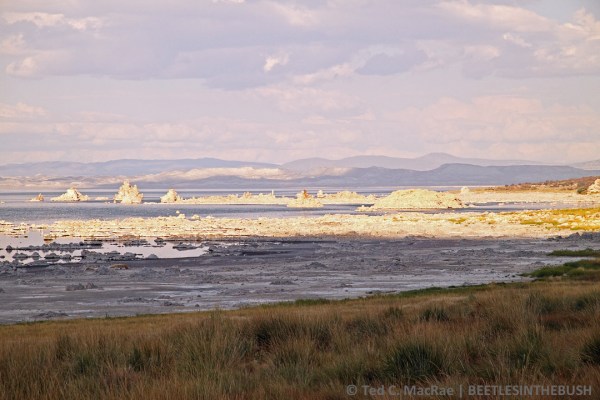
Mono Lake has no eventual outlet to the ocean. As a result dissolved salts in runoff from the surrounding landscape have accumulated in the lake, resulting in water with high pH levels.
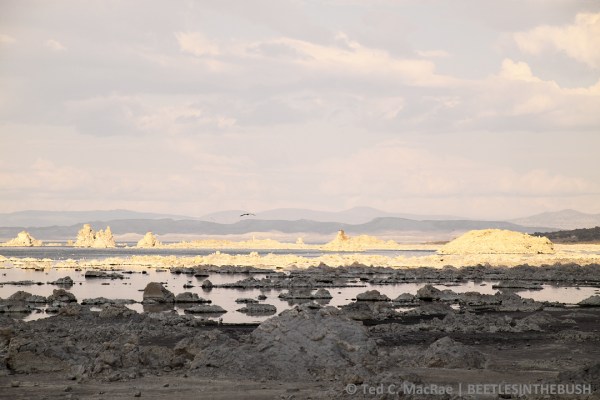
The late day shadows created a black/white tufa landscape.

Conservation actions have raised lake levels from their historical lows resulting from diversion of water to Los Angeles, but they have still not recovered to their former levels.

I held the camera barely above the water’s surface to get this shot. It took several tries to get just a thin sliver of perfectly horizontal water. Yes, it would have been easier to hold the camera higher, look through the viewfinder and then crop, but I wanted the widest view possible (besides, doing that would seem like “cheating”).

Tufa forms when calcium from underwater springs comes into contact with carbonates in the lake water, causing a chemical reaction that produces calcium carbonate (limestone). The calcium carbonate settles around the underwater spring and over time builds a tufa tower. This happens only underwater, and the tufa towers seen here are visible only because of the lowered lake level resulting from water diversion. Unless the lake level is restored completely, these towers are “dead” and will eventually erode away.

Smoke and haze from the Rim Fire burning near Yosemite boils over the eastern slope of the Sierra Nevada.
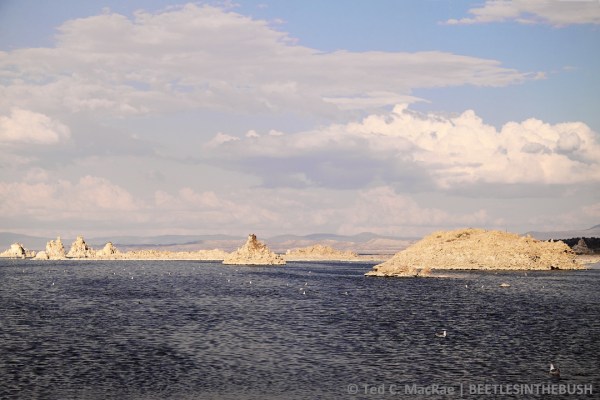
Mono Lake supports the second largest nesting population of California gulls after Utah’s Great Salt Lake.
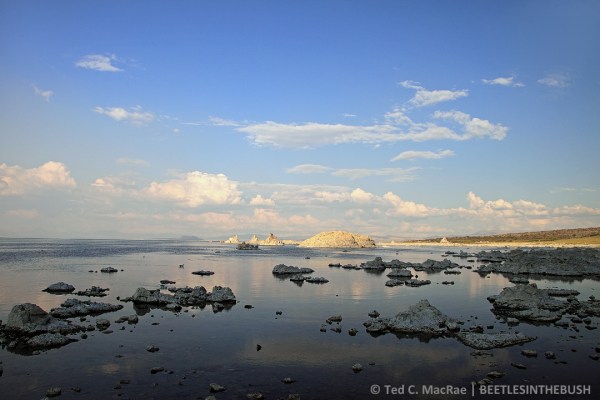
The water level at Mono Lake has dropped not only in recent years because of humans, but over several thousand years. At the end of the last ice age the water level was hundreds of feet higher than today and the lake 5 times its present size.
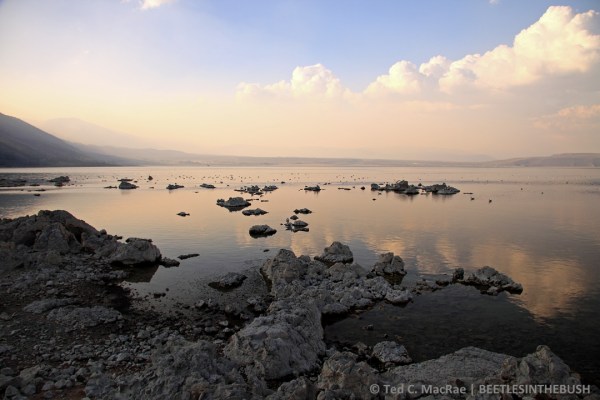
Late day shadows, wildfire haze, and perfectly still waters create a surreal scene.
Copyright © Ted C. MacRae 2013
If you are in the Champaign, Illinois area on Tuesday, 29 October 2013, I will be giving a seminar as part of the Illinois Natural History Survey Fall 2013 Seminar Series. I hope to see you there!
My thanks to Dr. Sam Heads for extending to me the invitation and to Jennifer Mui for preparing the very nice poster and attending to travel details.

Copyright © Ted C. MacRae 2013


Copyright © Ted C. MacRae 2013
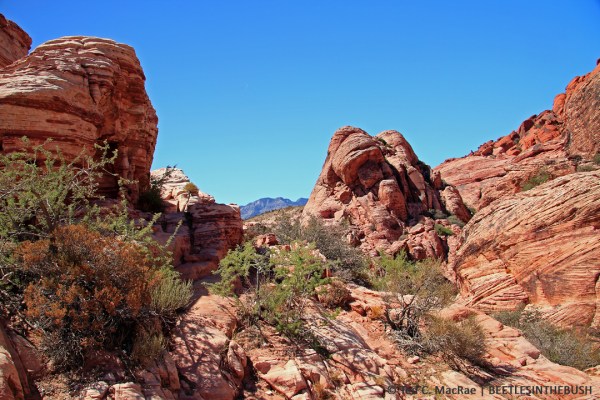
Calico Hills at Red Rock Canyon National Conservation Area | Las Vegas, Nevada.
In mid-August I traveled to Las Vegas with several hundred of my colleagues for week-long, organization-wide meetings. As would be expected, the itinerary was full with little time for diversions, but management was kind enough to call time out on Wednesday afternoon and offer up a choice of activities for us to choose from. Golf, a tour of Hoover Dam, and a massage at the spa were popular choices, but for me and a few other more adventurous sorts the natural choice was a jeep tour of Red Rock Canyon National Conservation Area. I’ll be honest—I hadn’t heard of RRCNCA before then (but then I’d never been nor even had the desire to visit Las Vegas, either), and I’m also not really a guided-tour-sort-of-guy. All I knew was that I was going to have a chance to get outside, at least for short stints, in rugged, natural terrain (something I need a regular dose of in normal circumstances, much less when I’m in the midst of week-long meetings). What I found, however, was an incredible landscape of rock, sky, color and texture that ranks among the most interesting landscapes I’ve ever seen. While I questioned it at the time, I’m really glad I brought my big camera. Not only did the landscape shots turn out so much better than they would have had I decided to settle for iPhone shots, but my long lens (100mm macro) proved to be essential for shots of some petroglyphs that visitors are kept a good distance from. I’ll not go too much into the geology of RRCNCA, as such information can easily be gleaned from Wikipedia (or for more detailed information see this excellent PDF by Tom Battista).
Some of my favorite photos from the afternoon are shown in the following slide show. The photos here are notably free of people (with two very slight exceptions)—more people-based photos featuring the colleagues I was with can be found in my “Red Rock Canyon – Aug 2013” album at my Facebook page.
Copyright © Ted C. MacRae 2013

Dr. Charles L. ”Chuck” Bellamy
Early this week I lost a good friend. Actually, just about everybody who has ever studied jewel beetles in any serious way lost a good friend. Dr. Charles L. Bellamy, arguably the most ardent and prolific buprestophile of our time (possibly ever), died on August 19, 2013 at his home in Sacramento, California. In a career spanning 30 years that took him from California to South Africa and back (twice!), “Chuck” pumped out more than 200 research papers (including nine research volumes and five book chapters), 27 book reviews, and with Art Evans co-authored the popular An Inordinate Fondness For Beetles! Perhaps his most significant contribution, however, was the landmark 5-volume, 3,200+ page, World Catalogue of Buprestoidea—a true magnus opus that serves as a fitting exclamation point to his remarkable career.
I write, however, not about the loss of a respected colleague, but of a true friend. I still remember receiving a letter from Chuck in late 1991 introducing himself to me, congratulating me on the publication of my Buprestidae of Missouri, and suggesting we might have reason to meet due to our common interests. I was, of course, already familiar with Chuck, as he had by then become well established as a leading authority in jewel beetle taxonomy. It was just a few months later that I would have the chance to meet Chuck in person, when I traveled with the late Gayle Nelson to southern Mexico to join Chuck and seven other colleagues at the 1992 Buprestid Workers Gathering. It was on that trip that Chuck and I struck up what would prove to be an enduring friendship. In the following years he and I teamed up on several collecting trips, first to southern California where he “introduced” me to some of southern California’s classic collecting localities such as Jacumba, Ocotillo, and Glamis Dunes, then to southeast Arizona where he introduced me to his close friend Art Evans, and later to South Africa where we spent three weeks in the veldt (a trip that remains one of the best collecting trips I have ever taken). Eventually we began a series of collecting trips to southern Mexico spanning the years 2004–2006. Declining health eventually put an end to these trips, and while I always hoped we would be able to resume them in the future, I knew that realistically his collecting days were behind him. Still, my family and I visited him and his wife Rose in Sacramento whenever we could, and when we couldn’t I enjoyed his almost daily correspondence by email.
Over the years, Chuck became my most important mentor. I remember mentioning to him during one of our trips to Mexico my interest in being an editor of an entomology journal—along with my doubts about whether I could do it. At the time Chuck was the Managing Editor of The Pan-Pacific Entomologist, and he immediately invited me to become the journal’s Coleoptera Subject Editor. Without his encouragement I may not have had the courage to try, and when the role of Managing Editor became available in 2011 he again encouraged me to take on the role. Chuck may have been the ultimate jewel beetle scholar, but he was also an avid sports fan. I remember fondly our two October trips to Mexico; making sure the hotel we checked into each night had cable television so that we could watch post-season baseball. How we enjoyed watching the Yankees fall to defeat in 2004 (my apologies to any New Yorkers that may be reading) and the Cardinals winning it all in 2006! Perhaps my fondest memory of Chuck, however, was having the privilege to fly to Sacramento and watch my friend being honored as The Coleopterists Society’s 12th Honorary Member.
As a remembrance, I have put together a slide show with photos of Chuck through the years. Although I have only a few photographs of my own (lesson learned: take photographs of friends and colleagues over the years!), mutual friends Rick Westcott and Art Evans have sent to me a number of photographs from their archives and graciously allowed me to use them in this slide show. Chuck was a colleague, my mentor, and my friend. I will miss his sage counsel and cerebral wit. I will miss his encouragement and support. But most of all, I will miss having him as my friend. My heartfelt condolences to his lovely wife Rose, whom I and my family have had the great privilege to know.
Copyright © Ted C. MacRae 2013
During the first few years of writing this blog, I maintained an open comment policy with few restrictions on who could comment. In November 2011, however, I began experiencing a flood of spam comments, and as a result I had to implement a new comment policy that included comment moderation for new commenters and the requirement for all commenters to include their name (shown publicly) and e-mail address (not shown publicly). My hope was that the change would end the hundreds of spam comments I was getting each day while minimizing the inconvenience to those leaving valid comments.
Fortunately, the spate of spam has abated, and I think now I can relax the comment requirements. I think such measures do much to inhibit comments, as many people simply find it easier to leave comments at links on outreach sites (e.g. Facebook) rather than the post itself if they have to enter extra information in addition to the comment itself. Remote comments such as this are, of course, appreciated, but my greatest pleasure is in seeing and partaking in the conversations that develop on-site in the direct comments. I also realize that many people simply are not comfortable divulging their name and providing their e-mail address, no matter how secure the site is proclaimed to be. As a result, beginning today I have removed all comment moderation and the requirement to include name and e-mail address when leaving a comment. This means that anonymous comments are once again welcome. By eliminating as many barriers as possible to free, open communication, it is my hope that readers will not only find leaving comments here easy, but also feel comfortable doing so.
Copyright © Ted C. MacRae 2013
Just released from ESA (Entomological Society of America):
Approaching the Unapproachable: Tips and Tricks for Field Photography of Wary Insects presented by Ted MacRae. Learn valuable field photography techniques from Ted MacRae, Senior Research Entomologist at Monsanto Company. Ted specializes in photographing tiger beetles in their natural habitats. These colorful beetles are fast runners and powerful fliers, making them among the more difficult insects to approach. Ted will describe some of the techniques that he uses to obtain close-up and macro photographs of these beautiful beetles and also techniques for field photography of other insects as well.
There’s no cost and you learn right from your desktop, laptop, or smart-phone. This 60 minute webinar takes place August 8 at 2 PM Eastern Time (US Time) and will be a great investment of your time.
Register for the live Webinar, August 8th at 2 PM Eastern Time (US Time).
Unable to attend, an archive of the presentation will be available at http://www.entsoc.org/students/esa-webinar-series for ESA members only.
Make a list of your pressing questions on this topic, as we’ll allow plenty of time for you to participate in the Q & A portion of the session. You may also send in questions prior to the event and this will assure you that the presenter will address your queries.
After registering you will receive a confirmation email containing information about joining the Webinar.
System Requirements
PC-based attendees
Required: Windows® 7, Vista, XP or 2003 ServerMacintosh®-based attendees
Required: Mac OS® X 10.5 or newer
 Beetles In The Bush