After several weeks of traveling to the outer reaches of the St. Louis area, the WGNSS Botany Group pinned their hopes on seeing good fall colors closer to home at Rockwoods Reservation in Wildwood. Despite its proximity to St. Louis, Rockwoods offers visitors a taste of the Ozarks with its mix of dry, rocky ridges, cool, moist ravines, and forested slopes featuring a variety of woodland types depending on substrate and exposure. Several trails are on offer, but the group chose the Rock Quarry Trail as the most likely to provide a diversity of plants and color.
A large (seemingly misplaced) Taxodium distichum (bald cypress) tree right at the trail entrance captured our attention, and numerous globular cones, still green at this point in the season could be seen within its crown. Bald cypress trees are often attacked by a small fly called the cypress twig gall midge (Taxodiomyia cupressiananassa—family Cecidomyiidae) which produces globular galls on the twigs that can be mistaken for immature cones, but despite thorough searching none were found.
As we started up the rocky trail, John noticed several freshly fallen leaves on the ground under a large(ish) tree and picked one up for the day’s first “pop quiz.” Morus (mulberry) or Tilia (linden or basswood), two unrelated trees that bear similar-looking leaves, were the early guesses, but which? The shape of the leaf base—usually symmetrical in the former and asymmetrical in the latter—can be useful but is not consistent. A better way is to break the leaf petiole to check the color of the sap that exudes—milky in the former and clear in the latter. In this case, it was milky, identifying the tree as Morus rubra (red mulberry).
Our late summer and early fall this year was unusually dry with almost no rain from the beginning of August until near the end of October. This year’s fall floral display has suffered as a result, with many of the plants we are seeing in flower now looking rather pitiful compared to if they had grown under more favorable conditions. The recent rains may not have been enough to “save” the season, but the landscape has “perked up” a bit in their wake. By early November, Solidago (goldenrods) and Symphyotrichum (true asters) make up the bulk of the anticipated plants in flower, and we were fortunate to see blooms of several species in these two genera. These included not only some species that we have seen in the past weeks, such as Solidago ulmifolia (elm-leaved goldenrod), Symphyotrichum anomalum (many-rayed aster), Symphyotrichum patens (spreading aster), and Symphyotrichum lateriflorum (calico aster), but also a few that we have not.
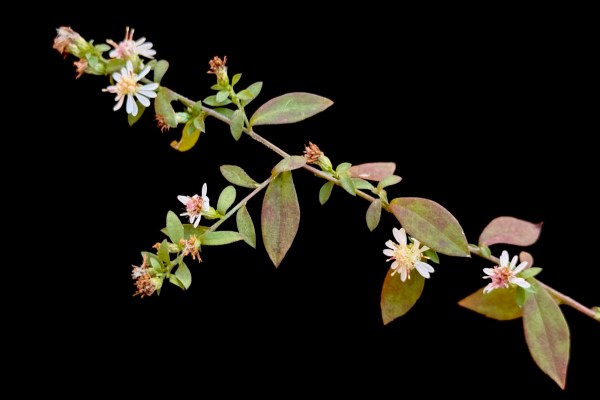
The bulk of these were located in or near a small “glade” on a southwest-facing not far from the trail entrance. The patch of xeric habitat is not a true glade, but rather a scar of past quarrying activity on the southwest-facing limestone slope that has resulted in a glade-like habitat. It was here that a few patches of Solidago rugosa (rough-leaved or wrinkle-leaved goldenrod) were found. This species is similar to S. ulmifolia but usually has multiple stems and sessile leaves with the margins not as coarsely toothed and the veins more deeply impressed, giving the leaf a rugose appearance (on which the species name is based).
We have seen Symphyotrichum oblongifolium (aromatic aster) in true glades the past few weeks (at Victoria Glades and Fults Hill Prairie), and we saw it blooming in this “pseudo glade” as well. Amongst the several plants of this species, however, was a single blue-flowered aster that did not exhibit the same profusely branched and many-leaved growth. This turned out to be the slightly more conservative (CC = 7) Symphyotrichum laeve (smooth blue aster), identifiable by its smooth, completely hairless, narrowly elongate leaves that clasp the stem at the base.
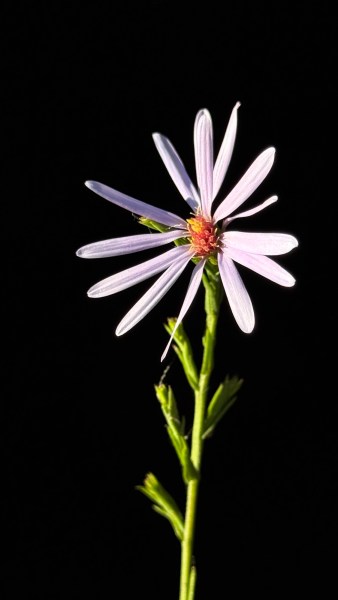

Just beyond the glade and reentering the dry woodland, a single white-flowered aster was seen and determined to represent Symphyotrichum urophyllum (arrowleaf aster) based on its leaves—heart-shaped at the base and gradually becoming more arrowhead-shaped and sessile to nearly sessile further up the stem—and dense, cylindrical cluster of white flowers at the top of the plant.


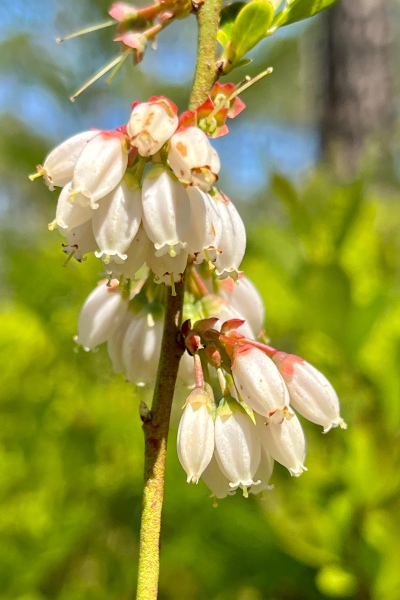
Moving further along the trail, the substrate transitioned from limestone to chert, which was accompanied by the appearance of more acid-loving lichens, mosses, and plants such as Vaccineum pallidum (lowbush blueberry) and Cunila origanoides (American dittany), a few plants of the latter still exhibiting blooms in good shape. The finely divided leaves of Viola pedata (bird’s foot violet), a characteristic occupant of upland forest openings having dry, cherty soils, were common along the steep trailside bank in this area.
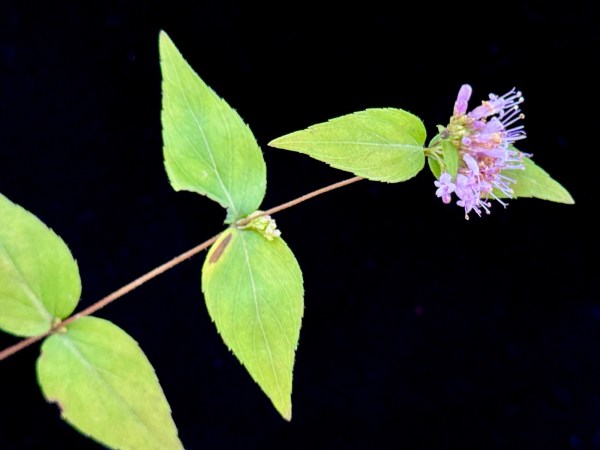
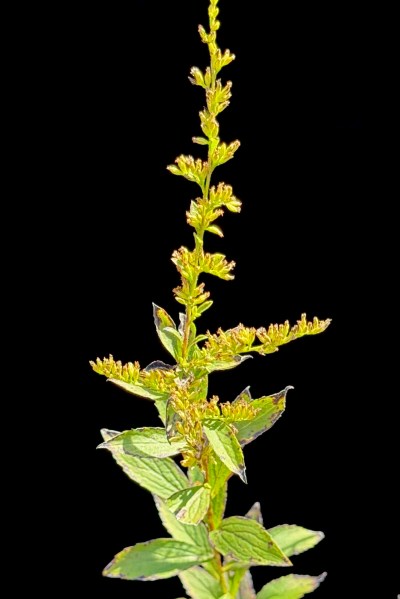
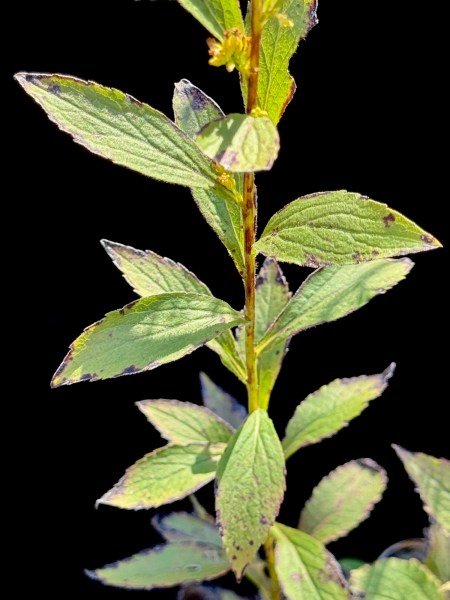
Further up the trail along the ridgetop, we saw a single plant representing yet another acidophile and first sighting for the season—Solidago hispida (hairy goldenrod). This species can be recognized by its single stem, erect, narrow cluster of yellow flowers at the top of the plant, distinctly hairy leaves and stems (especially at the base), and larger basal leaves. It typically inhabits dry, open, and rocky woodlands, especially those with acidic substrates.
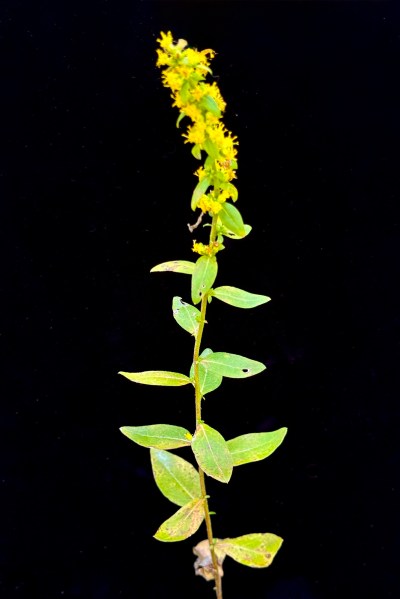

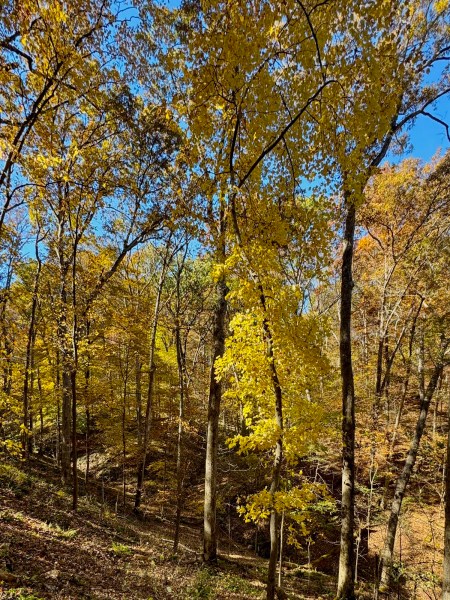
A long gentle descent off the ridge top took the group gradually down into a deep ravine with a tall, dense canopy that contrasted distinctly with the dry, rocky, more open forests seen to that point. Muted browns and yellows of oaks and hickories gave way to vibrant golds, oranges, and reds of hard maples. Polystichum acrostichoides (Christmas fern) was abundant on the north-facing slopes, the darkened tips of their fertile fronds conspicuous against the much more green rest of the plant, and two other fern species were noticed as well: Adiantum pedatum (northern maidenhair fern), a deciduous species with its fronds just starting to senesce, and Asplenium rhizophyllum (walking fern), an evergreen species that spreads vegetatively (“walks”) by rooting to form new plantlets whenever the tips of its long, undivided leaves touch moist substrate. Lindera benzoin (spicebush) was also abundant in the more mesic habitat now being traversed, their just-formed flower buds now sufficiently developed to distinguish male (larger buds) from female (smaller flower buds) plants at a glance.
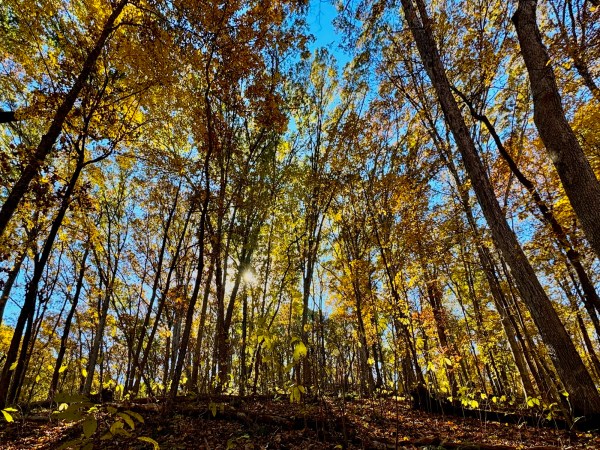
The trail ends up the road a ways from its start, requiring a short roadside walk to return to the parking lot. Despite the presence of asphalt, the group remained on the lookout for plants of interest in the now riparian forest corridor paralleling the road. A fourth goldenrod—Solidago altissima (tall goldenrod)—was seen (its identity confirmed by rubbing its leaves with the fingers to feel its roughness), but the biggest attention getter was a spectacularly large Ilex decidua (deciduous holly or possumhaw) bearing a profusion of bright orange-red berries.

For lunch afterwards, the group chose the ever-popular Clancy’s Irish Pub in nearby Ellisville.
©️ Ted C. MacRae 2025


 Beetles In The Bush