I’ve been taking advantage of my time off the bike to revisit some of my favorite local hiking spots, and today I returned to Young Conservation Area (formerly called Hilda J. Young Conservation Area) in the northwestern corner of Jefferson County. This is one of three conservation areas located within the LaBarque Creek watershed—by far the most ecologically diverse of the Meramec River’s 16 tributaries. The west side between the creek and the parking lot is a bit (okay, a lot) disturbed owing to its former days as a homestead, but the east side features high-quality forests ranging from riparian corridors and rich slopes of white oak to dry chert ridges of black oak and hickory and even a small semi-glade. The 6-mile LaBarque Hills Trail traverses all these habitats and provides some stunning vistas along its southernmost stretch.
For my part, other than the seclusion and exercise, I focused on continuing to learn my winter grasses. Indian grass (Sorghastrum nutans), big bluestem (Andropogon gerardii), and switchgrass (Panicum virgatum) were common in the open areas near the parking lot (none of which I saw on my previous hike at LaBarque Creek Natural Area), while river oats (Chasmanthium latifolium) was seen within the forest, especially in the lower, moister sections of the trail. Also, unlike that previous hike, I saw only a few plants of broomsedge bluestem (Andropogon virginicus) and no little bluestem (Schizachyrium scoparium) at all.
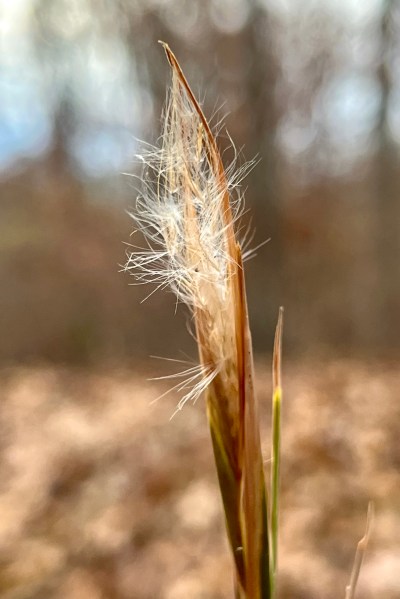
Bottlebrush grass (Elymus hystrix) occurred sporadically along the trail in the lower elevations within the forest, as well as two as yet undetermined species of wild rye (also in the genus Elymus)—one found along the trail inside the forest in moister areas (distinguished by its smaller, “hard-to-strip” seed-heads) and another found only in the much more open semi-glade (distinguished by its much more robust and “easy-to-strip” seed-heads). Nathan Aaron (via iNaturalist) identified the latter as Elymus glabriflorus (southeastern wildrye) based on habitat and season and suggested that the first one could be E. virginicus, which is distinguished by its inflorescence being barely (if at all) exerted from the sheath. Another grass, still undetermined, was found growing in patches in the riparian areas, its foliage still showing much more green than any of the other grasses and often growing intermixed with bottlebrush grass. I collected seed of all of them to sow in the back slope behind my house—the woodland species on the shadier side portions and the sun-loving species in the sunnier central area.


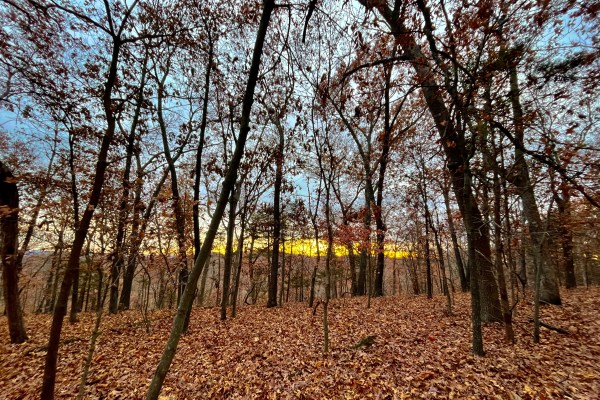
Unlike the lower areas, the upland stretches of trail were nearly devoid of grasses, or any ground layer for that matter other than a few lowbush blueberries (Vaccinium pallidum), but what they lacked in understory floral diversity they more than made up for in spectacular setting-sun vistas. I had to really hoof it during the last couple of miles to ensure that I reached the car before it got too dark, but it felt good to finish the hike with a nice effort. Now, time to jet out a key grasses and think about where I want to hike in the next couple of days.

©️ Ted C. MacRae 2023
 Beetles In The Bush