Earth’s oldest living things!

Westgard Pass

A view down towards Westgaard Pass.

I’ve mentioned before that I am never happier than when I am in the field, especially when it’s an extended insect collecting trip. One problem I face on these trips, however, is the conflict between my desire to stay focused on the task at hand (collecting insects) versus indulging my broader natural history interests—landscapes, botany, geology, etc. The urge to explore increases the further west I go, as the landscape becomes more diverse and unfamiliar, and reaches its zenith in the king of landscapes that is California.

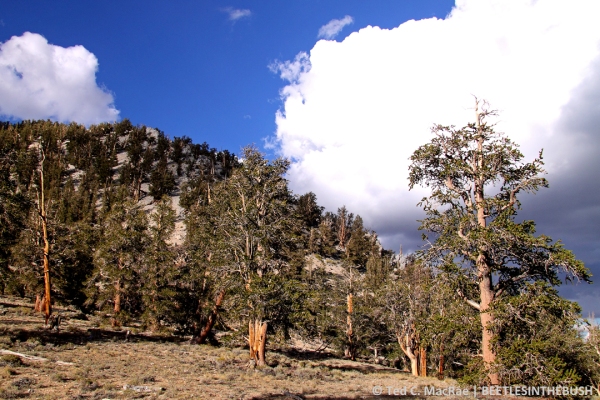
Ancient Bristlecone Pine Forest

Approaching Ancient Bristlecone Pine Forest from the south.

During our Great Basin collecting trip last August, field mate Jeff Huether and I visited the White Mountains near Bishop to look for Crossidius hirtipes nubilus, an isolated subspecies of longhorned beetle (family Cerambycidae) known only from the vicinity of Westgaard Pass. At 7,282′ elevation, the landscape around Westgaard Pass is beautiful enough, but we also knew that lying another 3,000′ above us was one of the most stunning landscapes that anyone even remotely interested in natural history could possibly imagine—Ancient Bristlecone Pine Forest (ABPF)!

Ancient Bristlecone Pine Forest

Entering the Ancient Bristlecone Pine Forest.

While Jeff had previously visited this magical place, I’d not yet had the chance despite my five years in California back in the 1990s (too many places, not enough time!). I had mentioned this to Jeff earlier in the trip, so with small but adequate series of C. hirtipes nubilus in our bottles Jeff suggested we take a break from insect collecting and visit ABPF. I was excited enough about the prospect of seeing these ancient trees, but I could not have anticipated just how bizarre and otherworldly a landscape we were about to see!

Bristlecone Pine Ancient Forest

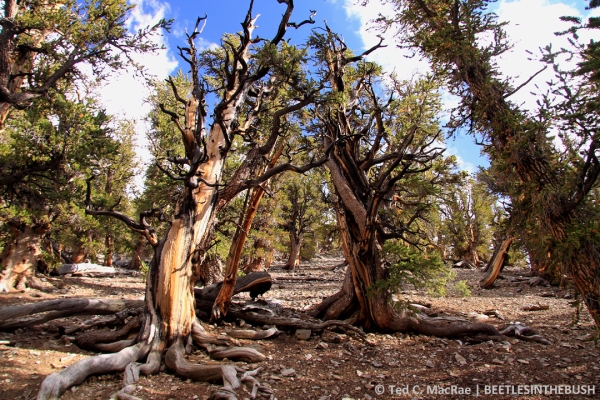
Bristlecones growing in the harshest sites tend to be the longest-lived.

ABPF is, of course, named for the Great Basin bristlecone pines (Pinus longaeva) that occur here, one of three closely related pine species found in scattered, high mountain localities across the western U.S. and widely regarded to be the longest-lived of any non-clonal organism. The oldest known individual tree in the world, measured in 2012 at 5,062 years of age, is a bristlecone that occurs at this very site (although its identity and precise location are kept secret—for sadly obvious reasons), and nearly two dozen additional trees exceeding 4,000 years of age are known to occur here as well. True—there are clonal plants such as creosote bush and quaking aspen that are believed to survive as distinct genotypes for longer periods of time. However, the individual plants themselves are short-lived and quickly replaced by new sprouts from the clonal root mat. A 6,000-year old clonal patch of aspen may be technically older than a 4,000-year old bristlecone, but in my mind only the latter is bona fide ancient!

Ancient Bristlecone Pine Forest

Most older bristlecones have trunks with large sections of exposed dead wood.

In the White Mountains, bristlecone pines are restricted to exposures of white dolomite (giving the mountains their name), usually between 10,000′ and 11,500′ in elevation. We could see the sharp demarcation between the white dolomite—heavily colonized by bristlecones—and non-dolomitic bedrock colonized by shrubs but devoid of pines as we approached ABPF from the south.

Bristlecone Pine Ancient Forest

Dead bristlecones stand with main limbs intact for centuries.

Great Basin bristlecones occur also in the Inyo Mountains and other high mountains sites in Nevada and Utah. Most of these other sites have milder climates that offer more favorable growing conditions for the trees, and as a result the trees at these sites grow faster but—ironically—also die younger (Lanner 1999). Greater moisture availability and soils with more organic matter favor denser stands of trees as well as a richer shrub layer. This results in a greater fuel load that can carry fires, which are generally absent in the White Mountains groves with their widely spaced trees and sterile, rock substrate. Moreover, the harsh, dry conditions in the White Mountains inhibit the growth of fungi that can penetrate and colonize trunks at injury points, and there is a general lack of other threats that exist at milder sites such as bark beetles, sapsuckers, and even porcupines!

Bristlecone Pine Ancient Forest

Bristlecone Pine Ancient Forest

Unlike other pines growing at high elevations, such as whitebark pine (Pinus albicaulis), which develops an almost shrubby, beaten-down form in the face of constant battering by fierce winter winds, Great Basin bristlecones grow solidly upright and develop massive branches supporting a spreading crown. As the trees get older, their outer branches become long and pendulous, drooping under the cumulative weight of numerous, tightly packed needle clusters that can remain on the tree for up to 40 years! (The needles of most pines are shed after just a few years.)

Pinus longaeva male catkins

Bright, reddish-brown male catkins emerge near the tips of the densely needeled branches.

Most of the trees at ABPF grow on steep slopes of barren dolomite with virtually no soil layer, and the trunks of older trees usually bear large sections of exposed dead wood. Over the course of their very long lives, erosion of the rocks on the steep slopes around them gradually exposes roots, killing them and resulting in death of the trunk sections and branches that they feed. In many cases nearly the entire trunk is dead, but the tree lives on in a narrow ribbon of living bark snaking or spiraling up the trunk and connecting the last surviving roots to a single living branch.

Pinus longaeva sapling

A bristlecone sapling represents the promise of enduring life in the face of harsh conditions.

Eventually death does come, but it can take centuries for the dry, cold air to decompose the standing carcass and even millenia for the hard, resinous wood to break down completely once the tree finally does fall. The oldest existing wood at ABPF has been dated to more than 9,000 years old! It is almost incomprehensible to imagine stepping over a log that began life as a sapling shortly after the last glacial retreat and the arrival of the first humans to step foot in North America!

Pinus longaeva cone

Bristlecones are named for, well.. the bristles on their cones!

Why do Great Basin bristlecones live so long? It’s tempting to presume that the dry, high elevation environment, with its long, harsh winters and short, cool growing season enables an unusually slow metabolism that somehow translates to longevity. There is no evidence to support this, however. Perhaps characteristics such as its extremely decay-resistant wood play a part, but there are a few other species of pine that are also extraordinarily long-lived, yet still fall far short of the great ages that can be attained by Great Basin bristlecone pine. These include limber pine (Pinus flexilis), which co-occurs with Great Basin bristlecone pine in the White Mountains, but this species maxes out at about 2,000 years of age. Likewise, Rocky Mountain bristlecone pine (Pinus aristata) in Colorado can reach around 2,500 years of age. (Interestingly, limber pine occurs here as well, but in this area it reaches at best only about 1,500 years of age.) Even Great Basin bristlecones themselves growing at other sites, as noted above, are unable to match the longevity of the trees growing here in the White Mountains. Perhaps, as California conifer expert Ronald Lanner remarked, the question is not why these trees “live so long”, but why they “take so long to die”.

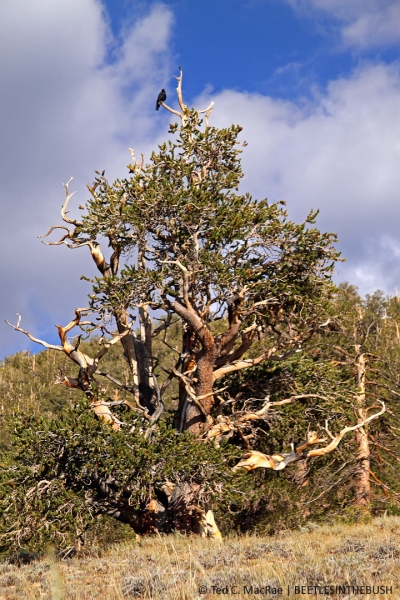
Bristlecone Pine Ancient Forest

A raven perches atop a fine, massively trunked specimen.

REFERENCE:

Lanner, R. M. 1999. Conifers of California. Cachuma Press, Los Olivos, California, 274 pp. [description].

Copyright © Ted C. MacRae 2014

I’m a fun guy!

The habit of looking at things microscopically as the lichens on the trees & rocks really prevents my seeing aught else in a walk.—Henry David Thoreau

I should have loved an opportunity to go for a walk in the woods with Thoreau—especially during the winter when my preoccupation with insects no longer restrains my fascination with all things natural. While many entomologists see winter as a break from field work—a time to indulge/suffer (depending on mood) the more mundane curatorial tasks associated with their studies, my time in the field continues uninterrupted with long walks in the woods. Hiking stick replaces insect net. Energy foods replace vials. I still pry bark and flip rocks—I cannot completely ignore the potential to find insects. But I also peer through miniature forests of moss, poke about the mushrooms on a fallen log, and squint at the lichens encrusting a rock. Yes, insect specimens collected during the previous summer still need to be pinned, but there is time for that. There will always be time for that—if not now then in my later years when my ability to scramble through the bush begins to wane. For now, the woods sing their siren song, and I must listen.

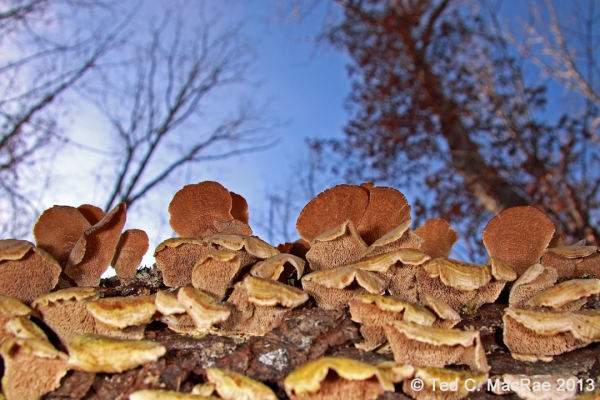
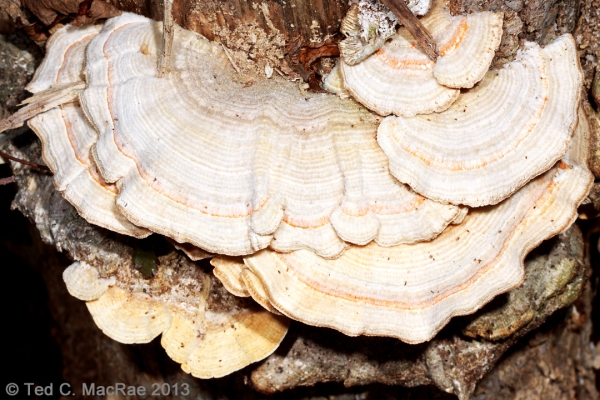
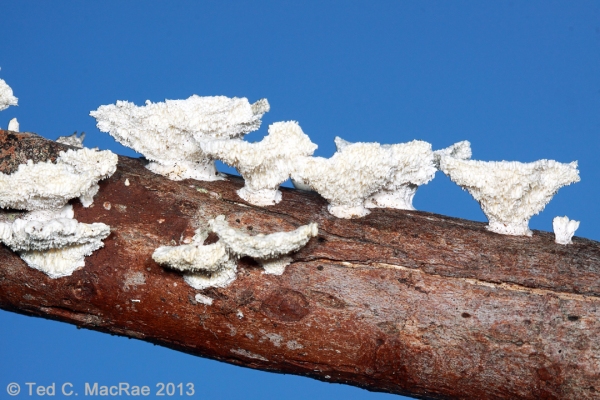
Trichaptum biforme (purple tooth) on fallen river birch (Betula nigra) | Reynolds Co., Missouri

Trichaptum biforme on fallen trunk of Betula nigra | Reynolds Co., Missouri

Purple tooth (Trichaptum biforme) on dead red maple (Acer rubrum) | Reynolds Co., Missouri

Trichaptum biforme on fallen branch of Acer rubrum | Reynolds Co., Missouri

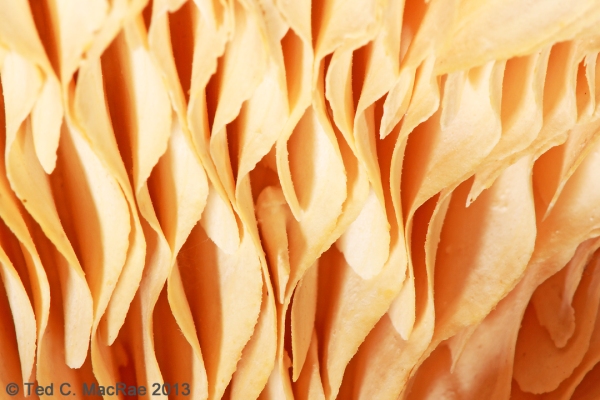
Multicolored gilled polypore (Lenzites betulina) on river birch (Betula nigra) stump | Reynolds Co., Missouri

Lensites betulina on dead stump of Betula nigra | Reynolds Co., Missouri

"Gills" distinguish this shelf fungus from turkey tails and other similar types.

“Gills” distinguish this shelf fungus from turkey tails and other similar types.

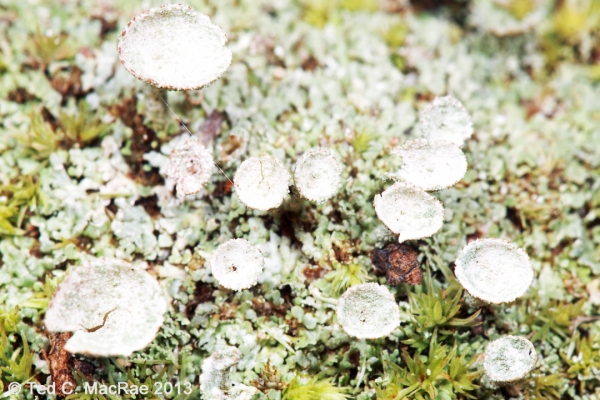
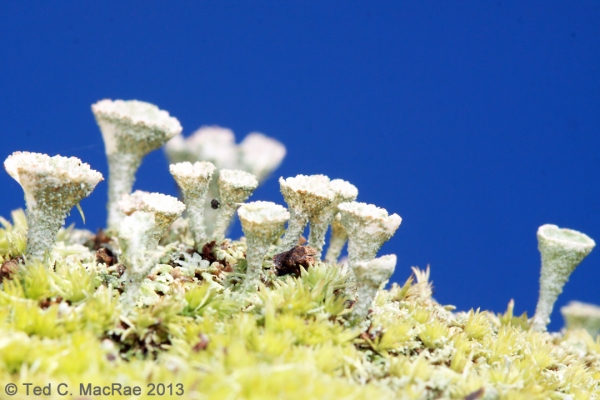
Cladonia chlorophaea or C. pyxidata on chert-trail | Reynolds Co., Missouri

Cladonia sp. (poss. C. chlorophaea or C. pyxidata) on chert-trail | Reynolds Co., Missouri

(Cladonia pyxidata)

A forest in miniature!

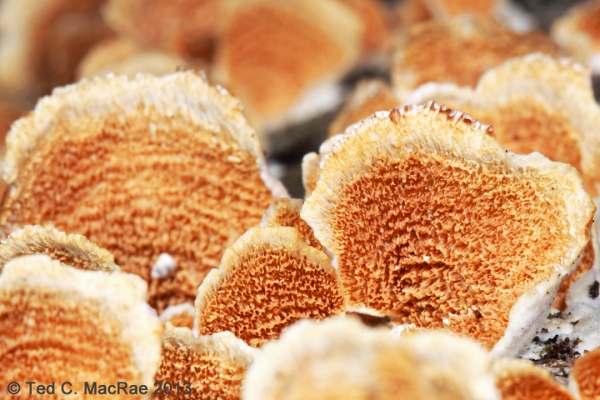
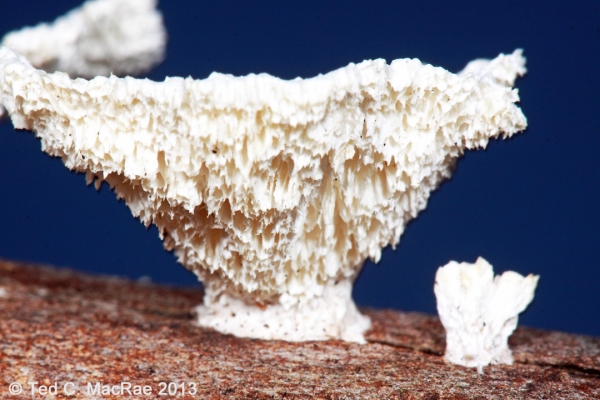
Irpex lacteus? on fallen branch of Acer rubrum | Iron Co., Missouri

Irpex lacteus (?) on fallen branch of Acer rubrum | Iron Co., Missouri

Spores are released from the toothy cap underside

Spores are released from the toothy cap underside

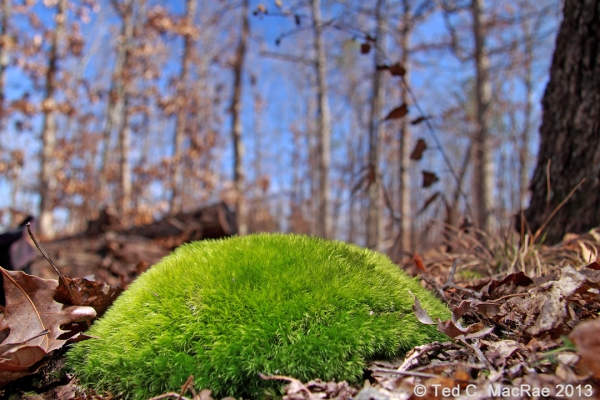
Leucobryum glaucum on forest floor | Reynolds Co., Missouri

Leucobryum glaucum on forest floor | Reynolds Co., Missouri

Postscipt: all photos shown taken on 30 November 2013 while hiking a 7-mile stretch of the Ozark Trail (Karkaghne Section in Reynolds Co. and Middle Fork Section in Iron Co.).

Copyright © Ted C. MacRae 2014

Q: How do you photograph cactus beetles?

A: Very carefully!

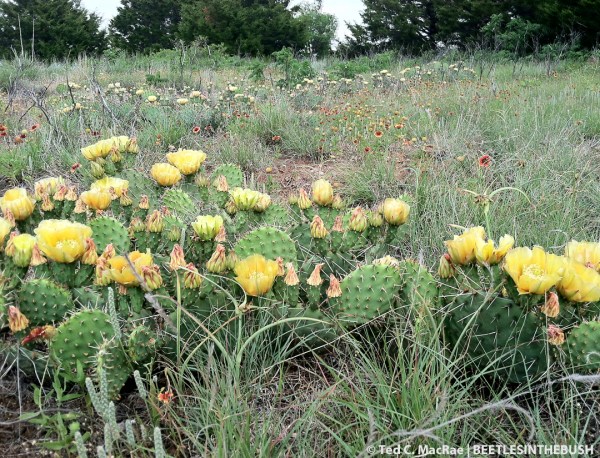
This past June I went out to one of my favorite spots in northwestern Oklahoma—Alabaster Caverns State Park in Woodward Co. The park, of course, is best known for its alabaster gypsum cavern—one of the largest such in the world—and the large population of bats that occupies it. Truth be told, in my several visits to the park during the past few years I have never been inside the cavern. The draw for me is—no surprise—it’s beetles. On my first visit in 2009 I found what is now known to be one of the largest extant populations of the rare Cylindera celeripes (swift tiger beetle), previously considered by some to be a potential candidate for listing on the federal endangered species list, and last year I found the northernmost locality of the interesting, fall-active jewel beetle Acmaeodera macra. This most recent visit was the earliest in the season yet, and as I walked the trails atop the mesa overlying the cavern I noticed numerous clumps of prickly pear cactus (Opuntia macrorhiza) dotting the landscape.

Opuntia phaecantha | Alabaster State Park, Woodward Co., Oklahoma

Opuntia macrorhiza | Alabaster Caverns State Park, Woodward Co., Oklahoma

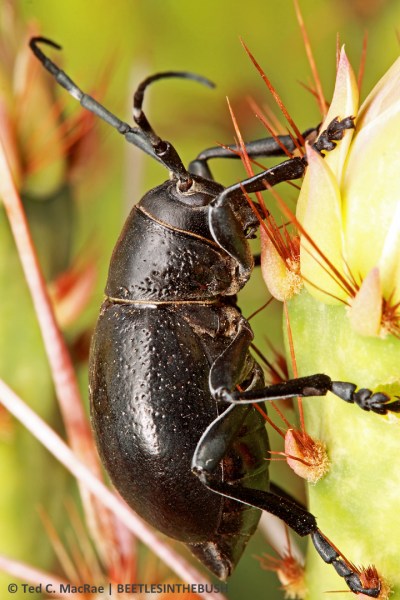
Whenever I see prickly pear cactus anywhere west of Missouri I immediately think of cactus beetles—longhorned beetles in the genus Moneilema. A half-dozen species of these relatively large, bulky, clumsy, flightless, jet-black beetles live in the U.S., with another dozen or so extending the genus down into Mexico and Baja California, and all are associated exclusively with cactus, primarily species of the genus Opuntia. It wasn’t long before I found one, and deliberate searching among the cactus clumps produced a nice series of beetles representing what I later determined as M. armatum. The resemblance between Moneilema spp. and darkling beetles of the genus Eleodes is remarkable, not only in their appearance but also in their shared defensive habit of raising the abdomen when disturbed. The genus has been related taxonomically to the Old World genus Dorcadion, but Linsley & Chemsak (1984) regard the loss of wings and other morphological modifications to represent convergence resulting from the environmental constraints imposed by root-feeding, subterranean habits in arid environments and other situations where flightlessness is advantageous.

Moneilema armatum adult.

Moneilema armatum adult in situ on Opuntia macrorhiza pad.

I have encountered Moneilema beetles a number of times out west, including this species in Texas where it is most common, but since I have only been photographing insects for the past few years this was my first  chance to capture cactus beetle images as well as specimens. The above shot, taken with my iPhone, was straightforward enough, but I wanted some real photographs of the beetle—i.e., true close-up photos taken with a dedicated macro lens. I quickly learned that this would be highly problematic—those cactus spines are long and stiff and vicious, and these beetles are no dummies! Clearly their ability to adapt to such a terrifyingly well-defended plant has had a lot to do with the evolution of their slow, clumsy, flightless, you-don’t-scare-me demeanor. Normally when I photograph insects I do a little pruning or rearranging of nearby vegetation to get a clear, unobstructed view of the subject, and sometimes this also involves “pushing” my way into the vegetation to get the most desirable angle on the subject for the sake of composition. Not so here! In my first attempt, all I could think to do was locate a beetle sitting in repose and try to position myself in some way so that the beetle was within the viewfinder and the cactus’ spines were not impaled within my arms! The photo below shows the only shot out of several that I even considered halfway acceptable, but clearly the spines obstructing the view of the beetle were not going to be to my liking.

First attempt - looking down into plant where beetle was first sitting.

First attempt – looking down into plant where beetle was first sitting.

What to do? The beetle was behaving fairly well (i.e., it was not bolting for cover upon my approach), so I pulled out a pair of long forceps (that I carry with me for just such cases) and used them to gently prod the beetle into a more exposed position. The beetle crawled up onto one of the unopened cactus flower buds and perched momentarily, and I thought I had my winner photograph. I crouched down again, was able to get a little bit closer to the beetle than before, and fired a few shots. Looking at them in the preview window, however, left me still dissatisfied—the beetle was no longer obstructed, but the background was still jumbled, messy and dark, making it difficult for the dark-colored beetle to stand out. I would need to think of something else.

Second attempt - looking down on beetle after coaxing it up.

Second attempt – looking down on beetle after coaxing it up.

I actually take a lot of my photos with the insects sitting on plant parts that have been detached from the plant. This allows me to hold the plant in front of whatever background I choose and micro-adjust the position of the insect in the viewfinder for the best composition. This is “easier” (a relative term) with a shorter lens (think MP-E 65-mm) because the lens-to-subject distance matches almost perfectly the distance between my wrist and my fingers, allowing me to rest the camera lens on my wrist while holding the plant part with my fingers to “fix” the lens-to-subject distance. These beetles, however, are much too big for the MP-E 65-mm, so I had to use my longer 100-mm macro lens. The longer lens-to-subject distance does not allow resting the lens on my wrist, so I must come up with other ways of bracing myself and the subject to minimize movement. Detaching the pad on which the beetle was resting (and if you’ve never tried to detach an Opuntia cactus pad from its parent plant while trying not to disturb a beetle sitting on it, I can tell you it is not an easy thing), I also discovered that the pad was quite heavy and that holding it with the same forceps that I had used to prod the beetle (because of its vicious spines) was yet another unanticipated difficulty. I decided the best way to deal with it would be to get down on one knee in front of the plant, rest my arm on my other knee with the cactus pad extending out in front of me, and photograph the beetle with the plant as close in the background as possible to achieve a lighted and colored background that would help the beetle stand out. Following are examples of those attempts.

Third attempt - holding detaching pad with forceps for better view.

Third attempt – holding detaching pad with forceps for better view.

Detached allows even better close-ups.

Detached allows even better close-ups.

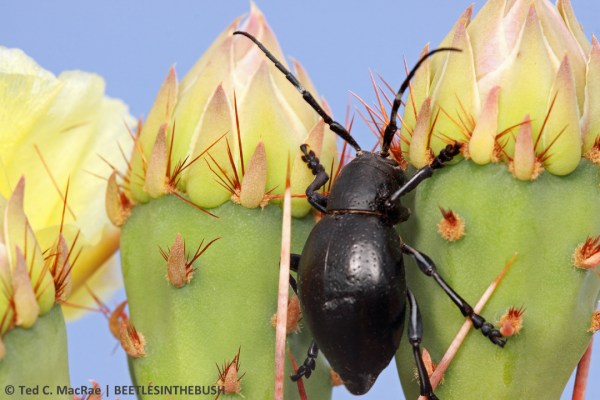
Better for sure, especially the latter, closer one. Still, I wasn’t satisfied—the backgrounds still just had too much clutter that detracted from the beetle and complicated the lighting. I decided to go for broke—why not go for the blue sky background, the cleanest, most natural and aesthetically pleasing background possible! This actually was my first thought when I saw the beetles, but I could never find one on a high enough plant that was growing in a situation where I was able to crouch low enough to get the angle with the sky in the background. By this time my arm was quite weak from holding the heavy cactus pad and squeezing the forceps firmly, and as I contemplated how I could possibly hold the pad up towards the sky and take the shots without being able to rest the camera on my arm I had an idea. Why not rest my arm on the camera? Specifically on top of the flash master unit atop the camera. I adjusted the camera settings for blue sky background, positioned the cactus pad in the forceps so that the pad (and beetle) were hanging down from the forceps but still in an upright position, pointed the camera to the brightest part of the sky (a few degrees from the sun), and then held the cactus pad out in front of the camera with my arm resting on the flash master unit. It worked! My arm still got tired quickly and needed frequent breaks, and I had to do a number of takes to get the exposure settings and composition I was looking for, but the photo below represents my closest approach to what I envisioned when I first knelt down to photograph these beetles. A clear view of the beetle, on its host plant, with lots of nice value contrast between beetle, plant and background.

Fourth attempt - holding detached pad up against sky for cleaner background.

Fourth attempt – holding detached pad up against sky for cleaner background.

Once I had the technique figured out, I was able to get some really close-ups shots as well, still, however, with enough blue sky in the background to make it clean and pretty…

Zooming in with sky background gives a nice, clean close-up.

Zooming in with sky background gives a nice, clean close-up.

…as well as playing with some unusual compositions that one can afford to try only after they are confident they have gotten the required shots. I am particularly fond of the following photo, in which the beetle appears to be “peeking” from behind its well-defended hiding place on its host plant.

Having a little fun with the close-ups - he's peaking!

Having a little fun with the close-ups – he’s peaking!

If you have any experiences photographing these or other such “well-defended” insects (without resorting to the white box!) I would love to hear about them.

REFERENCE:

Linsley, E. G. and J. A. Chemsak. 1984. The Cerambycidae of North America, Part VII, No. 1: Taxonomy and classification of the subfamily Lamiinae, tribes Parmenini through Acanthoderini. University of California Publications in Entomology 102:1–258 [preview].

Copyright © Ted C. MacRae 2013

Great Basin Collecting Trip iReport

During the last week of August, I teamed up with fellow longhorned beetle enthusiast Jeff Huether to look for species in the genus Crossidius. This exclusively North American genus contains a number of colorful species in the tribe Trachyderini that are associated with woody composites in the genera Ericameria and Chrysothamnus (rabbitbrush) and Gutierrezia (snakeweed). While centered in the vast Great Basin in the western U.S., many species occur further east into the Great Plains, west to the Great Central Valley and deserts of southern California, north into southwestern Canada, and south into mainland Mexico and Baja California.¹ Adults of most species emerge during late summer or fall to coincide with the profusion of yellow blooms that appear on their host plants and upon which the adults can be found feeding, mating, and resting. A conspicuous feature of most species in the genus is extreme polytopism—a consequence of discontinuous host plant distributions across the basin and range topography that has resulted in more or less insular local populations. Not surprisingly, the taxonomic history of the genus is complex, but many of the Great Basin taxa are now regarded as subspecies of two widely ranging species—C. coralinus and C. hirtipes (the latter being, perhaps, the most highly polytopic species of Cerambycidae in all of North America).²

¹ Morris & Wappes (2013) recently described and assigned to this genus a species apparently restricted to relict sand formations in southern Georgia. Its highly disjunct distribution, however, along with significant differences in morphology, habits and biology compared to other species of Crossidius suggest that it might more properly be regarded as a distinct genus.

² Not all longhorned beetle enthusiasts accept the current taxonomy, arguing that species such as C. coralinus and C. hiripes merely reflect clinal patterns of variability. I concede the genus needs further work, as did Linsley & Chemsak (1961), whose generic revision forms the basis for current species/subspecies concepts. I will note, however, that the aforementioned authors examined more than 12,000 specimens during the course of their study, and wholesale dismissal of the subspecies they recognized might be premature until a significantly larger amount of material, preferably supplemented with series of specimens from lesser known geographies as well as molecular data from across their ranges, can be examined.

We flew into Reno and spent the first several days in western Nevada. Jeff arrived the night before I did and, thus, had the chance to scope out Davis Creek Park south of Reno during the morning of my arrival. It must have been to his liking, as after he picked me up at the airport we went straight back to the park and found good numbers of what we consider to be C. hirtipes immaculatus on the stands of rabbitbrush at the park. There were at least two types of rabbitbrush present, with the beetles showing a distinct preference for one over the other (vouchers of both plant species were collected for ID confirmation). Thick haze from the ongoing Rim Fire to the south in the Sierra Nevada had settled over the area, greatly limiting visibility and reducing adjacent Mt. Rose to a faint silhouette but allowing some rather spectacular sunset photos of one of my favorite western jewel beetle species, Agrilus walsinghami, which we found in small numbers on both types of rabbitbrush.

Davis Creek Regional Park

Haze from the Rim Fire settles over Davis Creek Park | Washoe Co., Nevada

The following day we drove to several areas further east near Fallon (Churchill Co.) and along Coal Canyon Road near Lovelock (Pershing Co.), where we found good numbers of C. coralinus temprans on gray rabbitbrush (Ericameria nauseosa). In most spots only a few individuals were found—mostly males, but in one spot south of Fallon we encountered good numbers of the beetles (and the heaviest numbers of mosquitoes from nearby Carson Lake that I have ever experienced!). We were skunked in our attempt to find C. h. bechteli, which has been collected at a few spots across northern Nevada, but we knew it would be a long shot since known records of the subspecies are from mid- to late September. Our visit to the area, however, was not for naught, as the sinking sun in the still smoke-filled sky presented a short window of opportunity for more stunning photos of insects at sunset.

Ted MacRae

Using the “left wrist” technique for Crossidius coralinus temprans on Ericameria nauseosa | Pershing Co., Nevada

Day 3 was spent dropping south along US-95A in western Nevada towards Yearington and Wellington (Lyon Co.). We made a number of stops and encountered C. c. temprans at most of the rabbitbrush habitats we sampled, but our real quarry was several named subspecies of C. hirtipesC. h. rubrescens, and in adjacent Douglas Co., C. h. immaculipennis and C. h. macswainei. For much of the day it looked as though we might not find any of the C. hirtipes subspecies, but finally as we approached Yearington we found what we consider to be C. h. rubrescens hiding among the flowers of yellow rabbitbrush (Chrysothamnus viscidiflorus). (In fact, we were actually walking back to the car to leave the spot when we finally spotted a mating pair on a flower. It turns out that we were focusing on the larger Ericameria plants preferred by C. coralinus, rather than the smaller Chrysothamnus plants preferred by C. hirtipes.) Considerable effort was required to collect a decent series and obtain field photographs before the setting sun caused the beetles to retreat and become too difficult to find. It would also be my last opportunity to take dramatic sunset photos, this time with C. hirtipes.
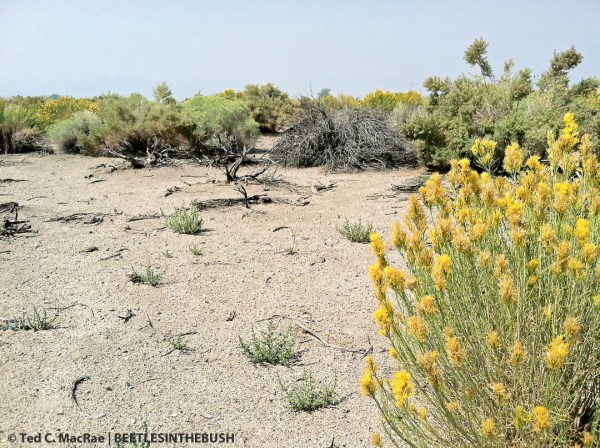
Sage grassland

Sage grasslands with established stands of rabbitbrush is perfect Crossidius habitat | Lyon Co., Nevada

Crossidius coralinus

Preparing to photograph a mating pair of Crossidius coralinus temprans | Lyon Co., Nevada

We continued our hunt for the other two C. hirtipes subspecies mentioned above on Day 4 in the area around Wellington in Lyon Co. and adjacent Douglas Co. Those of you who think Nevada is desolate and monotonous desert should take the drive south of Yearington through Walker Canyon and then south of Wellington through Toiyabe National Forest to Sweetwater Summit. I guarantee this will be some of the most spectacular countryside you have ever seen. As with C. h. rubrescens the previous day, it took some effort and trying several spots before we found a population in Douglas Co. west of Wellington that we consider to represent C. h. immaculipennis. They were co-occurring with almost equal numbers of C. ater, a widespread, all-black species that shows no appreciable variation across its range but which has been implicated in providing melanism to several C. hirtipes subspecies through introgressive hybridization (Linsley & Chemsak 1961). Eventually we decided we had sufficient material of C. h. immaculipennis and drove back through Wellington and south towards Sweetwater Summit, stopping at several spots along the way but finding nothing on either the Ericameria or Chrysothamnus. Finally, at the summit we found a single individual of C. h. macswainei, which I photographed later that evening. At the time we thought it was the only individual of this subspecies that we had collected on the trip, but closer examination of the material collected north of Yearington since returning home suggests that it may actually be a mixture of C. h. rubrescens and C. h. macswainei. [Clearly the taxonomy needs to be adjusted if this is the case; either the two taxa are not valid subspecies (in which case intermediates should also be found), or they actually represent two closely related but nevertheless distinct and partially sympatric species.]
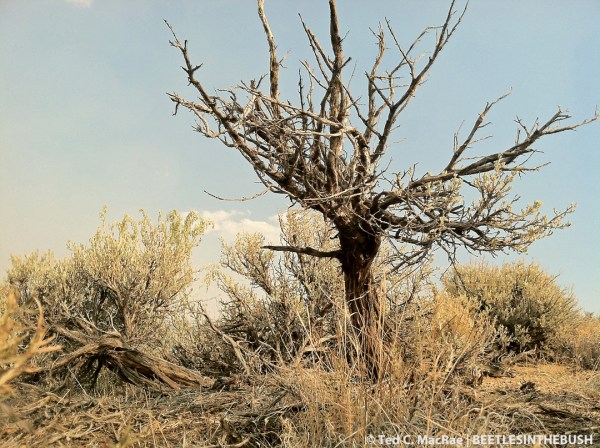
Toiyabe National Forest

Toiyabe National Forest, Nevada—what people think…
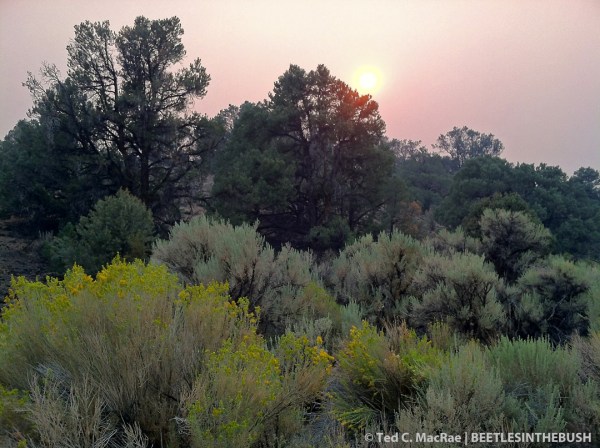
Toiyabe National Forest

Toiyabe National Forest, Nevada—the real thing (made even more dramatic by the setting sun)!

On Day 5 we continued our southward march, crossing over the Nevada-California border along US-95 and dropping south along the eastern flank of the Sierra Nevada—first into Mono Basin and then into Owens Valley. For me it was a return to one of my favorite places on earth, which I last visited way back in 1995 while living in California. We stopped briefly at Topaz Lake and found a few Cicindela o. oregona that proved to be extremely wary (white box photography alert), but our real target was C. h. flavescens, known only from the area around Kennedy Meadow in Inyo Co. Unfortunately, we didn’t pay attention to the county and went instead to Kennedy Meadows in Tuolomne Co.! Needless to say, while we did find some stands of Ericameria we did not find any Crossidius beetles, and it would not be until after the trip was over that we discovered our error. Nevertheless, the drive up the eastern flank of the Sierra Nevada, over Sonora Pass, and partway down the western flank to Kennedy Meadows allowed us to “clean up” on C. ater and offered spectacular scenery despite the continued cloaking of haze from the now much nearer Rim Fire. Jeff also managed to find the only specimen of C. punctatus that we would see on the trip.

Sonora Pass

Sonora Pass | Mono/Tuolomne Co., California
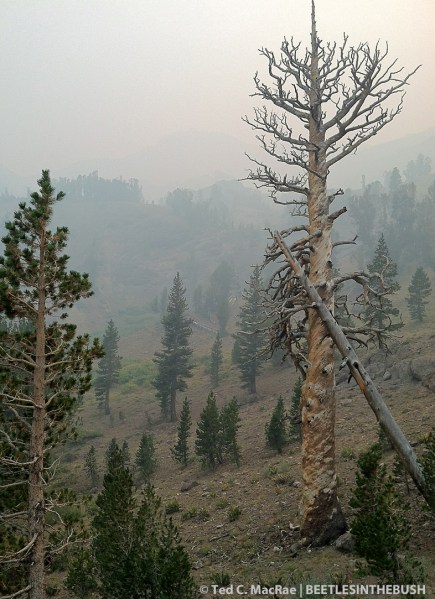
Pinus contorta murrayana

Lodgepole pine (Pinus contorta murrayana) cadaver at Sonora Pass

We continued south along US-95 into Mono Basin towards a locality near Mammoth Lakes to look for the spectacular orange subspecies C. c. monoensis. Of course, one cannot drive right through the Mono Lake area without stopping and every Vista Point and at the lake itself to admire its strange, almost moonscape-like tufa towers. It was getting late in the day, so I found myself in a bit of a race to photograph the towers before they were covered by the advancing shadows from the Sierra Nevada to the west. I did not succeed completely, but the resulting photos with contrasting “black and white” towers made for nevertheless interesting photos.
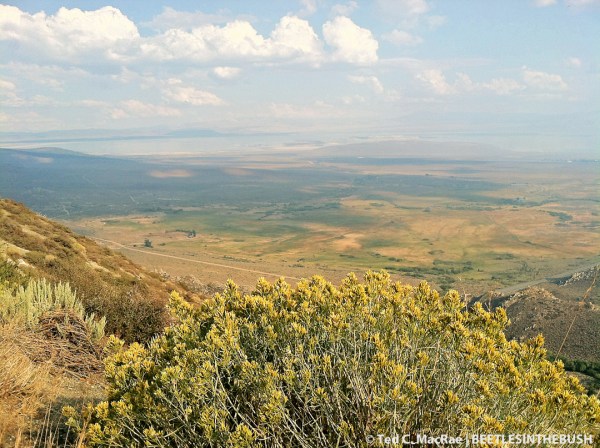
Mono Lake Vista Point

Mono Lake Vista Point along US-395 | Mono Co., California
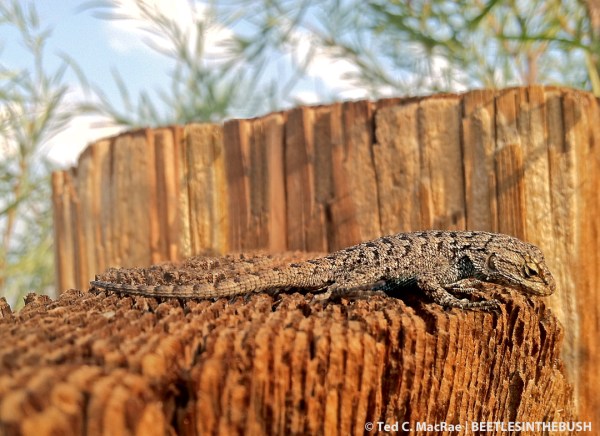
Great Basin fence lizard (Sceloporus occidentalis longipes)

Great Basin fence lizard (Sceloporus occidentalis longipes) at Mono Lake Vista Point

Mono Lake

Tufa towers at Mono Lake | Mono Co., California

Mono Lake

Late afternoon shadows create an interesting “black/white” contrast between shaded and sunlit tufa.

Eventually we resumed our southward trek and, with daylight waning rapidly, arrived at a spot near Mammoth Lakes where Jeff had taken C. c. monoensis in the past. We were rewarded with a few males and females, and I was able to take some rather spectacular field photographs of each. Until now, all of the C. coralinus I had seen were deep red and black, but these were bright orange with only a little bit of black—gorgeous! After failing in our attempt to find C. h. flavescens, finding this subspecies rescued the day as a success, and we were able to complete our drive into Bishop and spend the next day focusing on additional subspecies in Owens Valley and the White Mountains.

Sierra Nevada

The eastern slopes of the Sierra Nevada rise dramatically in the distance | Mono Co., California

Sierra Nevada

Mono Basin near Mammoth Lakes (7000 ft)—locality for Crossidius coralinus monoensis | Mono Co., California

Our first stop on Day 6 was just a short 2.5 drive north from our hotel in Bishop, where we found a very nice population of C. c. caeruleipennis. If you think C. c. monoensis is spectacular, wait until you see this subspecies bearing the same bright orange coloration as C. c. monoensis but larger and even less maculated with black—the males are almost pure orange! I presume we were on the early side of things (as with most of the populations we found), as the plants were just on the early side of blooming and the majority of individuals encountered were males (which tend to emerge earlier than females). The occasional E. nauseosa plant in full bloom often had several individuals on it, including mating pairs.

Sage grassland

Owens Valley near Bishop (4000 ft)—locality for Crossidius coralinus caeruleipennis | Inyo Co., California

With success already in hand, we continued south into the White Mountains to the area around Westgard Pass where a particularly dark subspecies—C. h. nubilus is known to occur. As we experienced earlier in the week, success did not come until we stopped searching the larger, more conspicuous Ericameria plants and focused on the much smaller and less conspicuous C. viscidiflorus plants. While I did manage to take some field photographs, the beetles were not numerous and I held some alive for photographs in the hotel room later than night. The beetles also seemed to be curiously patchy in their occurrence, with large stretches of seemingly good plants hosting none and the majority found in two small, localized spots in the area west of the pass.

Westgard Pass

Pinyon-juniper zone near Westgard Pass—locality for Crossidius hirtipes nubilus | Inyo Co., California

Under normal circumstances, I would have been content to close out the day looking for additional beetles to strengthen my series in the hopes of getting a good representation of the variation present in the population, but these were not normal circumstances—we were only a short drive from Ancient Bristlecone Pine Forest. Despite living in California for five years back in the 1990s, I never took the opportunity to visit this place and explore its incredible stands of Great Basin bristlecone pine (Pinus longaeva). The oldest non-clonal tree in the world, dated to nearly 5000 years old, occurs in this area, and many of the trees in the forest range from 1000–2000 years old. Indescribable is the only adjective that I can offer for one’s first sight of these trees, many gnarled and grotesquely twisted by age and wind, the older ones often with nothing but a narrow strip of living wood connecting the roots to a small group of live branches on an otherwise dead tree.
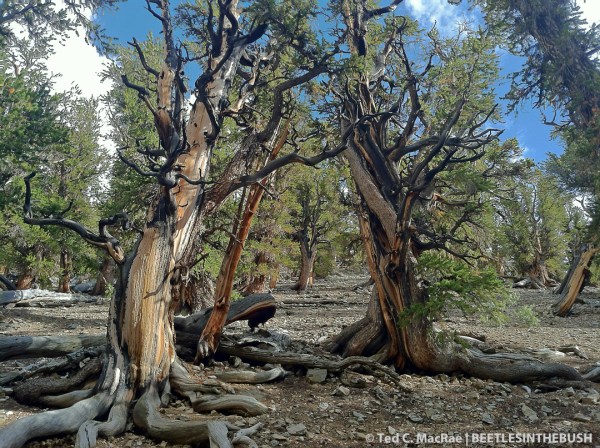
Pinus longaeva (bristlecone pine)

Great Basin bristlecone pines (Pinus longaeva) | Ancient Bristlecone Pine Forest, Inyo Co., California

Ted C. MacRae

Sitting next to an ancient cadaver—who knows how old it is?
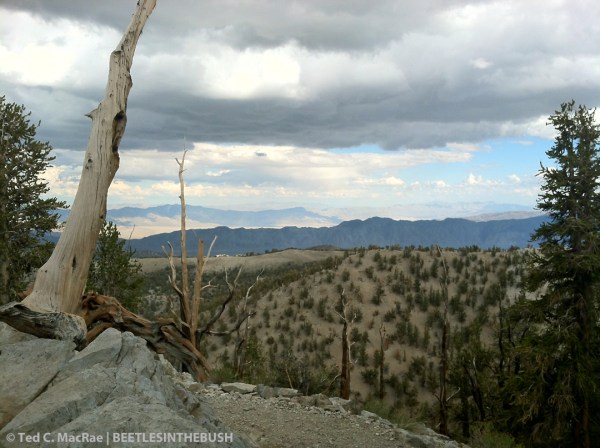
Bristlecone Pine Ancient Forest

Spectacular vistas around every bend at Ancient Bristlecone Pine Forest.

Pinus longaeva (bristlecone pine)

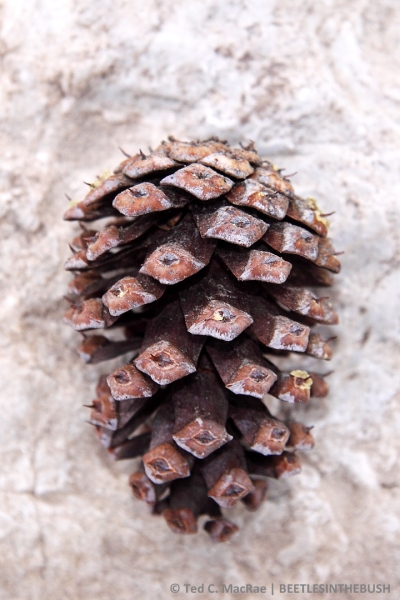
Female cones bear longish, incurved bristles on the tips of their scales.

Bristlecone Pine Ancient Forest

Great Basin bristlecone pines are restricted to high elevations in California, Nevada, and Utah.

On Day 7 we left Bishop and headed back north to Mono Basin to take another shot at C. c. monoensis and also look for C. h. rhodopus, the latter being a particularly reddish subspecies known only from Mono Basin. We had not seen the latter in our cursory look at Mono Basin habitats two days ago, and it continued to elude us at several stops in areas supporting the C. viscidiflorus host plants on which we expected it to occur (although we did manage to find a few more C. c. monoensis at the locality near Mammoth Lakes). I had collected C. h. rhodopus almost 20 years ago—my last trip to the Mono Basin—at a spot in the Benton Range at the south end of the Mono Basin (which also happens to be the type locality for the jewel beetle Nanularia monoensis, described by my late friend Chuck Bellamy in his 1987 revision of the genus). As a remembrance of Chuck I thought it would be nice to find and photograph N. monoensis as well, so we headed towards the Benton Range as our last stop in California before heading east through the Great Basin to look for additional C. hirtipes and C. coralinus subspecies. As we drove, we saw robust stands of C. viscidiflorus in Adobe Valley stretching south of Mono Lake towards the northern terminus of the White Mountains and decided to stop on the chance we might find C. h. rhodopus there. It’s a good thing we did, as the beetles were out in force. I tried photographing some individuals in the field, and while I did get some decent shots the beetles were generally too flighty and active to justify the effort. I was also anxious to look for N. monoensis, so I put a live male and female in a vial with a piece of host for photography later that evening and we continued towards the Benton Range.

Adobe Valley

Adobe Valley near the White Mountains—locality for Crossidius hirtipes rhodopus | Mono Co., California

Despite its close proximity to the comparatively lush Adobe Valley, conditions in the Benton Range were exceedingly dry. We searched around a bit, but it was apparent by the lack of any herbaceous plants or fresh growth on perennial plants that the area had not received rain for an extended period of time. In fact, I could not even find a single buckwheat (Eriogonum kearneyi var. monoensis) plant on which to search for jewel beetles. The only beetles seen were an aggregation of ~15 C. ater and C. h. rhodopus adults on a single E. nauseosa plant that, unlike the other plants in the area, somehow managed to achieve full bloom. Nevertheless, it was great to visit the locality and rekindle memories after so many years absence. Once we convinced ourselves that there were truly no more beetles to be had, we began the first leg of our long, 2-day drive across the southern Great Basin for the final phase of the trip.
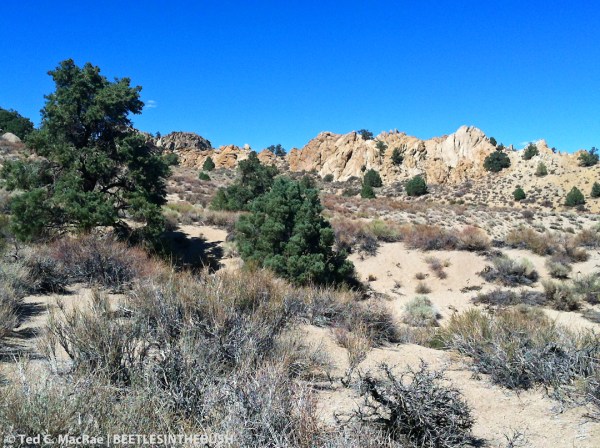
Benton Range

The Benton Range is the type locality of Nanularia monoensis | Mono Co., California

Benton Range

The White Mountains form a dramatic backdrop behind the Benton Range | Mono Co., California
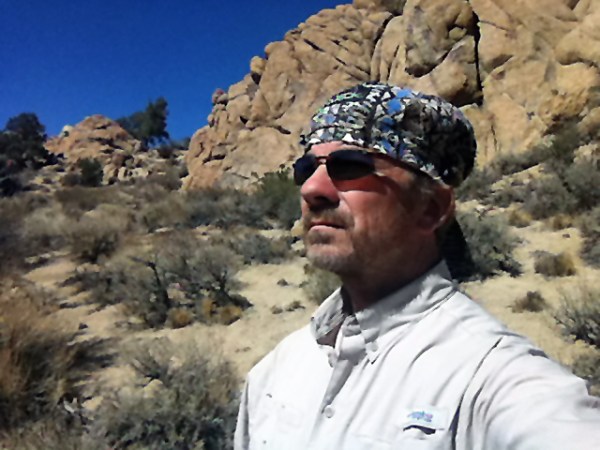
Ted C. MacRae

The author takes a “pensive” selfie | Benton Range, Mono Co., California

We spent the night in Tonapah, Nevada and began Day 8 by driving east along US-6, stopping along the roadsides periodically whenever particularly promising-looking stands of Ericameria/Chrysothamnus were seen. We had expected to begin finding populations assignable to subspecies C. h. brunneipennis as soon as we left Tonapah, but for the most part searching during the morning hours was fruitless. We did find single male and female examples from south-central Nevada of what seems to best fit C. coralinus coccineus (known mostly from southwestern Utah), but it was not until late morning when we were within about 30 miles of Ely in east-central Nevada that we began finding adults of C. hirtipes brunneipennis. At first they were scarce and difficult to find, ensconced as they were within the flowers of their C. viscidiflorus hosts, but shortly they began to appear in great numbers and offered opportunity for field photographs and good series. We had observed on several days of the trip that C. hirtipes began ‘disappearing’ during late afternoon, in contrast to C. coralinus which tended to settle down within the flowers of their host plant where they could be found even at dusk (and perhaps all night had we searched for them at that time). I now believe that C. hirtipes tends to crawl down to the base of the host plant to spend the night and requires some period of warming temperatures before they come back up to the flowers the following morning, and that this is the reason why we did not succeed in finding populations further to the west in the areas we searched after leaving Tonapah in the morning. In contrast, we rarely failed to succeed in finding C. coralinus in the locations where they occur during early morning or early evening hours.

A short drive further east to Ely got us within range of the darkened subspecies C. h. cerarius, and at the first stop south of town sporting a good stand of C. viscidiflorus we found this one also in good numbers. Another short drive further east to near the Utah border brought us within the western limit of the final C. hirtipes subspecies that we were targeting—C. h. wickhami. Unlike the previous subspecies, which has an extremely limited distribution in east-central Nevada, C. h. wickhami is widespread from east-central Nevada across western Utah and northern Arizona. We waited until we crossed the Utah border, stopped at the first stand of C. viscidiflorus that we saw, and found decent numbers of this subspecies distinguished by its light coloration and distinct sutural stripe.
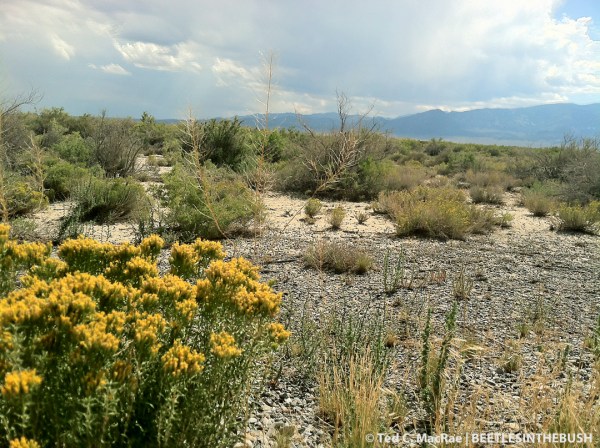
Great Basin desert

Yellow rabbitbrush (Chrysothamnus viscidiflorus) host for Crossidius hirtipes wickhami | Millard Co., Utah

We needed to make it to Moab, Utah in the evening, so we began the long trek across southern Utah. There is another C. coralinus subspecies known from southwestern Utah that we could have targeted—C. c. coccineus, but we had both already collected examples of this subspecies in Cedar City, Utah during a tour of the Great Western Sand Dunes two years ago. Finding a male and a female of what seem to be this subspecies fulfilled my desire for photography subjects, and there were additional C. coralinus subspecies to be had further east that I had not yet collected. As I first learned two years ago, and which was again confirmed on this trip, southern Utah has some of the most dramatic scenery in all of the western U.S. Period! The photos below are but two examples of the many spectacular sights that I saw, and more now than ever I hope to return to this area in the future for serious exploration.
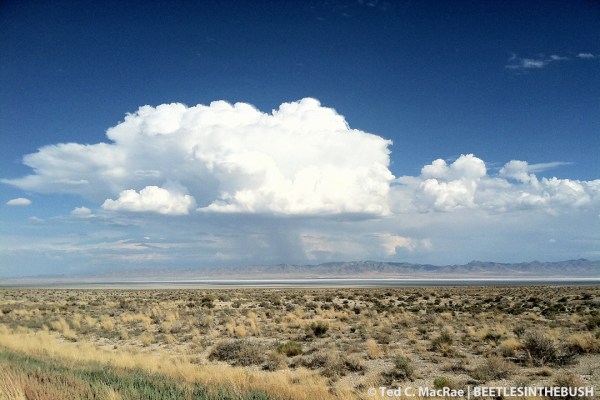
Sevier Lake

A thunderstorm settles over the Cricket Mountains behind Sevier Lake | Millard Co., Utah

Devil's Canyon

A late afternoon rainbow dissipates over Devil’s Canyon | Emery Co., Utah

The last field day of a trip is always a bit melancholic—I’m never happier than when I’m in the field, and when I’m having particularly good luck it makes the end of the trip even harder to think about. The best cure for melancholy, however, is more success in the field, and Day 9 started off with a bang. We had driven less than 40 miles south of Moab when we saw good looking stands of E. nauseosa and C. viscidiflorus, and on the very first plant we checked sat a spectacular female representing the robust, bright red and heavily marked nominotypical C. coralinus. Only a few more were found during the ensuing search until I found a “mother lode” plant hosting two mating pairs and three singletons. As it was still fairly early in the morning, the beetles were quite calm and I was able to fill my photographic quota of the subspecies with nice field shots of both sexes. We stopped at several more spots as we approached and crossed into Colorado, including Cortez where we found nice numbers of super-sized individuals. Mindful of the time, we tore ourselves away and continued east to the area around Fort Garland in south-central Colorado, where Jeff had previously seen C. c. jocosus—similar to C. c. coralinus but unusually diminutive in comparison. Anticipation, however, got the better of us before we made it to Fort Garland, for after passing through the San Juan Mountains we stopped at a few spots around Monte Vista on the western side of the San Luis Valley (Fort Garland lies further east on the opposite side of the valley). Good fortune awaited us, as we found a handful of individuals at two sites that appeared to represent C. c. jocosus, reducing the importance of getting to Fort Garland and finding them there. The sites where we found these beetles might represent the western limit of distribution for the subspecies, which would seem to be isolated from C. c. coralinus by the intervening San Juan Mountains. It’s a good thing we stopped at those sites, as further east near Fort Garland nearly all of the plants were past peak bloom and no beetles were seen. Only a last ditch stop at a stand of plants just east of Fort Garland produced a single male and single female to add to those we had collected earlier, but it was enough to put a smile on the face and make it easier to accept that a long, successful trip had finally come to an end. We recounted our successes during the 3-hour drive to Denver: 14 of 16 targeted taxa successfully located, plus an additional three taxa not targeted for a total count of 17 named taxa.
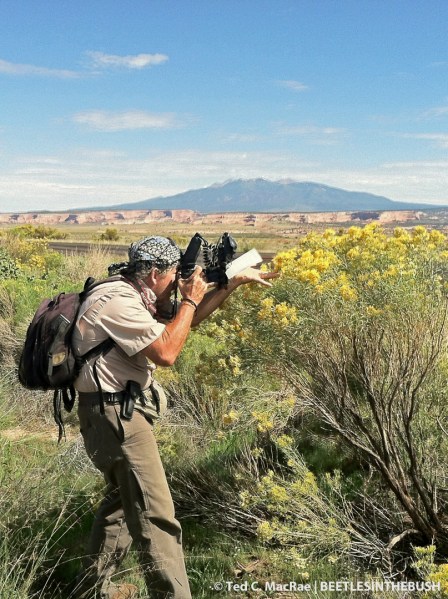
Ted MacRae

Photographing insects on Ericameria nauseosa | San Juan Co., Utah

In closing this report, I should note a few caveats:

  1. Identifications are preliminary and based primarily on expected geographical occurrence along with cursory comparison to descriptions and diagnoses published in Linsley & Chemsak (1961). Some modifications to these identifications might occur after collected material has been examined more closely (e.g., the possible co-occurrence of C. h. rubrescens and C. h. macswainei at a locality just north of Yearington, Nevada). This also applies to host plant identifications; however, voucher samples were collected from almost every location and will be submitted to specialists for ID confirmation.
  2. All of the photos in this post were taken with my iPhone. This does not mean that I have no photos taken with my ‘real’ camera to share—these will be forthcoming in future posts that examine many of the above mentioned subjects in more detail (as well as a few additional subjects not mentioned above). This also does not mean that these photos are ‘straight from the phone’—they have been post-processed in much the same way I process photos taken with the digital SLR to emphasize their good qualities and minimize their bad ones. I choose to include only iPhone photos in this post since the iPhone is what I mostly use to document a general ‘flavor’ of the trip, saving the digital SLR for true macro-photography or subjects requiring the highest possible quality. Aw heck, here’s a ‘real’ photo of one of the insects I found on the trip to whet your appetite for posts to come:
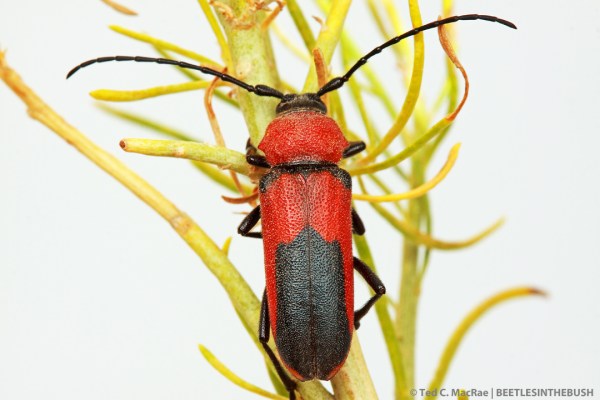
Crossidius coralinus temprans on Ericameria nauseosa | Churchill Co., Nevada

Crossidius coralinus temprans (female) on stem of Ericameria nauseosa | Churchill Co., Nevada

REFERENCES:

Bellamy, C. L. 1987. Revision of the genera Nanularia Casey and Ampheremus Fall (Coleoptera, Buprestidae, Chalcophorinae). Contributions in Science, Los Angeles County Museum of Natural History 387:1–20.

Linsley, E. G. & J. A. Chemsak. 1961. A distributional and taxonomic study of the genus Crossidius (Coleoptera, Cerambycidae). Miscellaneous Publications of the Entomological Society of America 3(2):25–64 + 3 color plates.

Morris, R. F., III & J. E. Wappes. 2013. Description of a new Crossidius LeConte (Coleoptera: Cerambycidae: Cerambycinae: Trachyderini) from southern Georgia with comments on its biology and unusual distribution. Insecta Mundi 0304:1–7.

Copyright © Ted C. MacRae 2013

2013 Oklahoma Collecting Trip iReport

I’m back home after my week-long collecting trip to western Oklahoma, and at the risk of sounding hyperbolous I can only describe it as one of the most successful collecting trips I’ve ever had. Seriously! These kinds of trips don’t happen all that often for a variety of reasons—timing is off, rains didn’t happen, weather was uncooperative, etc. etc. Once in a while, though, everything comes together, and this was one of those times. The trip was also a return to my roots so to speak—I’ve been rather distracted in recent years with tiger beetles, but jewel beetles (family Buprestidae) and, to a lesser extent longhorned beetles (family Cerambycidae), are really the primary focus of my taxonomic studies. It had been several years since I’d had a good “jewel beetle trip,” so that was the focus of this trip. In planning the trip, I recalled seeing jewel beetle workings in several woody plant species in the same area during last September’s trip, and the occurrence of May rains seemed to bode well for my early June timing.

Gloss Mountains State Park, Major Co., Oklahoma

Gloss Mountains State Park, Major Co., Oklahoma

My instincts proved to be justified—in seven days in the field I collected an estimated 1000–1500 specimens representing at least two dozen species of Buprestidae and a dozen or more Cerambycidae. More important than the numbers, I collected a number of species in good series that I have either not or only rarely collected before, and in fact the second beetle that I collected turned out to be a new state record! Of course, I also brought along my full-sized camera and associated gear and photographed many of the species that I collected. I will feature these photos in future posts, but for this post I thought it might be fun to give a high level view of the trip illustrated only with photos taken with my iPhone (which I also carry religiously in the field with me). The iPhone is great for quick snaps of scenery and miscellaneous plants and animals for which I don’t feel like breaking out the big camera, or as a prelude to the big camera for something I’d like to share right away on Facebook. Moreover, there are some types of photos (landscapes and wide-angles) that iPhones actually do quite well (as long as there is sufficient light!).

Gloss Mountains State Park, Major Co., Oklahoma

Atop the main mesa at Gloss Mountains State Park, Major Co., Oklahoma

My first destination was Gloss Mountains State Park (Major Co.), a stunning system of gypsum-capped, red-clay mesas. I’ve already found a number of rare tiger beetles here such as Cylindera celeripes (Swift Tiger Beetle), Amblycheila cylindriformis (Great Plains Giant Tiger Beetle) and Dromochorus pruinina (Frosted Dromo Tiger Beetle), and in the past two falls I’ve found two interesting jewel beetle records: Chrysobothris octocola as a new state record, and Acmaeodera macra as a northern range extension. On this trip, I started out beating the mesquite  (Prosopis glandulosa) and immediately got the longhorned beetle Plionoma suturalis—a new state record! They were super abundant on the mesquite, and I collected several dozen specimens along with numerous C. octocola as well. I then moved over to the red-cedar (Juniperus virginiana), which was showing a high incidence of branch dieback, and collected nice series of several buprestids, including what I believe to be Chrysobothis ignicollis and C. texanus. Up on top of the mesa there are small stands of hackberry (Celtis laevigata) and soapberry (Sapindus saponaria), both of which are very good hosts for Buprestidae. Not much was on the soapberry, but I beat large series of several Buprestidae from the hackberry, including what I believe to be Chrysobothris caddo and—the real prize—Paratyndaris prosopis! My old friend C. celeripes was also out in abundance, so I collected a series to add to my previous vouchers from this site. Back down below, I marveled at a juvenile western diamondback rattlesnake (Crotalus atrox) in the area where I found some more A. cylindriformis larval burrows. Daylight ran out before I could dig them up, and after 11 hours in the field I was exhausted, so I returned the next morning and got one 1st- and two 3rd-instar larvae and went back up on top of the mesa and beat several more P. prosopis from the hackberry.

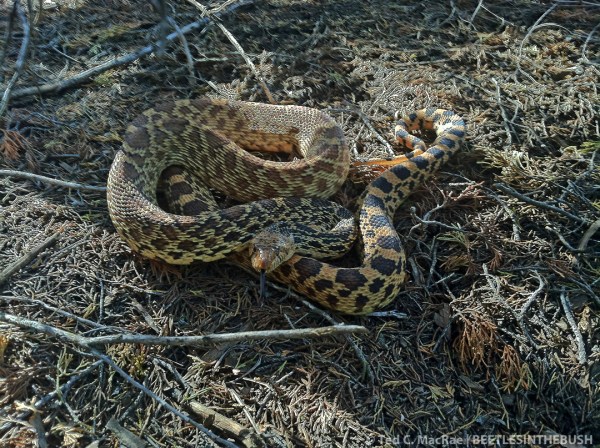
Bullsnake (Pituophis catenifer sayi) | Alabaster Cavern State Park, Woodward Co., Oklahoma

Bullsnake (Pituophis catenifer sayi) | Alabaster Cavern State Park, Woodward Co., Oklahoma

My second stop was at Alabaster Cavern State Park (Woodward Co.), where C. celeripes was again abundant on the gypsum-clay exposures surrounding an impressive gorge thought to be a collapsed cave complex. I focused on beating hackberry because of the success with buprestids on this plant at Gloss Mountains SP, and although they were not quite as abundant here as at Gloss Mountains I still managed to end up with good series of C. caddo and several species of Agrilus. Because I had spent the morning at Gloss Mountains, I had only a partial day to explore Alabaster Caverns and, still getting used to the weight of the camera bag on my back, decided to leave the big camera in the car. This was a mistake, as I encountered my first ever bullsnake (Pituophis catenifer sayi) and had to settle for iPhone photos of this species—the photo above being the best of the bunch. An approaching storm put an end to my second day after another 10 hours in the field, and I drove an hour to Woodward.

Moneilema sp. on Opuntia phaecantha | Alabaster Cavern State Park, Woodward Co., Oklahoma

Moneilema sp. on Opuntia macrorhiza | Alabaster Cavern State Park, Woodward Co., Oklahoma

My third day started out at nearby Boiling Springs State Park, a riparian oasis on sandy alluvium alongside the nearby Cimarron River. The woodlands are dominated by hackberry and American elm, and although a few buprestids were beaten from hackberry and honey locust (Gleditisia triacanthos), the numbers and diversity were not enough to hold my interest in the spot. After lunch, I decided to return to Alabaster Caverns SP and explore some other areas I had not had a chance to explore during the previous partial day. It’s a good thing that I did, as I ended up finding a nice population of longhorned cactus beetles in the genus Moneilema associated with prickly pear cactus (Opuntia macrorhiza). I collected a nice series of adults and also learned a few lessons in how to photograph these beetles on their viciously protective host plants. The photo above gives a taste of what will come in the photos that I took with the big camera. After eight hours in the field and darkness falling, I drove two hours to Forgan in Beaver Co.

Beaver Dunes State Park, Beaver Co., Oklahoma

Beaver Dunes State Park, Beaver Co., Oklahoma

Day 4 in the field started out cold and ominous, having stormed heavily during the previous night and with thick clouds still hanging in the sky. I feared the day might be a wash but decided to venture to Beaver Dunes State Park anyway and take my chances (beating can still be productive even in cold weather as long as the foliage is not wet). It’s a good thing that I did, as the buprestids were as numerous as I’ve ever seen them. The park’s central feature is a system of barren sand dunes that are frequented by ORV enthusiasts and surrounded by hackberry woodlands. The park also has a reservoir and campground, around which are growing a number of cottonwoods (Populus deltoides).

Hackberry Bend Campground, Beaver Dunes State Park, Beaver Co., Oklahoma

Hackberry Bend Campground, Beaver Dunes State Park, Beaver Co., Oklahoma

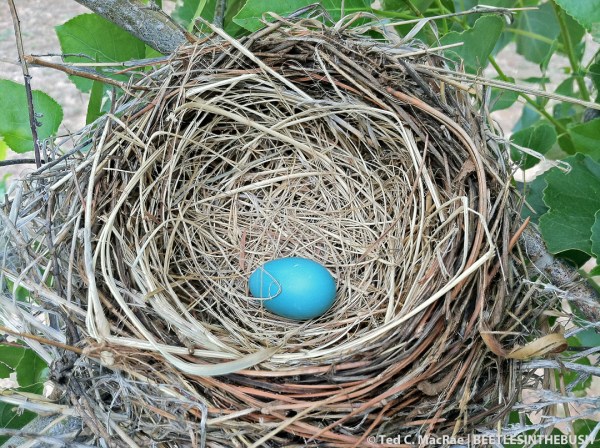
These hackberrys and cottonwoods proved to be extraordinarily productive. On the former I collected large series of several species of Chrysobothris and Agrilus, and while I collected fewer Buprestidae on the latter, these included Agrilus quadriguttatus and Poecilonota cyanipes! The latter species I had never collected until last year (from Cerceris fumipennis wasps), and beating the lower branches of the declining cottonwoods produced a series of about a dozen specimens. I also got one specimen on black willow (Salix nigra), along with a few Chrysobothris sp. and what I take to be Agrilus politus. Also in a low branch of one of the cottonwoods was a bird’s nest with a single egg that, according to Facebook comments, either represents the American Robin or a Gray Catbird. (I returned the next day and saw two eggs in the same nest.)

American Robin or Gray Catbird nest w/ egg | Beaver Dunes State Park, Beaver Co., Oklahoma

American Robin or Gray Catbird nest w/ egg | Beaver Dunes State Park, Beaver Co., Oklahoma

As the day drew to a close, I found two interesting longhorned beetle species at the edge of the dunes: one large, powdery gray Tetraopes sp. on milkweed (Asclepias sp.), and huge numbers of Batyle ignicollis evidently perched on the yellow spiked inflorescence of an as yet undetermined plant. I have seen this species on many occasions, but always in low numbers, yet here were literally hundreds of individuals on the plants, all having assumed a characteristic pose on the inflorescence suggesting that they had bedded down for the night. I only spent eight hours in the field on this day because of the late start, and as darkness approached I began the two-hour drive to Boise City.

Black Mesa landscape

Sculpted sandstone landscape in the vicinity of Black Mesa State Park, Cimarron Co., Oklahoma

The final two days in the field were supposed to be spent exploring the area around Black Mesa in the extreme northwest corner of Oklahoma, and another hour of driving was needed to get to the area from Boise City. I first went to Black Mesa State Park, and while the landscape was stunning (see above) the area was extremely dry. I feared the collecting would not be at all productive in this area but wanted to give the area a good effort before making a call. As I approached the entrance to the park, I saw a jeep parked by the side of the road with a license plate that read “Schinia,” which I recognized as a genus of noctuid moths that are very popular with collectors. I pulled over and talked to the driver, who was indeed a lepidopterist from Denver and had just arrived himself. We talked and exchanged contact information, and learning of my interest in beetles he directed me to a small stand of Gambel oak (Quercus gambelii) and one-seed juniper (Juniperus monosperma) on a sculpted sandstone escarpment not far from the park. I found the spot, and although I beat three Chrysobothris sp. from the first juniper tree that I whacked, another hour of beating produced only one more beetle from the juniper and nothing from the oak. I returned to the spot where we had met and encountered him again on his way out! We stopped and chatted again and found a few specimens of what I take to be Typocerus confluens on the yellow asters, but by then I was having my doubts about staying in the area. I told him I was going to check out a ravine in the park and then decide.

Petrified forest | Black Mesa State Park, Cimarron Co., Oklahoma

Petrified forest | Black Mesa State Park, Cimarron Co., Oklahoma

The petrified forest ended up being the only interesting thing I found in the ravine—the area was so dry that I think even the real trees were almost petrified! At any rate, it was clear that I was not going to have much success in this area. I looked at my watch, knowing that it would take three hours to drive back to Beaver Dunes, and estimated that if I left now I could get in about three hours of collecting at Beaver Dunes where I’d had so much success the previous day. Thus, I did what I rarely do on a collecting trip—drive during the afternoon!

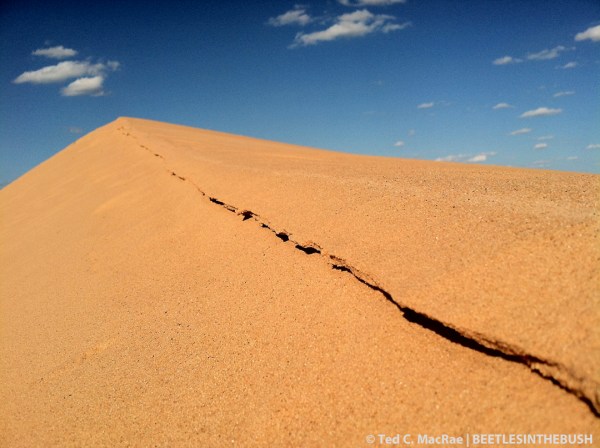
Beaver Dune

The main dune at Beaver Dunes State Park, Beaver Co., Oklahoma.

A chunky grasshopper nymph inhabiting the dune

A chunky grasshopper nymph inhabiting the main dune.

I arrived back at Beaver Dunes with several hours of daylight still remaining, so I decided to take a look around the main dunes before heading towards the woody plants. I’ve actually visited Beaver Dunes previously, on the tail end of a fall tiger beetle trip in 2011. At that time I had seen only the rather common and widespread species Cicindela formosa (Big Sand Tiger Beetle) and C. scutellaris (Festive Tiger Beetle), but I thought there could still be a chance to see the much less common C. lengi (Blowout Tiger Beetle). Early June, however, is a little late to see the spring tigers, and in fact I saw only a single C. formosa. Nevertheless, I find dune habitats irresistible—alien habitats occupied by strange plants and animals, and I spent a bit of time exploring the main dune before heading back towards where I had collected so many Buprestidae the previous day.

Low water levels in the reservoir at Beaver Dunes are a result of three years of drought.

Low water levels in the reservoir at Beaver Dunes are a result of three years of drought.

Western Oklahoma, like many parts of the central U.S., has suffered rather severe drought conditions for the past several years. This was evident not only in the large amount of branch dieback seen in the woody vegetation of the area (and probably a contributor to my success at collecting Buprestidae) but also the very low water level in the park reservoir. In the photo above the small cottonwood saplings in the foreground and large cottonwood trees in the left background indicate the normal water level. Cottonwoods, of course, like to keep their feet wet, and the trees around this reservoir—left high and dry by the drought—have responded with major branch dieback and lots of subsequent adventitious sprouting at the bases of the main branches. It was from this adventitious growth that I had beaten most of the Poecilonota cyanipes that I collected the previous day, so I repeated the cottonwood circuit in the hopes of collecting more. Not only did I collect more, but I collected twice as many as the previous day, so I ended up with a very nice series of more than two dozen individuals of the species from the two days collecting. I also did a little more beating of the hackberry trees which had produced well the previous day and collected several more Chrysobothris caddoC. purpureovittata, and Agrilus spp. such as A. leconteiA. paracelti, and perhaps others. When I arrived I was unsure whether I would stay here the following day, but eventually I decided I had sampled the area about as well as I could and that I would go back to the Gloss Mountains for my last day in Oklahoma. Thus, as the day began to wane I began hiking back to the car and spent the next two hours driving back to Woodward to spend the night.

Steep slope below the main mesa | Gloss Mountains State Park, Major Co., Oklahoma

Steep slope below the main mesa | Gloss Mountains State Park, Major Co., Oklahoma

Echinocereus sp. | Gloss Mountains State Park, Major Co., Oklahoma

Echinocereus sp. | Gloss Mountains State Park, Major Co., Oklahoma

Arriving at the Gloss Mountains the next morning was like coming home! I’ve spent so much time at this place and found so many great insects, yet every time I come here I find something new. Today, however, my goals were more modest—I wanted to improve on my series of Paratyndaris prosopis and Chrysobothris texanus, so I focused most of my time beating the hackberry and juniper on top of the mesa and continued beating the juniper down below as well. Success! I collected four more Paratyndaris off of the hackberry, but the C. texanus were far more abundant on this day than they were earlier in the week—I probably got another two dozen individuals of this species. Of course, I also got distracted taking photographs of a number of things, so the day went far more quickly than I realized. I wanted to leave around 6 pm and get in about three hours of driving so that I would have time to make it into Missouri the next morning and have a nice chunk of time to collect before finishing the drive and arriving home on Saturday night. It was actually closer to 7:30 pm before I hit the road, the reason for the delay being the subject of a future post (I will say that BioQuip’s extendable net handle comes in handy for much more than collecting tiger beetles!).

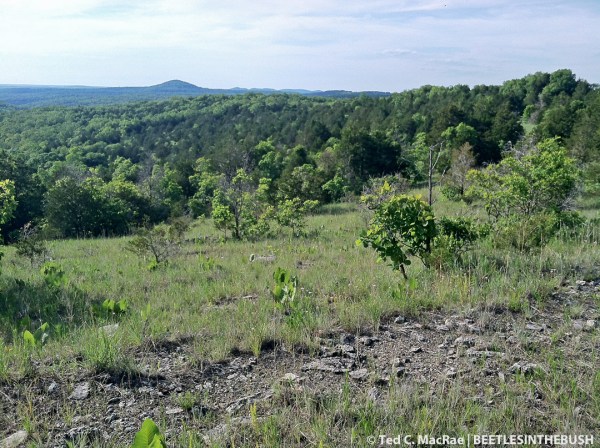
Dolomite glades | Hercules Glades Wilderness, Taney Co., Missouri

Dolomite glades | Hercules Glades Wilderness, Taney Co., Missouri

Long Creek | Hercules Glades Wilderness, Taney Co., Missouri

Long Creek | Hercules Glades Wilderness, Taney Co., Missouri

For my last day of collecting, I decided to stop by at one of my favorite spots in the White River Hills of extreme southwestern Missouri—Hercules Glades Wilderness in the Mark Twain National Forest. I’ve been to this place a number of times over the years, but in recent years my visits have usually been late in the season to look for the always thrilling to see Cicindelidia obsoleta vulturina (Prairie Tiger Beetle). It had actually been about 25 years since I’d visited these glades during the spring, and because of the success I’d had collecting in Oklahoma I was really optimistic that I would find the same here. Sadly (and inexplicably), insect activity was very low, and it didn’t take long for this to become apparent as branch after branch that I beat along the trail through the dry-mesic forest down to Long Creek yielded nothing. By the time I got to the creek I still had not collected a single beetle. A consolation prize was found along the creek, as beating the ninebark (Physocarpos opulifolius) produced a few specimens of the pretty little Dicerca pugionata, and a couple more consolation prizes were found further up the trail approaching the main glade when I saw a Cylindera unipunctata (One-spotted Tiger Beetle) run across the trail and then beat a single Agrilus fuscipennis from a small persimmon (Diospyros virginiana) tree at the edge of the glades. It had been about 25 years since I last collected the latter species, so I was very happy to see it, but no more were seen despite beating every persimmon tree that I saw during the rest of the day. At the end of the day, I had hiked seven miles and collected only six beetles—a rather inauspicious ending to what was otherwise a wonderfully successful trip.

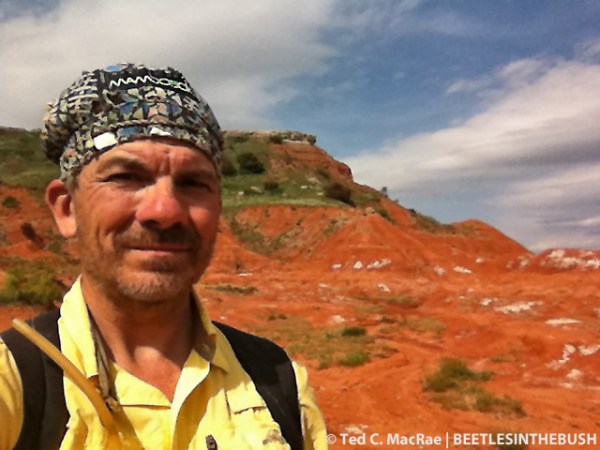
A rare ''selfie''

The author takes a rare ”selfie” at Gloss Mountains State Park.

Arriving back at the car at the end of the day on the last day of an extended collecting trip is always a little depressing—despite the vagaries of travel, cheap hotel beds, meals on the go, and general exhaustion, I’m never happier than I am when I am in the field. Still, the success that I’d had during this trip did much to ease my depression, and arriving home late that night and seeing my girls again (who waited up for me!) finished off any remaining depression.

© Ted C. MacRae 2013

Spring Unfolding

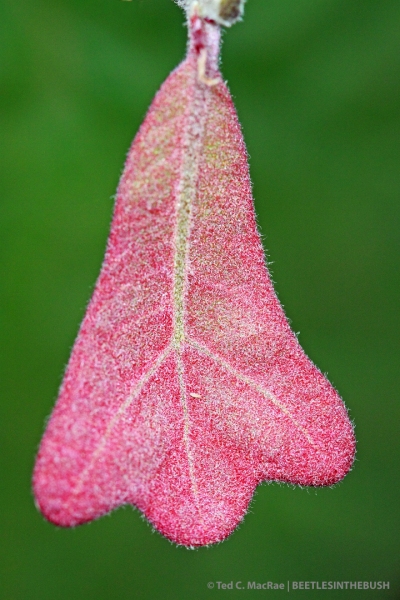
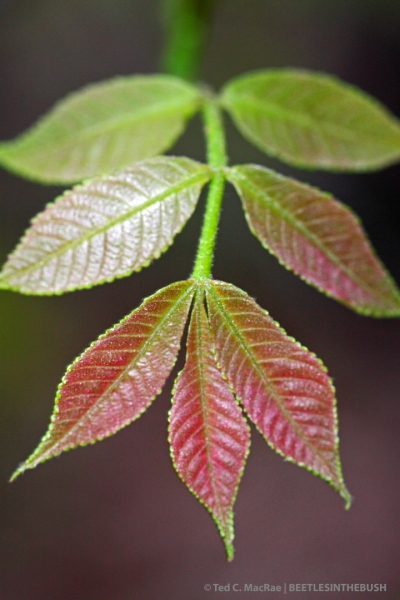
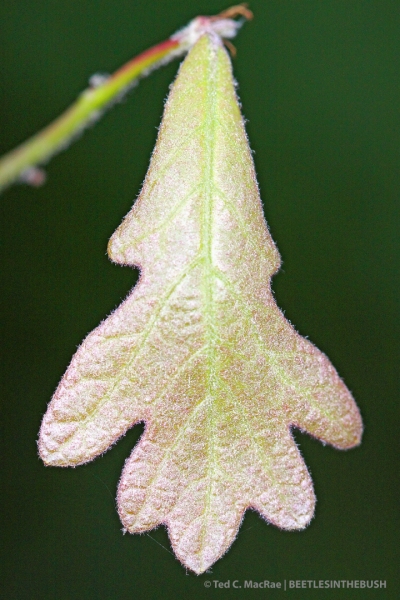
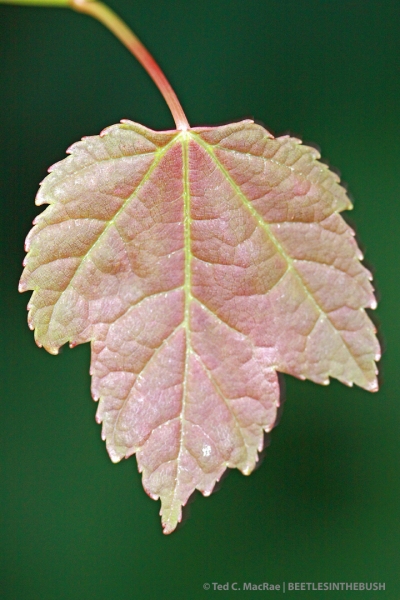
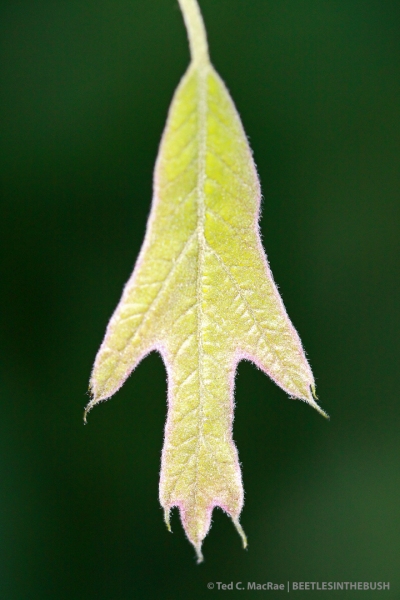
For many people, spring is their favorite time of year—the long, cold winter having given way to warmth, sunshine, and flowers. I love spring as well but find myself frustrated sometimes by its Jekyll and Hyde nature. This spring was particularly frustrating—the cold and rain seemed at times interminable, delaying the onset of the spring flora several weeks past normal. Once the sun finally did appear, the entire forest exploded in a cacophony of simultaneous leaf and bloom. Plant phenologies were so compressed that there was almost no time to appreciate the season before it was over. Nevertheless, as I waited patiently for those warmer days, I was still able to find beauty in the pre-bloom forest among its nascent leaves—their development put on hold for the time being but taking on an almost floral quality in the absence of the true flowers that they preceded. As a student of wood-boring beetles, I’ve had to become also a capable botanist, at least with regards to the woody flora, and pride myself on being able to identify trees not just by their mature leaves, but also their wood, bark, growth habit, and natural community—characters that are always available when leaves may not be (as is often the case with dead trees). Nascent leaves, on the other hand, are like flowers—ephemeral and often colorful. One must make an effort to see them, but it is effort well spent.

The photos below were taken on a cold, overcast day in late April at Holly Ridge Conservation Area in extreme southeastern Missouri. How many of them can you identify to species? This is an open challenge (i.e., no moderation of comments), and the first person to correctly identify all six will be declared the winner (remember, spelling counts!).


#1

IMG_2756_enh_720x1080


#2

IMG_2778_enh_720x1080


#3

IMG_2789_enh_720x1080


#4

IMG_2801_enh_720x1080


#5

IMG_2816_enh_720x1080


#6

IMG_2817_enh_720X1080
Copyright © Ted C. MacRae 2013

And the results are in…

I recently entered my first photo contest, a local competition sponsored by the Webster Groves Nature Study Society (of which I have been a member for ~30 years), and although the competition was limited to its few hundred members there were some serious cash prizes on offer. Being a noob at photo contests and a still relative newcomer to photography in general, I wasn’t sure what to expect. I thought my photos might be good enough to compete, but I also knew I would be going up against some long-time and very skilled nature photographers. The basic rules were a maximum of two submissions in no more than three of the following categories:

  • Botany
  • Entomology
  • Ornithology
  • Landscapes/habitats

Since I’ve only photographed two birds ever, I decided to submit entries to each of the other three categories. It was an interesting competition—the judges (each category had a panel of three consisting of a WNGSS board member, a natural history expert, and a photography expert) had a chance to see all of the photographs prior to the event (held last night) and select the top ten from each category, but the rest of the judging was done live at the event. Eventually, from each category a 1st place, 2nd place, and 3rd place photo was selected. The 12 winning photographs were then displayed in a continuous loop, and everybody attending the event was allowed to vote for one grand prize winner. The grand prize winner had to receive more than 50% of the vote, so a few runoff rounds were required to decide the final winner.

How did it go for me? I had a pretty good night, with three winning photographs:

Entomology—3rd place

Cicindela repanda (Bronze Tiger Beetle) | St. Louis Co., Missouri

Cicindela repanda (Bronze Tiger Beetle) | St. Louis Co., Missouri

Botany—2nd place

Hamammelis vernalis (Ozark witch hazel) | Iron Co., Missouri

Hamammelis vernalis (Ozark witch hazel) | Iron Co., Missouri

Entomology—1st place

Arctosa littoralis (beach wolf spider) | Lewis Co., Missouri

It was a thrill for me to learn that, out of the six photographs I submitted (and I really didn’t think my two landscape submissions were competitive to begin with), three were among the 12 final prize winners. That also made them eligible for the grand prize, but in this case I didn’t really expect the larger membership (which has a lot of birders) would really take to my closeup insect photographs. To my surprise, the first round of voting produced four finalists—two of which were my insect photos! The first runoff vote eliminated one photo—but not either of mine, and the second runoff eliminated one more photo—but again neither of mine. I had won the grand prize without yet knowing which photo would be the winner! In the end, the tiger beetle took the top prize. Personally, I was happy about that, because even though the photo took only 3rd place in the entomology competition, I thought it was the stronger of the two photos based on composition, the time and effort it took to work the beetle to finally “get the shot” (not that the wolf spider photo didn’t also take a lot of effort to get that close), and the natural history behavior that it captured (stilting and sun-facing for thermoregulation). I know blog commenting is becoming passé, but if you have any particular thoughts about these photos, good or bad, I would love to hear from you.

Overall I would have to say that, winner or not, participating in a photo competition was an extraordinary learning opportunity for me as I try to hone my craft. Listening to the comments of the judges in all of the categories, both on the natural history and the technical aspects of the photographs, gave me a lot of insight into how I might further improve my technique and take photographs that can be appreciated on both technical and artistic grounds. More importantly, the cash was nice, but the motivation to keep trying that I got out of the experience was priceless!

Copyright © Ted C. MacRae 2013
My favorite of Missouri’s milkweeds

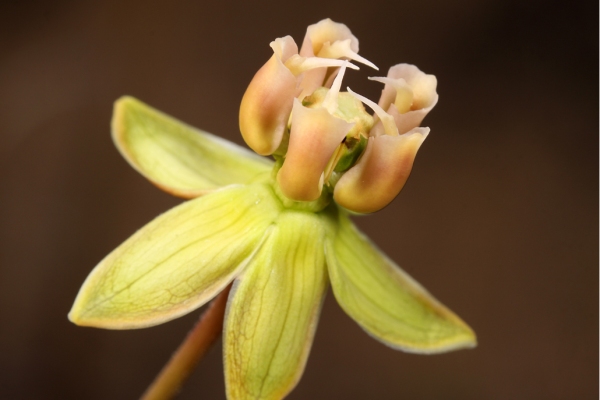
Milkweeds of the genus Asclepias are among my favorite plants, although I’m not fully sure why that is the case. Sure, their blooms are conspicuous and colorful, but so are those of many other plants. Perhaps one reason is their status as hosts for milkweed beetles (genus Tetraopes, family Cerambycidae). Four species of these beetles occur in Missouri, including the rare T. texanus. Another reason might be their diversity—in Missouri alone there are 16 different species, ranging from the ubiquitous common milkweed (A. syriaca) to the federally endangered Mead’s milkweed (A. meadii). The latter is one of six milkweed species occurring in Missouri that I have not yet seen, so I suppose I should withhold judgement until I’ve succeeding in finding all 16 species. Nevertheless, I would have to say that clasping milkweed (A. amplexicaulis) has to be my favorite of Missouri’s milkweeds.

Clasping milkweed (Asclepias amplexicaulis) | Sand Prairie Conservation Area, Scott Co., Missouri

Clasping milkweed (Asclepias amplexicaulis) | Sand Prairie Conservation Area, Scott Co., Missouri

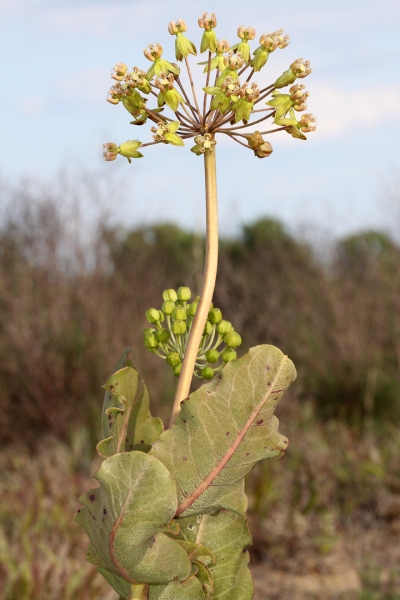
Clasping milkweed (also known as sand milkweed—not to be confused with A. arenaria occurring further west in the Great Plains) is said to occur sporadically throughout Missouri in prairies, glades, rocky open woods, roadsides, and railroads. However, I have seen this species only a few times—all in dry sand habitats in the southeastern Mississippi Alluvial Plain (or, the “bootheel” as we say here in Missouruh). Until a few  years ago the only time I had ever seen this plant was many years in an eroded sandy opening on Crowley’s Ridge (an elevated ridge of alluvium and loess deposited during the last glacial maximum). Those plants were not in flower, but their was no mistaking their identity due to their erect stems and broad, cordate-clasping, tomentulose leaves with wavy margins. I would see this plant again a few years ago during my first visit to Sand Prairie Conservation Area, and although I would see it again on many subsequent visits, at no time did I succeed in seeing the blooms.

This species is characterized by broad, clasping, tomentulose leaves with wavy margins.

Broad, clasping, tomentulose leaves with wavy margins.

Finally, last year, I returned to Sand Prairie during late April (a weather-delayed installment of my Annual-Birthday-First-Bug-Collecting-Trip-of-the-Year). I had actually gone there to photograph Missouri’s unique intergrade population of the Festive Tiger Beetle (Cicindela scutellaris), but the weather was cool and the beetles apparently had decided to remain in their burrows. A bad day of collecting, however, is still better than a good day of just about anything else—perhaps because there are almost always consolation prizes, and my consolation prize on this day was my first sight of clasping milkweed plants in full bloom.

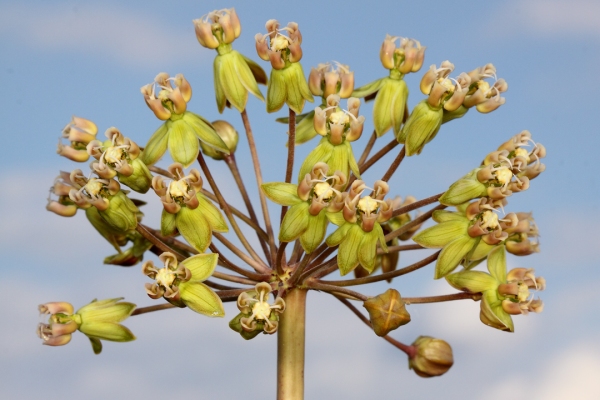
A single inflorescence atops each stem.

A single inflorescence atops each stem.

I may not be exactly sure why I like milkweeds so much, but I think I now know why I like clasping milkweed above all others. The softly colored green and pink blossoms are exquisite, to be sure, but more importantly the species is firmly linked in my mind to one of my favorite Missouri habitats. I imagine that clasping milkweed might be an attractive, if somewhat gangly, addition to a native wildflower garden. However, I’m not sure I would enjoy cultivated plants in my garden as much as I do seeing wild plants in one of Missouri’s rarest and most endangered natural communities.

Sand Prairie Conservation Area, Scott Co., Missouri

Sand Prairie Conservation Area, Scott Co., Missouri

Copyright © Ted C. MacRae 2013