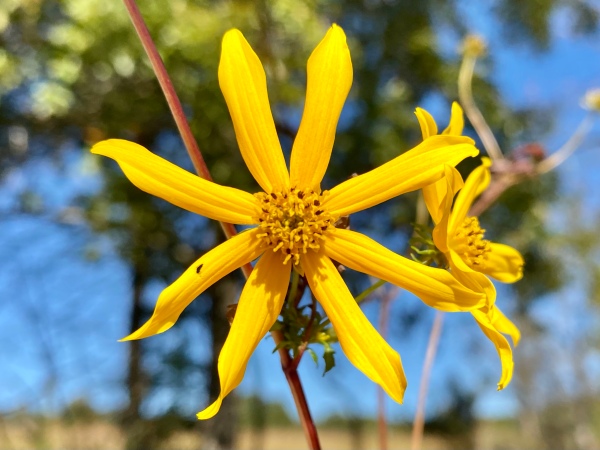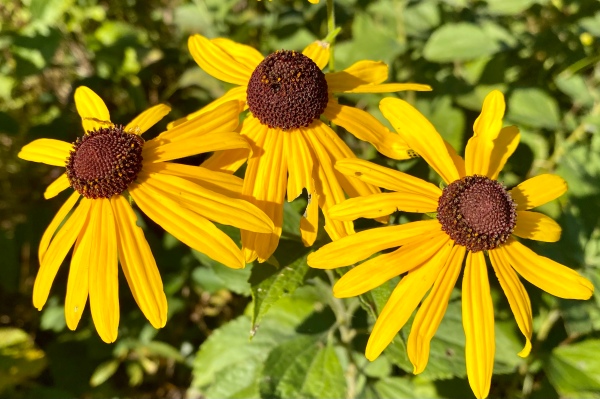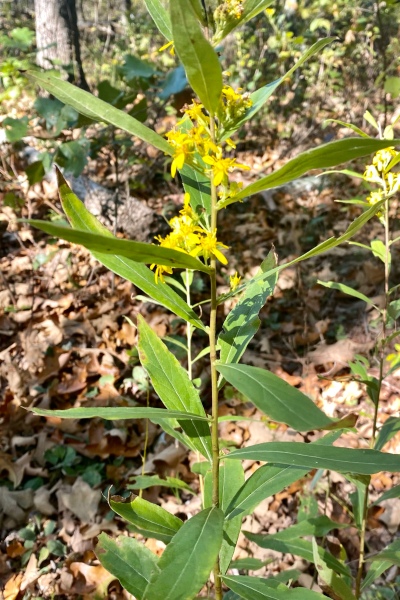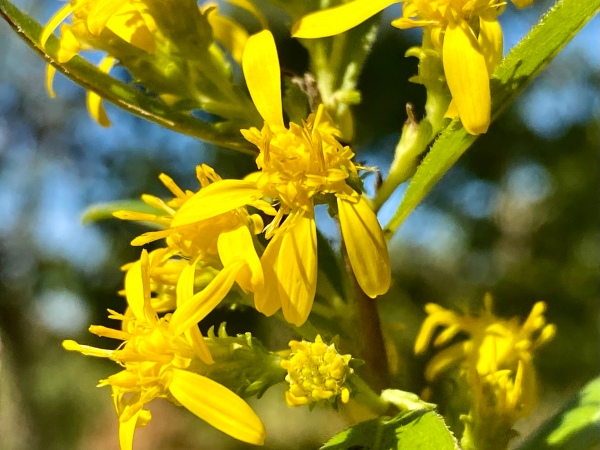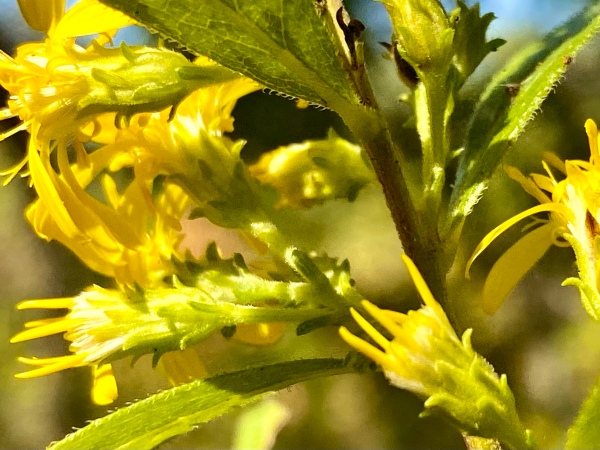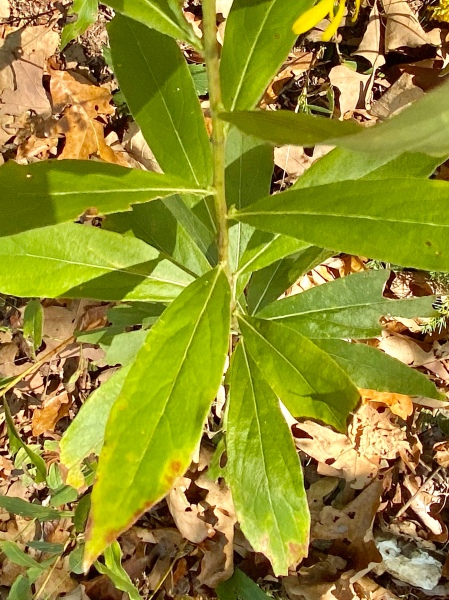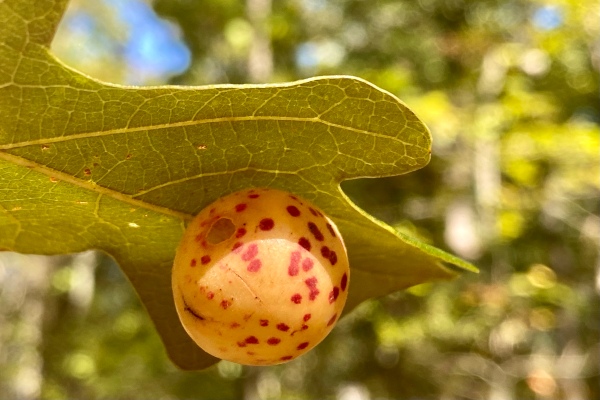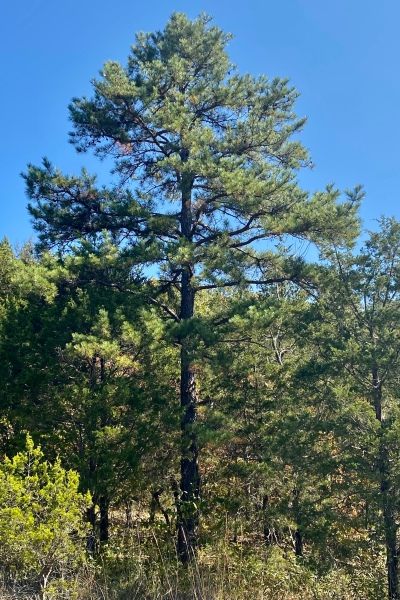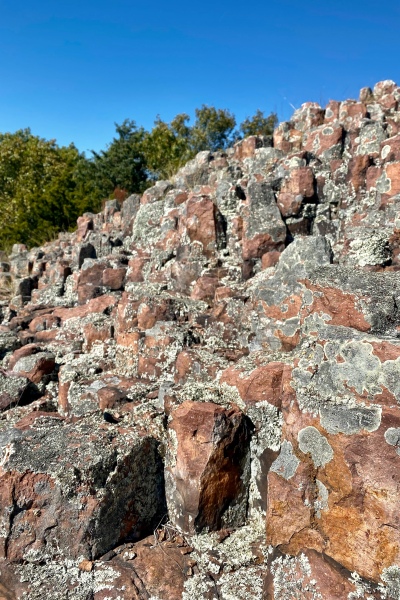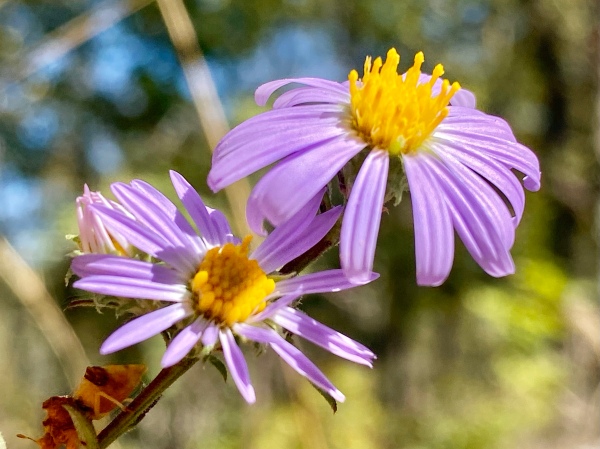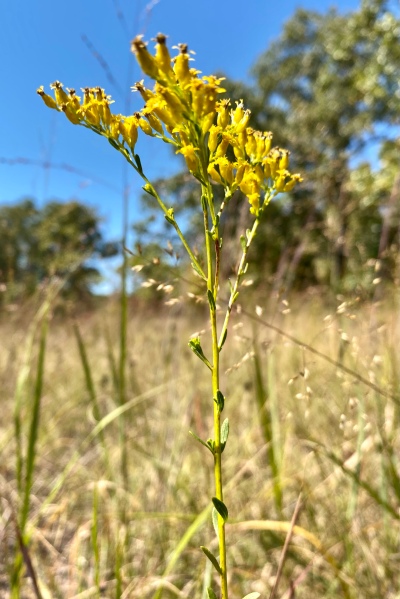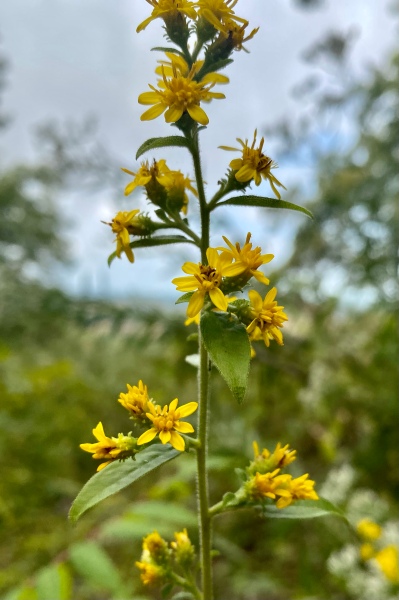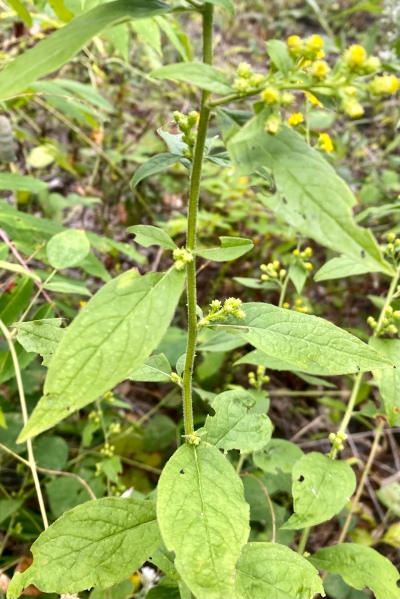
The late summer explosion of yellow composites has subsided greatly over the past week—Missouri conflower (Rudbeckia missouriensis) and rosinweed (Silphium integrifolium), and ashy sunflower (Helianthus mollis) have all gone to seed, and only sporadic still-blooming individuals of prairie dock (Silphium terebinthinaceum) and goldenrods—including old field goldenrod (Solidago nemoralis), stiff goldenrod (S. rigida), and Gattinger’s goldenrod (S. gattingeri)—can be found. Gattinger’s goldenrod, in particular, deserved extra attention, as this species has only a few known population centers and comes as close to a true Missouri endemic as any plant species in the state. It can be distinguished by its basally disposed, glaucus leaves which become very small on the upper stem and its pyramidal inflorescences radiating out from the stem in all directions.
Solidago gattingeri (Gattinger’s goldenrod).
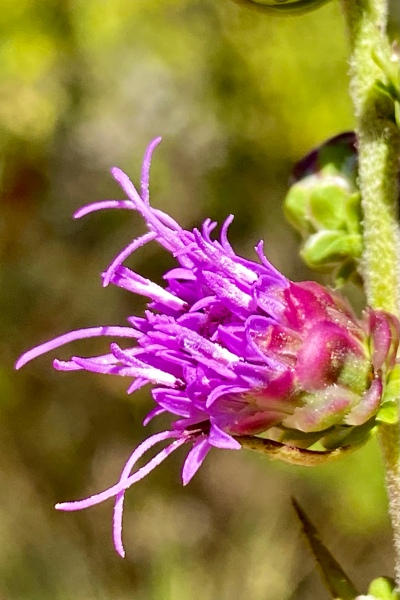
The decline of the fall composites does not mean, however, that the glades are now without color, as vibrant purples still dot the glade perimeter in the form of Liatris asperas (rough blazingstar).
Liatris asperas (rough blazingstar).
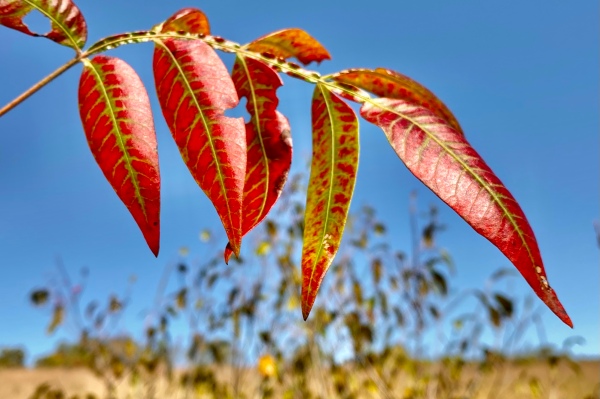
Sumacs, as well—both shining (Rhus copallinum) and fragrant (R. aromatica), and flowering dogwood (Cornus florida) have already begun turning rusty to bright red.
Shining shining (Rhus copallinum).
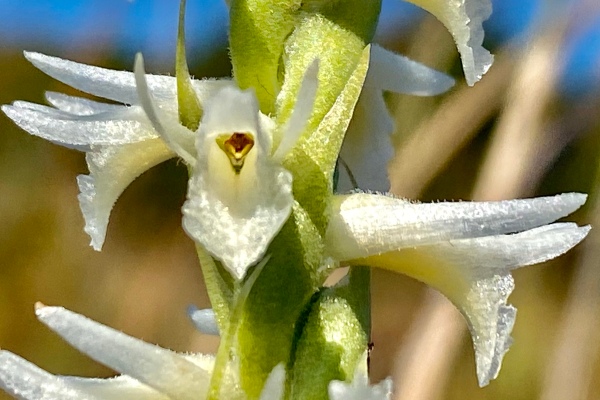
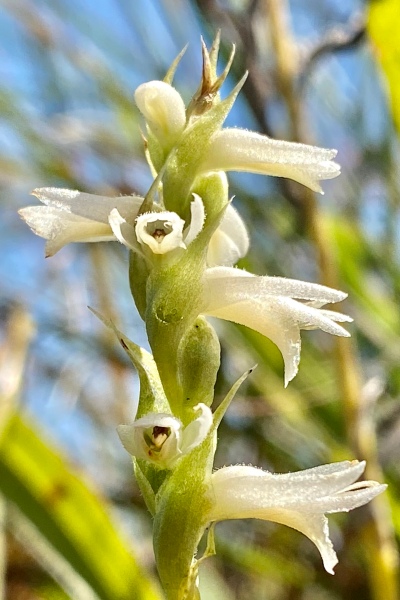
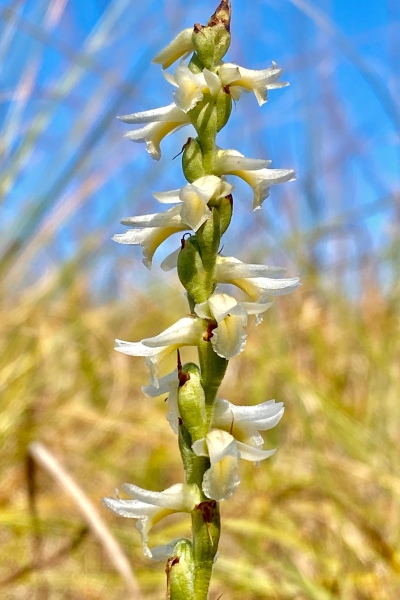
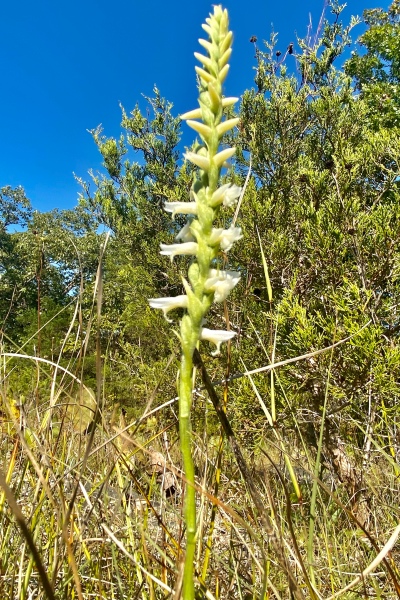
Nor does it mean that nothing new is coming into flower—Great Plains ladies’-tresses orchid (Spiranthes magnicamporum) are blooming for the first time this week, and I saw numerous individuals still developing their inflorescences to suggest a fantastic October display is around the corner.
Great Plains ladies’-tresses orchid (Spiranthes magnicamporum).
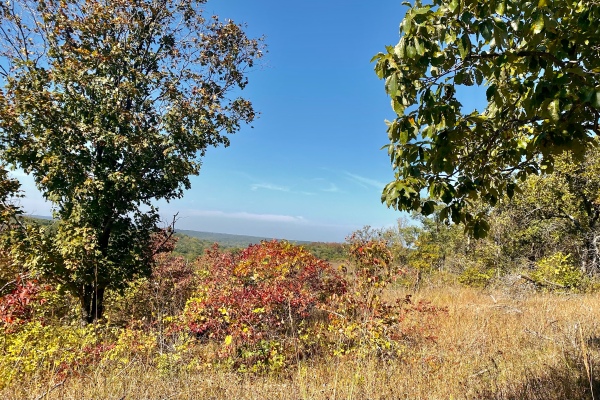
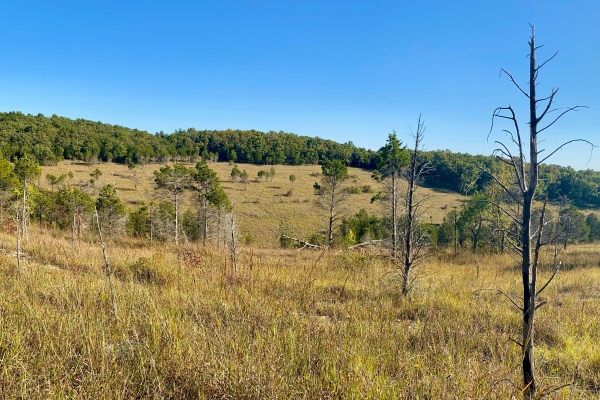
Bluff tops of Salt Lick Point Land & Water Reserve.
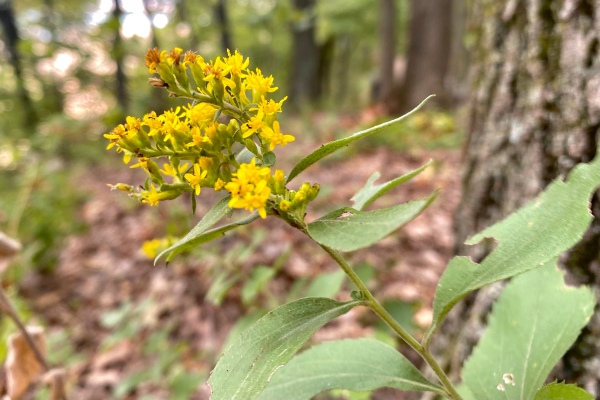
Today the WGNSS Botany Group ventured into Illinois for its Monday field trip to explore the limestone bluffs and hilltop prairies of Salt Lick Point Land & Water Reserve. This being the first day of autumn, goldenrods and other fall-blooming plants in the great family Asteraceae were expected to dominate the flora, which indeed was the case. Along the steep, rocky trail leading up to the prairies, Solidago buckleyi (Buckley’s goldenrod) and S. ulmifolia (elmleaf goldenrod) bloomed together in the dry-mesic deciduous forest. The former is a near-Missouri specialty, extending just barely into nearby portions of four adjacent states, and can be distinguished by its relatively larger flowers on columnar inflorescences with recurved involucral bracts and its relatively broad leaves with distinct teeth.
Solidago buckleyi (Buckley’s goldenrod).
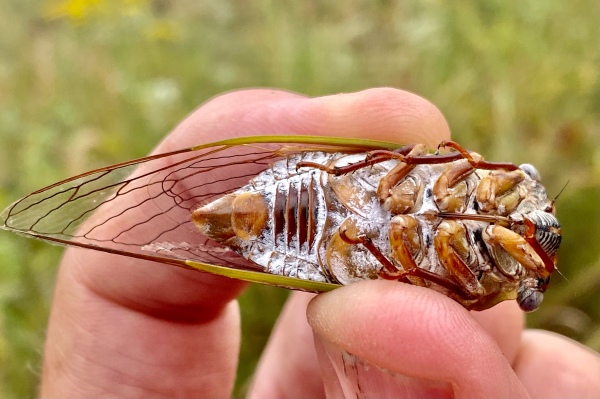
As we walked the trail, I heard several cicadas singing, starting with Megatibicen pronotalispronotalis (Walker’s annual cicada) near the bottom and Neotibicen robinsonianus (Robinson’s annual cicada) as we ascended, the latter eventually joined also N. lyricens (lyric cicada). Carcasses of the latter two were also seen along the trail (confirming my IDs based on their songs), and as we reached the second of three significant hilltop prairie remnants Kathy found a live male M. pronotalis in the low vegetation. It’s noisy, rattling alarm screeching as I held it attracted a crowd of gawkers within the group and a flurry of photographs before I secured the specimen in a pill bottle and recorded the location. Like most cicadas, only the males are capable of making sound, which they do by rapidly expanding and contracting hard membranes called tymbals that reside under distinctive plates found on the venter at the base of the abdomen.
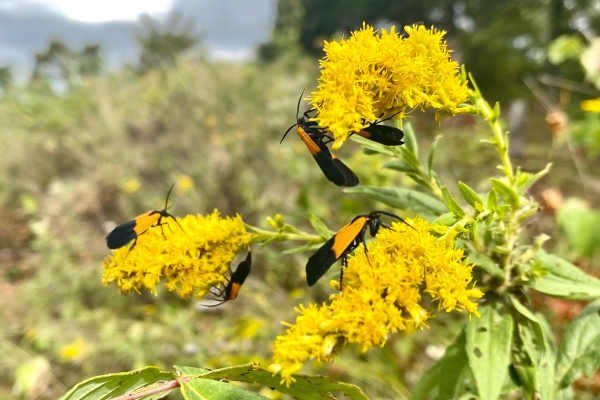
Goldenrods were blooming profusely in the prairie, attracting numerous insects including Lycomorpha pholus (black-and-yellow lichen moths)—a mimic of netwinged beetles in the genus Lycus.
Lycomorpha pholus (black-and-yellow lichen moths) on flowers of Solidagoulmifolia (elmleaf goldenrod).
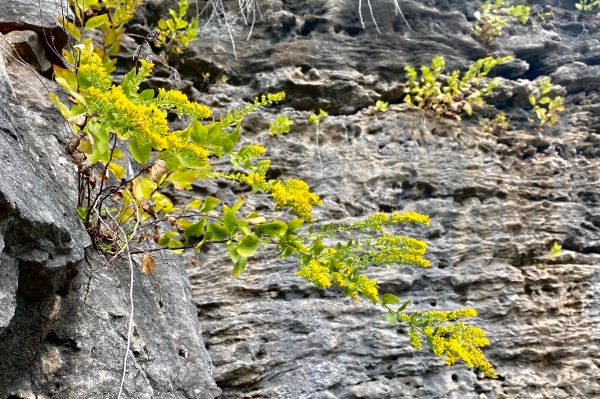
As the trail continued along the blufftops, we found a true bluff specialty—Solidago drummondii (bluff or Drummond’s goldenrod). Like S. buckleyi, this species also is very nearly a Missouri endemic and is found exclusively on or very near limestone/dolomite bluffs. It’s habitat and very wide, toothed leaves on short petioles easily distinguish this species from other goldenrods.
Solidago drummondii (bluff or Drummond’s goldenrod).
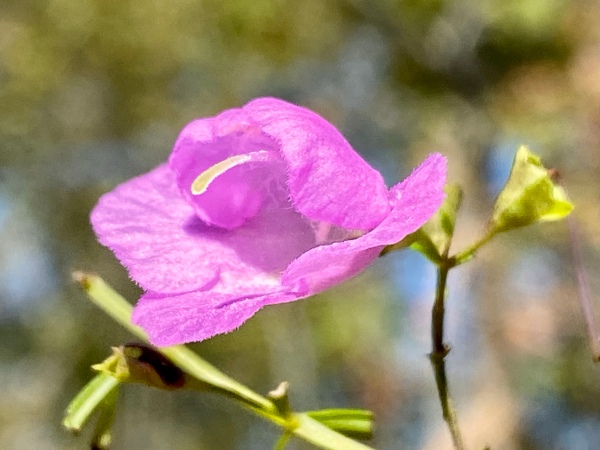
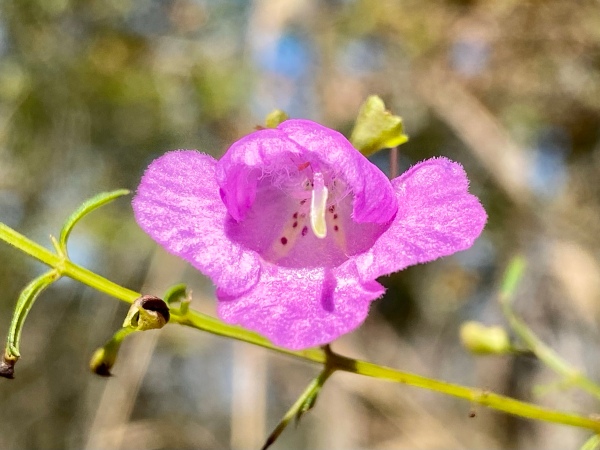
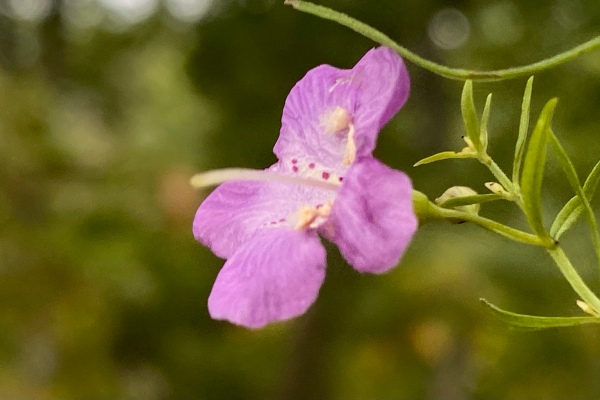
In the interface between the dry-mesic deciduous forest and another hilltop prairie, we saw a nice patch of Agalinis tenuifolia (slender false foxglove), distinguished by its thin, branching stems, opposite, linear leaves with long, thin pedicels, and small flowers with upper lip arching over and enclosing the stamens.
Agalinis tenuifolia (slender false foxglove).
As I photographed the plant, I heard others in the group on the prairie saying “We need an entomologist,” and as I approached the group I found them surrounding a Brickellia eupatorioides (false boneset) hosting two individuals of the large, black planthopper, Poblicia fulginosa. Although normally very wary, both individuals cooperated nicely for photos, and I succeeded in capturing a photo showing the bright red markings on their abdomen in obvious contrast to the otherwise dark, somber coloration of the insect. In fact, the dorsal portion of the abdomen is entirely bright red, presumably serving a “flash coloration” function similar to the brightly colored abdomen of jewel beetles or hind wings of underwing moths to confuse potential predators by its high visibility in flight and sudden disappearance when the insect lands and folds its wings over the abdomen.
Poblicia fulginosa on Brickellia eupatorioides (false boneset).
As we continued past the hilltop prairie, several individuals of Sideroxylon lanuginosum (gum bumelia or woolly buckthorn) were found along the dry ridgetop trail. Whenever I see S. lanuginosum, I look for signs of Plinthocoelium suaveolens (bumelia borer)—arguably North America’s most beautiful longhorned beetle. No signs were seen at the first tree, but at the second the telltale frass (digested sawdust ejected by the larvae that bore through the main roots of living trees) was easily spotted at the base of the trunk. This beetle is distributed across the southeastern and south-central U.S. wherever it’s host can be found, occurring reliably as far north as the dolomite glades south of St. Louis; however, I am unaware of any records of this beetle from Illinois.
Frass at trunk base of Sideroxylon lanuginosum (gum bumelia or woolly buckthorn) indicating active infestation by Plinthocoelium suaveolens (bumelia borer).
After a long, steep, rocky descent back down, we found many more S. drummondii perched poetically on the vertical limestone bluff face at the bottom.
Solidago drummondii (bluff or Drummond’s goldenrod).
The walk back to the parking lot gave us the opportunity to study several additional fall-blooming asters including Solidago altissimum (tall goldenrod), S. gigantea (giant goldenrod), Helianthus tuberosus (Jerusalem artichoke), and Smallanthia uvedalia (bearsfoot). While H. tuberosus is easily recognized by gestalt, John Oliver pointed out the main identifying characters that distinguish the species from the mutitude of other sunflowers such as leaves becoming alternate at the upper reaches of the stem, the rough, scabrous stem, and the basal “wings” on the distal portion of the leaf petioles, particularly the lower leaves.
Helianthus tuberosus (Jerusalem artichoke).
Smallanthia uvedalia, on the other hand, is much less common but immediately recognizable by its unique flower heads with few, well-spaced ray florets and large, maple-like leaves.
Solidago ridiga (stiff goldenrod) is now in full bloom at Victoria Glades Conservation Area in Jefferson. Co., and I took the chance to photograph it alongside its more common congener, Solidago nemoralis (old field goldenrod), to show the differences between the two species. Solidago ridiga has a flat-topped or shallowly rounded inflorescence (versus pyramidal for the latter), relatively larger individual flowers, and upper leaves wider at the base and often clasping the stem. It occurs throughout the central region of the continental U.S. and just began blooming in these glades (versus mid-August for S. nemoralis).
Solidago ridiga (stiff goldenrod) inflorescence.
Solidago nemoralis (old field goldenrod) inflorescence.
Solidago ridiga (stiff goldenrod) florets.
Solidago nemoralis (old field goldenrod) florets.
Solidago ridiga (stiff goldenrod) leaves.
Solidago nemoralis (old field goldenrod) leaves.
Black-and-yellow lichen moth (Lycomorpha pholus) on inflorescence of old field goldenrod (Solidago nemoralis).
The target for today’s WGNSS Botany Group field trip was Boltonia decurrens (decurrent false aster), a federally endangered species known only from isolated stations along the Illinois River and near its confluence with the Mississippi River. The present population was discovered recently, although it was first collected from here almost 100 years ago, and it represents the northernmost known station of the species along the Mississippi River. We would find the plants flowering in abundance at the expected location, but before that we found an incredible stand of Helianthus grosseserratus (sawtooth sunflower) at the first meetup parking lot. This distinctive sunflower is recognized by its large, serrate, opposite leaves and glabrous or even glaucus purple stems. Some of the plants were enormous—one stood an estimated 14 feet tall.
The author stands next to a Helianthus grosseserratus (sawtooth sunflower) estimated at 14 feet tall.
Caravanning to the south end of the conservation area, it was a short hike to a thick stand of the decurrent false asters. Along the way, Cirsium discolor (field thistle) was blooming in abundance, it’s flowers a magnet for bumble bees and butterflies, especially Phoebis sennae (cloudless sulphurs or cloudless giant sulphurs).
Phoebis sennae (cloudless sulphur or cloudless giant sulphur) on inflorescence of Cirsium discolor (field thistle).
The stand of B. decurrens was visible from afar, forming a cloud of dense white flowers in the distance. The species is easy to distinguish from the only other species of the genus in Missouri by way of the flanges, or “wings,” that extend along the stem on each side below the leaf attachment. In some plants, the wings were poorly developed, leading to some speculation that they could represent hybrids with the much more common B. asteroides (white doll’s daisy), which occurs nearby and with which decurrent false aster is known to hybridize.
In the same general area, the asteracous hits kept on rolling with three species of Bidens (beggarticks/bur-marigolds). First was B. cernua (nodding bur-marigold), recognized by its large yellow ray florets and simple, opposite, clasping leaves.
Next was what may have been B. aristosa (tickseed beggarticks) due to its small flowers with ray florets present and highly dissected, pinnately compound leaves, although it’s identity was never confirmed. Finally, along a nearby trail, we encountered B. vulgata (tall beggarticks), recognized by the small flowers with ray florets absent, numerous (>10) long phyllaries, and pinnately compound leaves.
I haven’t paid as much attention to aquatic plants as I should, but on this trip I benefitted from the willingness of a boot-clad Bruce to wade into a shallow pond and retrieve a Sagittaria calycina (Mississippi arrowhead, sometimes treated as a subspecies of S. montevidensis, or hooded arrowhead) for our examination. The species can be recognized by the pendent fruit clusters with persistent sepals strongly appressed to the clusters.
While we were looking at the Sagittaria, a Libytheana carinenta (American snout or common snout) butterfly posed cooperatively on Kathy’s thumb for photos.
The glades at Victoria Glades Conservation Area in Jefferson County are in full late summer glory, with Solidago ridiga (stiff goldenrod) and Liatris aspera (rough blazingstar) now joining their much more abundant congeners, S. nemoralis (old field goldenrod) and L. cylindracea (cylindrical blazingstar). Unlike the latter two, which are common across the open glades, the former two are restricted to spotty occurrences near the edge of the glade where it borders dry post oak woodland. Once again, however, I found a new (to me) plant on the glade—Nabalus asper (formerly Prenanthes aspera), commonly called rough rattlesnakeroot or rough white lettuce. I found just a single plant on the upper slopes of the glade near its interface with the dry post oak woodland that surrounds the glade. I’ve never seen this plant here or anywhere before, but the WGNSS Botany Group has recorded the species from this location. It is recognized by its pale ligulate flowering heads, rough, hairy stems and leaves, and relatively narrow, almost spike-like inflorescence.
Nabalus asper (rough white lettuce) inflorescence.
Nabalus asper (rough white lettuce) stem/leaves.
Also seen was the distinctive caterpillar of Chlorochlamys chloroleucaria (raspberry looper) on a flower of prairie dock (Silphium terebinthinaceum).
Chlorochlamys chloroleucaria (raspberry looper) on flower of prairie dock (Silphium terebinthinaceum).
Silphium terebinthinaceum (prairie dock) blooms across the glade.
I’ve been coming to Victoria Glades Conservation Area regularly for nearly 40 years now, yet still I continue to find things that I’ve not seen before. It had continued hot and muggy the last couple of days until a cold front come through, bringing rain and the classic early fall cool-off. The pre-flowering plants of a different goldenrod and blazing star still haven’t bloomed, but I’m fairly certain they are Solidago ridiga (stiff goldenrod) and Liatris aspera (rough blazingstar), respectively. They should definitely be in full bloom by the time I check the traps again in 10 days.
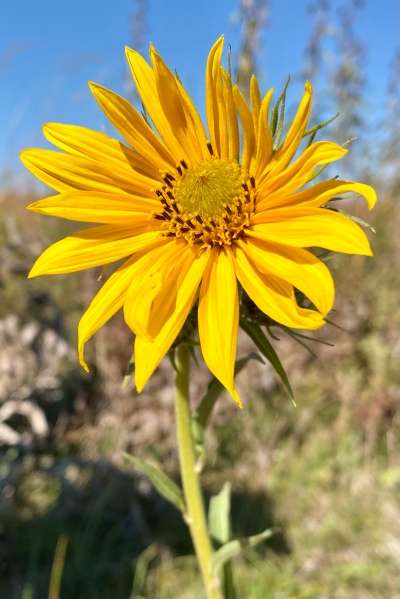
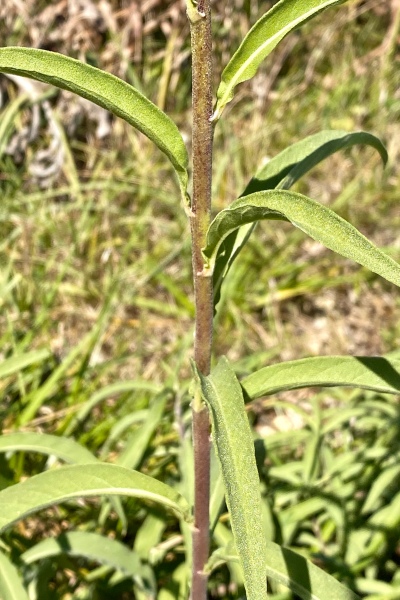
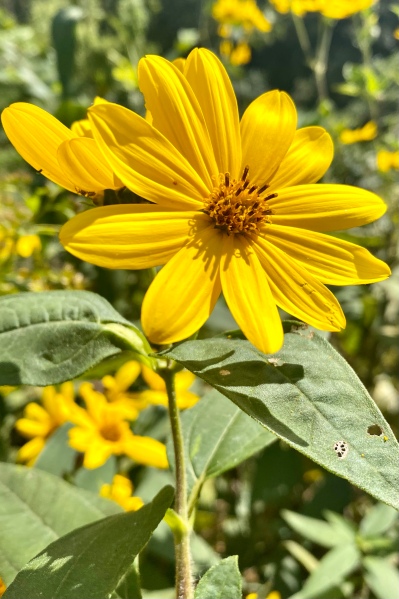
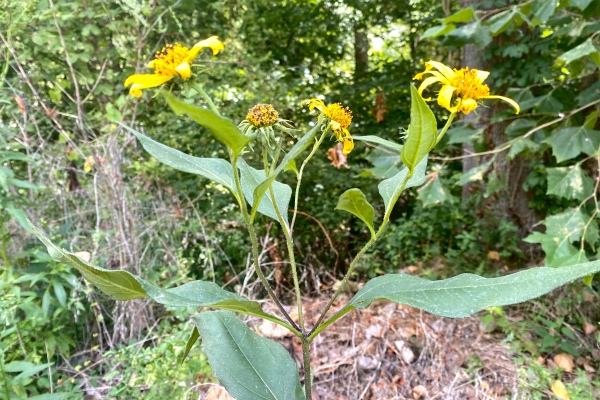
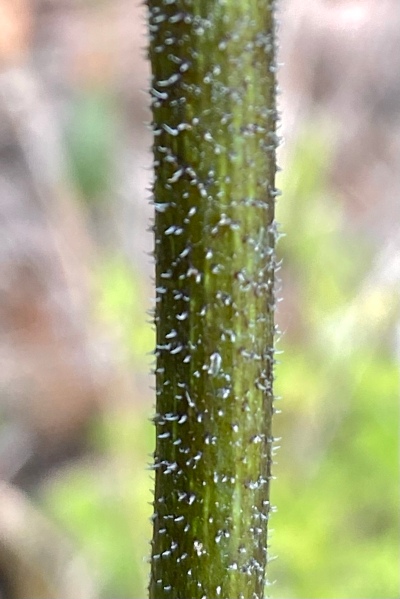
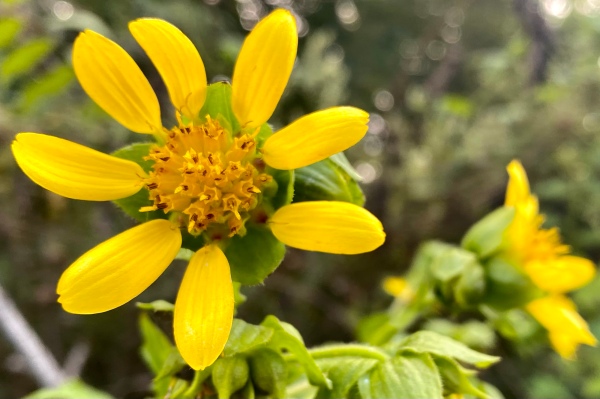
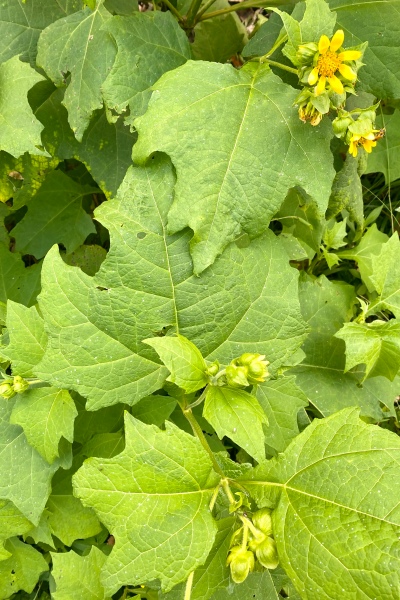
The plant of the day today, however, is what I believe to be Helianthus pauciflorus (stiff sunflower), a few plants of which I saw at the top of the knoll on the west side. There are no iNaturalist records for this species either here or at nearby Valley View Glades, but the WGNSS Botany Group has it on their floral list for Victoria Glades. This is a first sighting for me, but I am confident in the identification due to the dark disc florets, stiff lanceolate opposite leaves with rough upper and lower surfaces, and generally only one flower head per stem.
Unfortunately, non-native species continue to pop up with regularity in this gem of a natural area. This includes not only plants, such as Centaurea stoebe (spotted knapweed), a single plant of which I found in bloom at the edge of the parking lot…
The forecast over the weekend called for possible rain, so the WGNSS Botany Group chose a location close to home in case we got rained out. I would have never thought of Creve Coeur Park as a place to botanize, but the environs surrounding the lakes, particularly Mallard Lake, get good moisture and have been allowed to revert to semi-native vegetation (with a few significant exotic invasives) for many years now. We first examined a few native garden plantings near the parking lot and saw several things not typically found in this part of the state, but the most interesting to me was Liatris scariosa (savanna blazingstar), one of our less common species, and it’s large fantastically showy blooms.
Eupatorium serotinum (late boneset) was blooming profusely along the margins of the lake—I scanned the flowers for a while hoping to see some interesting beetles, with several Euphoria leucographa (a common flower chafer) being the only beetles seen. As I looked, I enjoyed Steve’s explanation of the common name of late boneset compared to another common Missouri species, Eupatorium altissimum (tall boneset)—the former actually blooms later than “late boneset,” and the latter is actually as tall as “tall boneset”!
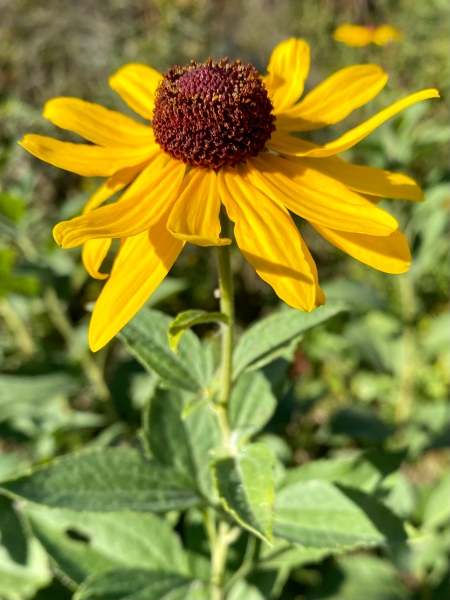
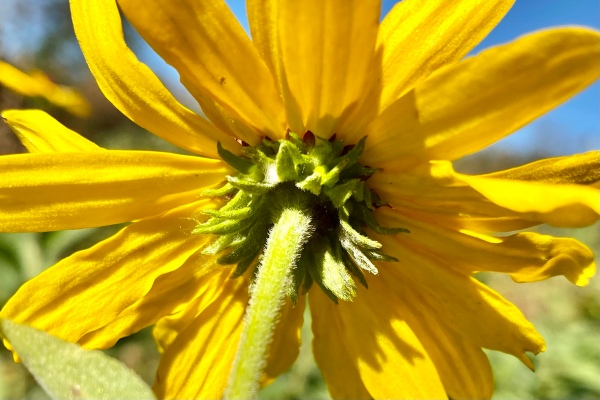
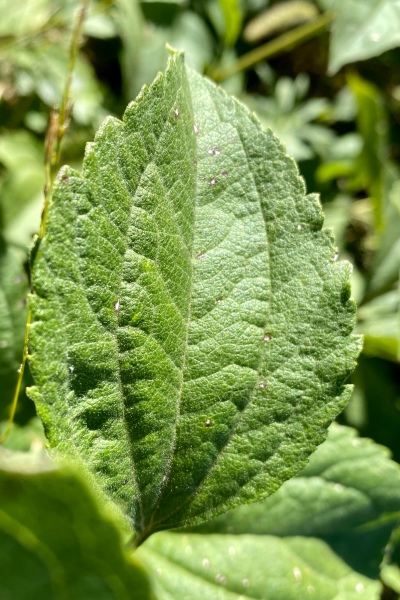
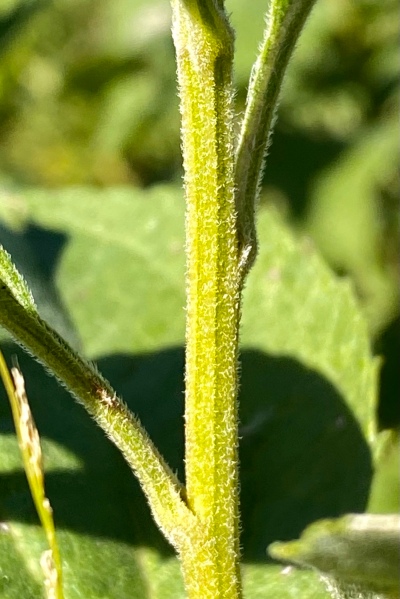
Further along the lake margin we found a stand of “Helianthus” sunflowers, but these proved to be the lookalike Heliopsus helianthoides (false sunflower)—I’d been fooled by their straight yellow color versus the orange-yellow color that is more typical of the species. A good character to distinguish this species when the color is not diagnostic is the double-rank of phyllaries on the underside of the flower head, with the inner ones short and rounded and the outer ones long and pointed-recurved.
There is also another easy way to distinguish false sunflower—by noting the presence of Lygaeus turcicus (false milkweed bug, also called the heliopsis bug), a close relative of L. kalmii (small milkweed bug) which looks very similar to the latter but, as indicated by the common name, feeds exclusively on false sunflower instead of milkweed. We eventually found several of the bugs (which, sadly, did not cooperate for photos), further confirming our identification of the plants.
We diverted to a dry, sandy spot under the bridge to check out some ant lion pits. Also called “doodlebugs,” these relatives to lacewings are surely the inspiration for the brain-eating “Ceti eels” in Star Trek: The Wrath of Khan! In the area, a super-fresh Limenitis arthemis astyanax (red-spotted purple) probed for salts on the ground, posing beautifully for a few photos.
Limenitis arthemis astyanax (red-spotted purple).
Walking along the trail north of Mallard Lake, we saw two species of vining plants: Amphicarpaea bracteata (hog peanut), and Apios americana (groundnut). Both of these plants belong to the bean family (Fabaceae) and have underground edible portions—the former in the form of peanut-like fruits formed from self-fertilizing, “cleistogamous” flowers that bloom near the ground (or even underground), and the latter in the form of tubers that form like strings of beads along the underground rhizomes of the vine. Both were important food sources for indigenous cultures. I’ve never seen either of these species in bloom (the flowers of groundnut, in particular, were unlike any other I’ve seen), so it was nice to be able to compare them on plants growing nearly side-by-side.
Amphicarpaea bracteata (hog peanut) inflorescence and leaves.
Walking back towards the cars, we had one more “DYC” (damned yellow composite) to test our ID skills. Fortunately, Helenium spp. (sneezeweed) are easily distinguished from other DYCs by their wedge-shaped ray florets with lobed tips and protuberant, nearly spherical disks. Helenium autumnale (common sneezeweed) is identified to species by its combination of yellow disk florets and broad leaves attached to a conspicuously winged stem.
By the time we reached our cars, I was as hungry, sweaty, and thirsty as I’ve ever been on one of these walks. My thirst and appetite for knowledge, however, were, for the moment, completely satiated.
Continuing hot and very muggy during the last week, and today it was already in the low 90s by the time I got into the field a little before noon. Silphium terebinthinaceum (prairie dock) and old Solidago nemoralis (field goldenrod) are are in full bloom across the glade, and I noticed pre-flowering plants of what must be a different goldenrod species and a different blazing star. I suspect they will be in full bloom by the time I check the traps again at the end of next week. The plant of the day, however, was Agalinis skinneriana (pale false foxglove), not a true foxglove but rather a member of the family Orobanchaceae. Midwestern gerardia is another common name for the species, and like other members of the family it is a hemiparasitic annual forb.
Agalinis skinneriana (pale false foxglove).
This plant is relatively uncommon, both in Missouri, being found primarily in glades, upland prairies, and in the few other states in which it is found, and though I’ve not noticed this plant here previously I found at least a few individuals in both the east and the west parcels. The upward-facing flowers are a key attribute for identification in the field. The two upper corolla lobes are spreading to reflexed, and the plants are relatively slender, being fewer-branched and less bushy than the more common A. tenuifoliaand A. gattingeri.