1986 Florida Field Trip Report

Ted C. MacRae & Rev. James M. Sullivan1

Fr. James Sullivan (left) and Ted MacRae (right) stand under a banyan tree in Key Largo, Florida, 9 May 1986 (photographer unknown).

In Spring 1986, the Rev. James Sullivan (Fr. Sullivan to those who knew him) and I made a two-week trip to Florida with the objective to explore as much of the state as we could—from the Panhandle to the Keys! My goal, of course, was to collect beetles2, especially woodboring beetles in the families Buprestidae and Cerambycidae (it was only my third trip outside of Missouri for such purpose), while Fr. Sullivan’s was to identify and document as many plant species as possible. This apparent dichotomy in interests was not as clean as it may seem—as an entomologist interested in host plant relationships, the chance to spend time in the field with as accomplished a botanist as Fr. Sullivan was too good to pass up, and Fr. Sullivan’s passion for studying insect associates of the plants he studied greatly aligned our interests. My memories of that trip have faced in the nearly 40 years since, jogged only by the specimens I collected now residing in my cabinet and two trays of 35 mm slides taken with an Olympus OM10 SLR film camera. Fortunately, Fr. Sullivan was more diligent than I in journaling his observations during that trip, a copy of which he gave to me. This report is an attempt to summarize our observations using these materials. In his journal, Fr. Sullivan made the following disclaimer: “Plant determinations in these notes must be regarded as tentative: We have not had the use of a complete flora for any portion of the State of Florida. We have been as precise as possible with the use of several less complete sources. ★This star symbol indicates plant determinations that were later confirmed by the use of the Flora of Tropical Florida or by other adequate keys.”

[Note: names for most of the plants included in this report were confirmed by Fr. Sullivan, the primary exceptions being those indicated with question marks (?). As a result, I have omitted use of the star symbol in this report. Also note that plant taxonomy has likely changed immensely during the past 39 years. Scientific names, common names, and plant families given are those we used at the time, and only in a few cases have they been harmonized with current nomenclature (my notes in [square brackets]). An asterisk (*) denotes plants and insects that were also photographed.]

We left St. Louis on the morning of April 28 with the goal of spending the night in Montgomery, Alabama. The next morning, true to form, Fr. Sullivan got up early to explore the area around the hotel before continuing the drive south. He noted two plants: Cirsium horridulum and Sapium sebiferum (Euphorbiaceae), the latter a fast-growing deciduous tree known as Chinese tallow and native to eastern Asia. All parts of the tree emit a milky white sap when damaged, which is toxic and can cause gastrointestinal upset if ingested. As we continued south, we noted the first Spanish moss (Tilandsia usneoides) draping the trees along Hwy 281. The growth was very well-developed, leading Fr. Sullivan to speculate that it also probably occurred north of Montgomery along I-65 but that we missed it due to our nighttime arrival.

Later in the day we arrived at our first destination, Torreya State Park in the Florida Panhandle, home of the extremely rare Florida nutmeg (Torreya taxifolia*) tree that grows only on the bluffs along the Apalachicola River. We explored the heavily forested hills and ravines of the area and found examples of this plant alongside the road near the entrance to the campground. However, we documented a diverse list of other plants including Acer barbatum [= A. saccharum ssp. floridanum] (Florida maple), Actaea pachypoda, Amorpha fruticosa, Aralia spinosa, Ascyrum sp., Callicarpa americana, Calycanthus floridus, Calycarpon lyoni, Cnidoscolus stimulosus*, Conopholis americana, Conradina canescens*(Lamiaceae), Croomia pauciflora* (Stemonaceae), Decumaria barbara, Dirca palustris, Erigeron strigosus, Erythrina herbacea*, Euonymus americanus*, Lonicera sempervirens*, Halesia sp., Hydrangea quercifolia*, Ilex opaca, Itea virginica*, Lygodium japonicum, Mitchella repens, Myrica serifera, Onoclea sensibilis*, Opuntia humifusa*, Rhaphidophyllum hystrix (needle palm), Ruellia carolinensis*, Sebastiana fruticosa* (Sebastianbush, Euphorbiaceae), Spiranthes praecox*, Viburnum sp., and Wahlenbergia marginata. Insect collecting consisted primarily of an assortment of longhorned beetles attracted to ultraviolet (UV) lights at night.

After two nights at Torreya State Park, we traveled further down the peninsula along the central spine to Highlands Hammock State Park, one of the oldest state parks in Florida protecting 9,000 acres of old-growth cypress swamp and oak hammock. We first explored the Wild Orange Grove Trail (noting wild orange trees as well as our first alligator!) but moved to other areas of the park over the next two days. We noted the occurrence of three species of palms here: Rhaphidophyllum hystrix (needle palm), which lacks the leaf midrib of and has fewer leaf divisions than Sabal palmetto (cabbage palm), the most common palm and distinguished by a strong leaf midrib, and Serenoa repens (saw palmetto) with its saw-toothed petiole edges. We repeatedly saw the tortoise beetle Hemisphaerota cyanea on the leaves of S. palmetto. A nice variety of longhorned beetles was also collected here, including the Florida endemic Typocerus flavocinctus and several lamiines at UV lights at night. A blister beetle (family Meloidae) similar to our Nemognatha nemorensis was common on the flowers of Aster reticulatus* and Pterocaulon pycnostachyum* (both Asteraceae), and on flowers of Cirsium horridulum we saw the leaf-footed bug Acanthocephala terminalis* (Coreidae). Other plants that Fr. Sullivan noted include Abrus precatorius*, Ardisia crenulata* (crenate berry bush, Myrsinaceae), Asimina pygmaea* (?), Bacopa sp.*, Bidens pilosa*, Callicarpa americana*, Cuthbertia graminea (?), Emilia sonchilfolius, Eriocaulon sp.*, Erythrina herbacea, Hypericum sp.*, Ilex cassine, Ilex glabra, Lachnocaulon anceps, Lygodesmia aphylla*, Lyonia lucida*, Mikania scandens, Oxalis violacea* (?), Persea borbonia, Polygala lutea*, Schrankia microphylla*, Tephrosia chrysophylla, Urena lobata, Utricularia sp.*, and Xyris sp.* Fr. Sullivan also noted in his journal a list of a dozen “rare” birds such (e.g., cardinal, catbird, crow, etc.!).

Our next destination was outside the northwestern limits of Everglades National Park at Collier-Seminole State Park, which lies partly within the great mangrove swamp of South Florida (one of the largest mangrove swamps in the world) and covering one of three original stands of royal palm (Roystonea elata [= Roystonea regia]) in Florida (the park was previously called Royal Palm Hammock). We primarily explored the Royal Palm Hammock Nature Trail and along the water’s edge around the boat basin, where Rhizophora mangle* (red mangrove) lined the edges of the salt marsh. Two species of Solanum were observed, primarily S. erianthum (potato tree) but also S. donianum*, and we noted the pleasant fragrance of a Eugenia sp. that escaped identification. Bursera simaruba (“tourist tree”), with its distinctive peeling bark, was also common here. We noted Baccharis halimifolia heavily infested with the leaf beetle Trirhabda bacharidus*, saw Heliconius charitonius butterflies on the wing, and observed a cluster of young seed bug nymphs* (Lygaeidae), likely one of the milkweed-associated species, on a vining species of milkweed. Deer flies (family Tabanidae) were a real problem for both of us, and we had to use head nets (Fr. Sullivan even resorted to wearing his London Fog jacket!). Other plants documented included Acrostichum sp., Alternanthera sp. poss. philoxeroides (Amaranthaceae), Batis maritima, Bidens pilosa var. radiata, Blechum brownei, Borrichia frutescens*(sea daisy), Commelina diffusa, Dicliptera assurgens*, Dicromena sp.* (white-bracted sedge, Cyperaceae), Eugenia sp.*, Ipomoea alba (moon flower), Ipomoea sagittata*, Passiflora pallens, Pithecellobium unguis-cati (cat claw), Pluchia odorata (camphor weed), Polygala grandiflora var. angustifolia, Psychotria undata*, Solidago sp.*, Triodanus sp., Urena lobata*, and Zanthoxylum fagara (lime prickly ash). Similar to previous localities, a diversity of longhorned beetles were attracted to UV lights at night.

After two days at Collier-Seminole, we drove east along the Tamiami Trail, noting the magnificent stands of bald cypress (Taxodium distichum) in the Big Cypress Swamp Preserve and seeing the first water hyacinths (Eichhornia crassipes) in bloom. We also saw Australian pines (several species in the genus Casuarina)—angiosperms rather than gymnosperms. Its needles are much longer than true pine (genus Pinus), and the trees appeared very dark green as seen from a distance. Eventually we landed at John Pennekamp Coral Reef State Park on Key Largo. Most people visit this park to dive and explore the spectacular living reefs of the Florida Keys; however, we had more terrestrial objectives. We began by exploring the coral limestone woodland along the Wild Tamarind Trail, where Metopium toxiferum *was common along the woodland border (and we took care not to touch!). A large ichneumonid wasp* (Ichneumonidae) was seen perched in the understory, and we noted the impressively oversized female of the spider Nephilia clavipes* being courted by an equally strikingly diminutive male. Lysiloma latisiliqua* was abundant in the woodland, as was Bursera simaruba* its bark red and peeling like a sunburned tourist! Coccoloba uvifera was also abundantly fruiting, and other plants seen include Alternanthera sp., Conocarpus erecta var. sericea, Schinus terebinthifolius*, and an unidentified composite (either Eupatorium villosum or Garberia sp.). Along the Mangrove Trail we saw (of course) not only red mangrove Rhizophora mangle*) but also black mangrove (Avicennia germinans*, Avicenniaceae) and white mangrove (Languncularia racemosa, Combretaceae). These three plants are placed in three unrelated families, yet all show a high degree of fidelity to mangrove ecosystems. At a Persea americana* orchard in the adjunct Shaw Property, we saw Hamelia patens* in bloom and Lysiloma latisiliqua growing around the orchard’s edge. Other plants seen in the area include Abutilon sp., Batis sp.*, Eupatorium villosum* (?), Gaillardia pulchella*, Heliotropium angiospermum, Heliotropium curassavicum, Hibiscus tiliaceus, Melanthera sp., and Rivina humilis*.

Our plan the following day was to continue down the length of the Keys, making stops at a few selected places along the way before spending the night in Key West. At our first stop on Lower Matecumbe Key, we noted Avicennia germinans, Eustoma exaltatum*, and Polygala baldwini (as well as a Great Blue Heron) and then continued southwestward to Long Key State Recreation Area [now Long Key State Park]. Most people visit Long Key for its beaches and fishing, but we came to the preserve to explore the endangered coastal dune ecosystem that it protects. Few insects were seen, but a number of interesting, mostly highly salt-tolerant, plant species were seen. These include Abutilon sp., Argemone mexicana*, Cassasia clusiifolia*, Chrysobalanus icaco, Ipomoea pes-caprae, Lantana involucrate, Manilkara bahamensis* (wild dilly, Sapotaceae), Scaevola plumieri* (inkberry, Goodeniaceae), Solanum diphyllum, and Suriana maritima* (bay cedar). We finished the day at Key Deer Preserve on Big Pine Key, a sanctuary for the smallest subspecies of white-tailed deer in North America. We did not see any deer, but we did see some interesting plants. Byrsonima cuneata* (Malphigiaceae) was common here, as was Croton linearis. Along the Nature Trail we saw the orchid Bletia purpurea* (pale pink) and also recorded Aletris sp., Chrysophyllum oliviforme (Sapotaceae), Dichromena sp., Ernodia littoralis*, Metopium toxiferum, Pithecellobium sp., Polygala verticillate (?), and “thatch palms” (plus a hissing alligator!).

The next two days were spent at Everglades National Park, where we began our visit by exploring the Long Pine Key Nature Trail, where Cladium jamaicensis* (sawgrass) and Taxodium distichum* dominated the landscape. We noted that it was easy to pass one’s fingers over the sawgrass blade edge in one direction, but not so easy in the other! It was here that I found what I considered a real prize—my first ever bumelia borer (Plinthocoelium suavelons)! I also collected the very colorful Trichodes apivorus on the flowers of Sabal palmetto. Fr. Sullivan had even more success with the plants—so much, in fact, that we were only able to explore the east end of the trail. Several plants belonging to largely tropical plant familys were seen, including Dodonaea viscosa (varnish leaf, Sapindaceae), Tatrazygia bicolor* (Melastomataceae), and Dipholis salicifolia (willow bustic, Sapotaceae). Polygala balduinii (or a similar species) and an unidentified Buchnera sp. were common. The recorded list of other plant species seen was diverse: Asclepias lanceolata*, Baccharis sp., Byrsonima cuneata, Calopogon sp.* [likely C. tuberosus var. simpsonii], Croton linearis, Dichromena sp., Heliotropium polyphyllum var, polyphyllum (H. leavenworthii ) (Boraginaceae), Jacquemontia jamaicensis, Lobelia glandulosa*, Melanthera angustifolia (Asteraceae), Myrica cerifera, Myrsine guianensis, Passiflora sp.*, Persea bordonia, Piriqueta caroliniana, Psychotria nervosa, Rhus sp., Sabatia sp. poss. brevifolia*, and Stillingia sylvatica ssp. tenuis (Euphorbiaceae). We returned again to Long Pine Key Nature Trail the following day to explore the west end near Pine Glades Lake, finding many of the same plants recorded the previous day but also Ageratum littorale (?), Bletia purpurea, Justicia ovata var. lanceolata*, Lippia stoechadifolia, and Morinda royoc. From there we moved on to the P.K. Nature Trail, where Cynanchum blodgettii was seen twining over much of the vegetation—including other plants of its own species!. Fr. Sullivan spent a good deal of time studying a plant found growing at the edge of Pine Glades Lake, which he presumed to be a species of Lippia that exhibited pleated leaves with matching teeth (leading him to call it “corduroy lippia” or “pleated lippia”). Eventually he settled (and later confirmed) the species as Lippia stoechadifolia, a Neotropical species limited in the U.S. to south Florida and the Keys. Other plants observed included Angadenia berterii, Urechites lutea, and (my favorite) Zamia floridana* [likely Z. integrifolia var. silvicola].

Back at Key Largo near Tarpon Bay (below our motel), Fr. Sullivan continued exploring the plants, especially the mangroves. He noted that Avicennia has “dewdrops” but that the other mangroves do not. This relates to the processes used by the plant to eliminate excess salt, which in Avicennia involves salt water “perspiration” that dries in the heat of the day (indeed, the residue of salt flecks is useful in distinguishing Avicennia from the other mangroves) but in Rhizophora is done by accumulating salt in the oldest leaves before they turn yellow and drop. He also noted that Avicennia and Rhizophora can be distinguished by color; Avicennia, which normally grow a little farther from the water, are closer to gray-green, while Rhizophora are closer to yellow-green. Tridax procumbens was a common roadside weed around the motel—its flowers and fluffy seedheads rise on long scapes, as if leafless, but are actually attached to the sprawling, hairy stems, which bear many deeply cleft leaves with opposite arrangement. He also noted Morinda royoc growing not only in the woods but also hedgerows. It is like Psychotria [both species are in the Rubiaceae], but without the large, nervy leaves. The fruits aggregate to look like large, yellowish mulberries. Hamelia patens grows right along the highway here, and several large Solanum shrubs with stellate trichomes on the leaves and white flowers were seen that may be a complex of species including S. donianum, S. verbascifolium, S. erianthum, or yet another species.

On May 10, the field visits were over, and it would take two days of driving to return to St. Louis. Even beginning the drive home, however, did not stop Fr. Sullivan from botanizing. During a stop at the drawbridge on Hwy 1 between Key Largo and the mainland, Fr. Sullivan collected Stachytarpheta jamaicensis, its flower tubes emerging from upward pointing, elongate triangular bracts, and its leaves being coarsely dentate. Also, from the highway in northern Florida, we saw what appeared to be the frequent occurrence of blooming Asimina. These were low plants with white flowers and leaves present. Spending several days in south Florida also gave Fr. Sullivan a chance to contemplate the different hammock habitats that we had visited, and he noted the following: “A hammock is basically a hardwood forest. A hammock in Florida has a significance parallel to that of a glade in Missouri: it is a relief from the ordinary situation. In the Everglades hammocks take the form of “hillocks”: The forest seems to build itself above the level of the sawgrass wetlands. In Highlands County, on the other hand, the hammocks occupy depressions in the topography. It is natural for the pinelands to burn with some degree of regularity, but the wet depressions are protected from most fires. Fire actually helps Pinus to have a competitive edge (since the needles make good tinder and the resin burns so hot, the pines contribute to their own survival situation), but in the wet depressions the broadleaf hardwoods are able to take over. The State Parks often feature the hammocks. As we go farther south, the hardwood species become more tropical. We have seen a lot of Bursera simaruba, a hammock feature, but have yet to see Ceratiola ericoides, which is more a representative of the norm for this state. Visiting Mahogany Hammock in the Everglades we learn that it is protected from sawgrass fires by a natural moat surrounding it. The moat results as limestone strata are eaten away by the hardwood-produced acids.”


1 Deceased April 15, 2025.

2 Permits for collecting beetles were obtained from the Florida Department of Agriculture and the National Park Service.

© Ted C. MacRae 2025
Hiking at Valley View Glades Natural Area

My good hiking/collecting buddy Rich called me yesterday and asked if I was interested in a hike. Since I am retired, and he is retired, there was nothing on either of our schedules that prevented us from doing it the very next day, so we decided to come to one of our favorite places that we haven’t been to in awhile—Valley View Glades Natural Area near Hillsboro.

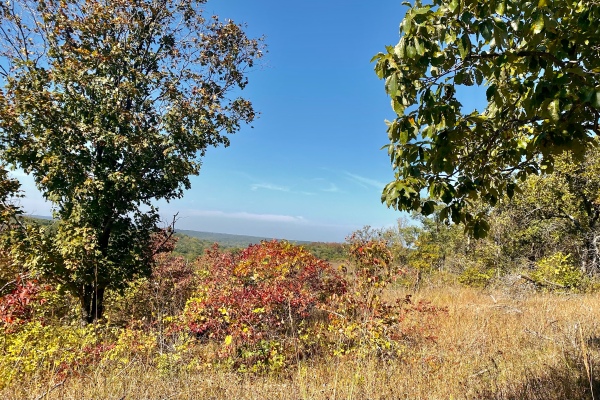
Fall color beginning at Valley View Glades Natural Area.

I brought my big camera along because I figured Great Plains ladies’-tresses orchids (Spiranthes magnicamporum) would be in good bloom, and I wanted to get good closeups with a blue sky background (I was successful in that regard—photos coming soon). I also brought along my collecting pack in case we found a beetle or two, but in this regard I was only half-successful—careful examination of several ninebark (Physocarpus opulifolius intermedius) patches did not reveal any Dicerca pugionata (seen a week ago at nearby Victoria Glades), but I did find a Blackburn’s earth-boring beetle (Geotrupes blackburni) on the trail. We also found a gum bumelia (Sideroxylon lanuginosum) tree with copious amounts of frass at the base, indicating infestation by a bumelia borer (Plinthocoelium suaveolens), and I recorded the location so I could put an emergence cage at the base of the tree next season to catch the emerging adult.

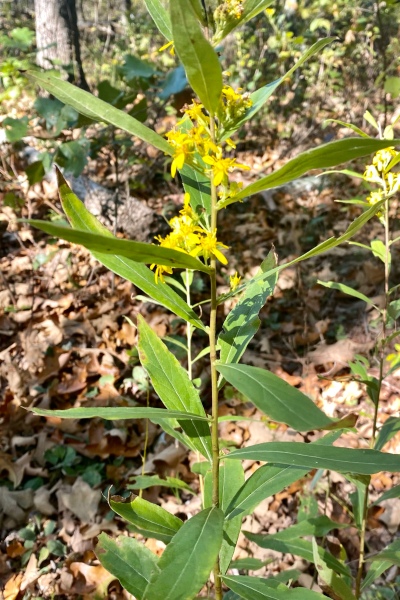
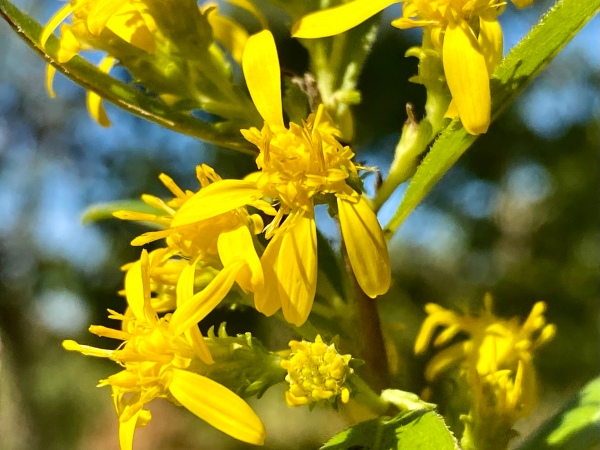
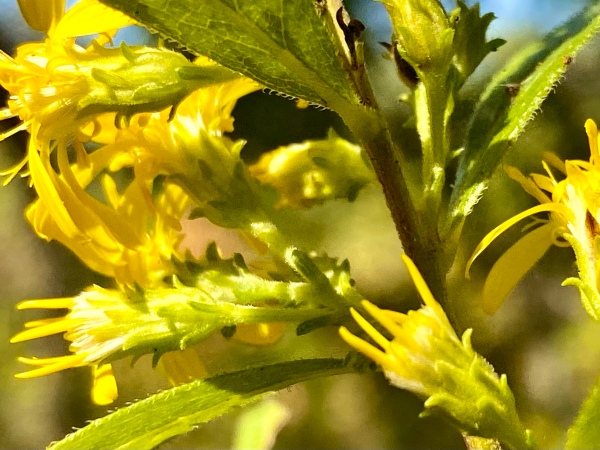
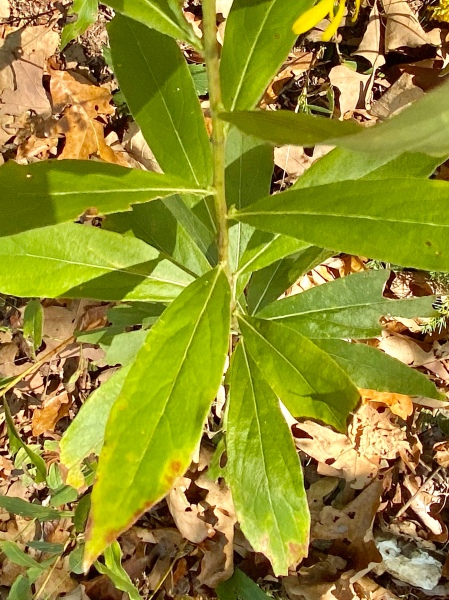
One other item of botanical interest was downy goldenrod (Solidago petiolaris) growing near the margins of the dry post oak woodlands—a species I’ve not previously noticed but was able to recognize due to its combination of recurved phyllaries and moderately widened leaves without teeth (Buckley’s goldenrod, S. buckleyi, also has recurved phyllaries but wider leaves with the edges distinctly toothed).

Downy goldenrod (Solidago petiolaris).

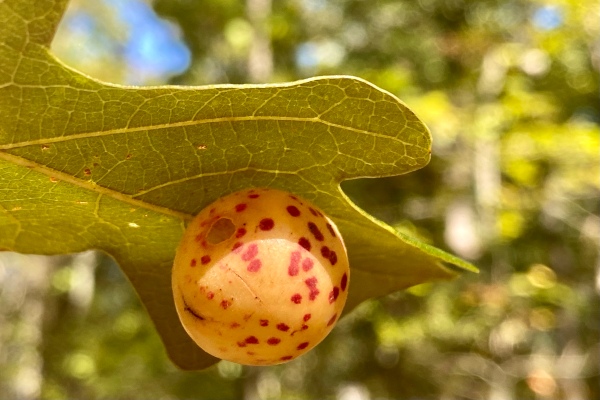
An especially colorful gall caused by the cynipid wasp Atrusca quercuscentricola on the leaf of post oak (Quercus stellata) piqued both entomological and botanical curiosity.

Atrusca quercuscentricola gall on leaf of post oak (Quercus stellata). Note adult emergence hole in upper left of gall.
Atrusca quercuscentricola gall on leaf of post oak (Quercus stellata)—turned upside down.

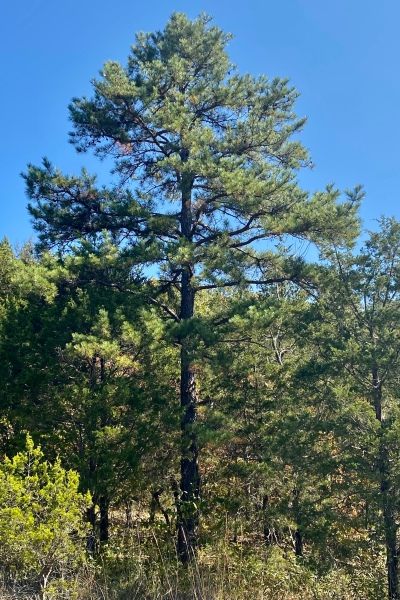
Near the end of the hike, I pointed out a shortleaf pine (Pinus echinata) tree that may be the northernmost naturally-occurring shortleaf pine in the state. I am aware of some trees further north along Hwy 21 at Sunridge Tower Park and in St. Louis Co. at Rockwoods Reservation, but I believe in both of these cases they are planted.

Shortleaf pine (Pinus echinata).
©️ Ted C. MacRae 2021

2018 New Mexico/Texas Insect Collecting Trip “iReport”

This is the fifth in a series of Collecting Trip “iReports”—so named because I’ve illustrated them exclusively with iPhone photographs (see previous articles for 2013 Oklahoma2013 Great Basin, 2014 Great Plains, and 2015 Texas). Note that I continue to use my “big” camera for specific insect targets—and these will be featured from time to time on this site. However, I use my iPhone camera much more during these trips for general photography to document habitats, landscapes, and miscellaneous subjects because it is so small and handy and because it is also capable of capturing reasonably good photographs (see this post for tips on making the most of the iPhone camera’s capabilities). This allows me to spend more time looking for and collecting insects—usually my primary objective on these trips! Collectively, these iPhone photos and the short narratives accompanying them form a nice trip synopsis when assembled into a single post.

This report covers a collecting trip I made with Jeff Huether from June 2–9, 2018 to southeastern New Mexico and west Texas. I’ve dabbled in this area before, primarily just a quick stop at Mescalero Sand Dunes many years ago, but not specifically targeted this area for any systematic collecting. Thus, most of the locations that we visited were new to me, which automatically means that I would find at least a few things of interest—and more probably a lot (as long as the insects are active). We had great success at many localities, having found areas where sufficient rain had occurred to trigger insect emergence despite the drought that was plaguing much of the area. Highlights were the areas along Hwy 380 between San Antonio and Bingham, the Mescalero Sand Dunes, and the dunes near Kermit, Texas. I haven’t yet tallied the number of species collected, as much of the material is still waiting to be mounted and identified. However, I estimate that it is in the neighborhood of about three dozen buprestids and maybe half that many cerambycids, including some quite charismatic species that I’d not collected previously (e.g., Prionus arenarius and Tragidion armatum).

Stay tuned, because I made a second insect collecting trip during 2018, this one with Art Evans to southeast Arizona during late July and early August.


Day 1 – Sandia Mountains, New Mexico
We flew into Albuquerque this afternoon and, after getting the car, supplies, and something to eat we came up to Sandia Crest Recreation Area looking for Cicindela longilabris (long-lipped tiger beetle). This was the first place I stopped on the first day of the trip for the first species I wanted to look for, and I found it in the first five minutes I was here!

View from near the summit of Sandia Mountain.

We stopped at the Capulin Picnic Ground on the way down the mountain. There were some oaks with fresh-looking foliage that I beat – no Buprestidae but a nice series of a treehopper (Telamonthe?) and a few odds and ends. There was also Robinia off which I beat a series of what is surely Agrilus egenus.

Penstemon sp. ID by George Yatskievych.

Day 2 – Walking Sands Rest Area, New Mexico
Quick stop to check the lights – later in the season Jeff has collected Prionus palparis here, but this time we saw nothing. Also checked the nearby vegetation, there was Dalea in bloom but no beetles on the flowers.

Hwy 380 between San Antonio & Bingham, New Mexico
We saw a few things in bloom at the Rio Grande bridge crossing so decided to stop. I took a fair series of what must be Acmaeodera mixta off of the Thelesperma flowers (along with a few mordellids for Enrico and one meloid for Jeff). Otherwise not much activity at the spot.

Bone dry Rio Grande!

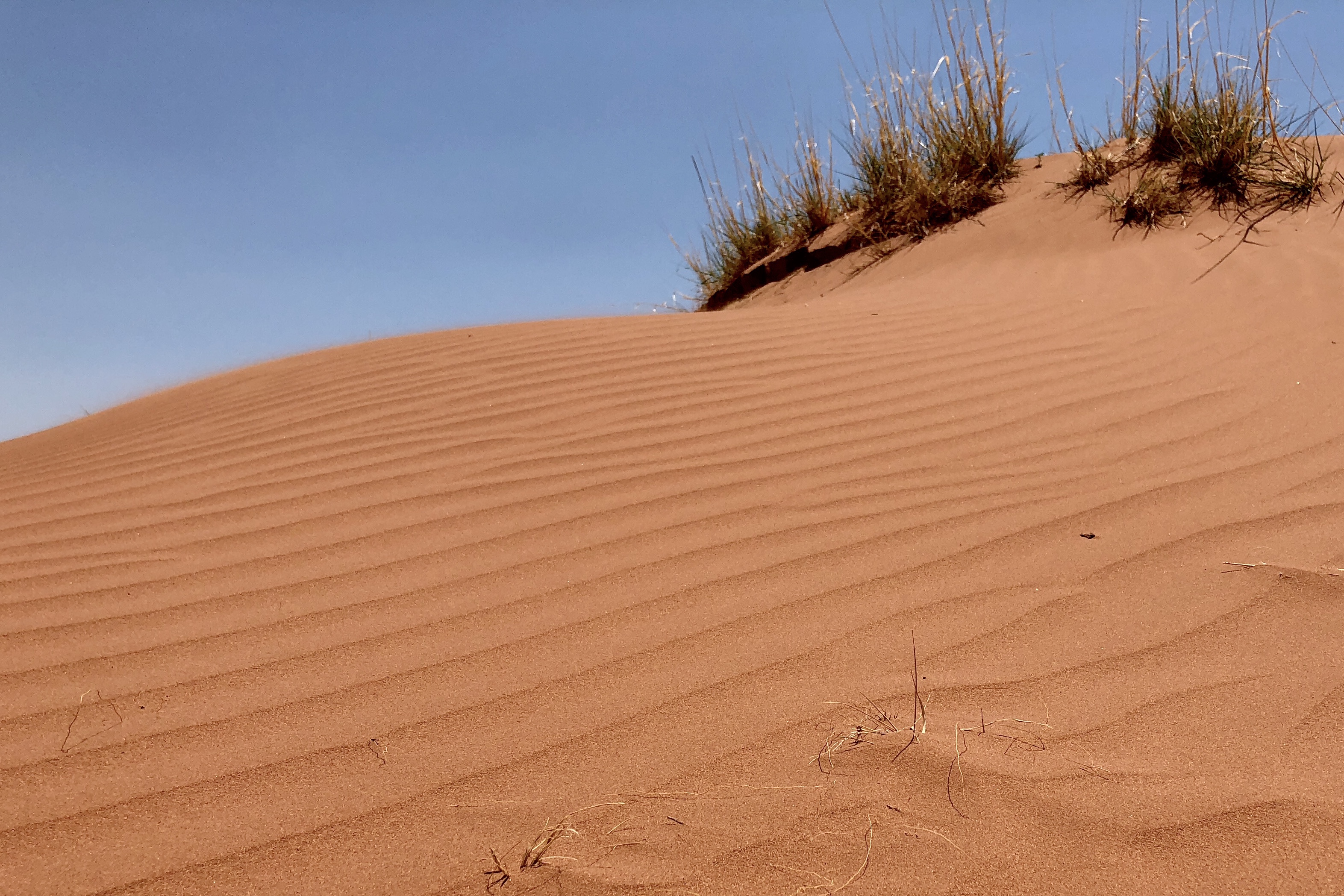
There were some cool looking red sand dunes on Hwy 380 east of San Antonio, so we stopped to see if there might be any tiger beetles. There weren’t any, but I found yucca stems infested with cerambycid larvae, likely Tragidion. I collected 6–8 stems to bring back and try to rear out the adults. Jeff also found a single Chrysobothris sp. on sage, otherwise we saw few beetles.

Going east on Hwy 380 we went into an area of higher elevation with junipers. We stopped to check the Thelosperma flowers, but there were no bups on them. I collected a few noisy cicadas and some Acmaeodera quadrivittatoides on Opuntia flowers. I then started beating the junipers, however, and got a fair series of a small green Gyascutus plus two tiny Chrysobothris. They were extremely difficult to collect – winds were very stiff and the beetles were very active. I probably lost as many as I collected. To finish off I found a mating pair of Moneilema sp. on cholla.

Acmaeodera quadrivittatoides in a flower of Opuntia sp.

Yours truly standing next to a cholla (Opuntia imbricata).
In addition the the Tragidion larvae that I collected two stops back, Jeff saw one adult at the previous stop. So, when we saw thick stands of yucca along the roadsides just a few miles down the road we stopped to take a look. They were out and not uncommon on the flower stalks and down in the basal rosettes. I collected about a dozen of them and also another Gyascutus.

A Tragidion female on a yucca flower stalk.
Tragidion sp. mating pair on yucca flower stalk.

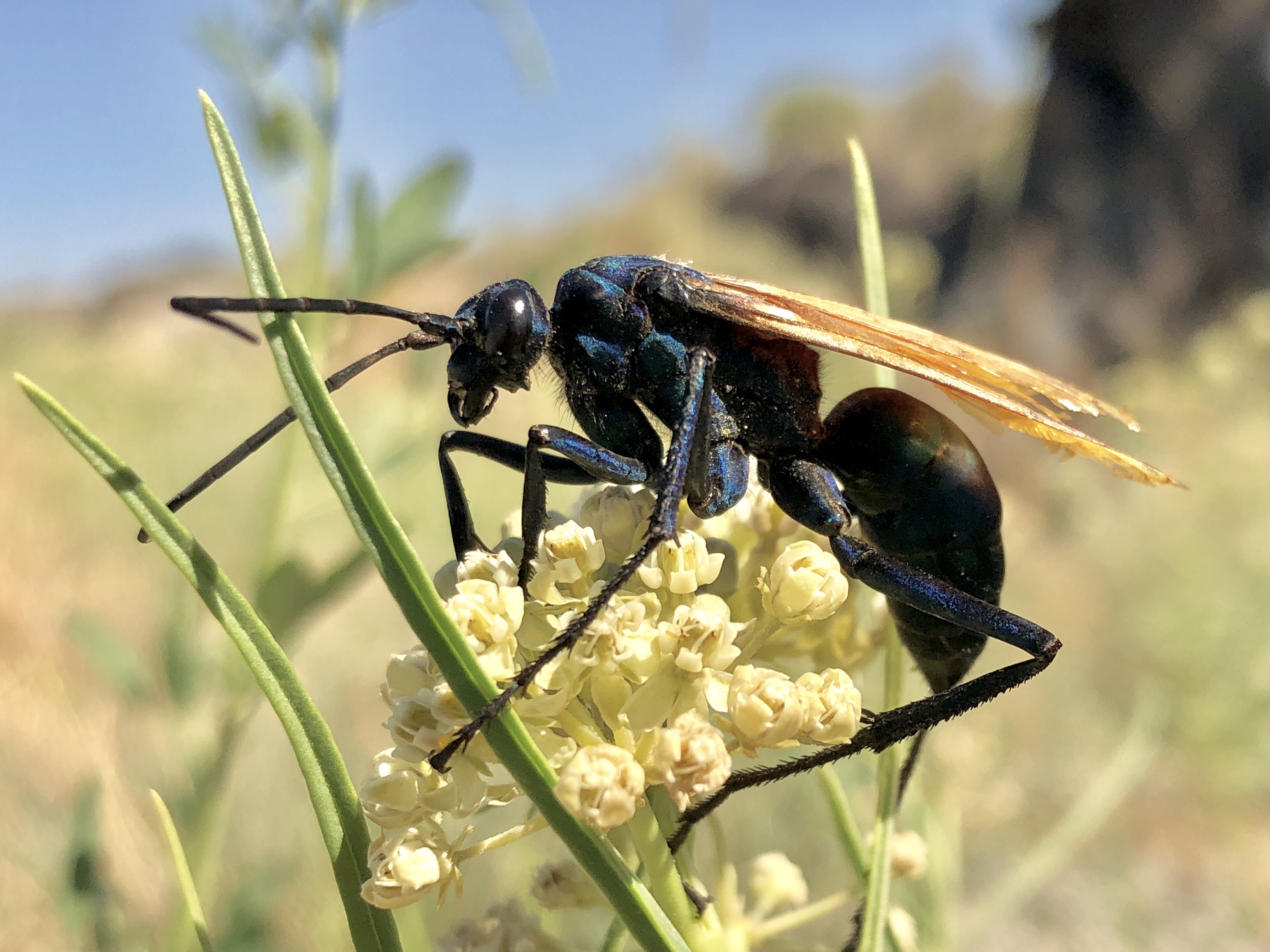
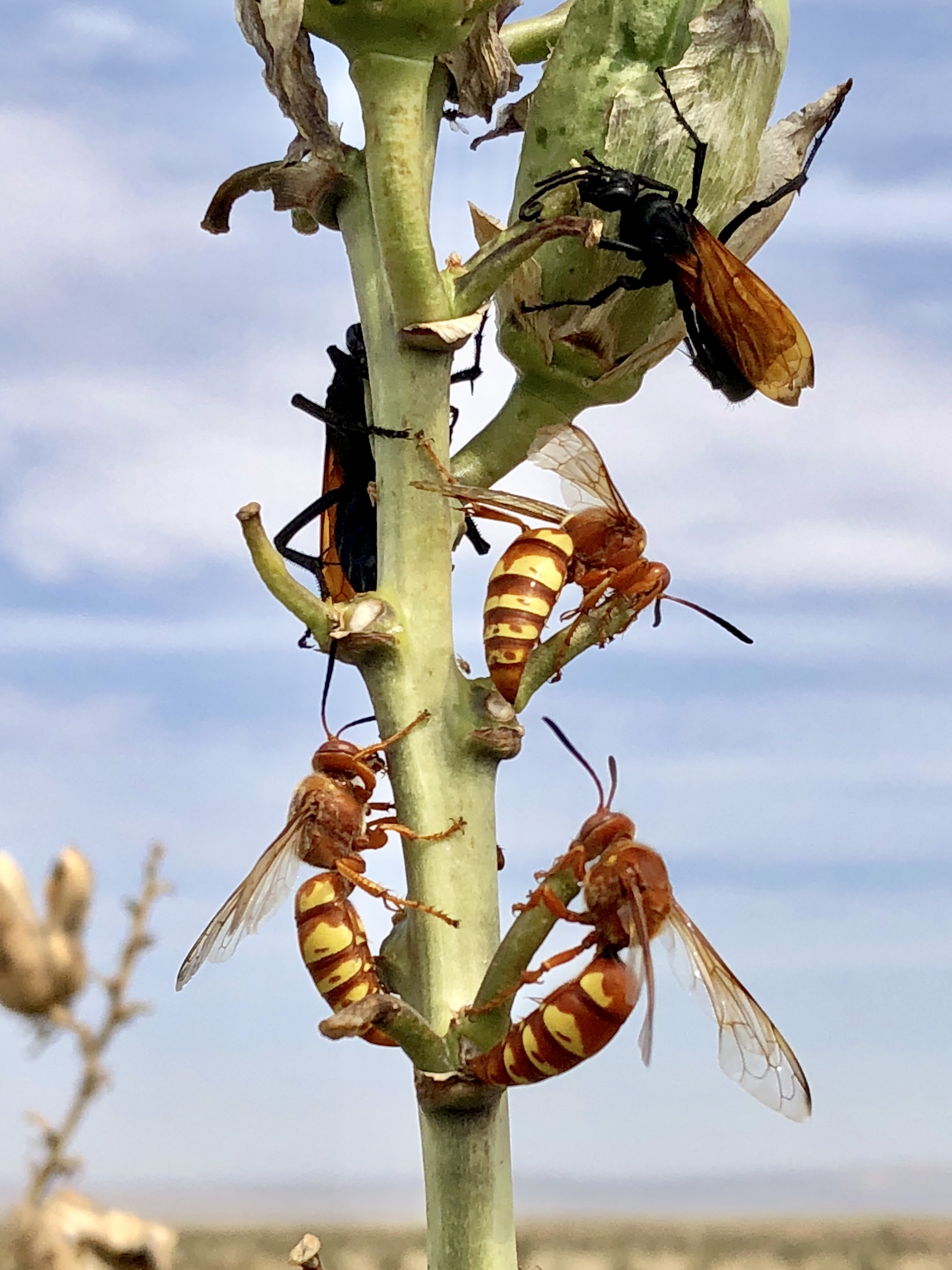
Tarantula hawk (family Pompilidae) on yucca flower stalk. This must be a mimicry model for Tragidion.

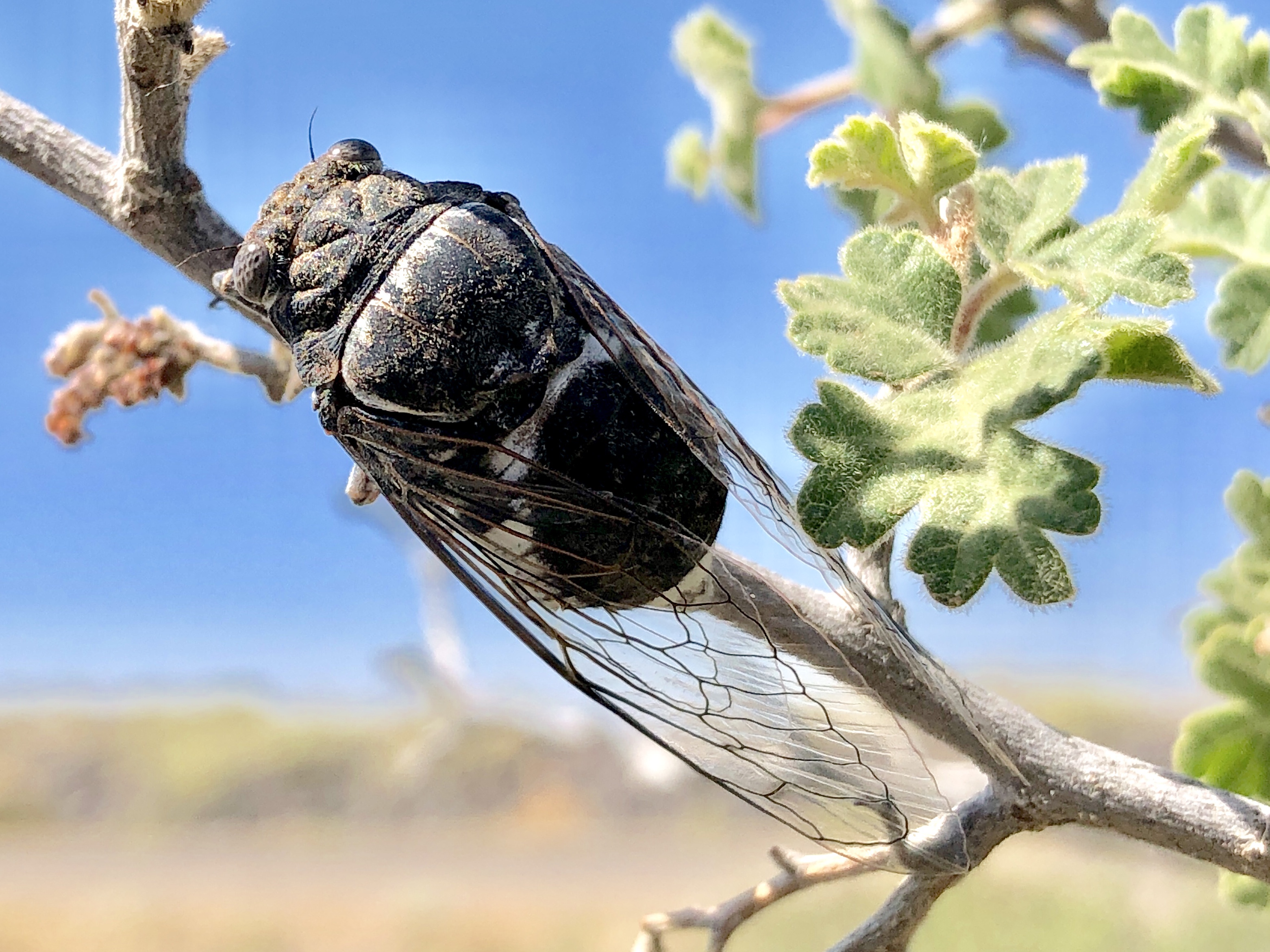
I believe this is a cactus dodger cicada (Cacama sp.).

At the last stop we noticed a lot of emergency vehicles rushing to the east. Just a couple of miles down the road we ran into an accident blockade. Since we were stopped I was tempted to look at the rock shop, but then I started looking at the cholla and found several Moneilema sp. adults on the plants.
Walking Sands Rest Area, New Mexico
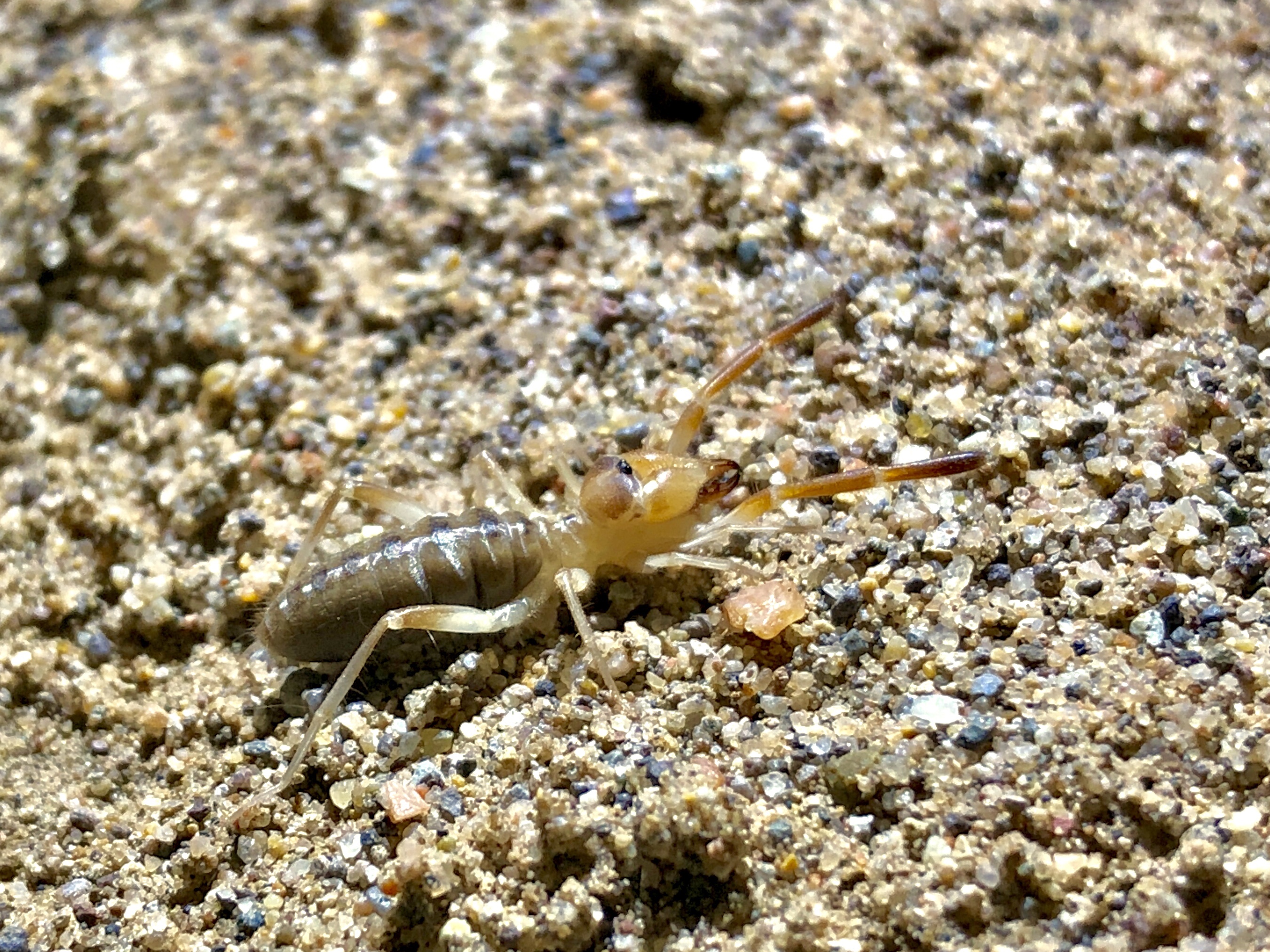
We came back up to the rest stop because of the dunes – there are Prionus spp. that live in the dunes, so we put out some pheromone to see if we could attract the males which fly at dusk and early nighttime. In the meantime we walked around looking for nocturnally active beetles – found a few skin beetles (Omorgus sp.) feeding in dried dog poop and a huge tenebrionid (Eleodes sp.) strangely perched up in a bush. Also photographed a cool little sun spider (Solifugida). When we went back to check the pheromone there was one male Prionus arenarius running around under the lure!

Skin beetle (Omorgus nodosus) feeding on dried dog poop at night. ID by Bill Warner.

A sun spider (Solifugida) pauses briefly from its frantic search for prey.

Day 3 – Valley of Fire National Recreation Area, New Mexico
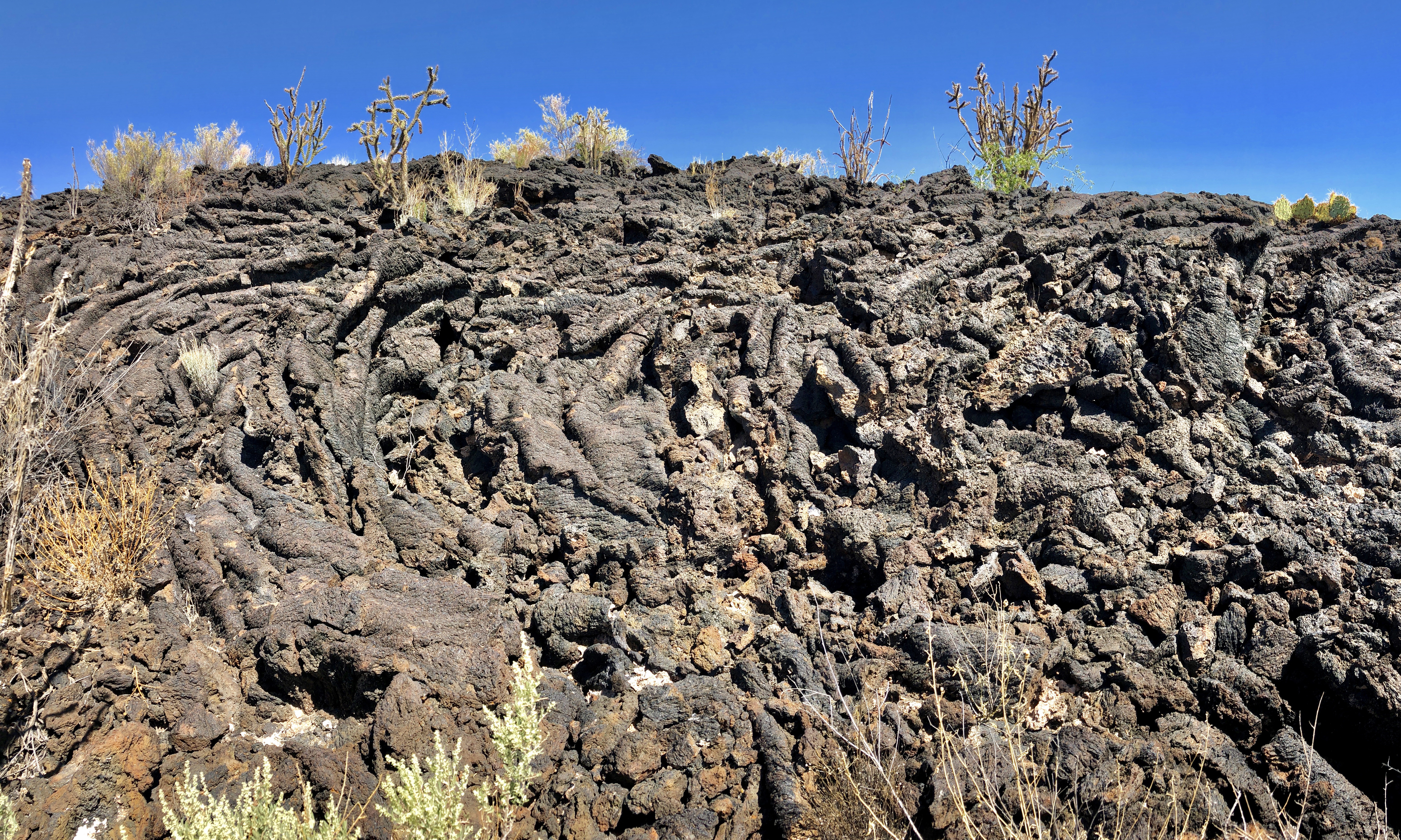
We came over the hill and saw a huge black area in the valley below. I thought it was just an area of thick woody vegetation, but it was actually a lava field! Very cool. There were tons of cicadas, I think also cactus dodgers (Cacama spp.) but look different from the one we saw yesterday. I beat a lot of Celtis and only got one Chrysobothris sp. (looks like analis), and there was nothing on the junipers. We also didn’t see any Moneilema on the abundant cholla. I did catch two Acmaeodera mixta on an unidentified white flower. I think yesterday’s rains must have missed this area!

Malpais Lava Beds.

A tarantula hawk (family Pompilidae) on flowers of milkweed (Asclepias sp.).

I believe this is another species of cactus dodger cicada (Cacama sp.).

Malpais Lava Beds.

Lead-footed bugs (family Coreidae) on cholla cactus (Opuntia imbricata).

Malpais Lava Beds.
Cactus dodger cicada (Cacama sp.)?
Male cactus dodger (Cacama sp.) on cholla cactus in mid-song.

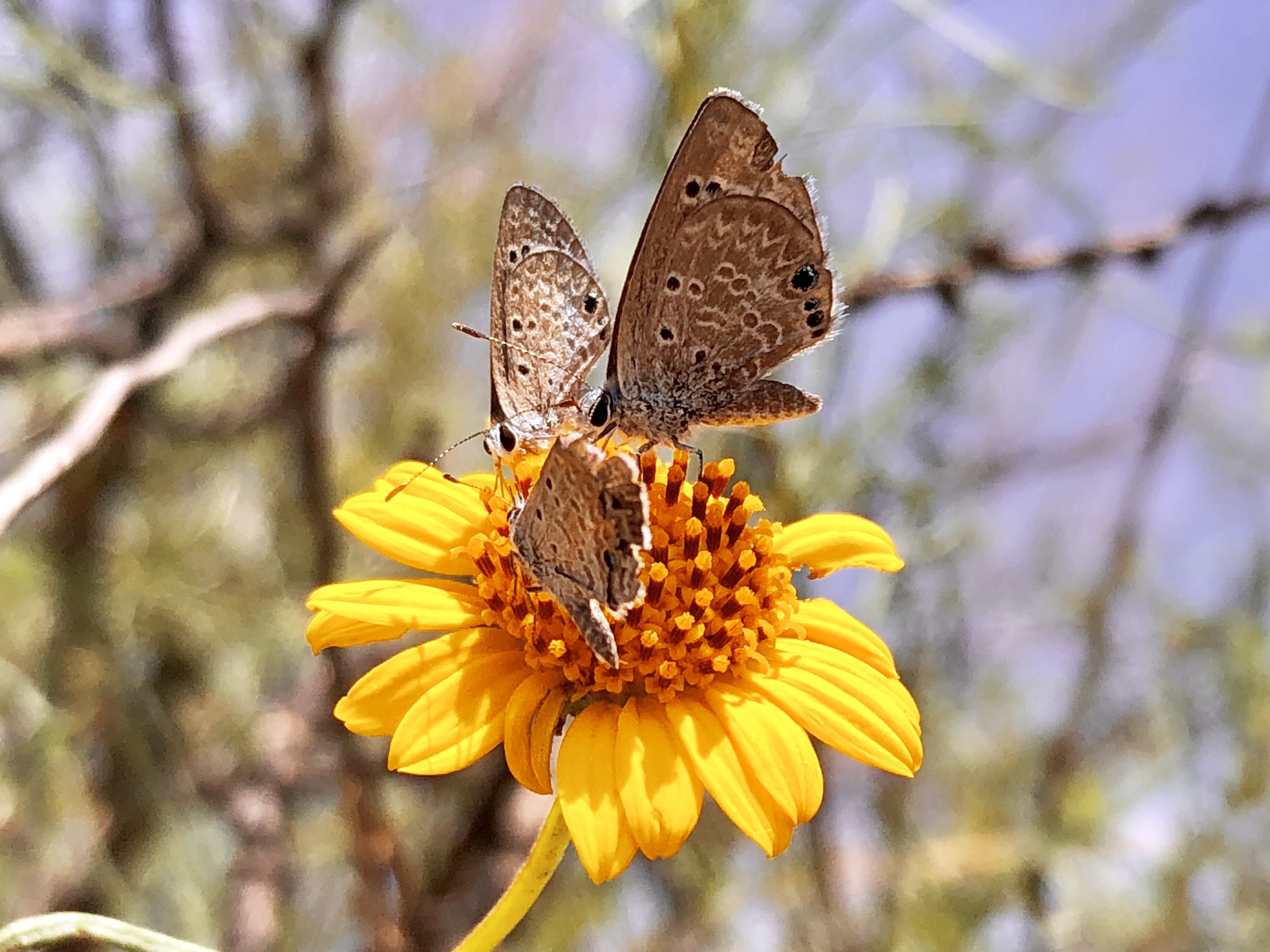
We drove a couple miles down the road and made just a quick stop to check flowers along the roadsides. No beetles seen – seems to be super dry, but I did photograph one of the tiniest butterflies (something in the family Lycaenidae) I’ve ever seen.

Western pygmy blue (Brephidium exilis). ID by Doug Taron.

Sierra Blanca Mountains, New Mexico
Jeff wanted to look for an Epicauta up here, but the whole drive up the mountain we could only comment on how dry it was and how extensively the area had burned. I only found two wood borers – an Anthaxia (Melanthaxia) and a lepturine cerambycid, both on iris flowers. We did find the Epicauta though, also on iris flowers.

Atop the Sierra Blanca.

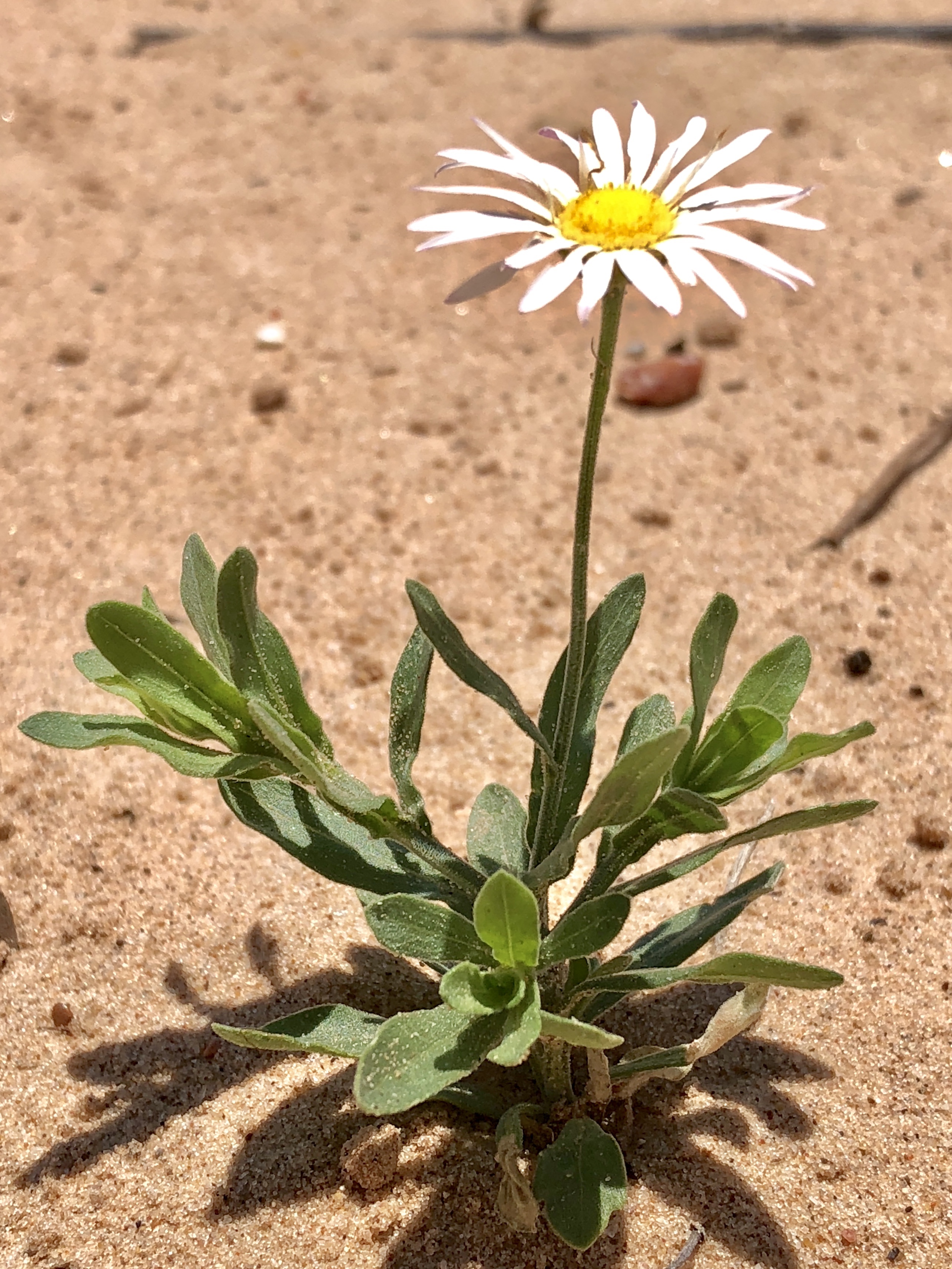
Perhaps Erysimum capitatum (Brassicaceae). ID suggested by Erik Emanuelsson.

Flower longhorn (subfamily Lepturinae) on flower of iris.

Vicinity Sunset, New Mexico
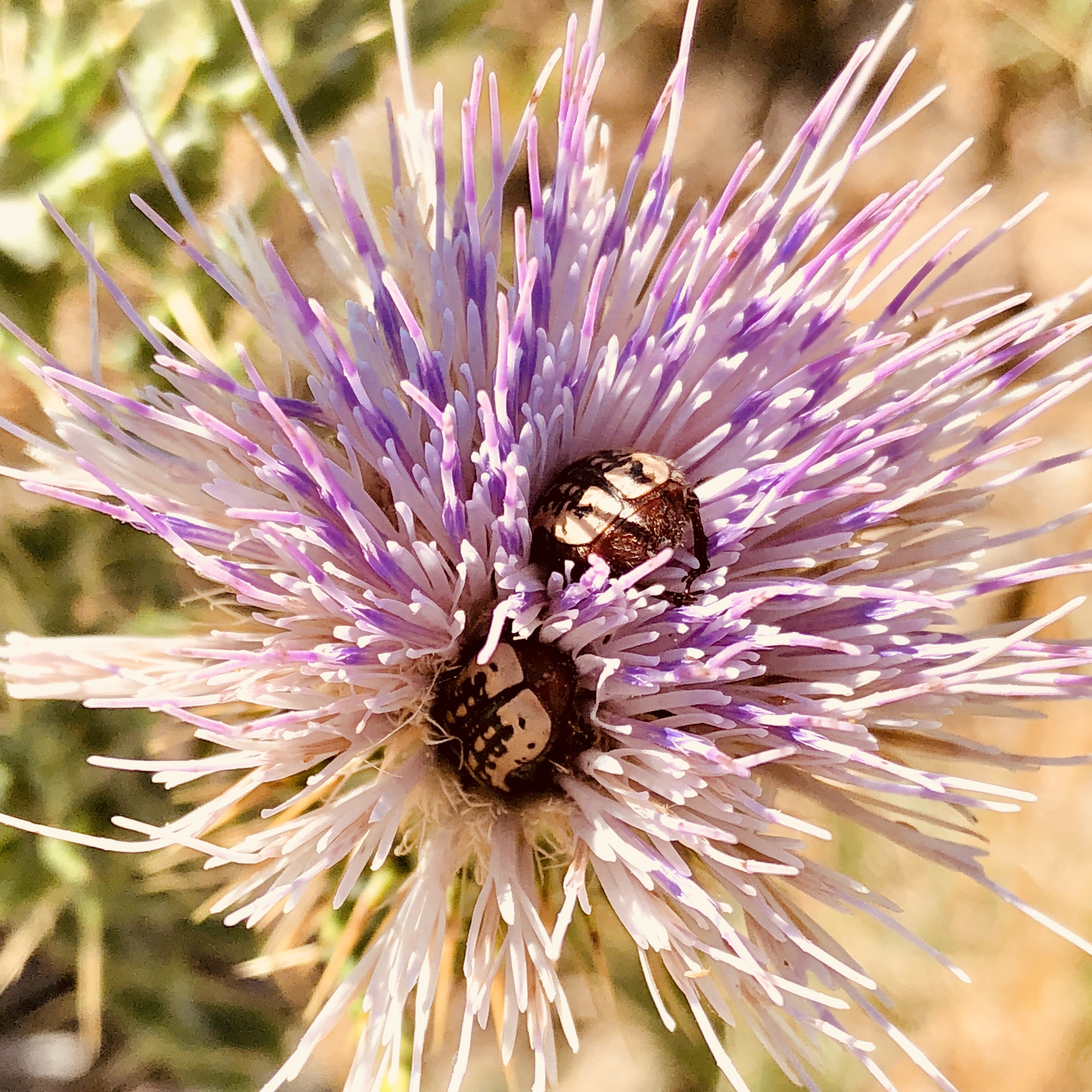
There were some mallow in bloom along the roadsides, so we stopped to see if there were any Acmaeodera on them. There weren’t, just a few meloids that Jeff was interested in. I found a a single Euphoria kerni on a flower of Acacia greggii and, of course, large numbers of them on thistle flowers. The area seems to have gotten some rain, but not much activity to speak of yet.

Euphoria kernii in their typical “buried-butt-upwards” post on a thistle flowerhead.

Mescalero Sand Dunes, New Mexico
This area got rain last night, so we suspected there would be a lot of insect activity, and we were right! The place was alive when we got here at ~6 pm. I walked the area while we waited for dusk to set out pheromone. I collected a series of Enoclerus zonatus off of yucca blooms, beat an Actenodes sp. (something new for me), a Chrysobothris octocola, and a nice series of treehoppers off of mesquite, and found three Batyle suturalis ssp. on an unidentified yellow comp.

Mescalero Sands Recreation Area.

A skin beetle (Omorgus nodosus) makes tracks in the sand.

Enoclerus spinolae on yucca.

Another Enoclerus spinolae individual on yucca. Note the larger spots on this one compared to the other, an example of intraspecific variation.

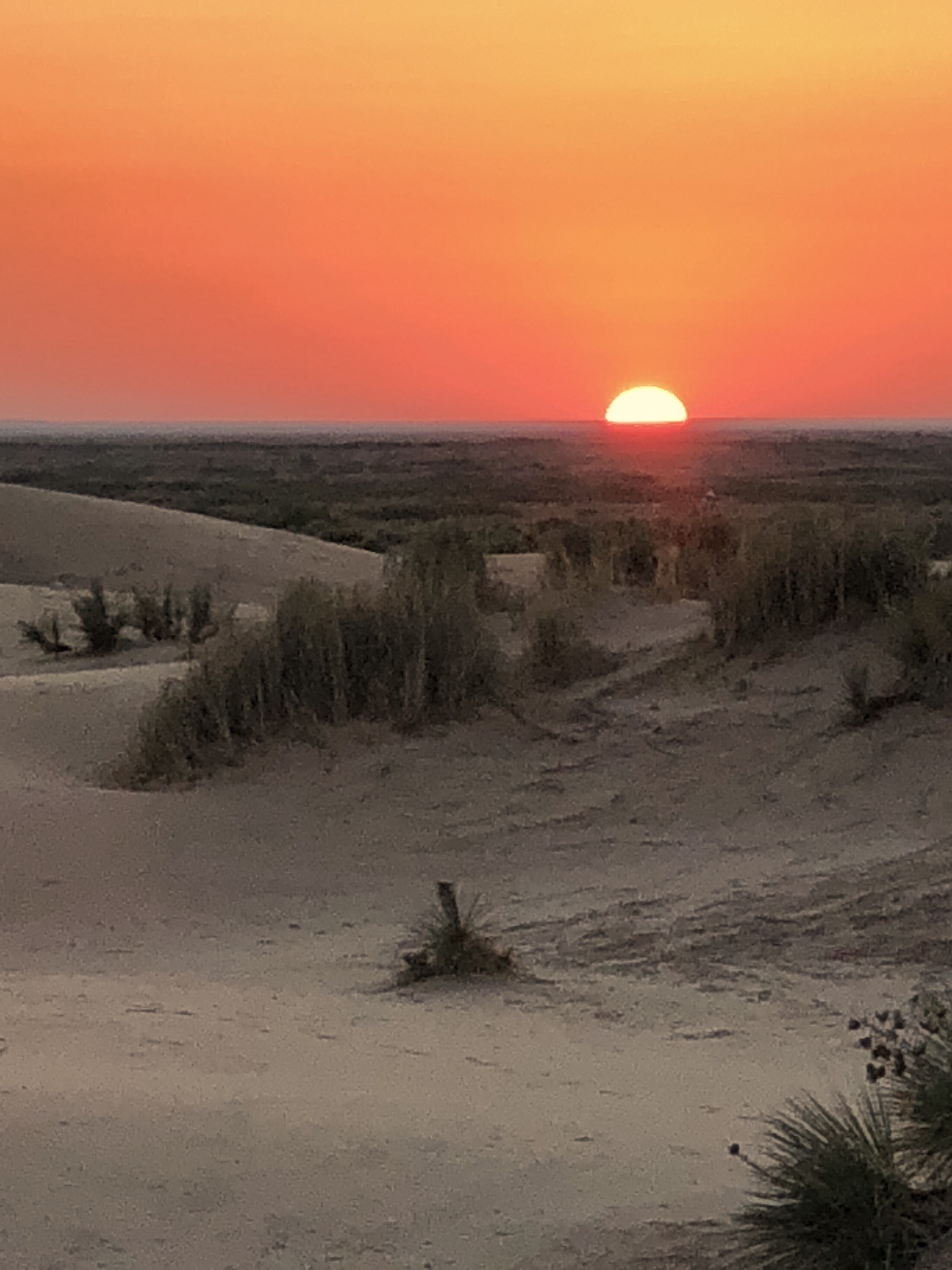
As the sun began to sink lower in the sky, I hiked around to the backside of the dunes and then bushwhacked across them to get the perfect perspective for photographs when the sun hit the horizon – spectacular sunset!

Sunset on the dune.

What a sunset!

I’m happier than I look! 

By the time I got back to the car, Jeff had already placed three lures out, so we started making the rounds and found at least one or two Prionus arenarius males running frantically in circles under each one. At the second lure, I started searching the area nearby and found a female walking on the ground! (Females are very rarely encountered, and it seems a little more than coincidental to me that for each species of Prionus, whenever we have collected good numbers of males with lures we have also found at least one or a few females in the same area – maybe cheaters [in the ecological sense]?).

As we made the rounds we picked up an amazing diversity of tenebrionids and a few carabids walking in the sand, and we finished off by picking up Jeff’s light trap, which had attracted one more Prionus male and a very light-colored Polyphylla sp. male.

Incredible huge blue spider on the dune at night.

Day 4—Mescalero Sand Dunes, New Mexico

We noticed a stand of soapberry (Sapindus drumondii) along the sides of the road just west of the entrance to Mescalero Sands Recreation Area last night, and I immediately thought of Agrilus sapindi, so this morning on our our way to the dunes we stopped by. I started beating the flowering branches of the larger soapberry trees but wasn’t really getting anything. Then I noticed an A. sapindi flying to a low non-flowering plant, so I caught it and resumed beating – now with more gusto knowing they were here. I still wasn’t getting anything and, again, saw another adult fly and land on a low non-flowering plant. Lesson learned – I started sweeping the low plants and started getting them. I worked all five stands in the area and got about 3 dozen adults, plus a few A. ornatulus, one A. limpiae, and spectacular Neoclytus.

After finishing with the soapberry, Jeff had noticed some tiny Acmaeodera on an unidentified white-flowered composite. We started searching in earnest and collected several dozen adults. I’m not sure what they are, but they are tiny and vittate (maybe A. quadrivittatoides). We also did a lot of sweeping of the short shrubby oak also and came up with a couple of Brachys. Overall a great morning/early afternoon in the field!

The only thing cooler than this abandoned homestead was the squawking ravens hanging out on it!

Soapberry (Sapindus drummondii) stands along Hwy 380 – host for Agrilus sapindi.

Host for unidentified Acmaeodera sp.

We next went into the Recreation Area proper to each lunch, after which we explored the rest of the area accessible by vehicle and saw a stand of cottonwood back in the dunes. We got out to see if there might be any Buprestidae on them (e.g., Poecilonota), but they were devoid of insects. The midday heat on the dunes was extreme! I did find, however, a single Prionus elytron lying on the sand beneath the cottonwoods, so we know they are further back in the dunes as well.

Mescalero Sands Recreation Area.

Mescalero Sands Recreation Area.

We worked the variety of blooming plants in the vicinity of the entrance. I collected ~22 of the small Acmaeodera that were on the white-flowered plant at the soapberry spot on two blossoms of a single yellow-flowered pad Opuntia sp., a couple of Acmaeodera spp. on Gaillardia sp. flowers, a few more Acmaeodera spp. on Prosopis, and several Acmaeodera mixta on another as-yet-unidentified white flower. It was hotter than bejesus we later learned 103°F!) – I had wanted to check out one more stand of soapberry at the entrance, but we were exhausted and dehydrated and had to quit!

Some kind of wasp on some kind of flower.

There are four separate bird nests in the cholla plant – a veritable avian apartment!

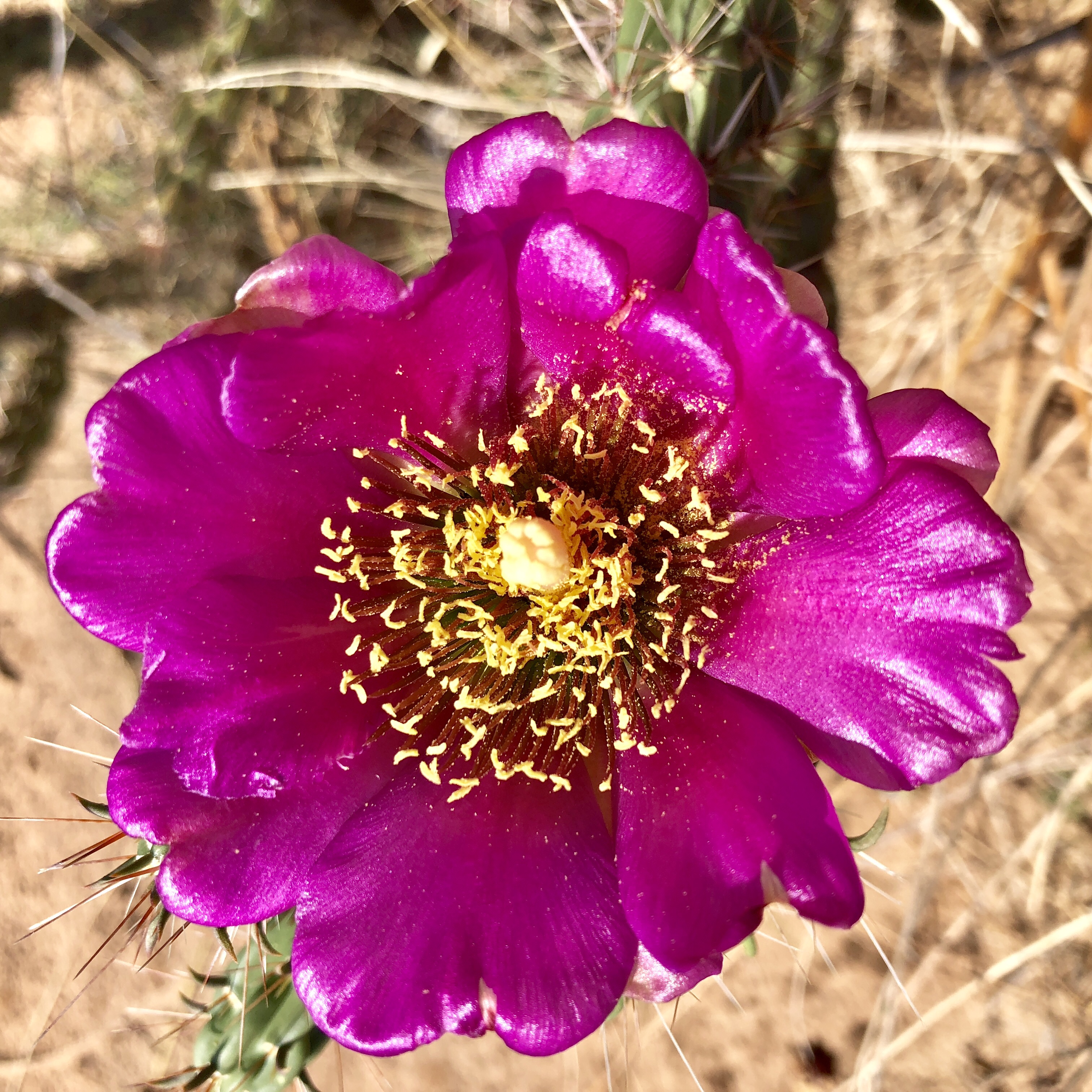
Cholla (Opuntia imbricata) blossom.

Vicinity Hobbs, New Mexico
We got a hotel in Hobbs and grabbed a sandwich for dinner, then went out west of town to see if we could find some good habitat for evening collecting. We found a spot of open rangeland about 8–9 miles west of town, set out the pheromone lures, and began beating the mesquite (Prosopis glandulosa). We had high hopes because there was still standing water, meaning that the area had gotten good rains on Sunday night. Boy were we correct! Beating the mesquite was amazing. For buprestids I got 10 individuals of an Actenodes sp., 4 individuals of a Paratyndaris sp., 4 Chrysobothris spp., 4 Acmaeodera spp., and 1 Agrilus sp. I also got several tiny cicadas, a couple treehopper species, and a few clerids and other odds and ends. We setup a blacklight and the scarabs were quite diverse, but the only thing I took was a tiger beetle (Cylindera lemniscata). I also picked up a Phyllophaga cribrosa and a tenebrionid walking on the ground at night. No Prionus came to the lures, any my searches of the ground at night turned up no Amblycheila.

Tiny scarab beetles in the genus Diplotaxis congregate on low plants to “catch” pheromone trails in search of mates.

Giant millipedes (genus Orthoporus) were common at night, a sure sign of recent rains. ID by Derek Hennen.

Ted of Arabia and Jeff.

Day 5—Sand Dunes near Kermit, Texas
We stopped just outside the Kermit Sand Dunes to beat the mesquite (Prosopis glandulosa) to see what might be out. I collected 8 species of Buprestidae: nice series of an Acmaeoderopsis (hoping A. prosopis), 1 sp. Actenodes, 2 spp. Chrysobothris, 1 sp. Paratyndaris, 1 sp. Agrilus, and 2 Acmaeodera spp. We eventually gave up – the heat had not only wilted us, but the Acmaeoderopsis were flying away immediately upon hitting the sheet.

Updated field pic (the last one was taken in 1999!).

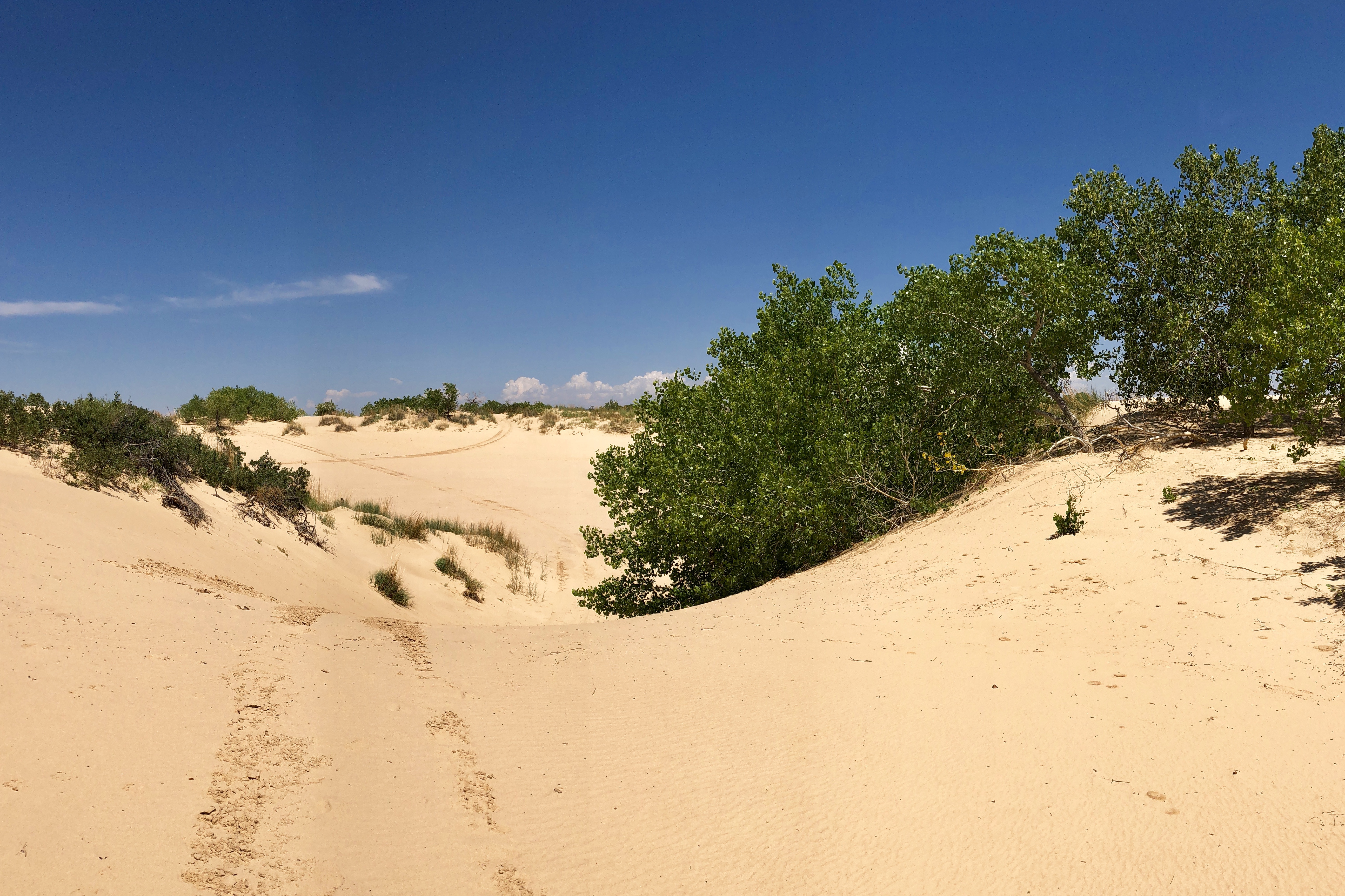
We drove a little further towards the heart of the dunes and found a spot where there were some blowouts and classic sand flora. Immediately upon starting out we noticed Acmaeodera mixta adults flying around commonly, so I swept through the vegetation a bit and collected a representative series. On Oenethera sp. flowers I found a single A. immaculata and later several A. mixta and a very small Acmaeodera (looked like the one we collected yesterday at Mescalero). In one spot I found a few plants of an unidentified yellow composite with a few more A. mixta, and on Baccharis I found one A. obtusa(?) along with A. mixta. Coming back to the car Jeff and I noticed huge numbers of A. immaculata flying to an unidentified shrub, from which we each swept a nice series. Eventually the heat (103°F) again overwhelmed us, and we had to get in the car, eat, and cool down for a bit on the way to another spot.

The dunes are part of an extensive series of dunes stretching from West Texas through southeastern New Mexico.

Acmaeodera mixta on flower of an unidentified yellow composite.

We returned to an area with stands of soapberry (Sapindus drummondii) that we had seen when we first arrived in the area. I swept all of the small plants on the east side of the highway and got a single Agrilus sapindi – not nearly as abundant as we had seen at Mescalero Sands.

On the west side of the highway there were some larger mesquite (Prosopis glandulosa). I found one Chrysobothris octocola on the trunk, then Jeff and I noticed Acmaeoderopsis flying to the tips of the high branches. I got my aerial net and just started betting them as they flew in while we stood and watched. I caught them from several trees, but a majority from a single tree. That worked much better than beating this morning – I probably lost as many as I collected because they flew so quickly upon hitting the sheet.

Underneath one large mesquite I found several prionid elytra – couldn’t tell if they were Prionus or Derobrachus, but then I noticed burrows in the ground very similar to those we saw for Prionus integer in Colorado (see photo). We dug a few out but found nothing. Something to keep in mind.

The high plains of west Texas.

Burrows like this one look suspiciously like those of Prionus integer in Colorado – did another Prionus make this one?

We returned to the dunes for some evening collecting. I beat the two large mesquite (Prosopis glandulosa) trees by the parking area and got an Actenodes and a few Chrysobothris octocola – no Acmaeoderopsis, I guess they hide elsewhere for the night. Once dusk fell we began checking the pheromones and light – only a single male Prionus arenarius came to the pheromone, but we got several individuals of two Polyphylla spp. (P. monahansensis – larger, and P. pottsorum – smaller) at the light. Walking around the dunes at night there were significantly fewer tenebrionids and other insects walking around, but I did pick up two cool “concave” tenebs and a Pasimachus ground beetle.

I’ve never seen a mourning dove make a nest in the ground before.
I always thought these oil pumps looked like dinosaurs bobbing up and down.

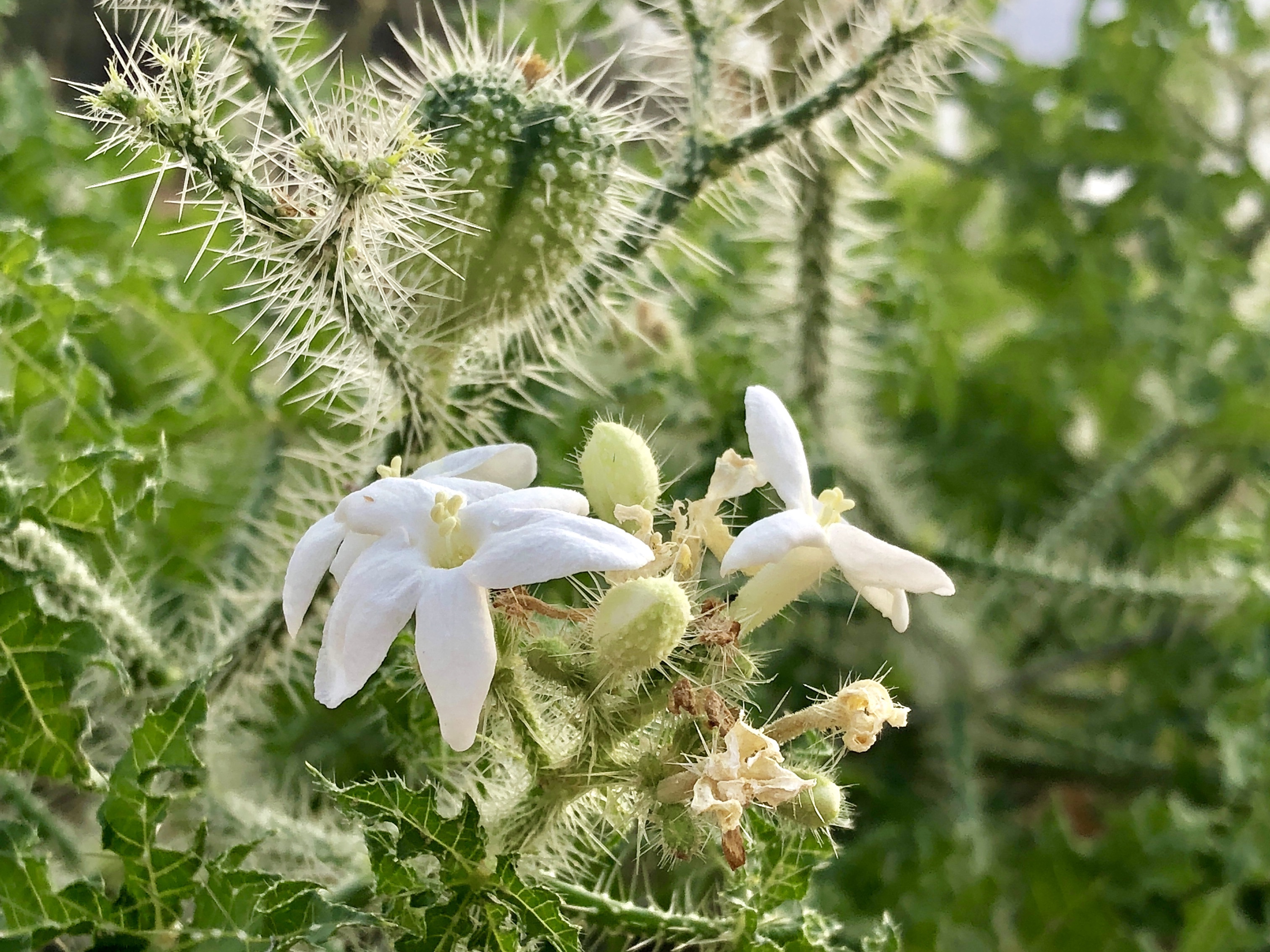
Bull nettle (Cnidoscolus texanus)—something tells me I should not touch this plant!

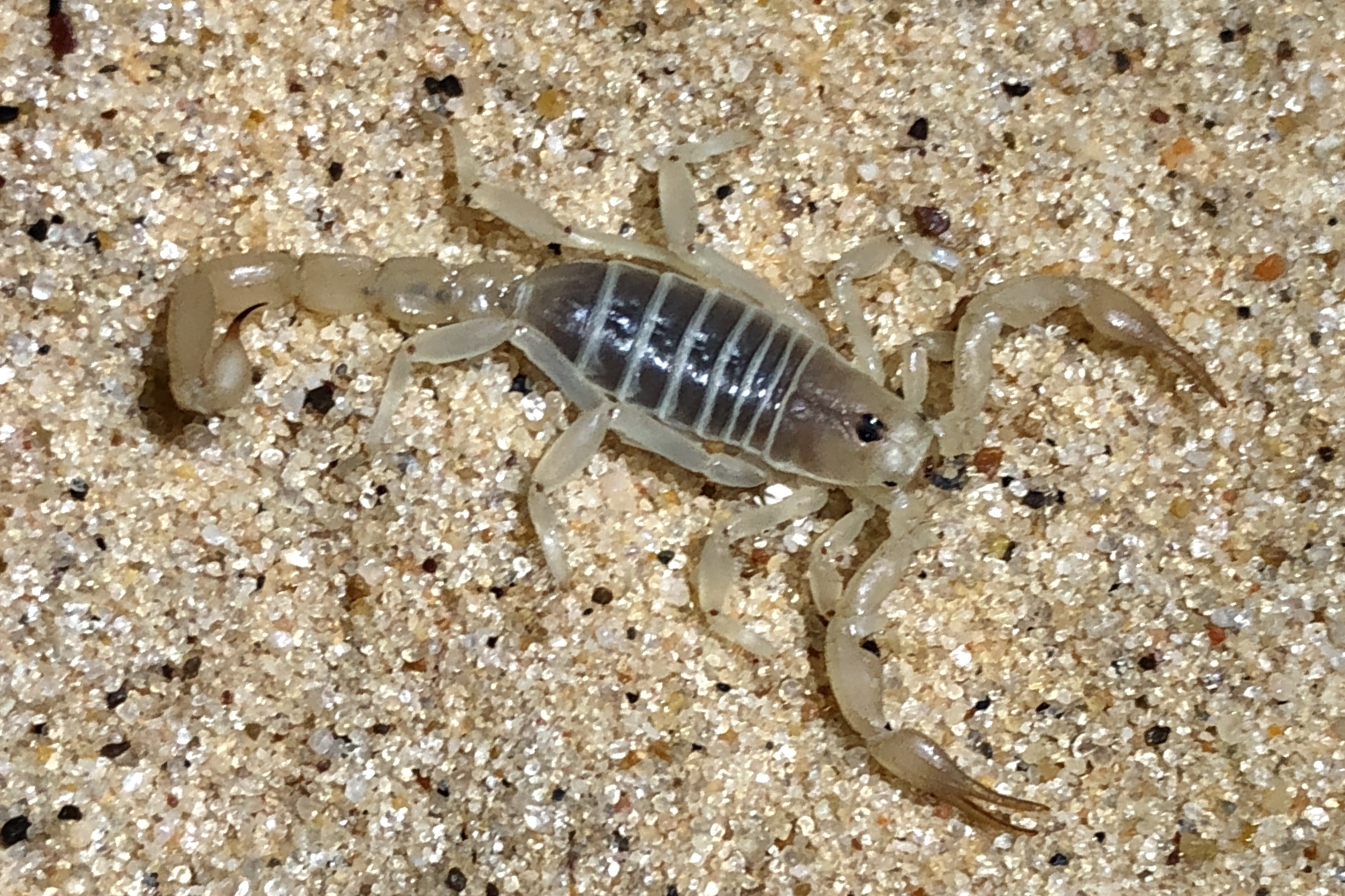
A very small (<1.5” in length) scorpion visits the light looking for a meal.

Face-to-face with a scorpion!

Day 6—I-10 Rest Area at mile marker 162, Texas
Just a quick stop to use the facilities, but I couldn’t resist the temptation to photograph these three Reakirts blues all on one flower (a fourth flew away before I could snap).

Reakirts blue (Echinargus isola). ID by Doug Taron.

San Felipe Park, near Fabens, Texas
We took a chance on going further west to the dunes near Fabens, since we’ve had such good luck with rains in the area. However, when we got here and started looking around it was apparent that nothing was happening here – dry, dry, dry with temps just over 100°F. I saw a few insects but only a single buprestid – Acmaeodera quadrivittatoides, and I missed it! We decided to cut bait and head back east and north towards Carlsbad – we should be able to get to the area in time for some late afternoon and evening collecting. You can’t win ‘em all!

This roadrunner was rather annoyed with us for intruding in his spot of shade under a Siberian elm.

A broad-nosed weevil.

A mating pair of walkingsticks. Note the great size difference between the male (smaller) and female (larger).

I think I found our retirement home!

Vicinity Carlsbad, New Mexico
After getting lost in the Fabens Sand Dunes and then a whole lot of driving back east into New Mexico, we arrived in Carlsbad with just enough time to grab a sandwich and head out to some promising habitat we’d noticed on the way in for some evening/night collecting.

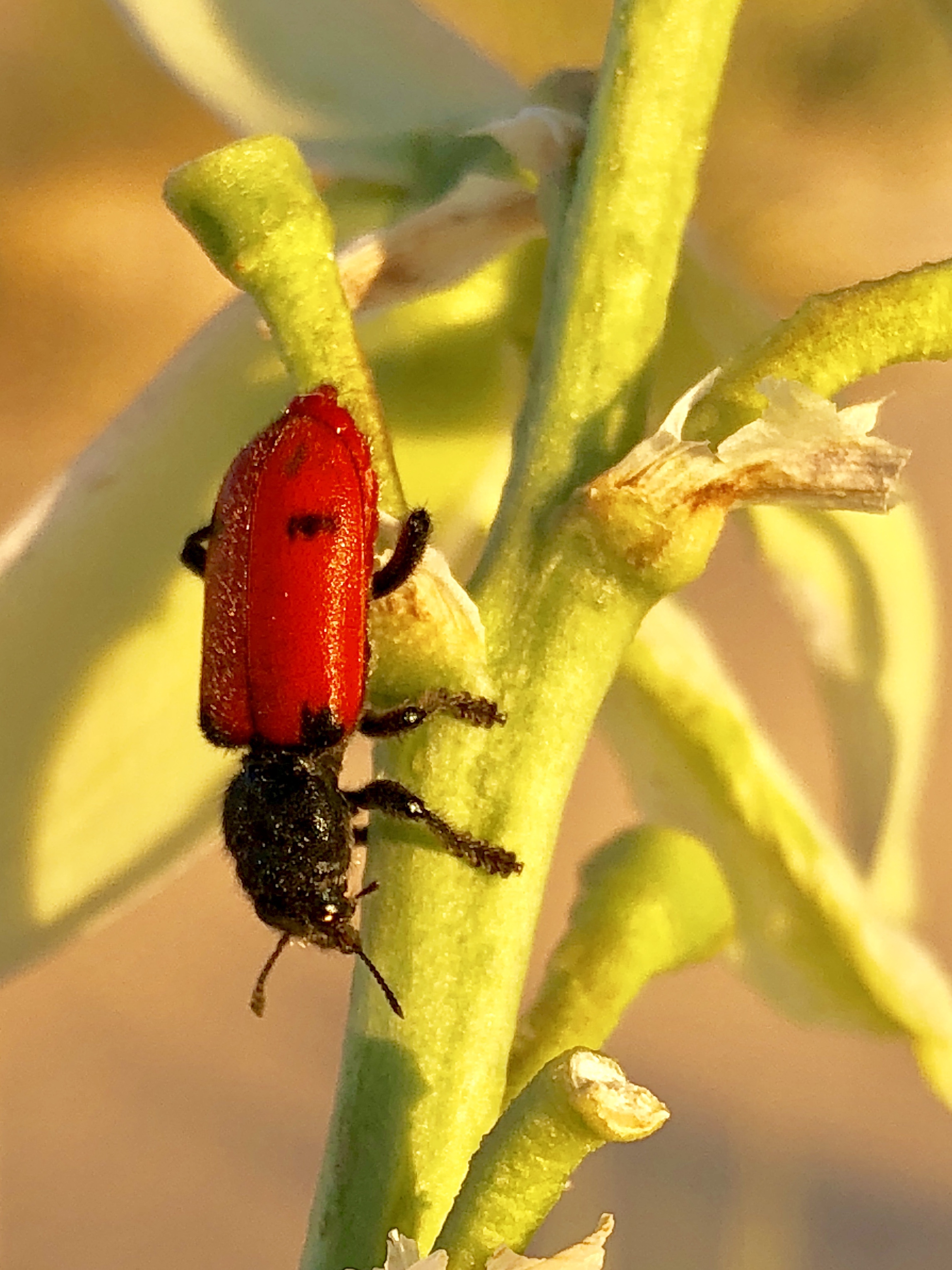
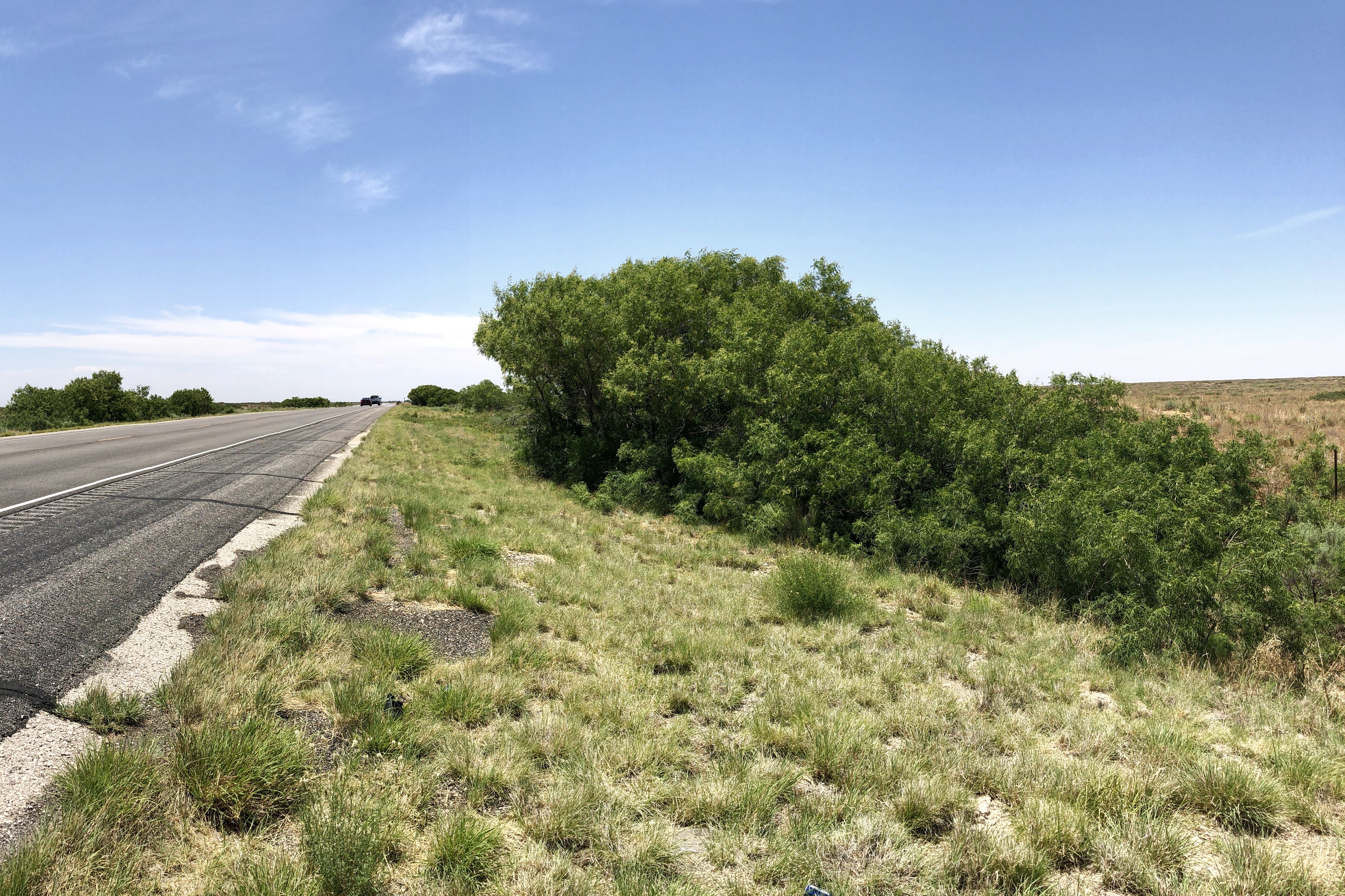
The area contained a ribbon of woodland with mesquite (Prosopis glandulosa), black acacia (Acacia rigida), and catclaw acacia (A. greggii). I beat only one tiny Chrysobothris sp. off the mesquite, but off the black acacia I beat three individuals (four actually, one got away) of a large, chunky Chrysobothris sp. that I do not recognize, plus an undetermined cerambycid and a few clytrines. Actually, before I collected the Chrysobothris I had given up on the lack acacia until I was walking by one plant and saw the first one sitting on a branch. I popped it in the vial and started beating the other plants in the area with renewed enthusiasm the find the other two (three!).

We setup the lights and the pheromones, but not much came to the former and nothing to the latter (expected, since there was no sand habitat nearby). The sunset beforehand, however, was magnificent, and I did find a couple of miscellaneous beetles walking around at night.


Day 7—vicinity Loco Hills, New Mexico
We saw an area with stands of soapberry (Sapindus drummondii) alongside the road so stopped to sample it for Buprestidae. I got 3 Agrilus limpiae on trees right around the car but nothing on all the rest of the three stands nearest the car on either side of the road. I hope the south area of Mescalero Sands is not as dry as it still appears around here.

Soapberry (Sapindus drummondii).

Mescalero Sand Dunes, New Mexico
We found the central dunes of the southern area and immediately found several Acmaeodera mixta adults on mesquite (Prosopis glandulosa) flowers. I started beating the mesquite and picked up a nice series of Acmaeoderopsis, one Actenodes, and a few other miscellaneous Acmaeodera off the larger trees. There was some soapberry (Sapindus drummondii) in bloom around the dunes, but beating it produced no Buprestidae.

A lone windswept soapberry tree hangs on precariously to life in the dunes.

Acmaeodera mixta on flowers of mesquite (Prosopis glandulosa).

We stopped at a spot outside the dunes because it looked pretty green with a number of plants in bloom suggesting recent rain. I saw but did not take Acmaeodera mixta on white flowers of undetermined composite. I did collect a small series of bright red and black clerids on a small blue-green euphorbiaceous plant. Also saw a little horned lizard, who cooperated just enough to get a few snaps!

A young Texas horned lizard (Phrynosoma cornutum) tries to make himself look big!

White-flowered composite blooming in the desert.

Vicinity Carrizozo, New Mexico
We stopped at a thick stand of yucca that we’d noted on the way past here earlier in the week, the hope being that we would find Tragidion armatum on the stems. Sadly we did not see any, nor did we see more than just a couple of the pompilid wasps that the beetles mimic. Surely this is a result of the lack of rain in the area, which the hotel clerk confirmed during our earlier check in. Cicadas, on the other hand, were everywhere!

The low sun illuminates the yuccas, while the higher clouds shade the mountains behind.

The low sun illuminates the yuccas, while the higher clouds shade the mountains behind.

How many cicadas do you see on this single yucca stem?

Promising clouds tease a thirsty landscape.

For the final stop for the day we returned to Valley of Fire Recreation Area – not really to collect insects, but to look about this fascinating landscape. The Lava Beds are thought to be 5,000 years old, having formed over a 30-year period when lava poured from Black Peak to the north (not a volcano, but a volcanic vent) at a rate that would fill 15 bathtubs every second! It was a serene and otherworldly walk in the falling darkness – nice way to cap off an evening.

Towering clouds try to squeeze out some moisture.

Lots of virga, little rain.

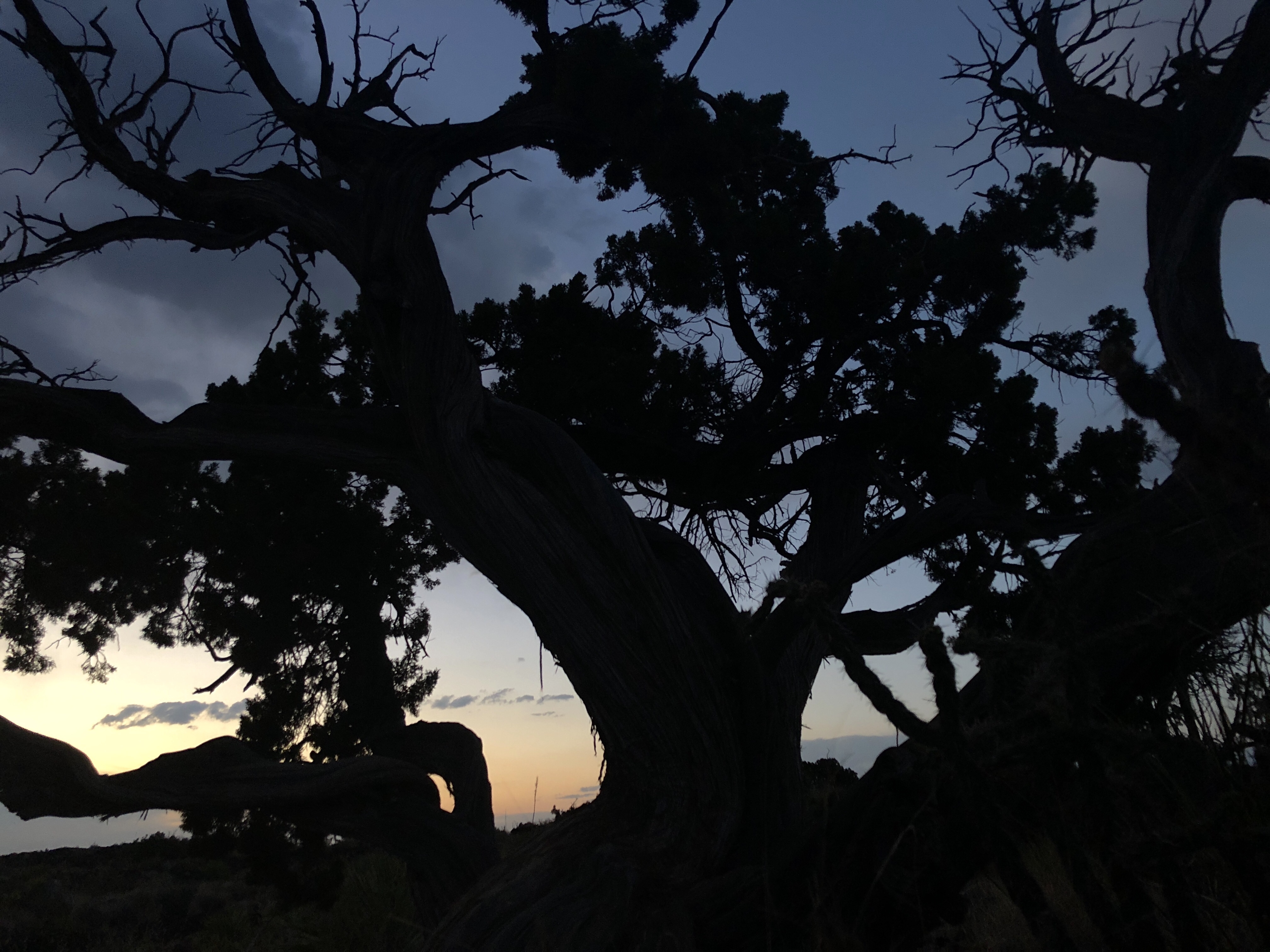
A 400-year old juniper watches another sunset.

Day 8—vicinity Bingham, New Mexico and west on Hwy 380
We stopped at another yucca stand very near where we’d found the Tragidion armatum last weekend – no problem finding them here either. I got plenty of photographs of the beetles (despite having to go ‘au natural’ with the lighting – my flash unit had died!), as well as of cicadas, wasps, and other insects on the yucca stems and pods. Otherwise I only collected two Acmaeodera (looks like A. immaculata) on flowers of Sphaeralcea sp., what looks to be A. disjuncta/paradisjuncta on Ephedra sp., and a single Moneilema sp. on Opuntia imbricata. Nice stop!

Variety of wasps on yucca.

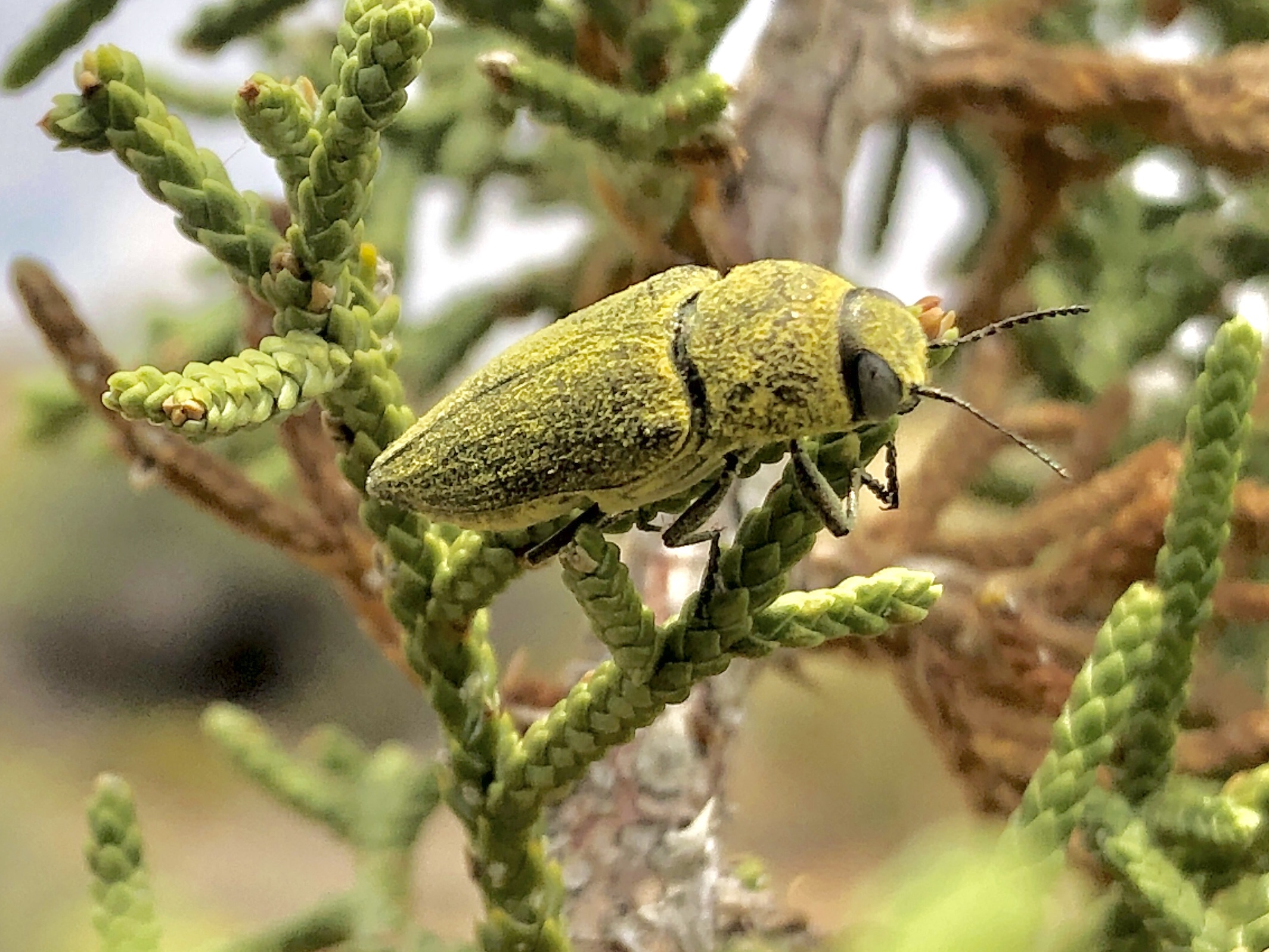
We then stopped by “the juniper spot” again to see if I could get a better series of the Gyascutus (G. carolinensis?) that we found on the junipers (Juniperus monosperma). Boy, did I ever! I collected about 30 specimens this time, made easier by the fact that it was cooler and not nearly as windy! I also again collected two small Chrysobothris sp. on the juniper, a single Moneilema sp. on cholla (Opuntia imbricata), and a single Acmaeoderopsis sp. beating mesquite (Prosopis glandulosa).

One of the more exciting finds of the trip – a jewel beetle in the genus Gyascutus on Juniperus monosperma (I believe this is G. carolinensis).
The greenish waxy bloom that covers the body must help the beetle blend into the foliage on which they perch.

A cactus beetle in the genus Moneilema on its host, cholla (Opuntia imbricata).

A multi-tool comes in very handy for collecting cactus beetles!

We stopped at another spot further west on Hwy 380, where last weekend when we were here we saw few beetles but I did collect yucca stems infested with Tragidion armatum larvae. It rained here later that day, so we stopped by again on our way back to see if the rains had prompted more insect activity. It didn’t seem to, but I did find a Tragidion armatum adult feeding on a yucca flower and photographed a big-as-heck katydid.

Tragidion armatum adult female feeding on a yucca flower.

Big katydid. You can tell this is a brachypterous adult because the anterior wings are on top and their costal margins oriented outside (in nymphs the posterior wings are on top and their costal margins oriented inside).

Perfect camouflage!

“The Box”, vicinity Socorro, New Mexico
Last stop of the trip – we just wanted to find some habitat to beat around in before finding a hotel in Socorro for the night. I beat a couple of small Chrysobothris sp. from the Juniperus monosperma – no Gyascutus – and a couple of treehoppers from Prosopis glandulosa – no Acmaeoderopsis, then turned my attention to the cholla (Opuntia imbricata), in what must have been the thickest stand of this plant I’ve ever seen. There were two species of cactus beetles on them – Moneilema sp. and Coenopoeus palmeri, the latter a first for the trip. After hiking up to the canyon overlook, I realized that the collecting and fun were finally over (until Arizona in August!).

“The Box.”

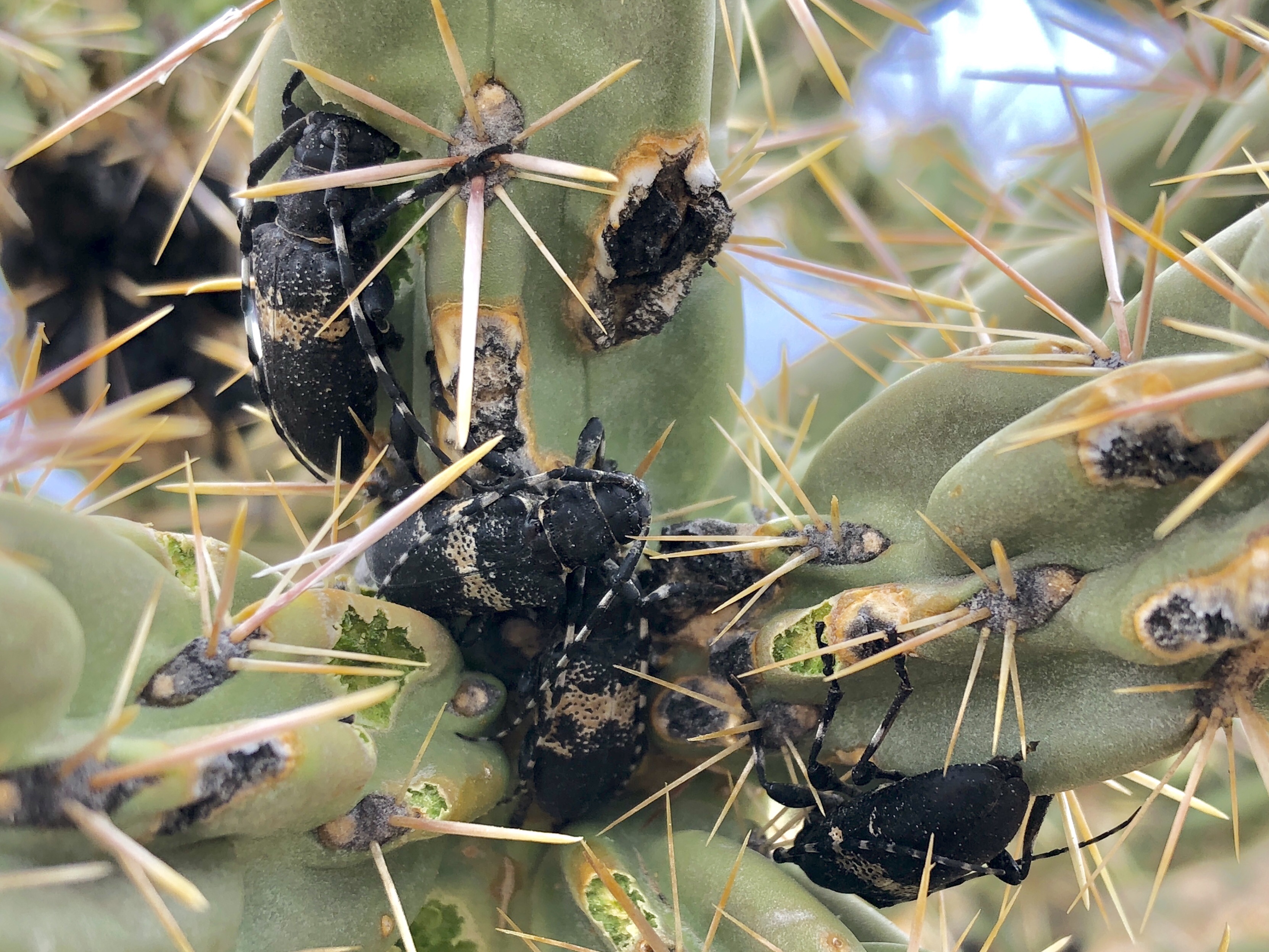
Cactus beetle (Moneilema sp,) on a cholla (Opuntia imbricata) skeleton.

The “other” cactus beetle (Coenopoeus palmeri).

How many cactus beetles can you count?

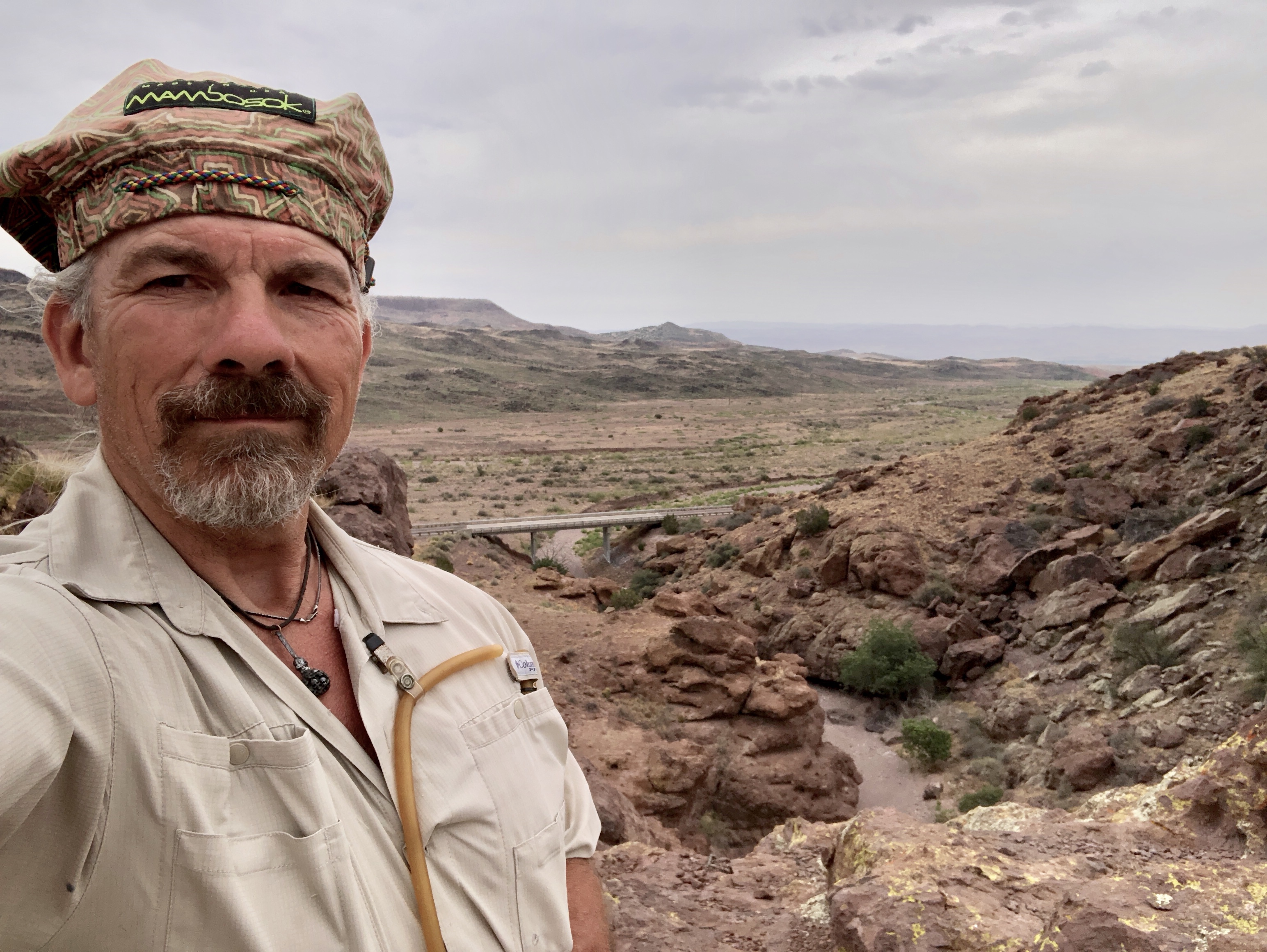
Last selfie of the trip. That wry smile is the satisfaction of knowing that the trip was success, I collected lots of great beetles, and I learned a ton!

© Ted C. MacRae 2019

North America’s most beautiful longhorned beetle

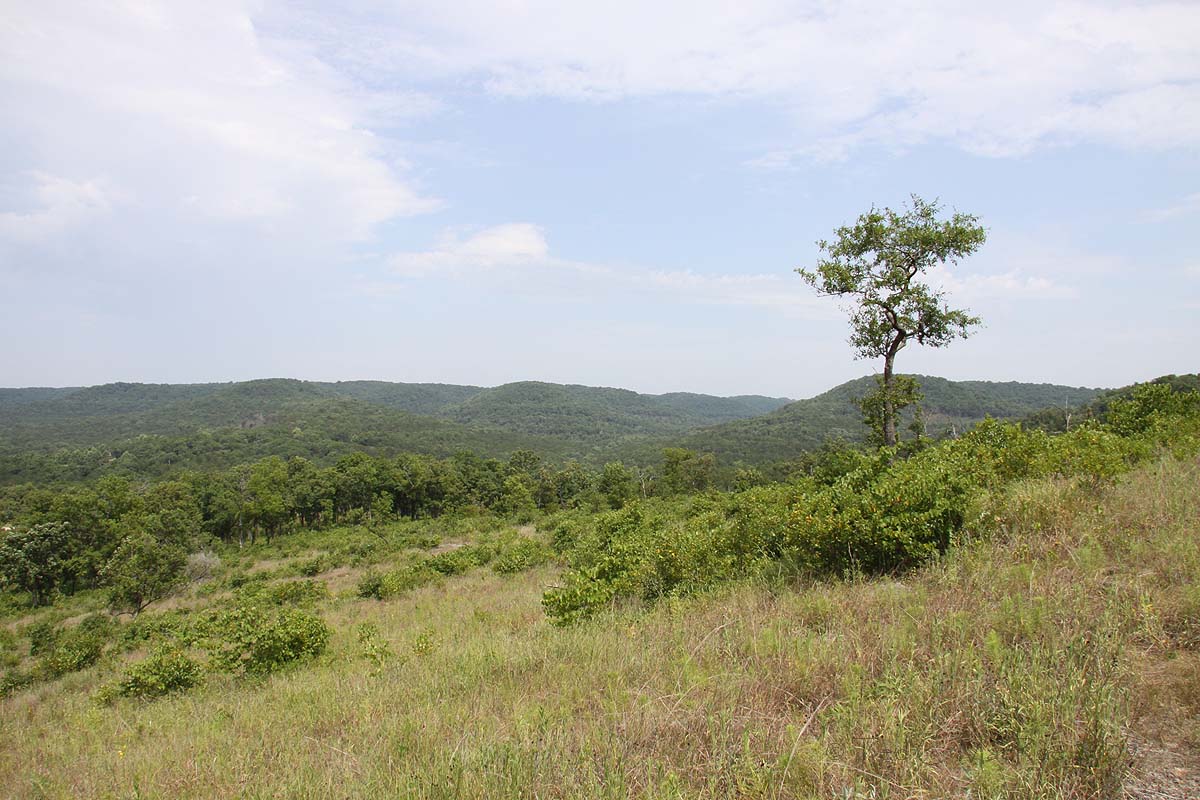
I’ve written a few posts in recent weeks highlighting some of the more interesting finds encountered during two visits this past July to the White River Hills region of extreme southwestern Missouri. It’s a land of extremes, with deeply dissected layers of limestone/dolomite bedrock supporting xeric glades, dry woodlands and riparian watercourses. The hilltop glades (“balds”), in particular, feature prominently in the region’s natural and cultural history and are the most extensive system of such habitat in Missouri. They support a number of plants and animals more characteristic of the grasslands of the south-central U.S., such as the recently featured Megaphasma denticrus and Microstylus morosum, North America’s longest insect and largest robber fly, respectively. Sadly, the glades in this region are much reduced in size and quality compared to their pre-settlement occurrence, primarily due to overgrazing and suppression of fire. These anthropogenic forces have combined to reduce overall vegetational diversity and accelerate encroachment by woody species (chiefly eastern red-cedar, Juniperus virginiana). Nevertheless, there still remain several high quality glade remnants in the area, and the public agencies charged with their conservation are increasingly utilizing mechanical removal of woody growth, controlled burns, and managed grazing in an effort to simulate the natural forces that mediated this landscape for thousands of years.

IMG_0871_1200x800

Chute Ridge Glade, Roaring River State Park, Barry Co., Missouri

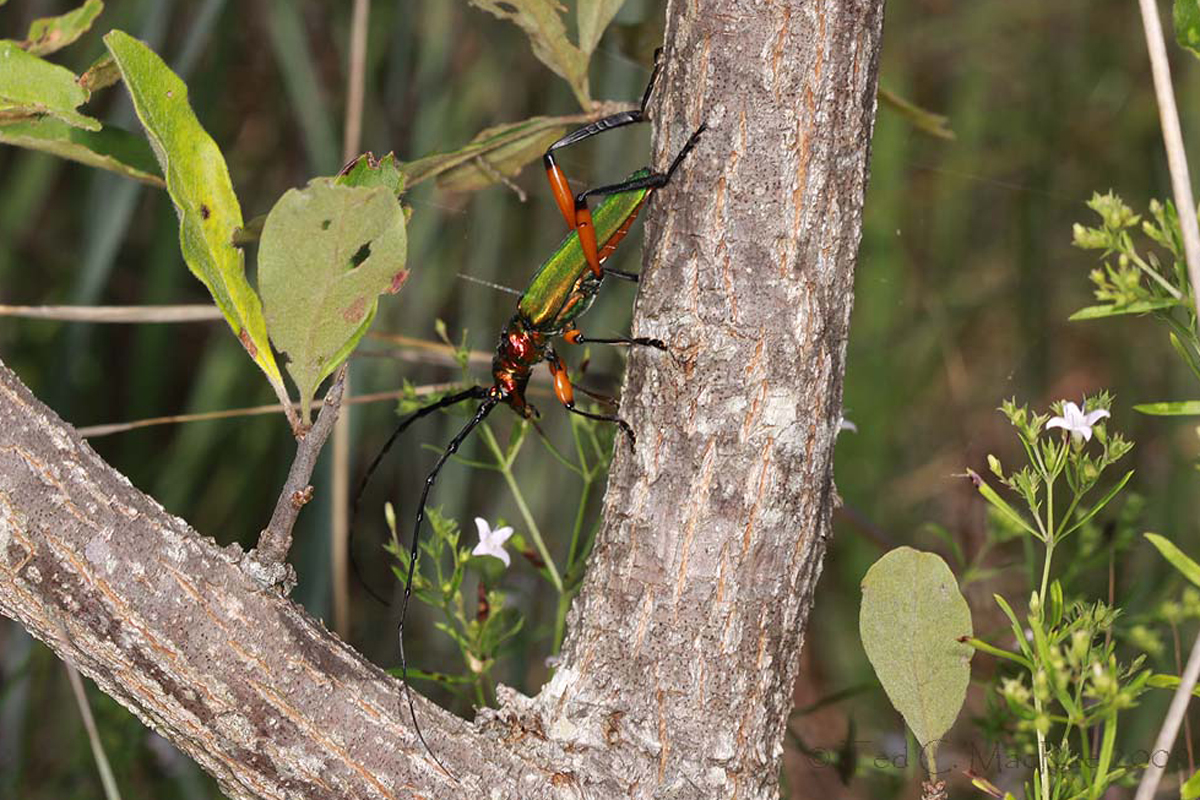
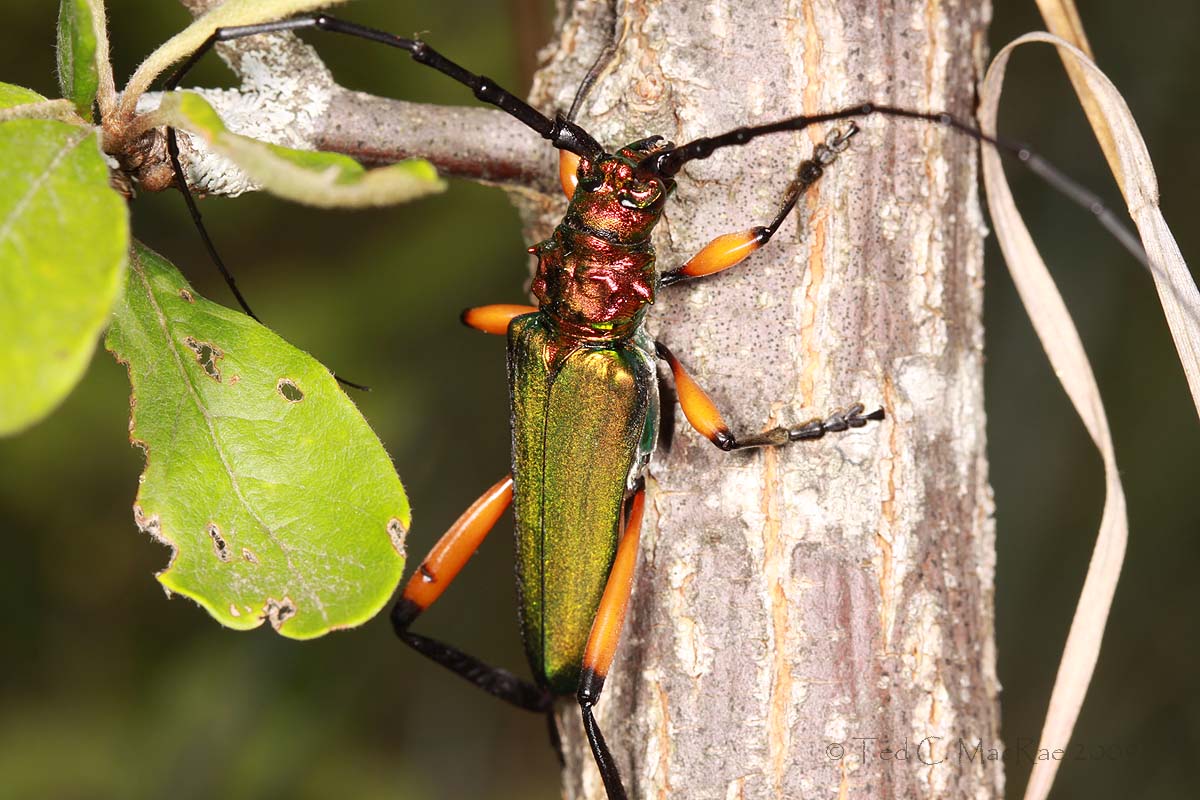
My reason for returning to the White River Hills this year was simple—find and photograph the magnificent longhorned beetle, Plinthocoelium suaveolens (family Cerambycidae). This species, occurring across the southern U.S. from Florida and Georgia west to New Mexico and Arizona, is truly one of North America’s most beautiful longhorned beetles due to its large size, brilliant iridescent green coloration, and super-elongate wildly-contrasting orange and black legs.  Until recently, this species was known in Missouri only from sporadic records across the southern part of the state (MacRae 1994). I knew of its association with gum bumelia (Sideroxylon lanuginosum [= Bumelia lanuginosa], also called gum bully and woolly buckthorn), which was first noted by Missouri’s first State Entomologist, C. V. Riley (1880) and later discussed in detail by Linsley and Hurd (1959) and Turnbow and Hovore (1979); however, my repeated searches over the years whenever I encoutered this plant came up empty.  A few years ago, Chris Brown and I were conducting a survey of tiger beetles in the White River Hills and noted the relatively common occurrence of bumelia on these glades.  Bumelia, like P. suaveolens, is one of only a few North American representatives of a largely tropical group, and it is one of the few woody species naturally adapted to the xeric conditions found on these glades.  Recalling the association of P. suaveolens with this plant, and also recalling that adults could be attracted to fermenting baits of the type described by Champlain and Knull (1932), we placed fermenting bait traps on several glades in the area and succeeded in trapping a number of individuals during the month of July.  When I began searching the bumelia trees at these glades, I found adults perching on the lower trunks of several trees. It was the first time I’d seen live individuals of this species in Missouri.  At the time I was not a photographer, and that experience became one of the many moments that I would later look back upon and think, “If only I’d taken a picture of that!”  Thus, at the end of June this year, having successfully found Cylindera celeripes in Missouri on the first day of a planned 3-week search, my attention immediately turned to the new goal of finding P. suaveolens and photographing it on its host plant.

IMG_0929_1200x800

Sideroxylon lanuginosum (gum bumelia) at Blackjack Knob, Taney Co., Missouri

I knew this wouldn’t be easy—the beetles were not abundant when I had last observed them, and those that I did find were quite wary to my approach.  Getting within striking distance with a net was one thing; doing so with a camera and macro lens would be another thing entirely.  In my first trip to the area (early July), I went to Chute Ridge Glade, a magnificently restored glade in Roaring River State Park where I had seen the greatest number of individuals before.  I was full of optimism on that first day as I zigzagged across the rough terrain from one bumelia tree to the next, but my optimism began to wane as I cautiously approached each tree and saw nothing.  Within an hour, I’d looked at every bumelia tree I could find on the glade and not even seen a beetle, much less attempted a photograph.  It would take a 2-hour drive along twisting back roads to reach the other sizeable glade complex where I had seen beetles before (Blackjack Knob in Taney County), and another hour of searching on several dozen trees would again yield nothing.  By now I was feeling rather frustrated—the day’s oppressive heat and humidity had taken its toll, and my 4.5-hour drive from St. Louis was looling like it would be for naught.  I had noted that the bumelia flowers were almost but not quite open yet—perhaps it was too early in the season still?  

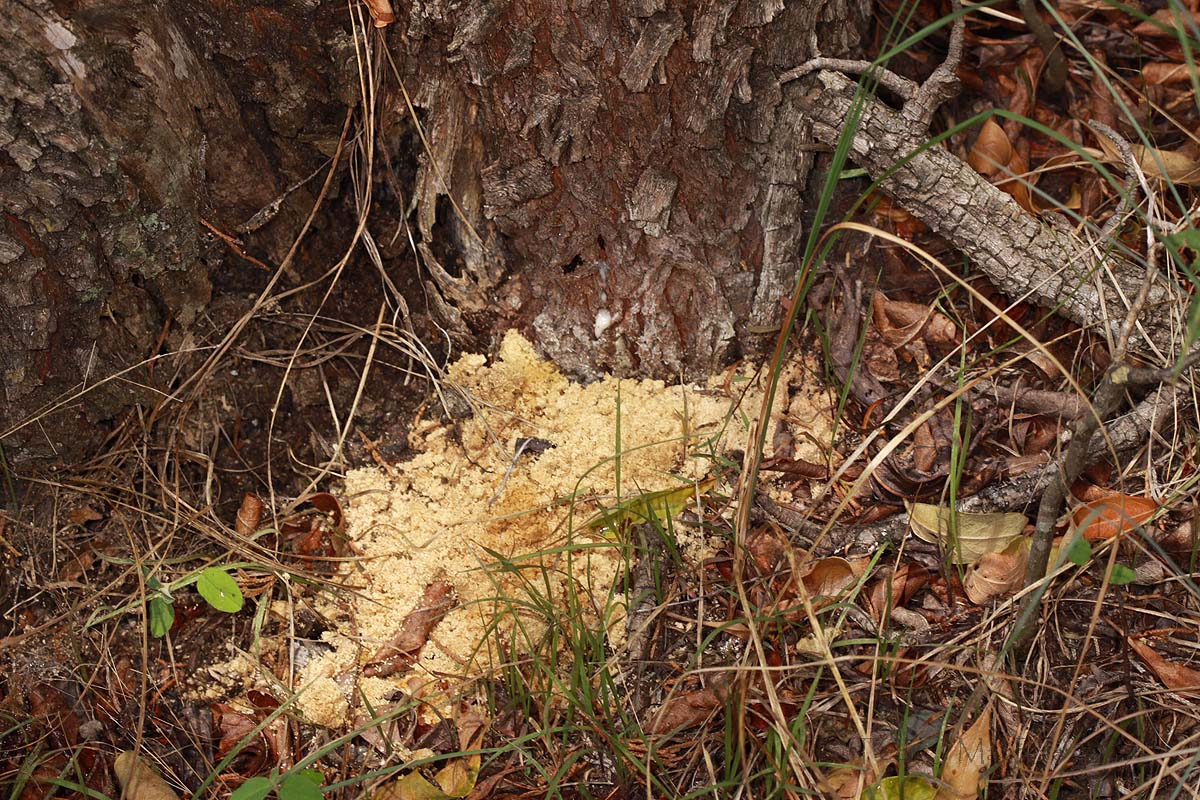
Plinthocoelium suaveolens larval frass pile at the base of living Sideroxylon lanuginosa

Plinthocoelium suaveolens larval frass pile at trunk base of living Sideroxylon lanuginosum

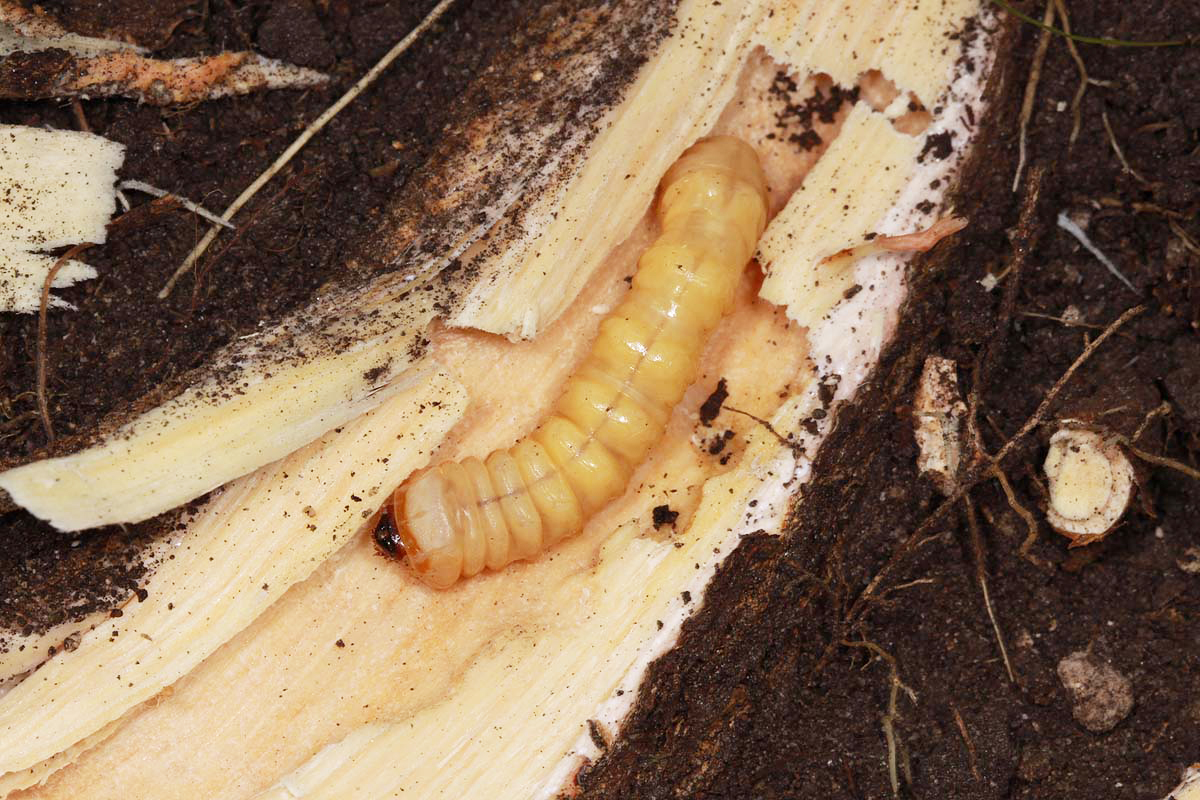
The remnant glades at Blackjack Knob are more extensive than those at Chute Ridge, so many more trees still awaited examination—if I could only muster the energy!  I trudged back to the truck, guzzled a nice, cold Powerade, and started off in another direction.  I looked at a number of trees and still had seen no sign of the beetle, but on one particular tree I noticed an enormous pile of sawdust on the ground at the base of the tree.  I looked at it more closely and saw that it had the rough, granular texture so characteristic of longhorned beetle larvae that like to keep their galleries clean, and its bright, moist  color suggested that it was being ejected by a larva tunneling through living wood.  I looked up into the tree above the pile to find where it was coming from but could find no ejection hole.  I checked the base of the trunk itself and still couldn’t find anything.  Then I started poking into the pile and felt a root.  Further poking revealed a soft spot on the root, and I immediately knew that I had found a P. suaveolens larval gallery—no other cerambycid species is known to bore in roots of living Sideroxylon, especially one as large as this based on the size of the frass pile.  I hurried back to the truck and grabbed my hatchet, returned to the tree, and scraped away the soil above the root to find an obvious ejection hole a few inches away from the base of the trunk.  I started chipped into the root at the ejection hole and found a large, clean gallery extending down the center of the root away from the trunk.  About 18” away from the trunk I found it—a large, creamy-white cerambycid larva.

Plinthocoelium suavelones larva in root of living Sideroxylon lanuginosa

Plinthocoelium suaveolens larva in root of living Sideroxylon lanuginosum

Plinthocoelium suavelones larva in root of living Sideroxylon lanuginosa

Plinthocoelium suaveolens larva in root of living Sideroxylon lanuginosum

Finding a P. suaveolens larva was gratifying, but it wasn’t what I had come here to do, which was photograph the adult. After placing the larva live in a vial for preservation later on (dropping into scalding water to “fix” the proteins and prevent discoloration when stored in 70% ethanol), I continued searching the trees for adults.  I found one tree on which the flowers were just barely beginning to open and collected a few of the pedestrian species of scarabs that are attracted to bumelia flowers in droves when fully open (e.g. Cotinis nitidus and Trigonopeltastes delta)—for the record.  There was still no sign of adult Plinthocoelium, and I was on the verge of calling it a day when I approached another tree and saw it!  I froze, then slowly geared up with the camera and started stalking slowly towards it.  It was not in a very convenient location, down low on the trunk and partially screened by foreground vegetation.  I got close enough to start attempting some shots—not ideally composed, but just to ensure that I had something before I tried to get any closer.  After the third shot, however, it became alarmed and started to flee, and I had no choice but to capture it for a “studio backup.”  That taste of success gave me the motivation to resume my search, but no additional beetles were seen before a dropping sun put an end to the day.

Plinthocoelium suaveolens on lower trunk of living Sideroxylon lanuginosum

Plinthocoelium suaveolens on lower trunk of living Sideroxylon lanuginosum

Not entirely satisfied with the shots that I’d gotten, I returned to Blackjack Knob the following day and also searched some of the extensive habitat at nearby Hercules Glades Wilderness.  I wouldn’t see another beetle the entire day, although encountering a nice series of Cicindela rufiventris (red-bellied tiger beetle) was some consolation for suffering the day’s oppressive heat and humidity.  I still had the live beetle, so I placed my hopes on getting better photographs of the beetle in confinement after returning home.  That would not come to pass—the beetle refused to sit obligingly on the stick I placed in the large screen cage, and instead clung to the cage itself.  For days I watched it, giving it honey-water for sustenance and waiting for an opportunity to photograph it on the stick on which it refused to sit.  It became clear to me that studio photographs, at least in the manner I was attempting, would not be possible.  Not entirely satisfied with having seen only a single beetle on my trip, and thinking that I may have been too early based on the flowering phenology of the bumelia host trees, I did what any dedicated entomologist would do—I made a second trip to the area two weeks later!

I didn’t mess with Chute Ridge Glade this time, instead making a beeline for Blackjack Knob right away.  Unfortunately, the weather was uncooperatively drizzley (I would have preferred hot and humid to rain!).  Nevertheless, daughter Madison and I made our way to the glades and began inspecting the trees that I had just examined two weeks earlier.  I noted immediately that the bumelias were now in full flower, and it wasn’t long before I saw the first adult flying into these flowers.  Exciting for sure, and this was a good sign to see an active adult despite the drizzly weather, but the situation of the beetle on a high branch left no possibility for photographs (and only with a rather acrobatic swing of my fully extended net handle amidst a jumble of dead branches was I able to capture it).  This same scenario would replay several times over the next two hours before rain finally drove us back to the car.  In total, we saw half a dozen active adults, but in each case they were seen flying to flowers on high branches and could not be photographed.  Despite that disappointment, I’ll never forget the spectacularity of seeing these beetles in flight—shimmering green and bold orange, with legs and antennae spread wide in all directions.  I was also fortunate to find another tree with a fresh frass pile at its base indicating an active larva.  This time, I cut the tree some inches above the ground and extracted the trunk base and root intact for transplanting into a large soil box upon my return home.  The appearance of new frass on the soil surface afterwards confirmed that I had gotten the root containing the larva and that it had survived the extraction and transplanting.  Hopefully I will be able to successfully rear this individual to adulthood.

Despite the rain, we then went back to Hercules Glades Wilderness to see if luck would follow suite there as it had at Blackjack Knob.  It didn’t, as rain continued to doggedly pursue us, but the day was not a total loss as daughter and I got in a nice 7-mile hike through some of Missouri’s most ruggedly scenic terrain and were rewarded with the sighting of a western pygmy rattlesnake.  The next day was sunny, much to our delight, and I considered going back to Blackjack Knob where we had seen a good number of adults the previous day.  In the end, I decided I’d played that card and rather than continue trying for photographs I’d rather see if the beetle could be found at another glade complex further to the east at Long Bald Glade Natural Area in Caney Mountain Conservation Area.  Things didn’t look promising, as I found bumelia trees occurring only sporadically across the main glade complex—with no sign of the beetles.  Nevertheless, we enjoyed the day and spent a bit of time chasing after some enormous robber flies that later proved to be Microstylum morosum, a new record for Missouri and a significant northeastern range extension.  I thought that would be the highlight of the day, but as we were heading back to the car I spotted a small glade relict on the other side of the road.  It was overgrown and encroached, apparently not receiving the same management attention as the glades in the main complex. Regardless, I went over to check it out and immediately spotted several bumelia trees amongst the red-cedars, and within minutes I saw a beetle—low on the trunk of a very small bumelia tree!  Once again I froze, then slowly geared up with the camera and began my ultra-cautious approach (remember, this was only my second photo chance after a combined four days in the field).  Like last time, I took one shot while still some distance away, then moved in for closer attempts.  Unlike last time, there was no bothersome vegetation cluttering the view, and when I moved in for closeups the beetle turned around, crawled up the trunk a short distance, and then paused.  I snapped off a small series of shots while it sat there, and then suddenly it became alarmed and flew away.  Though still not perfect, these photographs were better than the previous ones I had obtained (check out the pronotal armature in the last photo!), and the finding of this species at Long Bald Glades also represented a new county record.

Plinthocoelium suaveolens on trunk of living Sideroxylon lanuginosum

Plinthocoelium suaveolens on trunk of living Sideroxylon lanuginosum

Plinthocoelium suaveolens on trunk of living Sideroxylon lanuginosum

Plinthocoelium suaveolens on trunk of living Sideroxylon lanuginosum

Missouri populations are assignable to the nominotypical subspecies (southeastern U.S.), which is distinguished from subspecies plicatum (Texas, New Mexico, Arizona, and northern Mexico) by the bronze or cupreous tints and weak transverse rugae on the pronotum (Linsley 1964).  The distributional ranges of the two subspecies intermingle in northeastern Texas.

Photo details:
All photos: Canon 100mm macro lens on Canon EOS 50D
Photo 1 (Chute Ridge Glade): normal mode, ISO-400, 1/250 sec, f/16, natural light.
Photo 2 (Sideroxylon lanuginosum): landscape mode, ISO-100, 1/160 sec, f/6.3, natural light.
Photos 3 (P. suaveolens larval frass pile), 6—8 (P. suaveolens adult): manual mode, ISO-100, 1/250 sec, f/9-11, MT-24EX flash 1/2 power through diffuser caps (photo 7 slightly cropped).
Photos 4—5 (P. suaveolens larva): manual mode, ISO-100, 1/60 sec, f/14 (closeup f/25), MT-24EX flash 1/2 power through diffuser caps.

REFERENCES:

Champlain, A. B. and J. N. Knull.  1932.  Fermenting bait traps for trapping Elateridae and Cerambycidae (Coleop.).  Entomological News 43(10):253–257.

Linsley, E. G. 1964.  The Cerambycidae of North America. Part V. Taxonomy and classification of the subfamily Cerambycinae, tribes Callichromini through Ancylocerini.  University of California Publicatons in Entomology, 22:1—197, 60 figs., 1 pl.

Linsley, E. G. and P. D. Hurd, Jr.  1959.  The larval habits of Plinthocoelium suaveolens plicatum (LeConte).  Bulletin of the Southern California Academy of Sciences 58(1):27–33.

MacRae, T. C. 1994. Annotated checklist of the longhorned beetles (Coleoptera: Cerambycidae and Disteniidae) known to occur in Missouri. Insecta Mundi 7(4) (1993):223–252.

MacRae, T. C. and M. E. Rice. 2007. Distributional and biological observations on North American Cerambycidae (Coleoptera). The Coleopterists Bulletin 61(2): 227–263.

Riley, C. V.  1880.  Food habits of the longicorn beetles or wood borers.  The American Entomologist 3(10):237–239.

Turnbow, R. H. Jr. and F. T. Hovore.  1979.  Notes on Cerambycidae from the southeastern U. S.  Entomological News 90(5):219–229.

Copyright © Ted C. MacRae 2009

Add to FacebookAdd to NewsvineAdd to DiggAdd to Del.icio.usAdd to StumbleuponAdd to RedditAdd to BlinklistAdd to TwitterAdd to TechnoratiAdd to Furl