Newest Blog Carnival: House of Herps

Invertebrates?  Check.
Moths?  Check.
Plants?  Check.
Trees?  Check.
Birds?  Check.
Marine life?  Check.
Reptiles and amphibians?… Um… Er…

Despite their popularity, charisma, and status as icons for global conservation, reptiles and amphibians have not enjoyed the same attention by blog carnivals that insects, birds, plants, and even ideas (e.g., evolution) have received.  House of Herps is about to change all that.  The brainchild of Amber Coakley and Jason Hogle, this newest of blog carnivals will fill the void in celebration of all things herpetological.  The inaugural issue is scheduled for the middle of this month, so here’s your chance to be a founding contributor:

So if you love herps—if you photograph them, write about them, sketch or paint artwork based on them, study them, or just happen to see one that you mention on your blog—we want to hear from you for House of Herps coming in mid-December. We also want to hear from you if you’re interested in hosting the carnival.  Please visit the House of Herps site for contact information or send your submission links to us at submissions [at] houseofherps.com.

Submissions for the first issue are due by December 15, but if you miss the deadline don’t despair—I’ll be hosting HoH in January 2010.

Hmm, this gives me an idea.  Moths have their own carnival, why not beetles?  After all, they are far and away the most diverse ordinal taxon on earth (22% of all described life forms are beetles).  What do you think?  Coleo-Carnival?  In Celebration of Elytra?  An Inordinate Fondness?  Beetle Bacchanal?

Copyright © Ted C. MacRae

Add to FacebookAdd to DiggAdd to Del.icio.usAdd to StumbleuponAdd to RedditAdd to BlinklistAdd to TwitterAdd to TechnoratiAdd to Yahoo BuzzAdd to Newsvine

Email to a friend

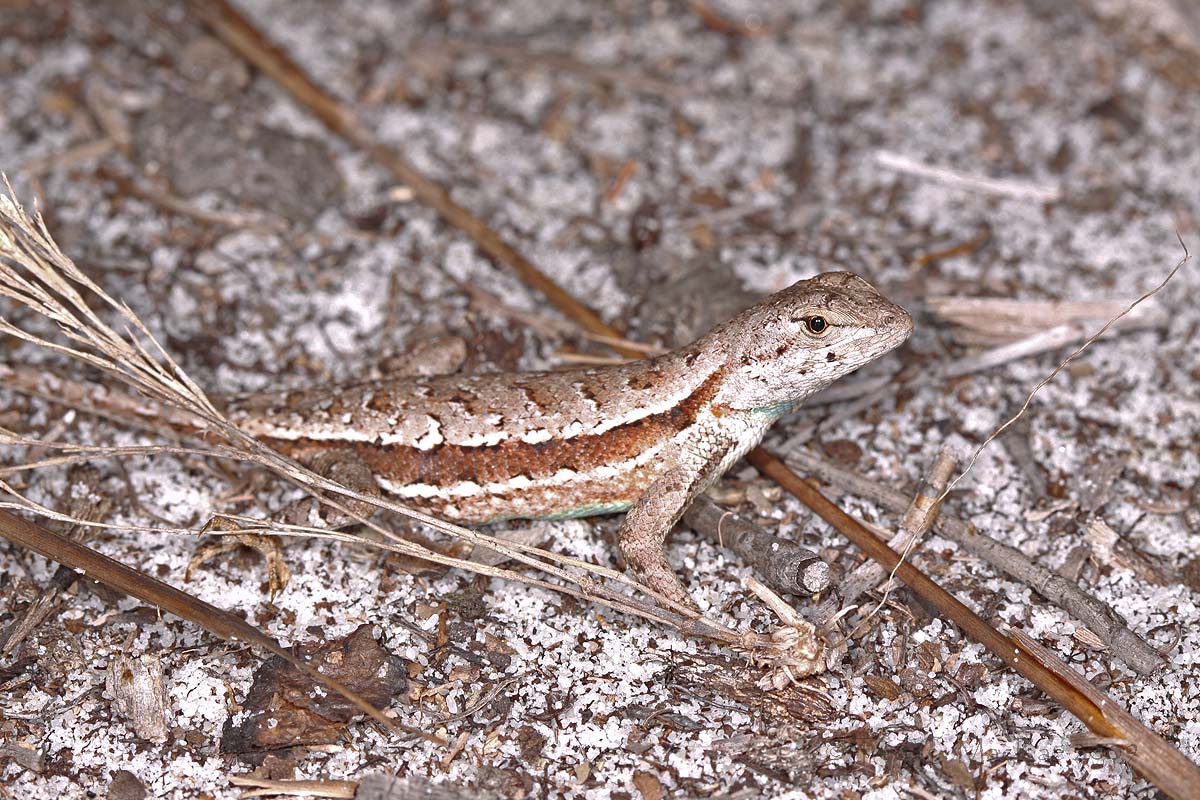
Florida Scrub Lizard

Sceloporus_woodi_IMG_1143_enh_1200x800

The Florida scrub lizard (Sceloporus woodi) is restricted to isolated sand scrub habitats in peninsular Florida.

Tiger beetles were not the only rare endemic species that I encountered during my visit to the Lake Wales Ridge in central Florida last August.  I didn’t know what this small lizard was as I watched it bolt from the trail and scamper for cover during my approach; however, having already found two endemic tiger beetles, I had a feeling that this lizard might also be a good one.  The photo shown here is admittedly not one of my best, but it was the only one I managed to get before the lizard ducked into the brush for good.  Horribly overexposed, I did what I could with it in Photoshop to make it halfway presentable, but there is no question that its subject represents a Florida scrub lizard, Sceloporus woodi¹.  This small, diurnal, ground-dwelling lizard belongs to the family Phrynosomatidae (same family as the Texas horned lizard that I featured in this post) and is restricted to Florida’s rare sand scrub and sandhill habitats.  Like the recently featured Highlands Tiger Beetle, this species is threatened by the isolated, disjunct nature of its required habitat—a threat made worse by the ever increasing pressures of agricultural conversion and urban development.

¹ Sceloporus is derived from the Greek word scelos meaning “leg” and the Latin word porus meaning “hole”, referring to the pronounced femoral pores found in this genus of lizards. The species epithet honors Nelson R. Wood, a taxidermist at the U.S. National Museum who collected the type specimen in 1912.

Distribution of the Florida scrub lizard (from Branch et al. 2003).

The Florida scrub lizard is related to and closely resembles the much more common and widely distributed southern fence lizard (Sceloporus undatus), which co-occurs with the scrub lizard in northern Florida.  Fence lizards, however, lack the dark brown lateral stripe that is clearly visible in the above photo, a feature seen in juveniles and adults of both sexes of the scrub lizard.  Juvenile and adult female scrub lizards also exhibit a dorsal zigzag pattern; however, this fades in males as they reach adulthood and develop the characteristic bright blue belly patches that are seen in both this species and in the fence lizard (Branch and Hokit 2000).  Since light blue patches are just visible on the belly and throat of the individual in the photograph, I haven’t been able to determine whether it represents a mature female or a still-juvenile male—any help from a knowledgeable reader would be greatly appreciated.  Unlike the fence lizard, the scrub lizard displays a high degree of habitat specificity, occurring as disjunct populations in strict association with the major sand scrub ridges of Florida.  The healthiest populations are found on the Mt. Dora Ridge in northern peninsular Florida, on which significant remnants of scrub habitat are preserved in the Ocala National Forest.  Populations also occur on the Lake Wales Ridge of central Florida and the Atlantic Coastal Ridge, but the status of these populations is less secure.  Populations also once occurred along the southwestern coast on the Gulf Coast Ridge, but these populations are now believed extirpated as a result of urban development (Jackson 1973, Enge et al. 1986).  While the Florida scrub lizard is not listed as a threatened or endangered species at the state or federal level, its high specificity to an increasingly isolated and fragmented habitat and its apparently low dispersal capabilities are clear causes for concern over its long-term prospects. As remnant habitats continue to shrink and become more isolated, the threat of localized extinction becomes an increasing concern for the lizard populations that they support.

Lake_Wales_Ridge_IMG_1129_1200x800_enh

Scrub lizard habitat is threatened by development, fragmentation and increased vegetation.

The precarious status of scrub lizards and their occurrence in several disjunct, isolated populations makes them interesting subjects for genetic studies. Mitochondrial DNA analyses suggest that scrub lizard populations exhibit a high degree of phylogeographical structure, with populations diverging significantly not only between major scrub ridges, but also within them (Branch et al. 2003).  The findings support the notion of long-term isolation of scrub lizard populations on the major scrub ridges and confirm their low dispersal rates among adjacent scrub habitats within ridges (as little as a few hundred yards of “hostile” habitat may be sufficient to prevent movement to adjacent habitats).  More significantly, the results support the concept of two distinct morphotypes on the Mt. Dora and Lake Wales Ridges and also raise the possibility that Atlantic Coastal Ridge populations represent a distinct evolutionary entity as well.  These findings are consistent with the hypothesis that scrub lizards evolved in central Florida, where they were isolated when surrounding lands were inundated by rising sea levels during the late Pliocene and subsequent interglacial periods during the Pleistocene.  During periods of low sea level they dispersed to the younger Atlantic and Gulf Coastal Ridges, where they were isolated from parent populations when more mesic conditions returned during the Holocene (12 kya to present).  The genetic distinctiveness of these different ridge populations may justify qualifying each of them for protection as “significant evolutionary units” under the U.S. Endangered Species Act, since it raises concerns about the use of translocations, a common strategy for establishing new populations in restored habitat or augmenting existing populations, as a conservation strategy for the species as a whole.  Since lizards located on different ridges are more divergent than lizards from populations located on the same ridge, movement of lizards between ridges could compromise the integrity of the genetic differences that have accumulated over millions of years and result in loss of genetic diversity.  As a result, augmenting populations on the Lake Wales and Atlantic Coast Ridges with lizards from robust populations on the Mt. Dora Ridge may not be desirable.  Instead, it may be necessary to protect individual scrub lizard populations on each of the major scrub ridges in order to preserve as much of their genetic diversity as possible.

REFERENCES:

Branch, L. C. and D. G. Hokit. 2000. Florida scrub lizard (Sceloporus woodi). University of Florida, IFAS Extension Service Publication #WEC 139, 3 pp.

Branch, L. C., A.-M. Clark, P. E. Moler and B. W. Bowen.  2003. Fragmented landscapes, habitat specificity, and conservation genetics of three lizards in Florida scrub.  Conservation Genetics 4:199

Enge, K. M., M. M. Bentzien, and H. F. Percival. 1986. Florida scrub lizard status survey. Technical Report No. 26, U.S. Fish and Wildlife Service, Jacksonville, Florida, U.S.A.

Jackson, J. F. 1973. Distribution and population phenetics of the Florida scrub lizard, Sceloporus woodi. Copeia 1973:746–761.

Copyright © Ted C. MacRae 2009

Add to FacebookAdd to NewsvineAdd to DiggAdd to Del.icio.usAdd to StumbleuponAdd to RedditAdd to BlinklistAdd to TwitterAdd to TechnoratiAdd to Furl

North America’s smallest rattlesnake

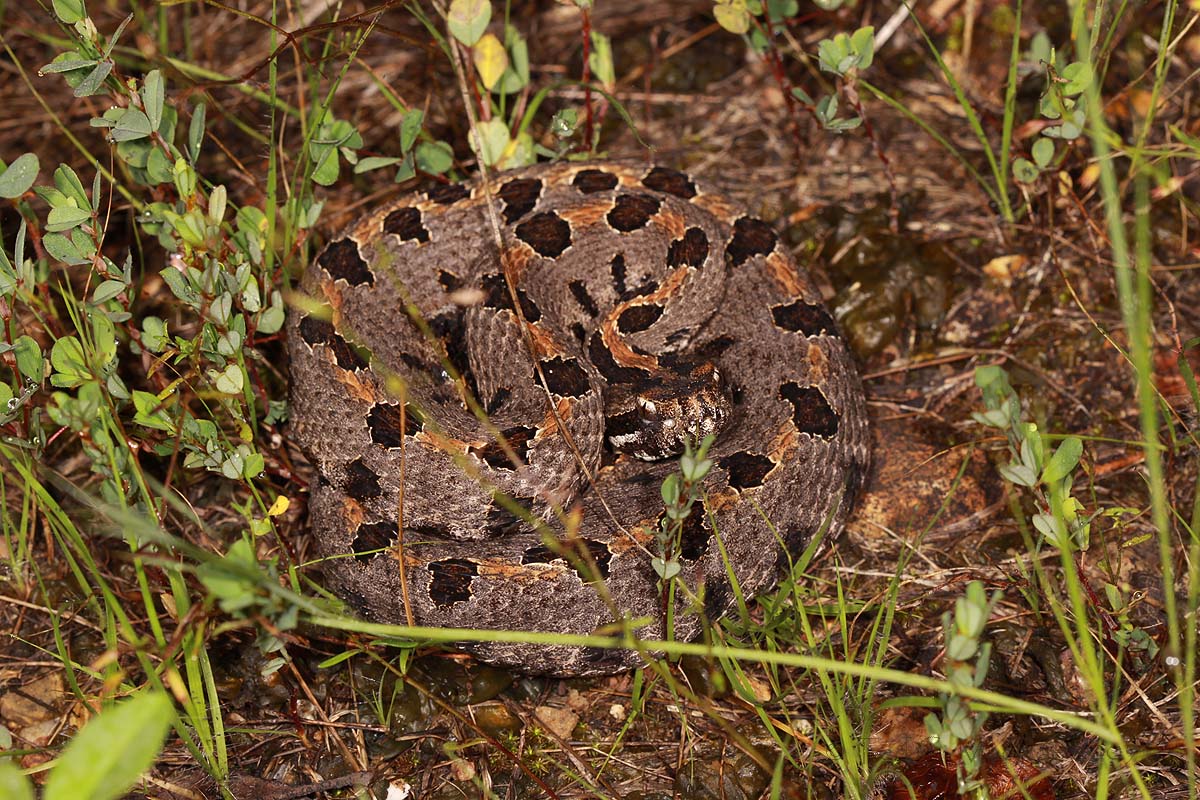
Despite tramping through the brush with great frequency during most of my life, I haven’t really seen that many noteworthy reptiles.  I don’t know whether its because I’ve failed to actually encounter them or whether my singleminded obsession with insects above all other things natural has instead prevented me from seeing what was right in front of me.  Regardless of the reason, all that has seemed to change during the past two seasons (strangely coincident with my decision to start carrying a camera), and I now seem to be enjoying a bit of a reptile bonanza.  Last summer I featured a super-aggressive prairie rattlesnake from a trip to the Black Hills of South Dakota and an uncooperative dusty hognosed snake from Missouri’s critically imperiled sand prairies (both first-time sightings for me).  The reptilian treats continued this year – I saw my first juvenile Osage copperhead in May to go along with the several adults that I’ve encountered, and shortly afterwards during a June trip to northwestern Oklahoma I was treated to a gorgeous male eastern collard lizard, two Texas horned lizards, and a much more cooperative western hognosed snake (the last two being first-time sightings for me).  There was another herp that I saw during that Oklahoma trip, but I did not feature it here because I had stupidly declined to strap the camera bag to my back during a quick look at a roadside habitat.  That sighting was another first-timer for me – a western pygmy rattlesnake (Sistrurus miliaris streckeri).  I’m no herp expert, so wasn’t sure what it was at the time, but I later learned that its small size and distinctive markings were quite diagnostic.

IMG_1014_1200x800
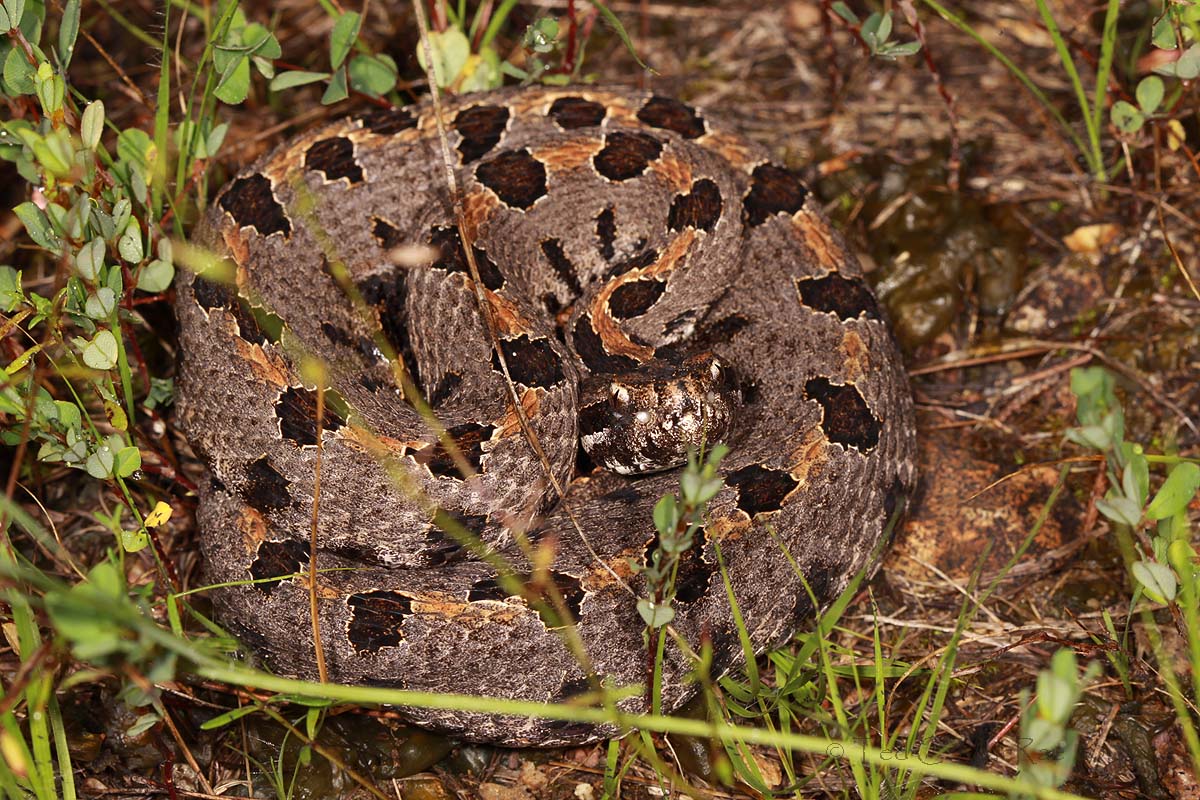
Western pygmy rattlesnake – Sistrurus miliarius streckeri

Amazingly, I encountered this same species again just a few weeks later during a visit to the White River Hills of extreme southwestern Missouri.  It was during the second of two trips to the region to search for the stunningly beautiful bumelia longhorned beetle, Plinthocoelium suaveolens plicatum (family Cerambycidae), and the weather during that day – continuous drizzle and low, threatening clouds – had not been at all conducive for finding such a sun loving beetle.  After searching an area where I knew the beetles occurred, without success, daughter Madison and I resigned that the drizzle was here to stay and decided to pass the rest of the day with some hiking at one of Missouri’s most spectacularly wild and beautiful places, Hercules Glades Wilderness.  A splendid mix of post oak savannahs and limestone glades intersperses through the oak/hickory forests in these rugged hills, creating some of Missouri’s most scenic vistas.  Near the end of the hike at the edge of one of these glades on the high point of Coy Bald, I saw this little individual coiled up underneath an eastern red-cedar (Juniperus virginiana) tree.  Unlike the terrifyingly aggressive prairie rattlesnakes I encountered in South Dakota last fall, this snake seem to be relying upon its cryptic coloration to avoid detection, rattling only after I had approached quite closely… or maybe it was only then I could actually hear the rattle, which was barely audible and sounded much like the buzz of a small katydid.

Pygmy rattlesnakes are the smallest rattlesnakes in North America, growing to around 15-25 inches long – this individual looked to be about 18-20 inches in length.  They are one of only two U.S. species in the primitive rattlesnake genus Sistrurus – the other being the larger wet prairie inhabiting massasauga (S. catenatus).  All other rattlesnakes (28 species, 13 in the U.S.) belong to the genus Crotalus (Smith et al. 2001).  Western pygmy rattlesnakes are not really a western U.S. species, but rather the westernmost subspecies of this southeastern U.S. species (with subspecies miliarius and streckeri occupying the northeastern and southeastern portions, respectively, of its range).  In Missouri, it is not nearly as common as the timber rattlesnake (Crotalus horridus), occurring only in the extreme southern Ozarks along the border with Arkansas and up into the St. Francois Mountains of the eastern Ozarks (Johnson 1997).  Although no known human deaths have ever been caused by this species, known locally as the “ground rattler,” it is nevertheless poisonous and worthy of respect.  I must admit to having been lulled a little bit by its calmness – much like the juvenile copperhead I photographed in May – and found myself tempted to approach ever closer for photographs.  The photograph below represents the closest that I was able to get before it began “striking” at me – whether these were bluff strikes intended to frighten or actual attempts to bite I do not know.  Suffice it to say that I “got the message” and ended my attempts to get even closer.  Daughter Madison watched in nervous amazement as all this was going on, and afterwards I tried to impress upon her young, virgin mind what a rare and wonderful experience we’d just had.  Perhaps I succeeded, as this was the first story she told to her head-shaking mother upon our return home the following evening!

IMG_1016_1200x800

Photo details: Canon 100mm macro lens on Canon EOS 50D, ISO 100, 1/250 sec, f/9-10, MT-24EX flash 1/2 power through diffuser caps.

REFERENCES:

Johnson, T. R. 1997. The Amphibians and Reptiles of Missouri. Missouri Department of Conservation, Jefferson City, 368 pp.

Smith, H. M., E. D. Brodie, D. M. Dennis and S. Barlowe. 2001. Reptiles of North America: A Guide to Field Identification. Golden Field Guide from St. Martin’s Press, New York, 240 pp.

Copyright © Ted C. MacRae 2009

Add to FacebookAdd to NewsvineAdd to DiggAdd to Del.icio.usAdd to StumbleuponAdd to RedditAdd to BlinklistAdd to Ma.gnoliaAdd to TechnoratiAdd to Furl

Western hognose snake

Another herp interlude…

IMG_0655_1200x800
Photo details: Canon 100mm macro lens on Canon EOS 50D, ISO 100, 1/250 sec, f/14, MT-24EX flash 1/4 power w/ diffuser caps.

During my visit to Salt Plains National Wildlife Refuge in northwestern Oklahoma this past June, tiger beetles were not the only wildlife subjects I encountered.  Near the edge of one of the alkaline flats along Sandpiper Trail was this hognose snake.  This is the second hognose snake that I’ve encountered in as many years, the first being a member of a rare, disjunct population of the dusty hognose snake (Heterodon nasicus gloydi) in one of southeastern Missouri’s critically imperiled sand prairie habitats.  There are two species of hognose snake in Oklahoma – eastern (H. platirhinos) and western (H. nasicus).  I presume this individual to be the western due to its strongly upturned rostral (snout), which is only moderately upturned in the eastern species, and black-checkered ventral coloration.  Surprisingly, in checking the Salt Plains reptile species list for confirmation on its identity, I noted that no confirmed sightings of either the eastern or western hognose snake have been recorded at the refuge.  I have since done my good deed to reptile science by submitting this and another photograph I took of the individual to the refuge biologist.  Ted MacRae – entomologist and discoverer of new reptile records!  Western hognose snakes are further classified into three subspecies, two of which – dusty and nominotypical – occur in Oklahoma (the third occurs in Mexico). However, the distinctions between the two U.S. subspecies are subtle¹ and not apparent in this photograph, preventing further classification.

¹ Some authors consider the dusty and western hognose snakes to be separate species, while others have regarded their differences too subtle to warrant even subspecific distinction.

Hognose snakes are famous for their well-choreographed sequence of defensive displays. Their first act is to rear up cobra-like and strike out with their mouth open while hissing (unfortunately, neither of the hognoses I’ve encountered entertained me in this manner).  If the threat continues, they then turn over and writh violently in mock agony before finally rolling over on their backs and playing dead (thanatosis).  Last year’s hognose snake didn’t do this either, insisting instead on continually trying to burrow into the loose sand.  As can be seen from the photograph above, however, playing dead is exactly what this individual did.  With the mouth agape and the tongue protruding, it’s a convincing display of lifelessness.  Amusingly though, whenever the snake was righted it immediately turned over on its back again – not such a good imitation of being dead!  Presumably the snakes predators are as bad at noticing that detail as are the snakes themselves.  As I continued to pester this individual, trying to get him to stick out his tongue further for a better photograph, he eventually started ejecting blood from the lacrymal glands and emitting musk from the cloaca – what better to emphasize a death display than blood and an offensive smell!

Western hognose snakes are classified as a species of ”least concern” on the IUCN Red List of Threatened Species and aren’t listed as a species of concern on the Oklahoma Natural Heritage Inventory database.  Nevertheless, as with many other reptiles and amphibians, populations are declining throughout much of their former range.  This is likely due to the combined effects of urbanization, reduction of habitat, predation by feral dogs and cats, and overcollection for sale to the pet trade.

Copyright © Ted C. MacRae 2009

Add to FacebookAdd to NewsvineAdd to DiggAdd to Del.icio.usAdd to StumbleuponAdd to RedditAdd to BlinklistAdd to Ma.gnoliaAdd to TechnoratiAdd to Furl

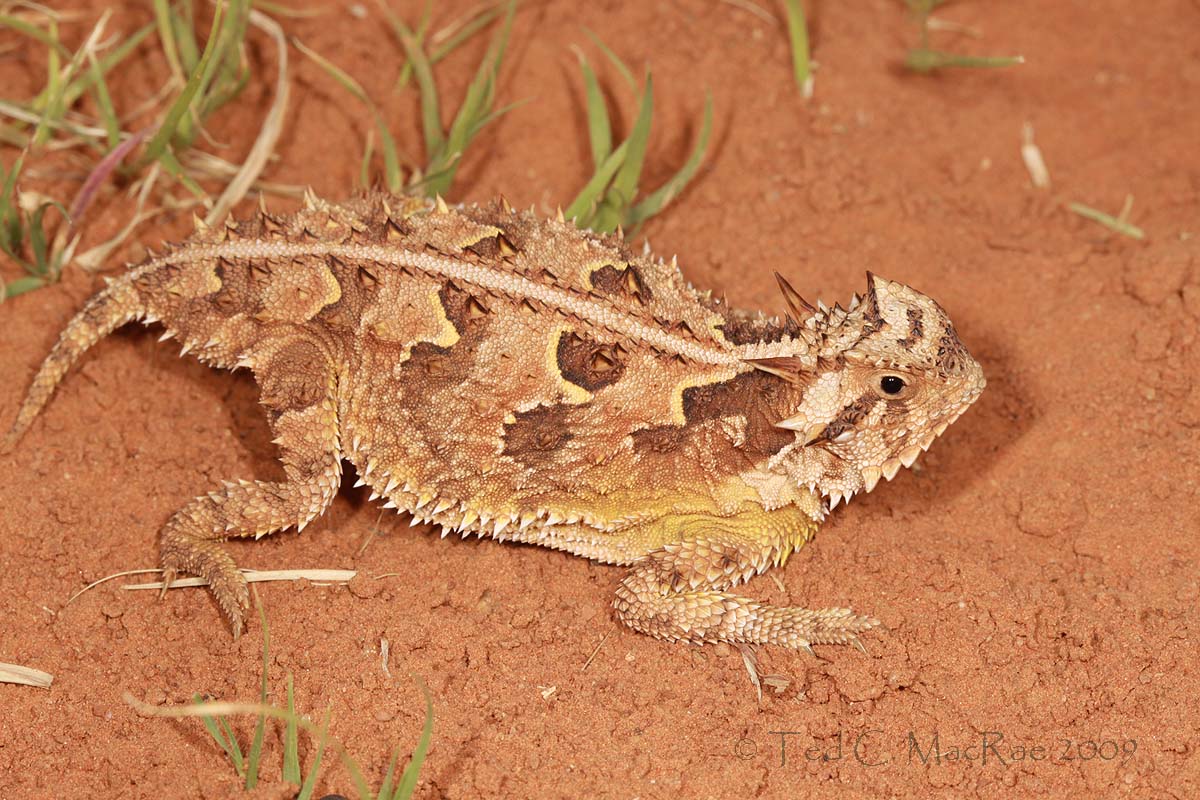
North America’s most bizarre lizard

Hmm, something funny going on here.  This is a bug blog – specifically a beetle blog, yet it’s a post about a lizard that generates a flurry of comments.  I don’t know if lightning will strike twice so quickly, but I did have this second ‘lizard’ post already lined up in the queue.

IMG_0390_1200x800

The day after seeing a couple of male eastern collared lizards at Four Canyon Preserve in northwestern Oklahoma, I got my second saurian treat with this horned lizard (genus Phrynosoma).  There are actually some dozen species of horned lizards in North America, but the majority are found further west in the U.S. and down into Mexico and Central America.  Of the two that occur in Oklahoma, this particular individual can be identified as a Texas horned lizard (P. cornutum) by the two occipital (back of the head) spines, presence of lateral abdominal finge scales, and dorsal white stripe.  Oklahoma’s other horned lizard (round-tailed horned lizard, P. modestum) is restricted to the northwestern corner of the panhandle and differs from the Texas horned lizard by having four occipital spines, lacking lateral abdominal fringe scales, and more solid pale coloration.

IMG_0392_1200x800Again, my claim of “most bizarre” might be open to debate, as there are certainly many bizarre lizards in North America.  The gila monster once more comes to mind, but I think grotesque is a better descriptor for that animal, and the fan-shaped toe pads of geckos might also get them some votes.  Nevertheless, do a Google search on the phrase “bizarre North American lizard” and the results will be overwhelmingly dominated by references to horned lizards.  It’s no surprise – their squat body form is more suggestive of toads than lizards¹, for which they are commonly called “horned toads” or “horny toads,” and their covering of “horns” (actually modified scales) gives them an otherworldly, almost dinosaurian appearance.  Who among my generation wasn’t terrorized by the sight of these lizards, cheaply magnified, as they threatened the scientists that encountered them in the 60’s sci-fi classic The Lost World?

¹ Even the genus name, derived from the Greek words phrynos (toad) and soma (body), alludes to its toad-like appearance.

IMG_0397_1200x800In reality, these lizards are anything but terrifying.  Instead they employ multiple strategies to avoid being eaten themselves. These adaptations were all on display as I initially passed this individual without even noticing it lying motionless in the middle of the road. Once I had passed I noted movement out of the corner of my eye and turned to see it scurrying towards the vegetation along the side of the road. It’s mottled coloration, blending well with its background, and spine-broken silhouette made it almost invisible. Feeling threatened by my too-close approach, it made a rapid burst for cover, but I cut it off at the pass and blocked its erratic scampers towards the roadside to keep it out in the open so I could take some photographs. Once cornered in the open, it resorted to a third strategy – puffing of the body to make it appear larger. Had I been a true predator, it would’ve had two more strategies up its sleeve that it could have employed as a last resort – bleeding from the eyes (which apparently has a foul taste and will cause a predator to drop the lizard from its mouth) along with the mechanical defense of its hard, spiny scales. Since I didn’t actually try to eat this little guy, I didn’t have a chance to experience these final lines of defense.

The photos here actually represent two individuals – the middle picture is a second lizard that suddenly appeared while I was photographing the first.  The second individual was somewhat smaller than the first and not as boldy marked (note the lack of a distinct dark stripe behind the eye).  Whether these were male and female is difficult to say – horned lizards lack outward sexual characters allow them to be easily distinguished in the field (females do tend to grow a little bit larger). While not threatened or endangered, Texas horned lizards, like many other horned lizard species, have experienced dramatic reductions in its range. Oklahoma has a year-round closed season for both species that makes it illegal to kill or capture horned lizards without written permission. I would see a few more of these fascinating little lizards during my three days at Four Canyon Preserve, suggesting that, at least in this part of the state, horned lizards are doing just fine.

Photo details: Canon 100mm macro lens on Canon EOS 50D, ISO 100, 1/250 sec, f/11-13, MT-24EX flash 1/4 power through diffuser caps.

Copyright © Ted C. MacRae 2009

Add to FacebookAdd to NewsvineAdd to DiggAdd to Del.icio.usAdd to StumbleuponAdd to RedditAdd to BlinklistAdd to Ma.gnoliaAdd to TechnoratiAdd to Furl

North America’s most beautiful lizard

Whew! My fingers and keyboard are still smoking after that long series on Cylindera celeripes (parts 1, 2, and 3). Exciting as my celeripes finds were, there were other “tiger beetle moments” from the Oklahoma trip as well that I want to highlight in future posts. However, I thought I’d give everyone a break from tiger beetles (and my rambling prose) and remind everyone that I can not only talk about other insects, but even non-insects.

IMG_0318_1200x800

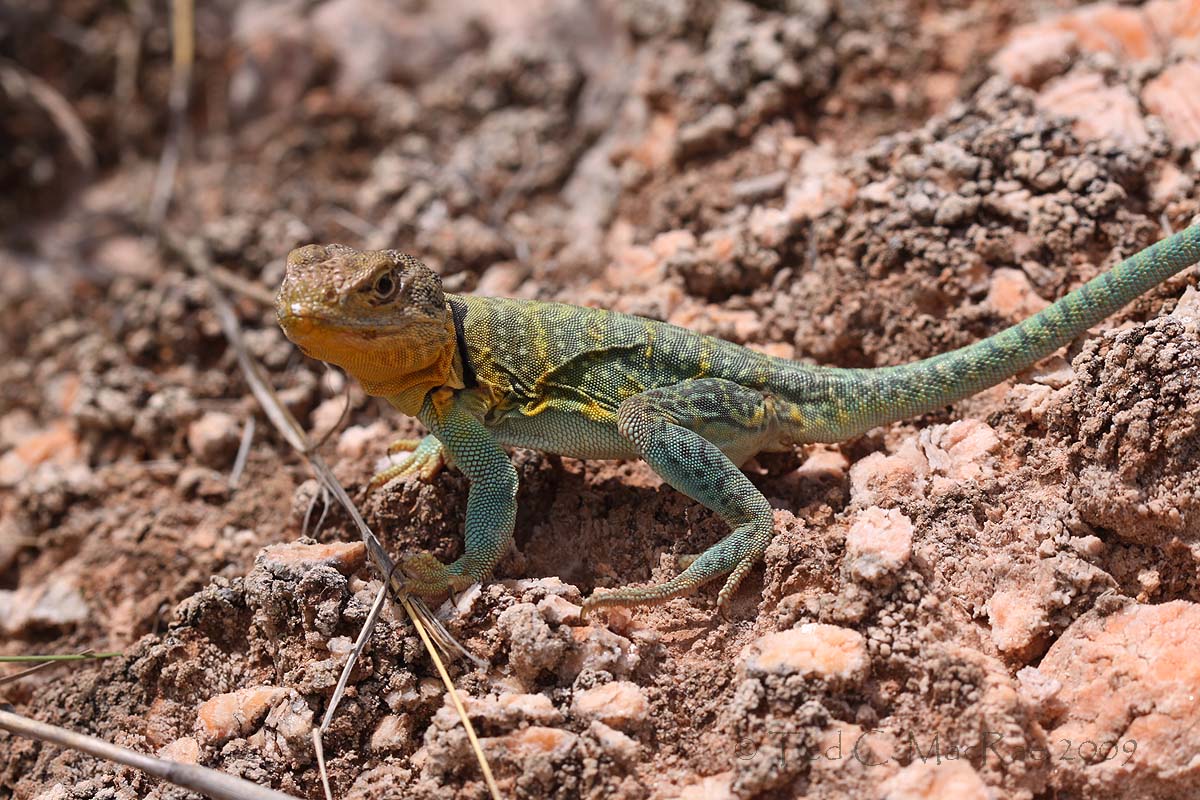
Isn’t he a looker?!  I came upon this this male eastern collared lizard (Crotaphytus collaris collaris) during my first day at Four Canyon Preserve – fitting, since the species is Oklahoma’s state reptile (a fine choice, unlike their dreadfully pedestrian choice for state insect – the honey bee!  Huh?  It’s not even native!).  When I first saw this fellow he skirted under a branch, then across the trail, under a ledge, up and over to another rock…  By the time I got him accustomed to my persistent approaches (remember, I stalk tiger beetles!) he was posing nicely at chest level and with the sun behind my shoulder for a nice series of photographs.  I have never been able to approach a “mountain boomer” this closely before (encountering them only a few times previously on igneous glades in the the St. Francois Mountains of my beloved Ozark Highlands), and the first time I do I have a Canon 50D and 100mm macro lens in my backpack – que suerte!

IMG_0328_1200x800Perhaps my title is a little presumptuous – surely there are other gorgeous lizards in North America.  However, I can’t imagine anything more breathtaking than the vivid blues, greens, and yellows with sharply contrasting black stripes of male eastern collared lizards.  Perhaps the gila monster might get a vote, although its impressiveness is more grotesque than beautiful.  Horned lizards as well are quite impressive, but again more bizarre than beautiful.  Added to the collared lizard’s visual appeal is their comically dinosaurian ability to run swiftly on their hind legs with the fore legs and head held upright (this is how most of my previous attempts to approach them have ended).

IMG_0314_1200x800The name “mountain boomer” probably originated with the early pioneers, who erroneously believed that they emitted sounds that echoed through the canyons and valleys.  An oft-cited theory in field guides (and also the Oklahoma Department of Wildlife Conservation and the Missouri Department of Conservation websites) states that the pioneers may have associated the sunning lizards with the barking of frogs.  This seems unlikely; frogs that make barking noises are creatures of wetlands – far from the rocky outcroppings of the glades and pinyon-juniper, sagebrush, desertscrub, and desert grassland habitats of the central and west-central U.S. where collared lizards are encountered.  Regardless of the source of its nickname, collared lizards in reality make no vocalizations at all (although like most lizards they can hiss when they feel threatened).

IMG_0316_1200x800

Copyright © Ted C. MacRae 2009

Add to FacebookAdd to NewsvineAdd to DiggAdd to Del.icio.usAdd to StumbleuponAdd to RedditAdd to BlinklistAdd to Ma.gnoliaAdd to TechnoratiAdd to Furl

Osage copperhead

Copperhead

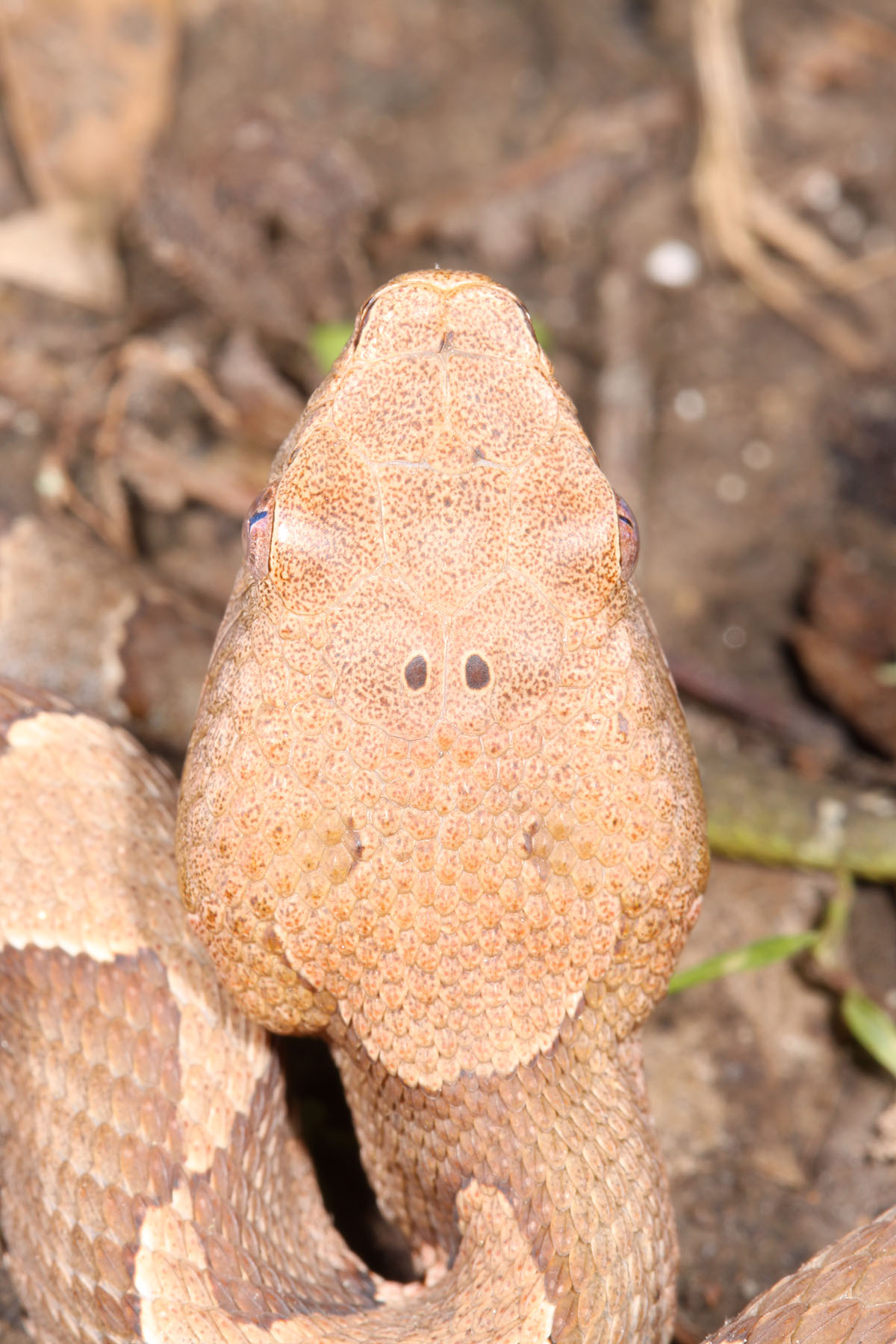
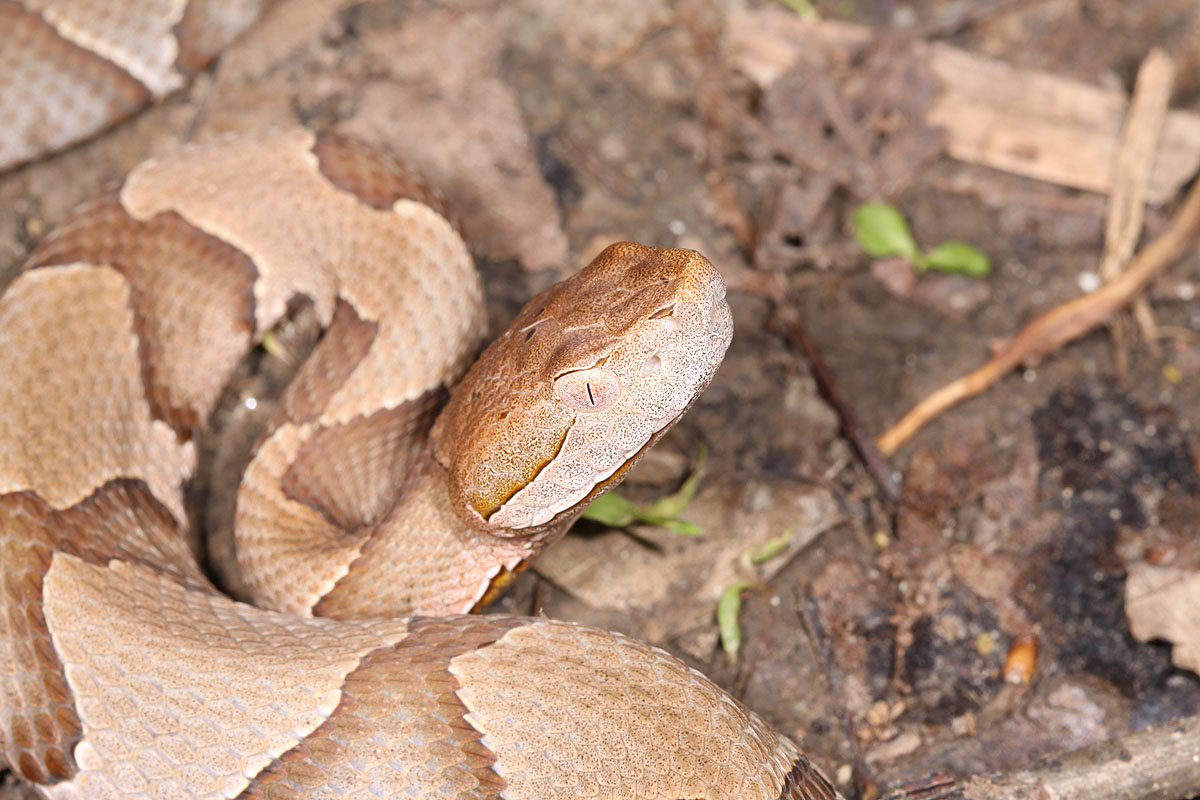
While photographing Cicindela sexguttata last weekend, Chris and I encountered this young copperhead snake (Agkistrodon contortrix).  It was the second copperhead I had seen in as many days – unusual, since I can count on my two hands the number of copperheads I’ve encountered in my many years of tramping through Missouri’s woodlands.  I did not even see my first copperhead (other than in the zoo) until early adulthood, one of many unfortunate consequences of my strictly urban childhood (more on that first encounter later).

Copperhead

Missouri copperheads don’t really have “copper heads” – the common name is derived from the northern subspecies that lives in the northeastern U.S. and down into Appalachia.  Instead, most of Missouri’s copperheads have a pinkish tan head that matches the color of the body.  Three of North America’s five copperhead subspecies live in Missouri, but it is the Osage copperhead (A. contortrix phaeogaster) that is most commonly encountered – the northern and southern subspecies being confined, respectively, to the extreme northern and southern portions of the state.  Osage copperheads are distinguished by the light bordering around each of their dark markings.

Copperhead

This individual can be recognized as a juvenile not only by its small size (it was just over 1 foot long), but also by the greenish yellow tail with small, white markings edged in black.  Juvenile copperheads need help capturing prey because of their small size and use their colorful tails for “caudal-luring” – that is, they use their tails to lure prey to within striking distance.  When prey approaches, the coiled juvenile snake moves its tail near the center of the coil and wiggles the colored portion – perhaps it looks like a caterpillar to the lizard or frog.  Copperheads lose their juvenile tail coloration at about 18 months to two years of age when they are large enough to capture prey without assistance.

Copperheads are famously non-aggressive – even though the majority of snake bites that occur in Missouri each year are from this snake (due to its abundance), nearly all are a result of human attempts to handle, capture, or (tragically) kill the snake.  I suppose someone might accuse me of doing likewise, since I used a stick to pick this individual up from the leaf litter in which it was lying, brilliantly camoflauged, and lay it down on the trail for photographs.  The snake did strike several times at the stick, but with my hand safely out of reach, and after it was in place it cooperated fully for these ever closer photographs.  My first encounter with a copperhead, however, was not so uneventful.  I was a budding entomologist fresh out of school and had just discovered the wonderful little herbaceous islands in the forest known as glades.  On my way back to St. Louis from a meeting in Jefferson City, I stopped by Graham Cave State Park in Montgomery Co. – a park I had not yet explored.  Of course, there’s a cave that one must see – in this case an unusual sandstone overhang cave (significant for its Native American artifacts dating back 10,000 years).  On top of the broad, sandstone arch above the cave I noticed a little glade habitat and clambered up to take a peek.  As I was standing atop the cave looking at the glade, I felt something hit my ankle.  I looked down and saw a full-grown copperhead coiled right next to my foot and instinctively jumped up and away from the snake (and fortunately not over the edge of the cave top).  Almost immediately, my leg started feeling tingly, and as I pulled up my pant leg, pushed down my sock, and began searching frantically for the wounds on my ankle my leg started going completely numb.  I was 40 miles from the nearest hospital, alone, and had not the wisdom to know that no fatalities from the bite of any of Missouri’s venomous snakes have been recorded for many decades.   Convinced I was going to die, I continued my frantic search for the wounds, but no amount of careful examination around the ankle revealed any broken skin (what I would have done had I actually found wounds I do not know).  I got up and tried to walk, almost collapsing at first on the completely numb leg.  Eventually I was able to walk some feeling back into the leg, and once the leg was feeling close to normal again I concluded that the numbness must have been a purely psychosomatic response to the perceived bite.  I went back to the snake, still coiled up where I first encountered it, and admired it for awhile – with due respect!

An excellent article on Missouri copperheads, by Missouri Department of Conservation herpetologist Tom R. Johnson, appeared in the May 1999 issue of The Missouri Conservationist.

Copyright © Ted C. MacRae 2009

Add to FacebookAdd to NewsvineAdd to DiggAdd to Del.icio.usAdd to StumbleuponAdd to RedditAdd to BlinklistAdd to Ma.gnoliaAdd to TechnoratiAdd to Furl

Tyrant ground beetles

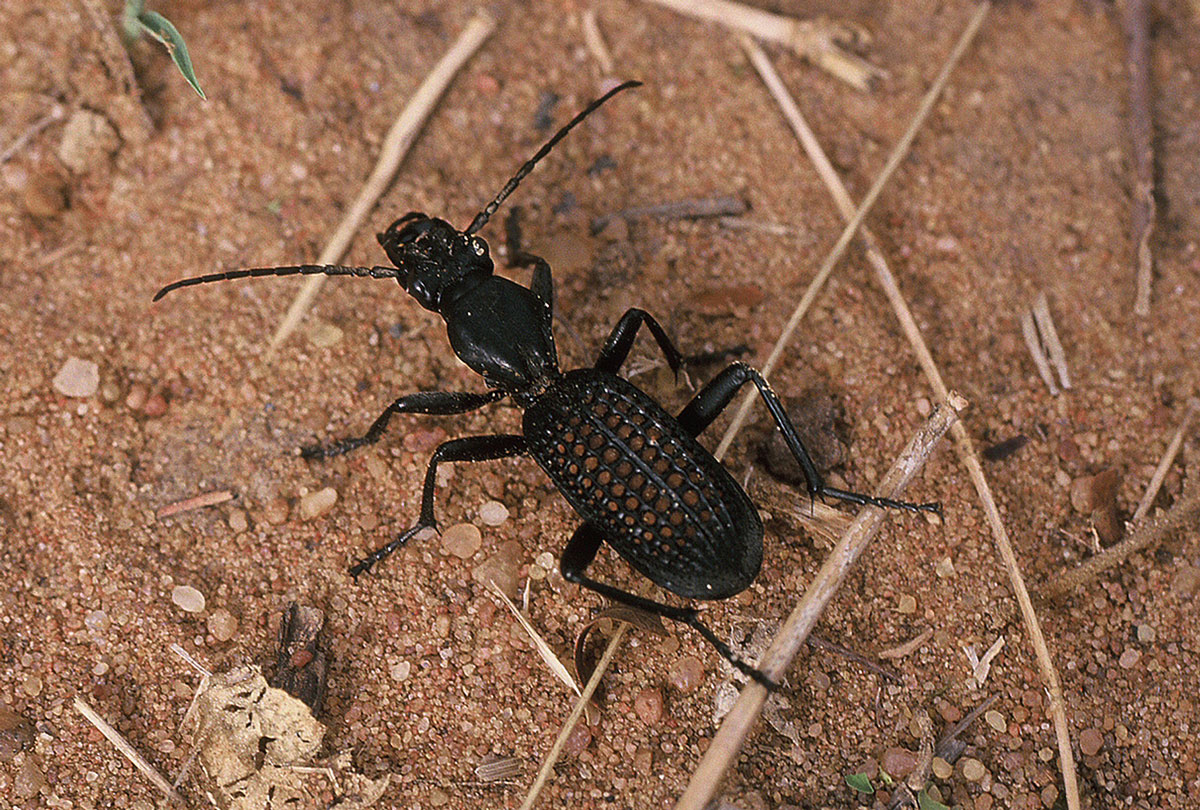
I return to my Afrikaans theme with a distinctive group of ground beetles (family Carabidae) called tyrant ground beetles or spotted ground beetles (tribe Anthiini). I think I prefer the former. This tribe is largely restricted to Africa and is especially diverse and abundant in the arid, sandy Karoo and Kalahari regions of southern Africa (Scholtz & Holm 1985). These beetles are large, powerful predators that rely on speed and agility for capturing prey, and since they are also flightless these characteristics come in handy for avoiding becoming prey themselves. Failing that, they employ chemical defense in the form of secretions from a pygidial gland located in the area of the ninth abdominal segment. The chemical cocktail within these secretions contains concentrated organic acids or quinone that can be squirted at potential predators in a strong jet. This is an effective deterrent to small mammalian and avian predators, and I suppose a careless beetle collector might also regret handling these beetles without due respect. These defensive spray capabilities give rise to another common name for the group, “oogpister” – an Afrikaner word that literally translates to (ahem) “eye pisser.”
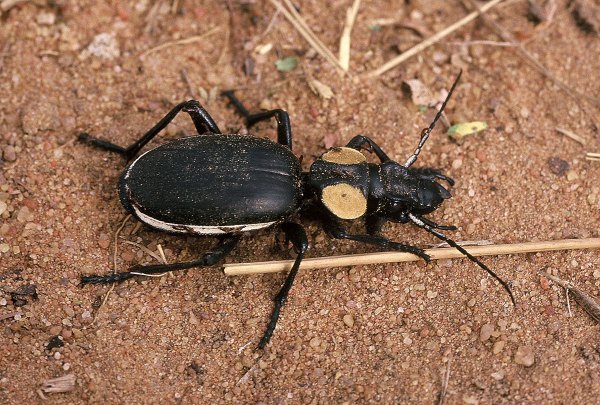
Anthia (s. str.) thoracicaDuring my time in Africa, Chuck Bellamy and I were primarily focused on collecting buprestids. However, we still couldn’t resist hanging an ultraviolet light in front of a sheet and searching the ground with flashlights at night to see what diversity of other African insects we might encounter. Truth be told, one of the non-buprestid groups that I’d really hoped to encounter was a near relative of these beetles – the so-called “monster tiger beetles” of the genus Manticora (family Cicindelidae1). We never did see any monsters, but we did encounter several species of anthiine ground beetles around our encampment at Geelhoutbos farm near the Waterberg Range in Limpopo Provice. Anthia (s. str.) thoracica, the giant African ground beetle (above), was the most impressive of these. Click on the photo to see a larger version – only then will it begin to convey how truly appropriate such a common name is for this species. It is certainly the largest ground beetle that I have ever seen – a full 50 mm in length! That’s 2 inches, folks! This species is easily recognized by the depressed lateral expansions of the pronotum covered with dense white/yellow pubescence, and the slightly smaller male that I caught exhibits more elongated mandibles (though not so incredibly as in Manticora) and marvelous lobes extending backward from the pronotum.

1 Increasingly placed within the Carabidae as subfamily Cicindelinae on the basis of molecular phylogenetic analysis, along with Paussinae and Rhysodinae (e.g., Beutel et al. 2008).
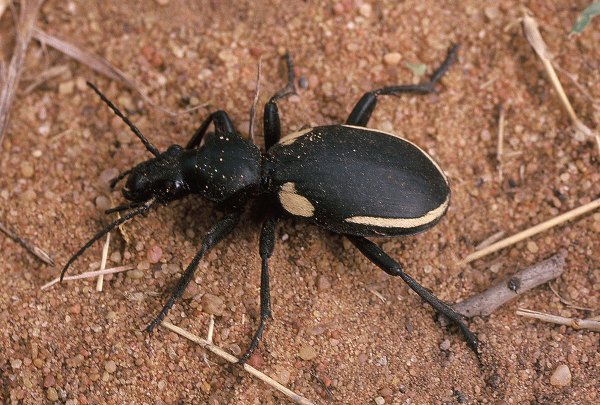
Anthia (Termophilum) omoplataIn addition to true Anthia, we saw two species of the subgenus Anthia (Termophilum)2. The species shown right is A. (T.) omoplata3, with the common name “two-spotted ground beetle” (Picker et al. 2002). It was almost as large as its giant brother above, measuring 47 mm in length. Of this species, I only saw this one individual, but I did also find two individuals of a related species, T. fornasinii. Unfortunately I was unable to photograph the latter species, which is equally large but with the elytral white markings limited to a thin marginal band and the surface of the elytra bearing strong longitudinal intervals – a handsome beast, indeed! Picker et al. (2002) mention T. homoplatum being a diurnal hunter, but we found all of our anthiines active nocturnally.

2 Treated variously in the literature as either a full genus or as a subgenus of Anthia. I follow Carabidae of the World, in which it is given subgeneric status. The name is often cited as “Thermophilum” in the literature, but this is an incorrect subsequent spelling according to Alexandre Anischenko (in litt.), coordinator/editor of Carabidae of the World.

3 Usually cited as “homoplatum” or “homoplata” in the literature, but this is an incorrect subsequent spelling (Anischenko in litt.).
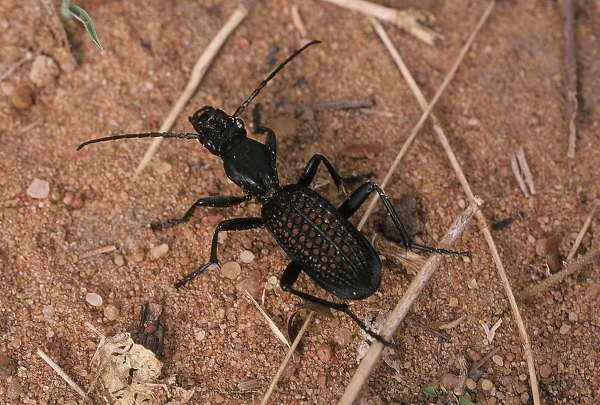
cypholoba-alveolataA second genus in the tribe is Cypholoba, represented here by C. alveolata. As far as I can tell it lacks a common name, which is not surprising since it is somewhat smaller than the Anthia species mentioned above. Still, my two specimens measure 38 and 35 mm in length – not puny by any standard. There can be no doubt as to the origin of the specific epithet of this species’ scientific name, with its marvelously alveolate elytra. I don’t think I’ve seen such an extraordinary example of this type of surface sculpturing on a beetle of this size, making the species every bit as spectacular as the larger anthiines.

A truly fascinating aspect of Africa’s tyrant ground beetles is their role as models in Batesian mimicry systems. That these beetles should serve as models is not at all surprising due to their chemical defensive capabilities and obviously aposematic coloration. What is surprising is the mimic – juveniles of the lizard species, Eremias lugubris, in what is believed to be the first reported case of a terrestrial vertebrate mimicking an invertebrate (Huey & Pianka 1977). The juveniles not only copy (roughly) the black and white coloration of anthiine beetles but also mimic their rapid, skitty movements – foraging actively with “jerky” motions and arched backs. Their tails remain somber colored, however, allowing them to blend into the sand. These adaptations combine to give the harmless little lizard the size, color, profile, and gait of the beetles. As the lizards reach adulthood (and their greater size makes them less prone to predation), they take on a more typical cryptic coloration and move in a slower, more deliberately lizard-like manner. This mimicry association effectively reduces predation of the juveniles by potential predators, who quickly learn to avoid the noxious, and more frequently encountered, anthiine models.

REFERENCES:

Beutela, R. G., I. Riberab and O. R. P. Bininda-Emonds. 2008. A genus-level supertree of Adephaga (Coleoptera). Organisms, Diversity & Evolution, 7:255–269.

Huey, R. B. and B. R. Pianka. 1977. Natural selection for juvenile lizards mimicking noxious beetles. Science, 195 (4274):201-203.

Picker, M., C. Griffiths and A. Weaving. 2002. Field Guide to Insects of South Africa. Struik Publishers, Cape Town, 444 pp.

Scholtz, C. H. and E. Holm (eds.). 1985. Insects of Southern Africa. Butterworths, Durbin, 502 pp.