T.G.I.Flyday—fuzzy wuzzy wuz a…

Megaphora? sp. | Lyon Co., Nevada

Megaphora? sp. | Lyon Co., Nevada

I’m back after an uncharacteristically lengthy absence, due not to loss of desire or inspiration but rather a malfunctioning computer. Repeated attempts to restore connectivity were unsuccessful, and heavy travel during the past week only exacerbated the situation. However, all is well now (for the time being—hopefully a new machine will arrive before my current one bites the dust), and as a peace offering until I can post something more substantial I offer this photo of a robber fly (family Asilidae) that I photographed near Wellington Springs in Lyon Co., Nevada during my late August Great Basin collecting trip. The fly was found very much alive but torpidly clinging to the stem of Chrysothamnus viscidiflorus (yellow rabbitbrush). My best guess is something in the genus Megaphorus (correction or confirmation by any passing fly guys would be much appreciated).

Speaking of my Great Basin collecting trip, I’m putting together an “iReport” of the trip featuring a general synopsis and photographs taken exclusively with my iPhone. Don’t snicker—when used within its capabilities an iPhone can take quite good photographs. I carry mine with me at all times despite also carrying a “real” camera and use it in situations that play to its strengths and don’t require the big camera. At any rate, look for something in the next day or so.

Copyright © Ted C. MacRae 2013

Sunset for another great collecting trip

All good things must come to an end, and so it is with my Great Basin collecting trip. From Nevada’s isolated ranges to California’s stunning Owens Valley; from Utah’s starkly beautiful canyons to Colorado’s majestic mountains, the experience not only quenched my thirst for natural history but also provided much needed spiritual renewal. Look for a “Trip iSummary” here at Beetles in the Bush in the coming days, and of course I have lots of photographs of the insects I encountered that I will share in the following weeks.

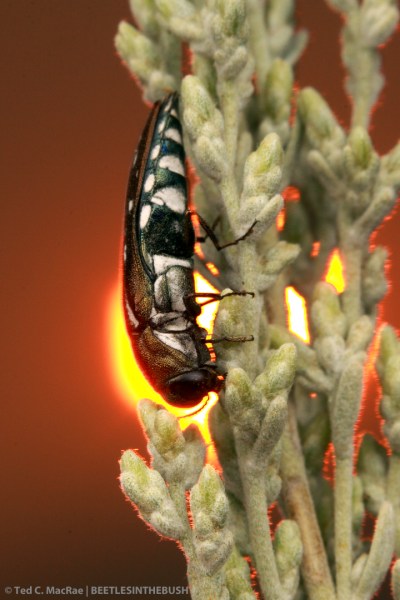
In the meantime, here’s a preview of one of the species that I encountered—a male Agrilus walsinghami preparing to bed down for the night.

Agrilus walsinghami | Davis Creek Regional Park, Washoe Co., Nevada

Agrilus walsinghami (male) | Davis Creek Park, Washoe Co., Nevada

© Ted C. MacRae 2013

Dr. Charles L. “Chuck” Bellamy—Tribute to a friend

Dr. Charles L. ''Chuck'' Bellamy

Dr. Charles L. ”Chuck” Bellamy

Early this week I lost a good friend. Actually, just about everybody who has ever studied jewel beetles in any serious way lost a good friend. Dr. Charles L. Bellamy, arguably the most ardent and prolific buprestophile of our time (possibly ever), died on August 19, 2013 at his home in Sacramento, California. In a career spanning 30 years that took him from California to South Africa and back (twice!), “Chuck” pumped out more than 200 research papers (including nine research volumes and five book chapters), 27 book reviews, and with Art Evans co-authored the popular An Inordinate Fondness For Beetles! Perhaps his most significant contribution, however, was the landmark 5-volume, 3,200+ page, World Catalogue of Buprestoidea—a true magnus opus that serves as a fitting exclamation point to his remarkable career.

I write, however, not about the loss of a respected colleague, but of a true friend. I still remember receiving a letter from Chuck in late 1991 introducing himself to me, congratulating me on the publication of my Buprestidae of Missouri, and suggesting we might have reason to meet due to our common interests. I was, of course, already familiar with Chuck, as he had by then become well established as a leading authority in jewel beetle taxonomy. It was just a few months later that I would have the chance to meet Chuck in person, when I traveled with the late Gayle Nelson to southern Mexico to join Chuck and seven other colleagues at the 1992 Buprestid Workers Gathering. It was on that trip that Chuck and I struck up what would prove to be an enduring friendship. In the following years he and I teamed up on several collecting trips, first to southern California where he “introduced” me to some of southern California’s classic collecting localities such as Jacumba, Ocotillo, and Glamis Dunes, then to southeast Arizona where he introduced me to his close friend Art Evans, and later to South Africa where we spent three weeks in the veldt (a trip that remains one of the best collecting trips I have ever taken). Eventually we began a series of collecting trips to southern Mexico spanning the years 2004–2006. Declining health eventually put an end to these trips, and while I always hoped we would be able to resume them in the future, I knew that realistically his collecting days were behind him. Still, my family and I visited him and his wife Rose in Sacramento whenever we could, and when we couldn’t I enjoyed his almost daily correspondence by email.

Over the years, Chuck became my most important mentor. I remember mentioning to him during one of our trips to Mexico my interest in being an editor of an entomology journal—along with my doubts about whether I could do it. At the time Chuck was the Managing Editor of The Pan-Pacific Entomologist, and he immediately invited me to become the journal’s Coleoptera Subject Editor. Without his encouragement I may not have had the courage to try, and when the role of Managing Editor became available in 2011 he again encouraged me to take on the role. Chuck may have been the ultimate jewel beetle scholar, but he was also an avid sports fan. I remember fondly our two October trips to Mexico; making sure the hotel we checked into each night had cable television so that we could watch post-season baseball. How we enjoyed watching the Yankees fall to defeat in 2004 (my apologies to any New Yorkers that may be reading) and the Cardinals winning it all in 2006! Perhaps my fondest memory of Chuck, however, was having the privilege to fly to Sacramento and watch my friend being honored as The Coleopterists Society’s .

As a remembrance, I have put together a slide show with photos of Chuck through the years. Although I have only a few photographs of my own (lesson learned: take photographs of friends and colleagues over the years!), mutual friends Rick Westcott and Art Evans have sent to me a number of photographs from their archives and graciously allowed me to use them in this slide show. Chuck was a colleague, my mentor, and my friend. I will miss his sage counsel and cerebral wit. I will miss his encouragement and support. But most of all, I will miss having him as my friend. My heartfelt condolences to his lovely wife Rose, whom I and my family have had the great privilege to know.

This slideshow requires JavaScript.

Copyright © Ted C. MacRae 2013

Flown the coop

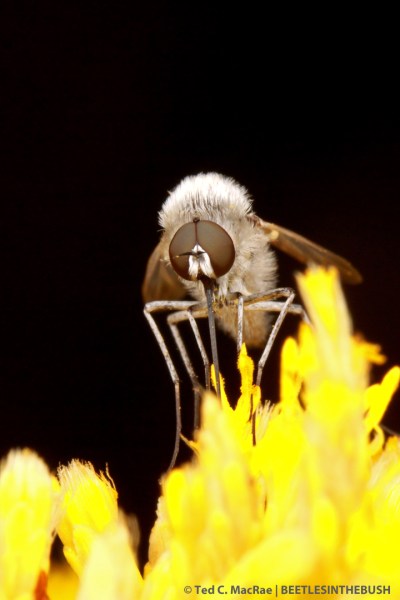
Ted has flown the coop and will be roaming the vastness of the Great Basin for the next week or so to collect and photograph beetles and other insects. Ted has asked me to watch over BitB while he is away, so allow me to introduce myself—I’m “fly guy” (although Ted calls me Geron sp. and insists that my family is called Bombyliidae or something weird like that). I live in the semi-arid hills near Washoe Lake, Nevada and spend my days flitting amongst antelope bitterbrush and desert peach and sipping nectar from rabbitbrush flowers with Mt. Rose in the backdrop. Anyway, I don’t think Ted has thought his plan through very well—since I’m not very smart (I am just a fly, afterall), a quick photo here and there is about the best I can do. Anyway, for my first post, I hope you’ll enjoy this portrait of ME!

Geron sp.

Copyright © Fly Guy 2013

An interesting flightless May beetle

I suppose you are an entomologist?

Not quite so ambitious as that, sir. I should like to put my eyes on the individual entitled to that name. No man can be truly called an entomologist, sir; the subject is too vast for any single human intelligence to grasp.

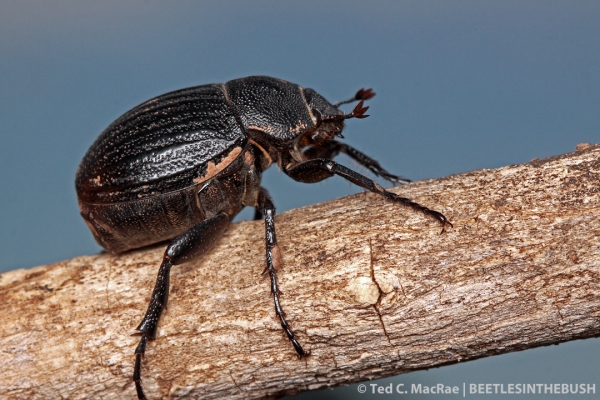
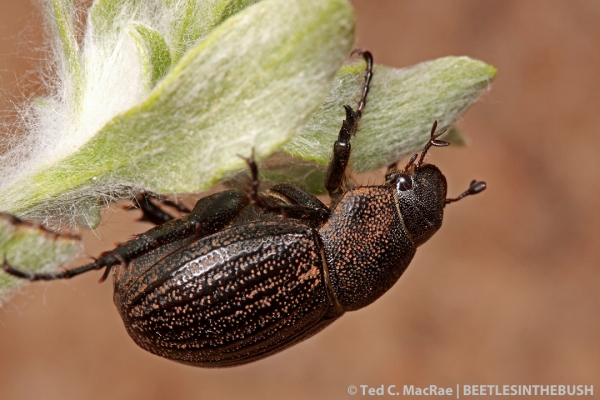
Phyllophaga cribrosa | Gloss Mountain State Park, Major Co., Oklahoma

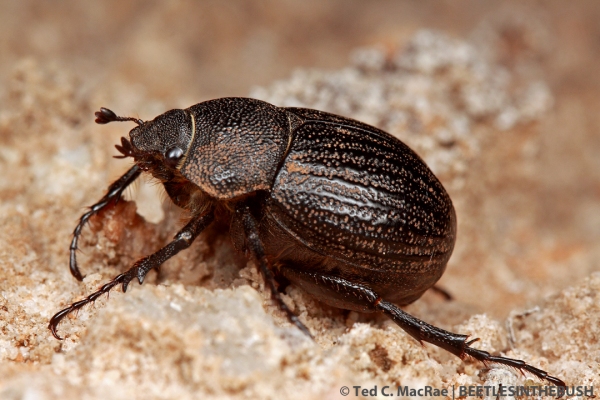
Phyllophaga cribrosa | Alabaster Cavern State Park, Woodward Co., Oklahoma

I suppose the above quote from The Poet at the Breakfast Table, by Oliver Wendell Holmes, Sr., applies just as well to those who would call themselves coleopterists, for restricting oneself to the study of beetles diminishes by scarcely more than half the known diversity of all insects. I still dare to call myself a coleopterist, but I’m the first to admit that while there are a few groups of beetles that I know very well, there are many more that I know only superficially and some that befuddle me completely. An example of the latter is May beetles (family Scarabaeidae, genus Phyllophaga). With more than 400 species in North America (Ratcliffe & Jameson 2010), it is one of the most speciose genera in our fauna. Not surprisingly, species identifications can be very difficult, oftentimes relying on examination of male and female genitalia.

xxx

The flightless adults are most often found on the ground or low vegetation.

Not all species of Phyllophaga, however, are difficult to identify. The species shown here—P. cribrosa—is rather easily recognized within the genus by its oval, convex shape, shining black coloration, cribrose (perforated like a sieve) surface, 10-segmented antennae, and flightless nature. The resemblance to certain darkling beetles (family Tenebrionidae) is striking, although I suspect this may be a result of convergent adaptation to dry habitats rather than mimicry (Kaufman & Eaton 2007). While most species of Phyllophaga are nocturnal and capable of flight, adults of P. cribrosa are flightless and can be found crawling on the ground and clinging to low vegetation during the day. I found these beetles this past June at several locations in northwestern Oklahoma.

xxx

The distinct elytral furrows distinguish P. cribrosa from closely related species.

There are at least two other closely related species in the genus (i.e., P. epigaea and P. zavalana) that resemble P. cribrosa; however, both of these species are restricted to Texas, and they lack the distinct longitudinal elytral furrows exhibited by P. cribrosa. The species is said to be an occasionally serious pest of crops (Luginbill & Painter 1953), although I suspect that in most cases this results from new plantings of crops in former grasslands because of the limited dispersal abilities of the beetles.

REFERENCES:

Eaton, E. R. & K. Kaufman. 2007. Kaufman Field Guide to Insects of North America. Houghton Mifflin Harcourt, 391 pp.

Luginbill, P., Sr. & H. R. Painter. 1953. May beetles of the United States and Canada. U.S. Department of Agriculture Technical Bulletin 1060, 102 pp,

Ratcliffe, B. C. & M. L. Jameson (eds.). 2010. Generic Guide to New World Scarab Beetles (available at: http://www-museum.unl.edu/research/entomology /Guide/index4.htm).

Copyright © Ted C. MacRae 2013

The one that got away!

It was disappointing to reach Black Mesa, the furthest west destination for my June collecting trip through northwestern Oklahoma, only to discover that the whole region was dry as a bone. I spent an hour or so sweeping yellow roadside composites and got a few Typocerus confluens—a reasonably uncommon longhorned beetle, and another hour’s worth of beating oaks and junipers in the area produced a grand total of three Chrysobothris ignicollis, a very common jewel beetle associated with junipers in the southern Great Plains. This in glaring contrast to the veritable smörgåsbord of jewel and longhorned beetles I had encountered earlier in the week at Beaver Dunes, Alabaster Caverns, and Gloss Mountain State Parks. I had planned to spend at least a full day in the Black Mesa area—maybe two if the collecting was good, but as it was I couldn’t justify spending even another minute in the area. Unable to resist the siren call of more productive areas back to the east, I decided to cut my losses and return to those areas to close out the week. It was still early afternoon, and if I left immediately I would arrive back at Beaver Dunes (from where I had left just the previous evening) with at least a few hours to pad my series and perhaps even find something new.

Oberea oculaticollis Say 1824 | Beaver Dunes State Park, Beaver Co., Oklahoma

Oberea oculaticollis Say 1824 | Beaver Dunes State Park, Beaver Co., Oklahoma

One area I wanted to take another look at was the small lake near the campground. I had beaten a few willow-feeding Agrilus spp. from the black willow (Salix nigra) and Poecilonota cyanipes from the cottonwoods (Populus deltoides) surrounding the reservoir. I desired better series of what I had collected the previous day, so I retraced my steps and beat most of the same trees I had beaten before. While I did quite well with P. cyanipes on the cottonwoods, again only a few Agrilus were beaten from the willows. I had nearly completed the circuit around the lake when I walked up to a small willow sapling that I had not sampled the previous day, gave it a whack over my sheet, and onto the sheet fell a nice longhorned beetle that I didn’t immediately recognize. At first I thought it was a species of Mecas due to the dense covering of gray pubescense, but the long and narrow form seemed much more agreeable with the genus Oberea. At any rate, seeing that it was something new for me I placed it back on a willow branch and began taking photos of it.

The dark integument and dense, grayish pubescence distinguish this species.

The dark integument and dense, grayish pubescence distinguish this species.

It was late in the day, and the beetle was unusually calm and cooperative and allowed me to take a number of shots, from which I have selected a few to show here. Once I had my fill of photographs, I slipped it into a vial for safe-keeping while I disassembled and stowed my camera equipment, and after I was finished I pulled out the vial with one hand and reached for my bottle dropper of ethyl acetate with the other. I have a technique to unscrew both the vial and the bottle with the fingers of the hand that is holding them, lifting both caps simultaneously, dropping a few drops of ethyl acetate into the vial, and again simultaneously placing both caps back in place and screwing them shut. This minimizes the time the cap is off the vial while the insect is in it, thus minimizing the chance of the insect escaping during the process. In this case, however, as I was trying to do this a dog-pecker gnat flew right at my eye, and I instinctively swiped at it with my left hand—the one holding the vial with the beetle in it! Of course, the cap was off, and the beetle when sailing out of the vial and immediately took flight. All I could do is just stand there dumbfounded at my stupidity. I did go back and beat the same sapling (and every other willow tree) on my way back in a last ditch effort to recollect the species, but fortune was not with me at this time.

This adult on black willow (Salix nigra) is the first indication of its host plant.

This adult on black willow (Salix nigra) is the first indication of its host plant.

Once I returned home and had a chance to examine the photos more carefully, I learned that I had photographed Oberea oculaticollis Say 1824, a longhorned beetle distributed in central North America from Manitoba to Texas and distinguished, not surprisingly, by its dark integument and dense, grayish pubescence (Chemsak & Linsley 1995). Not only have I never before encountered this species, but it is also completely lacking in my collection. As far as I can tell, no host information has been recorded for this species, so my collection of an adult on willow might be the first clue as to its host plant. Without a voucher specimen, however, I am reluctant to publish the record and will have to keep this spot in mind for possible future collection of the species.

REFERENCE:

Linsley, E. G. & J. A. Chemsak.  1995. The Cerambycidae of North America. Part VII, No. 2: Taxonomy and classification of the subfamily Lamiinae, tribes Acanthocinini through Hemilophini. University of California Publications in Entomology 114:1–292.

Copyright © Ted C. MacRae 2013

Rattlesnakes may be present!

I don’t know what it is, but even though I am first an entomologist I am also a sucker for snakes. Well, not just any snakes, but rattlesnakes. It must have something to do with my psyche—my favorite color is black, when it comes to music I choose metal (Slayer, anyone?), and I have a collection of replica fossil hominid skulls… in my office! At any rate, when I decided to return to Gloss Mountain State Park near the end of my early June collecting trip to Oklahoma, I also decided to make a real effort to find an adult western diamondback rattlesnake. Why did I decide to do this (other than my psyche)? Because I had seen a juvenile there earlier in the week but still hadn’t seen an adult, and there is an area in the park surrounded by signs that read “CAUTION. Rattlesnakes may be present! Stay out of the tall grass. Don’t reach into holes. Stay on marked trails. Be observant.” So, what did I do? I went in, of course!

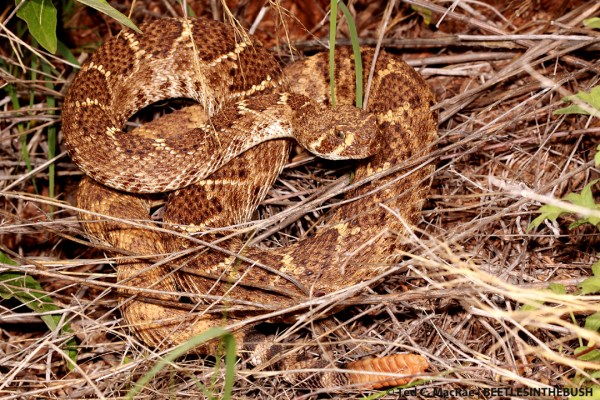
Western diamondback rattlesnake (Crotalus atrox) | Gloss Mountain State Park, Major Co., Oklahoma

Western diamondback rattlesnake (Crotalus atrox) | Gloss Mountain State Park, Major Co., Oklahoma

Actually, I had been in the area several times already on previous visits looking for these snakes, but for some reason—perhaps the juvenile from across the road still fresh in my mind, I just had the feeling that this time I was going to find one. One always enters cautiously at first, watching their every step as they wade through the waist high grasses while straining to see any sign of the diamondback pattern between the clumps of vegetation or on the steeply eroding red clay slopes above. Caution eventually subsides, however, and after about 15 minutes my attentions started drifting back to looking for beetles. I had walked along most of the southern perimeter of the area when I crested a small rise and my heart was jolted by the sudden and distinctive “buzz” of a full-sized rattlesnake. I couldn’t see it, but the sound was coming from about 10 yards in front of me, so I cautiously crept forward, moving from side to side bit as I did to help me triangulate the precise location of the sound. Within a few steps I finally saw it—a nice, adult western diamondback rattlesnake! It was largely hidden from view within a heavy jumble of vegetation—no hope for useful photographs, so I extended the telescoping handle of my insect net to its full 7-ft length and used it to carefully move away as much of the screening vegetation as I could. The snake rattled vigorously as I did this, its head always following the red grip at the end of the handle but never striking. That 7-ft distance was about as close I could comfortably get, and my 100-mm macro lens is the longest lens I have in the kit, so the full snake shot shown above and some similar shots were all I could really get. How I would have loved to have had a 200-mm or 300-mm lens to get some really close head shots!

I’ll admit that I tip-toed out of the area much more cautiously than I entered, but I did so with my held-held high and chest puffed out a bit knowing that, once again, persistence had paid off.

Copyright © Ted C. MacRae 2013
Tips for photographing shiny beetles on yellow flowers

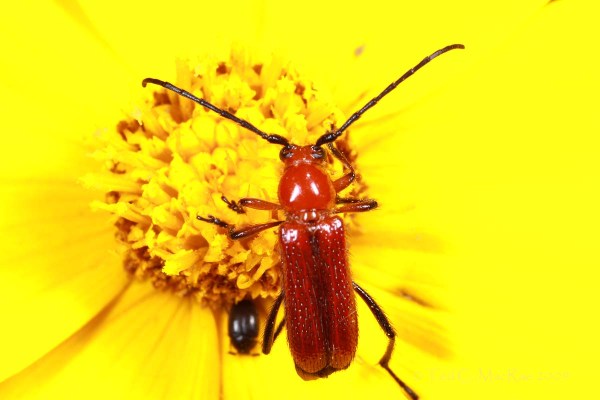
I really hate starting off this post with the following photo—typically it is the first photo in a post that readers see in syndicated feeds; however, I use it in this post to make a point. This photo was taken back in May 2009 and is among the very first photographs that I took after getting my current dSLR camera setup. I was certainly happy enough with it at the time; however, in the following years I have learned a lot about lighting and composition. Such is the curse of any photographer—the further back one goes in their portfolio, the less satisfied they are with the photos taken at a particular point in time. What was then a pretty photo of a shiny, red longhorned beetle on a bright, yellow flower is now teaching material for what not to do when taking photos of shiny beetles on yellow flowers.

One of my first photos of Batyle suturalis, taken in May 2009 | Franklin Co., Missouri

Batyle suturalis on Coreopsis lanceolata | Shaw Nature Preserve, Franklin Co., Missouri

Compare the above with the following much more recently taken photos of the same beetle species from this past June. The beetle is the same, and while the flowers are a different species they are the same intense shade of yellow, but in nearly all respects the photos are far superior to the first. What are the problems with the first photo? First, the smooth and shiny surface of the beetle combined with poor diffusion of the flash has resulted in intense specular highlights on the body of the beetle. This is especially evident in the “twin highlights” on the pronotum of the beetle that is the signature mark of the Canon MT-24EX twin flash unit when used without some type of diffuser. Secondly, the darker color of the beetle requires more flash for adequate illumination than does the much brighter yellow flower—setting the flash power high enough to fully expose the beetle resulted in overexposure of the yellow flower. One cannot even see where one petal ends and another begins. Thirdly, the top-down perspective is, well… boring, no doubt because this is far and away the most commonly used composition in photographs of insects on flowers. Lastly, in my zeal to get as close as possible to the subject, I’ve not only eliminated elements from the background that could add interest in texture to the composition but also clipped the hind tarsus of the beetle itself.

Batyle suturalis on paperflower (Psilostrophe villosa) | Alabaster Caverns State Park, Woodward Co., Oklahoma

Batyle suturalis on Psilostrophe villosa | Alabaster Caverns State Park, Woodward Co., Oklahoma

The first problem is easily addressed by using a good diffuser. It is remarkable that both Canon and Nikon have produced such incredibly effective lenses and flash units for macrophotography, yet completely ignored the demand for diffusers designed to work with them. As a result, most insect macrophotographers have resorted to various do-it-yourself (DIY) designs to fill the void. The diversity in DIY diffuser designs is as large as the diversity of insect macrophotographers, and each person has their own favorite. I have tried many different versions myself, and my current design (admittedly a fusion of ideas stolen from and Alex Wild and Piotr Naskrecki) has produced quite good results. This is evidenced in the more recent photos shown here by the very soft highlights that are spread out evenly over the body of the beetle and not concentrated into intense spots or bands.

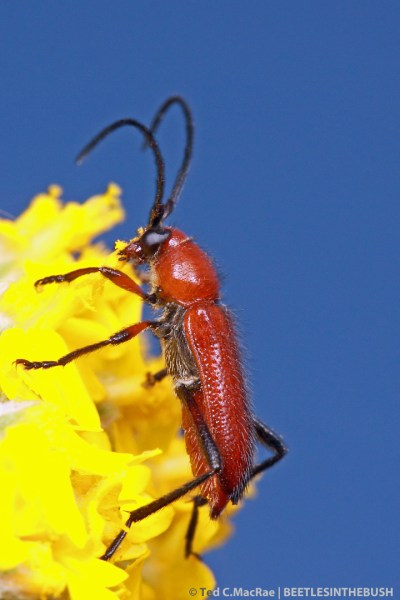
Batyle suturalis

Portrait orientation is under-utilized in ”bug on a flower” shots.

The second problem—that of overexposure of the flower to properly expose the beetle—is handled in a simple yet somewhat counter-intuitive manner. I find yellow flowers to be especially prone to overexposure. However, it is much easier to “fix” underexposed than overexposed areas of a photo in post-processing. When a photo is underexposed, all of the data regarding color and hue is still there. It is a simple matter to increase the brightness in the image processing software to restore underexposed areas to their natural brightness. Overexposure, however, is much more difficult to correct, as once the exposure is “blown” there is no data remaining regarding the true color and hue. The only way to fix blown highlights is with the laborious process of cloning over them with nearby areas of the photo that are not blown. Perhaps some can do this quickly and with good results, but I am not one of those people. I like to selectively increase the brightness of underexposed areas using “Lighten Shadows” tool in Photoshop. Be careful, as a light hand is all it takes—overly heavy-handed adjustments look  unnatural.

Batyle suturalis

Side profiles are more interesting than ”top down” shots and allow high color-contrast backgrounds.

Finally, think about more interesting compositions for your “bug on a flower” photos than the far too commonly used top-down perspective. Getting low relative to the beetle and looking at it from the side or front not only provides a less common view of the subject but also allows for far more creativity in the overall composition. My personal preference for insects on flowers is a blue sky background, which can add a lot of value contrast to photos compared to those in which the entire background consists only of the flower on which the insect is sitting. Use of blue sky background can also further help avoid overexposure of the yellow flower, as the slightly higher ISO and slightly lower aperture settings and shutter speeds used in that technique serve to increase the amount of ambient light contributing to the photo, thereby reducing the amount of illumination needed by the flash. Side views of the insect also facilitate use of portrait orientation—an important consideration if you are interested in producing photos for potential use on journal or magazine covers (nearly always printed in portrait). Also, as you compose your photo, try backing off a bit rather than trying to focus in on the subject as tightly as possible. Backed off views not only avoid the more straightforward problem of clipping parts of the insect but can also result in much more aesthetically pleasing photographs by allowing the incorporation of other elements in the composition for balance, scale, and even a sense of motion or dynamics (as exemplified by the partially buried grass blades in this photo of the Eastern Big Sand Tiger Beetle). Photos can always be cropped in post-processing, and while excessive cropping as a way to artificially increase magnification is to be avoided, there is nothing wrong at all with slight cropping to improve composition.

Copyright © Ted C. MacRae 2013