Just published: Cicindela 44(1) March 2012

Issue 44(1) of the journal Cicindela is now hitting mailboxes. This one-paper issue features an article by Chandima D. Dangalle and Nirmalie Pallewatta (University of Colombo, Sri Lanka) and Alfred P. Vogler (The Natural History Museum, London) reporting the results of a survey of tiger beetles of Sri Lanka and analysis of their habitat specificity. The authors sampled 94 locations on the island representing six habitat types: coastal and beach habitat, river and stream banks, reservoir systems, urban man-made sites, agri-ecosystems and marshy areas, finding ten species in the genera Cylindera, Calomera, Hypaetha, Lophyra and Myriochile at 37 locations representing all habitat types except the last two. The study further revealed that the species of tiger beetles were restricted to different habitat types, with most displaying a high degree of habitat specificity. Statistical analysis revealed significant differences between two or more species in four factors: solar radiation (i.e., sun or shade), soil salinity, soil moisture and wind speed. This suggests that these are the key factors involved in habitat selectivity in Sri Lankan tiger beetle species. Other factors such as temperature, relative humidity, soil type and soil color did not differ significantly between habitats for the different species, suggesting that these criteria are essential for tiger beetle survival in any habitat type.

You may also notice that my photo of Cicindela arenicola, taken last fall in Idaho Falls, graces the cover of this latest issue. Contact Managing Editor Ron Huber to begin your subscription—membership is a very nominal $10 per year in the U.S., a little more elsewhere to cover additional postage.

REFERENCE:

Dangalle, C. D., N. Pallewatta & A. P. Vogler. 2012.  Habitat specificity of tiger beetle species (Coleoptera, Cicindelidae) of Sri Lanka. Cicindela 44(1):1–32.

Dicerca pugionata – safe and sound!

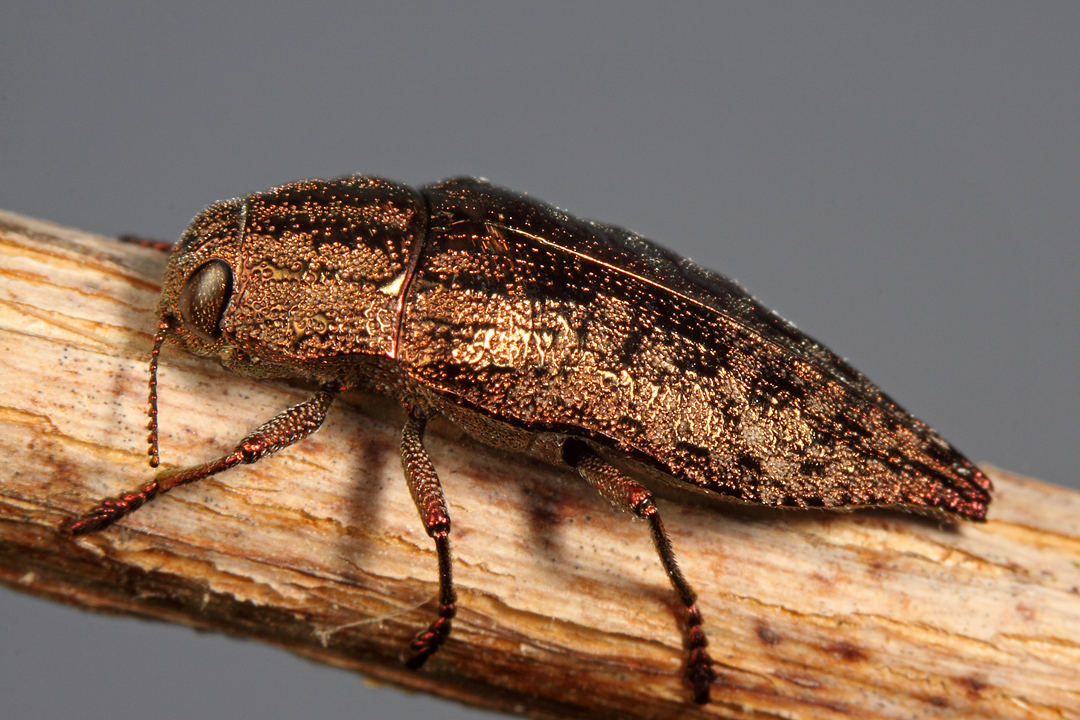
Dicerca pugionata on Physocarpus opulifolius (ninebark) | Jefferson Co., Missouri

One of my favorite beetle species in Missouri is Dicerca pugionata—a strikingly beautiful jewel beetle (family Buprestidae) found sporadically across the eastern U.S. Unlike most species in the genus, which breed in dead wood of various species of trees, D. pugionata larvae mine living stems of certain woody shrubs—namely alder (Alnus spp.), witch-hazel (Hamamelis virginiana) and ninebark (Physocarpus opulifolius) (Nelson 1975). When I first began studying Missouri Buprestidae (way back in 1982), the species had just been reported from the state based on a single specimen (Nelson et al. 1982). I happened to stumble upon these beetles at what became my favorite collecting spot during the 1980s—Victoria Glades Natural Area, just south of St. Louis in Jefferson Co. For several years while I was visiting Victoria Glades, I found these beetles regularly during spring and fall on stems and branches of living ninebark plants growing within the ravines and along the toeslopes at the lower edges of the glades.

After finding the beetles at Victoria Glades (and nearby Valley View Glades Natural Area), I made it a habit to examine ninebark wherever I found it growing in Missouri. Ninebark is actually rather common in the state along the rocky streams and rivers that dissect the Ozark Highlands. Interestingly, I almost never encountered this beetle on ninebark elsewhere in the state. I’m sure it occurs in other areas, but probably at too low a level to be easily detected. I surmised that the populations at Victoria and Valley View Glades were unusually high due to the non-optimal conditions for its host plant. The ravines and toeslopes where the plants grow are drier than typical for ninebark, and unlike the lush, robust plants found in moister streamside habitats, the plants at these glades are small, scraggly and often exhibit a certain amount of dieback. It seemed likely to me that the plants growing in the glades were less capable of fending off attacks by these insects, thus resulting in relatively higher numbers of beetles at these glades.

After the publication of my “Buprestidae of Missouri” (MacRae 1991), it would be many years before I actually returned to Victoria Glades. When I did return, I was pleased to see that management practices (e.g. prescribed burning, cedar removal, etc.) intended to halt the encroachment of woody vegetation and preserve the glade’s pre-settlement character had been implemented in the area. I was a little bothered, however, by the seeming paucity of insects compared to the years prior to management. I visited the glades again several times afterwards, and not only did insect populations in general seem to be depressed, but I never succeeded in finding D. pugionata adults on the ninebark plants. I began to worry that the prescribed burns, while clearly beneficial to the glade flora, might have had a negative impact on the glade’s insect populations.

I’m happy to report that, at last, I have found the beetles again. I returned to the glades in early May this year and, for the first time since 1987 I found the adults of this species—five in all (a typical number for the many dozens of plants checked) and right in the same areas where I had so consistently found them 25–30 years earlier. This does much to allay my concerns about the ability of these beetles to persist in the face of prescribed burning (though I remain convinced that this management technique should be used more judiciously in our state’s natural areas than it has in recent years), and I’m happy to have these new photographs of the species, which are a decided improvement over the old scanned slides taken nearly 30 years ago!

REFERENCES:

MacRae, T. C. 1991. The Buprestidae (Coleoptera) of Missouri. Insecta Mundi 5(2):101–126.

Nelson, G. H. 1975. A revision of the genus Dicerca in North America (Coleoptera: Buprestidae). Entomologische Arbeiten aus dem Museum G. Frey 26:87–180.

Nelson, G. H., D. S. Verity & R. L. Westcott. 1982. Additional notes on the biology and distribution of Buprestidae (Coleoptera) of North America. The Coleopterists Bulletin 35(2) [1981]:129–151.

Copyright © Ted C. MacRae 2012

Cosmetid harvestman with parasitic/phoretic mites in Argentina

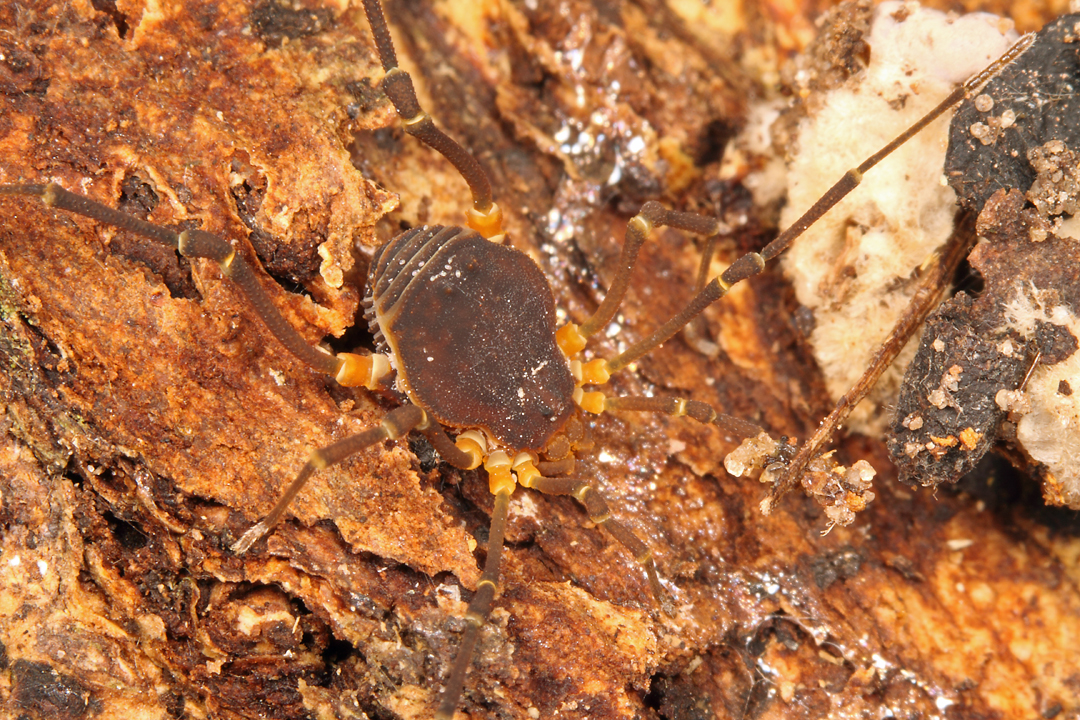
Metalibitia sp. poss. paraguayensis | Corrientes Province, Argentina

While searching logpiles last month in a relatively intact tract “Selva Paranaense” near Paso de la Patria (Corrientes Prov., Argentina), the most interesting find for me was , a bizarre longhorned beetle that is either amazingly cryptic or a curious mimic (I couldn’t decide). There wasn’t much else to be seen in the logpiles—it had been a very dry summer in northern Argentina, but I did find this interesting species of harvestman (class Arachnida, order Opiliones) huddled together in one of the punkier piles of wood.

Knowing little about harvestman taxonomy (but knowing of several specialists who do), I sent the photos around for expert opinion. Everyone responded with the same opinion—family Cosmetidae, apparently distinguished by its spoon-shaped pedipalps. Marshal Hedin compared them to this similar-looking species photographed in Bolivia, Christopher Taylor (Catalogue of Organisms) thought they might be a species of Metalibitia and Ricardo Pinto-da-Rocha suggested M. paraguayensis as having been recorded from the province of Corrientes (although a specimen would need to be examined to confirm the identification). My thanks to each of these gentlemen for weighing in on a possible ID.

Argentina represents the southernmost extent of this strictly New World family of harvestmen, while to the north the family extends up to the southern U.S. (genus Vonones). In between, the family is diverse and comprises up to one-third to one-half of the harvestman fauna (Kury & Pinto-da-Rocha 2007). Many species in the family are ornately marked, giving rise to the family name which is derived from the Greek kosmetós (= ornate)—check out this gallery of photos at Flickr to see some truly spectacular examples.

While I was photographing these individuals, and even when I first began processing the photos, I thought that they were quite dirty and debated whether to clean them in PhotoShop. Then I realized that the numerous white spots were not debris, but mites! Whether these represent a parasitic or phoretic relationship is not clear to me, however, and none of the gentlemen I sent the photos to offered any comment about them. Erythraeid and thrombidiid mites are well documented as harvestman ectoparasites during their larval stage, with recorded hosts including Neotropical species of Cosmetidae (Townsend et al. 2008). The tiny, white mites on these individuals, however, do not resemble the large, red erythraeid mites (probably genus Leptus) that I have seen parasitizing our North American harvestman species, and their numbers on multiple individuals is, to me, more indicative of a phoretic relationship. If you want to become thoroughly confused by the tremendous diversity of mites the parasitize harvestmen, see the comprehensive review by Cokendolpher (1993).

REFERENCES:

Cokendolpher, J. C. 1993. Pathogens and parasites of Opiliones (Arthropoda: Arachnida). The Journal of Arachnology 21:120–146.

Townsend, V. R., D. N. Proud, M. K. Moore, J. A. Tibbetts, J. A. Burns, R. K. Hunter, S. R Lazarowitz & B. E. Felgenhauer. 2008. Parasitic and phoretic mites associated with Neotropical harvestmen from Trinidad, West Indies. Annals of the Entomological Society of America 101(6):1026–1032.

Kury, A. B. & R. Pinto-da-Rocha. 2007. Cosmetidae Koch, 1839. Pp 182–185. In: R. Pinto-da-Rocha, G. Machado & G. Giribet (Eds.). Harvestmen: The Biology of the Opiliones. Harvard University Press, Cambridge and London, x + 597 pp.

Copyright © Ted C. MacRae 2012

Holy conglobulation, Batman!

It’s a pill bug… no, it’s a roach. It’s a pill roach!

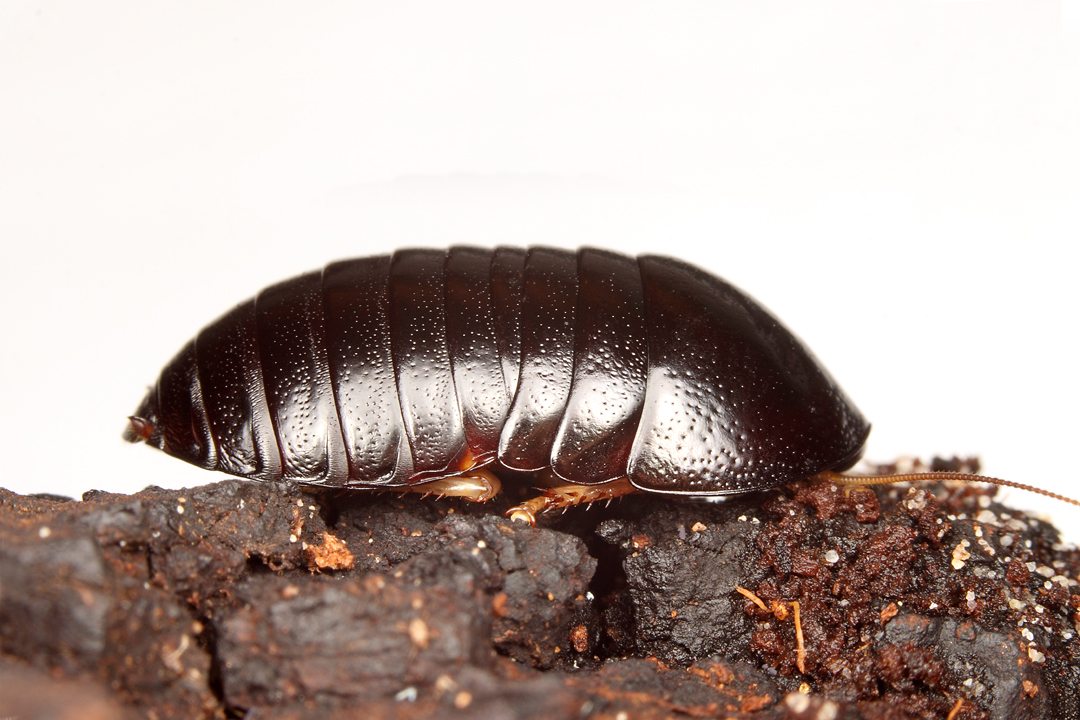
Earlier this month I made a quick trip out to California to see my good friend Chuck Bellamy receive his Honorary Membership in The Coleopterist Society. While I was there, I got a chance to spend some time with Chuck’s labmate Martin Hauser. Although Martin is a specialist of flies, he shares my fascination with unusual arthropods of all types and made available for me to photograph this adult female Perisphaerus sp. (order Blattodea, family Blaberidae), or “pill roach”. Seventeen species from southeast Asia and Australia have been described in this genus (Beccaloni 2007), but which (if any) this individual represents remains unknown.

In contrast to ”normal”-looking males, adult females exhibit a ”wingless, half-ellipsoid” morphology.

The most obvious characteristic of species in this genus is the ability of females to roll up into a ball; i.e., conglobulate.¹ Clearly this is a defensive morphotype, but curiously only females possess this ability—males are winged and exhibit the more flattened morphology typical of many cockroaches. Martin and I were unable to get this particular individual to completely enroll (we must not have been scary enough), but when it does the posterior abdomen fits tightly against the pronotal margin, covering all sensory organs and leaving no soft tissues exposed, gaps to enter or external projections to grab (Bell et al. 2007).

¹ I must thank Brady Richards, who, in his answer to ID Challenge #18, used this word to coin the phrase that would eventually become the title of this post.

Adult females apparently exhibit not only maternal protection but also nutrition.

But why should only females and not males exhibit this defensive morphotype? One would think that both males and females are equally threatened by predators. Apparently this is related to their unusual form of uniparental (maternal) care (Choe & Crespi 1997).  Early-instar nymphs in this genus remain closely associated with their mother and cling to her underside until they reach the third instar. These early-instar nymphs are not only blind, but they also exhibit a narrowed head with specially modified mouthparts that fit precisely into two pairs of orifices located on the female underside between the middle and hind pairs of legs. Whether the nymphs are feeding on glandular secretions or female hemolymph remains unknown, but regardless only a limited number of nymphs can be handled by a female at one time. This represents an unusual level of energetic investment in offspring among insects—especially among cockroaches, and thus the female has an interest in protecting that investment. Sealing them up inside an impenetrable ball is certainly one way to protect the nymphs.
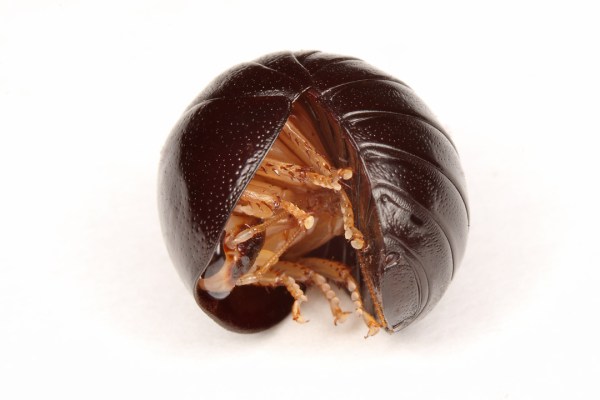
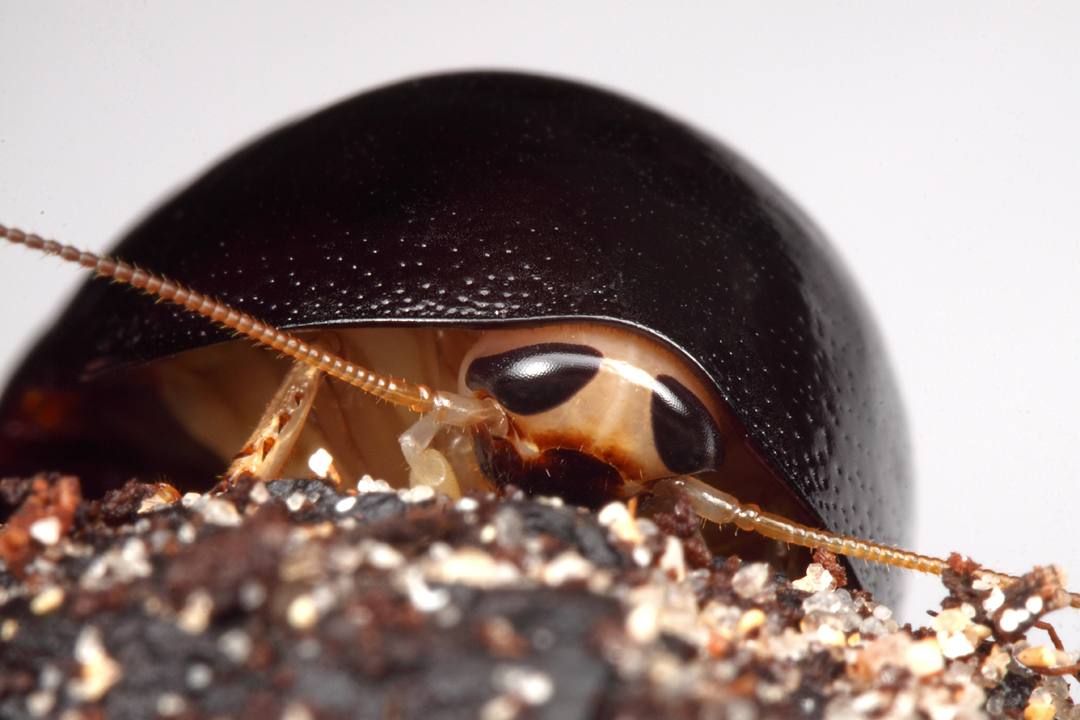
Despite first impressions, six legs and a very ”cockroach-ish” head belie its true identity.

Conglobulation has actually arisen several times amongst arthropods. Obviously pill bugs (a.k.a. roly-poly bugs) are the first group that comes to mind in this regard, but Eisner & Eisner (2002) illustrate nearly identical morphology in two oniscomorph millipedes as well as isopods and Perispharus and also describe strikingly similar behavior by the larva of Leucochrysa pavida  (family Chrysopidae).

Many thanks to those of you who participated in ID Challenge #18. As of now, the comments for that challenge are closed, and I will reveal the comments and award points shortly. My sincere thanks again to Martin Hauser for allowing me to photograph this most interesting insect!

Edit 5/28/12, 12:55 a.m.: For the first time ever, we have a 3-way tie for a BitB Challenge win—Sam Heads, Brady Richards, and Mr. Phidippus all earned 12 points to share the top spot in this challenge. Since these three gentlemen were already the three leaders in BitB Challenge Session #6, there is no change to the leaderboard in the overall standings (44, 42 and 37 points, respectively). However, Dennis Haines (34 points) is hanging close, and Tim Eisele (25 points) still has a shot at the podium. Any number of others following closely behind could also find themselves on the podium if any of the three leaders should falter down the stretch.

REFERENCES:

 Beccaloni, G. W. 2007. Blattodea Species File Online. Version 1.0/4.1. World Wide Web electronic publication. <http://Blattodea.SpeciesFile.org&gt; [accessed 27 May 2012].

Bell, W. J., L. M. Roth & C. A. Nalepa. 2007. Cockroaches: Ecology, Behavior, and Natural History. The Johns Hopkins University Press, Baltimore, Maryland, 230 pp.

Choe, J. C. & B. J. Crespi. 1997. The Evolution of Social Behavior in Insects and Arachnids. Cambridge University Press, Cambridge, U.K., 541 pp.

Eisner, T. & M. Eisner. 2002. Coiling into a sphere: defensive behavior of a trash-carrying chrysopid larva Leucochrysa (Nodita) pavida (Neuroptera: Chrysopidae). Entomological News 113:6–10.

Copyright © Ted C. MacRae 2012

ID Challenge #18

It’s time for another identification challenge. Currently we are in Challenge Session #6, with two challenges down (SSC#12 and IDC#17) and probably four more to go (including this one). Can you identify the critter in this photo? I’ll give 2 pts each for class, order, family and genus.

I think it would be good to restate the ground rules that I use in these challenges, as they have evolved somewhat since I first began these challenges and don’t seem to be easily accessible in their entirety to those who have begun participating more recently. They are:

  1. Points will be awarded for correctly named taxa—usually 2 pts each for order, family, genus and species.
  2. Points will only be awarded for the taxa requested.
  3. Taxa must be correctly spelled to receive full credit (this includes italicization for genus and species—and yes, italicization is easy in HTML, just look it up). Misspelled or non-italicized names may receive partial credit.
  4. Taxa must be explicitly stated to receive full credit. For example, if I request order, family, genus and species for Buprestis rufipes, but only genus and species are given in the answer, then “Coleoptera” and “Buprestidae” are “implied” taxa. I can’t give full credit for implied taxa but may give partial credit.
  5. In the case of outdated nomenclature, I won’t judge too harshly if the taxon is obscure or there is still disagreement about rank. However, obvious or easily referenced obsolescences (e.g. “Homoptera”) will get dinged.
  6. Bonus points may be given (at my discretion) for providing additional relevant information (e.g., diagnostic characters, biological/ecological uniquities, clever jokes, etc.). I’m more inclined to give bonus points for unusual features of biology/morphology/ecology, etc. that are not readily found in easily-found, Wikipedia-type summaries of the subject.
  7. Be sure to examine each post carefully in its entirety for the possible presence of clues 🙂
  8. Comments will be moderated during the 1- to 2-day open challenge period to allow all a chance to participate (i.e., you don’t have to be first to win!).
  9. In the case of multiple correct answers, “early-bird” tie-breaker points will be awarded to those that answered correctly first. The more people you beat to the punch with the correct answer, the more early-bird points you get.
  10. Submitted answers will be revealed at the end of the challenge period along with the number of points earned. This is generally followed closely by a new post discussing the subject in greater detail. Also, because I’m such a big Survivor and Jeff Probst fan, I’ll also say that “once the points are read the decision is final!”
  11. Winners of individual challenges get nothing more than my accolades; however, session winners get real loot! Thus, it pays to play consistently and try even when you don’t think you know the answer. Top three points earners at the end of each session (usually 5 to 6 individual challenges) get to choose from selection of gifts that will be communicated to the winners by email.

Copyright © Ted C. MacRae 2012

Science Outreach in Action

This evening I had the distinct pleasure of presenting to the Missouri Master Naturalist™ program, a community-based natural resource education and volunteer service program for adults whose mission is to “engage Missourians in the stewardship of our state’s natural resources through science-based education and volunteer community service.”  The purpose of this organization is to develop a corps of well-informed volunteers to provide education, outreach and service to benefit natural resources and natural areas management within the community. Master Naturalists receive training and contribute volunteer service to become a certified Master Naturalist™.

There are several chapters serving different areas of the state—my presentation was made to the Miramiguoa Chapter serving Franklin County in east-central Missouri. My talk was titled, “Tiger Beetles of Missouri,” and, as an “expert” in my chosen field, attendees received advanced training credit in addition to the basic training they receive in more general aspects of Missouri ecosystems. It is tempting to think that attendees were there just to get the credit, but what I found was one of the most engaged and interested audiences to which I’ve had the pleasure to speak in quite a long time. Naturally, it is not difficult for me to show a lot of passion when I get to present on something as dear to my heart as tiger beetles, but as a presenter I feed off audience enthusiasm as well. As a result, the combination of subject and audience engagement made for a fun discussion, and I only hope the audience enjoyed the 90 minute session as much as I did.

I write about this because I see Science Outreach by practicing scientists as critical to advancing appreciation of and participation in science by the general public—not just because I think they will have fun, but because a science-friendly community tends to make community and policy decisions favorable to and based on science. You might call it my brand of politics! I’ve been heavily involved in science outreach for many years now, talking to everyone from pre-schoolers to secondary school science classes to natural history organizations. The specifics of my message are tailored to the audience, but the underlying principle is the same—to help the audience gain appreciation of entomology in particular and science in general. I think I will chalk up tonight’s presentation as another win!

For those interested, here is a link to a PDF version of the presentation, which provides the best ‘snapshot’ look at the tiger beetle fauna of Missouri available so far:

Miramiguoa – May 2012 – TB of Missouri

Copyright © Ted C. MacRae 2012

Dr. Charles L. “Chuck” Bellamy – 12th Honorary Member of The Coleopterists Society

Dr. Charles L. ”Chuck” Bellamy

On Thursday of this past week, it was my distinct pleasure and honor to see my colleague and very good friend, Dr. Charles L. “Chuck” Bellamy named an Honorary Member of The Coleopterists Society. Honorary Membership is the highest level of distinction given by the Society in recognition of devotion to the Society and dedication to the discipline of coleopterology. Chuck was nominated for this honor by colleagues Andrew Cline and Robert Anderson, and the nomination was approved by President Michael Caterino and the rest of the Society Executive Board by unanimous vote. Chuck is only the 12th Honorary Member of the Society and joins such illustrious names as Ross Arnett, Jr., Patricia Vaurie, Henry and Anne Howden, Charles Triplehorn, Brett Ratcliffe, etc.

Selection criteria for Honorary Membership include sustained, active membership in and service to the Society, advancement of coleopterology nationally and/or internationally, and sustained history of publication in The Coleopterists Bulletin and/or other Society publications. Chuck’s qualifications in these regards are beyond reproach:

  • Nearly 40 years of continuous membership in the Society.
  • Served as President (2003–2004), Councillor (1993–1994), Investment Officer (2010–present), Website Coordinator (2006–2010), Book Review Editor (1993–2002) and Monograph Series Editor (2009–present).
  • Has advised six graduate students from USA, Mexico, South Africa, South Korea, Brazil and India (despite not holding an academic appointment) and also counselled and mentored numerous other coleopterists (including me) on the study of Buprestidae in particular and Coleoptera systematics in general.
  • Published more than 200 papers on Coleoptera—69 in Society publications (a record)—and numerous books, including the landmark 5-volume, 3,200+ page, World Catalogue of Buprestoidea.

Chuck’s contributions, of course, go well beyond this short list. He has had editorial roles with other entomology journals, including Zootaxa, The Pan-Pacific Entomologist (my favorite journal!), and Folia Heyrovskyana, served as a research associate with the National Museum of Natural History, the Florida State Collection of Arthropods, the Natural History Museum of Los Angeles County and the Department of Entomology at the University of California – Davis and ventured onto five continents in search of Buprestoidea—not only collecting the specimens, but describing the new taxa he found as well. Overall, Chuck has described more than 200 new species and over 50 new genera.  Andy Cline and Bob Anderson put it best: “Chuck’s contributions have led to a better understanding of one of the most diverse and speciose groups of beetles in the world.” More importantly, however, Chuck has been universally regarded as an excellent friend and colleague!

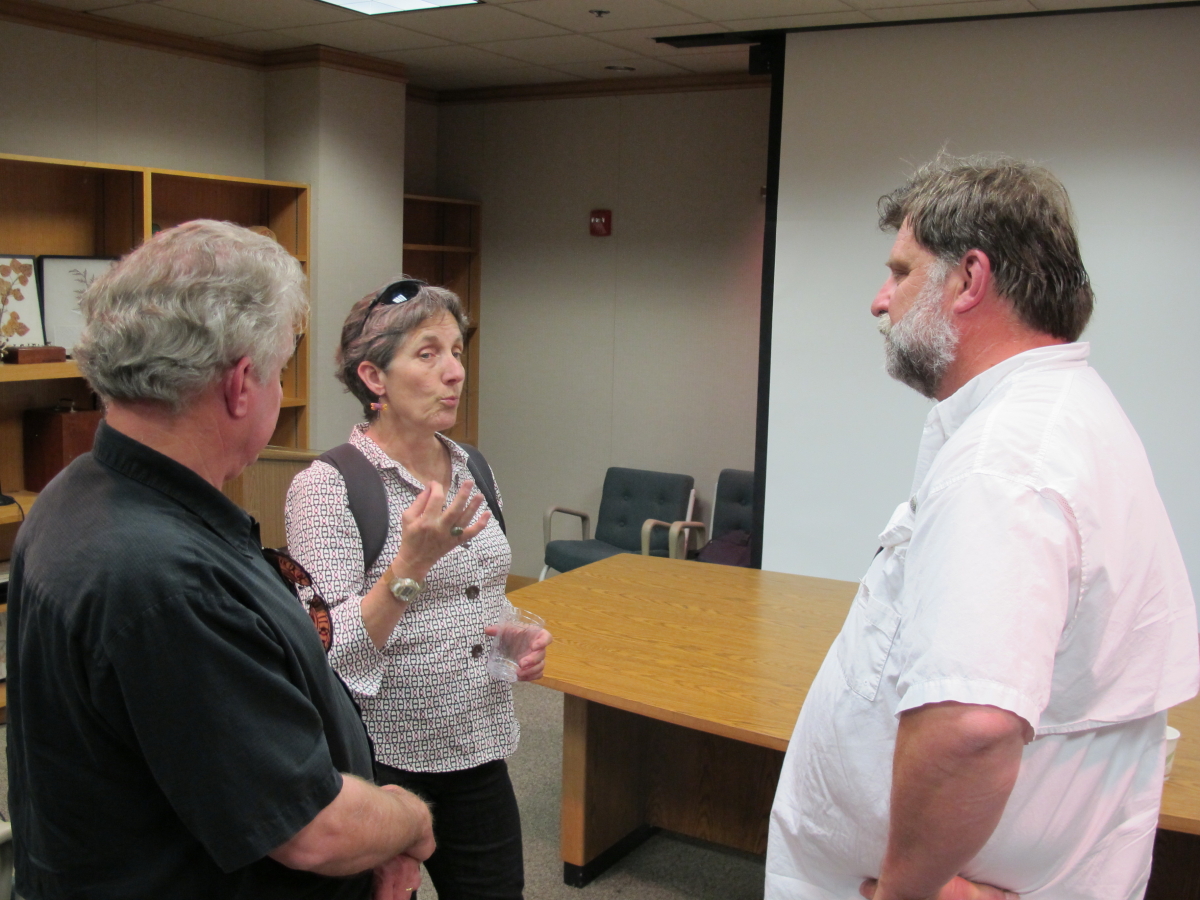
Chuck was presented his Honorary Membership at the California Department of Food & Agriculture’s Plant Pest Diagnostics Center in Sacramento prior to a seminar by Dr. Art Evans, entomologist. About 40 colleagues from California and beyond were on hand to see Chuck receive his award. For many people, the award presentation by Andy Cline would have been a tough act to follow, but Art Evans (author of multiple entomology books and field guides) had no problem entertaining the crowd with photos and reminiscences of his journey in the creation of another field guide, the highly anticipated Beetles of Eastern North America. For me it was a special week of meeting new colleagues, reconnecting with old friends, and seeing the most important mentor in my life as a coleopterist receive the highest award our society can bestow. Congratulations, Chuck!

For those of you who were not able to attend the event, I include here a link to a PDF version of Andy’s presentation (many thanks, Andy!):

Chuck Bellamy—Honorary Member of The Coleopterists Society

Special appreciation also to Martin Hauser, who graciously contributed these photos he took of the event:

Colleagues, friends and family gather for the presentation.

Chuck is announced as the 12th Honorary Member of The Coleopterists Society.

Chuck learns of his award with wife Rose and sister Gail at his side.

Andy Cline presents Chuck his Honorary Membership.

Chuck receives a standing ovation from the audience.

Dr. Art Evans reminisces about earlier days.

Art chats after the seminar with Lynn Kimsey and Rolf Aalbu.

Larry Bezark and Ted MacRae – we must be talking cerambycids!

Art Evans, Chris Borkent, Ted MacRae and Eric Fisher.

Copyright © Ted C. MacRae 2012

Milestone: Half a million page hits for BitB!

Just a quick post to thank BitB readers past and present—today BitB surpassed one-half million page hits! BitB may be a labor of love on my part, but its readers are who have made it fun and kept me motivated. To all of you—thanks!

Copyright © Ted C. MacRae 2012