A black background is better… sometimes

Eriophora ravilla (a tropical orb weaver) | Pinellas Co., Florida

If there is one subject that causes more disagreement among macrophotographers, it is the pitch black background. Granted, black backgrounds are common—almost ubiquitous in macrophotography, since they are easily created by using full flash illumination and ensuring that nothing lies behind the subject close enough to reflect the light from the flash. Detractors, however, claim that it gives subjects an ‘unnatural’ look, as they are rarely seen this way in nature. This may be true, but I still believe that for some subjects the black background simply cannot be beat for its aesthetics, even if the subject is not normally seen in this manner. Take, for example, the Great Plains ladies’-tresses orchid—nothing but a pitch black background could better showcase the delicate, white blossom and its almost crystalline lower lip!

That said, however, there are some subjects for which a pitch black background actually can be considered a ‘normal’ background. This tropical orb weaver spider (Eriophora ravilla) is one example. Unlike many other members of the family Araneidae (orb weavers), species in this genus are strictly nocturnal and not seen hanging on a web during daylight hours. Hiding in a curled leaf during the day, they emerge at night and build a large web (up to 1 meter wide), only to consume it by morning and return to their hiding place until the next evening. My nephew Jack and daughter Madison and I first saw this spider during our nighttime foray into the intertidal mangrove marsh behind my sister-in-law’s condominium in Seminole, Florida last month while discovering rare, endemic beetles and their larvae. Knowing that it would likely build its web in the same place on subsequent evenings, I went out a few nights later with my camera and took a few shots.

Some claim that black backgrounds are undesirable for even nocturnal subjects; that there is nothing ‘natural’ about an artificial, narrow beam of light illuminating a single subject at night since no animal other than a person with a flashlight would see something like this. This contention seems a little strained, as one could take such a stance on illumination of any kind. Technically speaking even colors don’t actually exist, so the rendering of subject images on camera film/sensor, whether by natural or artificial illumination,  is itself biased towards human sensibilities. Regardless, the sight of an eerily glowing spider hanging in the blackness strikes a familiar chord with anyone who has wandered the bush by night. A black background not only recreates that human experience, but also emphasizes the subject’s (in this case strictly) nocturnal nature with stark elegance.

At first I took this spider to represent the very common barn spider, Neosona crucifera—widespread across North America. However, after noting the dark femora and yellow “shoulders” of the abdomen I began to rethink that ID. Fortunately, I took one photo of the ventral side (not shown) that shows well the color pattern diagnostic for the circum-Caribbean species E. ravilla.

Copyright © Ted C. MacRae

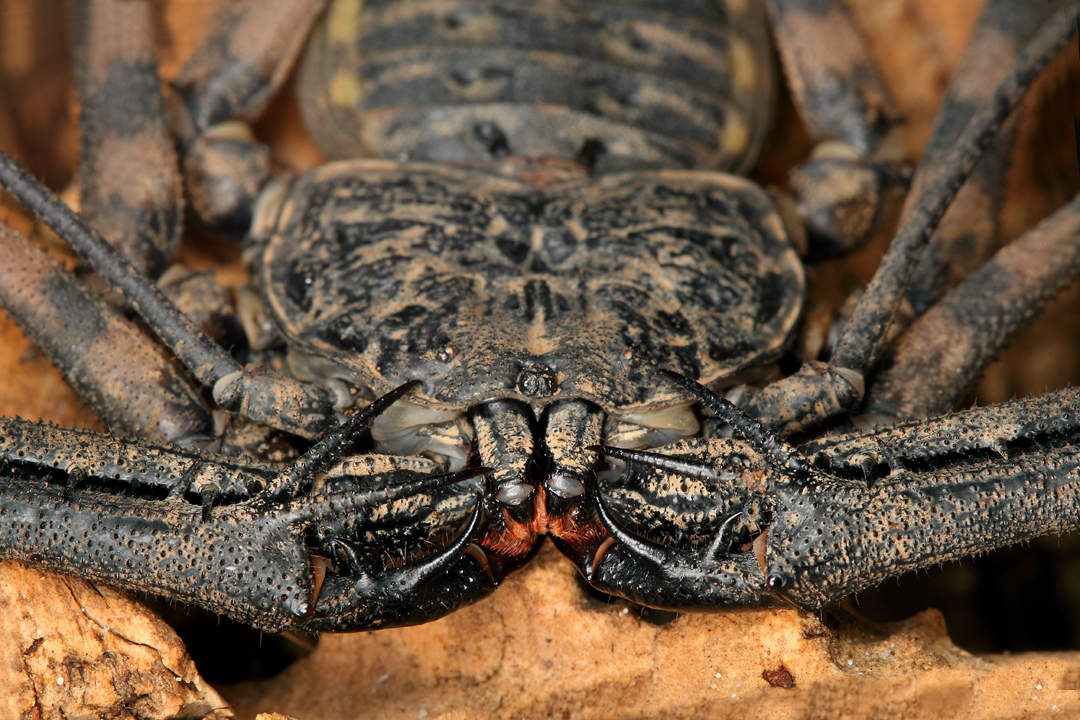
Damon diadema—Tanzanian giant tailless whip scorpion

Damon diadema, Tanzanian giant tailless whip scorpion (adult female)

I’ve reared more than my share of arthropods over the years—from easy ones like Madagascan hissing cockroaches to hard ones like certain tiger beetles (in fact, I’m the only person to have ever seen the larva of Cylindera celeripes, much less reared them from egg to adult) to the innumerable tarantulas, scorpions, millipedes, hickory horned devils, darkling beetles, etc. that fall somewhere in between. And that’s just as a hobby entomologist—nevermind that it has often been my job over the years to rear dozens of species of insects and other “critters” as part of my professional duties. One group of arthropods, however, that I have not yet tried to rear are tailless whip scorpions or whip spiders. Members of the arachnid order Amblypygi, they are not scorpions, not whip scorpions, not even spiders, but rather something else. Like other arachnids they have eight legs and the combined head and thorax (cephalothorax); however, more than any other arachnid, tailless whip scorpions have stumbled upon a most insect-like body plan—the first pair of true legs are modified to long, thin, sensory appendages that mimic in form and function insect antennae, leaving—again, like insects—only three pairs of walking legs, and as predators they have the anteriormost pair of appendages (pedipalps) modified into grasping,  jaw-like structures analogous to the toothy mandibles of predaceous insects.

Adult males have the pedipalps extending past the ”knee” of the first pair of walking legs…

Of course, any resemblance to insects ends right there—tailless whip scorpions look like they belong not only to another class, but another world! Flattened, scuttling sideways at blinding speeds, and with legs all asplay at odd angles, they are as frightful and menacing in appearance as the hairiest, jaws-dripping-with-venom spider imaginable. However, nothing could be further from the truth. Lacking the sting of a scorpion, the venom of a spider, the powerful bite of other “jawed” creatures, or even defensive chemicals of any kind, tailless whip scorpions have only their speed and ability to hide in the slimmest of crevices to prevent them from becoming easy meals for the vertebrate predators with which they share their world.

…while in females the pedipalps are distinctly shorter.

The male and female Damon diadema, or Tanzanian giant tailless whip scorpion, featured in these photos belong to Martin Hauser, a dipterist with the California Department of Food and Agriculture in Sacramento who I had the pleasure to spend some time with last month. Like me, Martin is a fan of invertebrates as pets, but unlike me he has strayed into unusual taxa that I haven’t yet tried—these tailless whip scorpions being perhaps the most impressive of these odd groups. Hailing from east Africa (eastern Tanzania and Kenya north to Ethiopia and Somalia), this species has gained some popularity in recent years among hobbyists due to their adaptability to culture, relatively docile nature, and—of course—their terrifyingly impressive size (body length up to 30 mm according to Prendini et al. 2005, although some hobbyist forums state as much as 2 inches, and with “whip” spans many times that). In this species males and females are immediately distinguishable by the relative length of the pedipalps—highly elongate in males and with the “elbow” extending past the “knee” of the first pair of walking legs, while shorter in females and not reaching the knee. Damon diadema is the largest of the East African Damon variegatus species-group, and while there are other amblypygids in the world that are larger (e.g., Acanthophrynus from Central and South America, with up to 10″ leg-span and nearly 20″ whip-span), none are so tolerant of captive rearing as this species. There seems to be some confusion about identification of Damon spp. among hobbyists, and even Martin wasn’t sure which species his represented; however, according to Prendini et al. (2005) all of the species are easily distinguished morphologically. Damon diadema is one of only two species in the genus with two spines rather than one on the ventral surface of the pedipalp trochanter, the other being D. brachialis from southern African and unknown in captivity. In the closeup face shot of the adult male below, two spines can be seen on the right pedipalp trochanter, just visible between two of the pedipalp apical spines.

Pedipalps modified as raptorial ”claws” make these arachnids formidable predators.

I visited Martin at a good time, for not only did he have these marvelous monsters available for me to photograph, but one of the females had just recently produced a brood of young. All of them had reached 2nd instar by the time of my visit, with one or two already at 3rd instar. It was interesting to note the tendency of the juveniles to aggregate under the adult female, as if they needed/wanted her for protection. While seemingly obvious, this is actually quite interesting because most amblypygids are considered to be solitary and intolerant of conspecifics (Walsh & Rayor 2008). Damon diadema, however, is known to live in prolonged subsocial groups, apparently aided by kin discrimination abilities. I find this fascinating, considering the extraordinarily limited neural capacity of these creatures—there are only so many brain cells available for conducting the business of life without diverting any of them to the ability to recognize unrelated conspecifics, much less their own kin. It is the reason so many spiders and other predaceous invertebrates tend to live solitary lives and have evolved elaborate courtship dances to convince a potential partner that they are, in fact, a mate and not a meal.
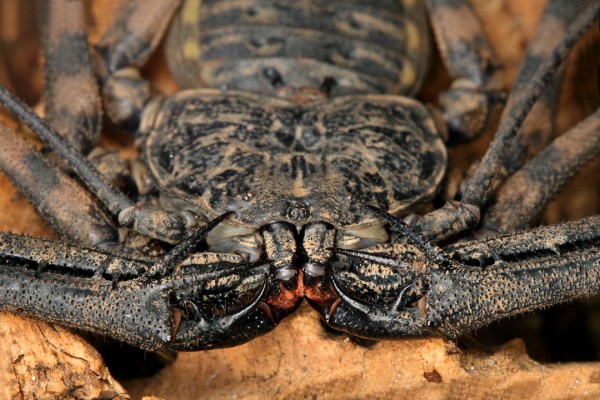
Two ventral spines on the pedipalp trochanter distinguish Damon diadema in east Africa.

I was so impressed by these creatures that after returning home from California I set about finding a source from which I could purchase one of them—or better yet a male/female pair. Sadly, I could not find any sources—my dream of seeing these fantastically fearsome-looking fellows in an aquarium in my office would have to wait. I happened to mention this in passing during correspondence with Martin about other matters, and although it was not intended as a suggestion (or even anticipated that it could be interpreted as such), Martin immediately offered to send me a couple of his juveniles. How could I refuse?! We corresponded a little more about preparations for and timing of the shipment, and on Friday last week the package arrived. Neither of us were completely sure how well the little guys would handle a 3-day transcontinental journey, so it was with a blend of anticipation and trepidation that I opened the package. Imagine my surprise when I found them not only alive and well, but all six of them were alive and well! Well, for now they are all going under the name “Baby Damon,” but I suppose as they grow and (hopefully) develop some distinctiveness I can start giving each of them their own, unique name. It may take awhile—individuals of this species don’t mature sexually until around 12-15 months. Martin was also kind enough to include some small, temporary containers that will provide better confines until they are large enough to move into the large terrarium that I readied for them, and just as Dave has been  doing with his tarantulas, it will be fun to monitor the progress of each individual through their molts. This will continue to provide entertainment even after they reach adulthood, as amblypygids continue to molt and increase in size all of their life. Their lives could also be long ones—I’ve read of people maintaining this species for 10 years or more as adults, so it looks like I am in this for the long haul. A formidable challenge it might seem, but in addition to the invertebrates I mentioned above, I’ve also spent the past several decades being responsible for cats, dogs, rats, salamanders, and—most recently—two hominine juveniles (and females at that). Now that’s a challenge!

This 2nd instar youngster can already handle crickets its own size.

REFERENCES:

Prendini, L., P. Weygoldt & W. C. Wheeler. 2005. Systematics of the Damon variegatus group of African whip spiders (Chelicerata: Amblypygi): Evidence from behaviour, morphology and DNA. Organisms, Diversity & Evolution 5:203–236.

Walsh, R. E. & L. S. Rayor. 2008. Kin discrimination in the amblypygid, Damon diademaThe Journal of Arachnology 36:336–343.

Copyright © Ted C. MacRae 2012

Welcome “Baby Damon”!

”Baby Damon”—one of six 2nd instar Tanzanian giant tailless whip scorpions that now call me Papa!

Just a quick post to formally introduce “Baby Damon,” who arrived last Friday with several siblings courtesy of my friend Martin Hauser in California. Damon represents the species Damon diadema, or the Tanzanian giant tailless whip scorpion. It will take at least a year for Damon to reach maturity, and he may live as long as ten years or more, so it looks like I’m in this for the long haul! When I visited Martin in California a couple of weeks ago I had a chance to photograph Damon’s terrifyingly impressive mother and father as well—look for those pics soon!

Copyright © Ted C. MacRae 2012

Poised for the bounty

Misumenops pallidus on soybean | Santa Fe Province, Argentina

By mid-April I was near the end of my 8-week stay in Argentina. One of the more enjoyable tasks during this time was to go back out and visit some of the soybean fields that I had seen earlier in the season. I enjoy watching the progression of soybeans over time—both in plant phenology and in the guilds of insects present. Defoliating caterpillars like Rachiplusia nu (oruga medidora) and Anticarsia gemmatalis (oruga de las leguminosas) abound during the late vegetative and early to mid-reproductive stages of growth, feeding day and night on the lush, green foliage. As the days grow shorter and cooler, the soybean fields slowly morph from dark green to tawny-yellow, and leaf-feeding guilds give way to seed-feeding stink bugs like Piezodorus guildinii (chinche de las leguminosas) and Nezara viridula (chinche verde).

Ever present amongst the plant-feeding insects are their natural enemies, with spiders being among the more numerous predators. This small (~10 mm length) crab spider (family Thomisidae) was seen in a soybean field in Santa Fe Province with the plants at R6 stage of growth (pods completely filled). I’m fairly certain it represents Misumenops pallidus based on its close resemblance to the spider in this photo. Piezodorus guildinii stink bugs were especially abundant, and just as the crop of newly hatched nymphs was poised to take advantage of the fat, juicy seed pods, this spider seemed poised and ready to take advantage of the fat, juicy nymphs. In fact, M. pallidus is the most abundant crab spider in soybean agroecosystems in the Humid Pampas of Argentina (Liljesthröm et al. 2002), which as a group comprise nearly half of all spiders in those systems (González et al. 2009). Perhaps one reason for this is their generalist prey selection tendencies, feeding on prey species such as R. nu and P. guildenii when they are abundant and switching to non-pest prey species (except the heavily sclerotized weevils and the large and noxious adults of N. viridula) when they are absent (González et al. 2009).

REFERENCES:

González, A., G. Liljesthröm, E. Minervino, D. Castro, S. González & A. Armendano. 2009. Predation by Misumenops pallidus (Araneae: Thomisidae) on insect pests of soybean cultures in Buenos Aires Province, Argentina. The Journal of Arachnology 37:282–286.

Liljesthröm, G., E. Minervino, D. Castro & A. González. 2002. La comunidad de arañas del cultivo de soja en la provincia de Buenos Aires, Argentina. Neotropical Entomology 31:197–209.

Copyright © Ted C. MacRae 2012

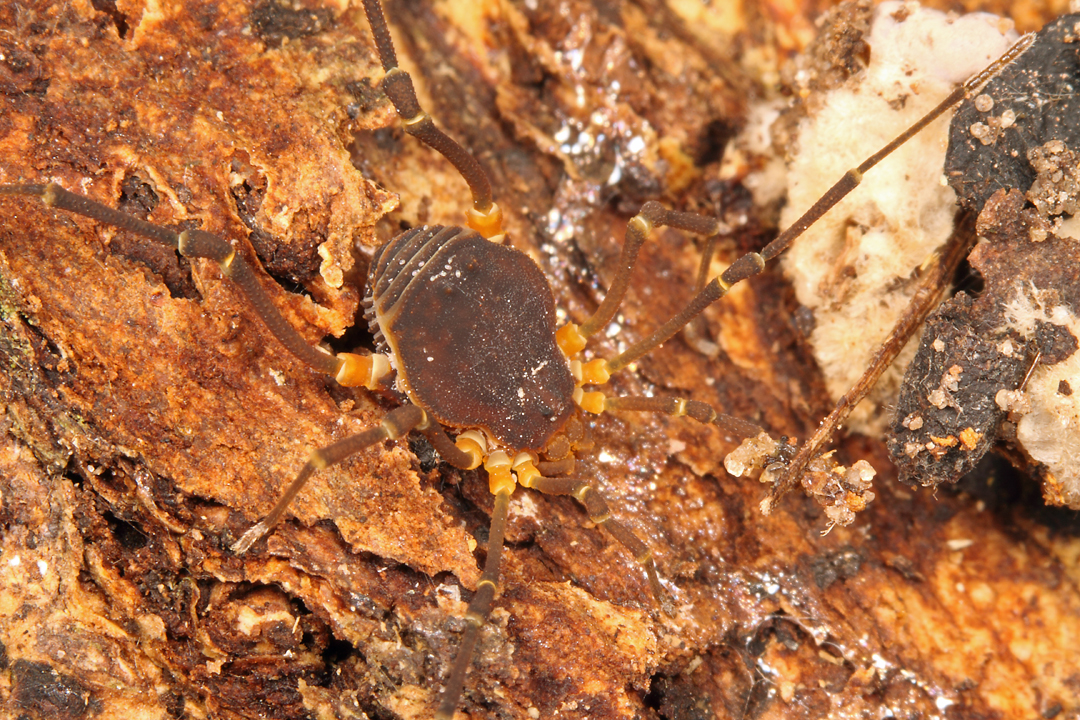
Cosmetid harvestman with parasitic/phoretic mites in Argentina

Metalibitia sp. poss. paraguayensis | Corrientes Province, Argentina

While searching logpiles last month in a relatively intact tract “Selva Paranaense” near Paso de la Patria (Corrientes Prov., Argentina), the most interesting find for me was , a bizarre longhorned beetle that is either amazingly cryptic or a curious mimic (I couldn’t decide). There wasn’t much else to be seen in the logpiles—it had been a very dry summer in northern Argentina, but I did find this interesting species of harvestman (class Arachnida, order Opiliones) huddled together in one of the punkier piles of wood.

Knowing little about harvestman taxonomy (but knowing of several specialists who do), I sent the photos around for expert opinion. Everyone responded with the same opinion—family Cosmetidae, apparently distinguished by its spoon-shaped pedipalps. Marshal Hedin compared them to this similar-looking species photographed in Bolivia, Christopher Taylor (Catalogue of Organisms) thought they might be a species of Metalibitia and Ricardo Pinto-da-Rocha suggested M. paraguayensis as having been recorded from the province of Corrientes (although a specimen would need to be examined to confirm the identification). My thanks to each of these gentlemen for weighing in on a possible ID.

Argentina represents the southernmost extent of this strictly New World family of harvestmen, while to the north the family extends up to the southern U.S. (genus Vonones). In between, the family is diverse and comprises up to one-third to one-half of the harvestman fauna (Kury & Pinto-da-Rocha 2007). Many species in the family are ornately marked, giving rise to the family name which is derived from the Greek kosmetós (= ornate)—check out this gallery of photos at Flickr to see some truly spectacular examples.

While I was photographing these individuals, and even when I first began processing the photos, I thought that they were quite dirty and debated whether to clean them in PhotoShop. Then I realized that the numerous white spots were not debris, but mites! Whether these represent a parasitic or phoretic relationship is not clear to me, however, and none of the gentlemen I sent the photos to offered any comment about them. Erythraeid and thrombidiid mites are well documented as harvestman ectoparasites during their larval stage, with recorded hosts including Neotropical species of Cosmetidae (Townsend et al. 2008). The tiny, white mites on these individuals, however, do not resemble the large, red erythraeid mites (probably genus Leptus) that I have seen parasitizing our North American harvestman species, and their numbers on multiple individuals is, to me, more indicative of a phoretic relationship. If you want to become thoroughly confused by the tremendous diversity of mites the parasitize harvestmen, see the comprehensive review by Cokendolpher (1993).

REFERENCES:

Cokendolpher, J. C. 1993. Pathogens and parasites of Opiliones (Arthropoda: Arachnida). The Journal of Arachnology 21:120–146.

Townsend, V. R., D. N. Proud, M. K. Moore, J. A. Tibbetts, J. A. Burns, R. K. Hunter, S. R Lazarowitz & B. E. Felgenhauer. 2008. Parasitic and phoretic mites associated with Neotropical harvestmen from Trinidad, West Indies. Annals of the Entomological Society of America 101(6):1026–1032.

Kury, A. B. & R. Pinto-da-Rocha. 2007. Cosmetidae Koch, 1839. Pp 182–185. In: R. Pinto-da-Rocha, G. Machado & G. Giribet (Eds.). Harvestmen: The Biology of the Opiliones. Harvard University Press, Cambridge and London, x + 597 pp.

Copyright © Ted C. MacRae 2012

Adult male Hentzia palmarum jumping spider

Hentzia palmarum, adult male | Scott Co., Missouri

A brief break from photos from Argentina. Last week—just a few days after returning from my 8-week absence—I visited two of the sand prairie preserves in Missouri’s southeastern lowlands to try to photograph individuals from the unique, disjunct population the Festive Tiger Beetle (Cicindela scutellaris) found down there. Spring was well underway in the area, but several days of cold and rain seemed to have sent the tigers into their burrows until warmer temperatures returned. I spotted some Hibiscus lasiocarpus plants growing along the edge of a low wet spot adjacent to the prairie, so I started peering into their still unfurling leaves in hopes of finding the jewel beetle Paragrilus tenuis that utilizes the living stems of plants of this genus for larval development, but even they seemed to be awaiting balmier days. As I peered down into the leaves of one plant I notice a flick of movement, and carefully peeling apart the leaves revealed this adult male of the diminutive jumping spider Hentzia palmarum. Something was odd about this spider, and I finally realized the little guy was missing one of his characteristically enlarged and darkened front legs.

Note the elongated chelicerae.

Despite its missing leg, I became determined to photograph this spider. It certainly did not wish to be photographed, and perhaps that is the reason why. I gently snipped the leaf it was sitting on and held it in front of the camera, but every time I turned the leaf towards the camera it cowered and zipped around to the backside. Several times it attempted to flee by jumping off the leaf, but each time I pulled it back up by its thread before it hit the ground and lowered it back down onto the leaf again. Eventually I got a few shots I could live with. Of course, then I found this photo by Thomas Shahan (he describes it as “not a great photo…”) and almost felt embarrassed to show these here. Maybe I’d better stick to photographing tiger beetles!

The enlarged and conspicuously colored front legs of the males almost certainly serve some function in courtship. However, there seems to be no discussion of this in a recent revision of the genus (Richman 1989), and my further search for information about this only turned up one paper by Crocker & Skinner (1984). I really couldn’t understand anything the paper said, so for now I’m left with my presumptions that the legs are used as flags of sort—both to females to signal his availability and willingness as well as other males with more threatening intentions.

REFERENCES:

Crocker, R. L. & R. B. Skinner. 1984. Boolean model of the courtship and agonistic behavior of Hentzia palmarum (Araneae: Salticidae). The Florida Entomologist 67(1):97–106.

Richman, D. B. 1989. A revision of the genus Hentzia (Araneae: Salticidae). Journal of Arachnology 17:285–344.

Best of BitB 2011

Welcome to the 4th Annual BitB Top 10, where I get to pick my 10 (more or less) favorite photographs of the year. As an insect macrophotographer I still feel like a relative newcomer, although with three seasons under my belt fewer and fewer people seem to be buying it anymore. Granted I’ve learned a lot during that time, but the learning curve is still looking rather steep. I don’t mind—that’s the fun part! With that said, I present a baker’s dozen of my favorite photographs featured here during 2011. I hope they reflect the learnings I’ve had the past year and maybe show some progress over previous years (2009, 2008 and 2010).

One more thing—I’m including a special bonus for the first time in this year’s edition. Each of the photos shown below is linked to a 1680×1120 version that may be freely downloaded for use as wallpaper, printing in calendars, or any other use (as long as it’s personal and non-profit). It’s my way of saying thanks for your readership and support.


From  (posted 8 Jan). I’ve done limited photography with prepared rather than live specimens. However, the recreated aggressive-defensive posture of this greater arid-land katydid (Neobarrettia spinosa)—or “red-eyed devil”—was too striking to pass up. A clean background allows every spine and tooth to be seen with terrifying clarity.


From  (posted 6 Feb). I had never seen a cactus fly until I encountered this Nerius sp. I’m especially fond of the bizzarely-shaped head and un-fly-like spines on the front legs.


From  (posted 17 Feb). This photo of a fungus weevil, Phaenithon semigriseus, is one of the first where I nailed the focus right on the eye at such a magnitude of closeup (~3X) and also got the composition I was looking for. I didn’t notice at the time, but the beetle seems to be “smiling.”


From  (posted 28 Mar). One of the field techniques I’ve been practicing this year is actually holding the plant with the subject in one hand, resting the camera on my wrist and controlling it with the other hand, and manipulating the position of the plant to achieve a desired composition. It’s a difficult technique to master, but the results are worth it. The jumping spider, Euophrys sutrix, represents one of my earliest successful attempts with this technique.


From  (posted 30 Mar). This South American tree fruit weevil looks like it is sitting quite calmly on a branch. In reality, it never stopped crawling while I attempted to photograph it. Crawling subjects are not only difficult to focus on but also almost always have a “bum” leg. I achieved this photo by tracking the beetle through the lens and firing shots as soon as the center focus point flashed, playing a numbers game to ensure that I got at least one with all the legs nicely positioned. I’d have been even happier with this photo if I had not clipped the antennal tip.


From  (posted 4 May). Face shots of predatory insects are hard to resist, and in this one of the fiery searcher beetle, Calosoma scrutator, the angle of the subject to the lighting was perfect for showing off every ridge and tooth in its impressive mandibles.


From  (posted 10 May). I’ve taken plenty of lateral profile shots of tiger beetles, but I like this slightly panned out one especially because of the sense of scale and landscape created by the inclusion of the plantlets and the view over the small rise.


From  (posted 18 May). I found these Edessa meditabunda stink bug eggs on the underside of a soybean leaf in Argentina almost ready to hatch. The developing eye spots in each egg gives the photo a “cute” factor rarely seen in such super close-ups.


From  (posted 15 July). Some of my favorite insect photos are not only those that show the bug in all its glory, but also tell a story about its natural history. This nymphal lichen grasshopper, Trimerotropis saxatilis, is almost invisible when sitting on the lichens that cover the sandstone exposures in its preferred glade habitat. 


From  (posted 23 Aug). I know this is the second beetle face shot I’ve included in the final selections, but it was while photographing this rare Florida metallic tiger beetle, Tetracha floridana, in the middle of the night that I discovered the use of extension tubes to improve the quality of flash lighting (decreased lens to subject distance results in greater apparent light size). This is perhaps one of the best illuminated direct flash photographs that I’ve taken, and I also like the symmetry of the composition.


From  (posted 17 Sep). The three-cornered alfalfa hopper (Spissistilus festinus) is a common pest of alfalfa and soybean in the U.S. However, despite its abundance, I’ve never noticed the bizarre zig-zag pattern of the eyes until I took this photo. Even though both the insect and the background are green, there is sufficient value contrast to create a pleasing composition. Bumping up the ISO and a lower FEC setting prevented overblowing the light greens—easy to do with full flash macrophotography.


From  (posted 4 Oct). This longhorned beetle had settled in for the night on its Ericamera nauseosa host plant, allowing me to use higher ISO and lower shutter speed settings with a hand-held camera to achieve this very pleasing blue sky background, while retaining the sharpness of detail of the subject that comes from full-flash illumination. The blue sky background provides a more pleasing contrast with the colors of this particular beetle and flowers than the black background that is more typically seen with full-flash macrophotography.


From  (19 Dec). An uncommon underside view of these purple tree fungus (Trichaptum biforme) caps and use of flash illumination allows the colors to literally glow against the bright green lichens also growing on the tree. Keeping aperture at a moderate setting allows blurring of the caps further back, adding three-dimensionality to the photo and preventing it from looking ‘flat.’


Well, there you have it, and I hope you’ve enjoyed my selections. Please do tell me if you have a favorite among theses (and if there were other photos posted during 2011 that you think deserved making the final selections).

Copyright © Ted C. MacRae 2011

BugShot 2011 – Final Thoughts

As I suspected would be the case,  has proven to be an especially difficult challenge.  As a result, instead of posting the answer tonight I’m going to give folks another day to make their play for points (remember, nobody walks away empty-handed).  In the meantime, I’ve had a chance to ruminate over this past weekend’s BugShot insect photography workshop at Shaw Nature Reserve in Gray Summit, Missouri, and now seems to be an appropriate time to post some final thoughts while they’re still fresh in my mind. Suffice it to say that it was an incredible experience—both technically and socially.  I learned far more than I thought possible (and hope I can remember even a portion of it) and made some great friends in the process.  It’s really not possible for me to summarize here all of the techniques, insights, equipment choices, etc. that were covered, nor do I want to—such a list would be boring to read and not very meaningful without the context to go with it.  What I would like to do is shout out a few people who, beyond the collective, helped make the weekend what it was for me.

Instructors.  The three instructors, all accomplished insect photographers of the highest caliber, typified three very different yet complimentary approaches to the art.  Alex Wild (University of Illinois), ant photographer extraordinaire and author of the insect blog I’ve most tried to emulate, gave me tremendous insight on lighting and practical approaches on how to use it effectively.  My discussions with John Abbott (University of Texas) about equipment will be very helpful for the type of photography that I like to do (I’m not sure I’m ready for the tripod yet, but maybe the other ideas we discussed will be the “slippery slope”).  Finally, I thoroughly enjoyed my time with Thomas Shahan (Norman, Oklahoma), whose great artistic insight helped me see a whole new world of possibilities for tiger beetle portraiture.  I must admit to feeling a little star-struck when I first began talking to him, but his infectious enthusiasm and exuberance quickly put me at ease.

Friends.  I can’t begin to list everybody whose company I enjoyed, but standouts include Jo Holly (Alex’s better half!), as well as fellow bloggers Crystal, Lee, Dave, and DragonflyWoman.  Even though I only met them this weekend, it was if I had known them for years.  My time “fishing” tiger beetle larvae with Crystal and Lee was not only a highlight of the trip (watching them “jump” as the larva came flying up and out of the burrow was a real treat), but also represented a discovery in the truest sense of the word (as will become clear in a future post).  No discussion of friends would be complete without mentioning James Trager, not only for opening up Shaw Nature Reserve to this weekend’s event, but also for the access he’s given me over the past several years and our frequent, humorous email discussions about all things entomological (or botanical, ecological, etc.).

Gratitudes.  I want to thank Alex for inviting me to take part in this event as something more than just an attendee.  I hope my contribution, however small, was beneficial.  My thanks also to Patsy Hodge, who was so helpful and gracious to me in the days leading up to and during the event.  I also appreciate the kind comments that many of the attendees made to me about my blog and my photographs—your encouragement means a lot to me.

Regrets.  In an event like this, packed as it was with seminars and group discussions, it is sad but unavoidable that one cannot spend at least a little time with each and every person in attendance.  To those that I did have a chance to talk to, the pleasure was all mine.  To those that I missed, I will catch you next time!

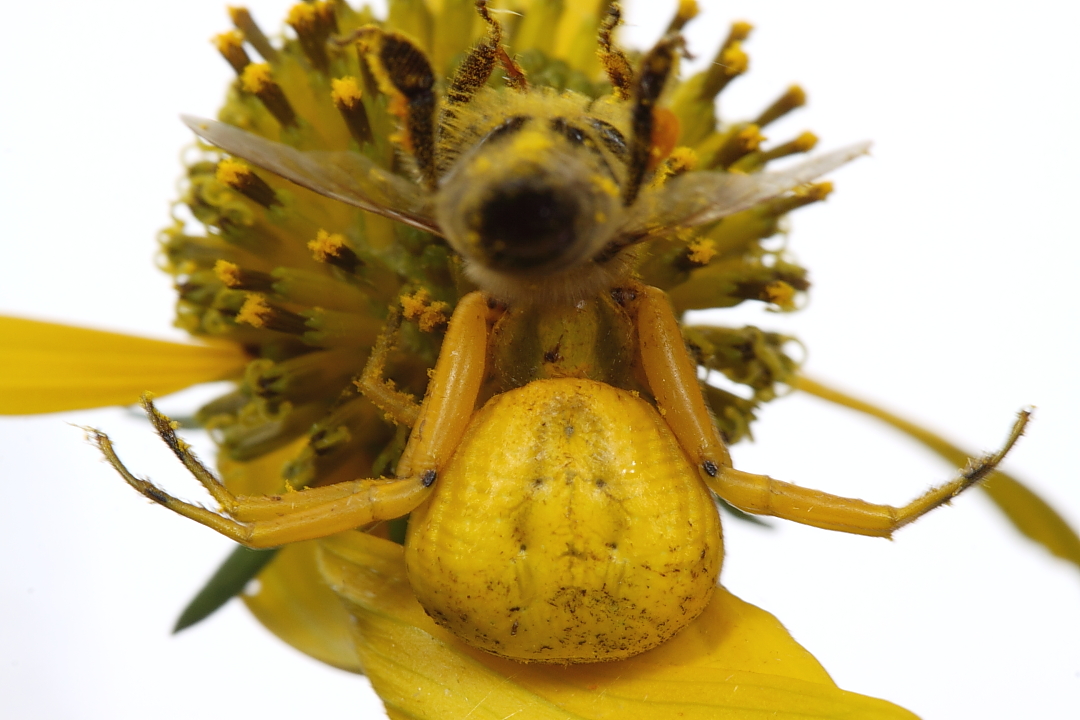
I think I’ll close with this minimally processed photograph of what I take to be Misumenoides formosipes (whitebanded crab spider) and its honey bee (Apis mellifera) prey.  Although I photographed this spider using flash and looking straight up into an overcast sky, I managed to properly illuminate the subject and avoid blown yellows and an all-black background by using some of the very techniques and principles that I had just learned earlier that day.  I hope to learn more at BugShot 2012!

Misumenoides formosipes (whitebanded crab spider) | Shaw Nature Reserve, Franklin Co., Missouri