Traffic Jam Treehoppers

Sometimes photo opportunities come at the unlikeliest of times. A few weeks ago while traveling back to Corrientes, Argentina from neighboring Chaco Province, I came upon traffic at a standstill just a few kilometers from the towering Gral. Belgrano bridge that spans the massive Rio Paraná to link Chaco and Corrientes Provinces. People were already getting out of their cars and walking around, suggesting a wreck closer to (or on) the bridge had completely shut down the highway for the time being. Somebody said they heard it might be another 45 minutes before it could be opened. What to do now? It was the end of my last day after a week of insect collecting/photographing in the area, and the last thing I wanted to do was spend the evening sitting on a divided highway with nowhere to go and nothing remotely interesting to look at…
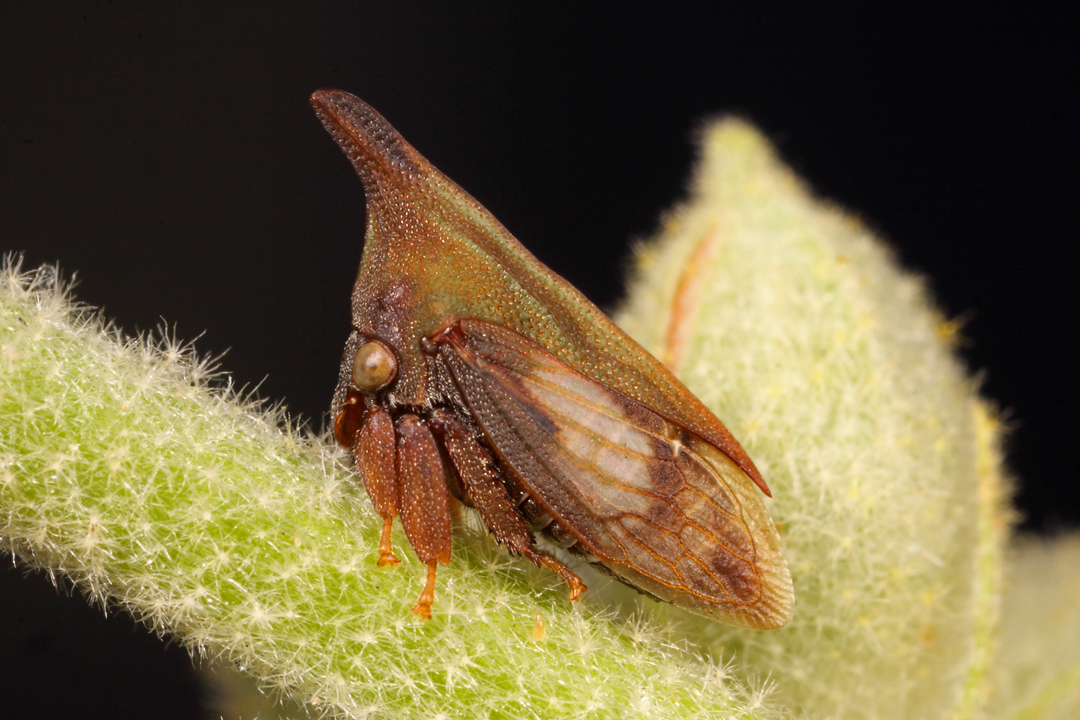
Enchenopa gracilis (Germar, 1821) | Chaco Province, Argentina

…or so I thought. While scanning the highway right-of-way to see if there might be anything possibly interesting to look at, I spotted a small clump of woody shrubs down the embankment and across the erosion gully before the fenceline. I looked around—everybody was out of their cars with the engines shut off, so I grabbed my camera (not really sure why) and started walking towards the shrubs while looking ahead every now and then for any sign that people were getting back in their cars and moving again. I reached the shrubs and saw they represented something in the mallow family (Malvaceae) due to their small, orange, über-staminate flowers. Immediately I spotted the familiar thorn-like shape of treehoppers in the tribe Membracini, probably a species of Enchenopa or related genus. I had been hoping to see more of these after photographing another species further south in Buenos Aires last year, but I hadn’t seen a single treehopper during the entire week. Fortunately I had my 65mm lens already on the camera, so I quickly snapped a few shots and collected a couple of specimens. Just as quickly as I had done that, I heard somebody yelling to me from the road above that people were getting back into their cars ahead. These few shots and specimens would have to do. (And, disappointingly, after spending the next hour creeping towards the bridge there wasn’t even a wreck to look at!)

As I did with those previous photos, I sent these to Andy Hamilton (Canadian National Collection, Ottawa), who forwarded them on to Dr. Albino Sakakibara (Universidad Federal de Parana, Brazil) and then reported back to me that:

My Brazilian colleagues…have been able to identify your “beautiful photos” as representing Enchenopa gracilis, a species that has been illustrated only once (in 1904), and certainly not by a photograph!
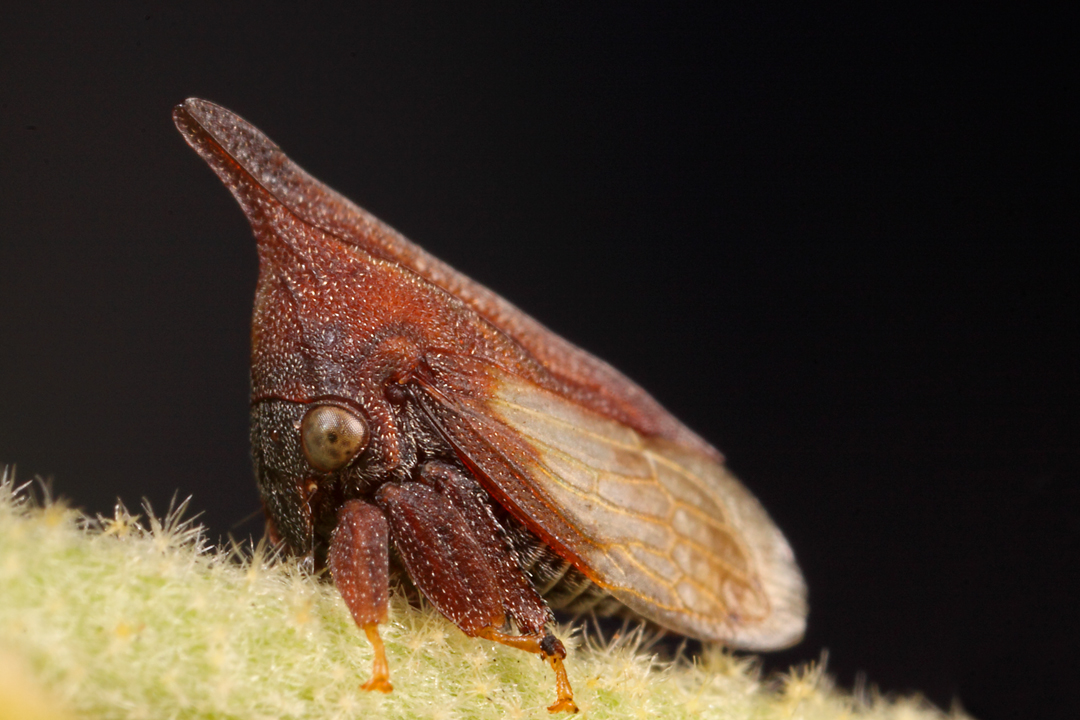
Another individual, this one with no trace of green colorationi and less distinctly marked wings.

The illustration referenced by Andy comes from Kellogg (1905—p. 169, fig. 239), and as he notes at BugGuide the problem with old illustrations is that many of them are either inaccurate or use obsolete names. Enchenopa gracilis does not occur in North America, thus the drawing in Kellogg (1905) probably does not actually represent this species. Nevertheless, a recent dissertation on the insect fauna associated with pigeon pea in Brazil (Azevedo 2006) shows several photographs of adults that agree nicely with these photos. Enchenopa gracilis actually seems to be a bit of a pest on that crop, and it has also been reported in association with a variety of other plants across several different families (Lopes 1995, Alves de Albuquerque et al. 2002). Interestingly, I could not find any species of the family Malvaceae recorded as a host for E. gracilis.

REFERENCES:

Azevedo, R. L. 2006. Entomofauna associada ao feijão guandu [Canjanus cajan (L.) Millspaugh] no recôncavo baiano. Ph.D. dissertation, Centro de Ciências Agrarias e Ambientais, Universidade Federal da Bahia, Cruz das Almas, 54 pp.

Alves de Albuquerque, F., F. C. Pattaro, L. M. Borges, R. S. Lima & A. V. Zabini. 2002. Insetos associados à cultura da aceroleira (Malpighia glabra L.) na região de Maringá, Estado do Paraná. Maringá 24(5):1245-1249.

Kellogg, V. L. 1905. American Insects. Henry Holt & Co., New York, 674 pp.

Lopes, B. C. 1995. Treehoppers (Homoptera, Membracidae) in southeastern Brazil: use of host plants. Revista Brasileira de Zoologia 1213:595-608.

Copyright © Ted C. MacRae 2012

“Cochinilla australiana” in Argentina

Icerya purchasi (''cochinilla australiana'') on citrus twig | western Buenos Aires Province, Argentina

After traveling through the northern provinces during late March and early April, I returned to my home base in western Buenos Aires Province for the last two weeks of my stay in Argentina. As soon as I could, I returned to the small grove of planted citrus trees on the station grounds where I had found a rather large, beautifully cryptic fulgorid nymph (see ““). Lois O’Brien had mentioned in her response to my query about the identity of the nymph that some species of Fulgoridae tend to live on the same tree for years and years—if I could go back to the tree on which I found the nymph perhaps I could find the adult. Sadly, no adults or additional nymphs were found, either on the original tree or any in its vicinity. What I did find, however, was this strange, cocoon-like structure on one of the branches of the tree. I had no idea what it was, having never seen anything quite like it, but I figured something—pupa, eggs, parasitoid, etc.—must be inside. I cut the piece of branch with the structure and tucked it inside a vial for later.

Egg case opened to reveal eggs and newly hatched nymphs

A little bit of searching online would have quickly told me what I was dealing with, but for some reason I felt the need to go ahead and start dissecting to see what was inside. It became obvious I was dealing with an egg mass when I peeled back the outer layers to reveal the cluster of red eggs inside, and very quickly I noticed that a few of the eggs had already hatched. The red nymphs had a decidedly “homopterous” look to them, and not much effort was required to figure out that I was looking at my very first “cottony cushion scale” insect.

Closer view of eggs - newly hatched nymph can be seen at bottom.

Icerya purchasi (Hemiptera: Monophlebidae) originally hails from Australia, but its preference for citrus and the realities of global commerce have resulted in its inevitable spread across the globe wherever citrus is grown (maybe I can be forgiven for having never before seen such a widespread insect—living most of my life in Missouri and northern California, I’ve not had much opportunity to visit citrus groves). The English common name clearly references the appearance the adult female, recognizable by the white, fluted egg sac shown here, while in Argentina it is called “cochinilla australiana”—literally meaning “Australian scale insect.”

Newly hatched nymphs are bright red with dark antennae and thin brown legs.

As I dissected the egg sac, a few of the newly hatched nymphs crawled out of the sac an onto the branch. Nymphs of this stage are referred to as “crawlers” because they are the dispersal stage. It’s a good name for these tiny little bugs, as the several that I tried to photograph never stopped moving. With the lens fully extended to 5X, it was difficult enough to just find them in the viewfinder, much less compose and focus with all the movement. It became a numbers game and test of patience—how many shots could I get fired off in the amount of time that I was willing to persist? Shown here are the few shots that I was the least displeased with.

First instar nymphs are the primary dispersal stage.

Crawlers disperse not only by crawling, but also by wind. One can imagine that such tiny insects could easily be picked up by the wind and carried long distances. However, I couldn’t help but notice the very long setae on the body and outer antennal segments (visible to greater or lesser degree in these photos) and think that perhaps they have some function in aiding wind dispersal. At the very least, aerial dispersal must be as important as crawling (if not more so) for colonization by this species—only adult males have wings (but they are rare), while egg-laying females (actually hermaphrodites) are completely sessile.

Do the long setae on the body and antennae of the nymph aid in wind dispersal?

The adult female and egg case may have confused me initially, but a ton of readers had no problem figuring out what it was. A record 24 people participated in this challenge, with all but five correctly guessing the species. Winning this challenge came down to bonus points for speed and uniqueness of additional information, and Christopher Taylor did this best to earn 17 pts and the win. Three others—Brady Richards, Mr. Phidippus and bicyclebug—each finished just 1 pt back of the win, but Sam Heads’ 15 pts keeps the overall lead in his possession. BitB Challenge Session #6 is young, but already a lot of people have a lot of points in the bank. It will be interesting to see how this session develops.

Copyright © Ted C. MacRae 2012

ID Challenge #17

Inaugural “One-Shot Wednesday”

On many occasions I have considered making my own contributions to the “Wordless Wednesday” meme. Unfortunately, I find it impossible to post photos of insects and not be allowed to say anything about them. I suppose I could follow Dragonfly Woman‘s “Well-Nigh Wordless Wednesday” example, but that seems like horning in on somebody’s trademark. At last it finally occurred to me a meme that I could use for Wednesday’s that gets around these issues—”One-Shot Wednesday”! Ever photograph an insect and only get off a single shot? Not just one keeper from a series of photos, but only one single photo of the insect, like it or lump it! That’s what I’m talking about here. The subtext, of course, is that there was only that one chance to get everything right—exposure, focus, composition, lighting, etc. Obviously, it’s not my plan to show crappy photos as part of this meme, but rather that occasional instance where I only got off a single shot, and for the most part everything worked pretty well to produce a decent photograph. I would, of course, be more than happy to see this meme take off and spread throughout the insect blogging community, but if it doesn’t and it remains a BitB exclusive then that’s fine also.

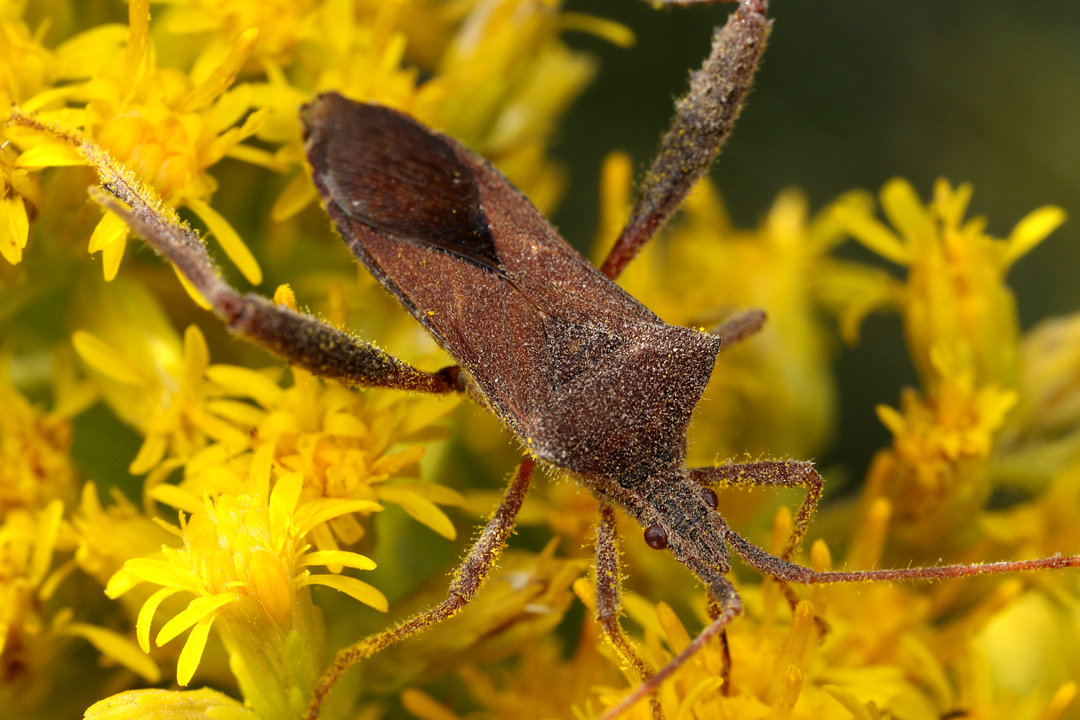
Leptoglossus sp. | nr. Corrientes, Argentina

Here is contribution in the meme: a leaf-footed bug (family Coreidae) feeding on flowers of Solidago chilensis  that I photographed a couple of weeks ago near Corrientes, Argentina. According to coreid-specialist Harry Brailovsky (Universidad Nacional Autónoma de México), the expanded hind tibiae place it in the large, mostly New World genus Leptoglossus. Which one, however, is a good question—according to Coreoidea Species File Online, ten species in the genus have been recorded in Argentina, but browsing through available images didn’t immediately turn up a good match for the individual shown in this photo.

I’ve often wondered about the purpose of the leaf-like expansions of the hind tibiae of coreids—which reach truly gargantuan proportions in some tropical species—and their adaptive significance. One can imagine they might serve as a “false target” for potential avian predators, and supporting this idea is the fact that the hind legs seem to break off rather easily when handled. It’s not rare to find individuals in the field missing one or even both hind legs.

Copyright © Ted C. MacRae 2012

Fly got eye!

While walking the grounds of my company’s experiment station in Fontezuela, Argentina, I encountered a massive European elm (Ulmus laevis)—its trunk enveloped by an unidentified woody vine with large, ball-clusters of small, green flowers. Despite their inconspicuous appearance, the flowers were highly attractive to insects, primarily honey bees and smallish, black and yellow vespid wasps. One of the wasps caught my attention—it was not quite as narrow as the others, and it flew a little differently. Closer inspection, of course, revealed that it was not a wasp after all, but rather a fly. I wasn’t sure what it was, but it was extremely flighty and wouldn’t allow me to get close enough even to attempt looking at it through the viewfinder—much less going for a composed shot. Now, if it were a tiger beetle I’d probably spend the next 2 hours “working” it to get that in situ shot. But, hey, it’s just a fly (with apologies to my dipterist friends)! I trapped it in a vial and collected some flowers and foliage from the vine with hopes of giving it a day or so to settle down enough to allow a few photographs in a more controlled environment.

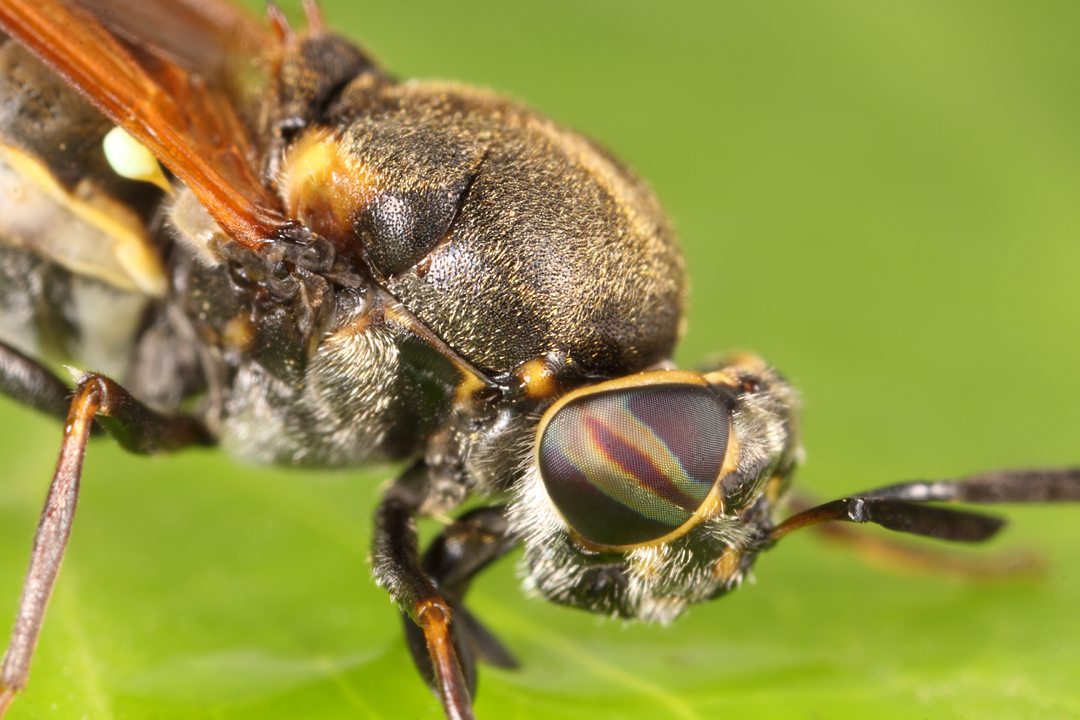
Hoplitimyia sp. poss. mutabilis | Buenos Aires Province, Argentina

That proved more difficult than expected, and a few photographs was all I could get. Even after a day in the vial it was extremely flighty, and every time I released it onto the flowers in the white box I had setup it immediately tried to take flight. I decided it must at least be hungry, so I whipped up some sugar solution and painted a small amount onto one of the leaves, then placed the open end of the vial over the leaf to let the fly find the sugar. That worked—briefly! The fly paused just long enough to allow me to fire off a half-dozen shots or so while it drank and preened before once again attempting to take flight. No amount of coaxing back to the sugar could interest the fly—she’d had enough, and so had I. I thought the fly had a soldier fly-ish look to it (family Stratiomyidae), and this was confirmed by dipterist Martin Hauser who wrote:

It is a female Hoplitimyia, maybe mutabilis…but the species are a mess. There are at least two species in the US, and more in South America. They have aquatic larvae…

Fly got eye!

Among flies, tabanids and syrphids seem to get all the attention from insect photographers because of their contrastingly colored eyes, but this fly had every bit as much eye as those better known families! Considering how broadly across the order Diptera that one finds these stunningly patterned eyes—72 species out of 23 families according to Lunau & Knüttel (1995), an obvious question is what is their purpose. Considering that the patterns and coloration are often sexually dimorphic, it’s tempting to think it has something to do with mate selection, especially with their large size and resulting prominence. However, Horváth et al. (2008) presented evidence that the ventral eye surface of many tabanids are stimulated by horizontally polarized light. Such capabilities are common in aquatic insects, suggesting some function in locating water for finding hosts, mates and suitable sites for laying eggs. This still doesn’t explain why the patterns are often sexual dimorphic, although one can imagine that males and females experience different selective pressures for specific visual cues that could have an effect on the resulting color pattern. Comments from any dipterists that happen by this blog and have greater insight into this question would be greatly appreciated.

REFERENCE:

Horváth, G., J. Majer, L. Horváth, I. Szivák & G. Kriska. 2008. Ventral polarization vision in tabanids: horseflies and deerflies (Diptera: Tabanidae) are attracted to horizontally polarized light. Naturwissenschaften 95:1093–1100, DOI 10.1007/s00114-008-0425-5.

Lunau, K. & H. Knüttel. 1995. Vision through colored eyes. Naturwissenschaften 82(9):432-434, DOI: 10.1007/BF01133678.

Copyright © Ted C. MacRae 2012

I fear no weevil…

Megabaris quadriguttatus (Klug, 1829) | Corrientes Province, Argentina

…especially when they are as colorful as these! I found this mating pair ~60 km south of Corrientes, Argentina feeding on flowers of what I presume to be the goldenrod species Solidago chilensis (family Asteraceae). Here, as in North America, goldenrod blooms in profusion along the roadsides during late summer and fall wherever moisture is to be found, and also as in North America goldenrod here is an insect magnet. During my week exploring Corrientes and Chaco Provinces, I learned to stop whenever I spotted a stand of the distinctive yellow blossoms. I found several stands and was treated to a variety of beetles, flies, and other insects that I’ll show over the coming days, with these being among the most striking that I found.

Weevils themselves may not be anything to be afraid of; however, their taxonomy is downright terrifying (and this coming from a beetle man!). With more than 40,000 described species worldwide (and who knows how many still awaiting description), the family Curculionidae (“true” weevils) may be the largest in the animal kingdom. I don’t know why, given the distinctive and striking coloration of these individuals, but I punted early and asked my friend Henry Hespenheide (a buprestid man, but knows a thing or two about weevils) if he knew what these were. Henry must have also been scared, because he went straight to the top and forwarded the photos to weevil heavy-hitters Charles O’Brien and Jens Prena, both of whom quickly replied back with an ID of Megadaris quadriguttatus (Klug, 1829). The state of weevil bionomics seems to be as incomplete as their taxonomy, as I was unable to find even the most basic information about the distribution and biology of this species (keep in mind I’m in Argentina right now with no access to libraries). As far as I can tell this is a strictly Neotropical genus.

Of course, had I checked Curculionidae de Argentina I might have noticed the photo of this species right there on the front page. Fear does strange things to one’s confidence.

Copyright © Ted C. MacRae 2012
Bicho palito, or “My longest post ever!”

The last day of my vacation week in Corrientes, Argentina got off to a bad start—heavy rain moved in during the morning, and I feared my last chance at looking for insects was about to be washed away. The weather radar, however, showed a curious, abrupt line between rain/no rain across the river in Chaco Province. At noon I decided it was do or die and played a hunch that one of my favorite spots ~50 km west might have been spared the downpour, and if not at least I tried. Yet another example of how it usually pays to play your hunches—while the skies were gray and the ground and foliage a little damp, there was plenty of insect activity afield (and perhaps even enhanced by the first significant moisture in almost two months).

Tetanorhynchus poss. n. sp. | Chaco Province, Argentina

No sooner than had I walked 20 feet from the car did I see an enormous stick insect in a low, spreading acacia tree. I don’t know why I saw it, as it’s camouflage was quite effective, but after so many years of doing this I think I’ve just developed an eye for seeing things often easily missed. This, of course, is not your normal, run-of-the-mill (at least to North Americans) walkingstick (order Phasmida), but rather a member of the curious and exclusively Neotropical grasshopper family Proscopiidae, referred to in English as “jumping sticks” and in Spanish as “bicho palito” (stick bug). I recognized the family instantly, as I had already seen one of these a number of years ago in Uruguay (though not so large as this one), and of course Alex Wild featured what has become one of his most famous photos of a species from Ecuador in one of his Monday Night Mystery posts.

The super elongate fastigium suggests this may be a new species.

Gleefully I set about taking photos, focusing almost exclusively on the head. One thing that immediately struck me was the super-elongate fastigium (frontal projection)—many proscopiids lack this elongate fastigium, and I had not recalled seeing any example as long as the one on this individual. When I saw the super-closeup I had taken of the eyes and antennal bases from the ventral view, I knew I had my own Super Crop Challenge. Of course, it was not until after I posted the challenge that I realized identifying this insect below the family level was more of a challenge than I had anticipated. How could I award points for genus when I wasn’t even sure of this myself? Eventually I enlisted the help of Alba Bentos-Pereira at São Paulo University—he and his doctoral student are perhaps the only two people in the world that are working on this family. I had suggested, based on its location in Chaco Province and consulting Orthoptera Species File Online, that it must be either Tetanorhynchus calamus or Cephalocoema daguerrei—both in the tribe Tetanorhynchini (Bentos-Pereira 2003). Alba kindly responded that it could be the former, it most definitely is not the latter, and perhaps most likely is that it represents an undescribed species (proscopiid taxonomy is still far from complete). He indicated that the presence of ventral spines on the metatibia would confirm membership in the tribe Tetanorhynchini (they are present), and provided several measurements from the male holotype of T. calamus that I could use to compare with my specimen. Although the absolute measurements might (and probably would) differ, their relative proportions should be the same as the type. Here are the results (measurements in mm):


Male type

Female

Ratio

Body

98

138

1.4

Head

18.5

32

1.7

Fastigium

9.5

19

2.0

Pronotum

20

25

1.3

Femur 1

14

17

1.2

Femur 3

28

38

1.4

Tibia 3

30

39

1.3

As can be seen, most of the measurements are consistently 1.2–1.4X that of the male type. The head, however, is proportionately longer (1.7X), primarily due to the much longer fastigium (2.0X). Is this difference significant, at least enough to consider it a different species? I am currently awaiting Alba’s opinion on that.

Like all proscopiids, the form of the face seems to be''smiling'.'

While only two species of Proscopiidae are described from Chaco Province, there are eleven species known from northeastern Argentina (which includes the provinces of Buenos Aires, Chaco, Córdoba, Corrientes, Entre Rios, Formosa, Missiones and Santa Fe)—these are shown in the following list with hyperlinks to their respective pages at Orthoptera Species File Online, along with notes on type localities for each (or synonyms) and the length of the fastigium relative to the body:  

Okay, in the title I indicated this was “My longest post ever!” Here’s why:


Congratulations to Sam Heads, whose work as a practicing orthopteran taxonomist and contributor to Orthoptera Species File Online set him up for the win with 17 points. Brady Richard takes 2nd place with 14 pts, while Chris Grinter and Dennis Haines share the final podium spot with 12 pts each. Congratulations to these folks, who jump out of the gate early in BitB Challenge Session #6.

REFERENCE:

Bentos-Pereira, A. 2003. The Tribe Tetanorhynchini, nov. (Orthoptera, Caelifera, Proscopiidae). Journal of Orthoptera Research 12(2):159–171.

Copyright © Ted C. MacRae 2012

Super Crop Challenge #12

It’s time for a new BitB Challenge Session, and to begin the 6th edition we start off with a Super Crop Challenge. This is a combination challenge, with points on tap for naming the organism (order, family, genus) and visible structures. As always, standard challenge rules apply, including moderated comments, tie-breaker points for first correct answers, and possible bonus pts for additional relevant information at my discretion. Mr. Phidippus ran away with BitB Challenge Session #5, but Tim Eisele and Dennis Haines fought to the end for podium honors. Will one of them de-throne Mr. Phidippus, or will somebody else make a surprise run? Or, perhaps, 3-time champ Ben Coulter will return to stake his claim as the true BitB Challenge Session champion. Let’s get started!

Copyright © Ted C. MacRae 2012