Sometimes the best collecting…

Anambodera sp. (prob. undescribed) | Nothing, Arizona

As a practicing (albeit non-professional) taxonomist, I spend a goodly amount of time examining specimens collected not only by me, but by others as well. I’ve mentioned before the benefits of doing this—both to the collector, who gets names for the specimens in their collection, and to my own research in being able to cast a broader net in my search for new distributions and host associations within my two primary focus groups—Buprestidae and Cerambycidae. Such information remains surprisingly incomplete for these two popularly collected groups of beetles, and every few years I assemble whatever records that I’ve accumulated to that point for publication in the form of a “notes” paper (e.g., Nelson and MacRae 1990, Nelson et al. 1996, MacRae and Nelson 2003, MacRae 2006, MacRae and Rice 2007). Occasionally I encounter species that I have not yet collected myself (although with ~70% of Nearctic species now represented in my collection, this is becoming more and more infrequent), and in most such cases the collector graciously allows me to keep an example or two (leading to the saying, “Sometimes the best collecting is in other people’s collections!” ☺). The ultimate find, however, is a specimen or series of specimens that represent an undescribed species. Yes, even amongst North America Buprestidae and Cerambycidae there are many species still awaiting discovery (imagine the situation with other families of beetles, many receiving far less attention than these two popular groups).

The beetle shown here, a member of the genus Anambodera, represents one such species. This individual is part of a small series collected in Nothing, Arizona this past summer by Paul Kaufman, an indefatigable amateur beetle collector who has routinely over the years provided fodder for my research in the way of new state records and, more recently, new larval host records through rearing. While the key characters that separate Anambodera from the closely related and exorbitantly speciose genus Acmaeodera (front margin of epistoma not reflexed or plate-like, front angles of pronotum rounded in side view, suture between 1st and 2nd abdominal sterna visible, etc.—see Barr 1972), the coarse elytral punctation and heavily sculptured and bronzed pronotal surface are classic gestalt for Anambodera and unlike any of the small, vittate species of Acmaeodera that they resemble. This specimen keys to A. gemina, but it clearly differs from that species in a number of characters. Anambodera is restricted to western North America, and species tend to be poorly represented in collections due to their more cryptic habits (unlike Acmaeodera, most tend not to visit flowers, but are instead found alighting on rock surfaces or bare soil). As a result, the genus is still incompletely known and in bad need of revision. Dennis Haines and George Walters are working on such a revision and have already found several undescribed species among material collected in Arizona—I’m sure they will be pleased to include these specimens in their study as well.

My sincere thanks to Paul Kaufman for faithfully sending to me for examination his “catch” at the end of each season and allowing me to publish information gleaned from the included specimens. Keep it up, Paul!

REFERENCES:

Barr, W. F. 1972. New genera and species of North American Buprestidae. Occasional Papers of the Biological Society of Nevada 39:1–13.

MacRae, T. C. 2006. Distributional and biological notes on North American Buprestidae (Coleoptera), with comments on variation in Anthaxia (Haplanthaxia) viridicornis (Say) and A. (H.) viridfrons Gory. The Pan-Pacific Entomologist 82(2):166–199.

MacRae, T. C., and G. H. Nelson. 2003. Distributional and biological notes on Buprestidae (Coleoptera) in North and Central America and the West Indies, with validation of one species. The Coleopterists Bulletin 57(1):57–70.

MacRae, T. C. and M. E. Rice. 2007. Distributional and biological observations on North American Cerambycidae (Coleoptera). The Coleopterists Bulletin 61(2):227–263.

Nelson, G. H., and T. C. MacRae. 1990. Additional notes on the biology and distribution of Buprestidae (Coleoptera) in North America, III. The Coleopterists Bulletin44(3):349–354.

Nelson, G. H., R. L. Westcott and T. C. MacRae. 1996. Miscellaneous notes on Buprestidae and Schizopodidae occurring in the United States and Canada, including descriptions of previously unknown sexes of six Agrilus Curtis (Coleoptera). The Coleopterists Bulletin 50(2):183–191.

Copyright © Ted C. MacRae 2011
 

Swift Tiger Beetle: Species on the Brink

ResearchBlogging.orgIn July 2008, Chris Brown and I made a spur-of-the-moment trip to Hitchcock Preserve near Council Bluffs, Iowa, where only a week earlier Cylindera celeripes (Swift Tiger Beetle), one of North America’s most enigmatic tiger beetles, had just been discovered. Reportedly once common in the blufftop prairies of western Iowa and further west in eastern Nebraska and Kansas, this tiny (6–8 mm in length), flightless beetle has suffered severe population declines over the past 100 years. Only small numbers of individuals have been encountered outside of the type locality (Fort Riley, Kansas) in recent years, and in Nebraska the species is now considered extirpated (Spomer et al. 2008). Our reasons for going to Iowa had to do with our as yet unsuccessful effort to find the species in northwestern Missouri as part of our broader studies of the state’s tiger beetle fauna. Although it had never been recorded from Missouri, we felt there was some chance it might be found in the tiny loess hilltop prairie remnants still remaining in the state at the southern terminus of the Loess Hills landform. We reasoned our failure to find the species might be related to its very small size and rapid running capabilities (giving them more the appearance of small ants or spiders than tiger beetles), limited temporal occurrence, and tendency to hide amongst the bases of grass clumps (Pearson et al. 2006). If we could find the species at a locality where they were known to occur, perhaps an improved search image and better understanding of their precise microhabitat preferences would help us locate the species in Missouri.

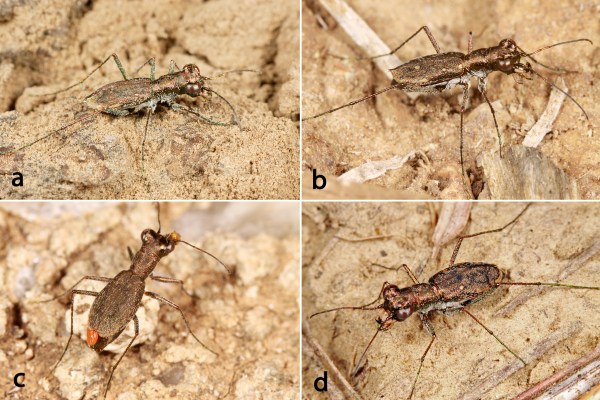
Fig. 1. Cylindera celeripes (LeConte) adults at: a) Hitchcock Nature Center, Pottawattamie Co., Iowa (13.vii.2008); b) Alabaster Caverns State Park, Woodward Co., Oklahoma (10.vi.2009); c) same locality as “b”, note parasite (possibly Hymenoptera: Dryinidae) protruding from abdomen and ant head attached to right antenna; d) Brickyard Hill Natural Area, Atchison Co., Missouri (27.vi.2009). Photos by C.R.Brown (a) and T.C.MacRae (b-d).

We didn’t realize it at the time, but that trip marked the beginning of a two-year study that would not only see us succeed in finding C. celeripes in Iowa, but also discover new populations in Missouri and northwestern Oklahoma (Figs. 1a–d). With so much new information about the species and the long-standing concerns by many contemporary cicindelid workers about its status, it seemed appropriate to conduct a comprehensive review of the historical occurrence of this species to establish context for its contemporary occurrence and clarify implications for its long term protection and conservation. This was accomplished through compilation of label data from nearly 1,000 specimens residing in the collections of contemporary tiger beetle workers, all of the major public insect museums in the states of Iowa, Kansas, Missouri, Nebraska, Oklahoma, and Texas, and the collections at the U.S. National Museum and Florida State Collection of Arthropods. Collectively, this material is presumed to represent the bulk of material that exists for the species, representing nearly all localities recorded for the species and time periods in which it has been collected.

Label data confirmed the historical abundance of this species, especially in the vicinity of Manhattan and Fort Riley, Kansas; Lincoln and Omaha, Nebraska; and Council Bluffs, Iowa. Hundreds of specimens were routinely collected in the native grassland habitats around these areas during the late 1800s and early 1900s, their abundance documented by entomologists in both journal articles and private letters. One of the most interesting examples of the latter was by Nebraska collector F. H. Shoemaker, who wrote the following in a 1905 letter to R. H. Wolcott:

There is another trip, down the river to the big spring by the railroad track near Albright, then across the river (the heronry route) where we collect hirticollis, repanda, vulgaris [= tranquebarica], cuprascens, and – vat you call ‘im? – celeripes! I took 147 of the latter in an hour and a half Sunday, and the supply was undiminished.

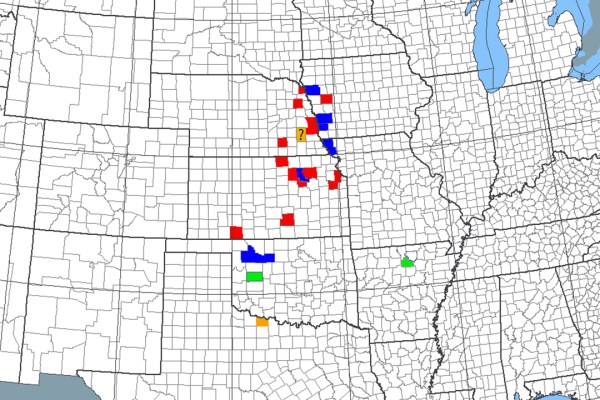
Fig. 8. Historical and currently known geographical occurrence of Cylindera celeripes by county. Red = last record prior to 1920; orange = last record 1941–1960 (“?” = questionable record); green = last record 1991–1996; blue = last record 2005–2011.

Although the recent collections of C. celeripes from near Council Bluffs and through the years near Fort Riley show that the species has managed to persist in these areas, there is little question that it is far less abundant and widespread now than it was in the early 20th century (Fig. 8).  Not only are the areas in which present day populations are known to occur limited, but the numbers of individuals seen in them are very low. In Missouri, the species was listed immediately after its discovery in the state as a species of conservation concern with a status of S1 (= “critically imperiled”) due to the highly restricted occurrence of suitable habitat (loess hill prairie) in the state and small populations observed within them. The situation is even worse in Nebraska, where the species has not been seen for nearly 100 years despite dedicated searches by expert contemporary tiger beetle workers such as Matt Brust and Steve Spomer. Considering the near-complete elimination of suitable native grassland habitats by conversion to agriculture and degradation of the few existing remnants due to encroachment by woody vegetation and invasive exotics, the likelihood of finding extant populations of C. celeripes in Nebraska seems remote. Only in the Red Hills of northwestern Oklahoma does the species appear to be secure due to the extensiveness of suitable areas of habitat and robust numbers of individuals observed within them at the present time. An enigmatic record exists from Arkansas, based on a single individual collected near Calico Rock in 1996. This individual represents a significant extension of the known geographical range of the species, but repeated attempts to find the species at that locality during the past year were not successful.

The persistence of populations, albeit small, in multiple areas, along with the occurrence of robust populations in northwestern Oklahoma, makes it unlikely that C. celeripesqualifies for listing as a threatened or endangered species at the federal level. Nevertheless, the limited availability of suitable habitat in many areas and low population numbers found within them clearly suggest that conservation measures are warranted at the state level, especially in Iowa, Kansas and Missouri, to prevent its extirpation from these states. In these states, land management practices should be implemented at sites known to support populations of the beetle in an effort to maintain and expand the native grassland habitats upon which they rely. These include various disturbance factors such as mechanical removal of woody vegetation, judicious use of prescribed burning, and selective grazing (taking care to do so in a manner that minimizes impacts to beetle populations).

REFERENCES:

MacRae, T. C. and C. R. Brown. 2011. Historical and contemporary occurrence of Cylindera (s. str.) celeripes (LeConte) (Coleoptera: Carabidae: Cicindelinae) and implications for its conservation. The Coleopterists Bulletin 65(3):230–241 DOI: 10.1649/072.065.0304

Pearson, D. L., C. B. Knisley and C. J. Kazilek. 2006. A Field Guide to the Tiger Beetles of the United States and Canada. Oxford University Press, New York, 227 pp.

Spomer, S. M., M. L. Brust, D. C. Backlund and S. Weins.  2008. Tiger Beetles of South Dakota & Nebraska. University of Nebraska, Department of Entomology, Lincoln, 60 pp.

Copyright © Ted C. MacRae 2011

Cycloalexy in tortoise beetle larvae

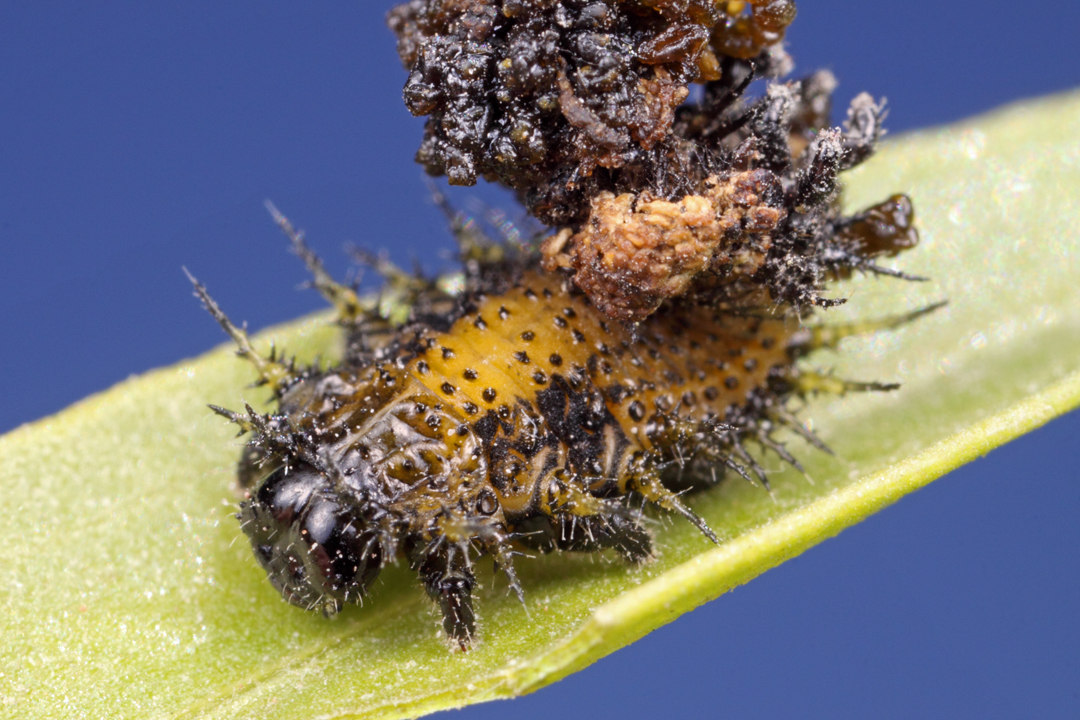
One of the first insects I encountered during my visit this past November to  in Buenos Aires, Argentina were these tiny beetle larvae grouped together on a single leaf of an unidentified shrub.  The presence of fringed lateral appendages and exuvial-fecal debris masses held by caudal appendages immediately identifies them as larvae in the leaf beetle subfamily Cassidinae, known commonly in North America as “tortoise beetles” due to the appearance of the adults.  With nearly 3,000 species distributed throughout the world, tortoise beetles are easily recognizable as a group; however, species identifications can be much more difficult, especially in the Neotropics where the group reaches its greatest diversity (Borowiec and Świętojańska 2002–2011). Identification of larvae can be even more challenging, as the larvae of many species remain unknown, and I was unable to find adults in association with the larvae to aid my identification.

Anacassis sp. (poss. exarata) early-instar larvae on Baccharis salicifolia | Buenos Aires, Argentina

Nevertheless, host plant can be an important clue to leaf beetle identity, as most species in the family limit their feeding to a single plant genus or group of related plant genera. The shrub on which the beetles were feeding looked familiar to me, and while perusing a list of plants that have been recorded from the Reserve (Burgueño 2005) I had an “Aha!” moment when I spotted the asteraceous genus Baccharis. I decided the plant must represent Baccharis salicifolia because of its narrowly lanceolate, willow-like leaves with fine apical serrations (Cuatrecasas 1968) (see first photo). The only tortoise beetles known to feed on Baccharis are species in the genus Anacassis (McFadyen 1987), several species of which are known from Argentina, and one (Anacassis exarata) looking very much like the larvae in these photos.

Note the circular, heads-directed-inward orientation of all larvae around the periphery

The manner in which these early-instar (perhaps even newly hatched) larvae were feeding as a group while working their way down the length of the leaf towards its base is not something I had observed before. Larvae of most tortoise beetles are solitary feeders (Borowiec and Świętojańska 2002–2011), and I was further intrigued by the deliberate circular formation that the larvae had assumed.  The larvae around the periphery were all facing inward, tightly packed against each other and with their exuvial-fecal debris masses directed outward. Additional larvae were seen inside the circular formation. As I manipulated the leaf for photographs, the larvae would occasionally raise their debris masses up and outward, presumably a defensive reaction to disturbance and a perceived threat. It was clear to me that the larvae had deliberately “circled their wagons” for defensive purposes.

Close body contact allows exuvial-fecal debris masses to form a protective barrier against predators

In fact, this type of defensive strategy has been reported in a number of South American cassidines, as summarized by Jolivet et al. (1990), who coined the term “cycloalexy” (from the Greek κύκλος = circle, and αλεξω = defend) to describe such strategies. Cycloalexy can either be “heads in, tails out” or vice versa and is usually associated with other repellent activities such as coordinated threat movements, regurgitation, or biting. The strategy is intended to provide protection from predators such as ants and true bugs and parasitioid wasps, although some parasitoids seem to have thwarted the strategy by depositing their eggs where they can be ingested (thus avoiding direct confrontation with the prey). Cycloalexy has been described primarily among chrysomelid beetles and tenthredinoid hymenopterans (sawflies); however, examples from a few other insect orders (e.g., Diptera, Neuroptera, Lepidoptera) are known as well (Jolivet 2008).  All known cycloalexic insects are subsocial in the larval stage and often also exhibit maternal protection of eggs or newly hatched larvae.

This and several other older larvae had become solitary, presumably protected in part by greater size

In addition to this single group of early instar larvae, I noted also a few larger individuals—all of whom were feeding on the plant in a more solitary fashion. Presumably as the larvae grow larger they are more able to defend themselves, or perhaps larger larvae simply demand more “elbow room” because of the larger amounts of leaf tissue they require for feeding. If cycloalexy is beneficial for small cassidine larvae but less so for larger larvae, perhaps this behavior is actually more common than is currently realized.

REFERENCES:

Borowiec, L., and J. Świętojańska. 2002–2011. Cassidinae of the world – an interactive manual (Coleoptera: Chrysomelidae). http://www.biol.uni.wroc.pl/cassidae/katalog%20internetowy/index.htm [accessed 3 Dec 2011].

Burgueño, G. 2005. Manejo de la vetación en reservas naturales urbanas de la region metopolitana de Buenos Aires. Aves Argentinas, Asociación Ornitológica del Plata, Proyecto Reservas Naturales Urbanas, 16 pp.

Cuatrecasas, J. 1968. Notas adicionales, taxonómicas y corológicas, sobre Baccharis. Revista de la Academia Colombiana de Ciencias Exactas, Físicas y Naturales 13(50):201–226.

Jolivet, P. 2008. Cycloalexy. In: J. L. Capinera [Ed.], Encyclopedia of Entomology, Springer Science+Business Media B.V.

Jolivet, P., Vasconcellos-Neto, J., and Weinstein, P. 1991. Cycloalexy: A new concept in the larval defense of insects. Insecta Mundi 4(1–4) (1990):133–141.

McFadyen, P. J. 1987. Host-specificity of five Anacassis species [Col.: Chrysomelidae] introduced into Australia for the biological control of Baccharis halimifolia [Compositae]. Entomophaga 32(4):377–379.

Copyright © Ted C. MacRae 2011

‘Beetles in the Bush’ T-Shirts now available!

I’ve mentioned before my preference for simple cotton t-shirts over fancy pocketed nylon shirts while I’m out in the field (see Beetle Collecting 101: Dress for Success). Lightweight and comfortable under even the most extreme conditions, they do the job cheaply and effectively. While most any t-shirt will do, I am especially fond of the set I purchased from CafePress, each artfully emblazoned with a stylized image of Cicindela ancosisconensis by Kirk Betts at The Wild Edge. In addition to their lightweight comfort, these shirts leave curious onlookers with little doubt about what I am up to (and of course, I also clearly be stylin’!).

Of course, variety is the spice of life, and I’m happy to now announce a new design created specifically for ‘Beetles in the Bush’. My deepest appreciation to Kirk, who has once again worked his PhotoShop filters magic to create a stylized image of this blog’s icon, the jewel beetle Agelia petalii (see Buppies in the bush(veld) for the original photo of this species that I took in South Africa back in 1999). Men’s, women’s and children’s t-shirts and other apparel bearing this design are now available at the new Beetles in the Bush CafePress online store. Two versions of each item are offered—one with the image and ‘Beetles in the Bush’ logo, and another with the image only, as shown below:

Image w/ logo

Image only


A variety of t-shirt and sweatshirt styles are available, as are coffee mugs for those who (like me) prefer to start their collecting day with a jolt of java! I hope you’ll browse the product selection and find something that you like.

Show your support for ‘Beetles in the Bush’! I don’t expect to get rich off of this, but whatever proceeds from sales that I do get will go a long way towards helping fund future insect collecting and photography expeditions. If you have any feedback on the design/organization of the online store, the products offered, or future designs that you would like to see made available please let me know, either by comment or by contacting me directly.

Copyright © Ted C. MacRae 2011

Arriving now in a mailbox near you…


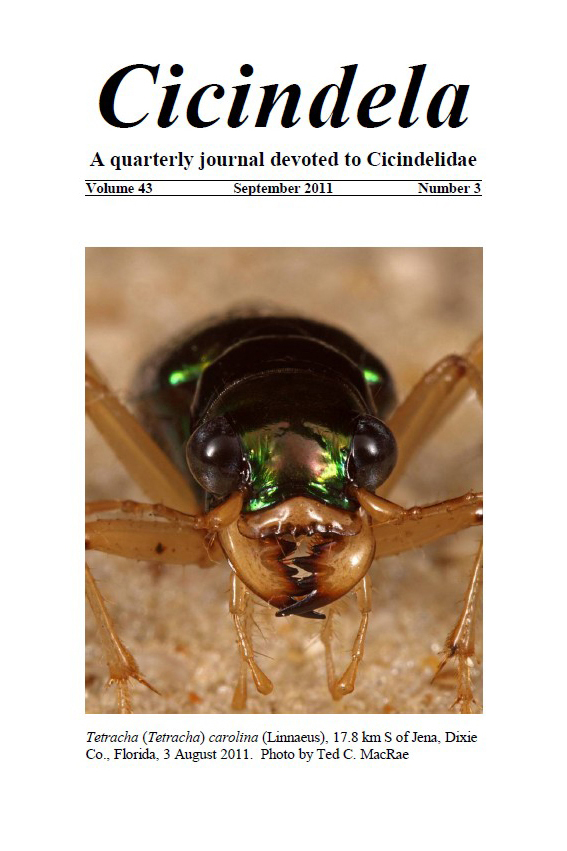
The latest issue of Cicindela (A quarterly journal devoted to Cicindelidae) has just been issued. My copy arrived yesterday and features on the cover a photograph that I took of Tetracha carolina in Florida this past August (original photo and more can be seen in my post ).

I’m also happy to report that I was lead author and co-author on the two papers included this issue. I’ll provide a more detailed summary of those papers in another post—look for it in the near future, or better yet contact Managing Editor Ron Huber to begin receiving your own copies of this fine journal (subscription and contact information here).

Copyright © Ted C. MacRae 2011

Zygogramma Desmogramma leaf beetles in Argentina


The east end of  in Buenos Aires offers a quiet contrast to the more populated central and western areas. Few people leave the levee-trail system that surrounds the famous wetlands and pampas grass stands in those latter areas; however, those that do find in the east a mosaic of pastures and young woodlands that offer a greater diversity of sights and invite a more leisurely pace. November is spring in Buenos Aires, and as such there were a number of plants beginning to bloom in the Reserve. One plant I found blooming in abundance in one small part of the east area was a member of the family Malvaceae that I take to be Abutilon pauciflorum, a few of which were being devoured by these leaf beetles (family Chrysomelidae).


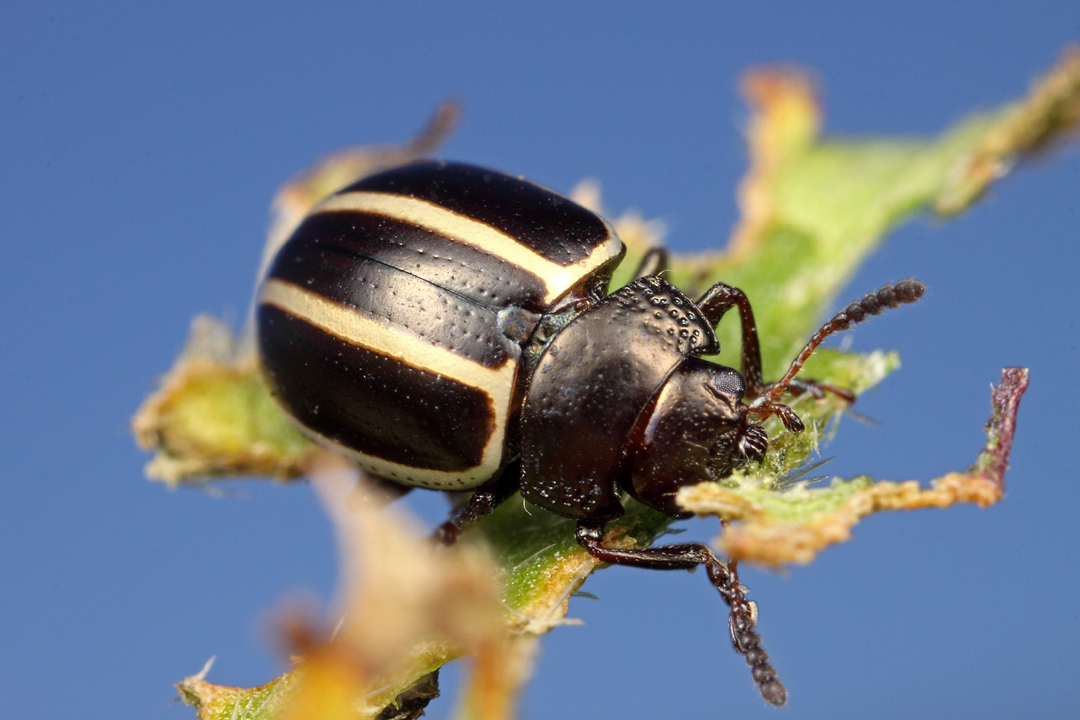
These beetles are clearly members of the subtribe Doryphorina within the nominate subfamily, looking very similar to the North American species Zygogramma suturalis (ragweed leaf beetle) or the vittate species of Calligrapha (subgenus Bidensomela), e.g. Calligrapha bidenticola. Both of these genera are represented in Argentina, and at first I was inclined to believe the beetles belonged to the latter genus since its Central and South American members are associated almost exclusively with malvaceous plants (North American species of Calligrapha have adapted to plants in several other families). However, a view of the tarsus in the last photo suggests that the claws are joined at the base, a character that immediately separates members of the genus Zygogramma from the genus Calligrapha (species of Doryphora also have fused tarsal claws but exhibit a completely different gestalt). Eight species of Zygogramma have been recorded from Argentina, but I wasn’t able to find photographs of any that look reasonably similar to the individuals in these photos.  The identification will have to remain, frustratingly, non-specific.

Update 12/6/11: I just received an email from Shawn Clark (Brigham Young University, Provo, Utah) saying that he suspects the beetles belong to the genus Desmogramma. This genus is distinguished from both Zygogramma and Calligrapha by having the prosternum sharply angled upward anterior to fore coxae or mesosternum with a distinct horn directed anteriorly (Flowers 2004) and the claws widely separated and unarmed. Unfortunately, neither character is visible in these photos. Three species of Desmogramma are recorded from Argentina, and the coloration of these individuals resembles that described by Stål (1862) for D. striatipennis (D. semifulva and D. nigripes have the 3rd, 5th and 9th elytral interstices light).


These photographs represent continued efforts with the so-called ‘blue sky background’ technique that I’ve been trying to perfect as an alternative to the black background one typically gets in insect macrophotography with full-flash illumination of the subject. All of these photos were taken at ISO 640 using an MP-E 65mm lens at f/13 with 1/160 sec (1st photo) or 1/125 sec (2nd and 3rd photos) exposure and F.E.C. -1. These are similar settings to those used in my previous and not as satisfactory attempt, but this time the results were much better. Not only is the color of the sky spot-on blue, but these photos have much better detail than the previous. In this case, I believe “locking'” the subject relative to the lens to prevent motion blur was the key—I used my left hand to hold the leaf with the beetle towards the bluest area of the sky, rested the camera lens on my left wrist, used my fingers to fine tune the leaf position as I looked through the viewfinder, and held my breath!

REFERENCE:

Flowers, R. W. 2004. The genera of Chrysomelinae (Coleoptera: Chrysomelidae) in Costa Rica. Revista de Biología Tropical 52(1):77–83.

Stål, C. 1862. Monographie des Chrysomélides l’Amérique. C. A. Leffler, Upsal, 365 pp.

Copyright © Ted C. MacRae 2011

Return to La Reserva Ecológica Costanera Sur

Last March I discovered —a gem of natural beauty in the heart of Buenos Aires, Argentina.  Though its origins are semi-artificial, its biota a mix of native and introduced species, and its pathways continually choked with pedestrians and cyclists, for me it is a refuge—a place where I can spend an entire day looking for insects without ever retracing my footsteps.  Last Sunday after arriving in Buenos Aires, I couldn’t check into my hotel and change into my “bug collecting clothes” fast enough before making a beeline to the Reserve just a few blocks away.  I “discovered” a huge area on the east side of the Preserve that I hadn’t found during my last visit that was devoid of paved paths—and thus people—and spent the next several hours rummaging through the brush looking for insects to photograph.  Early November is early spring in Buenos Aires, and insect activity was still just beginning.  I did find a number of insects to photograph, though not as many as I had found during my early March visit.

This butterfly, which I regard as Actinote carycina (Yellow Lazy), was common around stands of a purple-flowered plant.  I watched this particular individual flit endlessly back and forth in front of one particular stand, rarely pausing long enough to allow a shot or two before resuming its patrols.  Vigorous aerial battles ensued every time another individual approached the stand, and although I can’t say for sure that it was this individual that always won, the same patrolling flight pattern resumed as soon as one of the contestants flew away.

Beetles were scarce, but I saw this particular species of Melyridae (presumably in the genus Astylus, and thus a close relative of Astylus atromaculatus or “spotted maize beetle”).  I don’t normally do random “bug-on-a-flower” photos, but I’ve recently become enamored with the use of “blue sky technique” for insect macrophotography and thought the red and black color of the beetle against the yellow flower it was feeding on was well suited for a blue background.  The beetle was quite small (only ~6 mm in length), thus requiring the 65mm 1–5X lens and full-flash illumination.  Normally this would result in a black background unless something is placed behind the subject, and I suppose I could just carry around a colored cards for placing behind subjects to get whatever color background I want.  However, there is something appealing to me in having the ability to achieve a blue sky by actually using the sky, despite the trickiness of the technique.  In this case, I  played with ISO settings of 400–640 and shutter speeds of 1/100 to 1/125 sec (settling at the high end of each range for this photo) to get the color of the sky true, then used low F.E.C. settings (-1 2/3 in this case) to temper the illumination of the subject.  I’m still not completely happy with the results—there is more motion blur in the photo than I would like, and I burned the yellows a little too much as well.  I think ISO800 and F.E.C. -2 or even lower would have given better results.  At any rate, this photo was the best of the bunch, and it will have to do.

Copyright © Ted C. MacRae 2011

A Brazilian longhorned beetle – Oxymerus aculeatus

Oxymerus aculeatus aculeatus | January 2011 | nr. Campinas, São Paulo, Brazil

I was going through photographs from my visit to Brazil this past January and came across this forgotten photo of a longhorned beetle taken near Campinas in São Paulo.  Although I didn’t recognize the genus immediately, I was rather sure it belonged to the great tribe Trachyderini, generally characterized by medium to large-sized, brightly colored, diurnal (active during the day) species.  Knowing this it didn’t take me long to identify the species as Oxymerus aculeatus, occurring from Nicaragua and the West Indies south to Bolivia and Uruguay and, thus, the most widely distributed of the ten species in this exclusively Neotropical genus. As is typical with such widespread species, a few subspecies have also been described—this one should be the nominate subspecies, widely distributed throughout central, eastern, and southeastern Brazil (Hingrid et al 2010).

Like most other members of the family Cerambycidae, O. aculeatus is presumed to utilize dead or dying wood for larval development, but little else is known regarding its habits and host plants. Members of the tribe are often found frequenting flowers, although this and a few other individuals were encountered resting on the underside of foliage on an unidentified tree. The Florida Department of Agriculture & Consumer Services has become concerned about the possible establishment of this species in the U.S. after two recent collections of the West Indian subspecies in south Florida (Thomas 2006). Whether it goes on to have any economic impact remains to be seen, but if recent history with other wood boring beetles is any indication (e.g., Asian longhorned beetle, Anoplophora glabripennis; emerald ash borer, Agrilus planipennis; etc.) the concern may be warranted.

REFERENCE:

Hingrid Y. S. Q., J. P. Botero R. and M. L. Monné. 2010. Insecta, Coleoptera, Cerambycidae, Cerambycinae, Trachyderini: New state and country records from South America. Checklist 6(3):364–376.

Thomas, M. C. 2006. Another Neotropical longhorn beetle (Coleoptera: Cerambycidae) apparently new to the mainland of Florida. UF/IFAS Pest Alert (website accessed 7 Nov 2011).

Copyright © Ted C. MacRae 2011