
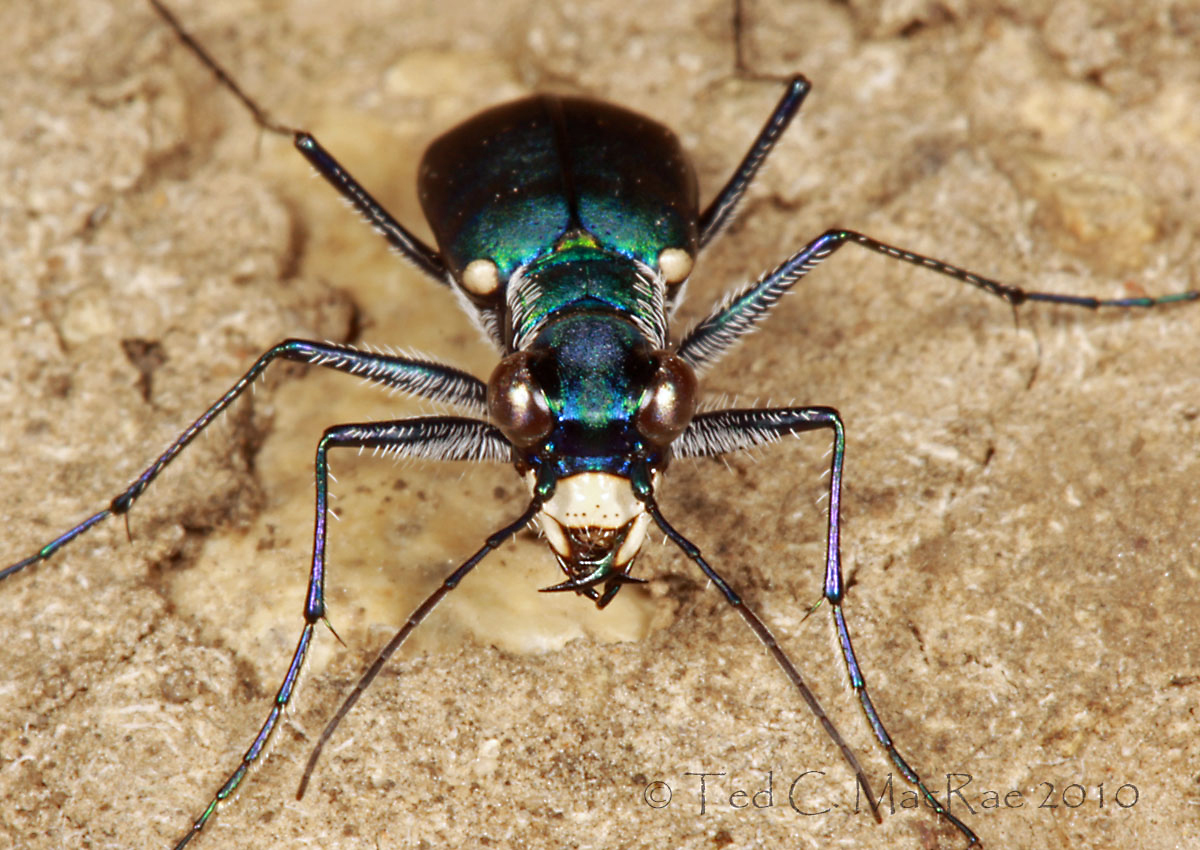
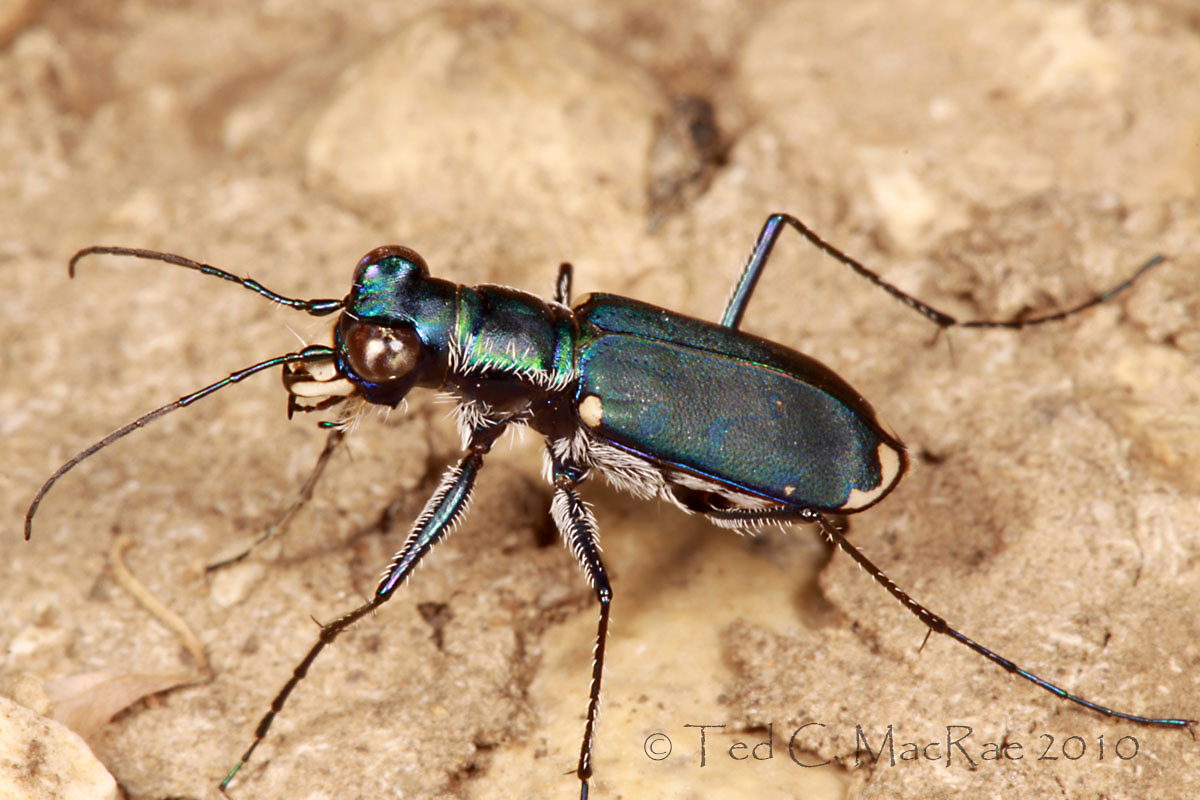
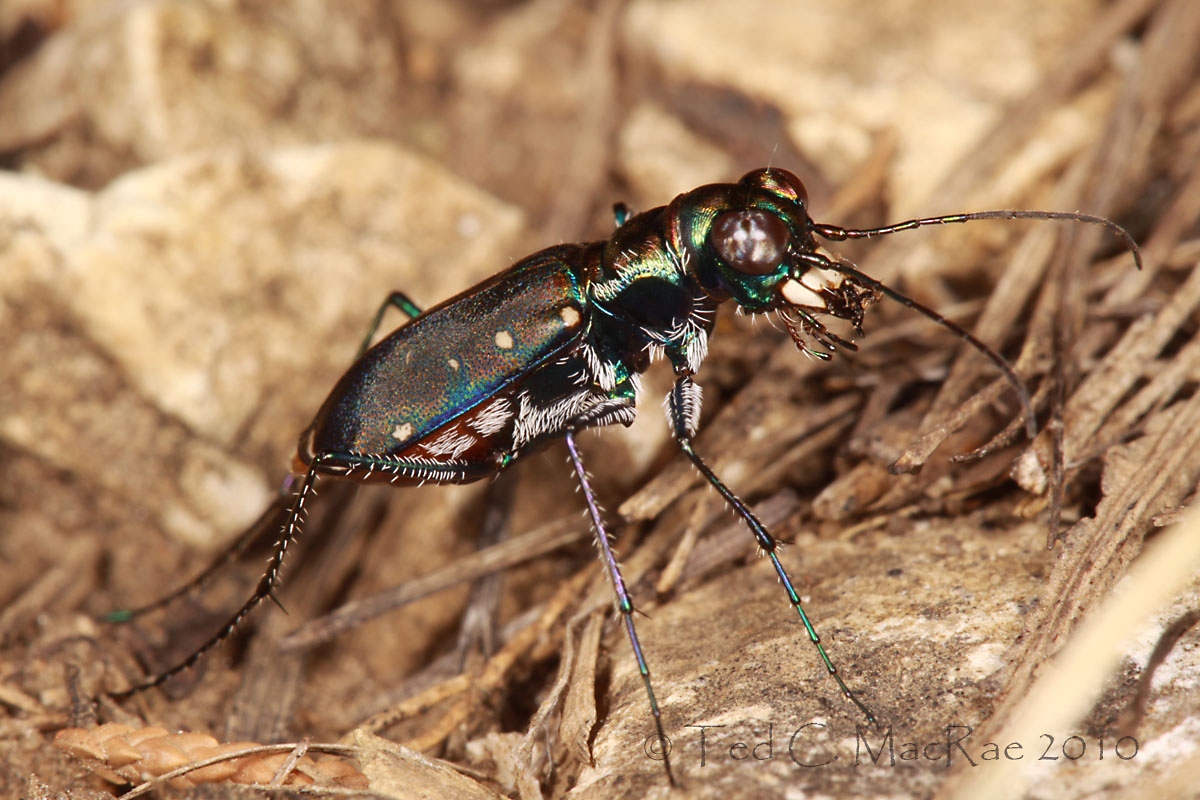
Regular readers of this blog might recognize this as the swift tiger beetle, Cylindera celeripes. This tiny, flightless beetle was once common in the central Great Plains; however, the species has experienced dramatic declines over the past century due to near complete destruction of its preferred prairie habitats. By the time I first became interested in this species a few years ago, the Flint Hills of Kansas were its last known stronghold.
But that’s not what’s so special about this beetle.
My colleague Chris Brown and I began looking for this species as part of a survey of Missouri tiger beetles. Although not previously known from the state, historical records from loess hilltop prairie habitats in southwestern Iowa suggested that it might be found in extreme northwestern Missouri at the southern terminus of the Loess Hills landform. Earlier searches in this part of the state by us and others had turned up empty; however, it was easy to imagine that the beetles had eluded detection due to their small size, cryptic resemblance to ants, and limited temporal occurrence. In an effort to understand more specifically its habitat preferences and gain a better search image for the species, we visited one of the historical Iowa localities in 2008 and succeeded in finding the species ourselves for the first time.
But that’s not what’s so special about this beetle.
Armed with this experience, Chris and I conducted another dedicated search for this species in Missouri during 2009, targeting the largest and highest quality loess hilltop prairie remnants remaining in the state. At last, our efforts were rewarded when we found beetles in several loess hilltop prairie remnants in Atchison and Holt Counties. Their numbers were not high at any of the sites, but the finds nevertheless represented a new state distribution for a species that has only seen contractions to its known range for many years now.
But that’s not what’s so special about this beetle.
A few weeks before finding the beetle in Missouri, I had an opportunity to visit Alabaster Caverns State Park in northwestern Oklahoma, where BugGuide contributor Charles Lewallen had photographed the species in 2003. I not only succeeded in finding the species at the original locality but determined also that its population there was quite robust. Indeed, on the same trip I discovered robust populations at several nearby localities, suggesting that the species occurrs commonly throughout the red clay/gypsum hills of northwestern Oklahoma. Further observations of the species in northwestern Oklahoma last month seem to confirm this. The beetle in these photographs comes from Alabaster Caverns, but that’s not what’s so special about it.
What is so special about it is that it’s the first ever reared individual of this species! For those of you wondering why this is significant, until now the immature stages of this species have remained completely unknown. A few contemporary students of the group have tried to rear the species, but the adults are delicate and do not travel well – indeed, my own first attempt to rear the species when I found it in Iowa was not successful. However, when I found the Alabaster Caverns population, I placed ~12 adults in a small terrarium into which I had placed a chunk of native soil and moistened with water. The adults survived well in this terrarium over several days of travel, and once back in the lab I kept them alive for several weeks by feeding them small caterpillars and fruit flies. When larval burrows began to appear I fed them periodically with very small caterpillars and rootworm larvae, inserting them into individual burrows and sealing the burrow entrance to prevent their escape. Additional prey larvae were inserted into burrow entrances as they were reopened, and the soil in the terrarium was moistened whenever its surface became quite dry. By late October, all of the burrows had become inactive, and I wasn’t sure if the larvae had died or were just overwintering. Nevertheless, I placed the terrarium in a cool (10°C) incubator, where it remained until this past March when I pulled it out of the incubator and returned it to warmer temperatures. Within days, larval burrows reappeared, and I knew then that I had a decent chance of rearing the species to adulthood. In early July, the beetle in these photographs emerged from its burrow – the first ever reared swift tiger beetle! Several more adults emerged during the following 2-3 weeks.

While this rearing was in progress, I managed to find larvae of this species on a return trip to Alabaster Caverns last October. Both 2nd- and 3rd-instar larvae were collected and preserved to go along with the preserved 1st-instar larva that I had extracted from the rearing container when larvae first began to appear. While these preserved specimens are all that I need to complete a manuscript describing the larval instars, having reared the species completely from egg to adult as well will provide a most gratifying conclusion for that manuscript.

Copyright © Ted C. MacRae 2010


 Email to a friend
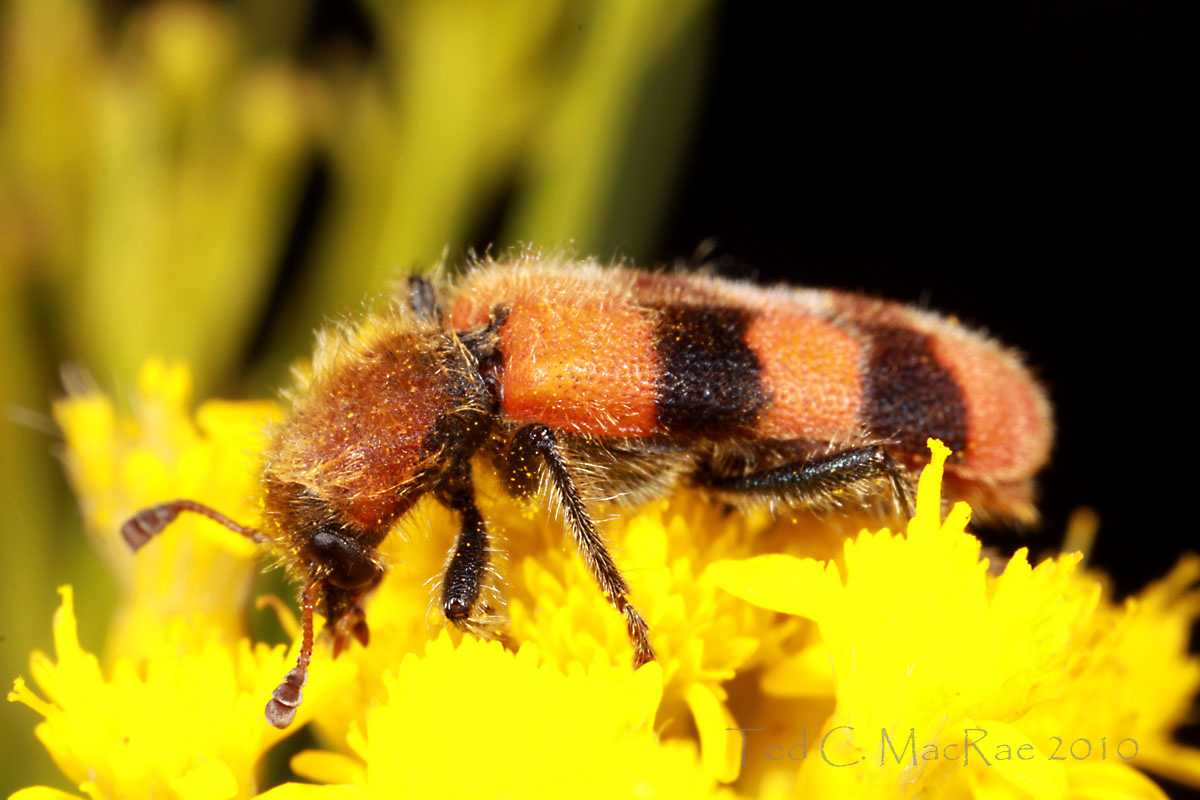 Among checkered beetles (family Cleridae), the genus Trichodes contains among the largest and most strikingly-colored species. The 11 North American species of this predominantly Holarctic genus are primarily western in distribution, although two species (T. nuttalli and T. apivorus) do occur in the eastern U.S. The individual in these photos was one of several I encountered feeding on the flowers of a yellow composite in the Gloss Mountains of northwestern Oklahoma during early July. I take them to represent the species T. bibalteatus based on their close resemblance to the holotype of that species from the LeConte Collection in the Museum of Comparative Zoology at Harvard University. While these photographs are admittedly far from perfect, they were about the best I could manage at the time considering the gusty post-storm winds that I encountered atop the mesa where these beetles were found (along with my continuing difficulty in achieving proper exposure with subjects on bright yellow flowers).
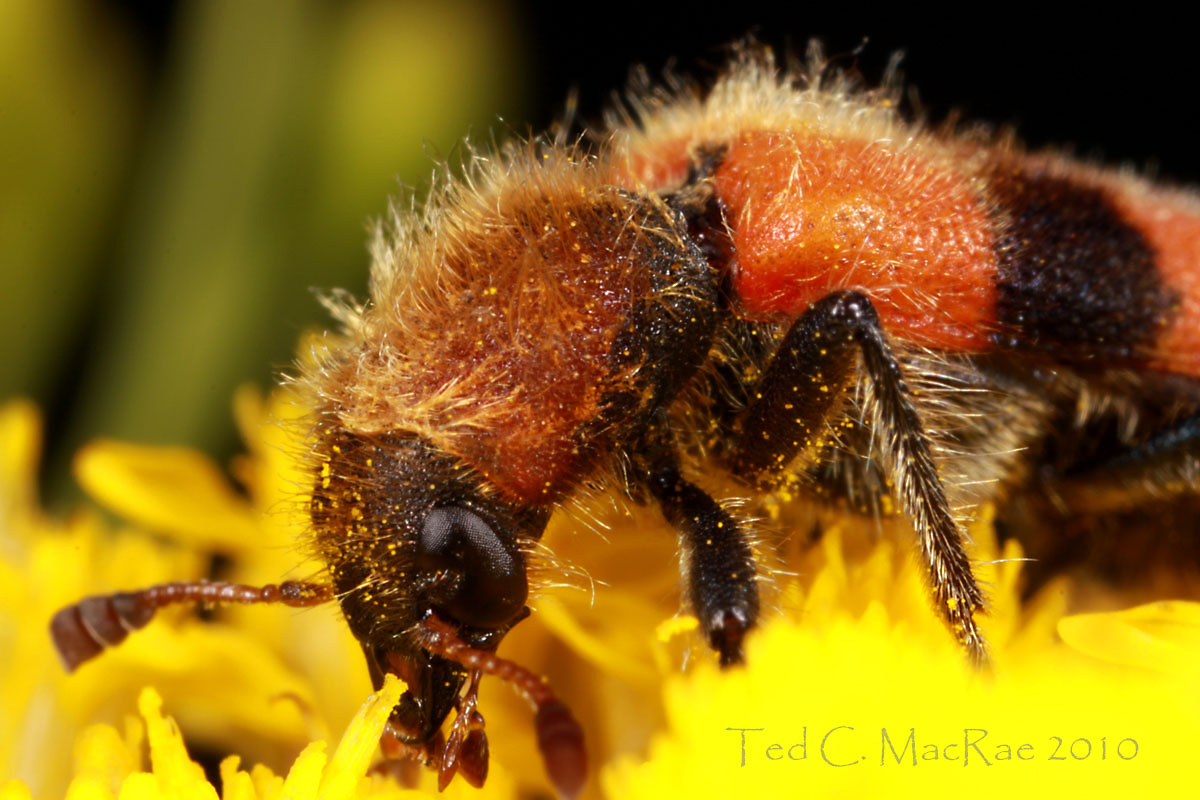 The striking colors of adult Trichodes and their frequent association with flowers for feeding and mating belies a more treacherous aspect of their life history. While adults may serve as important pollinators of native plant species (Mawdsley 2004), they also lay their eggs on flowers. The larvae that hatch from these eggs don’t eat the flower itself, but rather attach themselves to bees and wasps that visit the flower as they gather pollen for provisioning their own nests (Linsley & MacSwain 1943). The larvae hitch a ride back to the hymenopteran’s nest, where they then prey on the developing brood and usurp pollen provisions for themselves.




 Beetles In The Bush