Observation and Bias in Biology

The following is a guest post by my friend Kent Fothergill. Read more of Kent’s musings at his blog, biologistsoup.


Observation is a key activity in scientific inquiry. People who work with insects can make many interesting observations from collected insects: distribution, phenology, etc. Observations can be documented and analyzed later from photographs. A collection of photographs can also yield information about: associations with other species, behavior, while providing the same information as collected specimens – as such photography is a new tool changing entomology. Of course, most observations are made using only human senses without photographic or specimen documentation, but all observations can be subject to biases.

Observer biases are our evolutionary legacy. Our brains evolved to process and interpret data based on patterns observed in previously processed data. Because of the vast amount of data flowing in from our five senses and our limited ability to focus on data, our brains let most data be background. Even the subset of data that we focus our attention on is filtered, who hasn’t taken a photograph and found something much more interesting in the photograph than the original subject (e.g., these mites on harvestmen)? All data, even the data subset we are focused on can be misinterpreted. When teaching scientific methods, my students always enjoyed the optical illusion exercises to demonstrate why objective analyses and accurate measurement are important.

Remember, that the brain also compares incoming data to previous data. This allows pattern recognition. Recently, Ted and I were blacklighting along the Mississippi River in Southeast Missouri. We found a pair of Elaphidion mucronatum (spiny oak borer) a very common insect in Southeast Missouri. So common that many would move on to other more interesting subjects at that point. The insects were in a mate guarding situation.  Because I had a name for the behavior, my brain put my observation in the mate guarding category. At this point I would have moved on, except Ted wished to document the subject with his camera rig, which meant I would do what any friend should: watch the insects while Ted ran to vehicle to get his camera so he would be able to photograph them. While Ted was gone things got interesting. The male was positioned above the female, who was more or less caged between his legs. The pair was moving in unison on the tree trunk with very little actual contact between the pair. This was interesting, but when the female E. mucronatum suddenly shot out from under the male ending up 10’ vertical below him on the side of the tree trunk I was stunned. The male covered this distance with amazing speed and recaptured the female. After a couple minutes the female again shot out from under went down a few feet and doubled back ending out of sight above the male. At this point the male remained motionless for a brief period. When Ted came back with his camera, I took my eyes off of the male to tell him about what I had seen, and the male had vacated the area. Later, on the very same tree, we saw a mate guarding pair (presumably the same individuals) coming down towards us.

I have viewed many mate guarding insects. Mate guarding is a male insect using its body to prevent other males from mating with this female. Evolutionary biologists will explain mate guarding behavior in terms of enhanced male reproductive success, and that is why mate guarding persists. I never questioned this explanation, but should have. The E. mucronatum observation caused me to see mate guarding in a new way and realize that mate guarding involves a male and female component – I know this seems obvious, but I had my own cultural bias to overcome in this regard. I had never considered that mate guarding could involve non-willing females.

Based on a 10 minute observation of a very common insect my new understanding of mate guarding now recognizes that mate guarding influences female fitness also. Mate guarding persists when it creates a change in fitness in the male and female such that there is a positive net change in fitness for reproductive output for all individuals involved. In the case I witnessed, there may actually be a reproductive cost for the female and that is why she tried to avoid/escape the mate guarding. I have much more to learn about mate guarding.

Science is a way of objectively seeing the world and testing what you have seen to approach truth. This observation of E. mucronatum was also a mirror that showed my cultural bias and how that bias influenced my interpretation of my observations. For me, this observation could be a watershed event.

The moral(s) of this story:

  1. Life is short: enjoy time in the field with friends.
  2. Pay attention. There are new and wonderful things to observe even in the common and mundane.
  3. Be aware of the biases that can keep you from the truth.
  4. Have fun out there!

Copyright © Kent Fothergill 2013

Friday Flower: Phacelia purshii

Phacelia purshii (Miami mist) | Sam A. Baker State Park, Wayne Co., Missouri

It’s been rather a long time since I’ve featured a botanical subject here, so it seems a good time to resurrect my “Friday Flower” meme with this delightful little wildflower seen on my birthday field trip a few weeks ago. Phacelia purshii (family Hydrophyllaceae), also known as Miami mist, is one of only four species in this rather large genus (159 species in North America according to the USDA Plants Database) found in Missouri. Though the flowers are small, their deeply fringed petals are quite striking. The late Dan Tenaglia¹ notes at his Missouriplants.com website that the species is limited in Missouri to the extreme eastern portions of the state—the plant shown here was one of several I saw in rich, bottomland forest along Big Creek at Sam A. Baker State Park in Missouri’s southeastern Ozark Highlands.

¹ Dan Tenaglia was not only an expert botanist but a enthusiastic cyclist. He died in February 2007 after being struck by a car while riding his bicycle. Dan’s wife has kept Missouriplants.com up and running since then in honor of his passion for plants. You can help support its maintenance by making a donation to the “Dan Tenaglia Foundation”: 1416 Victoria Avenue, Opelika, Alabama 36801.

This particular woods is one of the richest I’ve seen in the state, and in the past two years I’ve featured a number of interesting plants (Phlox bifida and Tradescantia longipes), invertebrates (Drosphila sp., Magicicada sp.Calosoma scrutator, Pleuroloma flavipes, Graphisurus trianguliferG. fasciatus, Arrhenodes minutus, Neoclytus scutellaris, Corydalus cornutus and Panorpus helena) and even snakes (Crotalus horridus and Agkistrodon contortrix phaeogaster) from there. This year marks the third consecutive birthday that I’ve visited these woods, and since I’ve found something I’ve never seen before each time (hint: just wait till you see what I still have coming from there!), I have a feeling the trend will continue next year as well.

Copyright © Ted C. MacRae 2012

Adult male Hentzia palmarum jumping spider

Hentzia palmarum, adult male | Scott Co., Missouri

A brief break from photos from Argentina. Last week—just a few days after returning from my 8-week absence—I visited two of the sand prairie preserves in Missouri’s southeastern lowlands to try to photograph individuals from the unique, disjunct population the Festive Tiger Beetle (Cicindela scutellaris) found down there. Spring was well underway in the area, but several days of cold and rain seemed to have sent the tigers into their burrows until warmer temperatures returned. I spotted some Hibiscus lasiocarpus plants growing along the edge of a low wet spot adjacent to the prairie, so I started peering into their still unfurling leaves in hopes of finding the jewel beetle Paragrilus tenuis that utilizes the living stems of plants of this genus for larval development, but even they seemed to be awaiting balmier days. As I peered down into the leaves of one plant I notice a flick of movement, and carefully peeling apart the leaves revealed this adult male of the diminutive jumping spider Hentzia palmarum. Something was odd about this spider, and I finally realized the little guy was missing one of his characteristically enlarged and darkened front legs.

Note the elongated chelicerae.

Despite its missing leg, I became determined to photograph this spider. It certainly did not wish to be photographed, and perhaps that is the reason why. I gently snipped the leaf it was sitting on and held it in front of the camera, but every time I turned the leaf towards the camera it cowered and zipped around to the backside. Several times it attempted to flee by jumping off the leaf, but each time I pulled it back up by its thread before it hit the ground and lowered it back down onto the leaf again. Eventually I got a few shots I could live with. Of course, then I found this photo by Thomas Shahan (he describes it as “not a great photo…”) and almost felt embarrassed to show these here. Maybe I’d better stick to photographing tiger beetles!

The enlarged and conspicuously colored front legs of the males almost certainly serve some function in courtship. However, there seems to be no discussion of this in a recent revision of the genus (Richman 1989), and my further search for information about this only turned up one paper by Crocker & Skinner (1984). I really couldn’t understand anything the paper said, so for now I’m left with my presumptions that the legs are used as flags of sort—both to females to signal his availability and willingness as well as other males with more threatening intentions.

REFERENCES:

Crocker, R. L. & R. B. Skinner. 1984. Boolean model of the courtship and agonistic behavior of Hentzia palmarum (Araneae: Salticidae). The Florida Entomologist 67(1):97–106.

Richman, D. B. 1989. A revision of the genus Hentzia (Araneae: Salticidae). Journal of Arachnology 17:285–344.

Tiger Beetle Nocturnal Perching

Ellipsoptera hamata lacerata | "Road to Nowhere" Dixie Co., Florida

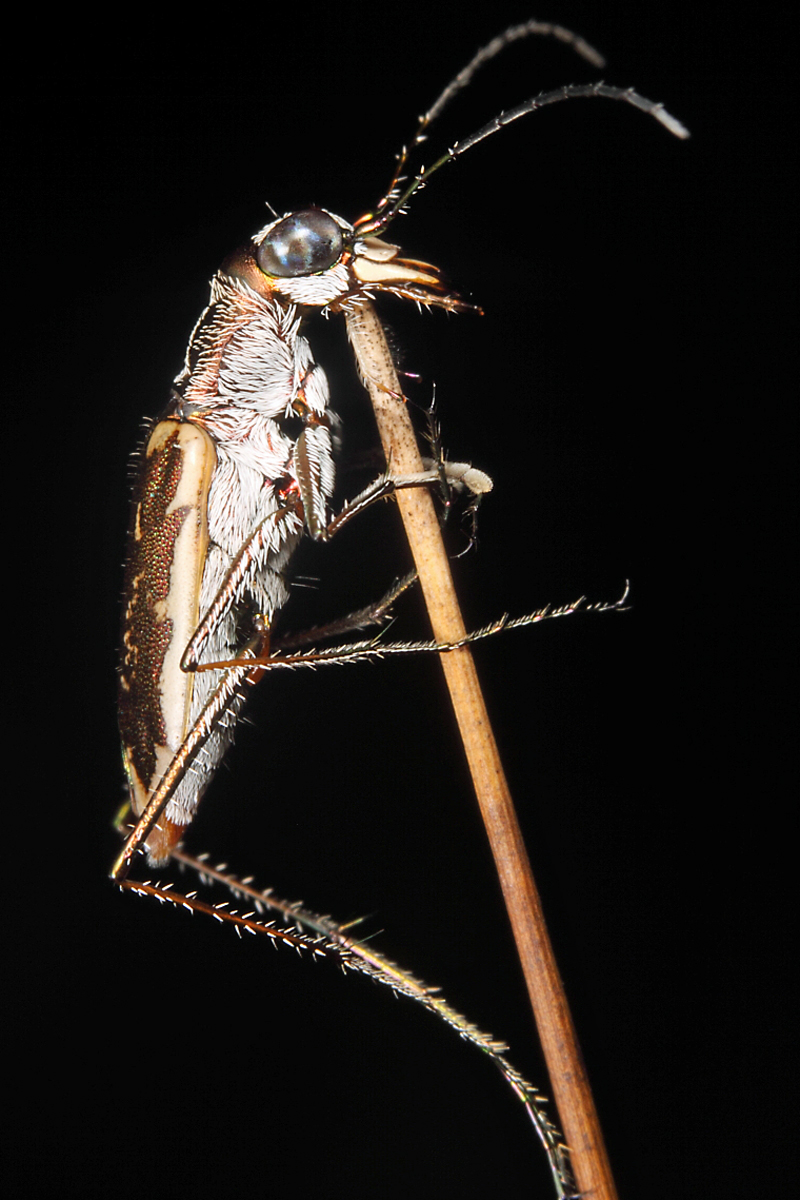
During last week’s 48-hour blitz through Florida, I spent one evening blacklighting at the famed “Road to Nowhere” tiger beetle hot spot and encountered this male individual of Ellipsoptera hamata lacerata¹ clinging to the grass near my light.  A quick search of the surrounding area revealed a number of similarly perched individuals, including a mating pair and all representing the same species.

¹ Males (identified by the brushy pads under the foretarsi) of this species are distinguished from the closely related E. marginata, which co-occurs with E. hamata lacerata along the Gulf coast of Florida, by the lack of a distinct tooth on the underside of the right mandible.

Like many species in this and related tiger beetle genera, E. hamata is diurnal but also highly attracted to lights at night. This is thought to be related to nocturnal dispersion behaviors (Pearson and Vogler 2001) intended to avoid higher daytime predation risks. Nocturnal perching on foliage is also common among diurnally-active species in riparian habitats and seems also to be an adaptation for reducing predation. Pearson and Anderson (1985) noted that perched beetles removed from the grass and placed on the ground were often quickly preyed upon by larger nocturnally-active tiger beetles. At “Road to Nowhere” this might include the slightly larger Habroscelimorpha severa which occurred in enormous numbers alongside this species on the mud flats, or the much larger Tetracha virginica which occurred in fair numbers on the adjacent road.

REFERENCES:

Pearson, D. L. and J. J. Anderson.  1985. Perching heights and nocturnal communal roosts of some tiger beetles (Coleoptera: Cicindelidae) in southeastern Peru.  Biotropica 17(2):126–129.

Pearson, D. L. and A. P. Vogler. 2001. Tiger Beetles: The Evolution, Ecology, and Diversity of the Cicindelids.  Cornell University Press, Ithaca, N.Y., xiii + 333 pp.

Copyright © Ted C. MacRae 2011

Answer to ID Challenge #4 – Aetalion reticulatum

Aetalion reticulatum female guarding her egg mass - São Paulo state, Brazil.

ID Challenge #4 seems to have been a little more difficult than I anticipated – only a few people mustered the courage to even hazard a guess, of whom TGIQ emerged with maximum points to take the win.  Looking sort of like a cross between a leafhopper (family Cicadellidae) and a treehopper (family Membracidae), Aetalion reticulatum is one of a few species and the only genus comprising the family Aetalionidae.  While lacking the pronotal processes that characterize species in the much more diverse and better known Membracidae, aetalionids are nevertheless considered treehoppers as well, along with another little-known family Melizoderidae.  As a whole, the Aetalionidae + Melizoderidae + Membracidae form a sister group to the Cicadellidae (Deitz and Dietrich 1993), which combine to form the most diverse and successful lineage of sap-sucking phytophagous insects. 

Like many treehoppers, A. reticulatum exhibits ant-mutualistic and presocial behaviors; however, it remains unclear whether these behaviors were acquired separately by each treehopper lineage or if they represent retention of a more primitive condition (sorry, Alex – it’s just easier to say it that way than deal with terms such as ‘retained plesiomorphy’ and ‘phylogenetic conservatism’).  Aetalion reticulatum occurs broadly in the New World tropics, where females can often be found perched on top of their egg masses.  Some (but not all) guarding females make periodic sweeps of the hing legs down the sides of the egg mass, apparently to dislodge egg parasitoids and discourage further attack (Preston-Mafham & Preston-Mafham 1993).  Ant-mutualistic relationships and the tendency to form colonies provide additional protection from predators.

Now is a good opportunity to summarize the ‘1st BitB Challenge Series’ overall standings – Ben Coulter maintains his overall lead by gaining points in every challenge.  TGIQ climbs into 2nd place with this week’s win, and tceisele leap frogs over several contestants to tie Janet Creamer for the 3rd podium spot (and gets the nod for more frequent participation).  It’s no real surprise that the most frequent players took the top spots.  At this point, I’m going to call a close to the 1st series and declare Ben Coulter the overall series winner – contact me for your loot!  To the rest, thanks for playing, and now that you know how this game works maybe you’ll think about making a move for the 2nd series win!

Place Commenter IDC SSC IDC IDC IDC #4 Total
1 Ben Coulter 9 14 9 4 4 40
2 TGIQ 8 5 10 23
3 tceisele 3 8 3 14
4 Janet Creamer 14 14
5 James Trager  6 5 11
6 Dave 11 11
7 Christopher Taylor 7 3 10
8 Dave Hubble 6 2 8
  JasonC 5 3 8
10 Charley Eiseman 7 7
  Delbert La Rue 7 7
  jason 7 7
  Techuser 7 7
14 Richard Waldrep  6 6
15 Alex/Watcher 2 2
  dragonflywoman 2 2
  nellie 2 2
16 Brady Richards  1 1
  Francis 1 1
  macroinstantes 1 1
  Margarethe 1 1
  Mark Deering  1 1
  Andrew 1 1

REFERENCES:

Deitz, L. L. and C. H. Dietrich.  1993.  Superfamily Membracoidea (Homoptera: Auchenorrhyncha). I. Introduction and revised classification with new family-group taxa.  Systematic Entomology 18(4):287–296.

Preston-Mafham, R. and K. Preston-Mafham.  1993.  The Encyclopedia of Land Invertebrate Behaviour.  The MIT Press, 320 pp.

Copyright © Ted C. MacRae 2011

Red-eyed Devil

In June 1994, I made my first insect collecting trip to Big Bend National Park.  Both of my previous visits to Texas had been to the Lower Rio Grande Valley, so I was anxious to see what beetle treasures awaited me in this huge chunk of western Texas.  For three days I sampled the astounding diversity of beetles found in the park’s low desert scrub, oak/juniper woodlands, and high pine forests, and on the final day I decided to visit the sotol grasslands – a transitional habitat between the desert and woodlands in the Chisos Mountains foothills.  Sotol (Dasylirion wheeleri) is the host plant of jewel beetles in the genus Thrincopyge – exquisitely beautiful beetles of metallic blue or green and vivid yellow.  Larvae bore through the plant’s dried flower stalks, while adults wedge themselves in the base of this agave-like plant, hidden from view by the plant’s long, strap-like, saw-toothed leaves.  I had not yet seen these beetles for myself, so I began searching the through the plants – carefully prying apart the wicked leaves in hopes of seeing adults peering up from the base, and then using my foot-long forceps to extract them.  It’s a painful process, as no amount of care completely prevents the plant’s stout, recurved spines from impaling and ripping forearm flesh while trying to grab and pull out the beetles! 

While prying apart the leaves of one particular plant, I was startled by one of the most imposing-looking insects that I have ever seen as it jumped up on top of the foliage and assumed this decidedly aggressive posture.  Although I recognized it as some type of katydid, it was unlike any I’d seen before – large and robust, vivid green and yellow with flashing red eyes, its short spotted hind wings outstretched, spiny forelegs held high, and huge jaws spread wide open.  Her long dagger-like ovipositor only added to her impressiveness.  So spectacularly terrifying was its threat display that I couldn’t resist the opportunity to collect it for eventual mounting in life-like position.  I felt a little silly being scared of a katydid but nevertheless took great care to avoid getting my fingers anywhere near those jaws as I gingerly corraled it into a jar. 

Neobarrettia spinosa is also known as the greater arid-land katydid or spiny bush katydid, but I prefer the name that has been coined by some – “red-eyed devil”!  This species belongs to a small genus of primitive katydids largely restricted to northern Mexico, with only two species extending north into the south-central and southwestern U.S.  The black front edge of the pronotum and (in life) red eyes identify this individual as N. spinosa (N. victoria, also occurring in Texas, has the pronotal front edge green and the eyes pale).  Unlike most katydids, which have adopted omnivorous or hervivorous feeding habits, species of Neobarrettia and their subfamilial relatives are pure carnivores capable of capturing and consuming prey as large as themselves.  Its bulging eyes, elongate and heavily spined forelegs, and massively robust mandibles on a large head (presumably for enlarged mandibular musculature) clearly represent adaptations for predation (Cohn 1965).

The painting above from Cohn’s revision of the genus shows the true colors of a living female and its threat display.  I collected this specimen before the days of the internet or my own interest in photography, so I had nothing but my memory to guide me as I tried to recreate the threat display during mounting.  I got it mostly right but missed on a few details – the wings should have been placed more vertically, and the insect also rears back more on its hind legs to display the brightly colored cephalic portion of its abdominal venter.  I could try to relax and remount the specimen, but given its fragility and the fact that doing so would do little to make it any more imposing, I think the pose I have it in now is just fine.

This turned out to be a more difficult ID Challenge than I anticipated, but a record number of participants played along anyway.  Dave wins this challenge with 11 pts on the basis of a correct identification and entertaining logic to accompany it.  Ben Coulter was the only other person to correctly identify the genus and species, earning 9 pts for 2nd place, while BitB’s own James Trager and TGIQ share the final podium spot with 5 pts each.  Ben continues to dominate the overall competition with 32 pts now, but the battle for 2nd place has really heated up – Janet Creamer (14 pts) and TGIQ (13 pts) have the edge, but Dave (11 pts), James Trager (11 pts), and Christopher Taylor (10 pts) are all within easy striking distance.

REFERENCE:

Cohn, T. J. 1965. The arid-land katydids of the North American genus Neobarrettia (Orthoptera: Tettigoniidae): their systematics and a reconstruction of their history.  Miscellaneous Publications of the University of Michigan Museum of Zoology 126:1-179.

Copyright © Ted C. MacRae 2011

Halloween ID challenge answer – Argiope trifasciata

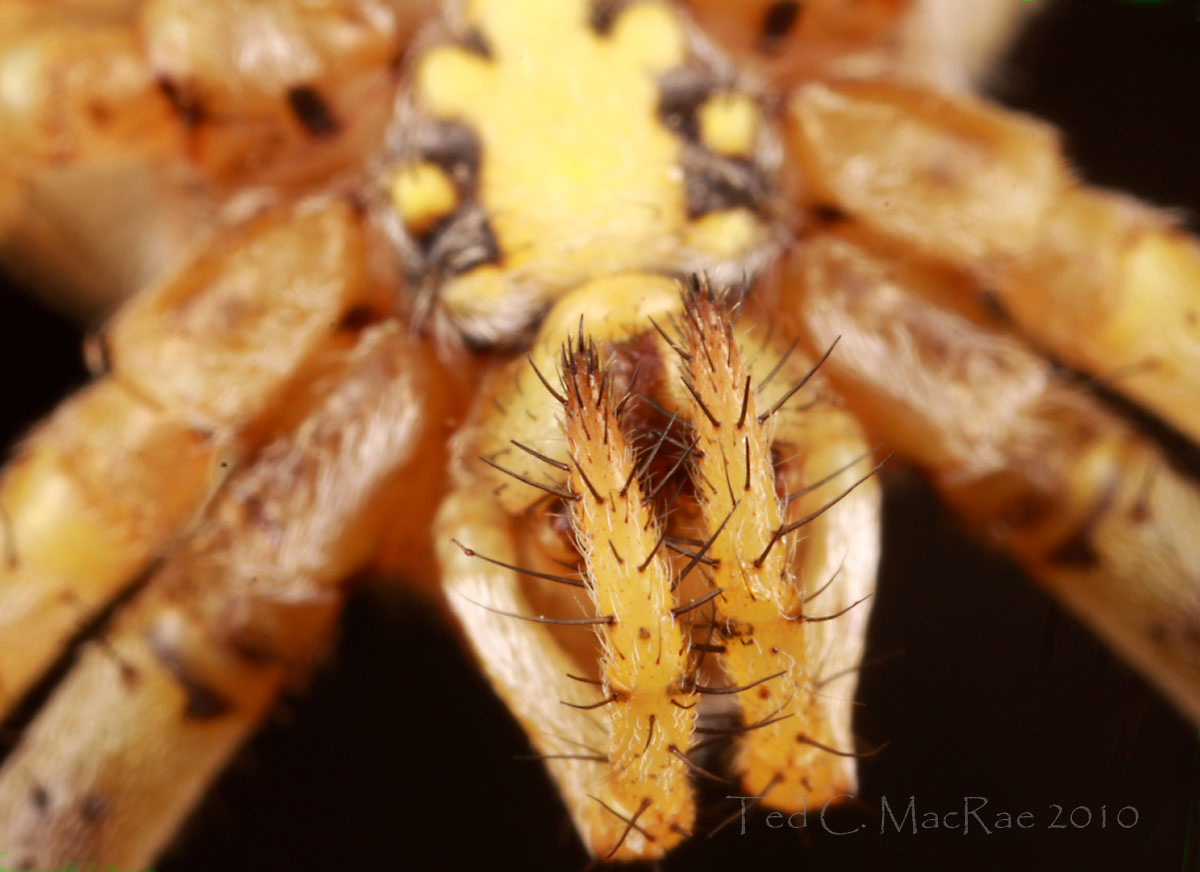
Here is another photo of the spider in the previous post with a closer view of its spiny pedipalps (mouth feeler thingys).  Troy Bartlett and BitB’s own James Trager got it right – the spider is, indeed, Argiope trifasciata, the banded garden spider (a.k.a. banded garden orbweaver, banded argiope, whitebacked garden spider, etc.).   I figured the genus would be easy, but the species might be a little tricky – at least for those in North America who might be tempted to conclude it was the larger A. aurantia (black and yellow garden spider, etc.).  The broken banding on the femora and generally lighter ventral coloration are usually enough to distinguish A. trifasciata from its more conspicuous congener.  Argiope trifasciata is also distinguished as one of the few truly cosmopolitan arthropod species, occurring naturally on all continents except Antarctica.

Both Troy and Dave Walter mentioned the conspicuous stabilimentum (heavy zig-zagging pattern) that Argiope spiders are perhaps best known for and that they often add to the center of their otherwise cryptic webs. Originally thought to possess a web-stabilizing function (hence the name), a variety of alternative explanations have since been proposed.  These include camouflage (to break up the body outline of the spider and make it less visible to predators), web protection (to make the web more visible to birds and prevent them from flying into and damaging it), prey luring (since it reflects ultraviolet light efficiently), thermal protection (by providing a shield against the sun), and a repository for excess silk.   An alternative hypothesis that I had not heard of but mentioned by Dave is that they serve as sponges for accumulating water for the spider to drink.  Webs with stabilimenta are more common and larger in exposed versus sheltered locations, and a recent study by Blackledge and Wenzel (1999) using A. aurantia found that webs with a stabilimentum suffered significantly less damage from birds (45% on average) than those without, but that they also caught fewer insects (34% on average).  The presence or absence of a stabilimentum, however, was not a significant factor in predation of the spiders by birds.  This implies not only a web protective function for the stabilimentum, but that there is an evolutionary trade-off between web protection and foraging success.  These authors concluded that variation in stabilimenta might be accounted for by a cost—benefit trade-off and that the decision by the spider to include a stabilimentum when building a web may be influenced by external factors such as prey density and web exposure.

Specific to A. trifasciata, a less well known but equally interesting aspect of its behavior is the use of web orientation for thermoregulation.   Tolbert (1979), in a study conducted in the southeastern US, found that web orientation was non-random during the hottest part of the summer, when spiders largely occupied east-west oriented webs with their silver/white dorsal surfaces facing south and their dark ventral surfaces facing north, and during October when the situation was reversed.  Orientation of the white/silver dorsal surface towards the sun presumably is done to help lower body temperatures, while orienting the ventral surface of the spider, which changes from silver to black as the spider reaches maturity, would maximize solar radiation for heat gain.  In contrast, Ramirez et al. (2003) found the species in coastal southern California never oriented their webs in a non-random fashion – rather, they always oriented them along an east-to-west axis with the mostly dark ventral surface of their abdomens facing south.  They suggested that dealing with a high heat load is not a significant problem in the predominantly cool environment of coastal southern California and that staying warm is the greater challenge for this mostly fall active species.

I’ll give 6 points to Troy for agreeing with me on everything, 4 to Dave for playing Devil’s advocate with the species and his unique alternative stabilimentum hypothesis, and 2 points to James for agreeing with Troy’s species ID. 🙂

Photo Details: Canon 50D w/ MP-E 65mm 1-5X macro lens (ISO 100, 1/250 sec, f/14), Canon MT-24EX flash w/ Sto-Fen + GFPuffer diffusers. Typical post-processing (levels, minor cropping, unsharp mask).

REFERENCES:

Blackledge, T. A. and J. W. Wenzel. 1999. Do stabilimenta in orb webs attract prey or defend spiders? Behavioral Ecology 10(4):372–376.

Ramirez, M. G., E. A. Wall and M. Medina. 2003. Web orientation of the banded garden spider Argiope trifasciata (Araneae, Araneidae) in a California coastal population. The Journal of Arachnology 31:405–411.

Tolbert, W. W.  1979. Thermal stress of the orb-weaving spider Argiope trifasciata (Araneae).  Oikos 32(3):386–392.

Copyright © Ted C. MacRae 2010

Bruneau Sand Dune tiger beetles caught in the act!

ResearchBlogging.orgThe newest issue of CICINDELA (“A quarterly journal devoted to Cicindelidae”) contains an interesting article by my good friend and fellow tiger beetle enthusiast Kent Fothergill, who presents a fascinating sequence of photos documenting a field encounter with a mating pair of the endangered Bruneau Sand Dune tiger beetle (Cicindela waynei) (Fothergill 2010).  This is one of several tiger beetle species in the C. maritima species group that inhabit sand dunes in central and western North America – others include the Coral Pink Sand Dune tiger beetle (C. albissima), the St. Anthony Sand Dune tiger beetle (C. arenicola), the Colorado dune tiger beetle (C. theatina), and the sandy tiger beetle (C. limbata).  With the exception of the latter, these species show highly restricted distributions in their preferred sand dune habitats, and because their populations are so small they are especially vulnerable to drought and ever-increasing anthropogenic pressures (i.e., invasive plants, motorized vehicular traffic, overzealous collectors).  While the Bruneau Sand Dune tiger beetle has not been accorded status on the Endangered Species List, the Idaho Department of Fish and Game and the Bureau of Land Management have classified it as globally imperiled.

Bruneau Sand Dune tiger beetle, Bruneau Sand Dune State Park, Idaho. Photo © Kent Fothergill 2009.

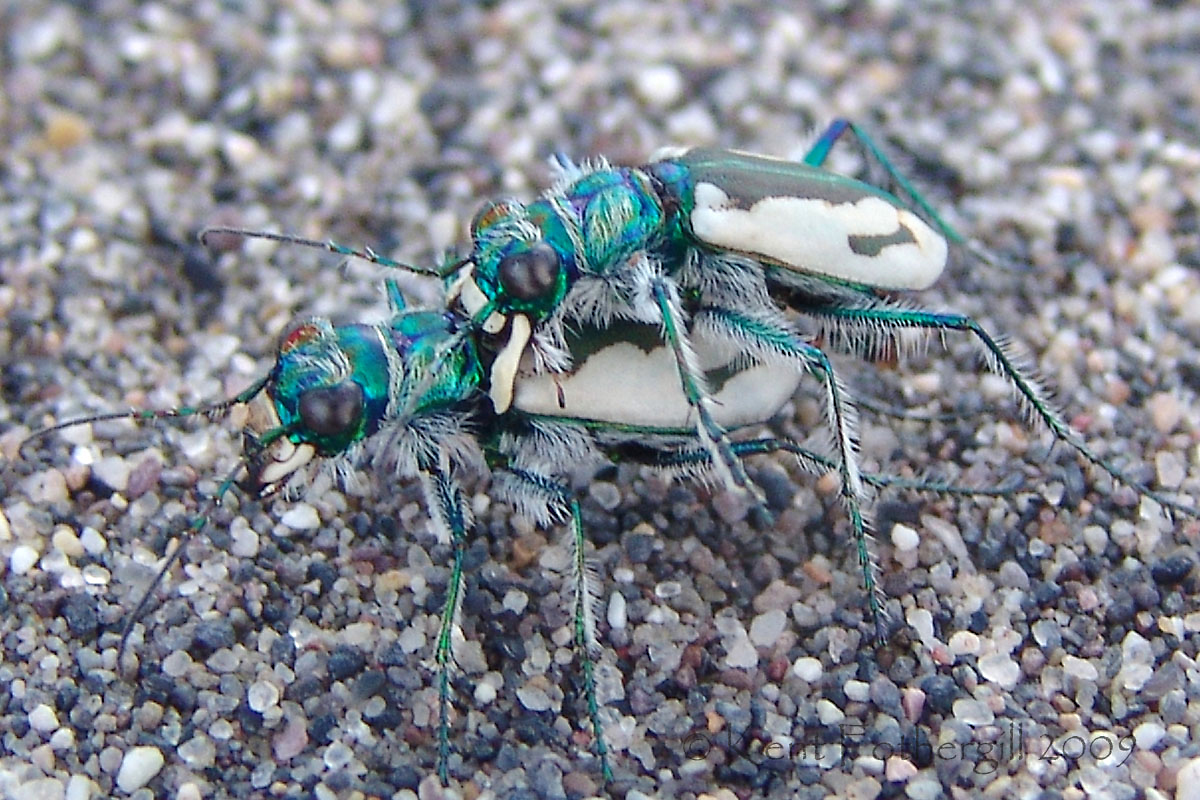
Kent was observing these beetles in Bruneau Dune State Park in southwestern Idaho – the main habitat for this species – when he encountered several pairs of C. waynei in the process of mating.  Photographs were taken of one mating pair, revealing a fascinating sequence of behaviors that included vigorous but unsuccessful attempts by the female to dislodge the male, eversion and penetration of the female by the male aedeagus, and subsequent mate guarding (see photo above).  It is, in fact, this latter behavior that is most often observed among tiger beetle mating pairs and not actual mating itself, which is only rarely observed.  Kent noted the uniquely modified male mandibles (see photo below) and their possible role in preventing the male from being dislodged during the female’s initial protestations.

Male Bruneau Sand Dune tiger beetles sport impressive choppers! Photo © Kent Fothergill 2009.

This apparently is the first documented report of mating in this species, and its occurrence in May is considerably later in the season than Baker et al. (1997) speculated – significant because protection of 1st instar larvae is a management priority for conservation of this species.  The potential occurrence of 1st instars during a longer period of time is an important consideration for continued management of this species, as the Bruneau Sand Dune population continues to show evidence of decline despite the prohibition of insect collecting, cattle grazing, and off-road vehicles within the park (Bosworth et al. 2010).  Human trampling and pesticide applications to adjacent rangelands are continuing threats that have proven more difficult to manage.

My sincerest thanks to Kent Fothergill for presenting me the opportunity to review his manuscript prior to publication and allowing me to reproduce here two of his spectacular photographs of this gorgeous and rare species.

REFERENCES:

Baker, C. W., J. C. Munger, K. C. Cornwall and S. Staufer.  1997. Bruneau Dunes tiger beetle study 1994 and 1995.  Idaho Bureau of Land Management, Technical Bulletin 97-7, 52 pp.

Bosworth, W. R., S. J. Romin and T. Weekley.  2010. Bruneau Dunes tiger beetle assessment.  Idaho Department of Fish and Game, Boise, Idaho, 36 pp.

Fothergill, K.  2010. Observations on mating behavior of the Bruneau Dune tiger beetle, Cicindela waynei Leffler (Coleoptera: Carabidae: Cicindelinae).  CICINDELA 42(2):33–45, 7 color plates.

Copyright © Ted C. MacRae 2010

Add to FacebookAdd to DiggAdd to Del.icio.usAdd to StumbleuponAdd to RedditAdd to BlinklistAdd to TwitterAdd to TechnoratiAdd to Yahoo BuzzAdd to Newsvine

Email to a friend