North America’s most beautiful longhorned beetle

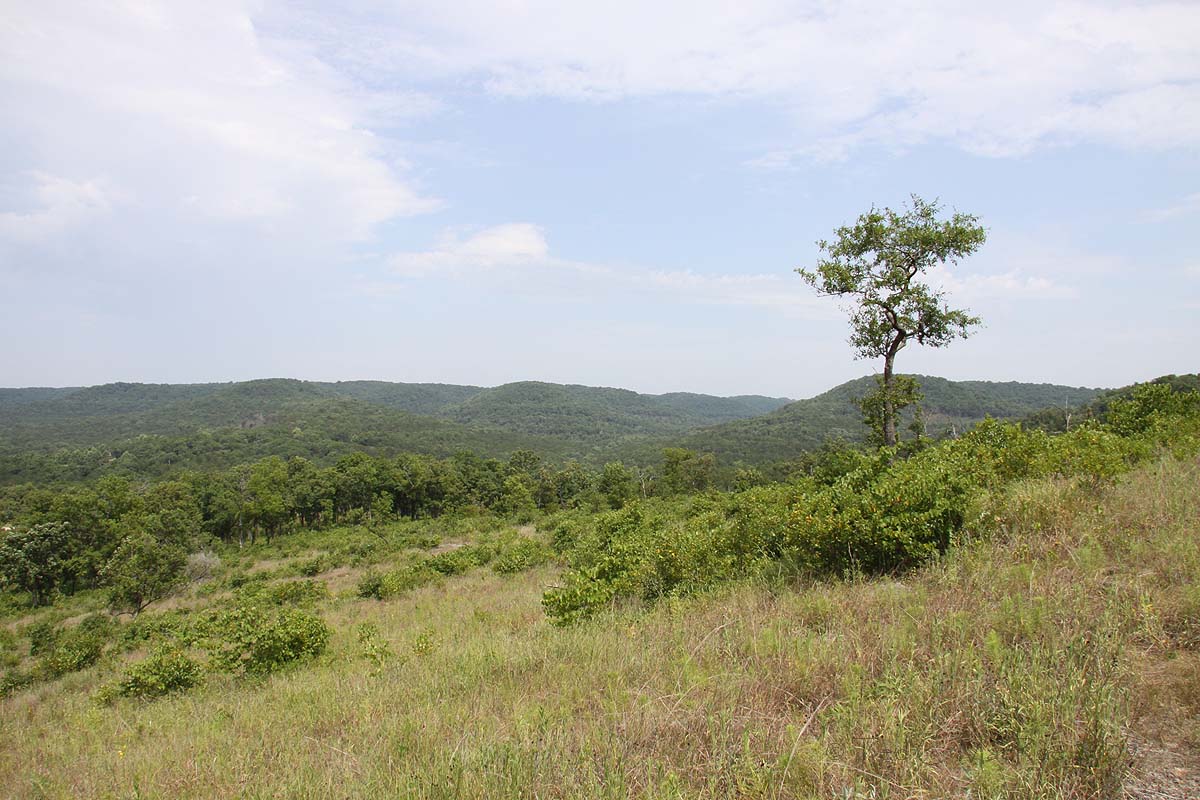
I’ve written a few posts in recent weeks highlighting some of the more interesting finds encountered during two visits this past July to the White River Hills region of extreme southwestern Missouri. It’s a land of extremes, with deeply dissected layers of limestone/dolomite bedrock supporting xeric glades, dry woodlands and riparian watercourses. The hilltop glades (“balds”), in particular, feature prominently in the region’s natural and cultural history and are the most extensive system of such habitat in Missouri. They support a number of plants and animals more characteristic of the grasslands of the south-central U.S., such as the recently featured Megaphasma denticrus and Microstylus morosum, North America’s longest insect and largest robber fly, respectively. Sadly, the glades in this region are much reduced in size and quality compared to their pre-settlement occurrence, primarily due to overgrazing and suppression of fire. These anthropogenic forces have combined to reduce overall vegetational diversity and accelerate encroachment by woody species (chiefly eastern red-cedar, Juniperus virginiana). Nevertheless, there still remain several high quality glade remnants in the area, and the public agencies charged with their conservation are increasingly utilizing mechanical removal of woody growth, controlled burns, and managed grazing in an effort to simulate the natural forces that mediated this landscape for thousands of years.
IMG_0871_1200x800

Chute Ridge Glade, Roaring River State Park, Barry Co., Missouri

My reason for returning to the White River Hills this year was simple—find and photograph the magnificent longhorned beetle, Plinthocoelium suaveolens (family Cerambycidae). This species, occurring across the southern U.S. from Florida and Georgia west to New Mexico and Arizona, is truly one of North America’s most beautiful longhorned beetles due to its large size, brilliant iridescent green coloration, and super-elongate wildly-contrasting orange and black legs.  Until recently, this species was known in Missouri only from sporadic records across the southern part of the state (MacRae 1994). I knew of its association with gum bumelia (Sideroxylon lanuginosum [= Bumelia lanuginosa], also called gum bully and woolly buckthorn), which was first noted by Missouri’s first State Entomologist, C. V. Riley (1880) and later discussed in detail by Linsley and Hurd (1959) and Turnbow and Hovore (1979); however, my repeated searches over the years whenever I encoutered this plant came up empty.  A few years ago, Chris Brown and I were conducting a survey of tiger beetles in the White River Hills and noted the relatively common occurrence of bumelia on these glades.  Bumelia, like P. suaveolens, is one of only a few North American representatives of a largely tropical group, and it is one of the few woody species naturally adapted to the xeric conditions found on these glades.  Recalling the association of P. suaveolens with this plant, and also recalling that adults could be attracted to fermenting baits of the type described by Champlain and Knull (1932), we placed fermenting bait traps on several glades in the area and succeeded in trapping a number of individuals during the month of July.  When I began searching the bumelia trees at these glades, I found adults perching on the lower trunks of several trees. It was the first time I’d seen live individuals of this species in Missouri.  At the time I was not a photographer, and that experience became one of the many moments that I would later look back upon and think, “If only I’d taken a picture of that!”  Thus, at the end of June this year, having successfully found Cylindera celeripes in Missouri on the first day of a planned 3-week search, my attention immediately turned to the new goal of finding P. suaveolens and photographing it on its host plant.

IMG_0929_1200x800

Sideroxylon lanuginosum (gum bumelia) at Blackjack Knob, Taney Co., Missouri

I knew this wouldn’t be easy—the beetles were not abundant when I had last observed them, and those that I did find were quite wary to my approach.  Getting within striking distance with a net was one thing; doing so with a camera and macro lens would be another thing entirely.  In my first trip to the area (early July), I went to Chute Ridge Glade, a magnificently restored glade in Roaring River State Park where I had seen the greatest number of individuals before.  I was full of optimism on that first day as I zigzagged across the rough terrain from one bumelia tree to the next, but my optimism began to wane as I cautiously approached each tree and saw nothing.  Within an hour, I’d looked at every bumelia tree I could find on the glade and not even seen a beetle, much less attempted a photograph.  It would take a 2-hour drive along twisting back roads to reach the other sizeable glade complex where I had seen beetles before (Blackjack Knob in Taney County), and another hour of searching on several dozen trees would again yield nothing.  By now I was feeling rather frustrated—the day’s oppressive heat and humidity had taken its toll, and my 4.5-hour drive from St. Louis was looling like it would be for naught.  I had noted that the bumelia flowers were almost but not quite open yet—perhaps it was too early in the season still?  
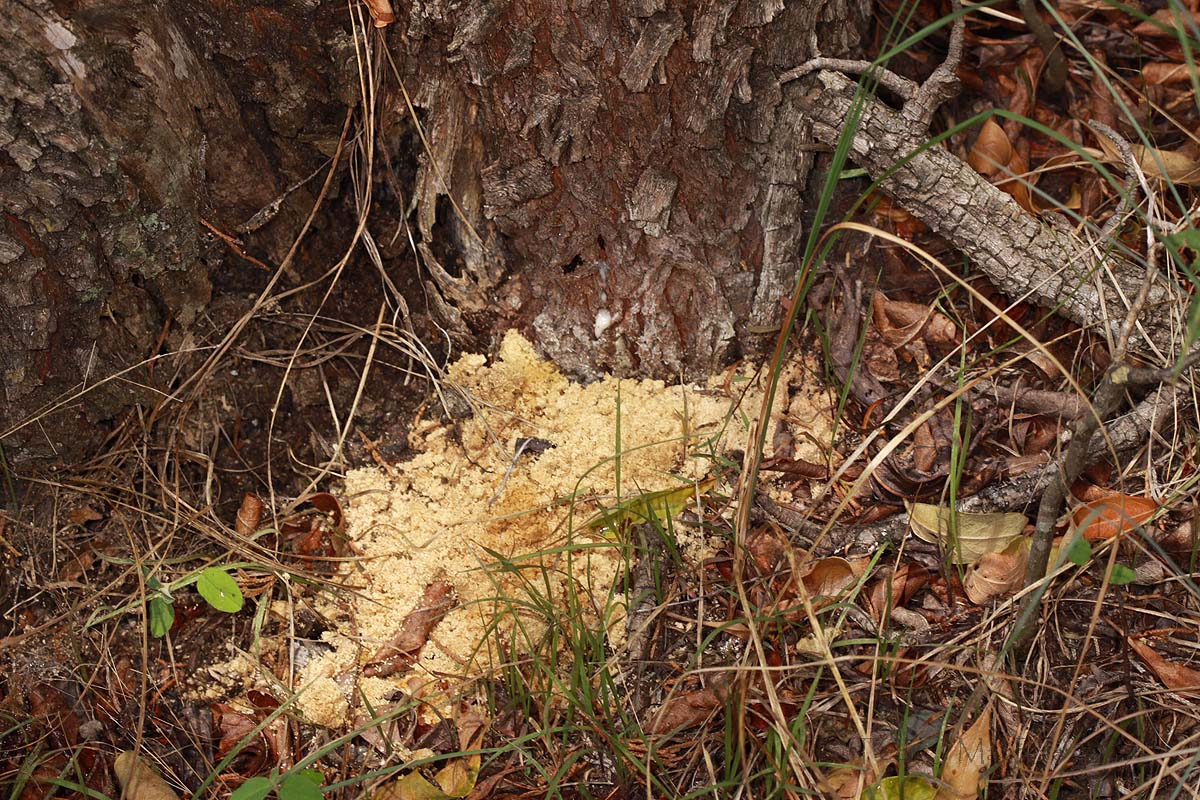
Plinthocoelium suaveolens larval frass pile at the base of living Sideroxylon lanuginosa

Plinthocoelium suaveolens larval frass pile at trunk base of living Sideroxylon lanuginosum

The remnant glades at Blackjack Knob are more extensive than those at Chute Ridge, so many more trees still awaited examination—if I could only muster the energy!  I trudged back to the truck, guzzled a nice, cold Powerade, and started off in another direction.  I looked at a number of trees and still had seen no sign of the beetle, but on one particular tree I noticed an enormous pile of sawdust on the ground at the base of the tree.  I looked at it more closely and saw that it had the rough, granular texture so characteristic of longhorned beetle larvae that like to keep their galleries clean, and its bright, moist  color suggested that it was being ejected by a larva tunneling through living wood.  I looked up into the tree above the pile to find where it was coming from but could find no ejection hole.  I checked the base of the trunk itself and still couldn’t find anything.  Then I started poking into the pile and felt a root.  Further poking revealed a soft spot on the root, and I immediately knew that I had found a P. suaveolens larval gallery—no other cerambycid species is known to bore in roots of living Sideroxylon, especially one as large as this based on the size of the frass pile.  I hurried back to the truck and grabbed my hatchet, returned to the tree, and scraped away the soil above the root to find an obvious ejection hole a few inches away from the base of the trunk.  I started chipped into the root at the ejection hole and found a large, clean gallery extending down the center of the root away from the trunk.  About 18” away from the trunk I found it—a large, creamy-white cerambycid larva.
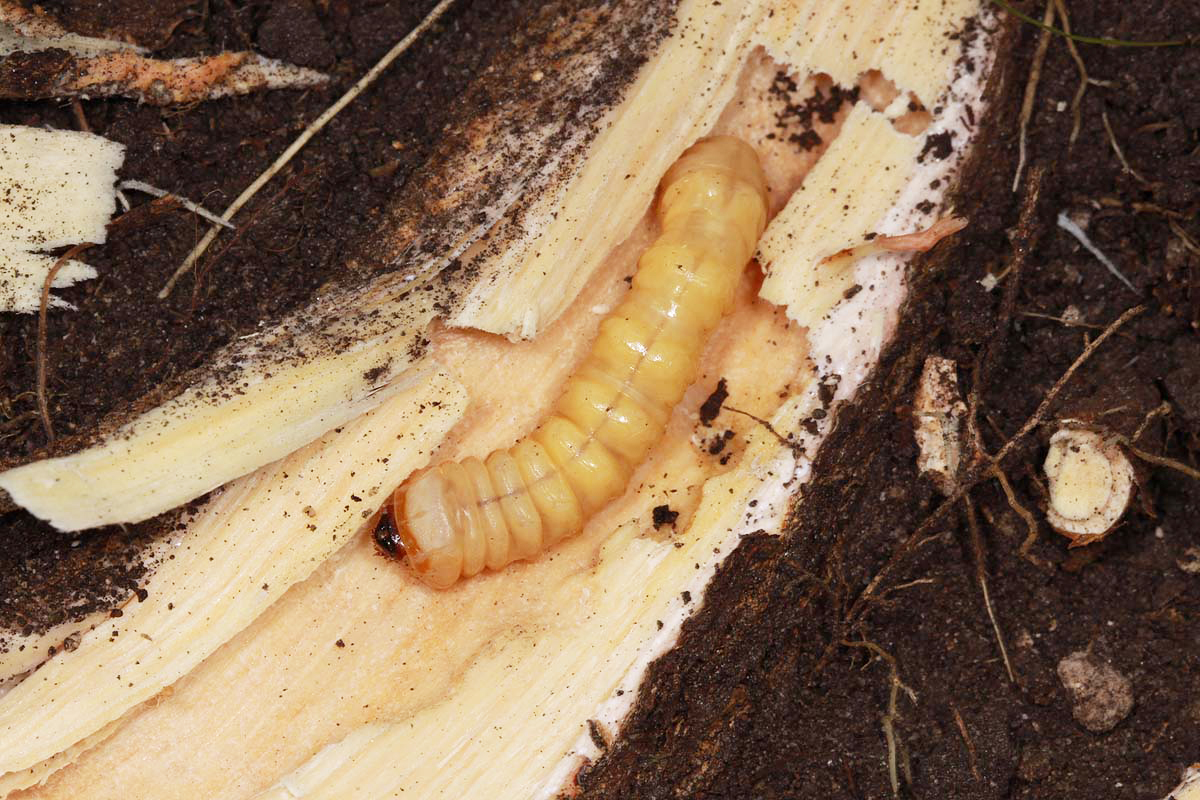
Plinthocoelium suavelones larva in root of living Sideroxylon lanuginosa

Plinthocoelium suaveolens larva in root of living Sideroxylon lanuginosum

Plinthocoelium suavelones larva in root of living Sideroxylon lanuginosa

Plinthocoelium suaveolens larva in root of living Sideroxylon lanuginosum

Finding a P. suaveolens larva was gratifying, but it wasn’t what I had come here to do, which was photograph the adult. After placing the larva live in a vial for preservation later on (dropping into scalding water to “fix” the proteins and prevent discoloration when stored in 70% ethanol), I continued searching the trees for adults.  I found one tree on which the flowers were just barely beginning to open and collected a few of the pedestrian species of scarabs that are attracted to bumelia flowers in droves when fully open (e.g. Cotinis nitidus and Trigonopeltastes delta)—for the record.  There was still no sign of adult Plinthocoelium, and I was on the verge of calling it a day when I approached another tree and saw it!  I froze, then slowly geared up with the camera and started stalking slowly towards it.  It was not in a very convenient location, down low on the trunk and partially screened by foreground vegetation.  I got close enough to start attempting some shots—not ideally composed, but just to ensure that I had something before I tried to get any closer.  After the third shot, however, it became alarmed and started to flee, and I had no choice but to capture it for a “studio backup.”  That taste of success gave me the motivation to resume my search, but no additional beetles were seen before a dropping sun put an end to the day.

Plinthocoelium suaveolens on lower trunk of living Sideroxylon lanuginosum

Plinthocoelium suaveolens on lower trunk of living Sideroxylon lanuginosum

Not entirely satisfied with the shots that I’d gotten, I returned to Blackjack Knob the following day and also searched some of the extensive habitat at nearby Hercules Glades Wilderness.  I wouldn’t see another beetle the entire day, although encountering a nice series of Cicindela rufiventris (red-bellied tiger beetle) was some consolation for suffering the day’s oppressive heat and humidity.  I still had the live beetle, so I placed my hopes on getting better photographs of the beetle in confinement after returning home.  That would not come to pass—the beetle refused to sit obligingly on the stick I placed in the large screen cage, and instead clung to the cage itself.  For days I watched it, giving it honey-water for sustenance and waiting for an opportunity to photograph it on the stick on which it refused to sit.  It became clear to me that studio photographs, at least in the manner I was attempting, would not be possible.  Not entirely satisfied with having seen only a single beetle on my trip, and thinking that I may have been too early based on the flowering phenology of the bumelia host trees, I did what any dedicated entomologist would do—I made a second trip to the area two weeks later!

I didn’t mess with Chute Ridge Glade this time, instead making a beeline for Blackjack Knob right away.  Unfortunately, the weather was uncooperatively drizzley (I would have preferred hot and humid to rain!).  Nevertheless, daughter Madison and I made our way to the glades and began inspecting the trees that I had just examined two weeks earlier.  I noted immediately that the bumelias were now in full flower, and it wasn’t long before I saw the first adult flying into these flowers.  Exciting for sure, and this was a good sign to see an active adult despite the drizzly weather, but the situation of the beetle on a high branch left no possibility for photographs (and only with a rather acrobatic swing of my fully extended net handle amidst a jumble of dead branches was I able to capture it).  This same scenario would replay several times over the next two hours before rain finally drove us back to the car.  In total, we saw half a dozen active adults, but in each case they were seen flying to flowers on high branches and could not be photographed.  Despite that disappointment, I’ll never forget the spectacularity of seeing these beetles in flight—shimmering green and bold orange, with legs and antennae spread wide in all directions.  I was also fortunate to find another tree with a fresh frass pile at its base indicating an active larva.  This time, I cut the tree some inches above the ground and extracted the trunk base and root intact for transplanting into a large soil box upon my return home.  The appearance of new frass on the soil surface afterwards confirmed that I had gotten the root containing the larva and that it had survived the extraction and transplanting.  Hopefully I will be able to successfully rear this individual to adulthood.

Despite the rain, we then went back to Hercules Glades Wilderness to see if luck would follow suite there as it had at Blackjack Knob.  It didn’t, as rain continued to doggedly pursue us, but the day was not a total loss as daughter and I got in a nice 7-mile hike through some of Missouri’s most ruggedly scenic terrain and were rewarded with the sighting of a western pygmy rattlesnake.  The next day was sunny, much to our delight, and I considered going back to Blackjack Knob where we had seen a good number of adults the previous day.  In the end, I decided I’d played that card and rather than continue trying for photographs I’d rather see if the beetle could be found at another glade complex further to the east at Long Bald Glade Natural Area in Caney Mountain Conservation Area.  Things didn’t look promising, as I found bumelia trees occurring only sporadically across the main glade complex—with no sign of the beetles.  Nevertheless, we enjoyed the day and spent a bit of time chasing after some enormous robber flies that later proved to be Microstylum morosum, a new record for Missouri and a significant northeastern range extension.  I thought that would be the highlight of the day, but as we were heading back to the car I spotted a small glade relict on the other side of the road.  It was overgrown and encroached, apparently not receiving the same management attention as the glades in the main complex. Regardless, I went over to check it out and immediately spotted several bumelia trees amongst the red-cedars, and within minutes I saw a beetle—low on the trunk of a very small bumelia tree!  Once again I froze, then slowly geared up with the camera and began my ultra-cautious approach (remember, this was only my second photo chance after a combined four days in the field).  Like last time, I took one shot while still some distance away, then moved in for closer attempts.  Unlike last time, there was no bothersome vegetation cluttering the view, and when I moved in for closeups the beetle turned around, crawled up the trunk a short distance, and then paused.  I snapped off a small series of shots while it sat there, and then suddenly it became alarmed and flew away.  Though still not perfect, these photographs were better than the previous ones I had obtained (check out the pronotal armature in the last photo!), and the finding of this species at Long Bald Glades also represented a new county record.
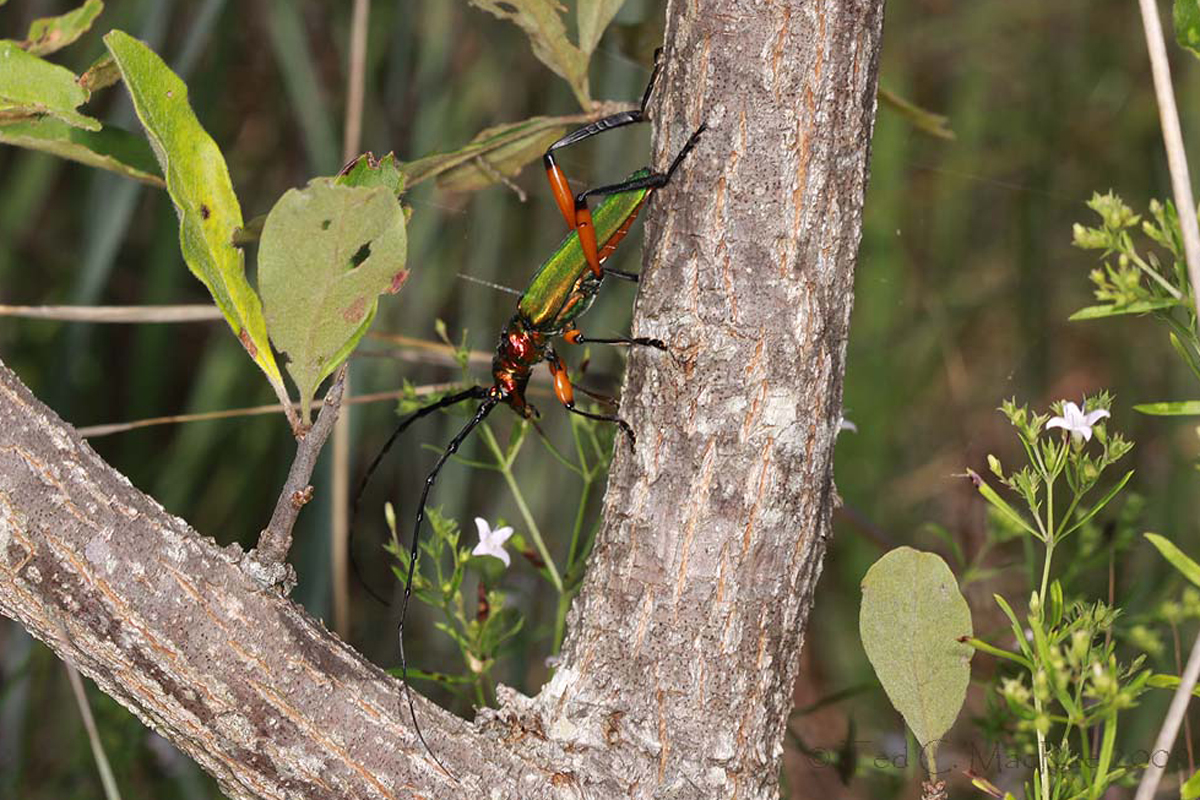
Plinthocoelium suaveolens on trunk of living Sideroxylon lanuginosum
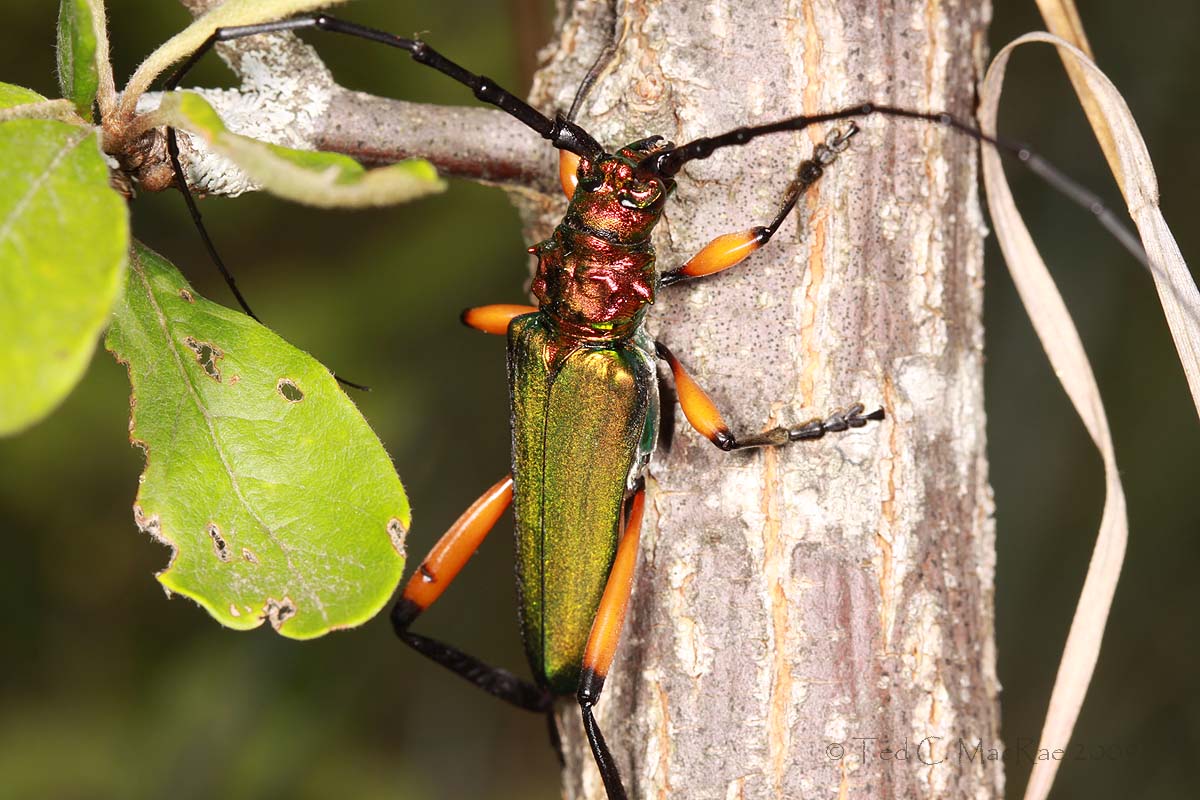
Plinthocoelium suaveolens on trunk of living Sideroxylon lanuginosum

Plinthocoelium suaveolens on trunk of living Sideroxylon lanuginosum

Plinthocoelium suaveolens on trunk of living Sideroxylon lanuginosum

Missouri populations are assignable to the nominotypical subspecies (southeastern U.S.), which is distinguished from subspecies plicatum (Texas, New Mexico, Arizona, and northern Mexico) by the bronze or cupreous tints and weak transverse rugae on the pronotum (Linsley 1964).  The distributional ranges of the two subspecies intermingle in northeastern Texas.

Photo details:
All photos: Canon 100mm macro lens on Canon EOS 50D
Photo 1 (Chute Ridge Glade): normal mode, ISO-400, 1/250 sec, f/16, natural light.
Photo 2 (Sideroxylon lanuginosum): landscape mode, ISO-100, 1/160 sec, f/6.3, natural light.
Photos 3 (P. suaveolens larval frass pile), 6—8 (P. suaveolens adult): manual mode, ISO-100, 1/250 sec, f/9-11, MT-24EX flash 1/2 power through diffuser caps (photo 7 slightly cropped).
Photos 4—5 (P. suaveolens larva): manual mode, ISO-100, 1/60 sec, f/14 (closeup f/25), MT-24EX flash 1/2 power through diffuser caps.

REFERENCES:

Champlain, A. B. and J. N. Knull.  1932.  Fermenting bait traps for trapping Elateridae and Cerambycidae (Coleop.).  Entomological News 43(10):253–257.

Linsley, E. G. 1964.  The Cerambycidae of North America. Part V. Taxonomy and classification of the subfamily Cerambycinae, tribes Callichromini through Ancylocerini.  University of California Publicatons in Entomology, 22:1—197, 60 figs., 1 pl.

Linsley, E. G. and P. D. Hurd, Jr.  1959.  The larval habits of Plinthocoelium suaveolens plicatum (LeConte).  Bulletin of the Southern California Academy of Sciences 58(1):27–33.

MacRae, T. C. 1994. Annotated checklist of the longhorned beetles (Coleoptera: Cerambycidae and Disteniidae) known to occur in Missouri. Insecta Mundi 7(4) (1993):223–252.

MacRae, T. C. and M. E. Rice. 2007. Distributional and biological observations on North American Cerambycidae (Coleoptera). The Coleopterists Bulletin 61(2): 227–263.

Riley, C. V.  1880.  Food habits of the longicorn beetles or wood borers.  The American Entomologist 3(10):237–239.

Turnbow, R. H. Jr. and F. T. Hovore.  1979.  Notes on Cerambycidae from the southeastern U. S.  Entomological News 90(5):219–229.

Copyright © Ted C. MacRae 2009

Add to FacebookAdd to NewsvineAdd to DiggAdd to Del.icio.usAdd to StumbleuponAdd to RedditAdd to BlinklistAdd to TwitterAdd to TechnoratiAdd to Furl

Western hognose snake

Another herp interlude…

IMG_0655_1200x800
Photo details: Canon 100mm macro lens on Canon EOS 50D, ISO 100, 1/250 sec, f/14, MT-24EX flash 1/4 power w/ diffuser caps.

During my visit to Salt Plains National Wildlife Refuge in northwestern Oklahoma this past June, tiger beetles were not the only wildlife subjects I encountered.  Near the edge of one of the alkaline flats along Sandpiper Trail was this hognose snake.  This is the second hognose snake that I’ve encountered in as many years, the first being a member of a rare, disjunct population of the dusty hognose snake (Heterodon nasicus gloydi) in one of southeastern Missouri’s critically imperiled sand prairie habitats.  There are two species of hognose snake in Oklahoma – eastern (H. platirhinos) and western (H. nasicus).  I presume this individual to be the western due to its strongly upturned rostral (snout), which is only moderately upturned in the eastern species, and black-checkered ventral coloration.  Surprisingly, in checking the Salt Plains reptile species list for confirmation on its identity, I noted that no confirmed sightings of either the eastern or western hognose snake have been recorded at the refuge.  I have since done my good deed to reptile science by submitting this and another photograph I took of the individual to the refuge biologist.  Ted MacRae – entomologist and discoverer of new reptile records!  Western hognose snakes are further classified into three subspecies, two of which – dusty and nominotypical – occur in Oklahoma (the third occurs in Mexico). However, the distinctions between the two U.S. subspecies are subtle¹ and not apparent in this photograph, preventing further classification.

¹ Some authors consider the dusty and western hognose snakes to be separate species, while others have regarded their differences too subtle to warrant even subspecific distinction.

Hognose snakes are famous for their well-choreographed sequence of defensive displays. Their first act is to rear up cobra-like and strike out with their mouth open while hissing (unfortunately, neither of the hognoses I’ve encountered entertained me in this manner).  If the threat continues, they then turn over and writh violently in mock agony before finally rolling over on their backs and playing dead (thanatosis).  Last year’s hognose snake didn’t do this either, insisting instead on continually trying to burrow into the loose sand.  As can be seen from the photograph above, however, playing dead is exactly what this individual did.  With the mouth agape and the tongue protruding, it’s a convincing display of lifelessness.  Amusingly though, whenever the snake was righted it immediately turned over on its back again – not such a good imitation of being dead!  Presumably the snakes predators are as bad at noticing that detail as are the snakes themselves.  As I continued to pester this individual, trying to get him to stick out his tongue further for a better photograph, he eventually started ejecting blood from the lacrymal glands and emitting musk from the cloaca – what better to emphasize a death display than blood and an offensive smell!

Western hognose snakes are classified as a species of ”least concern” on the IUCN Red List of Threatened Species and aren’t listed as a species of concern on the Oklahoma Natural Heritage Inventory database.  Nevertheless, as with many other reptiles and amphibians, populations are declining throughout much of their former range.  This is likely due to the combined effects of urbanization, reduction of habitat, predation by feral dogs and cats, and overcollection for sale to the pet trade.

Copyright © Ted C. MacRae 2009

Add to FacebookAdd to NewsvineAdd to DiggAdd to Del.icio.usAdd to StumbleuponAdd to RedditAdd to BlinklistAdd to Ma.gnoliaAdd to TechnoratiAdd to Furl

Oklahoma is for lovers

A few rather risqué photos from my June trip to northwestern Oklahoma.

Eleodes suturalis (family Tenebrionidae) - June 6, 2009 at Four Canyon Preserve, Ellis Co., Oklahoma

Eleodes suturalis (family Tenebrionidae) - June 6, 2009 at Four Canyon Preserve, Ellis Co., Oklahoma

Chrysobothris ignicollis (family Buprestidae) - June 6, 2009 at Four Canyon Preserve, Ellis Co., Oklahoma

Chrysobothris ignicollis (family Buprestidae) - June 6, 2009 at Four Canyon Preserve, Ellis Co., Oklahoma

Ellipsoptera nevadica knausii ("family" Cicindelidae) - June 12, 2009 at Salt Plain National Wildlife Refuge, Alfalfa Co., Oklahoma

Ellipsoptera nevadica knausii ("family" Cicindelidae) - June 12, 2009 at Salt Plain National Wildlife Refuge, Alfalfa Co., Oklahoma

Photo details:
Eleodes suturalis: Canon 100mm macro lens on Canon EOS 50D, ISO 100, 1/250 sec, f/13, MT-24EX flash 1/4 power through diffuser caps.
Chrysobothris ignicollis: Canon 65mm 1-5x macro lens on Canon EOS 50D, ISO 100, 1/250 sec, f/13, MT-24EX flash 1/8 power through diffuser caps.
Ellipsoptera nevadica knausii: Canon 100mm macro lens on Canon EOS 50D, ISO 100, 1/250 sec, f/14, MT-24EX flash 1/4 power through diffuser caps.

Copyright © Ted C. MacRae 2009

Add to FacebookAdd to NewsvineAdd to DiggAdd to Del.icio.usAdd to StumbleuponAdd to RedditAdd to BlinklistAdd to Ma.gnoliaAdd to TechnoratiAdd to Furl

Dromochorus pruinina in Oklahoma

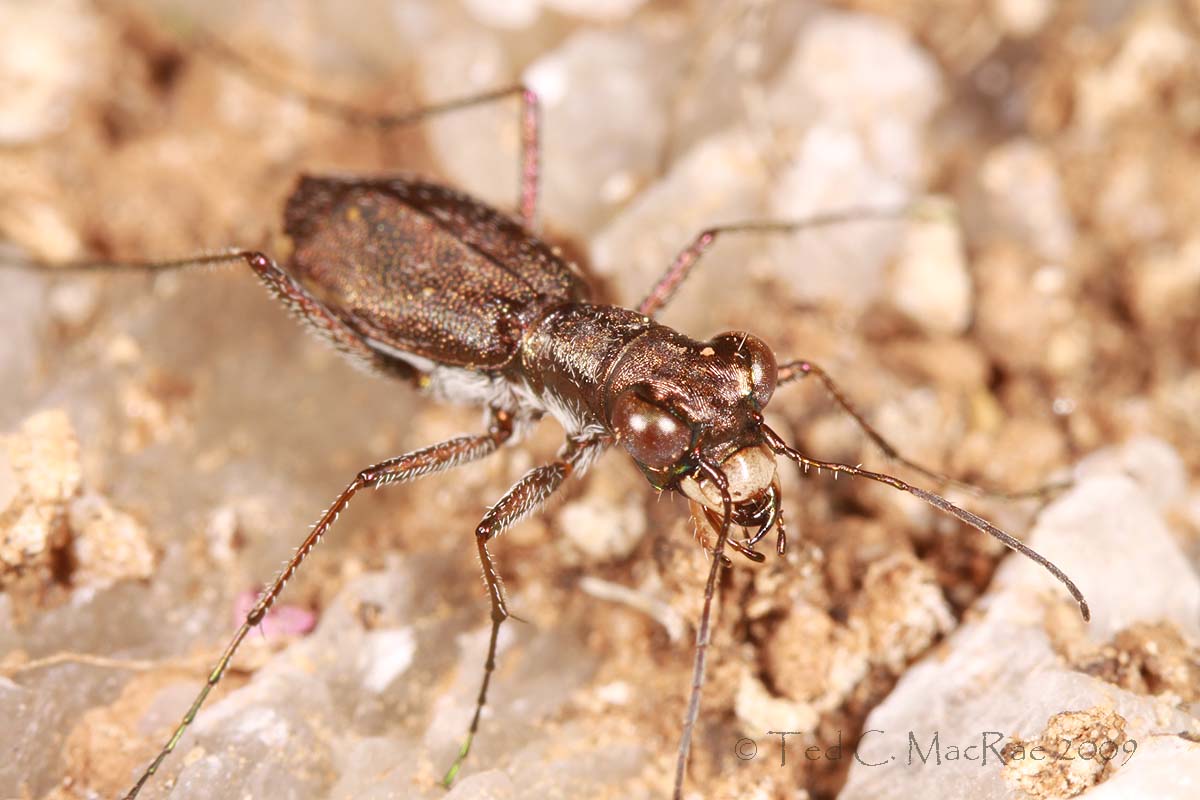
As my colleague Chris Brown and I continue to study the tiger beetle fauna of Missouri, one of the species we have become very interested in is Dromochorus pruinina (frosted dromo tiger beetle).  This is another of North America’s more enigmatic species and is one of a handful of species in Missouri – along with Cylindera cursitans (ant-like tiger beetle), C. celeripes (swift tiger beetle), Habroscelimorpha circumpicta johnsonii (Johnson’s tiger beetle), and Cicindela (Cicindelidia) obsoleta vulturina (prairie tiger beetle) – whose highly restricted distributions within the state make them worthy of special consideration for conservation (see Saving Missouri’s tigers and Revisiting the Swift Tiger Beetle – Part 3).  Of these, D. pruinina appears to be the most highly localized – thus far we have found this species only in west-central Missouri along a 2.5 mile stretch of roadside habitat in Knob Noster State Park.  This tiny population is not only the easternmost known occurrence of the species, but is also disjunct from the main population in Kansas, Oklahoma, and Texas by nearly 100 miles.  As a result of this extreme localization within the state, the species has been accorded a conservation status in Missouri of S1 – the state’s highest conservation ranking. 

IMG_0624_1200x800

Dromochorus pruinina is secretive and easily overlooked, and as a result little is known about it – in fact, the larva was unknown until just last year (Spomer et al. 2008).  There has also been little agreement on what to call it – many authors (e.g., Freitag 1999, Pearson et al. 2006) have considered it a synonym or subspecies of D. belfragei (loamy-ground dromo tiger beetle) from Texas; however, Spomer et al. (2008) and Erwin and Pearson (2008) consider it a valid species based on its smooth elytra in contrast to the granulated elytral surface of D. belfragei and the apparent lack of intergrades in central Texas where their geographical distributions overlap.  It was one of the species I had hoped to see during my early June visit to The Nature Conservancy’s Four Canyon Preserve in northwestern Oklahoma; however, I would not see this species there despite its abundance of exposed red clay slopes.  Following that visit, as I sat in a coffee shop in north-central Oklahoma trying to predict where the pounding rainstorm outside was least likely to spoil my collecting plans for the next few days, this species again came to my mind when I decided to go back to the red clay/gypsum hills just north of Four Canyon Preserve – where I had just seen the even more enigmatic C. celeripes.  I noted that this corner of Oklahoma was just at the western edge of the distribution given by Pearson et al. (2006) for the species, but still read through the notes on its habits and habitats in the off chance that I might still encounter it.  Despite all the forethought, it was nevertheless a surprise when an adult bolted across my path soon after beginning my search of the Gloss Mountains the next day (see Revisiting the Swift Tiger Beetle – Part 2).  Like C. celeripes, this species is flightless and runs swiftly – perhaps even more so – as it dashes between clumps of vegetation before disappearing.  It’s larger size would seem to make it easier to capture than C. celeripes, but that is not the case, yet I still managed to capture all three individuals I saw during the course of the several hours I spent on the lower talus slopes at the Gloss Mountains Scenic Overlook that morning.  With none of them could I even make an attempt at field photographs – their repeated mad dashes for cover eliminated all opportunity.  I placed the three individuals into a terrarium of native soil, resigned that I would have to settle for photographs in confinement (there is nothing wrong with confined photographs, which look every bit as natural as true field photographs – still, there is just something about not succeeding in photographing the subject in its native habitat).

IMG_0622_1200x800_2I returned to the Gloss Mountains late in the day and completed my search for C. celeripes in the State Park across the highway (and also saw my first massasauga rattlesnake).  By then it was about 7:00 pm, and my thoughts turned back to the D. pruinina I had seen across the highway earlier that day.  I recalled the tendency of the Missouri population of D. pruinina to be most active in the few hours before dusk and decided to have another go at them.  No sooner than I had begun to climb the talus slope did I see another one – he bolted into a grass clump, and despite my best attempts to tear the vegetation apart he was gone.  Frustrated, I got up and started walking up the slope again – and saw another one, with the same result!  Now I was mad.  I started searching the rankly vegetated clay slope with determination, and it wasn’t long before I saw a third individual higher up on the slope.  It was then and there that I decided I was going to get a field photograph.  I stopped dead in my tracks so as not to further disturb the beetle, and carefully took off my backpack and put my camera together as I kept a watchful eye on him.  Once ready, I moved slowly toward him – and he bolted.  This time I managed to catch him before he disappeared.  Okay – I’ve got one in the hand, now what?  I decided to try the time-out trick – placing him in the middle of an open area on top of the small mesa and covering him with my camera lens cap.  With luck, being covered momentarily would cause him to “settle down” long enough for me to get some shots.  I waited a few minutes, then carefully lifted up the lens cap – out he bolted with a vengeance.  Time for a new strategy.  I started blocking his path with my free hand everytime he tried to run out of the open area I had designated for him, hoping that he would eventually tire and rest momentarily – this was the strategy I successfully employed to get my first field photographs of C. celeripes the day before at Alabaster Caverns (see Revisiting the Swift Tiger Beetle – Part 1).  I did this for several minutes, and the little bugger just refused to settle down.  Finally, as I took my eye off of him for a split second, he disappeared into an adjacent grass clump and was never seen again.  IMG_0626_1200x800By now I was so frustrated that I considered giving up. Of course, I couldn’t – there was still daylight, and if there’s one thing I’ve learned in this game, it’s persistence. I started walking back down the slope searching for another individual, and right at the edge of the vegetated area I saw one running for cover.  This time I cut him off at the pass and forced him to run back towards the more open area of the upper slope.  Once out in the open, I continued to follow him as he nervously ambled across the slope into and out of erosion channels, looking for a place to hide.  Everytime he siddled up against a chunk of clay or tried to crawl into a crack I forced him out.  In the open expanse of the upper slope where I had him trapped, he eventually started pausing – not for long, but just long enough that I could get a shot or two in before he started running again.  Eventually, I got several shots that I thought might turn out acceptable.  I briefly looked at my camera to try another setting, looked up, and he was gone!  By now it was past 8:30 pm, and the sun was sinking fast.  I decided that I had given it my best effort, and that whatever shots I had would have to do.  I share with you here three of the five shots that I kept.

Photo details: Canon 100mm macro lens on Canon EOS 50D, ISO 100, 1/250 sec, f/14-16, MT-24EX flash 1/4 power through diffuser caps.

REFERENCES:

Erwin, T. L. and D. L. Pearson. 2008. A Treatise on the Western Hemisphere Caraboidea (Coleoptera). Their classification, distributions, and ways of life. Volume II (Carabidae-Nebriiformes 2-Cicindelitae). Pensoft Series Faunistica 84. Pensoft Publishers, Sofia, 400 pp.

Freitag, R.  1999.  Catalogue of the tiger beetles of Canada and the United States.  National Research Council Canada, Ottawa, Ontario, 195 pp.

Pearson, D. L., C. B. Knisley and C. J. Kazilek. 2006. A Field Guide to the Tiger Beetles of the United States and Canada. Oxford University Press, New York, 227 pp.

Spomer, S. M., P. D. Nabity and M. L. Brust. 2008. Larval description of Cicindela (Dromochorus) pruinina (Casey) (Coleoptera: Carabidae: Cicindelinae) with notes on habitat and adult behavior. The Coleopterists Bulletin 62(1):37-41.


Copyright © Ted C. MacRae 2009

Add to FacebookAdd to NewsvineAdd to DiggAdd to Del.icio.usAdd to StumbleuponAdd to RedditAdd to BlinklistAdd to Ma.gnoliaAdd to TechnoratiAdd to Furl

North America’s most bizarre lizard

Hmm, something funny going on here.  This is a bug blog – specifically a beetle blog, yet it’s a post about a lizard that generates a flurry of comments.  I don’t know if lightning will strike twice so quickly, but I did have this second ‘lizard’ post already lined up in the queue.

IMG_0390_1200x800

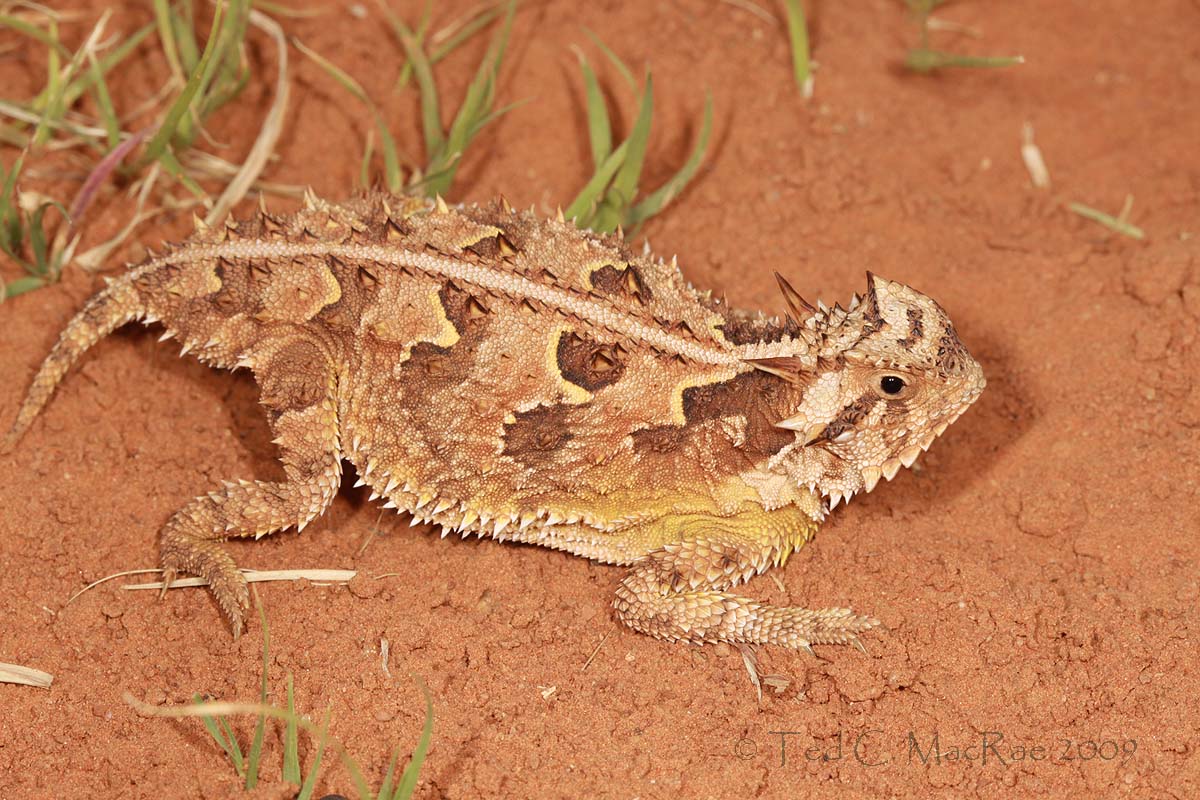
The day after seeing a couple of male eastern collared lizards at Four Canyon Preserve in northwestern Oklahoma, I got my second saurian treat with this horned lizard (genus Phrynosoma).  There are actually some dozen species of horned lizards in North America, but the majority are found further west in the U.S. and down into Mexico and Central America.  Of the two that occur in Oklahoma, this particular individual can be identified as a Texas horned lizard (P. cornutum) by the two occipital (back of the head) spines, presence of lateral abdominal finge scales, and dorsal white stripe.  Oklahoma’s other horned lizard (round-tailed horned lizard, P. modestum) is restricted to the northwestern corner of the panhandle and differs from the Texas horned lizard by having four occipital spines, lacking lateral abdominal fringe scales, and more solid pale coloration.

IMG_0392_1200x800Again, my claim of “most bizarre” might be open to debate, as there are certainly many bizarre lizards in North America.  The gila monster once more comes to mind, but I think grotesque is a better descriptor for that animal, and the fan-shaped toe pads of geckos might also get them some votes.  Nevertheless, do a Google search on the phrase “bizarre North American lizard” and the results will be overwhelmingly dominated by references to horned lizards.  It’s no surprise – their squat body form is more suggestive of toads than lizards¹, for which they are commonly called “horned toads” or “horny toads,” and their covering of “horns” (actually modified scales) gives them an otherworldly, almost dinosaurian appearance.  Who among my generation wasn’t terrorized by the sight of these lizards, cheaply magnified, as they threatened the scientists that encountered them in the 60’s sci-fi classic The Lost World?

¹ Even the genus name, derived from the Greek words phrynos (toad) and soma (body), alludes to its toad-like appearance.

IMG_0397_1200x800In reality, these lizards are anything but terrifying.  Instead they employ multiple strategies to avoid being eaten themselves. These adaptations were all on display as I initially passed this individual without even noticing it lying motionless in the middle of the road. Once I had passed I noted movement out of the corner of my eye and turned to see it scurrying towards the vegetation along the side of the road. It’s mottled coloration, blending well with its background, and spine-broken silhouette made it almost invisible. Feeling threatened by my too-close approach, it made a rapid burst for cover, but I cut it off at the pass and blocked its erratic scampers towards the roadside to keep it out in the open so I could take some photographs. Once cornered in the open, it resorted to a third strategy – puffing of the body to make it appear larger. Had I been a true predator, it would’ve had two more strategies up its sleeve that it could have employed as a last resort – bleeding from the eyes (which apparently has a foul taste and will cause a predator to drop the lizard from its mouth) along with the mechanical defense of its hard, spiny scales. Since I didn’t actually try to eat this little guy, I didn’t have a chance to experience these final lines of defense.

The photos here actually represent two individuals – the middle picture is a second lizard that suddenly appeared while I was photographing the first.  The second individual was somewhat smaller than the first and not as boldy marked (note the lack of a distinct dark stripe behind the eye).  Whether these were male and female is difficult to say – horned lizards lack outward sexual characters allow them to be easily distinguished in the field (females do tend to grow a little bit larger). While not threatened or endangered, Texas horned lizards, like many other horned lizard species, have experienced dramatic reductions in its range. Oklahoma has a year-round closed season for both species that makes it illegal to kill or capture horned lizards without written permission. I would see a few more of these fascinating little lizards during my three days at Four Canyon Preserve, suggesting that, at least in this part of the state, horned lizards are doing just fine.

Photo details: Canon 100mm macro lens on Canon EOS 50D, ISO 100, 1/250 sec, f/11-13, MT-24EX flash 1/4 power through diffuser caps.

Copyright © Ted C. MacRae 2009

Add to FacebookAdd to NewsvineAdd to DiggAdd to Del.icio.usAdd to StumbleuponAdd to RedditAdd to BlinklistAdd to Ma.gnoliaAdd to TechnoratiAdd to Furl

Revisiting the Swift Tiger Beetle – Part 1

Photo details: Canon 100mm macro lens with 68mm extension on a Canon EOS 50D, ISO 100, 1/250 sec, f/13, MT-24EX flash 1/4 power through diffuser caps

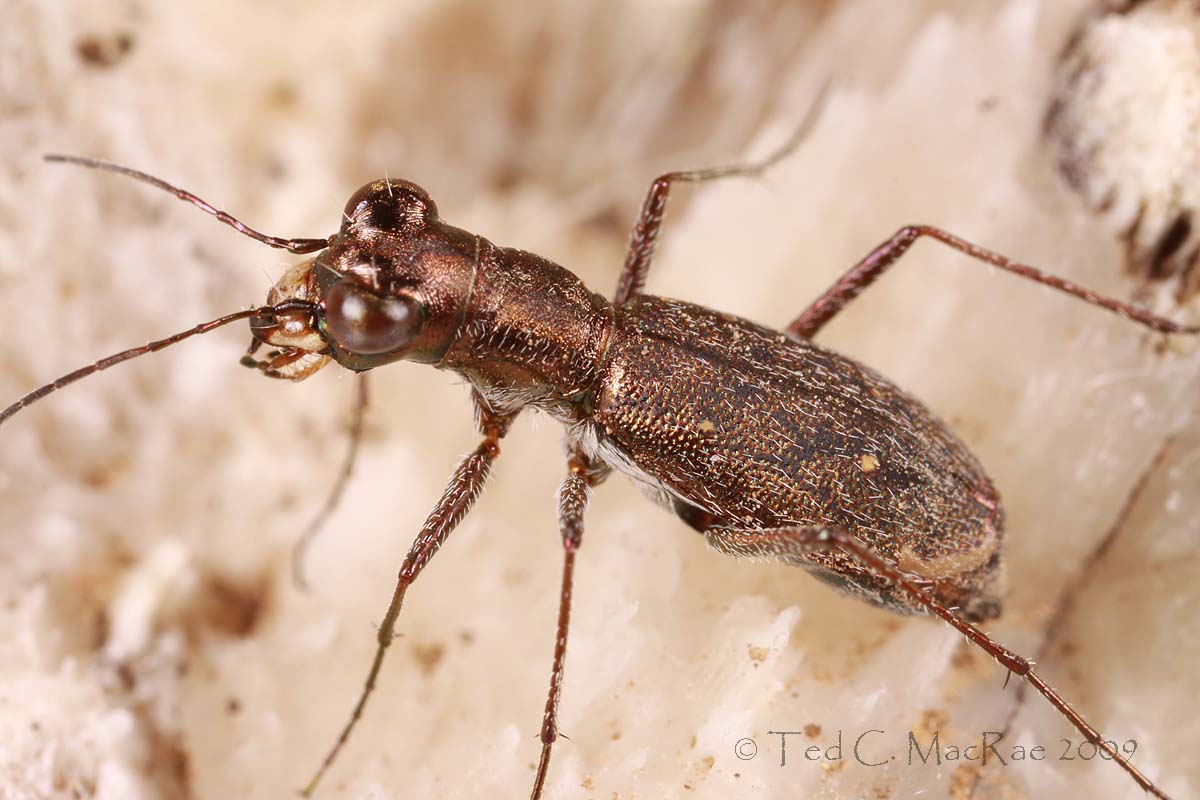
Photo 1 - Cylindera celeripes at Alabaster Caverns State Park in northwestern Oklahoma.

When my hymenopterist friend, Mike Arduser, came back from his first trip to Oklahoma’s Four Canyon Preserve last September, my first thought upon seeing his photos of the area was, “Ooh, that looks like a good place for tiger beetles!” Its rugged red clay and gypsum exposures reminded me of similar country I had seen in the not-too-distant Gypsum Hills of south-central Kansas, where I was fortunate enough to observe a nice population of the fantastically beautiful Cicindela pulchra (beautiful tiger beetle) back in 2005. When I later realized that the area was only 30 miles southwest of a confirmed recent sighting of Cicindela celeripes (swift tiger beetle, now Cylindera celeripes), I thought, “Ooh, I wonder if celeripes might occur there also.”

Photo details: Canon 100mm macro lens with 68mm extension tube on a Canon EOS 50D, ISO 100, 1/250 sec, f/13, MT-24EX flash 1/4 power through diffuser caps

Photo 2 - Cylindera celeripes on lichen-encrusted clay soil at Alabaster Caverns State Park.

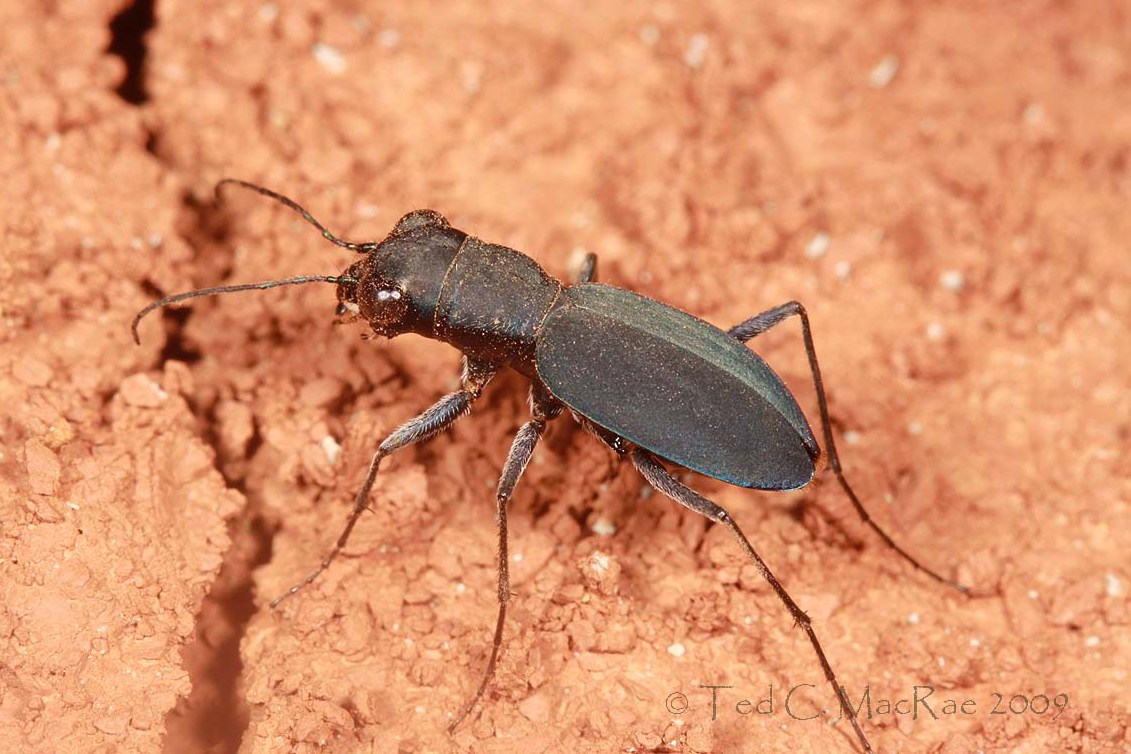
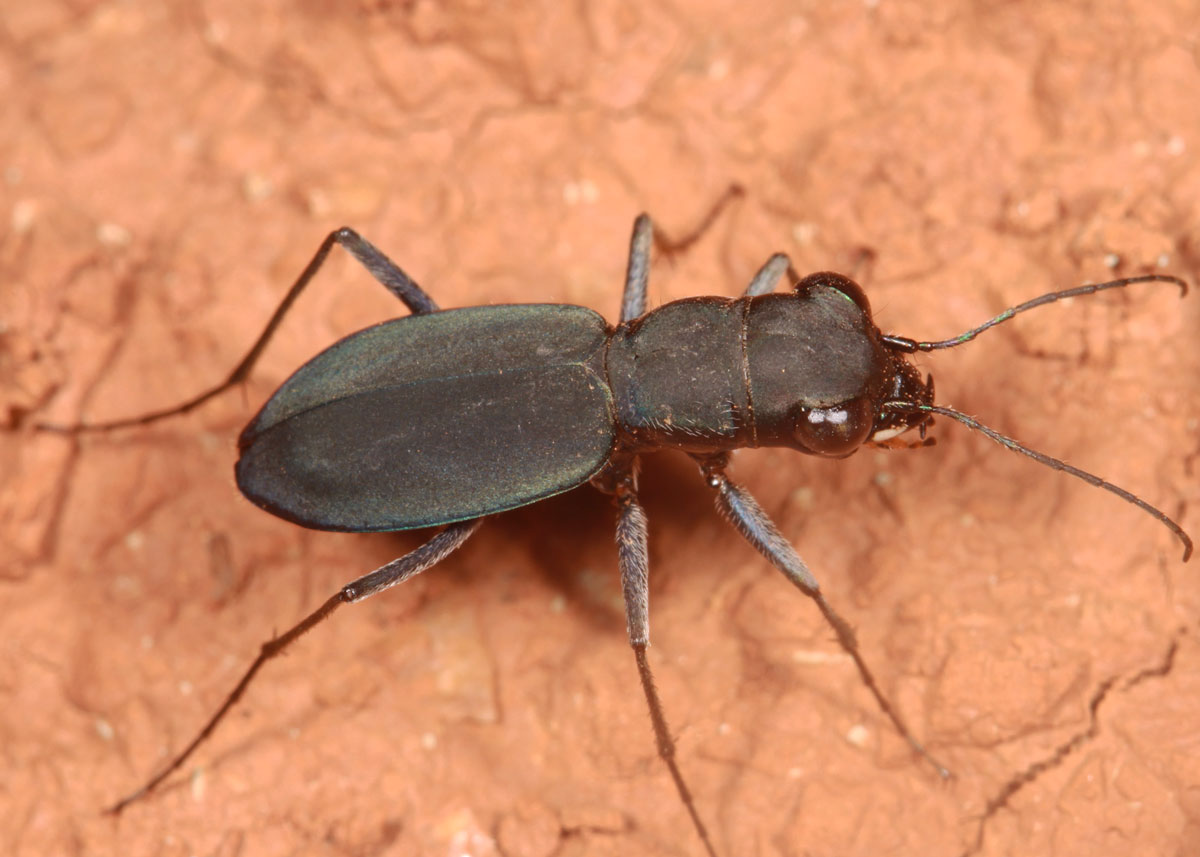
Recall that C. celeripes is one of North America’s rarest and least understood tiger beetles. This tiny, flightless, ant-like species has been recorded historically from eastern Nebraska south to north-central Texas, but its range appears to have become highly restricted over the past century. It hasn’t been seen in Nebraska for nearly 100 years now, and most recent records have come from its last known stronghold in the Flint Hills of Kansas. In 2003, however, a photographer by the name of Charles Schurch Lewallen posted on BugGuide a photograph of this species taken at Alabaster Caverns State Park in northwestern Oklahoma, and last year small numbers of adults were seen in the Loess Hills of western Iowa. This last sighting triggered an immediate trip to the site by myself and Chris Brown, who has been co-investigating the tiger beetle fauna of Missouri with me for several years now. The occurrence of this species in Iowa’s Loess Hills had reignited our hopes – faint as they were – that the beetle might yet occur in extreme northwestern Missouri, where the Loess Hills reach their southern terminus. We wanted to see the beetle in the wild to better understand its habitat requirements before resuming our search for this species in northwestern Missouri. We succeeded in finding the beetle – an amazing experience in itself – and brought three adults of this never-before-reared species back to the lab for photographs and an attempt at rearing. We did manage to obtain viable eggs, but we were not successful in rearing the larvae beyond first instar. I wrote about that experience last August in a post entitled, “The hunt for Cicindela celeripes” (that post is now currently in press as an article in the journal CICINDELA).

Photo details: Canon 100mm macro lens with 68mm extension tube on a Canon EOS 50D, ISO 100, 1/250 sec, f/11, MT-24EX flash 1/4 power through diffuser caps

Photo 3 - Cylindera celeripes on gypsum exposure at Alabaster Caverns State Park.

Thus, when my friend Mike asked me earlier this year if I might be interested in joining him on his return trip to Four Canyon Preserve in June, I jumped at the chance. I figured I could look for celeripes at the preserve, and if I failed to find it there then I would go to Alabaster Caverns and see if I could relocate the beetle where it had been photographed in 2003. My goals were modest – I simply wanted to find the beetle and voucher its current presence in northwestern Oklahoma (and if possible photograph it in the field with my new camera!). Before leaving, I wrote to Charles Lewallen, who graciously responded with details regarding the precise location and time of day that he had seen the beetle at Alabaster Caverns, and on the first Friday of June I followed behind Mike and his lovely wife Jane during our ten-hour drive out to Four Canyon Preserve. For three days, I roamed the mixed-grass prairie atop the narrow ridges and dry woodland on the steep, rugged canyon slopes of the preserve – always on the lookout for that telltale “flash” between the clumps of bluestem and grama, ever hopeful that one would prove not to be the ant or spider that it appeared to be (and, indeed, always was). Many tiger beetles would be seen – chiefly the annoyingly ubiquitous Cicindela punctulata (punctured tiger beetle), but celeripes would not be among them. Whether this is due to historical absence from the site or a more recent consequence of the wildfires that swept the area a year earlier is hard to say, but its absence at Four Canyon meant that I would need to make a quick, 1-day detour to Alabaster Caverns before rejoining Mike and Jane at Tallgrass Prairie Preserve in northeastern Oklahoma, where we planned to spend the second half of the week.

Photo details: Canon 65mm 1-5X macro lens on a Canon EOS 50D, ISO 100, 1/250 sec, f/13, MT-24EX flash 1/4 power through diffuser caps

Photo 4 - Cylindera celeripes on gypsum exposure at Alabaster Caverns State Park.

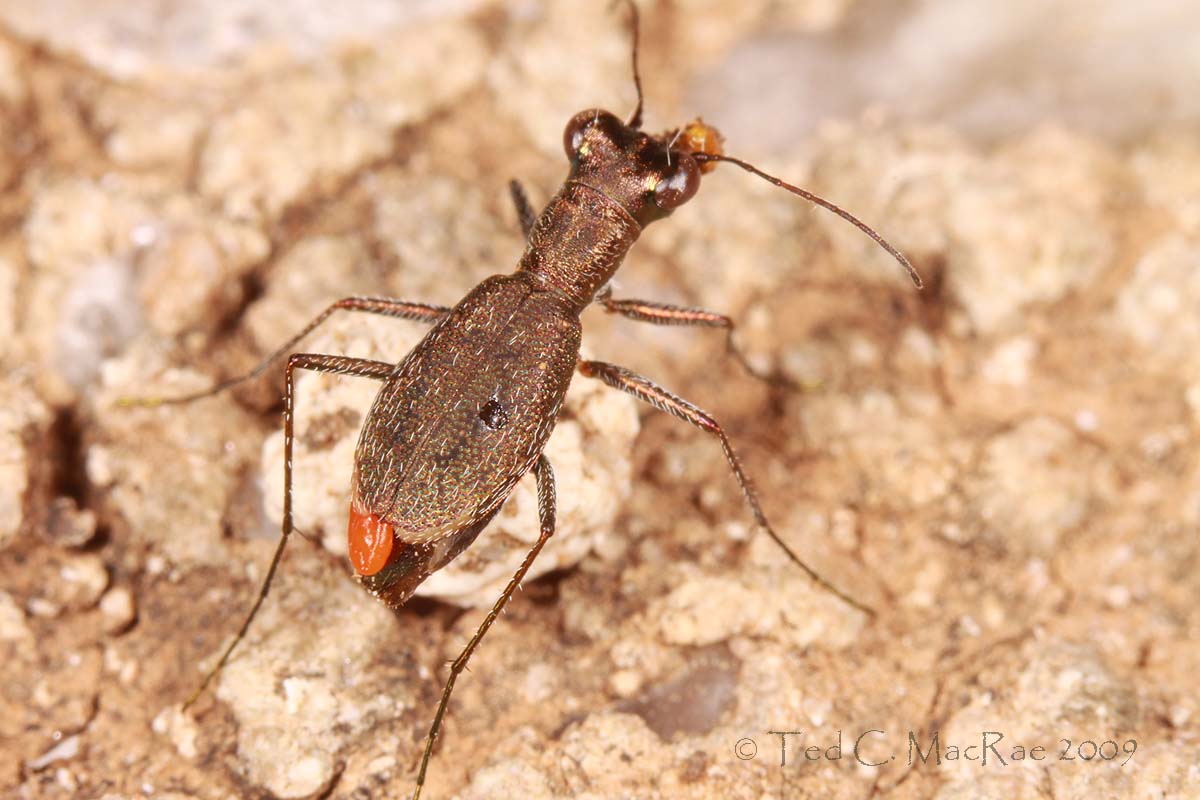
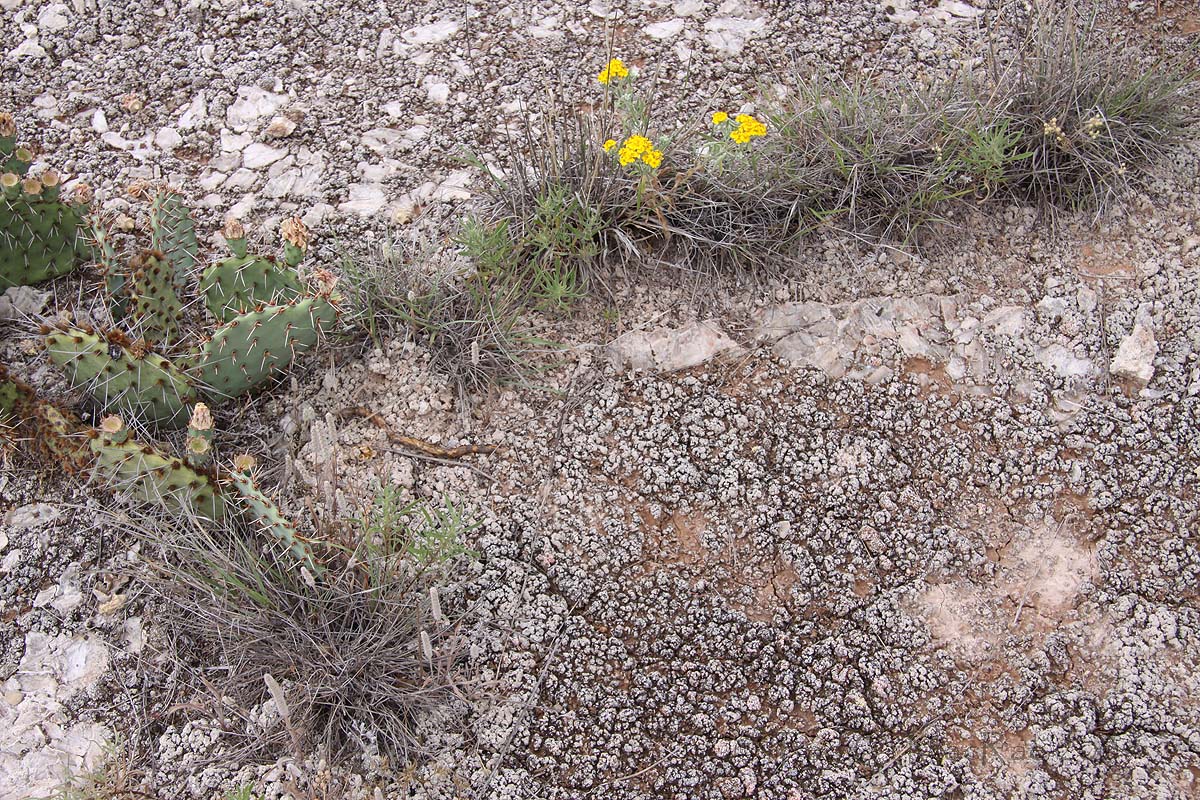
Arriving at Alabaster Caverns I was filled with nervous, excited anticipation. Would I find the species, as Charles Lewallen had, or would I get skunked? I kitted up and started walking towards the area where Charles wrote that he had seen the beetle, noting the annoying “Removal of plants and animals prohibited” sign along the way. I hadn’t taken ten steps off the parking lot when I saw it! I froze at first, hardly believing that I had found it that quickly, then started watching the tiny beetle as it bolted urgently from one grass clump to the next. Recalling my experience with this beetle in Iowa (and fearing I would lose it amongst the vegetation), I captured the specimen and placed it live in a vial – I would talk to the park staff later about taking the beetle, but for now I needed to guarantee I had a backup for the lab in case I was unable to get field photographs of the beetle. I started walking again, and within a few minutes I saw another one – okay, they’re here in numbers. I carefully took off my camera bag and assembled the components, all the while keeping my eye on the beetle, and then I began trying to do what last year had seemed impossible – getting field photographs. It was easier this time – the vegetation was not so dense, so I could keep an eye on the beetle as he darted from one clump to another. I tried to wait until he settled in an open spot, but it soon became apparent that just wasn’t gonna happen without a “helping” hand. I started blocking the path of the beetle as he tried to dart away and then removing my hand to see if he would stay put. There were a few false starts, where the beetle looked like he would sit still and then dart just as I was set to take the shot, but eventually it wore down and started sitting still long enough for me to shoot a few frames. Torn between the need to get as many photographs as possible and the desire to look for more beetles, I decided to look around more to see how common the beetle was. As I walked out into the shortgrass prairie above the canyons, I began to see adults quite commonly. Most often they were seen as they bolted out into the open from a clump of vegetation when disturbed by my approach. The substrate was red clay and gypsum – just as I had seen in Four Canyon Preserve, but unlike that area the clay exposures were heavily colonized by a mottling of green, blue, and gray lichens. It made the beetles almost impossible to see when they were not moving – even at close range! I spent about an hour taking photographs of several individuals, even managing to photograph one that appeared to be parasitized by what I take to be a dryinid hymenopteran.

Photo 5 - Cylindera celeripes with parasite (dryinid hymenopteran?).  Note also the ant head attached to right antenna.

Photo 5: Cylindera celeripes with parasite (dryinid hymenopteran?). Note also the ant head attached to right antenna.

After getting a sufficient series of photographs (is there really such thing?), I went to the park office hoping to convey the significance of this find to the Park Naturalist and to convince him/her to let me take some live individuals with me for another attempt at rearing. The Park Naturalist was out of the office, but the Park Historian was there. I could hardly contain my excitement as I explained to her what I had found, why it was so important, and my hope to try to rear the species with adults collected in the field. She not only responded as positively as I had hoped, but accompanied back out into the field so that I could show her the beetles. She told me it would be no problem to take some live individuals for rearing and to please let them know if there was anything else they could do to help me.  She then provided me with the day’s natural history “dessert” by pointing out a Mexican free-tailed bat (Tadarida brasiliensis) – Oklahoma’s state flying mammal – roosting up in the top of a nearby picnic shelter. Standing atop the picnic table put me within arm’s length of the little chiropteran – close enough to see his tiny little eyes looking quizzically back at me.

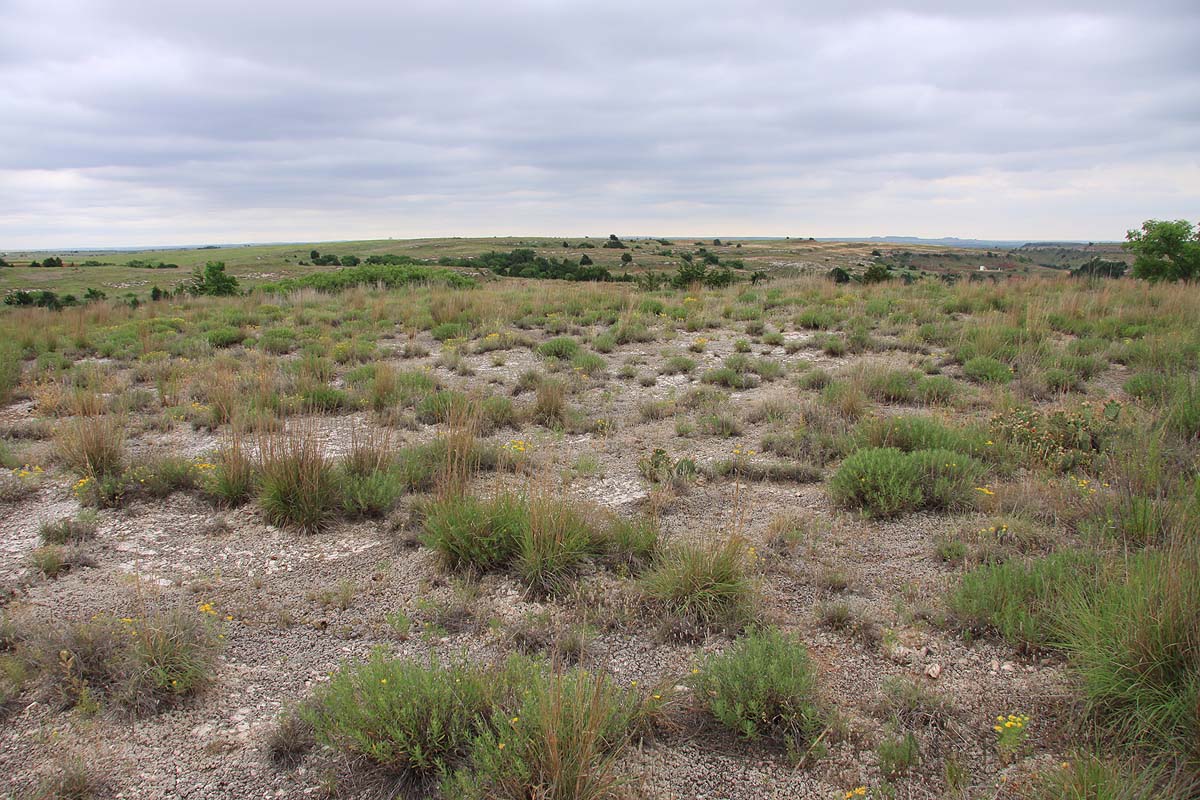
Photo 6 - Cylindera celeripes macrohabitat, Alabaster Caverns State Park, Oklahoma.  Note rather widely spaced clumps of vegetation (photo details: Canon 17-85mm zoom lens (17mm) on a Canon EOS 50D, ISO 100, 1/64 sec, f/8).

Photo 6 - Cylindera celeripes macrohabitat at Alabaster Caverns State Park. Note rather widely spaced clumps of vegetation.

It had begun sprinkling rain by then, so with some urgency I got my tools, extracted a couple of chunks of native soil and transferred them to the small “Critter Totes” that I had brought for the purpose, and began searching for live individuals to place within them. The beetles had become scarce as the drizzle turned to light rain, and by the time I had split about a dozen individuals between the two containers the rain was coming down hard enough to start puddling. I continued a last ditch effort to find “just one more,” but a lightning strike within a mile of the park put an end to that – the air now felt electric as I hurriedly walked back to the car (gloating unabashedly inside) and began the three-hour drive towards Tallgrass Prairie Preserve… (to be continued).

IMG_0580_1200x800

Photo 7 - Cylindera celeripes microhabitat at Alabaster Caverns State Park. Note thick encrustation of lichens on clay substrate amidst white gypsum exposures.

Photo details:
-3, 5: Canon 100mm macro lens w/ 68mm extension on Canon EOS 50D, ISO 100, 1/250 sec, f/13 (photo 3, f/11), MT-24EX flash 1/4 power through diffuser caps.
#4: Same except Canon 65mm 1-5X macro lens, flash 1/8 power.
#6: Same except Canon 17-85mm zoom lens (17mm), 1/64 sec, f/8, natural light.
#7: Same except Canon 17-85mm zoom lens (35mm), 1/100 sec, f/7, natural light.

Copyright © Ted C. MacRae 2009

Add to FacebookAdd to NewsvineAdd to DiggAdd to Del.icio.usAdd to StumbleuponAdd to RedditAdd to BlinklistAdd to Ma.gnoliaAdd to TechnoratiAdd to Furl

Do the Doodlebug Flip

I’ve been on a doodlebug kick ever since I finally figured out how to find the little buggers on my trip down to southeast Missouri.  I even found one in one of the tiger beetle terraria that I setup with native soil brought back from that trip, so I’ll get the chance to try to rear one out.  Shortly after finding those first antlion larvae, I traveled to Rock Island, Illinois to attend the Second Illinois Hill Prairie Conference as a panelist for the insects discussion group.  During a field trip to a nearby hilltop prairie, I spotted a pit in a bed of sawdust that had the unmistakeable look of an antlion pit.  I can’t say that I’ve ever seen an antlion pit in anything but sand, so I dug up the larva to confirm that that was, indeed, what it was.  The larval pit site must have been selected by the adult female who laid the egg, so apparently the loose sawdust had the appropriate texture to induce oviposition.  The larva was fat and happy, suggesting it was feeding well in its sawdust pit.

Antlions flick sand with their head and elongated mandibles to create the pit, and they also flick it on prey that has fallen in their pit to thwart their escape.  Watch how this one also use its head flicking ability to right itself in a most humerous manner after being flipped over:

Copyright © Ted C. MacRae 2009

Add to FacebookAdd to NewsvineAdd to DiggAdd to Del.icio.usAdd to StumbleuponAdd to RedditAdd to BlinklistAdd to Ma.gnoliaAdd to TechnoratiAdd to Furl

Tiger Beetle Rearing

I recently found an interesting website called Tiger Beetle Rearing.  This website by doctoral candidate Rodger Gwiazdowski in the Joseph S. Elkinton lab, University of Massachusetts, Amherst contains a wealth of information and photographs covering equipment, techniques, and methods for rearing tiger beetles from egg to adult, with a primary focus on rearing endangered and threatened species of tiger beetles for conservation and re-release into the wild.  The lab has reared a number of tiger beetle species but is particularly interested in the Puritan tiger beetle (Cicindela puritana), threatened in the northeastern U.S.  After the first year of rearing, 90 2nd and 3rd instar C. puritana larvae were obtained and, as of the last update, were overwintering in individual tubes.  You’ll need to register with the site with a username and password to access the site, but this is accomplished quickly and easily.

Welcome to the Hotel Cicindela!

Welcome to the Hotel Cicindela!

I found this website of great interest as I begin my own efforts at rearing these beetles in the laboratory.  My primary interest is in rearing larvae that I collect in the field to adulthood – adults are much more easily identified than larvae (indeed, the larvae of many species remain undescribed), and rearing field-collected larvae is one way to get around the often limited temporal occurrence that many tiger beetle species exhibit as adults.  My operation isn’t nearly as sophisticated as the one developed in the Elkinton lab, but then I’m just a working stiff trying to do this (and a million other things) on the side. Despite this, I have had my first success, rearing to adulthood a larva I collected during the summer last year (see my post It’s a girl!).  In addition, I currently have a number of larvae collected last fall in Nebraska and South Dakota, which I put in terraria of native soil and kept in a cold incubator during the winter.  I pulled them out earlier this spring, and soon afterwards a number of larvae opened up their burrows and have been feasting on fall armyworm and corn earworm caterpillars every 2-3 days or so.  The larvae were collected from a variety of habitats and soil types, including sand, alkaline seeps, and red clay banks, so I’m hopeful that the ensuing adults will represent a variety of interesting species – perhaps some that I did not encounter in the field during that trip.

Cicindela_scutellaris_rearing_P1020931_2Beyond this, however, I am also interested in trying my hand at cross-breeding experiments – particularly with Missouri’s unique population of Cicindela scutellaris (festive tiger beetle).  I’ll need to wait until fall for this, however, since adults that are active in the field right now are sexually mature and have presumably already mated.  In the fall, a new generation of sexually-immature adults will emerge and feed for a time before burrowing back in for the winter and re-emerging the following spring ready to mate.  I would like to cross individuals from southeastern Missouri – representing an intergrade between the northern subspecies lecontei and the southern subspecies unicolor – with individuals from the northern part of the state that are clearly assignable to subspecies lecontei.  If possible, I would also like to obtain individuals from even further south that are clearly assignable to subspecies unicolor and cross them with both the southern and northern Missouri populations.  These crossing experiments may provide some insight into which of the subspecies the intergrade population is more closely related to, and it will be interesting to see how closely the progeny from the lecontei x unicolor cross resemble individuals from the intergrade population and the range of variation that they exhibit.  I should mention that Matt Brust (Chadron State College, Nebraska) has done a number of these inter-subspecific crosses with C. scutellaris, with some very interesting results among the progeny.

What I can do right now is work on techniques to make sure I can get females to lay eggs and then rear the larvae all the way through to adulthood.  For this, I brought back 9-10 live individuals from two localities of the intergrade population encountered on my recent trip to the southeastern lowlands.  Adults imbibing moisture from polymer gelI put equal numbers of males and females from each locality into separate terraria – each filled with native soil and a hydrophilic polymer gel made of anionic polyacrylamide. The beetles, who normally obtain moisture from their food or by “chewing” moist soil, chew instead on the gel. This eliminates the need to maintain a water dish or cotton batting that must be changed daily in order to prevent the growth of mold and bacteria. A few of the adults in each terrarium died shortly afterwards, possibly a result of stress or dehydration during transport (the photo right shows how eagerly they imbibed moisture from the polymer gel after being placed in the terrarium), but the remainder have lived for four weeks now and have been digging burrows and feeding whenever food is offered.  According to Matt Brust, C. scutellaris does not lay eggs on the surface of the soil (as does C. celeripes), but rather lays them about 1.5 to 2 inches below the surface.  It takes 2-3 weeks before the eggs start hatching, so I am expecting to see larval burrows appearing anytime now.  Matt tells me the key to getting eggs is to feed the adults “big-time” – thus, I have been offering fat, juicy fall armyworm or corn earworm larvae to the adults whenever they are out of their burrows.  Watch this entertaining video of one adult having lunch:

Copyright © Ted C. MacRae 2009

Add to FacebookAdd to NewsvineAdd to DiggAdd to Del.icio.usAdd to StumbleuponAdd to RedditAdd to BlinklistAdd to Ma.gnoliaAdd to TechnoratiAdd to Furl