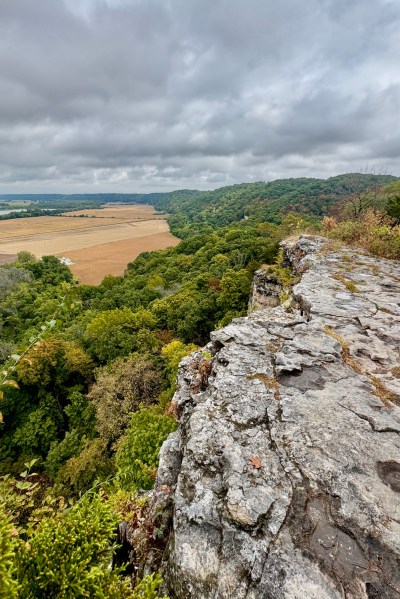
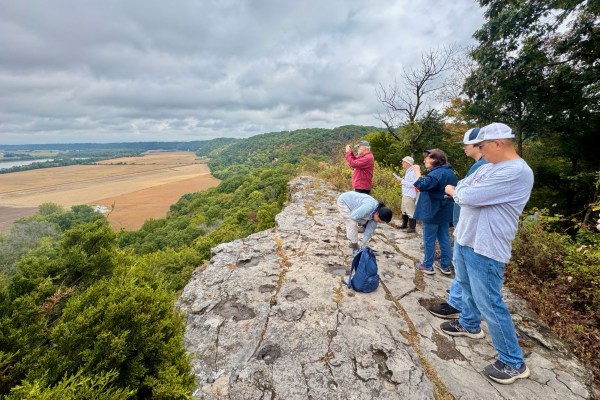
After missing the last three weeks, I was happy to rejoin the WGNSS botanists on their regular weekly outing this past Monday. This week’s destination—Salt Lick Point Land & Water Reserve in western Monroe Co., Illinois—features a mosaic of loess hill prairie and limestone glades amidst dry to dry-mesic upland forest atop limestone bluffs towering up to 400 feet above the Mississippi River valley below.
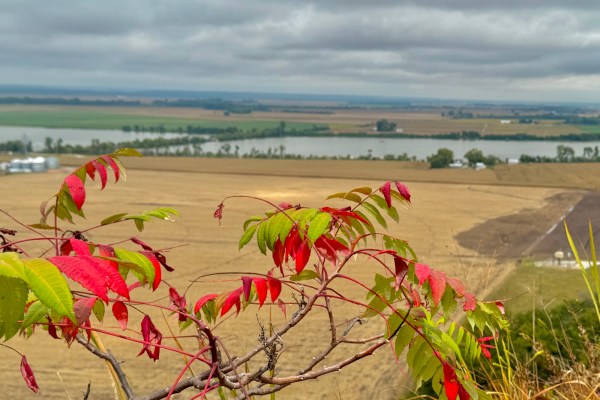
View from the Newman Trail at Salt Lick Point.
It has been an exceptionally dry August and September, so much that fall blooming plants are noticeably delayed and sparse in their blooms. Nevertheless, welcome rains just in the past few days have breathed some “fall life” into the woods and brought with them the pungent, earthy aromas that one expects to accompany a landscaping morphing from the dull greens of summer to the vibrant ambers, tawnies, and golds of fall.
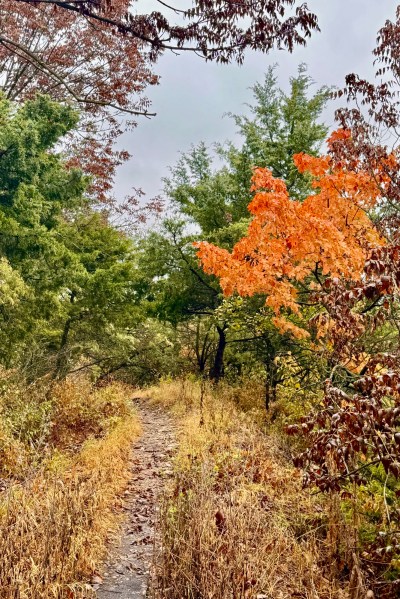
View from the Salt Lick Trail at Salt Lick Point.
The group first explored the upland and blufftop habitats along the challenging terrain of the Salt Lick and Newman Trails, then returned through flat lowlands along the bluff bottoms via the Johnson Trail. Although still just beginning to bloom, a diverse palette of “fall asters” gave us an opportunity to reacquaint ourselves with the characters that distinguish these often “easy-to-identify-to-genus but difficult-to-identify-to-species” plants. The bulk of these fell into one of two groups—the true asters (genus Symphyotrichum) and the goldenrods (genus Solidago).
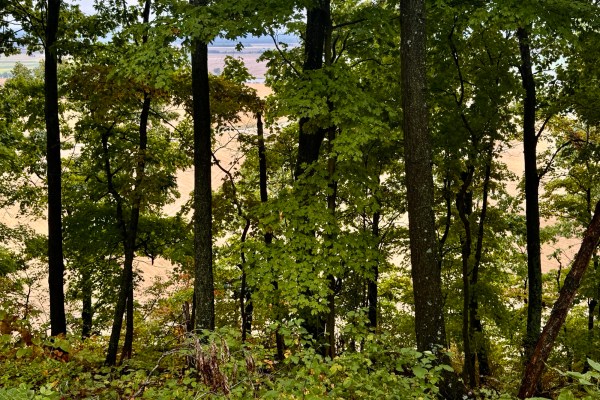
Salt Lick Trail at Salt Lick Point.
Symphyotrichum patens (late purple aster) was the first true aster that we noticed, a rather common species distinguished by its purple (of course) flowers with loose but not recurved phyllaries and leaves broadly clasping the stem. It wasn’t long before we had a chance to test our knowledge when we encountered the similar appearing Symphyotrichum anomalum (manyray aster), also with purple flowers but distinguished from S. patens by its distinctly recurved phyllaries and petiolate rather than clasping leaves. Eventually, we would encounter a third species of the genus—Symphyotrichum lateriflorum (calico aster), distinguished by its numerous small white flowers at the tips of numerous lateral branches rather than the terminus of the stem.
View from the Newman Trail at Salt Lick Point.
Goldenrods, on the other hand, were not only more diverse but also comprised some quite conservative species. The first of these was Solidago drummondii (Drummond’s goldenrod). This near-endemic species is restricted to eastern Missouri and adjacent parts of Illinois and Arkansas and grows almost exclusively on limestone or dolomite bluffs. However, we found it growing on limestone boulders placed at the trailhead next to the parking lot. Its wide, toothed leaves on short petioles (along with habitat) make this species easy to identify. Another quite conservative goldenrod was found as we entered the dry to dry-mesic forest further up the trail—Solidago buckleyi (Buckley’s goldenrod). Restricted to the Ozarks and adjacent areas, it is a showy species with relatively large flowers and spready phyllaries. In this and other respects, it greatly resembles the much more common Soldago petiolaris (downy goldenrod); however, it differs from that species by its narrower leaves that lack distinct teeth. A third species was seen as we approached one of the larger loess hilltop prairie remnants—Solidago altissima (tall goldenrod). Unlike the previous two species, this is one of the commonest and weediest species of goldenrod in the region. Relatively tall and with pyramidal inflorescences, this species often aggressively monopolizes roadsides and fallow fields. It greatly resembles another fairly common species—Solidago gigantea (late goldenrod), which we would later see during the return hike along the edge of the river valley. Leaf texture, however, differs between these two species—S. altissima has leaves with rough surfaces (caused by stiff, unidirectionally recurved hairs that cause the leaf to move only one direction when rubbed between the thumb and forefinger), while S. gigantea has smooth leaves (that move in any direction when rubbed).
The group not only spent its time with its eyes down, but also out—across the vast Mississippi River valley spread out below the several lookout points dotting the trails. Tawny fields of near-ready-to-harvest corn provided a beautiful backdrop against the resplendent red sumacs and brilliant orange maples lining the blufftops.
Members of the WGNSS Botany Group admire the view from the Newman Trail at Salt Lick Point.
View from the Newman Trail at Salt Lick Point.
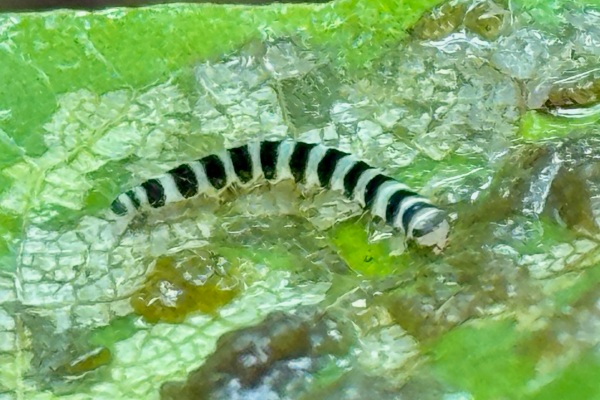
As the group’s lone entomologist/botanist (“entomotanist”?), I also kept an eye out for insects and was richly rewarded. A tiny “thorn” on the stem of S. buckleyi proved to be Enchenopa latipes (wide-footed treehopper), and unfolding the “folded” leaves of Cercis canadensis (eastern redbud) revealed the culprits—zebra-striped caterpillars of Fascista cercerisella (redbud leaffolder moth).
Enchenopa latipes (wide-footed treehopper—family Membracidae) on stem of Solidago buckleyi (Buckley’s goldenrod).
Fascista cercerisella (redbud leaffolder—family Gelechiidae) on Cercis canadensis (eastern redbud).
A spectacular earth boring beetle, Geotrupes splendidus, was seen lumbering clumsily along the trail in its endless quest for mammal dung to bury and lay an egg upon, while Bombus impatiens (common eastern bumble bee) worked the flowers of Eupatorium altissimum (tall boneset) and Eupatorium serotinum (late boneset).
Geotrupes splendidus (splendid earth-boring beetle—family Geotrupidae) on trail through dry-mesic loess woodland.
Bombus impatiens (common eastern bumblebee—family Apidae) on flower of Eupatorium altissimum (tall boneset).
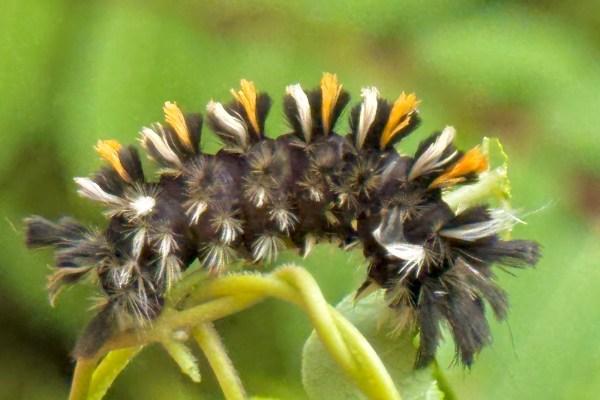
A nearly mature Euchaetes egle (milkweed tussock moth) consumed the dwindling foliage of Cynanchum laeve (climbing milkweed), and Piezogaster calcarator (leaf-footed bugs) congregated on the inflorescences of Verbesina alternifolia (yellow ironweed).
Piezogaster calcarator (leaf-footed bug—family Coreidae) on flower of Verbesina alternifolia (yellow ironweed).
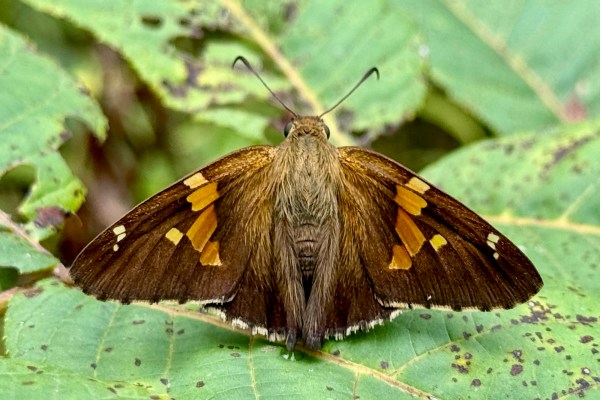
Nowhere, however, was insect activity more abundant than on the goldenrods, particularly the abundant stands of S. altissima in the uplands and S. gigantea below. Overwhelming numbers of Chauliognathus pennsylvanicus (goldenrod soldier beetles) and Lycomorpha pholus (black and yellow lichen moths) were accompanied by a cacophony of bees, wasps, and flies—a situation tailor made for Phymata sp. (jagged ambush bugs) to lay in wait while Epargyreus clarus (silver-spotted skipper) flew erratically overhead.
Phymata sp. (jagged ambush bug—family Reduviidae) mating pair on flower of Solidago altissima (tall goldenrod).
Epargyreus clarus (silver-spotted skipper—family Hesperiidae) perched on Solidago altissima (tall goldenrod).
Even in the deeply shaded mesic forest, Cyllopsis gemma (eastern gemmed satyrs) flitted deftly through the undergrowth.
Cyllopsis gemma (eastern gemmed satyr—family Nymphalidae) in mesic riparian forest.
The most unusual find, however, was a bizarre, green, jewel of a caterpillar found crawling on the forest floor—Isa textula (crowned slug moth or skiff moth), fringed with lacy projections that make it look more like a sea slug than an insect!
Isa textula (crowned slug moth, skiff moth—family Limacodidae) in leaf litter of mesic riparian forest.
Of course, a Monday WGNSS Botany Group outing isn’t truly consummated until it has enjoyed lunch at a local establishment—the choice this time being Tequila Mexican Restaurant in nearby Waterloo (best fish tacos I’ve ever had!).
Fr. James Sullivan (left) and Ted MacRae (right) stand under a banyan tree in Key Largo, Florida, 9 May 1986 (photographer unknown).
In Spring 1986, the Rev. James Sullivan (Fr. Sullivan to those who knew him) and I made a two-week trip to Florida with the objective to explore as much of the state as we could—from the Panhandle to the Keys! My goal, of course, was to collect beetles2, especially woodboring beetles in the families Buprestidae and Cerambycidae (it was only my third trip outside of Missouri for such purpose), while Fr. Sullivan’s was to identify and document as many plant species as possible. This apparent dichotomy in interests was not as clean as it may seem—as an entomologist interested in host plant relationships, the chance to spend time in the field with as accomplished a botanist as Fr. Sullivan was too good to pass up, and Fr. Sullivan’s passion for studying insect associates of the plants he studied greatly aligned our interests. My memories of that trip have faced in the nearly 40 years since, jogged only by the specimens I collected now residing in my cabinet and two trays of 35 mm slides taken with an Olympus OM10 SLR film camera. Fortunately, Fr. Sullivan was more diligent than I in journaling his observations during that trip, a copy of which he gave to me. This report is an attempt to summarize our observations using these materials. In his journal, Fr. Sullivan made the following disclaimer: “Plant determinations in these notes must be regarded as tentative: We have not had the use of a complete flora for any portion of the State of Florida. We have been as precise as possible with the use of several less complete sources. ★This star symbol indicates plant determinations that were later confirmed by the use of the Flora of Tropical Florida or by other adequate keys.”
[Note: names for most of the plants included in this report were confirmed by Fr. Sullivan, the primary exceptions being those indicated with question marks (?). As a result, I have omitted use of the star symbol in this report. Also note that plant taxonomy has likely changed immensely during the past 39 years. Scientific names, common names, and plant families given are those we used at the time, and only in a few cases have they been harmonized with current nomenclature (my notes in [square brackets]). An asterisk (*) denotes plants and insects that were also photographed.]
We left St. Louis on the morning of April 28 with the goal of spending the night in Montgomery, Alabama. The next morning, true to form, Fr. Sullivan got up early to explore the area around the hotel before continuing the drive south. He noted two plants: Cirsium horridulum and Sapium sebiferum (Euphorbiaceae), the latter a fast-growing deciduous tree known as Chinese tallow and native to eastern Asia. All parts of the tree emit a milky white sap when damaged, which is toxic and can cause gastrointestinal upset if ingested. As we continued south, we noted the first Spanish moss (Tilandsia usneoides) draping the trees along Hwy 281. The growth was very well-developed, leading Fr. Sullivan to speculate that it also probably occurred north of Montgomery along I-65 but that we missed it due to our nighttime arrival.
Later in the day we arrived at our first destination, Torreya State Park in the Florida Panhandle, home of the extremely rare Florida nutmeg (Torreya taxifolia*) tree that grows only on the bluffs along the Apalachicola River. We explored the heavily forested hills and ravines of the area and found examples of this plant alongside the road near the entrance to the campground. However, we documented a diverse list of other plants including Acer barbatum [= A. saccharum ssp. floridanum] (Florida maple), Actaea pachypoda, Amorpha fruticosa, Aralia spinosa, Ascyrum sp., Callicarpa americana, Calycanthus floridus, Calycarpon lyoni, Cnidoscolus stimulosus*, Conopholis americana, Conradina canescens*(Lamiaceae), Croomia pauciflora* (Stemonaceae), Decumaria barbara, Dirca palustris, Erigeron strigosus, Erythrina herbacea*, Euonymus americanus*, Lonicera sempervirens*, Halesia sp., Hydrangea quercifolia*, Ilex opaca, Itea virginica*, Lygodium japonicum, Mitchella repens, Myrica serifera, Onoclea sensibilis*, Opuntia humifusa*, Rhaphidophyllum hystrix (needle palm), Ruellia carolinensis*, Sebastiana fruticosa* (Sebastianbush, Euphorbiaceae), Spiranthes praecox*, Viburnum sp., and Wahlenbergia marginata. Insect collecting consisted primarily of an assortment of longhorned beetles attracted to ultraviolet (UV) lights at night.
After two nights at Torreya State Park, we traveled further down the peninsula along the central spine to Highlands Hammock State Park, one of the oldest state parks in Florida protecting 9,000 acres of old-growth cypress swamp and oak hammock. We first explored the Wild Orange Grove Trail (noting wild orange trees as well as our first alligator!) but moved to other areas of the park over the next two days. We noted the occurrence of three species of palms here: Rhaphidophyllum hystrix (needle palm), which lacks the leaf midrib of and has fewer leaf divisions than Sabal palmetto (cabbage palm), the most common palm and distinguished by a strong leaf midrib, and Serenoa repens (saw palmetto) with its saw-toothed petiole edges. We repeatedly saw the tortoise beetle Hemisphaerota cyanea on the leaves of S. palmetto. A nice variety of longhorned beetles was also collected here, including the Florida endemic Typocerus flavocinctus and several lamiines at UV lights at night. A blister beetle (family Meloidae) similar to our Nemognatha nemorensis was common on the flowers of Aster reticulatus* and Pterocaulon pycnostachyum* (both Asteraceae), and on flowers of Cirsium horridulum we saw the leaf-footed bug Acanthocephala terminalis* (Coreidae). Other plants that Fr. Sullivan noted include Abrus precatorius*, Ardisia crenulata* (crenate berry bush, Myrsinaceae), Asimina pygmaea* (?), Bacopa sp.*, Bidens pilosa*, Callicarpa americana*, Cuthbertia graminea (?), Emilia sonchilfolius, Eriocaulon sp.*, Erythrina herbacea, Hypericum sp.*, Ilex cassine, Ilex glabra, Lachnocaulon anceps, Lygodesmia aphylla*, Lyonia lucida*, Mikania scandens, Oxalis violacea* (?), Persea borbonia, Polygala lutea*, Schrankia microphylla*, Tephrosia chrysophylla, Urena lobata, Utricularia sp.*, and Xyris sp.* Fr. Sullivan also noted in his journal a list of a dozen “rare” birds such (e.g., cardinal, catbird, crow, etc.!).
Our next destination was outside the northwestern limits of Everglades National Park at Collier-Seminole State Park, which lies partly within the great mangrove swamp of South Florida (one of the largest mangrove swamps in the world) and covering one of three original stands of royal palm (Roystonea elata [= Roystonea regia]) in Florida (the park was previously called Royal Palm Hammock). We primarily explored the Royal Palm Hammock Nature Trail and along the water’s edge around the boat basin, where Rhizophora mangle* (red mangrove) lined the edges of the salt marsh. Two species of Solanum were observed, primarily S. erianthum (potato tree) but also S. donianum*, and we noted the pleasant fragrance of a Eugenia sp. that escaped identification. Bursera simaruba (“tourist tree”), with its distinctive peeling bark, was also common here. We noted Baccharis halimifolia heavily infested with the leaf beetle Trirhabda bacharidus*, saw Heliconius charitonius butterflies on the wing, and observed a cluster of young seed bug nymphs* (Lygaeidae), likely one of the milkweed-associated species, on a vining species of milkweed. Deer flies (family Tabanidae) were a real problem for both of us, and we had to use head nets (Fr. Sullivan even resorted to wearing his London Fog jacket!). Other plants documented included Acrostichum sp., Alternanthera sp. poss. philoxeroides (Amaranthaceae), Batis maritima, Bidens pilosa var. radiata, Blechum brownei, Borrichia frutescens*(sea daisy), Commelina diffusa, Dicliptera assurgens*, Dicromena sp.* (white-bracted sedge, Cyperaceae), Eugenia sp.*, Ipomoea alba (moon flower), Ipomoea sagittata*, Passiflora pallens, Pithecellobium unguis-cati (cat claw), Pluchia odorata (camphor weed), Polygala grandiflora var. angustifolia, Psychotria undata*, Solidago sp.*, Triodanus sp., Urena lobata*, and Zanthoxylum fagara (lime prickly ash). Similar to previous localities, a diversity of longhorned beetles were attracted to UV lights at night.
After two days at Collier-Seminole, we drove east along the Tamiami Trail, noting the magnificent stands of bald cypress (Taxodium distichum) in the Big Cypress Swamp Preserve and seeing the first water hyacinths (Eichhornia crassipes) in bloom. We also saw Australian pines (several species in the genus Casuarina)—angiosperms rather than gymnosperms. Its needles are much longer than true pine (genus Pinus), and the trees appeared very dark green as seen from a distance. Eventually we landed at John Pennekamp Coral Reef State Park on Key Largo. Most people visit this park to dive and explore the spectacular living reefs of the Florida Keys; however, we had more terrestrial objectives. We began by exploring the coral limestone woodland along the Wild Tamarind Trail, where Metopium toxiferum*was common along the woodland border (and we took care not to touch!). A large ichneumonid wasp* (Ichneumonidae) was seen perched in the understory, and we noted the impressively oversized female of the spider Nephilia clavipes* being courted by an equally strikingly diminutive male. Lysiloma latisiliqua* was abundant in the woodland, as was Bursera simaruba* its bark red and peeling like a sunburned tourist! Coccoloba uvifera was also abundantly fruiting, and other plants seen include Alternanthera sp., Conocarpus erecta var. sericea, Schinus terebinthifolius*, and an unidentified composite (either Eupatorium villosum or Garberia sp.). Along the Mangrove Trail we saw (of course) not only red mangrove Rhizophora mangle*) but also black mangrove (Avicennia germinans*, Avicenniaceae) and white mangrove (Languncularia racemosa, Combretaceae). These three plants are placed in three unrelated families, yet all show a high degree of fidelity to mangrove ecosystems. At a Persea americana* orchard in the adjunct Shaw Property, we saw Hamelia patens* in bloom and Lysiloma latisiliqua growing around the orchard’s edge. Other plants seen in the area include Abutilon sp., Batis sp.*, Eupatorium villosum* (?), Gaillardia pulchella*, Heliotropium angiospermum, Heliotropium curassavicum, Hibiscus tiliaceus, Melanthera sp., and Rivina humilis*.
Our plan the following day was to continue down the length of the Keys, making stops at a few selected places along the way before spending the night in Key West. At our first stop on LowerMatecumbe Key, we noted Avicennia germinans, Eustoma exaltatum*, and Polygala baldwini (as well as a Great Blue Heron) and then continued southwestward to Long Key State Recreation Area [now Long Key State Park]. Most people visit Long Key for its beaches and fishing, but we came to the preserve to explore the endangered coastal dune ecosystem that it protects. Few insects were seen, but a number of interesting, mostly highly salt-tolerant, plant species were seen. These include Abutilon sp., Argemone mexicana*, Cassasia clusiifolia*, Chrysobalanus icaco, Ipomoea pes-caprae, Lantana involucrate, Manilkara bahamensis* (wild dilly, Sapotaceae), Scaevola plumieri* (inkberry, Goodeniaceae), Solanum diphyllum, and Suriana maritima* (bay cedar). We finished the day at Key Deer Preserve on Big Pine Key, a sanctuary for the smallest subspecies of white-tailed deer in North America. We did not see any deer, but we did see some interesting plants. Byrsonima cuneata* (Malphigiaceae) was common here, as was Croton linearis. Along the Nature Trail we saw the orchid Bletia purpurea* (pale pink) and also recorded Aletris sp., Chrysophyllum oliviforme (Sapotaceae), Dichromena sp., Ernodia littoralis*, Metopium toxiferum, Pithecellobium sp., Polygala verticillate (?), and “thatch palms” (plus a hissing alligator!).
The next two days were spent at Everglades National Park, where we began our visit by exploring the Long Pine Key Nature Trail, where Cladium jamaicensis* (sawgrass) and Taxodium distichum* dominated the landscape. We noted that it was easy to pass one’s fingers over the sawgrass blade edge in one direction, but not so easy in the other! It was here that I found what I considered a real prize—my first ever bumelia borer (Plinthocoelium suavelons)! I also collected the very colorful Trichodes apivorus on the flowers of Sabal palmetto. Fr. Sullivan had even more success with the plants—so much, in fact, that we were only able to explore the east end of the trail. Several plants belonging to largely tropical plant familys were seen, including Dodonaea viscosa (varnish leaf, Sapindaceae), Tatrazygia bicolor* (Melastomataceae), and Dipholis salicifolia (willow bustic, Sapotaceae). Polygala balduinii (or a similar species) and an unidentified Buchnera sp. were common. The recorded list of other plant species seen was diverse: Asclepias lanceolata*, Baccharis sp., Byrsonima cuneata, Calopogon sp.* [likely C. tuberosus var. simpsonii], Croton linearis, Dichromena sp., Heliotropium polyphyllum var, polyphyllum (H. leavenworthii ) (Boraginaceae), Jacquemontia jamaicensis, Lobelia glandulosa*, Melanthera angustifolia (Asteraceae), Myrica cerifera, Myrsine guianensis, Passiflora sp.*, Persea bordonia, Piriqueta caroliniana, Psychotria nervosa, Rhus sp., Sabatia sp. poss. brevifolia*, and Stillingia sylvatica ssp. tenuis (Euphorbiaceae). We returned again to Long Pine Key Nature Trail the following day to explore the west end near Pine Glades Lake, finding many of the same plants recorded the previous day but also Ageratum littorale (?), Bletia purpurea, Justicia ovata var. lanceolata*, Lippia stoechadifolia, and Morinda royoc. From there we moved on to the P.K. Nature Trail, where Cynanchum blodgettii was seen twining over much of the vegetation—including other plants of its own species!. Fr. Sullivan spent a good deal of time studying a plant found growing at the edge of Pine Glades Lake, which he presumed to be a species of Lippia that exhibited pleated leaves with matching teeth (leading him to call it “corduroy lippia” or “pleated lippia”). Eventually he settled (and later confirmed) the species as Lippia stoechadifolia, a Neotropical species limited in the U.S. to south Florida and the Keys. Other plants observed included Angadenia berterii, Urechites lutea, and (my favorite) Zamia floridana* [likely Z. integrifolia var. silvicola].
Back at Key Largo near Tarpon Bay (below our motel), Fr. Sullivan continued exploring the plants, especially the mangroves. He noted that Avicennia has “dewdrops” but that the other mangroves do not. This relates to the processes used by the plant to eliminate excess salt, which in Avicennia involves salt water “perspiration” that dries in the heat of the day (indeed, the residue of salt flecks is useful in distinguishing Avicennia from the other mangroves) but in Rhizophora is done by accumulating salt in the oldest leaves before they turn yellow and drop. He also noted that Avicennia and Rhizophora can be distinguished by color; Avicennia, which normally grow a little farther from the water, are closer to gray-green, while Rhizophora are closer to yellow-green. Tridax procumbens was a common roadside weed around the motel—its flowers and fluffy seedheads rise on long scapes, as if leafless, but are actually attached to the sprawling, hairy stems, which bear many deeply cleft leaves with opposite arrangement. He also noted Morinda royoc growing not only in the woods but also hedgerows. It is like Psychotria [both species are in the Rubiaceae], but without the large, nervy leaves. The fruits aggregate to look like large, yellowish mulberries. Hamelia patens grows right along the highway here, and several large Solanum shrubs with stellate trichomes on the leaves and white flowers were seen that may be a complex of species including S. donianum, S. verbascifolium, S. erianthum, or yet another species.
On May 10, the field visits were over, and it would take two days of driving to return to St. Louis. Even beginning the drive home, however, did not stop Fr. Sullivan from botanizing. During a stop at the drawbridge on Hwy 1 between Key Largo and the mainland, Fr. Sullivan collected Stachytarpheta jamaicensis, its flower tubes emerging from upward pointing, elongate triangular bracts, and its leaves being coarsely dentate. Also, from the highway in northern Florida, we saw what appeared to be the frequent occurrence of blooming Asimina. These were low plants with white flowers and leaves present. Spending several days in south Florida also gave Fr. Sullivan a chance to contemplate the different hammock habitats that we had visited, and he noted the following: “A hammock is basically a hardwood forest. A hammock in Florida has a significance parallel to that of a glade in Missouri: it is a relief from the ordinary situation. In the Everglades hammocks take the form of “hillocks”: The forest seems to build itself above the level of the sawgrass wetlands. In Highlands County, on the other hand, the hammocks occupy depressions in the topography. It is natural for the pinelands to burn with some degree of regularity, but the wet depressions are protected from most fires. Fire actually helps Pinus to have a competitive edge (since the needles make good tinder and the resin burns so hot, the pines contribute to their own survival situation), but in the wet depressions the broadleaf hardwoods are able to take over. The State Parks often feature the hammocks. As we go farther south, the hardwood species become more tropical. We have seen a lot of Bursera simaruba, a hammock feature, but have yet to see Ceratiola ericoides, which is more a representative of the norm for this state. Visiting Mahogany Hammock in the Everglades we learn that it is protected from sawgrass fires by a natural moat surrounding it. The moat results as limestone strata are eaten away by the hardwood-produced acids.”
1 Deceased April 15, 2025.
2 Permits for collecting beetles were obtained from the Florida Department of Agriculture and the National Park Service.
Despite the relatively long drive from St. Louis, a healthy group of 15 showed up for this past Monday’s WGNSS Botany Group outing at Hughes Mountain Natural Area; participation no doubt helped out by a spectacular forecast (sunny with highs in the 70s) and near-peak fall colors. Hughes Mountain is situated in the northern portion of the St. Francois Mountains. At its summit is Devil’s Honeycomb—a barren expanse of uniquely fractured Precambrian rhyolite formed by the gradual cooling of magma inside a volcano that was then exposed over 1.5 billion years of erosion. Devil’s Honeycomb is one of Missouri’s geologic wonders, and it’s rocks are among the oldest exposed rocks in all of North America.
Devil’s Honeycomb, summit of Hughes Mountain.
Rocks are not the only items of interest here; the igneous substrate results in acidic conditions that affect the flora in equally interesting ways. This is most pronounced in the igneous “glades” (more properly called xeric igneous prairies) where the soils are too thin and conditions too dry to support the growth of trees, offering refugia for grasses and other herbaceous plants more typical of the western grasslands to persist. Surrounding the glades are dry and dry-mesic upland deciduous forests of oak and hickory featuring a rich shrub layer and open woodland-adapted herbaceous plants.
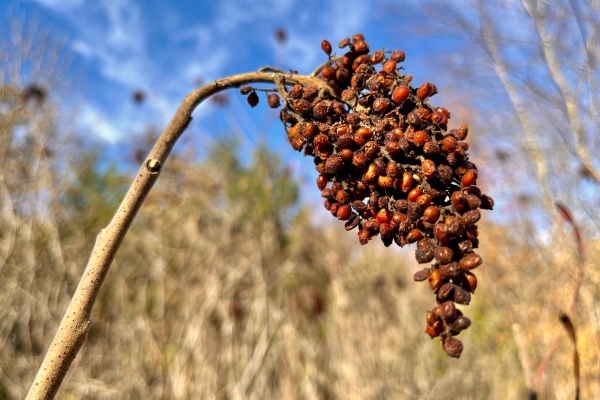
Beginning on the trail from the parking lot, John Oliver pointed out a stand of tall, now leafless sumacs which nearly everybody (including this author) assumed to be Rhus glabra (smooth sumac) due to their size. In fact, despite their size, they proved to be R. copallinum (winged sumac), with the ID confirmed by a few persisting leaves and their distinctive axial “wings.” John pointed out that an easy winter ID tip for this species is the fruiting structures, which nod distinctively after first frost (those of R. glabra do not).
Post-frost “nodding” seed head of Rhus copallinum (winged sumac).
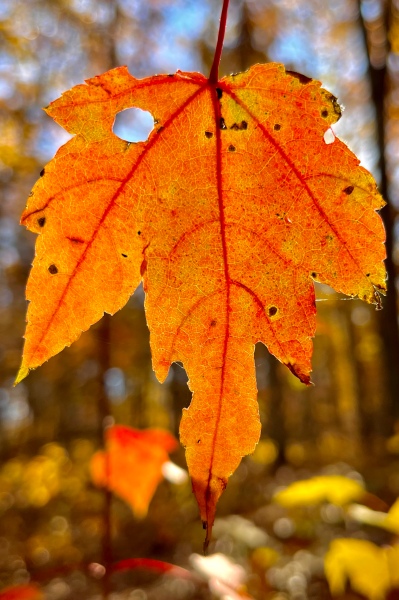
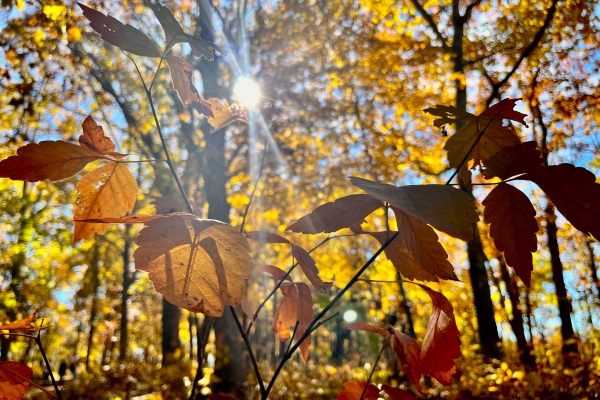
Ascending the trail through the dry-mesic forest towards the first set of glades, we noted the brilliant colors of small Acer rubrum (red maple) saplings in the understory. When their leaves finally drop, they will be more difficult to distinguish from A. saccharum; however, their rounded rather than elongated buds will still allow differentiation.
Acer rubrum (red maple).
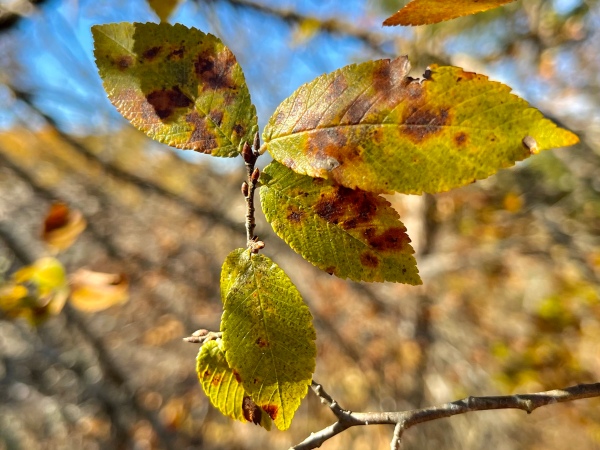
Several of the oaks were examined, with most thinking they were largely Quercus shumardii (Shumard’s oak) and Q. velutina (black oak)—both similar to each other but the latter bearing larger, grayer, pubescent, quadrangular terminal buds. Approaching the glades, Q. marilandica (blackjack oak), Carya texana (black hickory), and Ulmus alata (winged elm) became more abundant, all three much preferring the drier conditions found around the glade margins. An interesting feature of the latter (in addition to the distinctive, corky ridges on the twigs), is the leaves, which are smaller than those of most other elms but tend to grow larger towards the terminus of the twig. They also tend to be much less asymmetrical at their base than other elms.
Ulmus alata (winged elm) showing gradually larger leaves towards the twig terminus.
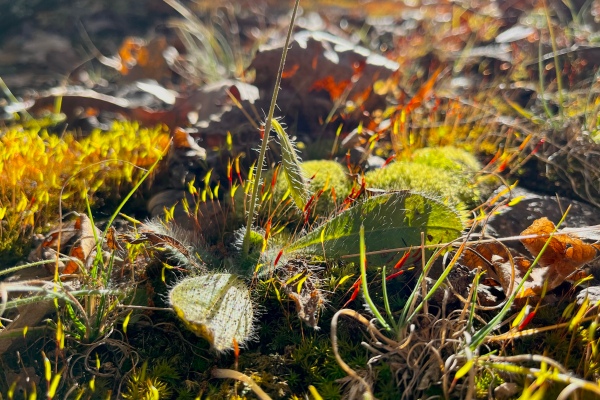
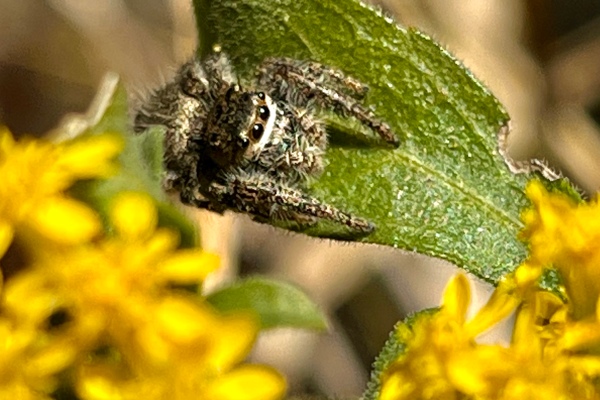
Very little was left in bloom, but the remnants of recent bloomers were still evident. Solidago petiolaris (downy goldenrod) and Symphyotrichum anomalum (many-rayed aster) were common along the trail and still recognizable, their showy flowers gone and replaced by developing seeds. Hieracium sp. prob. gronovii (beaked hawkweed) was found nestled among mosses perched on a rhyolite shelf, the flowers gone but the leaves still green and distinctively hairy. Hypericum gentianoides (pineweed) was found on the glades proper, most with their stems and leaves turning red but the occasional plant still green enough to allow crushing its stems and enjoying its orange-like fragrance. Bucking the trend, however, was a small patch of Solidago nemoralis (old-field goldenrod), it’s yellow flowers fresh and bright in defiance of the calendar’s call to senescence. A small jumping spider in the genus Phidippus took advantage of the lingering greenery, hiding among the leaves in hopes of finding equally persistent prey.
Hieracium sp. prob. gronovii (beaked hawkweed).
Solidago nemoralis (old-field goldenrod).
Phidippus sp. on Solidago nemoralis (old-field goldenrod).
The benefits of management efforts by the Missouri Department of Conservation in the area’s forests were more evident than ever. Between the first set of glades and the main glades surrounding the summit, a rich shrub layer dominated by Rhus aromatica (fragrant sumac) stretched endlessly under an open woodland of oak and hickory, the latter turning the canopy bright yellow in vivid contrast to the orange and red shrub layer beneath. Such open woodlands were once common in pre-settlement Missouri but are now rare due to the elimination of fire in the landscape and its mediating impacts.
Rhus aromatica (fragrant sumac).
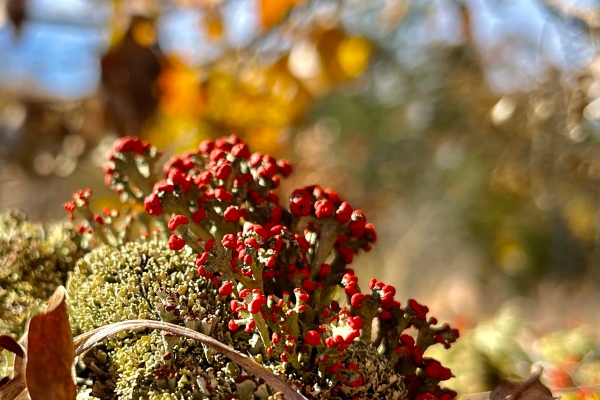
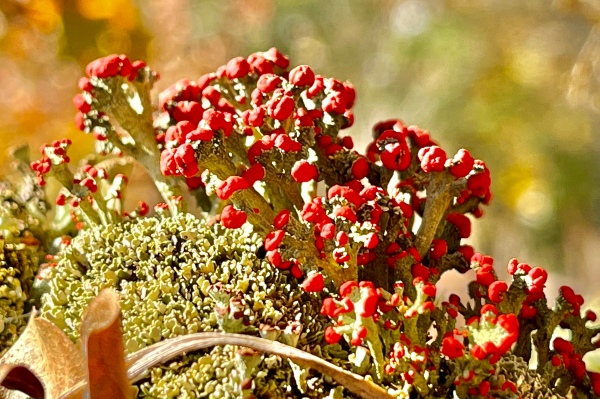
Entering the main glades, the group made their way up towards the summit and Devil’s Honeycomb, while Ted and Sharon stayed back to take a closer look at and photograph a robust colony of Cladonia cristellata (British soldiers) growing under Juniperus virginiana (eastern red-cedar). Lichens, of course, are unique in the world of vegetation in that they are a composite organism—a fusion between a fungus and another organism (usually a green alga or cyanobacterium) capable of producing food via photosynthesis. None of these groups of organisms are considered plants in the modern sense, and, in fact, fungi are more closely related to animals than they are to plants. Nevertheless, the convergence in appearance, habitat, and ecology of lichens with plants puts their study much more in the realm of botany than zoology.
Cladonia cristatella (British soldiers).
Cladonia cristatella (British soldiers).
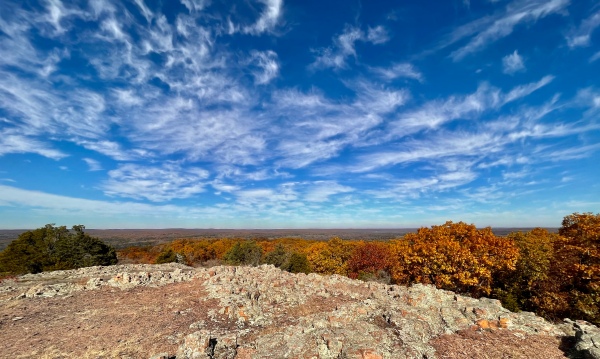
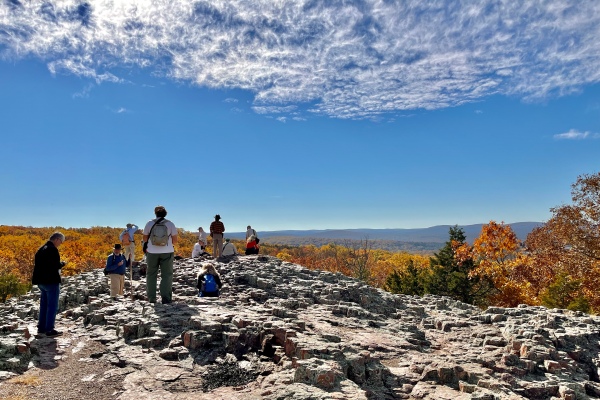
The group arrived at the summit just in time to enjoy spectacular vistas under crystal blue skies with wisps of clouds and the balmiest temperatures one could possibly hope for in early November.
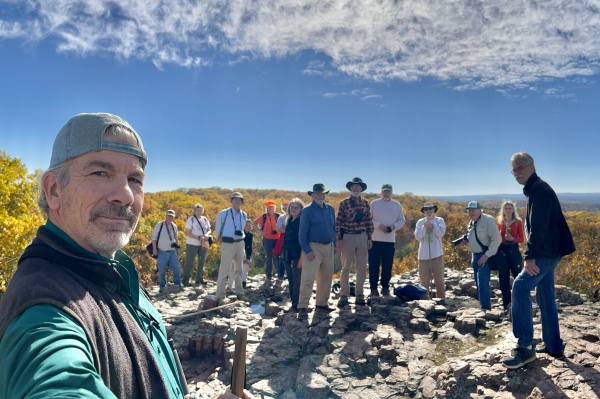
The group enjoys the view from the summit of Hughes Mountain.
L–R: Ted MacRae, Rich Thoma, Kathie Bildner, Michael Laschober, Tina Cheung, Kathy Thiele, Nancy Mathis, Sharon Lu, Alan Brant, Mark Peters, John Oliver, Larry Lindenberger, Burt Noll, Gwyn Wahlman, Keith Woodyard.









 Beetles In The Bush