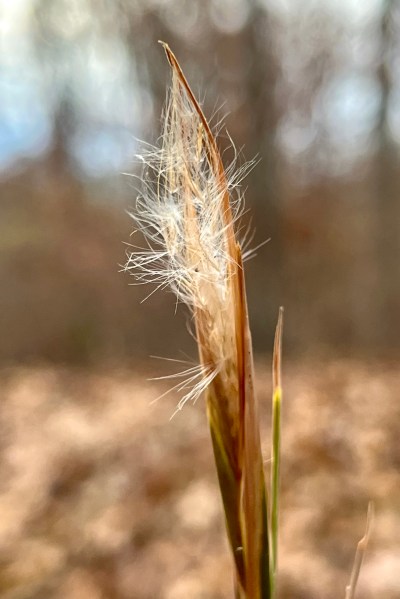
🌿 Botanizing w/ the Webster Groves Nature Study Society (WGNSS) Botany Group at Rockwoods Reservation – 3 Nov 2025

After several weeks of traveling to the outer reaches of the St. Louis area, the WGNSS Botany Group pinned their hopes on seeing good fall colors closer to home at Rockwoods Reservation in Wildwood. Despite its proximity to St. Louis, Rockwoods offers visitors a taste of the Ozarks with its mix of dry, rocky ridges, cool, moist ravines, and forested slopes featuring a variety of woodland types depending on substrate and exposure. Several trails are on offer, but the group chose the Rock Quarry Trail as the most likely to provide a diversity of plants and color.
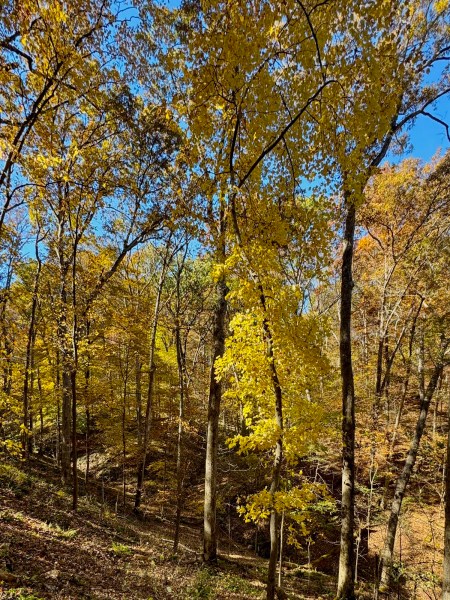
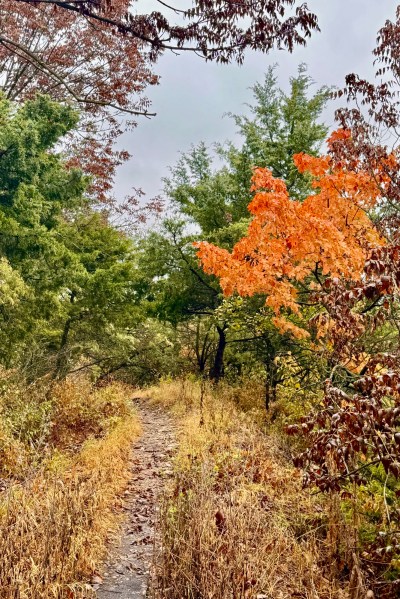
Hard maples ablaze!

A large (seemingly misplaced) Taxodium distichum (bald cypress) tree right at the trail entrance captured our attention, and numerous globular cones, still green at this point in the season could be seen within its crown. Bald cypress trees are often attacked by a small fly called the cypress twig gall midge (Taxodiomyia cupressiananassa—family Cecidomyiidae) which produces globular galls on the twigs that can be mistaken for immature cones, but despite thorough searching none were found.

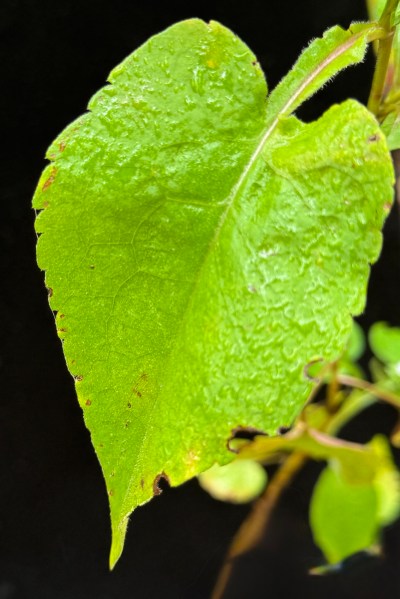
As we started up the rocky trail, John noticed several freshly fallen leaves on the ground under a large(ish) tree and picked one up for the day’s first “pop quiz.” Morus (mulberry) or Tilia (linden or basswood), two unrelated trees that bear similar-looking leaves, were the early guesses, but which? The shape of the leaf base—usually symmetrical in the former and asymmetrical in the latter—can be useful but is not consistent. A better way is to break the leaf petiole to check the color of the sap that exudes—milky in the former and clear in the latter. In this case, it was milky, identifying the tree as Morus rubra (red mulberry).

Our late summer and early fall this year was unusually dry with almost no rain from the beginning of August until near the end of October. This year’s fall floral display has suffered as a result, with many of the plants we are seeing in flower now looking rather pitiful compared to if they had grown under more favorable conditions. The recent rains may not have been enough to “save” the season, but the landscape has “perked up” a bit in their wake. By early November, Solidago (goldenrods) and Symphyotrichum (true asters) make up the bulk of the anticipated plants in flower, and we were fortunate to see blooms of several species in these two genera. These included not only some species that we have seen in the past weeks, such as Solidago ulmifolia (elm-leaved goldenrod), Symphyotrichum anomalum (many-rayed aster), Symphyotrichum patens (spreading aster), and Symphyotrichum lateriflorum (calico aster), but also a few that we have not.
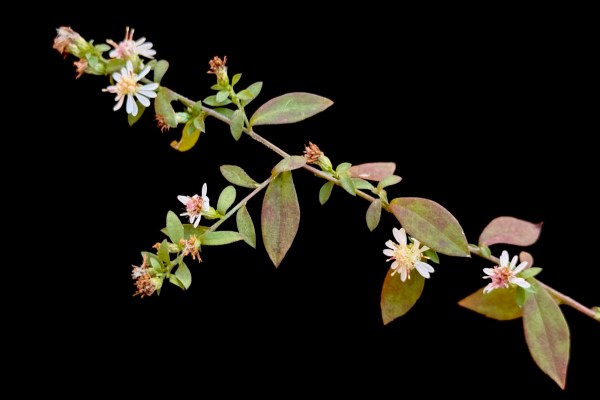
Symphyotrichum lateriflorum (calico aster—family Asteraceae).

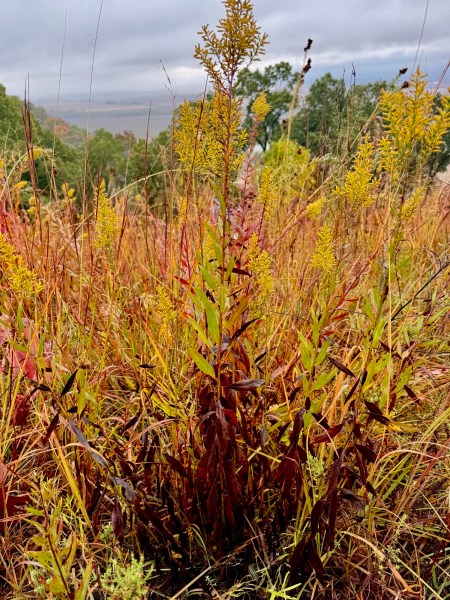
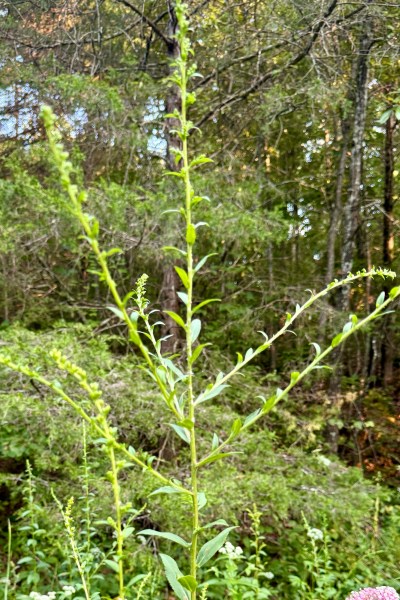
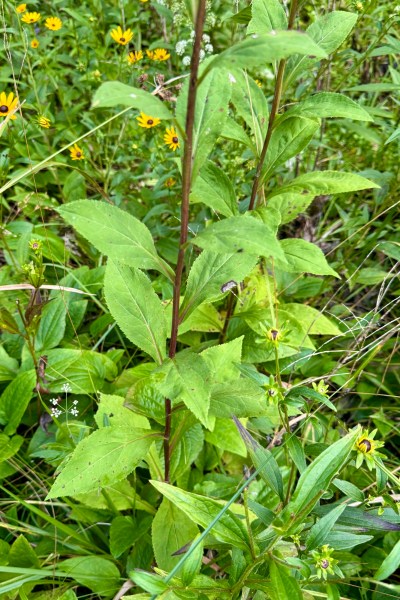
The bulk of these were located in or near a small “glade” on a southwest-facing not far from the trail entrance. The patch of xeric habitat is not a true glade, but rather a scar of past quarrying activity on the southwest-facing limestone slope that has resulted in a glade-like habitat. It was here that a few patches of Solidago rugosa (rough-leaved or wrinkle-leaved goldenrod) were found. This species is similar to S. ulmifolia but usually has multiple stems and sessile leaves with the margins not as coarsely toothed and the veins more deeply impressed, giving the leaf a rugose appearance (on which the species name is based).
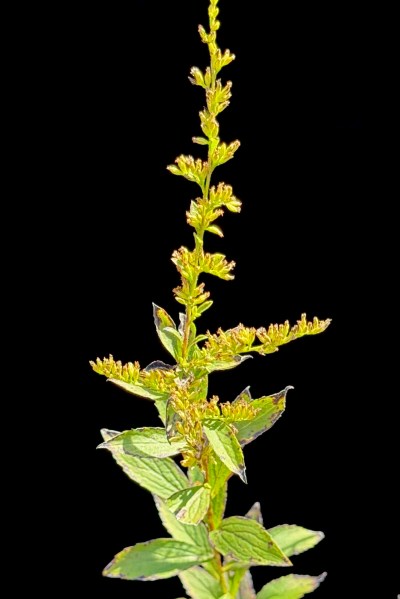
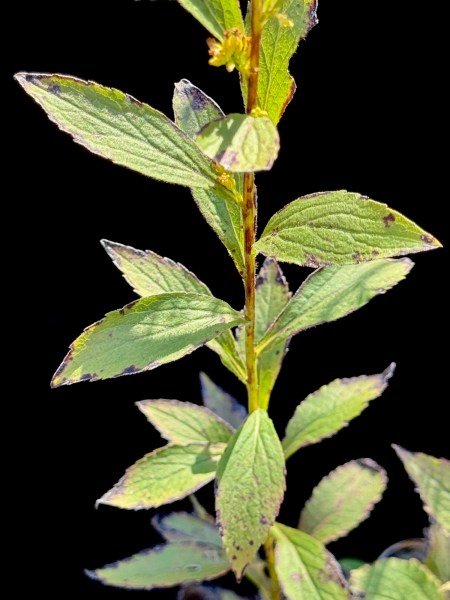
Solidago rugosa (wrinkleleaf or rough-stemmed goldenrod—family Asteraceae) inflorescence.
Solidago rugosa (wrinkleleaf or rough-stemmed goldenrod—family Asteraceae) leaves.

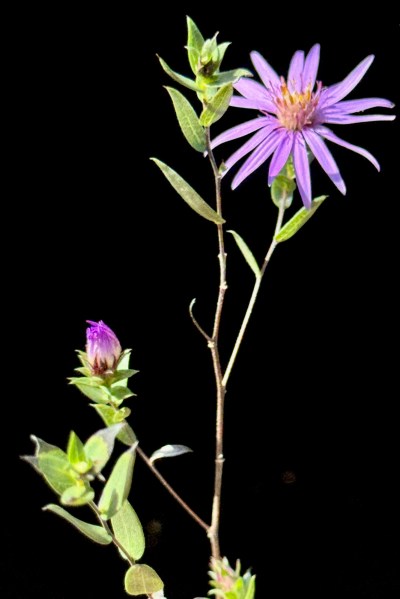
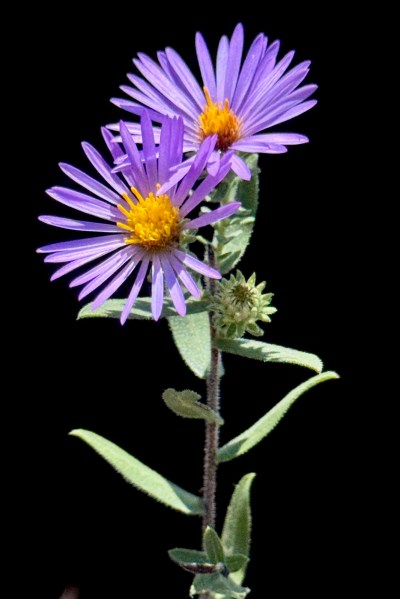
We have seen Symphyotrichum oblongifolium (aromatic aster) in true glades the past few weeks (at Victoria Glades and Fults Hill Prairie), and we saw it blooming in this “pseudo glade” as well. Amongst the several plants of this species, however, was a single blue-flowered aster that did not exhibit the same profusely branched and many-leaved growth. This turned out to be the slightly more conservative (CC = 7) Symphyotrichum laeve (smooth blue aster), identifiable by its smooth, completely hairless, narrowly elongate leaves that clasp the stem at the base.
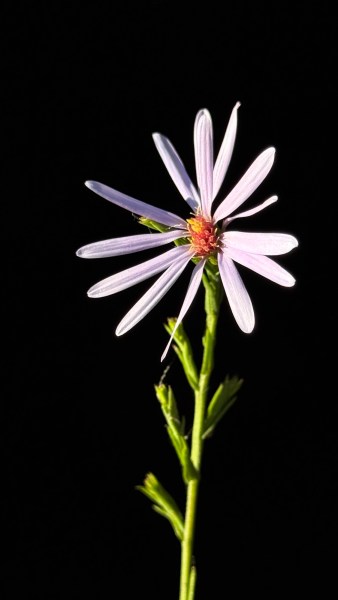
Symphyotrichum laeve (smooth blue aster—family Asteraceae) flower.
Symphyotrichum laeve (smooth blue aster—family Asteraceae) stem and leaves.

Just beyond the glade and reentering the dry woodland, a single white-flowered aster was seen and determined to represent Symphyotrichum urophyllum (arrowleaf aster) based on its leaves—heart-shaped at the base and gradually becoming more arrowhead-shaped and sessile to nearly sessile further up the stem—and dense, cylindrical cluster of white flowers at the top of the plant.

Symphyotrichum urophyllum (arrowleaf aster—family Asteraceae) inflorescence.
Symphyotrichum urophyllum (arrowleaf aster—family Asteraceae) stem and leaf.

Moving further along the trail, the substrate transitioned from limestone to chert, which was accompanied by the appearance of more acid-loving lichens, mosses, and plants such as Vaccineum pallidum (lowbush blueberry) and Cunila origanoides (American dittany), a few plants of the latter still exhibiting blooms in good shape. The finely divided leaves of Viola pedata (bird’s foot violet), a characteristic occupant of upland forest openings having dry, cherty soils, were common along the steep trailside bank in this area.
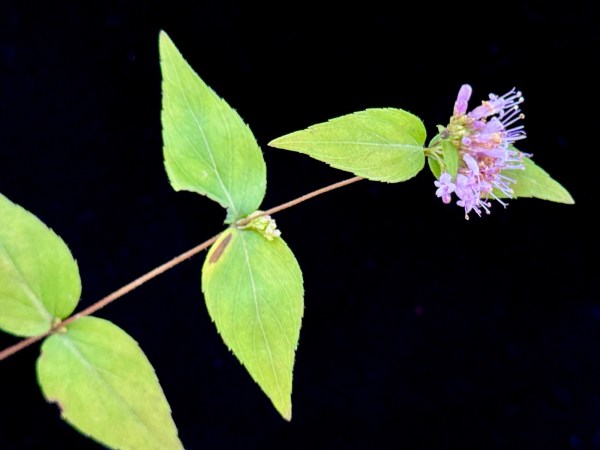
Cunila origanoides (American dittany—family Lamiaceae).

Further up the trail along the ridgetop, we saw a single plant representing yet another acidophile and first sighting for the season—Solidago hispida (hairy goldenrod). This species can be recognized by its single stem, erect, narrow cluster of yellow flowers at the top of the plant, distinctly hairy leaves and stems (especially at the base), and larger basal leaves. It typically inhabits dry, open, and rocky woodlands, especially those with acidic substrates.
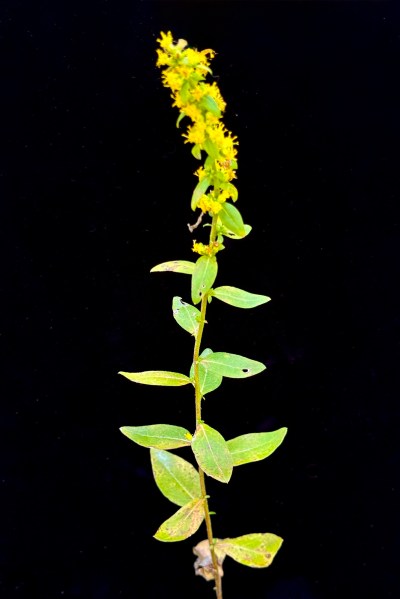
Solidago hispida (hairy goldenrod—family Asteraceae) upper stem leaves and inflorescence.
Solidago hispida (hairy goldenrod—family Asteraceae) lower stem.

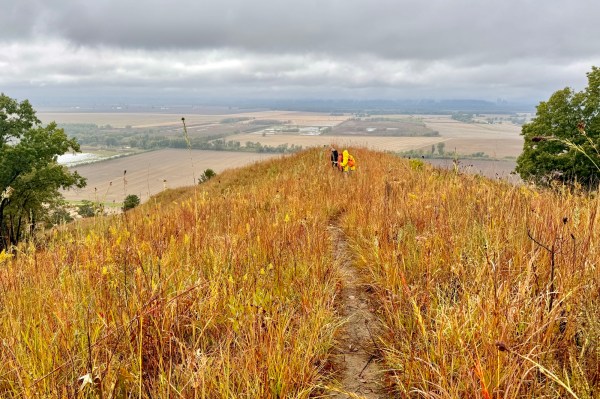
A long gentle descent off the ridge top took the group gradually down into a deep ravine with a tall, dense canopy that contrasted distinctly with the dry, rocky, more open forests seen to that point. Muted browns and yellows of oaks and hickories gave way to vibrant golds, oranges, and reds of hard maples. Polystichum acrostichoides (Christmas fern) was abundant on the north-facing slopes, the darkened tips of their fertile fronds conspicuous against the much more green rest of the plant, and two other fern species were noticed as well: Adiantum pedatum (northern maidenhair fern), a deciduous species with its fronds just starting to senesce, and Asplenium rhizophyllum (walking fern), an evergreen species that spreads vegetatively (“walks”) by rooting to form new plantlets whenever the tips of its long, undivided leaves touch moist substrate. Lindera benzoin (spicebush) was also abundant in the more mesic habitat now being traversed, their just-formed flower buds now sufficiently developed to distinguish male (larger buds) from female (smaller flower buds) plants at a glance.
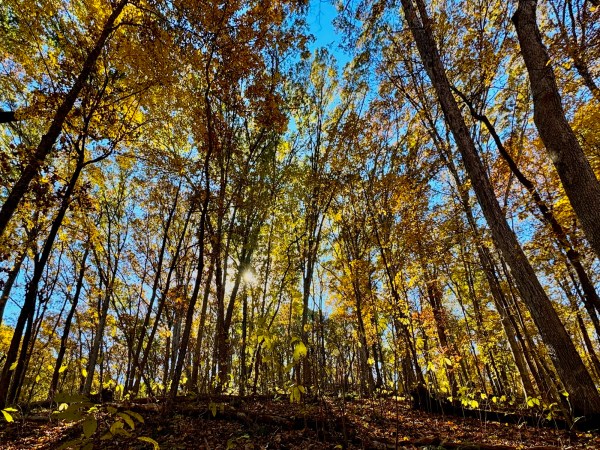
Backlit leaves of Asimina triloba (pawpaw) under a canopy of blazing yellow Acer saccharum (sugar maple).

The trail ends up the road a ways from its start, requiring a short roadside walk to return to the parking lot. Despite the presence of asphalt, the group remained on the lookout for plants of interest in the now riparian forest corridor paralleling the road. A fourth goldenrod—Solidago altissima (tall goldenrod)—was seen (its identity confirmed by rubbing its leaves with the fingers to feel its roughness), but the biggest attention getter was a spectacularly large Ilex decidua (deciduous holly or possumhaw) bearing a profusion of bright orange-red berries.

Ilex decidua (deciduous holly, possumhaw—family Aquifoliaceae).

For lunch afterwards, the group chose the ever-popular Clancy’s Irish Pub in nearby Ellisville.

©️ Ted C. MacRae 2025

🌿 Botanizing w/ the Webster Groves Nature Study Society (WGNSS) Botany Group at Fults Hill Prairie Nature Preserve — 27 Oct 2025

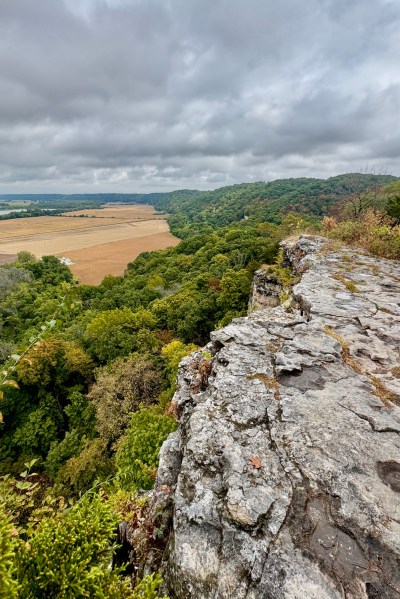
After visiting Salt Lick Point Land & Water Preserve a few weeks ago, the WGNSS Botany Group continued its exploration of the Mississippi River bluffs in southern Illinois by visiting Fults Hill Prairie, a 532-acre preserve 13 miles south of Salt Lick Point. In addition to upland forests and glades, Fults Hill Prairie features the largest complex of high-quality loess hill prairie still existing in the state. This diversity of habitats correlates with a rich diversity of plants, which at this time of year is exemplified by the classic fall genera Solidago (goldenrods) and Symphyotrichum (true asters). While late October is a bit past peak bloom and the persistent precipitation that only began a few days earlier after an extraordinarily dry previous three months further dampened expectations, a decent-sized group of intrepid explorers nevertheless defied the forecast, steep wooden stairway, and slippery final ascent (along with the subsequent descent) to explore the area’s diversity and admire its bluff-top views.

View of the Mississippi River valley from Fults Hill Prairie Nature Preserve.

Some of the same goldenrods and asters that the group saw a few weeks ago at Salt Lick Point were again seen during the initial ascent. Among the more conservative of these were Solidago buckleyi (Buckley’s goldenrod), Solidago drummondii (cliff goldenrod), and Symphyotrichum anomalum (many-rayed aster). Less conservative (i.e., more commonly encountered) counterparts also were seen such as Solidago ulmifolia (elm-leaved goldenrod) and Symphyotrichum patens (spreading aster). In all cases, the plants exhibited precious few pitiful flowers due to the combination of late season and the drought-compromised display, but this didn’t prevent the group from practicing their identification skills based on non-floral characters.

Ascending the steep rocky slopes, the canopy was dominated by Quercus muhlenbergii (chinquapin oak)—an indicator of the thin, rocky soils underfoot. As the group continued to ascend, Quercus alba (white oak) also began to appear and eventually replaced Q. muhlenbergii as the dominant oak, signaling the presence of deeper deposits of the wind-blown loess soils that characterize the hilltops. Further up, on the south- and west-facing slopes at the top, such soils are unable to hold sufficient moisture to support the growth of trees. As a result, despite the presence of deep soils, the forest gives way to the first of two large hilltop prairie remnants featured in the preserve. A lone, Quercus stellata (post oak) stood sentry atop the prairie, adding to the diversity of oaks seen and framing a gorgeous view from the prairie across the valley below.

A lone Quercus stellata (post oak—family Fagaceae) stands sentry atop a loess hill prairie.

Entering the woodlands along a remnant 2-track belying the past presence of a farm, the group encountered a third species of blue-flowered aster whose cordate, scabrous leaves, pubescent stems, and distinctly winged leaf petioles identified it as Symphyotrichum drummondii (Drummond’s aster). This and another more commonly encountered aster, Symphyotrichum lateriflorum (calico aster), were found scattered along the sides of the 2-track until the group began its descent down into the second large loess prairie remnant.

Symphyotrichum drummondii (Drummond’s aster—family Asteraceae) inflorescence.
Symphyotrichum drummondii (Drummond’s aster—family Asteraceae) leaf and petiole.

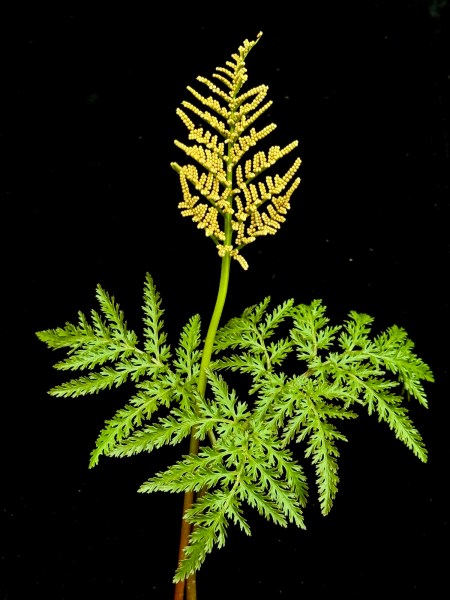
Also along the 2-track, but only in one small area, the group observed Sceptridium dissectum (cut-leaf grape fern, formerly Botrychium dissectum) in “flower” with mature fertile fronds. The finely divided leaves identified the plants as var. dissectum, which is a bit less common than var. obliquum.

Sceptridium dissectum var. dissectum (cutleaf grapefern—family Ophioglossaceae).

The diversity of oaks seen increased as the group traversed the forests along the 2-track, with Quercus velutina (black oak) becoming co-dominant with Q. alba. Numerous freshly-fallen twigs littered the 2-track due to the recent rains, and the shapes of some of the leaves seemed to suggest they might be from the more southerly Quercus falcata (southern red oak); however, careful examination of their lobes along with newly-formed buds and fully-developed acorns confirmed them, nevertheless, to be Q. velutina.

Quercus velutina (black oak—family Fagaceae) leaf.
Quercus velutina (black oak—family Fagaceae) buds.
Quercus velutina (black oak—family Fagaceae) acorn.

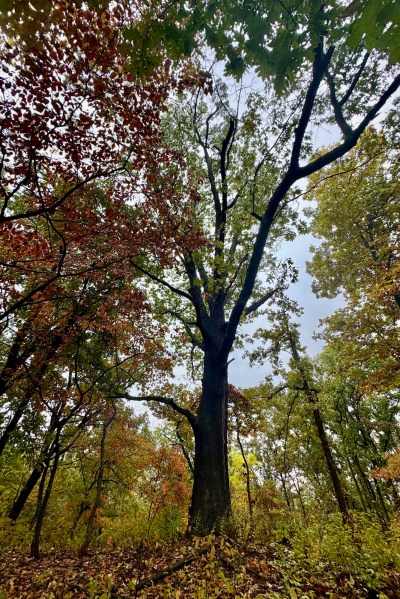
Still, the diversity observed oaks increased to five species when we began encountering Quercus shumardii (Shumard’s oak), including one particularly grand old tree whose spreading main branches and broadly-formed crown whispered stories about the more open conditions that must have occurred around it during its youth.

Quercus shumardii (Shumard’s oak—family Fagaceae).

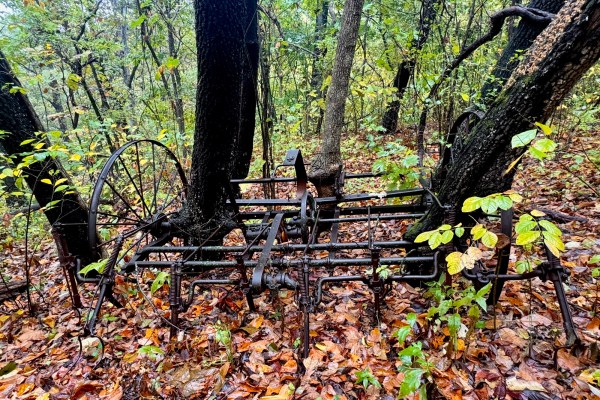
Nearby, a rusty farm implement, actively being engulfed by trees that sprouted after the last time it saw any movement, further attested to the area’s long-forgotten days as a farm.

Old farm implement taken over by trees.

The diversity of goldenrods seen also continued to tick upwards along the 2-track as we encountered what was either Solidago atltissima (tall goldenrod) or Solidago canadensis (Canadian goldenrod). These two species are difficult to distinguish, especially when the foliage is wet since leaf pubescence is a key distinguishing characteristic, but the upland habitat initially suggested the latter since S. altissima prefers more mesic habitats. A number of other more mesic-preferring plant species were also noticed in the area, however, perhaps a result of the underlying deep loess soils, so a final determination was not made. It was upon the final approach towards and down onto the second main loess prairie remnant, however, that the diversity of goldenrods and asters really began to skyrocket. Near the edge of the prairie but still in the forest, we saw Symphyotrichum oolentangiense (pronounced oh-OH-len-tang-ee-IN-say) (azure aster)—easily identifiable by its blue flowers and long, narrow, arrowhead-shaped lower leaves that are rough and sandpapery to the touch. At the prairie edge Symphyotrichum turbinellum (prairie aster), identifiable by its many-branched growth habit, elliptic leaves with tapered bases, and long vase-shaped involucres, began to appear. Symphyotrichum sericea (silky aster) further padded the diversity totals, a small patch of plants with their distinctive silvery leaves occupying the farthest (and possibly driest) extent of the loess prairie ridge before it began dropping precipitously towards the towering limestone blufftop.

Kathy, Michael, and John examine plants in a loess hill prairie.

The most dazzling addition to the diversity, however, was Solidago rigidiuscula (stiff-leaved showy goldenrod). Until recently considered to be a variety of Solidago speciosa (showy goldenrod), the large showy inflorescences of this species are every bit as attractive as the latter, but the plants feature narrower leaves, and while the flowers had largely faded by this late date, the lower foliage turning brilliant red provided stunning contrast with the still-green upper leaves and more muted colors of the surrounding vegetation.

Solidago rigidiuscula (stiff-leaved showy goldenrod—family Asteraceae).

The group then began its long, slow, careful descent off the prairie and through the lower woodlands back to the parking lot. Separating the two, however, is a limestone glade that features a slightly different flora of prairie-associated species than the hilltop prairie due to its thin, rocky versus deep loess soils, and it was in these glades where the group saw the day’s ninth and final species of aster—Symphyotrichum oblongifolium (aromatic aster), distinctive by its branched growth with numerous small leaves amongst normal-sized leaves (and if there is still any doubt, a quick crush-and-smell of the latter reveals its highly aromatic nature). A sixth and final goldenrod also was seen on the rocky slopes just below the glade—Solidago radula (rough goldenrod), its short, clump-like stature and densely numerous, heavily scabrous, serrate leaves confirming its identity.

As the lone entomologist in the group, I had been keeping my eye out for any insect activity—particularly Oncideres cingulata (twig girdler), a longhorned beetle (family Cerambycidae) that appears only during fall and “girdles” twigs of hickory and certain other trees before laying eggs in them. Numerous such twigs were seen, and I picked up several in hopes of finding females still upon them—unfortunately, to no avail. In fact, but a single insect was seen all day, and even it was not until I had returned to the parking lot—a nymph of the distinctively green Zelus luridus (pale green assassin bug).

Zelus luridus (pale green assassin bug—family Reduviidae) nymph.

©️ Ted C. MacRae 2025

🌿 Botanizing w/ the WGNSS Botany Group at Victoria Glades Preserve

6 Oct 2025—Fall continues to advance in the St. Louis area, and despite very dry conditions during the past two months the fall bloomers continue to make their appearance. One of the area’s most reliable and interesting places to see fall blooms is Victoria Glades south of Hillsboro, where orchids, gentians, and asters anchor a unique suite of fall-blooming plants that are rarely seen elsewhere in our mostly forested environs.

The group chose the Nature Conservancy portion of the complex to explore, as it was in the mesic forest along the riparian corridor below the glade on this side that the first of two orchids—the charmingly diminutive and seldom-seen Spiranthes ovalis (lesser ladies’ tresses)—was expected to be seen in bloom. Despite having recently taken GPS coordinates for the plants, it took several minutes of the group scouring the area around the coordinates before the tiny plants were finally found. Its delicate blooms, fall flowering season, small size, presence of basal and cauline leaves at anthesis, and preference for mesic habitats all serve to identify this species. Missouri’s populations are considered var. erostella, which lack certain essential flowering organs and are, thus, self-pollinated (cleistogamous).

Spiranthes ovalis var. erostellata (lesser ladies’ tresses—family Orchidaceae).

Clambering up and out of the creek bed and onto the open glade, the group found, again with some difficulty, the second orchid we were looking for—Spiranthes magnicamporum (Great Plains ladies’ tresses). Unlike S. ovalis, however, this species is much more commonly seen on dolomitic glades throughout the state, and there have been fall seasons at Victoria Glades featuring spectacular displays of it. Sadly, it does not appear that this will be one of those falls, almost surely because of the near absence of rain in recent months. The first two plants were found under and next to a cut eastern red-cedar, whose cadaver perhaps provided just enough protection to prevent a complete drying of the soil underneath and allowed the two plants to proceed to flowering. Of the nine species of Spiranthes presently known to occur in Missouri, S. magnicamporum is among the showiest due to its robust, often doubly helical inflorescences and relatively large flowers with spreading and arching lateral sepals. It is also among the most fragrant, with a sweetish fragrance of coumarin, which some people liken to vanilla.

Spiranthes magnicamporum (Great Plains ladies’ tresses—family Orchidaceae).

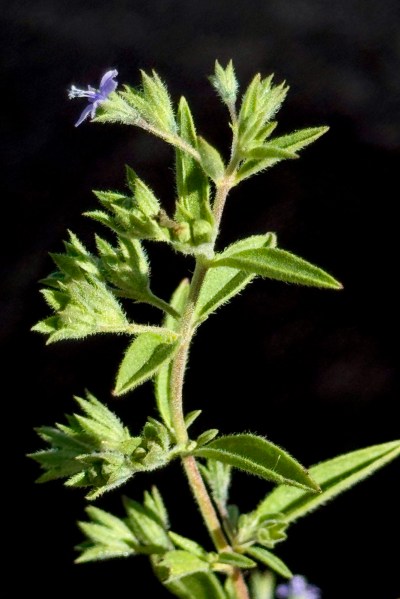
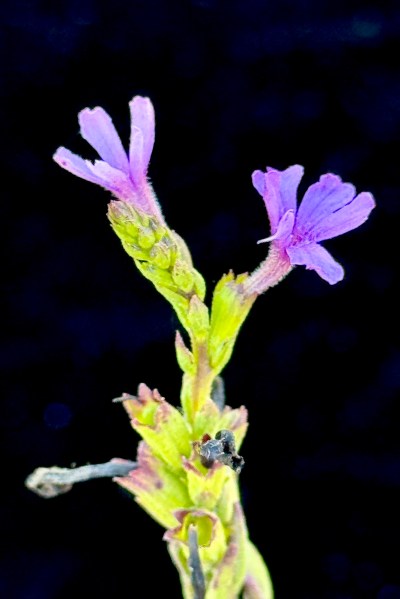
I’ve been visiting Victoria Glades for more than 40 years, yet I continue to see things I haven’t previously notified. This time it was Trichostema coeruleum (pennyroyal bluecurls), a member of the mint family (Lamiaceae). [Note: Trichostema coeruleum was known until recently as Trichostema brachiatum—now a synonym of Trichostema dichotomum.] Unlike Trichostema dichotomum (bluecurls), which prefers glades and other dry habitats with acidic substrates (e.g., sandstone), T. coeruleum prefers such habitats with calcareous substrates (e.g., dolomite). A third species of the genus, Trichostema setaceum (narrow-leaf bluecurls), also occurs in Missouri but is restricted to sand prairies in extreme southeastern Missouri.

Trichostema coeruleum (pennyroyal bluecurls—family Lamiaceae).

Dolomite glades are also the preferred habitat for many species of plants in the family Orobanchaceae, a bizarre family of mostly hemiparasitic plants that derive at least some of their nutrition not from the sun, but by tapping into the roots of nearby plants. Castilleja coccinea (scarlet paintbrush) is perhaps the best known of these, in most years joining the cacophony of wildflowers that form colorful displays across Victoria Glades during spring and early summer. There are, however, several less conspicuous but equally beautiful wildflowers in the family that are restricted in the area almost exclusively to the dolomite glades of Jefferson Co. One of these is Agalinis skinneriana (Skinner’s or pale gerardia/false foxglove), which the group found sporadically still in bloom across the open glade. There are several species of Agalinis in Missouri, some of which are quite common. However, A. skinneriana can usually be recognized by the characteristic habitat and generally upward-facing flowers with spreading to reflexed upper corolla lobes. The plants are also relatively slender and fewer-branched than the more common A. tenuifolia (common gerardia/false foxglove) and A. gattingeri (rough-stemmed gerardia/false foxglove).

Agalinis skinneriana (Skinner’s or pale gerardia/false foxglove—family Orobanchaceae).

Another plant in the family Orobanchaceae that the group saw was Buchnera americana (American bluehearts), represented by a single plant still bearing two worn blossoms. Normally blooming from June through September, plants in full bloom have no look-alikes and are not likely to be confused with anything else. Despite this, the vervain-like fruit-bearing structure of this late straggler fooled the group into at first thinking it was a species of Verbena until its true identity was realized.

Buchnera americana (American bluehearts—family Orobanchaceae).

No group of plants more iconically represents fall than goldenrods (genus Solidago) and true asters (genus Symphyotrichum), and no place allows as many uncommonly seen species to be seen together as the dolomite glades. Three species of goldenrods were seen during the day—the super common Solidago nemoralis (old field goldenrod), the less common but more showy Solidago rigida (stiff goldenrod), and the highly restricted Solidago gattingeri (Gattinger’s goldenrod) (we were not able to locate a fourth species—Solidago radula [rough goldenrod], which we have observed during previous visits on the MDC portion of Victoria Glades). It was the true asters, however, that truly tested our plant identification abilities. Relatively easier are the purple asters, of which we found three species. The first and most abundant was Symphyotrichum oblongifolium (aromatic aster), recognized by its recurved phyllaries and branched habit with narrow, linear leaves that become more numerous and smaller in the upper plant. If one is still in doubt as to its identity, however, one needs only to crush the leaves between the fingers and enjoy its distinct aroma.

Symphyotrichum oblongifolium (aromatic aster—family Asteraceae).

Along the intermittent creek and near the interface with the dry post oak woodland on the north of the glade, we encountered a second species—Symphyotrichum oolentangiense (azure aster). Identification of this species came only near the end of the outing, as a key identifying characteristic of this species—the presence of distinctly petiolate cordate basal leaves that are rough to the touch—was not seen on any of the plants examined before then. At that point, we suspected Symphyotrichum turbinellum (prairie aster) due to the vase-shaped involucres. While that species has been found at Victoria Glades, it is usually a much more highly branched plant associated with more wooded habitats (despite the common name). Finally, we found a plant with such leaves present, albeit dried up, and then another with the leaves present and still fresh to confirm the identification.

Symphyotrichum oolentangiense (sky blue aster—family Asteraceae).

In a small area at the northernmost point of the glade, we found Symphyotrichum sericeum (silky aster). This species is immediately recognizable from afar by the silvery cast to the foliage—this, combined with its highly preferred habitat of glades or dry prairies are usually enough to identify the species, although it is said that the flowers are often more purple and less bluish than other “purple asters.”

Symphyotrichum sericeum (silky aster—family Asteraceae).

As we walked the margins of the glade, the group kept their collective eyes out for Gentiana puberulenta (downy gentian), a striking and rarely seen fall flowering species that has been found on several occasions at Victoria Glades. The species has been seen at Victoria Glades on a few occasions in past years, and the locations of these sightings were scoured thoroughly but without success. Unexpectedly, near the end of the outing, a single plant in flower was located—its perfectly fresh blossom initially hidden from view underneath fallen leaves. One of three members of the genus Gentiana in Missouri, this species is easily differentiated by having the corolla spread open at maturity. Missouriplants.com notes “The rich, deep blue color of the corollas is a striking and uncommon hue among our flora.” A strikingly beautiful final find of the day indeed, and a perfect note on which to gather for lunch at historic Russell House in nearby Hillsboro.

Gentiana puberulenta (downy gentian—Gentianaceae).

For me, no botany outing is strictly about plants (just as no entomology outing is strictly about insects), so there were a few interesting insect observations on the day. On our way to look for Spiranthes ovalis (lesser ladies’ tresses), June noticed a caterpillar on the Ulmus rubra (slippery elm) that we decided must represent Halysidotus tessellaris banded tussock moth).

Halysidota tessellaris (banded tussock moth—family Erebidae) on Ulmus rubra (slippery elm).

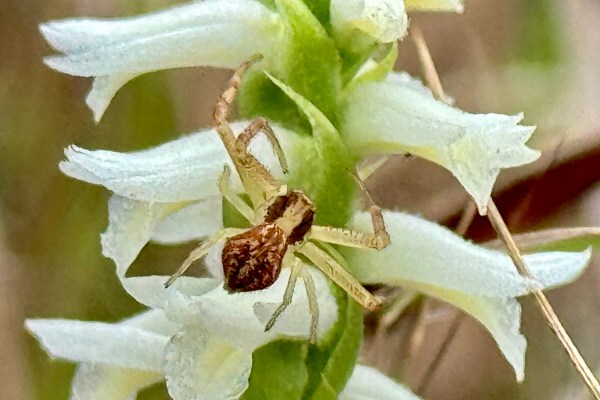
Later, after lunch with the group, I returned with the goal of more closely inspecting Physocarpus intermedius (Midwest ninebark) along the glade toeslopes and intermittent creek to see if Dicerca pugionata was out. It has been many years since I’ve seen this species in the fall (but it has also been many years since I’ve really tried to look for it during the fall). I started first with the plants along the moist toeslopes along the west side of the glade, checking several of the now very scraggly-looking plants without success. Along the way, I encountered an especially beautiful Spiranthes magnicamporum, so I paused to take photos. While doing so, I noticed a cryptically-colored crab spider on its blossoms—Mecaphesa asperata (northern crab spider)—the first time I’ve ever seen a spider hunting on the flowers of an orchid.

Mecaphesa asperata (northern crab spider—family Thomisidae) on flowers of Spiranthes magnicamporum (Great Plains ladies’ tresses).

Towards the end of the toeslopes, finally, two D. pugionata plopped onto my sheet. The plant they were on was near the far end of the toeslopes, and if I hadn’t seen any beetles by the time I reached the far end I would have given up the search. Finding them, however, motivated me to hike over to and continue looking along the intermittent creek, where I saw three more beetles in three different spots, the last one—satisfyingly—on the very last plant I checked before the creek disappears into denser woodland.

Dicerca pugionata (ninebark borer—family Buprestidae) beaten from living Physocarpus intermedius (Midwest ninebark).

Mission accomplished, I enjoyed one more leisurely stroll across the glade before calling it another (successful) day in the field.

©️ Ted C. MacRae 2025
Botanizing w/ the WGNSS Botany Group at Salt Lick Point

After missing the last three weeks, I was happy to rejoin the WGNSS botanists on their regular weekly outing this past Monday. This week’s destination—Salt Lick Point Land & Water Reserve in western Monroe Co., Illinois—features a mosaic of loess hill prairie and limestone glades amidst dry to dry-mesic upland forest atop limestone bluffs towering up to 400 feet above the Mississippi River valley below.

View from the Newman Trail at Salt Lick Point.

It has been an exceptionally dry August and September, so much that fall blooming plants are noticeably delayed and sparse in their blooms. Nevertheless, welcome rains just in the past few days have breathed some “fall life” into the woods and brought with them the pungent, earthy aromas that one expects to accompany a landscaping morphing from the dull greens of summer to the vibrant ambers, tawnies, and golds of fall.

View from the Salt Lick Trail at Salt Lick Point.

The group first explored the upland and blufftop habitats along the challenging terrain of the Salt Lick and Newman Trails, then returned through flat lowlands along the bluff bottoms via the Johnson Trail. Although still just beginning to bloom, a diverse palette of “fall asters” gave us an opportunity to reacquaint ourselves with the characters that distinguish these often “easy-to-identify-to-genus but difficult-to-identify-to-species” plants. The bulk of these fell into one of two groups—the true asters (genus Symphyotrichum) and the goldenrods (genus Solidago).

Salt Lick Trail at Salt Lick Point.

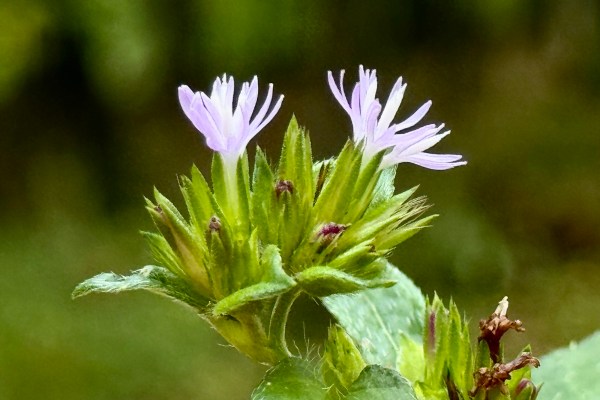
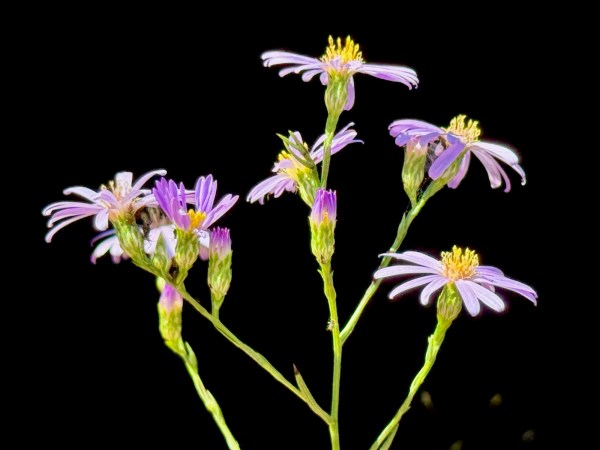
Symphyotrichum patens (late purple aster) was the first true aster that we noticed, a rather common species distinguished by its purple (of course) flowers with loose but not recurved phyllaries and leaves broadly clasping the stem. It wasn’t long before we had a chance to test our knowledge when we encountered the similar appearing Symphyotrichum anomalum (manyray aster), also with purple flowers but distinguished from S. patens by its distinctly recurved phyllaries and petiolate rather than clasping leaves. Eventually, we would encounter a third species of the genus—Symphyotrichum lateriflorum (calico aster), distinguished by its numerous small white flowers at the tips of numerous lateral branches rather than the terminus of the stem.

View from the Newman Trail at Salt Lick Point.

Goldenrods, on the other hand, were not only more diverse but also comprised some quite conservative species. The first of these was Solidago drummondii (Drummond’s goldenrod). This near-endemic species is restricted to eastern Missouri and adjacent parts of Illinois and Arkansas and grows almost exclusively on limestone or dolomite bluffs. However, we found it growing on limestone boulders placed at the trailhead next to the parking lot. Its wide, toothed leaves on short petioles (along with habitat) make this species easy to identify. Another quite conservative goldenrod was found as we entered the dry to dry-mesic forest further up the trail—Solidago buckleyi (Buckley’s goldenrod). Restricted to the Ozarks and adjacent areas, it is a showy species with relatively large flowers and spready phyllaries. In this and other respects, it greatly resembles the much more common Soldago petiolaris (downy goldenrod); however, it differs from that species by its narrower leaves that lack distinct teeth. A third species was seen as we approached one of the larger loess hilltop prairie remnants—Solidago altissima (tall goldenrod). Unlike the previous two species, this is one of the commonest and weediest species of goldenrod in the region. Relatively tall and with pyramidal inflorescences, this species often aggressively monopolizes roadsides and fallow fields. It greatly resembles another fairly common species—Solidago gigantea (late goldenrod), which we would later see during the return hike along the edge of the river valley. Leaf texture, however, differs between these two species—S. altissima has leaves with rough surfaces (caused by stiff, unidirectionally recurved hairs that cause the leaf to move only one direction when rubbed between the thumb and forefinger), while S. gigantea has smooth leaves (that move in any direction when rubbed).

Elephantopus carolinianus (Carolina elephantsfoot, leafy elephant’s foot—family Asteraceae).

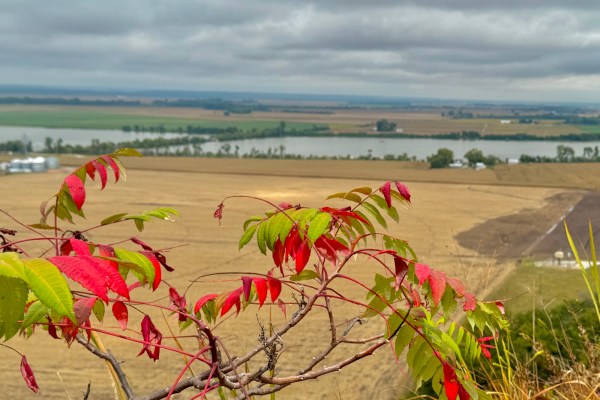
The group not only spent its time with its eyes down, but also out—across the vast Mississippi River valley spread out below the several lookout points dotting the trails. Tawny fields of near-ready-to-harvest corn provided a beautiful backdrop against the resplendent red sumacs and brilliant orange maples lining the blufftops.

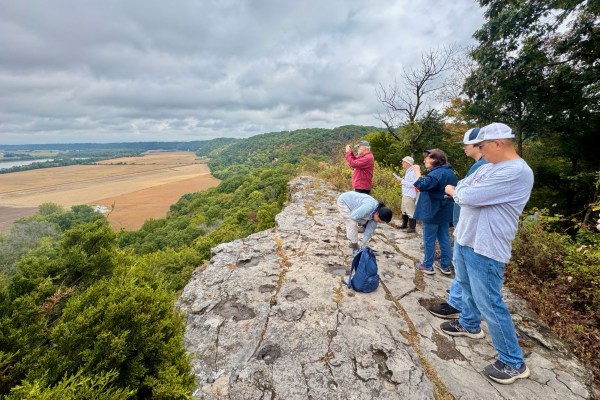
Members of the WGNSS Botany Group admire the view from the Newman Trail at Salt Lick Point.
View from the Newman Trail at Salt Lick Point.

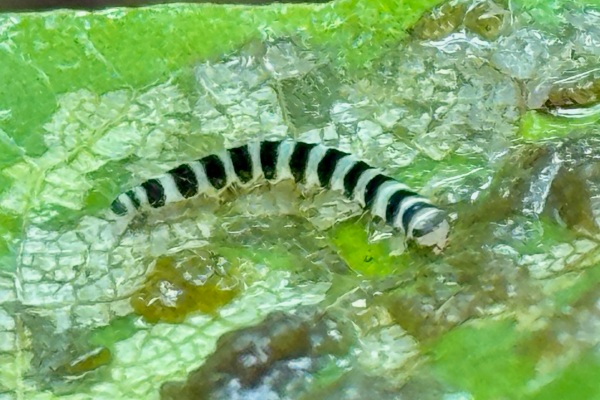
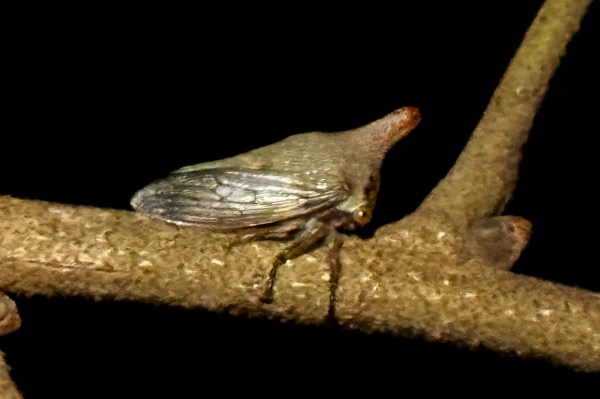
As the group’s lone entomologist/botanist (“entomotanist”?), I also kept an eye out for insects and was richly rewarded. A tiny “thorn” on the stem of S. buckleyi proved to be Enchenopa latipes (wide-footed treehopper), and unfolding the “folded” leaves of Cercis canadensis (eastern redbud) revealed the culprits—zebra-striped caterpillars of Fascista cercerisella (redbud leaffolder moth).

Enchenopa latipes (wide-footed treehopper—family Membracidae) on stem of Solidago buckleyi (Buckley’s goldenrod).
Fascista cercerisella (redbud leaffolder—family Gelechiidae) on Cercis canadensis (eastern redbud).

A spectacular earth boring beetle, Geotrupes splendidus, was seen lumbering clumsily along the trail in its endless quest for mammal dung to bury and lay an egg upon, while Bombus impatiens (common eastern bumble bee) worked the flowers of Eupatorium altissimum (tall boneset) and Eupatorium serotinum (late boneset).

Geotrupes splendidus (splendid earth-boring beetle—family Geotrupidae) on trail through dry-mesic loess woodland.
Bombus impatiens (common eastern bumblebee—family Apidae) on flower of Eupatorium altissimum (tall boneset).

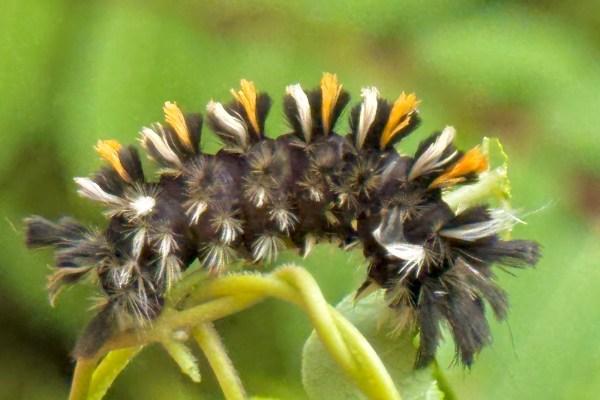
A nearly mature Euchaetes egle (milkweed tussock moth) consumed the dwindling foliage of Cynanchum laeve (climbing milkweed), and Piezogaster calcarator (leaf-footed bugs) congregated on the inflorescences of Verbesina alternifolia (yellow ironweed).

Euchaetes egle (milkweed tiger moth, milkweed tussock—family Erebidae) on Cynanchum laeve (climbing milkweed).
Piezogaster calcarator (leaf-footed bug—family Coreidae) on flower of Verbesina alternifolia (yellow ironweed).

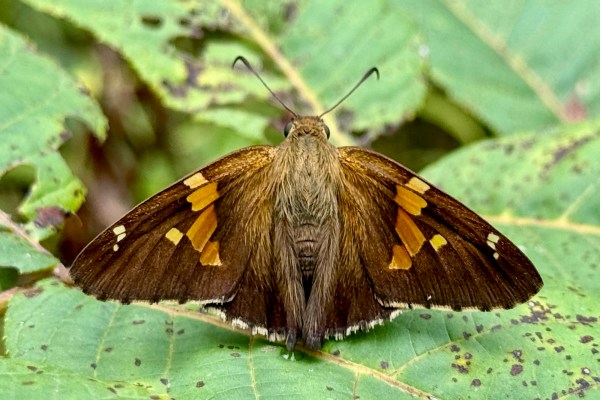
Nowhere, however, was insect activity more abundant than on the goldenrods, particularly the abundant stands of S. altissima in the uplands and S. gigantea below. Overwhelming numbers of Chauliognathus pennsylvanicus (goldenrod soldier beetles) and Lycomorpha pholus (black and yellow lichen moths) were accompanied by a cacophony of bees, wasps, and flies—a situation tailor made for Phymata sp. (jagged ambush bugs) to lay in wait while Epargyreus clarus (silver-spotted skipper) flew erratically overhead.

Phymata sp. (jagged ambush bug—family Reduviidae) mating pair on flower of Solidago altissima (tall goldenrod).
Epargyreus clarus (silver-spotted skipper—family Hesperiidae) perched on Solidago altissima (tall goldenrod).

Even in the deeply shaded mesic forest, Cyllopsis gemma (eastern gemmed satyrs) flitted deftly through the undergrowth.

Cyllopsis gemma (eastern gemmed satyr—family Nymphalidae) in mesic riparian forest.

The most unusual find, however, was a bizarre, green, jewel of a caterpillar found crawling on the forest floor—Isa textula (crowned slug moth or skiff moth), fringed with lacy projections that make it look more like a sea slug than an insect!

Isa textula (crowned slug moth, skiff moth—family Limacodidae) in leaf litter of mesic riparian forest.

Of course, a Monday WGNSS Botany Group outing isn’t truly consummated until it has enjoyed lunch at a local establishment—the choice this time being Tequila Mexican Restaurant in nearby Waterloo (best fish tacos I’ve ever had!).

©️ Ted C. MacRae 2025
2025 WGNSS Photo Contest

Last night the Webster Groves Nature Study Society (WGNSS) held its biennial nature photo contest, and I was fortunate to grab two placings with the following photographs.

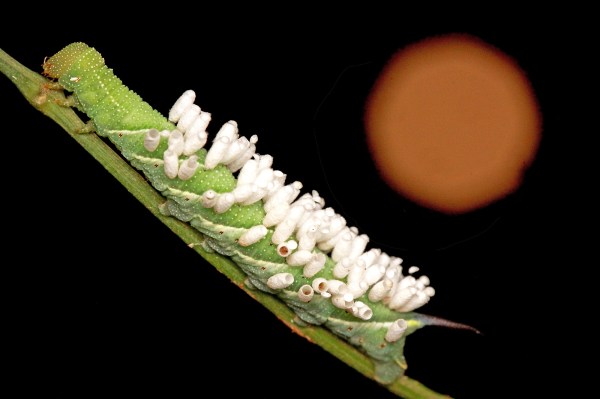
2nd place (Invertebrates)

A tobacco hornworm (Manduca sexta) caterpillar that has been parasitized by braconid wasps (Cotesia sp.). The wasps developed inside the caterpillar as grubs, consuming all but the most vital of organs to avoid killing it before they completed their development. They then exited the caterpillar’s body and spun small white silken cocoons in which to pupate and eventually emerge as adults. The adult wasps have already emerged, and though the caterpillar is still alive, it will die before it can complete its development and become an adult moth. The caterpillar was photographed at night in front of a so-called “supermoon” rising in the eastern sky. This is a single exposure image—-not a composite photograph—with the camera focused on the caterpillar (illuminated by flash) but its settings adjusted to also detect ambient light from the distant moon. The moon is necessarily out of focus due to depth-of-field constraints. Photographed 11 Aug 2014 in Mississippi Co., Missouri at the Hwy 62 bridge over the Mississippi River.

Honorable Mention (Plants and Fungi)

A single blossom on the inflorescence of clasping milkweed (Asclepias amplexicaulis). This uncommon species is scattered throughout Missouri but is especially fond of habitats with dry sand substrates. It can be easily identified by its erect, glabrous stems, sessile, clasping leaves, and pinkish flowers. Photographed 23 April 2012 in Scott Co., Missouri at Sand Prairie Conservation Area.

©️ Ted C. MacRae 2025
“BioBlitzing” Schoolcraft Prairie

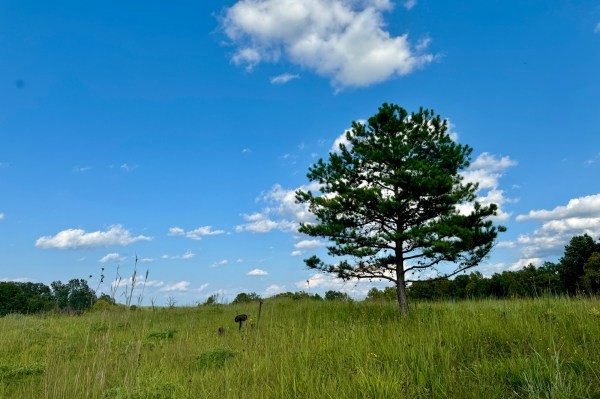
It’s been a few months since I’ve been on a WGNSS field trip, so I was anxious to attend this past weekend’s joint trip between the Entomology and Nature Photography Groups to visit a private restored tallgrass prairie remnant located in extreme southwestern Washington County and named after Henry Schoocraft, who famously chronicled his journey through the Missouri Ozarks in the early 1800s and passed within a few miles of this spot (if you’ve not yet read Schoolcraft’s journal, I highly recommend this natural history classic!). The landowner, a restoration ecologist for Shaw Nature Reserve, has been using prescribed burns and selective thinning over the past several years to restore the 70-acre tract of upland forest, former cropland, and grassland remnants to their presettlement character. Stupidly, I did not bring my main camera, preferring to focus instead on collecting rather than photography. In hindsight, I would have been much better served had I had my camera, as the beetle groups that I study (Buprestidae and Cerambycidae) tend to be scarce at this time of season in Missouri, while interesting subjects for photography in other insect groups abound. As far as photos go, my iPhone would have to suffice.

A lone Pinus echinata (shortleaf pine) in restored tallgrass prairie remnant.

We arrived a bit after mid-afternoon and spent the bulk of the remaining daylight hours in the prairie remnant. Florally, it was one of the most diverse prairies I’ve ever seen, especially in this part of the Missouri Ozarks. One plant in bloom that was new to me was Liatris scariosa (devil’s bite blazingstar), distinguished from the similar L. aspera (also in bloom) by its flower heads on long stalks and with mostly flat phyllaries.

Liatris scariosa (devil’s bite blazingstar—family Asteraceae) in restored tallgrass prairie remnant.

The first insect of interest that I found was the white fluffy early-instar caterpillar of Megalopyge crispata (black-waved flannel moth). The hairs of all species in this genus are venomous in the larval stage, and interestingly the later instars of a related species (M. opercula) resemble a tiny Trump toupee (look it up!).

Megalopyge crispata (black-waved flannel moth—family Megalopygidae) early-instar caterpillar on foliage of Carya tormentosa (mockernut hickory) in restored tallgrass prairie remnant.

Also present were Neotibicen auriferus (prairie dog-day cicada), whose whining, metallic songs filled the air. Normally very skittish and difficult to approach, I managed to snag one on the trunk of a small persimmon tree in the middle of the prairie.

Neotibicen auriferus (plains dog-day cicada—family Cicadidae) captured while singing on trunk of Diospyros virginiana (persimmon) in restored tallgrass prairie remnant.
Atalopedes huron (Huron skipper—family Hesperiidae) perched on foliage of Rhus copallina (shiny sumac) in restored tallgrass prairie remnant.

As afternoon progressed to evening, I went back down from atop the ridge and visited a small calcarous fen—a unique wetland habitat created by seepage of calcareous groundwater that results in saturated, low-oxygen soil. Fens often support unique plants, and in this one I found Solidago patula (swamp goldenrod). I’ve never seen this plant before, so I was a bit disappointed it was not yet in bloom, but I marveled at an enormous, darkly colored banded fishing spider (Dolomedes vittatus) sitting on one of the plants.

Solidago patula (swamp goldenrod—family Asteraceae) in small calcareous fen.
Dolomedes vittatus (banded fishing spider—family Pisauridae) on Solidago patula (swamp goldenrod) in small calcareous fen.

After dinner we set up several light stations, including one up in the restored prairie remnant. Despite the warm, humid conditions, I had little optimism that we would see much of interest at the lights due to the near-full moon shining brightly in the cloudless sky. This was mostly true, although I did collect a few ceresine treehoppers and weevils from the lights. Additionally, a few small but pretty moths warranted a photograph or two.

Pyrausta tyralis (coffee-loving pyrausta moth—family Crambidae) at ultraviolet light in restored tallgrass prairie remnant.
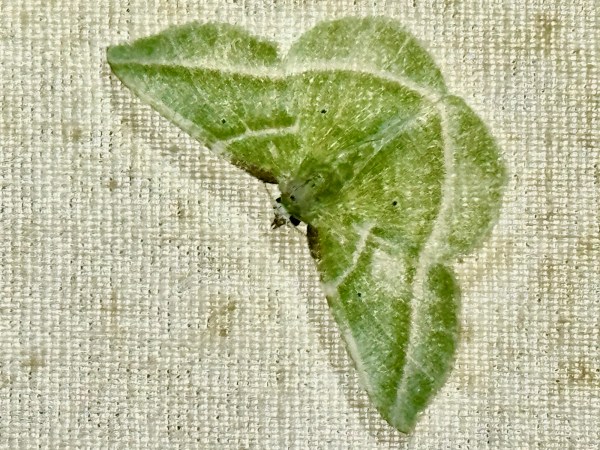
Dichorda iridaria (showy emerald moth—family Geometridae) at ultraviolet light in restored tallgrass prairie remnant.

The truly interesting finds, however, would come in the form of caterpillars on the foliage of nearby trees. Three species of slug moths (family Limacodidae)—among the most bizarre-looking of caterpillars, and all of which can sting—would be found. Two of them were new to me—a beautifully lichen-colored Euclea delphinii (spiny oak slug moth), and the nearly amorphous Apoda y-inversa (yellow-colored slug moth). The third species was the striking Parasa indetermina (stinging rose slug moth)—always a treat to see!

Euclea delphinii (spiny oak slug—family Limacodidae) caterpillar on foliage of Quercus stellata (post oak) in restored tallgrass prairie remnant.
Apoda y-inversa (yellow-collared slug moth—family Limacodidae) caterpillar on foliage of Quercus stellata (post oak) in restored tallgrass prairie remnant.
Parasa indetermina (stinging rose moth—family Limacodidae) caterpillar on foliage of Quercus marilandica (blackjack oak) in restored tallgrass prairie remnant.

Other striking caterpillars were found as well: Amorpha juglandis (walnut sphinx) and Ceratomia catalpae (catalpa sphinx)—adults of each also visiting the lights, Anisota virginiensis (pink-striped oakworm), Automeris io (io moth), Acronicta superans (splendid dagger moth), and Halysidota tessellaris (banded tussock moth). Some of these were photographed in situ, but most were brought back to camp for photographs under more controlled conditions.

Amorpha juglandis (walnut sphinx—family Sphingidae) caterpillar on foliage of Juglans nigra (black walnut) in dry-mesic upland oak/hickory forest.
Acronicta superans (splendid dagger moth—family Noctuidae) on foliage of Prunus serotina (black cherry) in dry-mesic oak/hickory forest.
Halysidota tessellaris (banded tussock moth—family Erebidae) on foliage of Carya tomentosa (mockernut hickory) in restored tallgrass prairie remnant.

Another interesting observation near the light in the prairie was a Neoconocephalus ensiger (sword-bearing conehead katydid—family Tettigoniidae) final-instar nymph molting to adulthood. At the time that I photographed it, the antennae were pulled taught—almost but not completely pulled free from the exuviae.

Neoconocephalus ensiger (sword-bearing conehead katydid—family Tettigoniidae) final-instar nymph molting to adulthood at night in restored tallgrass prairie remnant.

A final observation of a small treehopper (Platycotis vittata) on a Quercus stellata (post oak) twig—after which I called it a night (it was around 2 am!).

Platycotis vittata (family Membracidae) on twig of Quercus stellata (post oak) in dry-mesic oak/hickory forest.

©️ Ted C. MacRae 2024

Botanizing at Hawn State Park

Today I joined the WGNSS Botany Group as we hiked a portion of the Whispering Pines Trail to look for a rare clubmoss, then bushwhacked back to the beginning and went off-trail to a nearby sandstone box canyon to look for rare ferns. We found the clubmoss—Diphasiastrum tristachyum (blue clubmoss)—growing in the shortleaf pine/scarlet oak forest atop a LaMotte Sandstone cliff. Though common in eastern North America and Eurasia, the area in and around Hawn State Park is the only known station for the plant in Missouri, and this population is highly distinct from the next nearest population in Tennessee.

Diphasiastrum tristachyum (blue clubmoss—family Lycopodiaceae) in shortleaf pine forest atop LaMotte Sandstone cliff.
Diphasiastrum tristachyum (blue clubmoss—family Lycopodiaceae) with an old strobilus (spore-bearing reproductive structure).

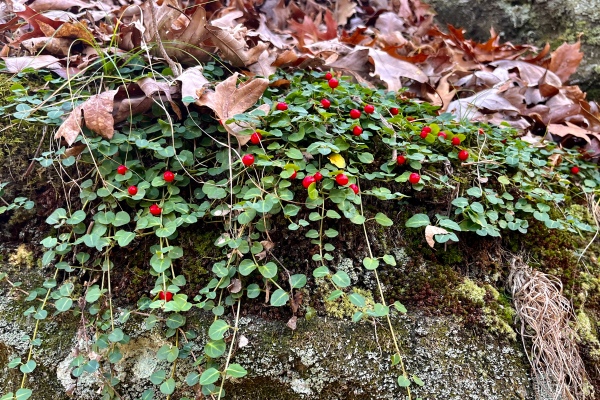
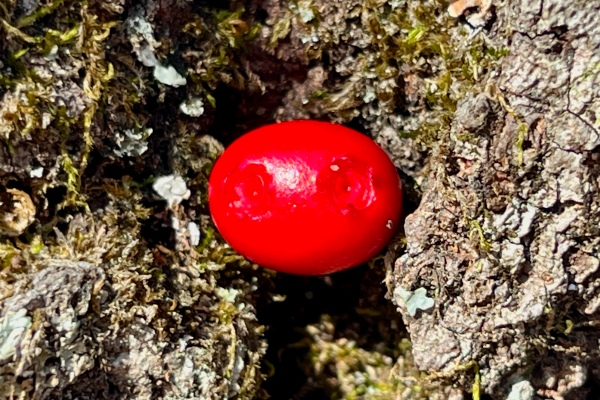
We also found the ferns in the box canyon along with Mitchella repens (partrideberry) growing on the moist sandstone bluff faces of the canyon. This plant is not as rare in Missouri as blue clubmoss, but it is still seldom encountered outside of the LaMotte Sandstone forests of Ste. Genevieve County. An interesting feature of the berries is that they require two flowers to be fertilized and then develop together into a single berry—if you look closely at the berry you can see two “dimples” representing the remnants of the two flowers.

Mitchella repens (partridgeberry—family Rubiaceae) in shortleaf pine/scarlet oak upland forest on LaMotte Sandstone.
Each Mitchella repens (partridgeberry—family Rubiaceae) berry exhibits two “dimples” belying its two-flower provenance.

As we hiked I paid attention to the grasses (family Poaceae), which were as diverse as anywhere I’ve been lately (at least, since I’ve started paying attention to such things). Many of them I can recognize easily—river oats (Chasmanthium latifolium), little bluestem (Schizachyrium scoparium), Broomsedge bluestem (Andropogon virginica), etc, but many more were new to me, including several species in the large and diverse genus Dichanthelium (rosette grasses). For most of them, rather than trying to identify in the field, I collected samples to look more closely at home with a microscope and my copy of “Steyermark’s Flora of Missouri.”

Dichanthelium sp. (rosette grass—family Poaceae) basal rosette in shortleaf pine/ scarlet oak upland forest atop LaMotte Sandstone.

One of them seems to be D. commutatum var. ashei (Ashe’s panic grass) [identified by Nathan Aaron via iNaturalist], which is distinguished by habitat (intact sandstone or chert woodlands), nodes not hairy, and small stature with leaves clustered towards the tip of the stem. We also saw (but I did not photograph) the common woodland D. boscii, which is larger and has massive spikelets and famously long-hairy nodes. I’ll share the full list here when I can, but it probably numbers around a dozen species.

Dichanthelium commutatum var. ashei (Ashe’s pacifist grass—family Poaceae) in shortleaf pine/scarlet oak upland forest on LaMotte Sandstone.

Insects were not numerous, despite the pleasant conditions, but I did see and manage to photograph a fiery skipper (Hylephila phyleus—family Hesperiidae).

Hylephila phyleus (fiery skipper—family Hesperiidae) in shortleaf pine/scarlet oak upland forest on LaMotte Sandstone.

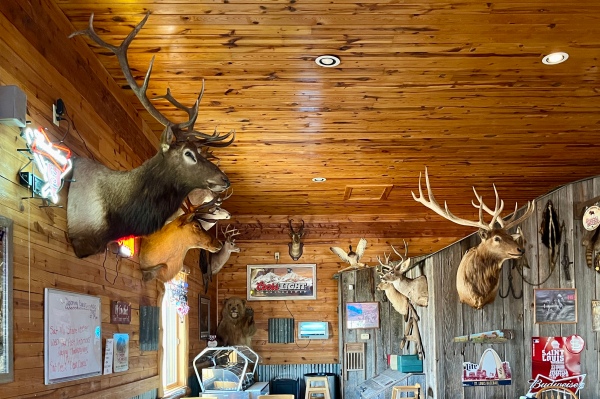
After the outing, several of us enjoyed lunch at the Midway Bar & Grill in Weingarten, Missouri. I had an elk burger, yum!

Midway Bar & Grill in Weingarten, Missouri. I had an elk burger—yum!

©️ Ted C. MacRae 2023

Young Conservation Area

I’ve been taking advantage of my time off the bike to revisit some of my favorite local hiking spots, and today I returned to Young Conservation Area (formerly called Hilda J. Young Conservation Area) in the northwestern corner of Jefferson County. This is one of three conservation areas located within the LaBarque Creek watershed—by far the most ecologically diverse of the Meramec River’s 16 tributaries. The west side between the creek and the parking lot is a bit (okay, a lot) disturbed owing to its former days as a homestead, but the east side features high-quality forests ranging from riparian corridors and rich slopes of white oak to dry chert ridges of black oak and hickory and even a small semi-glade. The 6-mile LaBarque Hills Trail traverses all these habitats and provides some stunning vistas along its southernmost stretch.

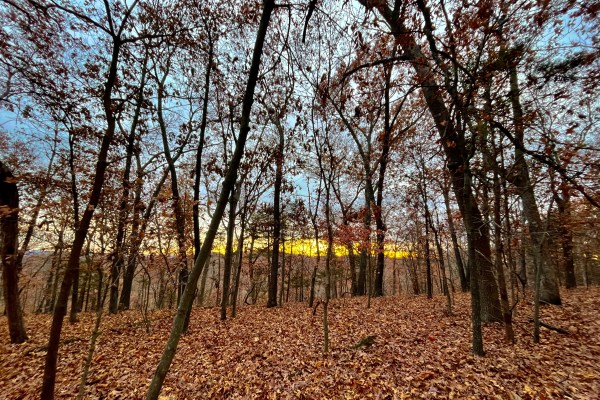
Spectacular setting sun vista from chert ridge along the backside of the trail.

For my part, other than the seclusion and exercise, I focused on continuing to learn my winter grasses. Indian grass (Sorghastrum nutans), big bluestem (Andropogon gerardii), and switchgrass (Panicum virgatum) were common in the open areas near the parking lot (none of which I saw on my previous hike at LaBarque Creek Natural Area), while river oats (Chasmanthium latifolium) was seen within the forest, especially in the lower, moister sections of the trail. Also, unlike that previous hike, I saw only a few plants of broomsedge bluestem (Andropogon virginicus) and no little bluestem (Schizachyrium scoparium) at all.

Broomsedge bluestem (Andropogon virginicus) growing in dry-mesic upland oak/hickory forest.

Bottlebrush grass (Elymus hystrix) occurred sporadically along the trail in the lower elevations within the forest, as well as two as yet undetermined species of wild rye (also in the genus Elymus)—one found along the trail inside the forest in moister areas (distinguished by its smaller, “hard-to-strip” seed-heads) and another found only in the much more open semi-glade (distinguished by its much more robust and “easy-to-strip” seed-heads). Nathan Aaron (via iNaturalist) identified the latter as Elymus glabriflorus (southeastern wildrye) based on habitat and season and suggested that the first one could be E. virginicus, which is distinguished by its inflorescence being barely (if at all) exerted from the sheath. Another grass, still undetermined, was found growing in patches in the riparian areas, its foliage still showing much more green than any of the other grasses and often growing intermixed with bottlebrush grass. I collected seed of all of them to sow in the back slope behind my house—the woodland species on the shadier side portions and the sun-loving species in the sunnier central area.

The appropriately-named “bottlebrush grass” (Elymus hystrix—family Poaceae) in mesic riparian deciduous forest.
Elymus glabriflorus (southeastern wild rye—family Poaceae), the more robust, “easy-to-strip” species growing in a sunny, semi-glade.

Unlike the lower areas, the upland stretches of trail were nearly devoid of grasses, or any ground layer for that matter other than a few lowbush blueberries (Vaccinium pallidum), but what they lacked in understory floral diversity they more than made up for in spectacular setting-sun vistas. I had to really hoof it during the last couple of miles to ensure that I reached the car before it got too dark, but it felt good to finish the hike with a nice effort. Now, time to jet out a key grasses and think about where I want to hike in the next couple of days.

End of the hike!

©️ Ted C. MacRae 2023