Berry Go Round #21

Berry Go Round copyWelcome to Berry Go Round issue #21.  As a first time host of this – or any – blog carnival, I can tell you that it has not only been more work than I could have imagined, but also a lot more fun!  I’ve read, learned, and marveled at the diversity of knowledge presented by the posts that make up this issue – in all, 25 contributions from 15 blogs by 14 authors who know an awful lot more about plants than I do.  Read my summaries first, or jump straight to the posts, but please visit as many as you can. They will be worth the time spent!  If you’ve not visited Beetles in the Bush before now, I hope you’ll also take a moment to browse its Contents to see what might be of interest.

First things first, however.  Berry Go Round needs a badge!  The small badge you see at the beginning of this post is something I made to put in my sidebar using the masthead and title from the BGR website – not a real badge like the ones you find at Circus of the Spineless, Festival of the Trees and Carnival of Evolution.  If you’re artistically inclined and would like to contribute to the growth of BGR, please leave a comment and contact information – we could use your help!  Now – on with the show.
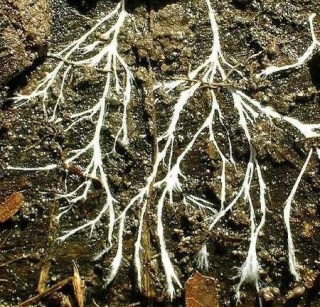
hyphae5Alex at Watching the World Wake Up gets us started with a trilogy of posts as diverse as his interests.  In this fungus¹ post, Alex makes the improbable connection between fungi and The Force (yes, a reference to Star Wars).  Read it, and you will be a believer, too.  I especially enjoyed his post on the search for a rare hybrid oak, not only for the thrill of seeing a probable 4,000-7,000 year old F1 hybrid clone, but also for the most awesome tangent on spiders that any non-entomologist has ever written.  In his post on tumbleweeds, he reminds us that these icons of the west are actually an exotic introduction from Eurasia and recounts the mechanisms by which these ubiquitous plants took over the western U.S.

¹ TANGENT.  Okay I know fungi aren’t really plants, nor are they animals – they’re kinda both and neither.  Botanists, however, appear to have accomodated fungi in their realm of study², I guess because they basically look like plants.  This is much the same situation as entomologists and spiders – the latter not being insects, but sort of looking like them and giving lay folk the same creepy crawly impression.

² NESTED TANGENT.  Despite crossing Kingdom boundaries, the placement of fungi within the botanical realm doesn’t come close to matching the taxonomic disparities that plant pathologists must accept, who despite the microorganismal connotation of the term plant disease have had to accomodate organisms crossing not only Kingdom but also karyotic boundaries – with all three eukaryotic Kingdoms (plants, animals, and fungi) being causal agents in addition to the prokaryotic bacteria³ and the hard-to-even-consider-as-a-life-form viruses.

³ NESTED, NESTED TANGENT4.  I’ve no doubt given short shrift to modern Kingdom-level concepts regarding prokaryotes – I know there are “regular” bacteria and the terribly misnomered blue-green algae, but this entomologist who sometimes masquerades as a general biologist quickly became confused when he found references listing as many as 13 prokaryotic Kingdoms.

4 NESTED, NESTED, NESTED TANGENT. Alex is the undisputed king of the nested tangent, and I hope he forgives me for taking his idea to such level of absurdity!
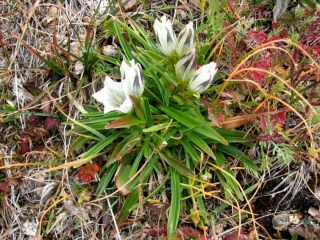
Genalg1On the other side of the Rocky Mountains, Sally at Foothills Fancies highlights color in alpine tundra – it is amazing how much color can be seen in a high-country fall!  She follows up on that post with another highlighting fall tundra wildflowers, including the spectacular Arctic Gentian (Gentiana algida to most of us, Gentianodes algida if Dr. William Weber has his way).  She also focuses on the less conspicuous “flora” of the tundra – cryptogams – and how seemingly “bare” ground in the tundra is actually thick with lichens and mosses.  Most tundra cryptograms represent species not seen in the lower 48 states except at very high altitudes.
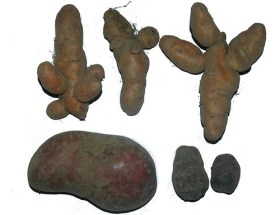
3973291903_8fce836aacLaurent at Seeds Aside submitted a quadrilogy (is that a word?) of posts covering Blogger Bio Blitz 2009.  To start the series, Laurent thinks outside the box by presenting a sampling of old French cultivated potato varieties, then does more conventional bioblitzing in a hedged farmland area in French Brittany (noting a possible case of spider kleptoparasitism along the way) and near the Couesnon river, next to Mézière sur Couesnon.  Seeing and reading these botanical/entomological accounts in France brought back memories of my own visit to the country in 2007.  As I write this piece, I can almost hear the droning buzz of cigales in the dry coastal Mediterranean pine forests.

TrabutJeremy contributes this piece on the history of agriculture at Vaviblog, where he writes about Dr. Louis Trabut – one of many agricultural explorers who searched the North African colony of Algeria in search of plants for introduction into the southwestern United States.  He notes that Algerian agriculture was carried out almost exclusively by the indigenous Berbers for more than a thousand years, resulting in the development and propagation of myriad races of the grape, fig, olive, apricot, and walnut grown in the region today. Jeremy thinks it would be terrific if his post smokes out any information about the history of dates (the plant) in California.

Jeremy is also an author at the Agricultural Biodiversity Weblog and submitted this post about plant breeding in relation to climate change (raising a fair few comments).  He also notes that the addition of agricultural statistics to the astonishing and wonderful GapMinder deserves celebration and wonders if there some other botanical datasets that might be interesting.  db091001Quick to remind us that he’s not all history and no humor, Jeremy puts together (at “great personal expense”) a series of Doonesbury comic strips at his other blog, Another Blasted Blog.  Doonesbury fans, having surely already seen these, will chuckle once again.  Gardener’s who don’t follow Doonesbury will still appreciate their humor.  Doonesbury fans who are also gardeners will guffaw!
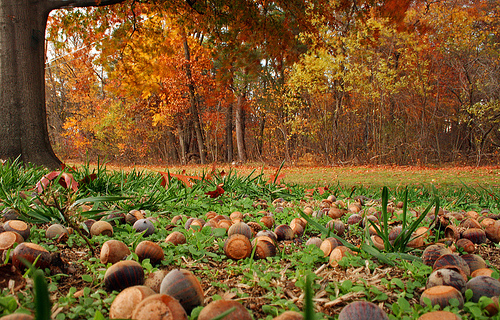
At Denim and Tweed, Jeremy Yoder notes the obvious benefits of synchronized mast seed production as an adaptation in the plants’ coevolution with seed predators, but the not so obvious mechanisms by which this occurs.  He reviews a paper in the latest issue of Ecology Letters that has an answer — synchronization happens accidentally.  I won’t spoil the details of the research and how they reached their conclusion, as Jeremy has done a much finer job of that than I ever could (I study beetles, remember?), but the interaction of resource and pollen limitations is a clue to the answer.

chrysanthFor the pedants among us (count me in!), The Phytophactor has been running a series on plants whose generic names are the common names everyone knows. Here is lesson 4: can you say chrysanthemumum?  This genus has suffered a bit of a decline at the hand of taxonomists in recent years, falling from a burgeoning 300-400 species that used to be in the genus to a pitiful two (not a typo!).  Phytophactor also visited the Great Pumpkin Patch and reports – you won’t believe the cucurbitaceous rainbow he saw! 

1517959584_23c90b9ace

Photo by memotion (http://www.flickr.com/)

Elizabeth Hargrave at The Natural Capital submitted this post on wild grapes.  Native grapes may be smaller and not as sweet as the giant Chilean juice balls found in modern grocery stores. Still, harvesting native species from the wild has its charms – as long as you’re familiar with the several non-edible and sometimes poisonous look-alikes.  If wild harvest isn’t your thing, she also offers some tips for cultivating wild grapes (which is actually much easier than with most cultivated varieties).

myconetThe EEB & flow offers a review of a scientific paper discussing mycorrhizal networks – fungal mycelium that colonize and connect roots of one or more plant species.  Whis this is one of the most intriguing types of fungal-plant associations, even more interesting is its continuation of “The Force” idea brought up in Alex’s fungus post – i.e., evidence of substantial facilitation between plant individuals via these fungal networks (i.e., plants tend to grow better if they are associated with a network).  This is in opposition to the long-held belief that competition, herbivory and dispersal are the main drivers of plant community associations.  They also reviewed a recent paper on the impact of exotic plants on plant-pollinator systems, finding a high overall abundance of exotics in many plant communities but a relative lack of substantial changes in network connectedness.

Fungi continue to muscle in on this carnival of plants, being the subject of a post by Chris Taylor at Castanea dentataCatalogue of Organisms on Diaporthales fungi  that cause disease in trees.  Among the most famous of these to North American readers is Cryphonectria parasitica, the cause of chestnut blight and famed as the bane of the American chestnut, Castanea dentata. However, other trees such as butternut, dogwood, and even non-arboreous woody plants such as grape also have their own pathogenic associates.

PA081120Justin Thomas is one of several erudite botanists behind Get Your Botany On! In this post, Justin discusses Pteris multifida, an exotic fern that he found in Hot Springs National Park while conducting an invasive species survey.  Sadly, this is symptomatic of the Hot Springs area in general, where habitat alteration and rapidly colonizing invasive species have left little room or hope for naturally functioning ecosystems.  Another of the blog’s authors, Keith, quotes with enthusiasm from “Of Woods and Other Things” (Beech Leaf Press, Kalamazoo, 1996), by renowned Indiana Dunes region naturalist Emma “Bickie” Pitcher.  One that caught my eye was “…pale satiny yellow breasts and dark velvety smudges around eyes are apparent.”

20091010-007 Caladenia concolorTim Entwisle at Talking Plants discusses the gorgeous blood orchid, Caladenia concolor.  This endangered Australian species grows sporadically around Victoria and into southern New South Wales.  Apparently some populations consist of only a handful of individuals, and weeds and passing foot damage are probably their biggest threats.  Hopefully Tim and his colleagues will succeed in their efforts to save this stunning species.

herbarius_latinusMary Farmer at A Neotropical Savanna sent me this note, writing “I don’t know how many readers of BGR use the Biodiversity Heritage Library, or know of it, but it is (to me) an extremely valuable resource and they have their own blog (which you no doubt know of) called News and Updates from the Biodiversity Heritage Library. This week’s feature, the oldest book in the BHL, Herbarius latinus, is a ‘…Pre-Linnean text [that] describes 150 plants and 96 medicines commonly found in apothecaries, and each plant description is accompanied by a detailed woodcut.'”  How I adore old botanical scribes – thanks, Mary!

279952-color

Dover photo

For literature along more whimsical lines, NellJean of Secrets of a Seed Scatterer presents an herbalist’s view of tea with Peter Rabbit and its mentions of Camomile Tea and Rabbit Tobacco.  Apparently smoking rabbit tobacco is done only by little boys in the south, but cut stalks, bundled and dried, can impart a pleasingly aromatic and resinous fragrance to the mustiest of tool sheds.

Copyright © Ted C. MacRae 2009

Add to FacebookAdd to NewsvineAdd to DiggAdd to Del.icio.usAdd to StumbleuponAdd to RedditAdd to BlinklistAdd to TwitterAdd to TechnoratiAdd to Furl

North America’s most beautiful longhorned beetle

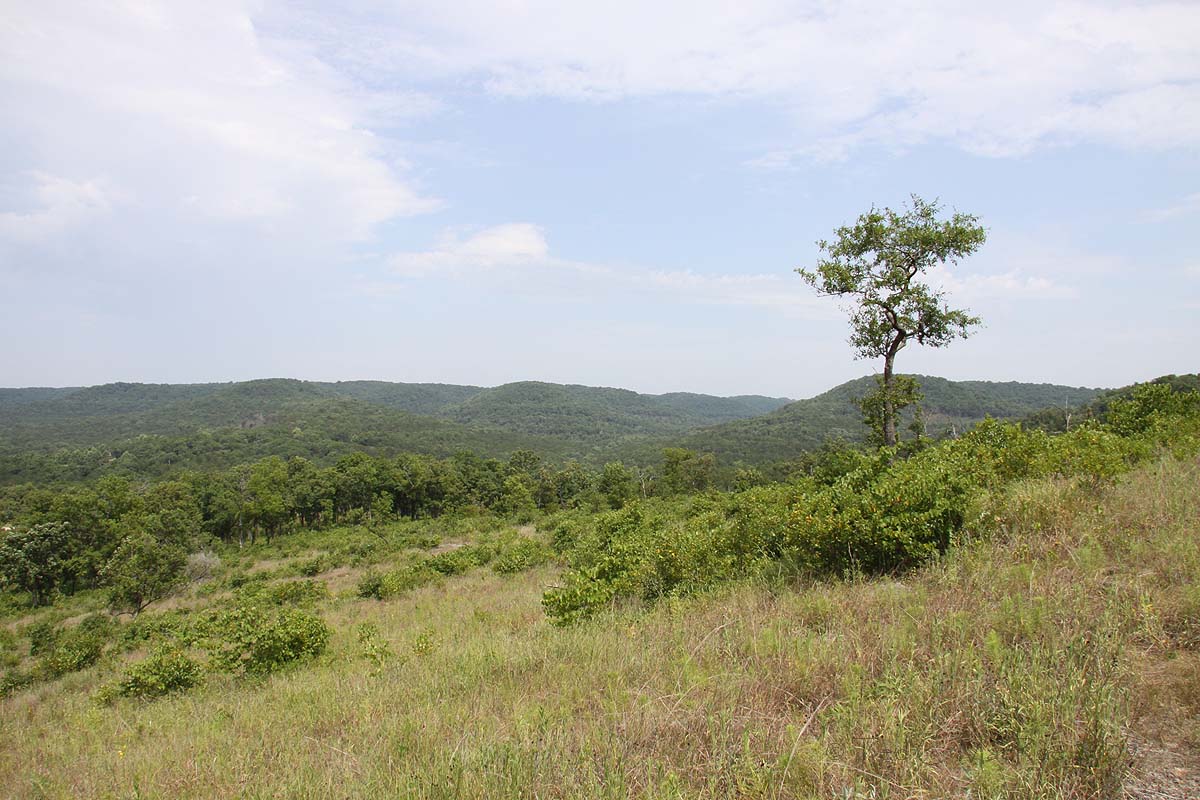
I’ve written a few posts in recent weeks highlighting some of the more interesting finds encountered during two visits this past July to the White River Hills region of extreme southwestern Missouri. It’s a land of extremes, with deeply dissected layers of limestone/dolomite bedrock supporting xeric glades, dry woodlands and riparian watercourses. The hilltop glades (“balds”), in particular, feature prominently in the region’s natural and cultural history and are the most extensive system of such habitat in Missouri. They support a number of plants and animals more characteristic of the grasslands of the south-central U.S., such as the recently featured Megaphasma denticrus and Microstylus morosum, North America’s longest insect and largest robber fly, respectively. Sadly, the glades in this region are much reduced in size and quality compared to their pre-settlement occurrence, primarily due to overgrazing and suppression of fire. These anthropogenic forces have combined to reduce overall vegetational diversity and accelerate encroachment by woody species (chiefly eastern red-cedar, Juniperus virginiana). Nevertheless, there still remain several high quality glade remnants in the area, and the public agencies charged with their conservation are increasingly utilizing mechanical removal of woody growth, controlled burns, and managed grazing in an effort to simulate the natural forces that mediated this landscape for thousands of years.

IMG_0871_1200x800

Chute Ridge Glade, Roaring River State Park, Barry Co., Missouri

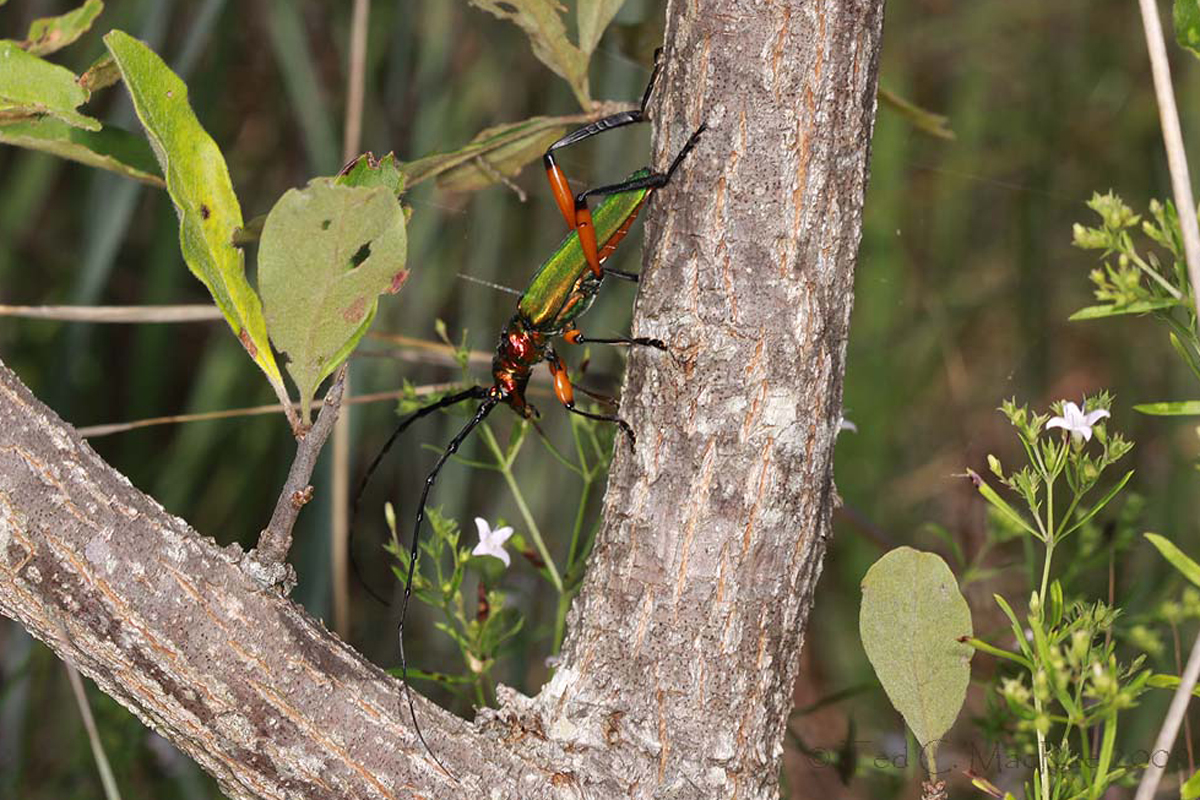
My reason for returning to the White River Hills this year was simple—find and photograph the magnificent longhorned beetle, Plinthocoelium suaveolens (family Cerambycidae). This species, occurring across the southern U.S. from Florida and Georgia west to New Mexico and Arizona, is truly one of North America’s most beautiful longhorned beetles due to its large size, brilliant iridescent green coloration, and super-elongate wildly-contrasting orange and black legs.  Until recently, this species was known in Missouri only from sporadic records across the southern part of the state (MacRae 1994). I knew of its association with gum bumelia (Sideroxylon lanuginosum [= Bumelia lanuginosa], also called gum bully and woolly buckthorn), which was first noted by Missouri’s first State Entomologist, C. V. Riley (1880) and later discussed in detail by Linsley and Hurd (1959) and Turnbow and Hovore (1979); however, my repeated searches over the years whenever I encoutered this plant came up empty.  A few years ago, Chris Brown and I were conducting a survey of tiger beetles in the White River Hills and noted the relatively common occurrence of bumelia on these glades.  Bumelia, like P. suaveolens, is one of only a few North American representatives of a largely tropical group, and it is one of the few woody species naturally adapted to the xeric conditions found on these glades.  Recalling the association of P. suaveolens with this plant, and also recalling that adults could be attracted to fermenting baits of the type described by Champlain and Knull (1932), we placed fermenting bait traps on several glades in the area and succeeded in trapping a number of individuals during the month of July.  When I began searching the bumelia trees at these glades, I found adults perching on the lower trunks of several trees. It was the first time I’d seen live individuals of this species in Missouri.  At the time I was not a photographer, and that experience became one of the many moments that I would later look back upon and think, “If only I’d taken a picture of that!”  Thus, at the end of June this year, having successfully found Cylindera celeripes in Missouri on the first day of a planned 3-week search, my attention immediately turned to the new goal of finding P. suaveolens and photographing it on its host plant.

IMG_0929_1200x800

Sideroxylon lanuginosum (gum bumelia) at Blackjack Knob, Taney Co., Missouri

I knew this wouldn’t be easy—the beetles were not abundant when I had last observed them, and those that I did find were quite wary to my approach.  Getting within striking distance with a net was one thing; doing so with a camera and macro lens would be another thing entirely.  In my first trip to the area (early July), I went to Chute Ridge Glade, a magnificently restored glade in Roaring River State Park where I had seen the greatest number of individuals before.  I was full of optimism on that first day as I zigzagged across the rough terrain from one bumelia tree to the next, but my optimism began to wane as I cautiously approached each tree and saw nothing.  Within an hour, I’d looked at every bumelia tree I could find on the glade and not even seen a beetle, much less attempted a photograph.  It would take a 2-hour drive along twisting back roads to reach the other sizeable glade complex where I had seen beetles before (Blackjack Knob in Taney County), and another hour of searching on several dozen trees would again yield nothing.  By now I was feeling rather frustrated—the day’s oppressive heat and humidity had taken its toll, and my 4.5-hour drive from St. Louis was looling like it would be for naught.  I had noted that the bumelia flowers were almost but not quite open yet—perhaps it was too early in the season still?  

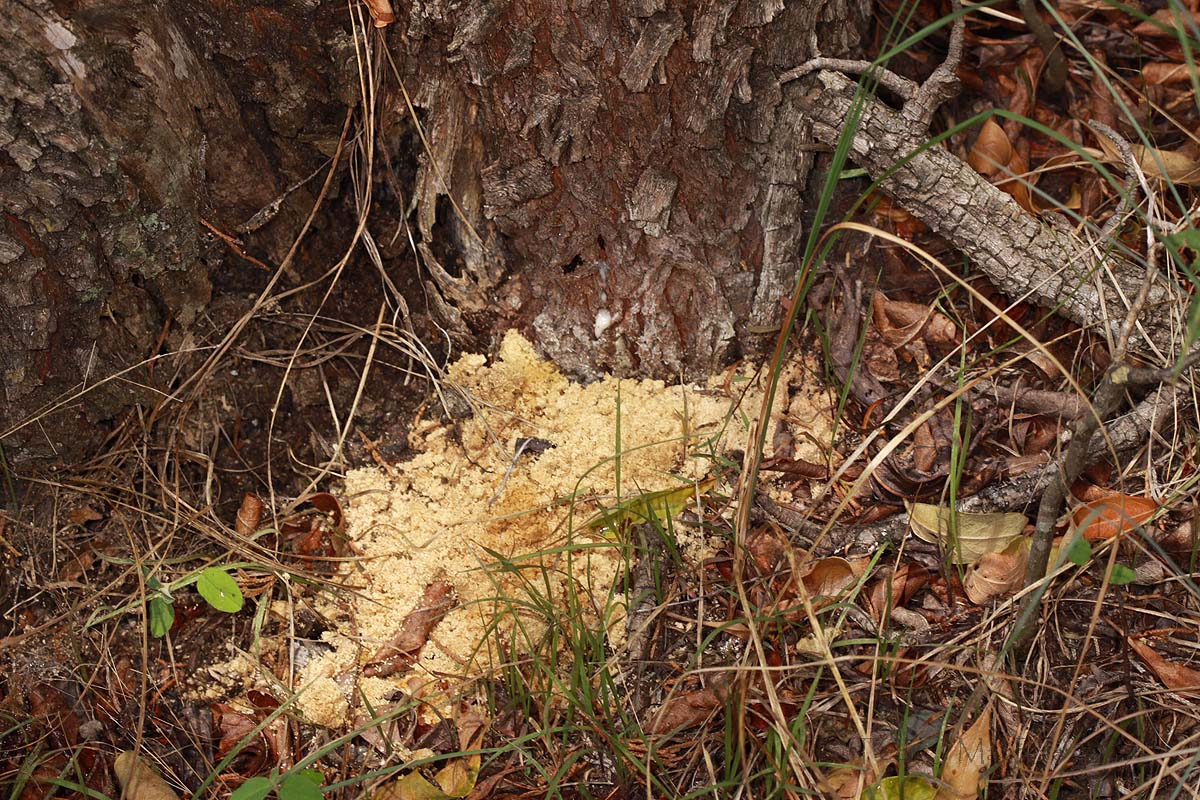
Plinthocoelium suaveolens larval frass pile at the base of living Sideroxylon lanuginosa

Plinthocoelium suaveolens larval frass pile at trunk base of living Sideroxylon lanuginosum

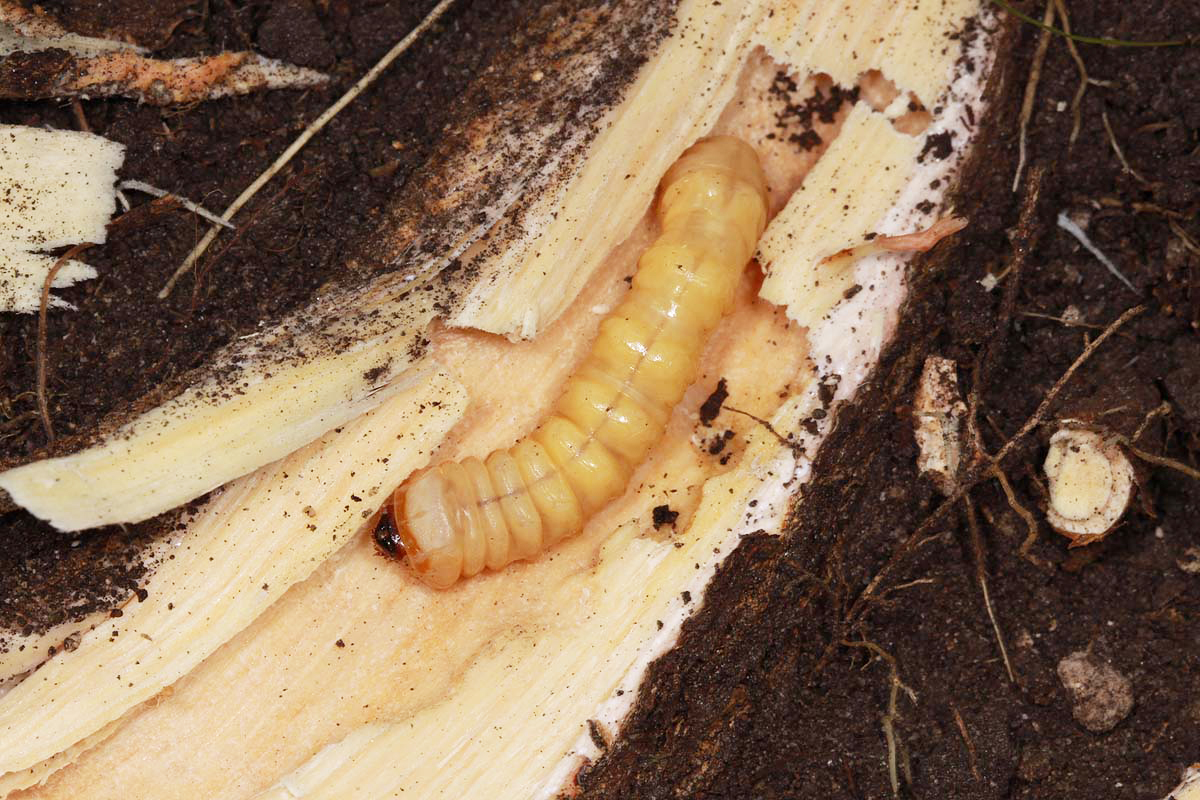
The remnant glades at Blackjack Knob are more extensive than those at Chute Ridge, so many more trees still awaited examination—if I could only muster the energy!  I trudged back to the truck, guzzled a nice, cold Powerade, and started off in another direction.  I looked at a number of trees and still had seen no sign of the beetle, but on one particular tree I noticed an enormous pile of sawdust on the ground at the base of the tree.  I looked at it more closely and saw that it had the rough, granular texture so characteristic of longhorned beetle larvae that like to keep their galleries clean, and its bright, moist  color suggested that it was being ejected by a larva tunneling through living wood.  I looked up into the tree above the pile to find where it was coming from but could find no ejection hole.  I checked the base of the trunk itself and still couldn’t find anything.  Then I started poking into the pile and felt a root.  Further poking revealed a soft spot on the root, and I immediately knew that I had found a P. suaveolens larval gallery—no other cerambycid species is known to bore in roots of living Sideroxylon, especially one as large as this based on the size of the frass pile.  I hurried back to the truck and grabbed my hatchet, returned to the tree, and scraped away the soil above the root to find an obvious ejection hole a few inches away from the base of the trunk.  I started chipped into the root at the ejection hole and found a large, clean gallery extending down the center of the root away from the trunk.  About 18” away from the trunk I found it—a large, creamy-white cerambycid larva.

Plinthocoelium suavelones larva in root of living Sideroxylon lanuginosa

Plinthocoelium suaveolens larva in root of living Sideroxylon lanuginosum

Plinthocoelium suavelones larva in root of living Sideroxylon lanuginosa

Plinthocoelium suaveolens larva in root of living Sideroxylon lanuginosum

Finding a P. suaveolens larva was gratifying, but it wasn’t what I had come here to do, which was photograph the adult. After placing the larva live in a vial for preservation later on (dropping into scalding water to “fix” the proteins and prevent discoloration when stored in 70% ethanol), I continued searching the trees for adults.  I found one tree on which the flowers were just barely beginning to open and collected a few of the pedestrian species of scarabs that are attracted to bumelia flowers in droves when fully open (e.g. Cotinis nitidus and Trigonopeltastes delta)—for the record.  There was still no sign of adult Plinthocoelium, and I was on the verge of calling it a day when I approached another tree and saw it!  I froze, then slowly geared up with the camera and started stalking slowly towards it.  It was not in a very convenient location, down low on the trunk and partially screened by foreground vegetation.  I got close enough to start attempting some shots—not ideally composed, but just to ensure that I had something before I tried to get any closer.  After the third shot, however, it became alarmed and started to flee, and I had no choice but to capture it for a “studio backup.”  That taste of success gave me the motivation to resume my search, but no additional beetles were seen before a dropping sun put an end to the day.

Plinthocoelium suaveolens on lower trunk of living Sideroxylon lanuginosum

Plinthocoelium suaveolens on lower trunk of living Sideroxylon lanuginosum

Not entirely satisfied with the shots that I’d gotten, I returned to Blackjack Knob the following day and also searched some of the extensive habitat at nearby Hercules Glades Wilderness.  I wouldn’t see another beetle the entire day, although encountering a nice series of Cicindela rufiventris (red-bellied tiger beetle) was some consolation for suffering the day’s oppressive heat and humidity.  I still had the live beetle, so I placed my hopes on getting better photographs of the beetle in confinement after returning home.  That would not come to pass—the beetle refused to sit obligingly on the stick I placed in the large screen cage, and instead clung to the cage itself.  For days I watched it, giving it honey-water for sustenance and waiting for an opportunity to photograph it on the stick on which it refused to sit.  It became clear to me that studio photographs, at least in the manner I was attempting, would not be possible.  Not entirely satisfied with having seen only a single beetle on my trip, and thinking that I may have been too early based on the flowering phenology of the bumelia host trees, I did what any dedicated entomologist would do—I made a second trip to the area two weeks later!

I didn’t mess with Chute Ridge Glade this time, instead making a beeline for Blackjack Knob right away.  Unfortunately, the weather was uncooperatively drizzley (I would have preferred hot and humid to rain!).  Nevertheless, daughter Madison and I made our way to the glades and began inspecting the trees that I had just examined two weeks earlier.  I noted immediately that the bumelias were now in full flower, and it wasn’t long before I saw the first adult flying into these flowers.  Exciting for sure, and this was a good sign to see an active adult despite the drizzly weather, but the situation of the beetle on a high branch left no possibility for photographs (and only with a rather acrobatic swing of my fully extended net handle amidst a jumble of dead branches was I able to capture it).  This same scenario would replay several times over the next two hours before rain finally drove us back to the car.  In total, we saw half a dozen active adults, but in each case they were seen flying to flowers on high branches and could not be photographed.  Despite that disappointment, I’ll never forget the spectacularity of seeing these beetles in flight—shimmering green and bold orange, with legs and antennae spread wide in all directions.  I was also fortunate to find another tree with a fresh frass pile at its base indicating an active larva.  This time, I cut the tree some inches above the ground and extracted the trunk base and root intact for transplanting into a large soil box upon my return home.  The appearance of new frass on the soil surface afterwards confirmed that I had gotten the root containing the larva and that it had survived the extraction and transplanting.  Hopefully I will be able to successfully rear this individual to adulthood.

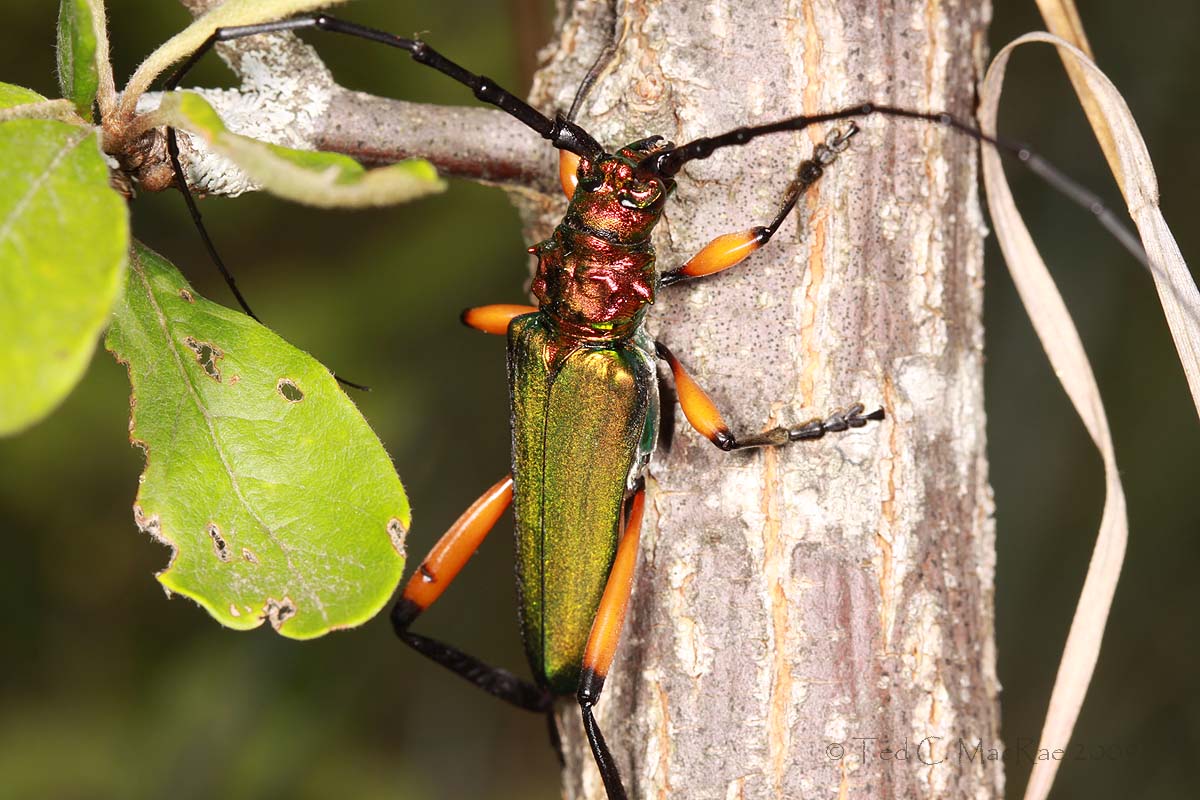
Despite the rain, we then went back to Hercules Glades Wilderness to see if luck would follow suite there as it had at Blackjack Knob.  It didn’t, as rain continued to doggedly pursue us, but the day was not a total loss as daughter and I got in a nice 7-mile hike through some of Missouri’s most ruggedly scenic terrain and were rewarded with the sighting of a western pygmy rattlesnake.  The next day was sunny, much to our delight, and I considered going back to Blackjack Knob where we had seen a good number of adults the previous day.  In the end, I decided I’d played that card and rather than continue trying for photographs I’d rather see if the beetle could be found at another glade complex further to the east at Long Bald Glade Natural Area in Caney Mountain Conservation Area.  Things didn’t look promising, as I found bumelia trees occurring only sporadically across the main glade complex—with no sign of the beetles.  Nevertheless, we enjoyed the day and spent a bit of time chasing after some enormous robber flies that later proved to be Microstylum morosum, a new record for Missouri and a significant northeastern range extension.  I thought that would be the highlight of the day, but as we were heading back to the car I spotted a small glade relict on the other side of the road.  It was overgrown and encroached, apparently not receiving the same management attention as the glades in the main complex. Regardless, I went over to check it out and immediately spotted several bumelia trees amongst the red-cedars, and within minutes I saw a beetle—low on the trunk of a very small bumelia tree!  Once again I froze, then slowly geared up with the camera and began my ultra-cautious approach (remember, this was only my second photo chance after a combined four days in the field).  Like last time, I took one shot while still some distance away, then moved in for closer attempts.  Unlike last time, there was no bothersome vegetation cluttering the view, and when I moved in for closeups the beetle turned around, crawled up the trunk a short distance, and then paused.  I snapped off a small series of shots while it sat there, and then suddenly it became alarmed and flew away.  Though still not perfect, these photographs were better than the previous ones I had obtained (check out the pronotal armature in the last photo!), and the finding of this species at Long Bald Glades also represented a new county record.

Plinthocoelium suaveolens on trunk of living Sideroxylon lanuginosum

Plinthocoelium suaveolens on trunk of living Sideroxylon lanuginosum

Plinthocoelium suaveolens on trunk of living Sideroxylon lanuginosum

Plinthocoelium suaveolens on trunk of living Sideroxylon lanuginosum

Missouri populations are assignable to the nominotypical subspecies (southeastern U.S.), which is distinguished from subspecies plicatum (Texas, New Mexico, Arizona, and northern Mexico) by the bronze or cupreous tints and weak transverse rugae on the pronotum (Linsley 1964).  The distributional ranges of the two subspecies intermingle in northeastern Texas.

Photo details:
All photos: Canon 100mm macro lens on Canon EOS 50D
Photo 1 (Chute Ridge Glade): normal mode, ISO-400, 1/250 sec, f/16, natural light.
Photo 2 (Sideroxylon lanuginosum): landscape mode, ISO-100, 1/160 sec, f/6.3, natural light.
Photos 3 (P. suaveolens larval frass pile), 6—8 (P. suaveolens adult): manual mode, ISO-100, 1/250 sec, f/9-11, MT-24EX flash 1/2 power through diffuser caps (photo 7 slightly cropped).
Photos 4—5 (P. suaveolens larva): manual mode, ISO-100, 1/60 sec, f/14 (closeup f/25), MT-24EX flash 1/2 power through diffuser caps.

REFERENCES:

Champlain, A. B. and J. N. Knull.  1932.  Fermenting bait traps for trapping Elateridae and Cerambycidae (Coleop.).  Entomological News 43(10):253–257.

Linsley, E. G. 1964.  The Cerambycidae of North America. Part V. Taxonomy and classification of the subfamily Cerambycinae, tribes Callichromini through Ancylocerini.  University of California Publicatons in Entomology, 22:1—197, 60 figs., 1 pl.

Linsley, E. G. and P. D. Hurd, Jr.  1959.  The larval habits of Plinthocoelium suaveolens plicatum (LeConte).  Bulletin of the Southern California Academy of Sciences 58(1):27–33.

MacRae, T. C. 1994. Annotated checklist of the longhorned beetles (Coleoptera: Cerambycidae and Disteniidae) known to occur in Missouri. Insecta Mundi 7(4) (1993):223–252.

MacRae, T. C. and M. E. Rice. 2007. Distributional and biological observations on North American Cerambycidae (Coleoptera). The Coleopterists Bulletin 61(2): 227–263.

Riley, C. V.  1880.  Food habits of the longicorn beetles or wood borers.  The American Entomologist 3(10):237–239.

Turnbow, R. H. Jr. and F. T. Hovore.  1979.  Notes on Cerambycidae from the southeastern U. S.  Entomological News 90(5):219–229.

Copyright © Ted C. MacRae 2009

Add to FacebookAdd to NewsvineAdd to DiggAdd to Del.icio.usAdd to StumbleuponAdd to RedditAdd to BlinklistAdd to TwitterAdd to TechnoratiAdd to Furl

Friday flower – Sabatia angularis

Photo details: Canon 100mm macro lens on Canon EOS 50D, ISO 100, 1/60 sec, f/22, MT-24EX flash 1/4 power w/ diffuser caps.

Photo details: Canon 100mm macro lens on Canon EOS 50D, ISO 100, 1/60 sec, f/22, MT-24EX flash 1/4 power w/ diffuser caps.

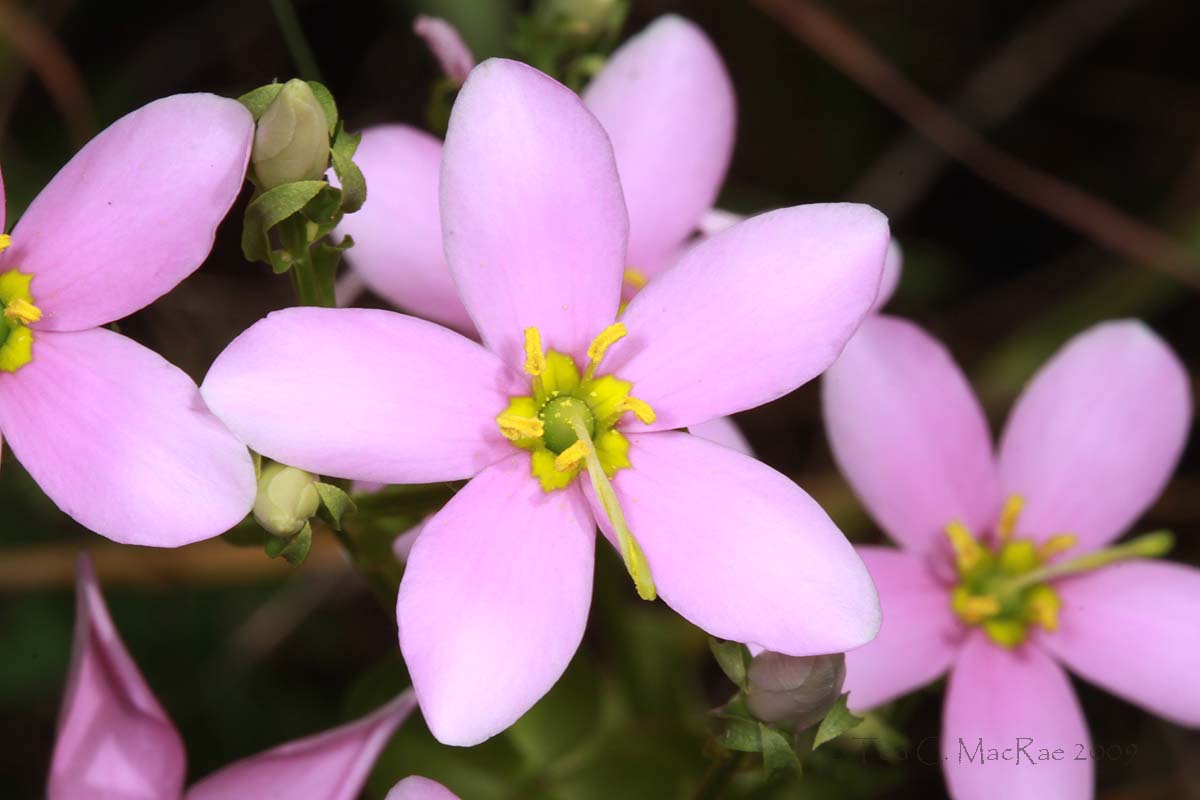
During my explorations of the glades in the White River Hills in southwestern Missouri this past July, I noticed large populations of a flower that I couldn’t recall having ever seen before.  Vivid, striking pink petals with contrasting yellow anthers and a curiously recurved style, it seemed difficult to believe that I had simply overlooked it during my many previous visits to the area over the past 25 years.  Perhaps it was the time of year – I’ve generally avoided these glades during the month of July – normally hot, dry, and baked to a crisp.  This year and the last, however, have been different, with timely rains resulting in unusually lush July vegetation.  I also had no clue as to the identity of the plant – the square stems and opposite branching suggested a mint of some kind, but the flowers were definitely not “minty.”  I would have to simply take photographs and hope that I captured enough key characters to allow its identification once I returned home.

As it turns out, I was able to easily identify the plant as Sabatia angularis¹ (rose pink, rose gentian) using the late Dan Tenaglia’s excellent Missouri Plants website, and I wasn’t the only person to notice an apparent population explosion of this beautiful species across the Missouri Ozarks (see Justin Thomas’ excellent essay, A Sabatia Induced Rant).  As suggested by the common name, this species is in the family Gentianaceae, but it doesn’t resemble other gentians in general appearance, especially the iconic Gentianopsis crinita (greater fringed gentian) and, closer to home, Gentiana puberulenta (downy gentian), that usually come to mind upon mention of this plant family.

¹ Sabatia, for Liberato Sabbati, an 18th Century Italian botanist; angularis, Latin for angular, referring to the angled stem.

This plant occurs in the eastern U.S. west to Wisconsin in the north and Texas in the south.  Denison (1978) and Kurz (1999) both mention a preference by this species for acid soils, usually in rocky open woods, glades, old fields, and upland ridges – habitats which occur primarily across southern Missouri.  The opposite pattern of branching distinguishes this species from the alternately branched, somewhat smaller, and much less commonly encountered S. campestris (prairie rose gentian), which is most commonly encountered in the unglaciated plains of west-central Missouri.

These plants were common throughout the many glades that I visited during my two trips to the White River Hills in July, adding a vibrant splash of color to the glades after most of the other flowering plants found in these habitats have long flowered out and contrasting beautifully against the green background of uncommonly lush July grasses.

REFERENCES:

Denison, E.  1978.  Missouri Wildflowers.  A Field Guide to Wildflowers of Missouri and Adjacent Areas, 3rd revised edition.  Missouri Department of Conservation, Jefferson City, 286 pp.

Kurz, D.  1999.  Ozark Wildflowers.  A Field Guide.  Globe Pequot Press, Guilford, Connecticutt, 262 pp.

Copyright © Ted C. MacRae 2009

Add to FacebookAdd to NewsvineAdd to DiggAdd to Del.icio.usAdd to StumbleuponAdd to RedditAdd to BlinklistAdd to Ma.gnoliaAdd to TechnoratiAdd to Furl

Friday flower – Krameria lanceolata

Photo details: Canon 100mm macro lens on Canon EOS 50D, ISO 100, 1/250 sec, f/9, MT-24EX flash 1/4 power w/ diffuser caps.

Photo details: Canon 100mm macro lens on Canon EOS 50D, ISO 100, 1/250 sec, f/9, MT-24EX flash 1/4 power w/ diffuser caps.

I encountered few insects this past June on the dry slopes of sand shinnery oak shrubland that just makes it into the northwestern corner of Oklahoma’s Four Canyon Preserve – insect population levels were still depressed from the wildfire that swept through the area in April of last year.  Plant life, however, was diverse and abundant, including this most unusual plant – Krameria lanceolata (many common names, including trailing krameria, trailing ratany [sometimes spelled “rhatany”], Texan ratany, prairie sandbur, sandspur, etc.).  A dicot in the monogeneric family Krameraceae, plants in this genus share several unusual traits, the most obvious being their distinctly orchid-like, zygomorphic flowers (i.e., capable of division into symmetrical halves by only one longitudinal plane passing through the axis).  The resemblance to orchids is strictly superficial – they are most closely related to plants in the family Zygophyllaceae.

Orchids, of course, are monocots with trimerous flowers that only appear to be five-petaled because of the three petal-like sepals and the third true petal being modified into a “lip” onto which pollinating bees land.  Krameria flowers also appear five-petaled with a lip, but in this case it is the five sepals that form the “petals,” while the five true petals are modified into a lip (three fused petals) and two lateral upright “flags” called elaiphores.  These eliaphores play a central role in Krameria‘s unusual pollination biology, whose flowers produce not nectar, but fatty oils as rewards for their visitors – female bees of the genus Centris (Anthophoridae) (Simpson and Neff 1977).  The bees collect the oils from the modified external surfaces of the eliaphores, pollinating the flower in the process, and mix the oils with pollen to feed their larvae.  Although the Krameria plants are wholly dependent upon Centris bees to effect their pollination, the relationship is not mutually exclusive – Centris bees utilize other oil-producing plants as well.

All species of Krameria examined to date are obligate semiparasites, forming haustoria on the roots of a broad range of host plants.  Of the 18 species currently known in the genus, five occur in the U.S., with K. lanceolata the most widespread (Kansas and Colorado south to Arizona, New Mexico, and Texas and east to Georgia and Florida) (Austin and Honeychurch 2004). It is distinguished from the other U.S. species by its herbaceous, prostrate form.

Update 8/10/09: Mike Arduser, my hymenopterist friend who visited Four Canyon Preserve with me, wrote the following in response to my query about collecting bees from these flowers:

Yes, collected several off Krameria at Four Canyons and at Packsaddle – all were the same species, and I’m trying to remember the name as I’m writing this (all notes and material are at home) –  it was Centris lanosa. They are best found by listening, as they have a distinctive buzz as they move from flower to flower at ground level (difficult to see there).

REFERENCES:

Austin, D. F. and P. N. Honychurch.  2004.  Florida ethnobotany. CRC Press, Boca Raton, Florida. 909 pp.

Simpson, B. B. and J. L. Neff. 1977. Krameria, free-fatty acids and oil-collecting bees. Nature 267: 150-151.

Copyright © Ted C. MacRae

Add to FacebookAdd to NewsvineAdd to DiggAdd to Del.icio.usAdd to StumbleuponAdd to RedditAdd to BlinklistAdd to Ma.gnoliaAdd to TechnoratiAdd to Furl

Friday flower

Photo details: Canon MP-E 65mm 1-5X macro lens on a Canon EOS 50D, ISO 100, 1/250 sec, f/16, MT-24EX flash 1/8 power through diffuser caps

Photo details: Canon MP-E 65mm 1-5X macro lens on a Canon EOS 50D, ISO 100, 1/250 sec, f/16, MT-24EX flash 1/8 power through diffuser caps

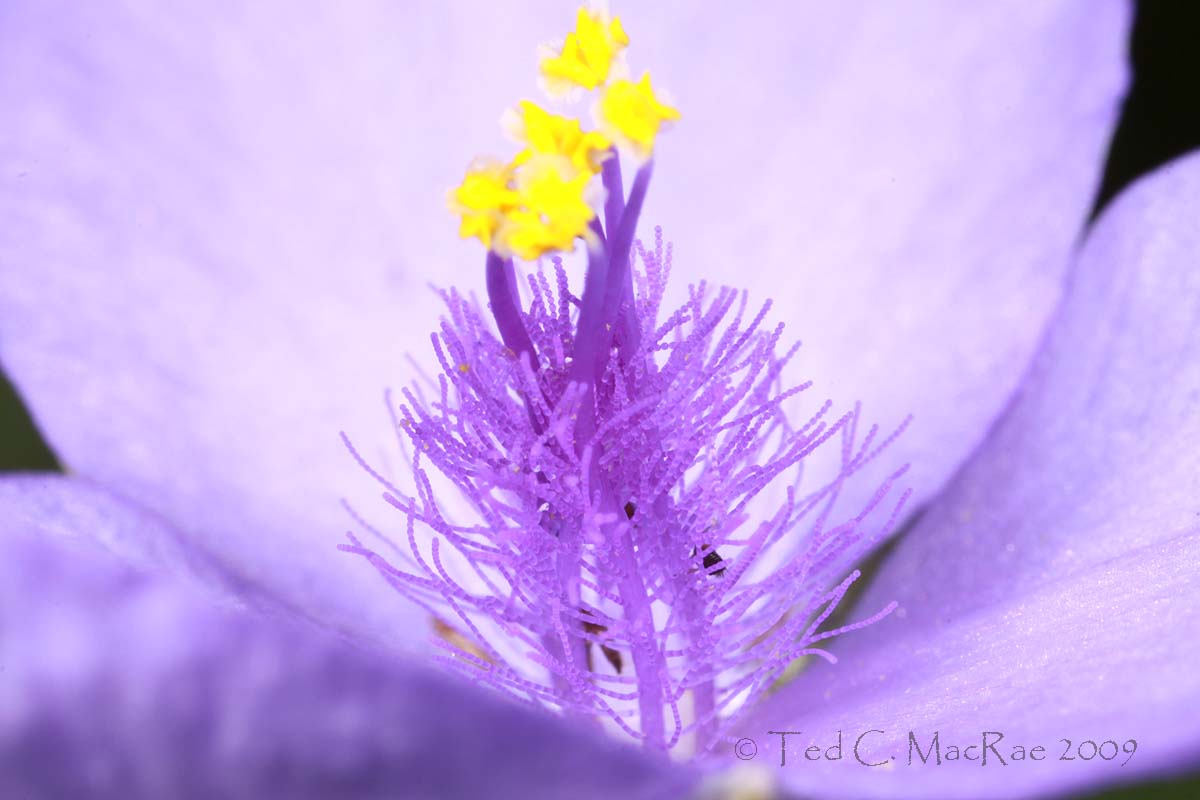
While photographing small Acmaeodera beetles on flowers of Tradescantia ohioensis at Packsaddle Wildlife Management Area, I thought I should take a photo of the flower itself.  Flowers of Tradescantia species, or spiderworts, are notable for their bright yellow anthers and filaments with numerous hairs. Each of the (usually) six stamens possesses around 70-100 hairs, which in turn are composed of a chain of about 20 large, single cells that are purple in color and contain a large, water-filled central vacuole. The cells can be seen easily with low magnification – click on the photo to see the larger version, with the individual cells that make up each hair clearly visible. I haven’t been able to ascertain the function of these hairs for the plant, but their usefulness in observing division in plant cells (the flowing cytoplasm and nucleus can be seen easily) and their sensitivity to radiation and chemical mutagens have been recognized for many years. The hairs turn pink when exposed to radiation, allowing them to be used as a sort of ‘natural’ Geiger counter.

Update: While writing this post, I sent an email to George Yatskeivych, botanist at the Missouri Botanical Garden and author of Steyermark’s Flora of Missouri (1999, 2006), asking if he knew the function of the filamental hairs.  After reading his response (below), I don’t feel quite so bad for not being able to determine the answer myself:

I don’t know that I have ever heard anyone express a particular use for the hairs on the filaments of Tradescantia species.  Sometimes, hairy filaments help to trap pollen from visiting insects in proximity to the stigma or act as nectar guides, but I do not think that anyone has determined such “uses” in Tradescantia.  There may not be a selective advantage to hairy filaments in the genus.

If any botanist happens to read this post and has some insight about this, a comment would be most appreciated.

REFERENCES:

Yatskievych, G. 1999. Steyermark’s Flora of Missouri, Volume 1. Missouri Department of Conservation, Jefferson City, 991 pp.

Yatskievych, G. 2006. Steyermark’s Flora of Missouri, Volume 2. The Missouri Botanical Garden Press, St. Louis, 1181 pp.

Copyright © Ted C. MacRae 2009

Add to FacebookAdd to NewsvineAdd to DiggAdd to Del.icio.usAdd to StumbleuponAdd to RedditAdd to BlinklistAdd to Ma.gnoliaAdd to TechnoratiAdd to Furl

Trilogy of Terror

Last week, Alex at myrmecos tagged me with a fun new meme called These are a few of my favorite stings…. It’s simple – list the things which have stung you (biting doesn’t count), and tag three others for their tales of envenomization. Of course, being the dedicated myrmecologist that he is, Alex leads off with a most impressive list of venomous arthropods, and he selected worthy competition in buzzybeegirl and bugeric.  But me?  I have, for the most part, succeeded in avoiding stings by focusing on a group of insects (beetles) that never evolved such structures.  My domestic list is short and mundane – honey bees, paper wasps, sweat bees, fire ants – and even those not very often.  Alex, however, suspected I might have some tales from exotic lands – thus, I offer the following trilogy and tag Art, Doug, and Kolby.

Tale 1
When I made my first Neotropical collecting excursion some 20 years ago to Ecuador, I was warned by my guide about large, black ants that he called “Congas.” I later learned the species to be what many people call the bullet ant (Paraponera clavata). Now, I’m not an expert on which arthropod truly has the most painful sting, but many people knowledgeable about such matters say it is this species – and I believe them! We were camped out in Sucumbios Province east of Nueva Loja (also called “Lago Agrio”) at an Amazon forest site where recent construction had left rows of month-old slash lining both sides of a 2-km stretch of new road through the forest – can you say woodboring beetles? I roamed up and down that stretch of road, picking a wonderful diversity of longhorned beetles (Cerambycidae) and jewel beetles (Buprestidae) off the slash. At one point, I encountered a whole tree crown laying by the side of the road that required some clambering to get at the beetles crawling on its inner branches. At one point, I braced myself with my arm against a branch and immediately felt an excruciating pain. I looked at my arm and saw one of these large ants clamped onto my arm and quickly slapped it off. I really don’t think words can describe how painful that sting was, and not only did it throb for the rest of the day, but I actually felt sick for the next several days (though I still managed to keep roaming the slash rows). I don’t know if the bullet ant I captured right afterwards was the one that stung me, but I still took great delight in impaling a insect pin through its thorax after I returned home.

Tale 2
Alex mentioned one plant – stinging nettle (Urtica dioica, which also lines one of my favorite mountain bike trails), but I’ve also had a run-in with a much more formidable plant in Mexico. Mala mujer (Cnidoscolus angustidens), which translates as “bad woman” in Spanish, deserves all the respect you can give it. Reported to be one of the most painful stinging nettle-type plants known, it grows commonly from the arid southwest down into the dry, tropical thorn forests of southern Mexico where my colleague Chuck Bellamy and I have made several trips in recent years to search for jewel beetles. One quickly learns to recognize this distinctive euphorbiaceous plant by its green palmate leaves with white veins and thick covering of yellow, stinging trichomes. Unfortunately, in my zeal for beating buprestids from Leucaena diversifolia (netting several of the rare Pelycothorax tylauchenioides and a now paratypical series of what was then an undescribed species of Agrilus), I forgot to maintain my lookout for this common understory plant and got a swipe across the knuckles. Not only did the extreme pain last for hours, but my ring finger began swelling so worrysomely that we stopped in a hospital looking for somebody to cut the ring off. My poor Spanish brought me no sympathy (or service), but fortunately the swelling began subsiding that evening and I didn’t lose my finger. I did, however, live with a rash for the next several days that developed into a hard, purple skin discoloration for the next several weeks.  Bad woman, indeed!

Tale 3
I debated whether to include this experience, but the terror was real so here it is. I wrote about it recently in an article called “Dungers and Chafers – a Trip to South Africa” that appeared in the December 2008 issue of SCARABS Newsletter. Enjoy this excerpt:

After arriving at the park [Borakalalo National Park, North West Province], I could hardly contain myself – I was so anxious to start collecting… We drove through the park for a little bit looking for a good spot to pull over and begin the hunt. After finding such a spot, I grabbed my trusty beating sheet and began doing what I have done so many times before – walking up to a tree, giving a branch a whack with the handle of my net, and hoping to see some prized buprestid laying on the beating sheet. The habitat was ideal for this – dominated by low, spreading acacias such as Acacia tortilis and A. karoo. Buprestids love acacias! I had already learned this in my travels through the American desert southwest and down into Mexico and South America – surely it was the same in South Africa. The first whack yielded nothing – typical. Even when collecting is good, buprestids are never “dripping from the trees,” and often one must literally beat dozens and dozens of trees to really get a good idea of the diversity and abundance of buprestid species that are active in a given area. I whacked a few more trees, with similar results. I then spotted one particularly large acacia tree – something about it said, “beat me!” I walked over to it and gave a branch a whack. All at once, it seemed as though the world was exploding! The air was suddenly abuzz with dozens of large, flying insects, whirring and swirling all around me. My first thought in that initial moment of terror was that I had whacked a hornet’s nest – who knew what kinds of deadly, venomous wasps one might encounter in Africa? Instinctively I ducked and started running, but within a few moments I realized that I was not being chased. Cautiously, I sneaked back towards the tree (after stuffing my heart back down my throat) and realized that they were not hornets after all, but instead beetles. I looked more closely and saw that the tree was literally alive with dozens and dozens of large, green cetoniines resembling our own green June beetle, Cotinis nitida (L.), which seemed to be attracted to the small, white blooms that covered the tree in profusion. I netted a few of the beetles, which I would later determine to represent the common savannah species Dischista cincta (de Geer) (Photo 2). Such was my welcome to Africa, where it seemed the trees literally are ‘dripping’ with beetles!

Disticha cincta (de Geer)

Photo 2. Disticha cincta (de Geer)

Copyright © Ted C. MacRae 2009
Add to FacebookAdd to NewsvineAdd to DiggAdd to Del.icio.usAdd to StumbleuponAdd to RedditAdd to BlinklistAdd to Ma.gnoliaAdd to TechnoratiAdd to Furl

Blackjack oak “flower”

Quercus_marilandica_P1020923_2

This blackjack oak (Quercus marilandica) was found on one of southeastern Missouri’s finest sand prairie relicts a couple of weeks ago on my ‘Annual Birthday Season Opener Bug Collecting Trip.’ Growing near the edge of the prairie at the transition to dry sand forest (Nelson 1985), the arrays of soft, red, newly-expanding leaves at each branch tip had a distinctly floral quality to them. Of course, as with all oaks, the actual flowers of blackjack oak are much less conspicuous, with the staminate (male) flowers borne on drooping catkins, the pistillate (female) flowers on separate spikes on the branch, and pollination accomplished by wind.

Missouri is oak country – nearly a quarter of North America’s 90 oak species (Nixon 2009) occur naturally within the state. This high diversity is explained partly by Missouri’s ecotonal continental position – straddling the east-west transition from the great eastern deciduous forest to the western grasslands. The boundary between these two great biomes is a dynamic, ever-changing interdigitation of woodland, savanna, and prairie that ebbs and flows with the prevailing climatic conditions. Unlike the more mesic forests further east, these dry woodland habitats were often subjected to fire during presettlement times – to which oaks in general (and blackjack oak in particular) are supremely adapted with their thick bark and ability to resprout repeatedly after being burned or grazed back. Sadly, the suppression of these fires post-settlement has caused many of these unique, fire-mediated natural communities to shrink drastically amidst a choking growth of junipers (“cedars” ’round these parts), maples, and other fire-intolerant species. Only on publicly owned preserves and a few private parcels under progressive ownership (such as the sand prairie relict where this photograph was taken) is fire once again shaping the landscape.

Oaks are among my favorite trees, and among the oaks I have several favorites. White oak (Quercus alba) – tolerating many forest types but forming nearly pure stands in high-quality, mesic sites, its tall symmetrical crown, pale bark, and brilliant fall colors are unparalleled among Missouri’s other oaks. Post oak (Q. stellata) as well – lacking the elegance of white oak but achieving its greatest character in fire-adapted savannas and open woodlands as squat, gnarled, massively-trunked trees with broad, spreading crowns¹. Blackjack oak has none of these qualities, yet somehow, it is still one of my favorite Missouri oaks. Stunted and gnarled (‘scrub oak’ to some), it occurs mostly in sandstone and limestone glades, savannas and woodlands on dry, nutrient-poor soils that support few other tree species. The dark green of its tough, waxy (to limit the loss of water), pear-shaped leaves contrasts beautifully with its rough, blocky, almost black bark. Blackjack oak has virtually no timber value, although it is sometimes used for charcoal and firewood. Nevertheless, for me, it is almost an icon for the unique natural communities in Missouri in which it occurs – communities that face ever-increasing pressure from human and forest encroachment.

¹ Please refer to this lovely essay about post oaks in Missouri, by the talented Allison Vaughn.

REFERENCE:

Nelson, P. W. 1985. The Terrestrial Natural Communities of Missouri. Missouri Natural Areas Committee, Jefferson City, 197 pp.

Nixon, J. C.  2009. Quercus in Flora of North America, Vol. 3.

Copyright © Ted C. MacRae 2009

Add to FacebookAdd to NewsvineAdd to DiggAdd to Del.icio.usAdd to StumbleuponAdd to RedditAdd to BlinklistAdd to TwitterAdd to TechnoratiAdd to Furl

Trees of Lake Tahoe – The Deciduous Trees

Alder, Maple, and Nuttall’s Flowering Dogwood make beautiful bowers over swift, cool streams at an elevation of from 3000 to 5000 feet, mixed more or less with willows and cottonwood; and above these in lake basins the aspen forms fine ornamental groves, and lets its light shine gloriously in the autumn months.–John Muir, The Mountains of California (1894).

p1020724_2

This is the third installment of a “Trees of Lake Tahoe” series summarizing the trees of Tahoe Basin. The basin forests are, of course, dominated by a diverse assemblage of conifers – eleven species in all.  These were covered in parts 1 (Trees of Lake Tahoe – The Pines) and 2 (Trees of Lake Tahoe – The “Other” Conifers ) of this series.  Yet, despite this coniferous domination, the 14 species of deciduous trees¹ that occur in the Tahoe Basin is three more than the number of coniferous tree species.  These deciduous tree species will be covered in this third and final part, including the nine species I was able to locate on my recent visit to the area back in mid-March.  Because of the timing of that trip, the trees will be discussed from a decidedly wintertime perspective that makes species identifications a little more challenging compared to the coniferous species.

¹ Admittedly, I use the term “tree” in the broadest sense, since many of these species might better be described as “tree-like shrubs” or “shrubby trees,” often representing only the largest examples of genera whose members include a number of true shrubs.  Only a handful of these species routinely form large, unmistakably tree-like forms, the largest of which still pale in comparison to the coniferous giants that dominate the basin.

Family SALICACEAE

This family of dioecious plants (male and female flowers on separate plants) is represented in the Tahoe Basin by two genera.  Two species of Populus occur here, and both decidedly trees in form.  Most of the nine species of Salix that grow in the basin grow only as shrubs, while two of them sometimes form distinct trees.

Quaking aspen (Populus tremuloides)

…in winter, after every leaf has fallen, the white bark of the boles and branches seen in mass seems like a cloud of mist that has settled close down on the mountain, conforming to all its hollows and ridges like a mantle, yet roughened on the surface with innumerable ascending spires.–John Muir, Steep Trails (1918).

p1020610_2p1020611_2

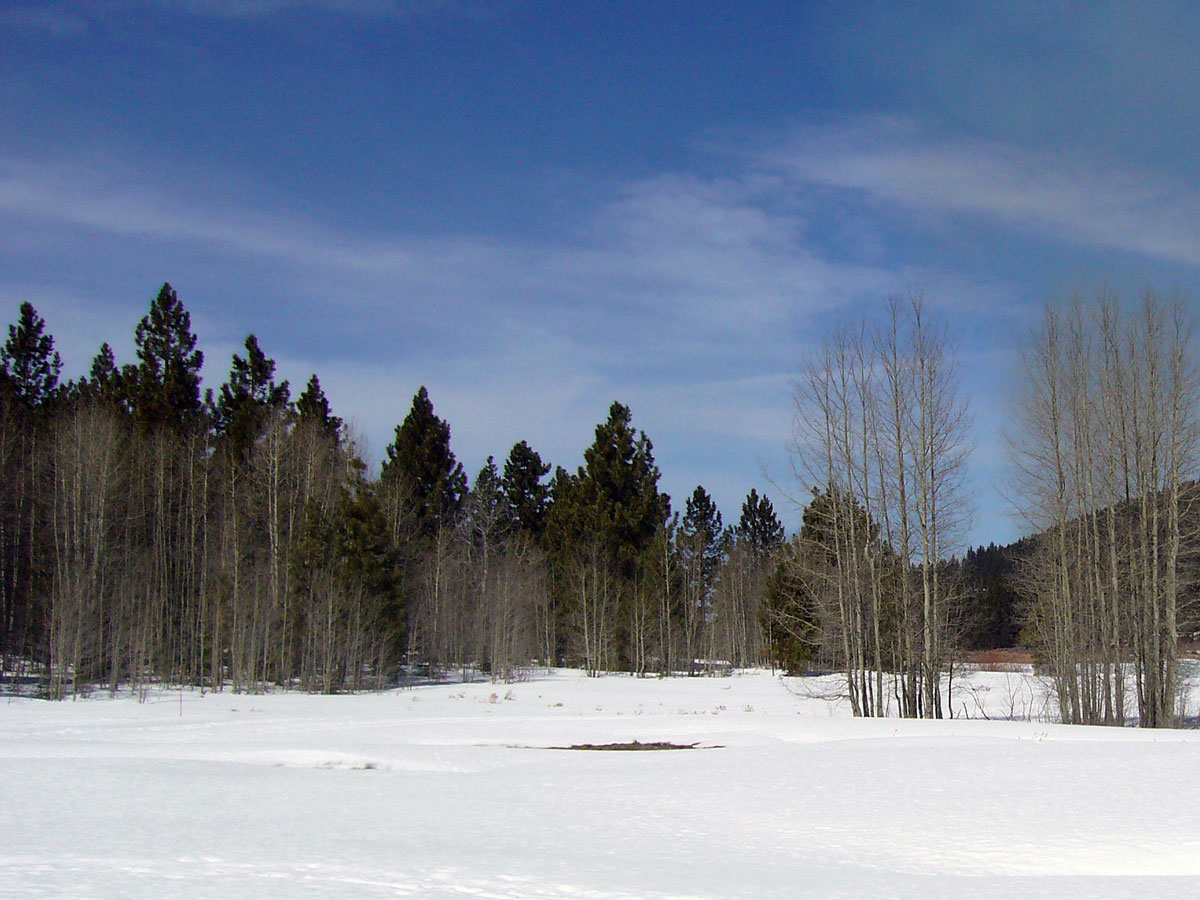
Quaking aspen is one of the most unmistakable trees of the Tahoe Basin – regardless of the season.  Famous for its shimmering foliage during summer and blazing fall colors, it is equally distinctive during winter when its smooth, creamy, greenish-white trunks stand in stark, leafless contrast to the dark green coniferous foliage that cloaks the landscape.  Thick stands of this species are common in moist meadows and stream margins, with stands typically representing clonal colonies of genetically identical trees sprouting from a common root mat.  Although another species of Populus does occur in the basin (black cottonwood – see below), that species is not nearly as abundant as quaking aspen and lacks its distinctive smooth bark.

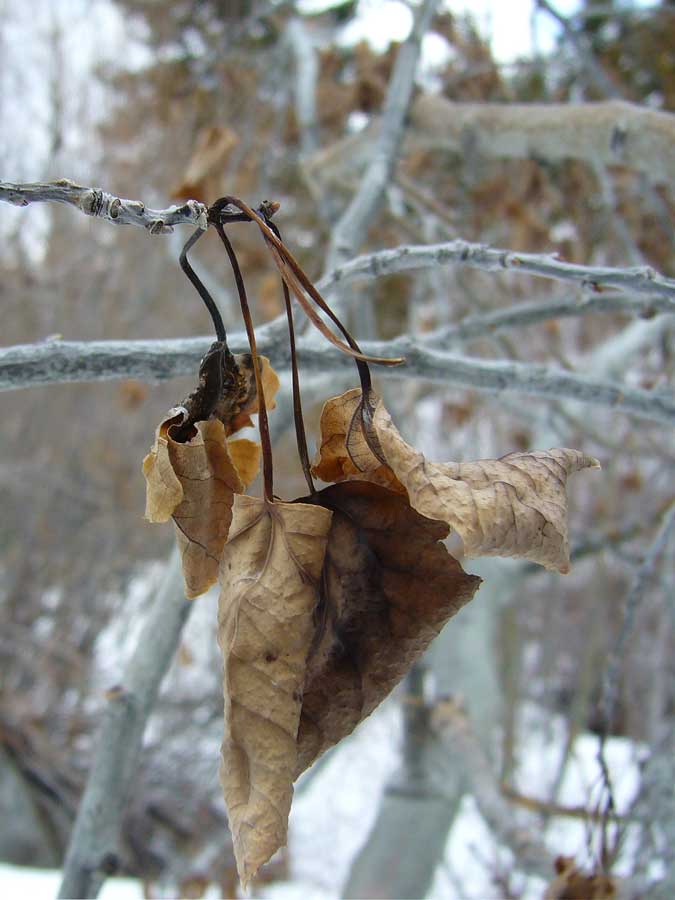
The second photo above shows some of the few, still-clinging leaves that I found, unremarkable in senescence but showing the flattened petioles that cause to summertime leaves to flutter and quiver incessantly with the summer breezes, alternately flashing their bright green upper surface and silvery underside.

Black cottonwood (Populus balsamifera ssp. trichocarpa)

p1020701_2p1020700_2

Black cottonwood is the largest American Populus and the tallest non-conifer in western North America.  Growing throughout the cool, moist Pacific Northwest, it is at its elevational limit in the Sierra Nevada along moist streams and lakeside habitats in the lower Tahoe Basin. The wonderfully knowledgeable Forest Service worker, who helped me greatly in my quest to locate all of the basin’s conifers, was skeptical about my chances of finding this species; however, while hiking the Rubicon Trail at Emerald Bay State Park I spotted the unmistakable, deeply furrowed, gray bark of this close relative of our own eastern cottonwood (Populus deltoides).  Examining the twigs revealed the large, pointed buds, sticky with resin, and a few clinging leaves whose wide, ovate shape confirmed the species’ identity.  It was the only black cottonwood I saw in the basin, although surely others exist throughout the basin at lakeside elevations.

Willows (Salix spp.)

p1020673_2

As a group, willows are easily distinguished from the other deciduous trees and shrubs that occur in the Tahoe Basin.  However, discriminating among the several species can be quite difficult, even for trained botanists.  Winter is not the best time to try to identify willows, as many species are distinguished by characters of the foliage and flowers.  In some cases, examination of both male and female flowers is required – frustrating since they are borne on separate plants!  Wintertime characters normally useful for other plants such as bark and twig color are rarely informative for different species of willow, and even growth habit as trees or shrubs can vary greatly within species depending on elevation and available moisture.  All of this is a long-winded way of saying I don’t know which or how many species of willow I observed in the Tahoe Basin.

p1020705_2p1020707_2According to Graf (1999), there are nine species of willow in the Tahoe Basin; however, only two of them are trees – the abundant shining willow (S. lucida spp. lasiandra), and the more drought-tolerant Scouler’s willow (S. scouleriana).  The remaining seven species are shrubs that rarely exceed 10-12 feet in height.  Indeed, one of them – arctic willow (Salix arctica) – grows no more than 4 inches tall, occurring in seepy slopes and along lake and stream margins in the subalpine zone at Carson Pass.  Most of the willows I observed were at lower elevation along the shore of Emerald Bay and in the wet meadows around South Lake Tahoe and Spooner Lake and were growing as large shrubs or small trees and exhibited either bright yellow or red bark on the year-old branches, turning to smooth gray on older branches.  I don’t know whether these represent one or more species, or if they even represent one of the two arborescent species, but I suspect the yellow-twigged species may represent Lemmon’s willow (S. lemmonii), one of the shub species and Tahoe’s most common willow.  Perhaps a stretch goal for next year’s trip could be to find and distinguish all nine Tahoe Basin willow species, but realistically I would settle for knowing for sure what species the plants in these photographs represent (although I definitely would like to find the diminutive arctic willow).

Family BETULACEAE

Like the Salicaceae, plants in this family have male and female flowers on separate structures called catkins, but the plants themselves are monoecious (both sexes on the same plant).  Two genera – Alnus and Betula – occur in the basin, each represented by one species.

Mountain alder (Alnus incana ssp. tenuifolia)

p1020675_2p1020677_2

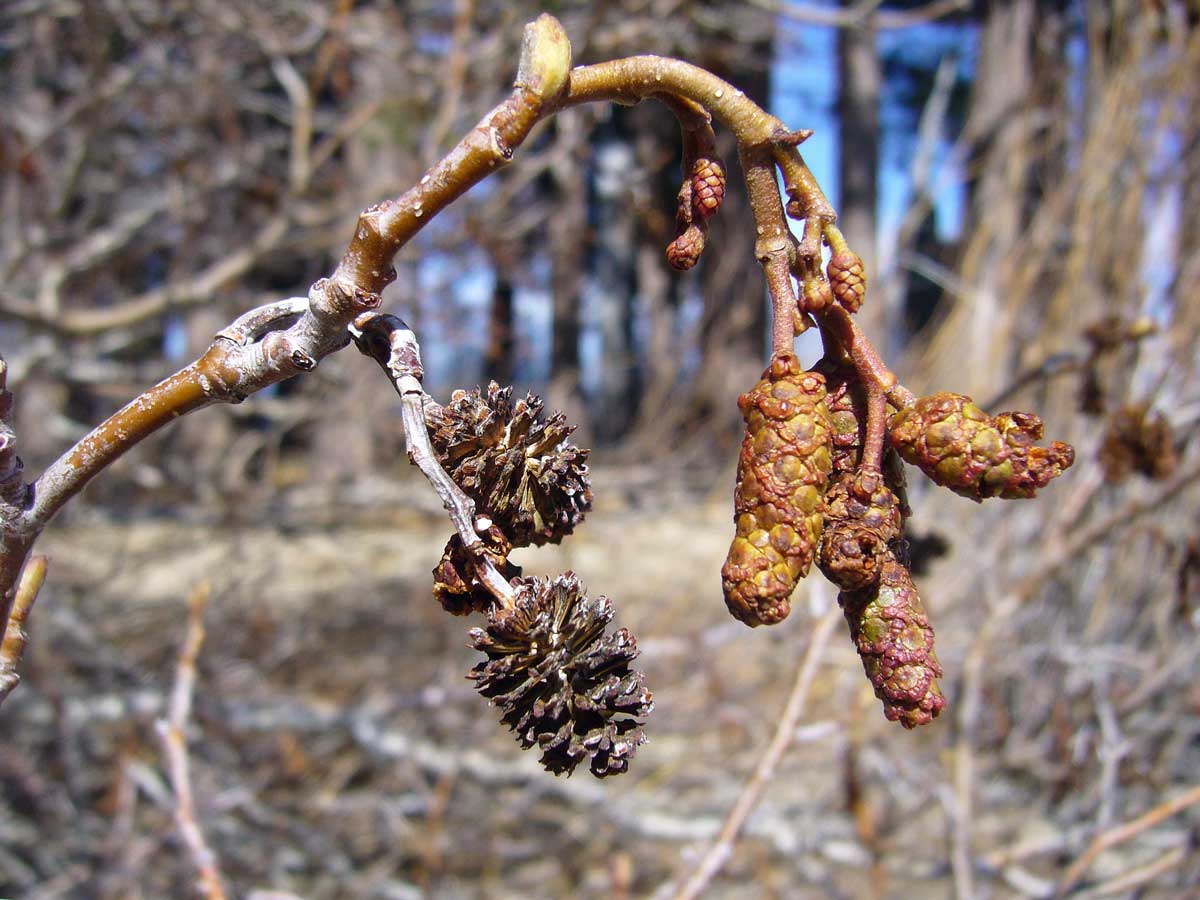
Like the willows, mountain alder is another deciduous plant that straddles the line between tree and shrub, and as is typical of most species in these two plant families (Salicaceae and Betulaceae) the species shows a high affinity for moist sites along stream and lake margins and on seepy north- and east-facing slopes.  The largest specimens I saw, as pictured above left, were found growing on the granite sand beaches along the Rubicon Trail on the western shore of Emerald Bay in Emerald Bay State Park.  Like alders anywhere, this species is immediately recognizeable in winter due to the persistent woody cones that represent the previous year’s female catkins.  Another larger species of alder, white alder (A. rhombifolia), occurs in the Sierra Nevada, but it is not clear to me whether this species actually occurs in the Tahoe Basin proper.  Graf (1999) does not include it in his rather comprehensive treatment of Tahoe Basin plants, but Peterson & Peterson (1975) and Quinn (2006) both list it from the basin (although rare). 

Water birch (Betula occidentalis)

I did not observe this species, which Graf (1999) records from Carson Pass.  The only birch occurring in the Sierra Nevada, it is more common outside the basin proper on the eastern slopes above the burning sagebrush plains.  Like alder, separate male and female catkins are borne on the same tree; however, the female catkins of birch are solitary rather than clustered and disintegrate when ripe rather than persisting as woody cones.

Family FAGACEAE

This family contains the über diverse genus Quercus – represented in California by 20 species.  However, of the five arborescent oaks that occur in the Sierra Nevada, only one has successfully penetrated the high elevations of the Tahoe Basin. A second species of Quercus also inhabits this montane region but grows exclusively as a low shrub, and another shrub in the related genus Chrysolepis also grows here – these two latter species will be treated more fully in a future post.

Canyon live oak (Quercus chrysolepis)

The trunk was all knots and buttresses, gray like granite, and about as angular and irregular as the boulders on which it was growing—a type of steadfast, unwedgeable strength.–John Muir, The Mountains of California (1894).

p1020618_2p1020614_2

This is one of North America’s most variable oaks, exhibiting extreme variability in leaves and fruit and developing as either a tree or a shrub, depending upon the site where it grows. Slow growing and solid, it does best in sheltered locations, where it can develop an impressive, spreading crown and live a hundred years or more. On exposed slopes, it takes on a shorter, shrubbier aspect (above left) or forms dense thickets (above right).  I saw most of this species at lower elevations within the basin – along the Vikingsholm Trail in Emerald Bay State park leading down to the west shore of Emerald Bay.

p1020615_2

The leaves of this evergreen species are bluish green with numerous golden glandular hairs when young and becoming dull gray and smooth with age. Although there are no other arborescent oaks at this elevation with which it can be confused, I did find growing alongside it the strictly montane and shrubby huckleberry oak (Q. vaccinifolia).  The somewhat smaller, mostly entire leaves were the only indication it was not merely a shrub form of canyon live oak, and further study revealed that the two species can be distinguished by the presence of multiradiate glandular hairs on both leaf surfaces of canyon live oak.  These two species are closely related (both are in the Protobalanus – or “golden oak” – section of the genus), and widespread hybridization has apparently been documented in this part of the Sierra Nevada where the two species’ distributions overlap (Nixon 2002).

Family ROSACEAE

This large family of dioecious plants with usually pentamerous radial flowers is represented in the Tahoe Basin by nearly three dozen mostly perennial shrubs.  Six of these species, representing the genera Amelanchier, Cercocarpus, Prunus and Sorbus, sometimes develop a tree form.

Cherry (Prunus sp.)

p1020713_2p1020712_2

Two species of Prunus – bitter cherry (P. emarginata) and western chokecherry (P. virginiana var. demissa) – occur in the Tahoe Basin, both growing as either shrubs or small trees.  I cannot say for sure which species is represented in these photographs (taken on the slopes above Emerald Bay at Emerald Bay State Park), as the two species are best distinguished by subtle differences in their flowers and foliage.  Bitter cherry is apparently common in the Tahoe Basin and has bark that is smooth and dark brown, while chokecherry is more of a foothill species that is uncommon on the western shore (where these photos were taken) and has more grayish brown and somewhat scaly bark.  I can go either way with bark color based on these photos, so I’ll forgo an ID for the time being and seek to follow up during my next visit.  A third species of Prunus, the strictly shrubby desert peach (P. andersonii), formerly occurred at low elevations around the south shore, but it is now considered to be extirpated from the basin.

Mountain ash (Sorbus californica)

While hiking the Rubicon Trail in Emerald Bay State Park, I spotted a single, small tree with distinctive, large winter buds that reminded me immediately of the ornamental species mountain ash (Sorbus aucuparia) from my former days as a nursery inspector.  This thought seemed to be confirmed when I found a senesced but still attached leaf, pinnately compound with nine ovate, toothed leaflets.  However, my pocket copy of Native Trees of the Sierra Nevada (Peterson & Peterson 1975) included no species of Sorbus, and I concluded it must be something else.  This lone tree was located in deep shade within the white fir forest near the western shore of Emerald Bay, so I opted to find another tree in better lit conditions for taking photos – unfortunately, no other trees of this species were found.  Once I got back home, I was happy to find Sorbus californica listed in my just purchased copy of Graf (1999).  This species has attractive white flowers in small panicles during the summer that give rise to bright red berries during fall and is apparently common in mid- to higher-elevation riparian communities around the lake.

Serviceberry (Amelanchier spp.)
Curl-leaf mountain mahogany (Cercocarpus ledifolius)

I did not locate either of the two species of serviceberry that occur in the Tahoe Basin, the common serviceberry (Amelanchier utahensis) and the more localized glabrous serviceberry (A. alnifolia var. pumila).  Being highly familiar with our eastern species, A. arborea (just recently finished flowering), I suspect either of these species would be readily recognized, even in winter, by their smooth, silvery-gray bark and shrubby, small-tree form.  I also did not see curl-leaf mountain mahogany (Cercocarpus ledifolius), another species that barely qualifies as a small tree.  It is apparently more at home on the dry eastern flank of the Sierra Nevada but can be found within the basin proper sporadically in the southwest and along the southeastern lake shore and more commonly on dry slopes in the far north and south of the basin.  I have collected a number of woodboring beetles from mountain mahogany across the southwestern U.S. from the mountains of southern California to the Chisos Mountains of Texas.

Family ACERACEAE

The single North American genus, Acer, is represented in California by four species, three of which occur in the Sierra Nevada but only one occurring in the Tahoe Basin.  Plants in this family are closely related to the Hippocastanaceae, represented in the Sierra Nevada foothills by California buckeye (Aesculus californica).

Mountain maple (Acer glabrum var. torreyi)

As with mountain ash, I found a single small tree representing this species near the west shore of Emerald Bay while hiking the Rubicon Trail.  Despite lacking foliage, I recognized it immediately as a maple by its opposite, scaly buds.  Also like mountain ash, I assumed I would see more after finding the first one and thus didn’t photograph this particular tree growing in deep shade.  That’ll teach me.  This species sometimes grows as a multi-stemmed shrub in moist situations, and even when assuming tree form, as did the one I saw, it is at best a small tree with a maximum height of only around 15′.  With fall foliage in varying shades of pink to red, it must rather nicely compliment the blazing yellow cloak of the quaking aspen during September and October.  Tahoe Basin individuals are placed in var. torreyi due to their bright reddish twigs, while those on the eastern slope of the Sierra Nevada exhibit gray twigs and are placed in var. diffusum.

This concludes my “Trees of Lake Tahoe” series – at least until next year when I hope to locate some of the remaining species I did not find during this year’s visit.  However, I do have one more “flora of Lake Tahoe” post in preparation covering some of the many woody shrubs that occur within the basin.

REFERENCES:

Arno, S. F. 1973. Discovering Sierra Trees. Yosemite Association, Yosemite National Park, California, 89 pp.

Graf, M. 1999. Plants of the Tahoe Basin. Flowering Plants, Trees, and Ferns. A Photographic Guide. California Native Plant Society Press, Berkeley, 308 pp.

Muir, J. 1894. The Mountains of California. The Century Co., New York, xiii+381 pp.

Muir, J.  1918. Steep Trails. Houghton, Mifflin, Boston, ix+390 pp.

Nixon, K. C. 2002. The oak (Quercus) biodiversity of California and adjacent regions. USDA Forest Service General Technical Report PSW-GTR-184, 20 pp.

Peterson, P. V., and P. V. Peterson, Jr. 1975. Native Trees of the Sierra Nevada. University of California Press, Berkeley, 147 pp.

Quinn, C.  2006.  A Nature Guide to the Southwest Tahoe Basin: Including Desolation Wilderness and Fallen Leaf Lake: Trees, Shrubs, Ferns, Flowers, Birds, Amphibians, Reptiles, Mammals, and Fishes Inhabiting the Sierra Nevada Watershed Southwest of Lake Tahoe, California.  CraneDance Publications, Eugene, Oregon, 232 pp. 

Copyright © Ted C. MacRae 2009
Add to FacebookAdd to NewsvineAdd to DiggAdd to Del.icio.usAdd to StumbleuponAdd to RedditAdd to BlinklistAdd to Ma.gnoliaAdd to TechnoratiAdd to Furl