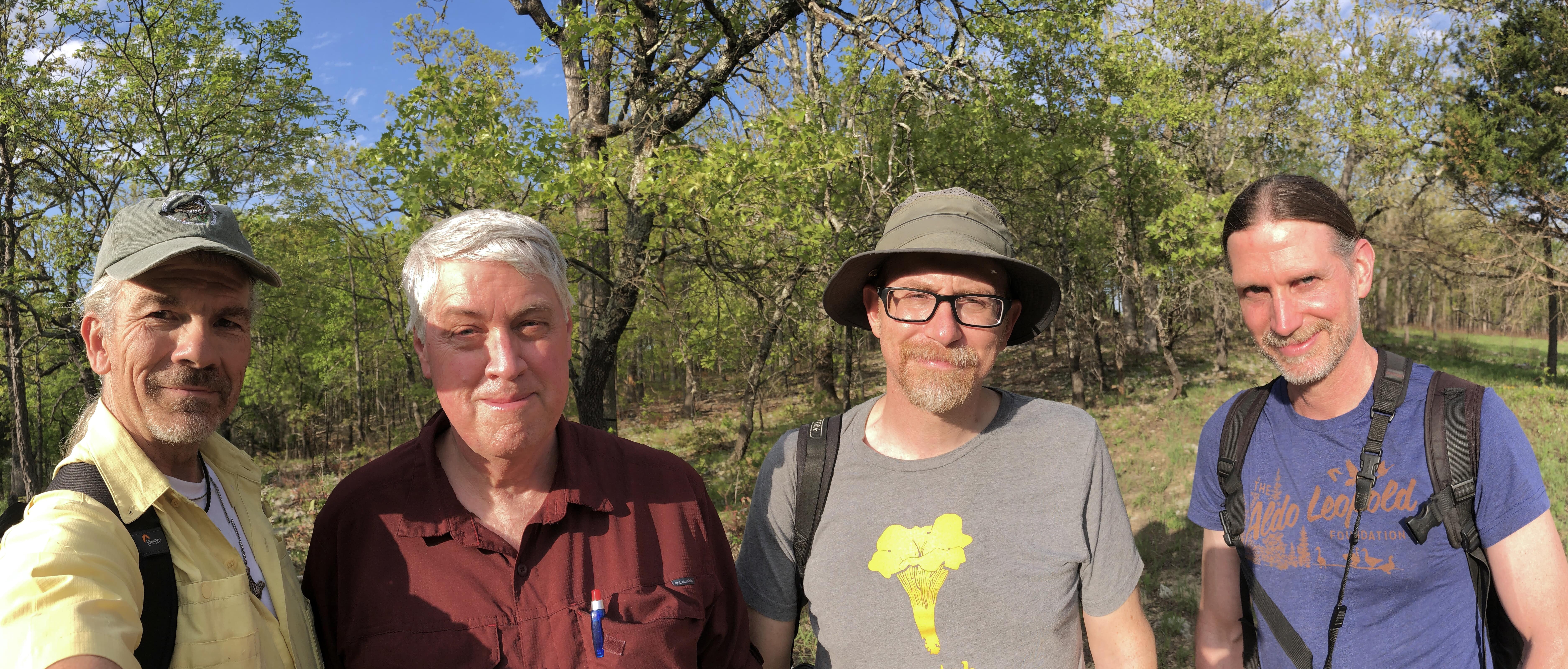
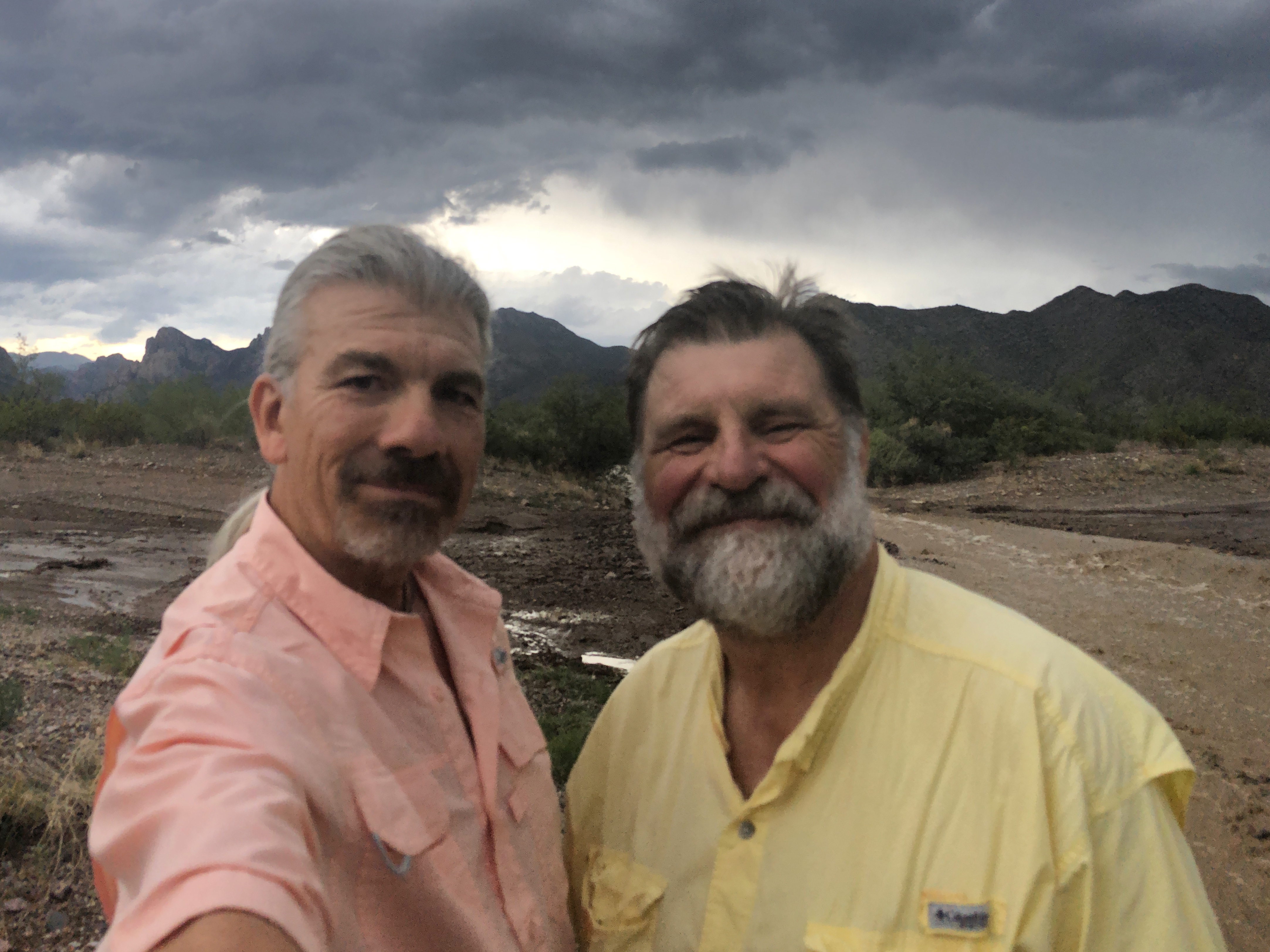
L-R: Ted “BugMan” MacRae, Pete Kozich, David Seidensticker, “Ozark Bill” Duncan, Lisa Meihls, Chris Brown.
The Webster Groves Nature Study Society (WGNSS) Entomology Group began its final outing of the 2025 field season when eight participants (Chris Brown, Nathalie de Rocquigny, “Ozark Bill” Duncan, Jack Hambene, Pete Kozich, Ted “BugMan” MacRae, Lisa Meihls, and David Seidensticker) met up in the parking lot at Hughes Mountain Natural Area. Tucked into the southeastern corner of Washington Co., this gem of a natural area features 1.5 billion year old Precambrian outcrops that are among the oldest continuously exposed rocks in North America. Once molten as a result of volcanic activity associated with the St. Francois Mountains, the now hardened and weather-resistant rhyolite that formed after it cooled lies still exposed at the summit and surrounding areas. To the geologist, the polygonal columnar pattern of cracking at the summit—resulting in a unique formation called the “Devil’s Honeycomb”—might be the area’s most interesting feature. To the botanist, the xeric grasslands that formed on the surrounding exposures—i .e., “igneous glades”—might instead take this honor. To the entomologist, however, the unique fauna of insects associated with this interesting natural community earns top billing.
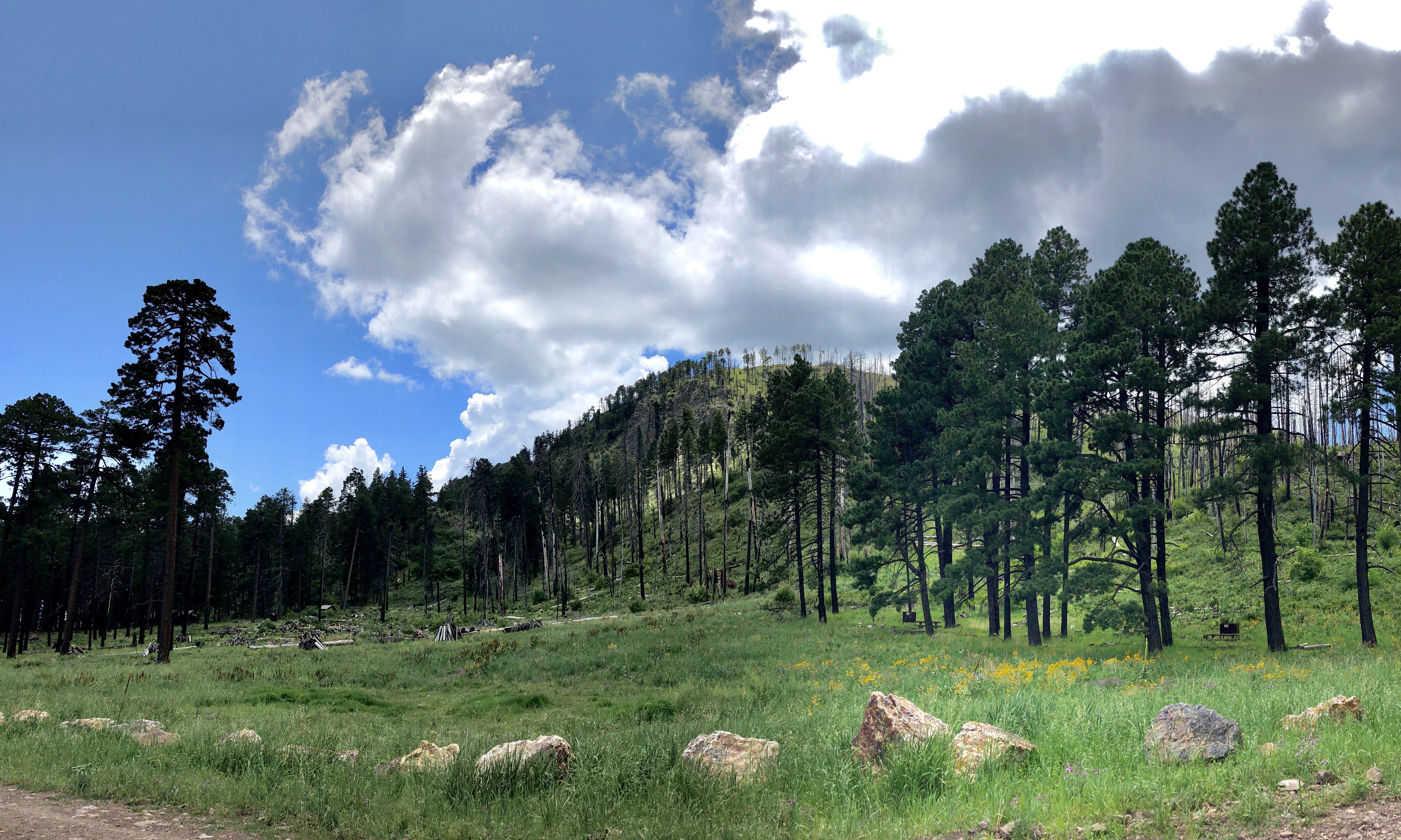
Rhyolite glade at Hughes Mountain Natural Area.
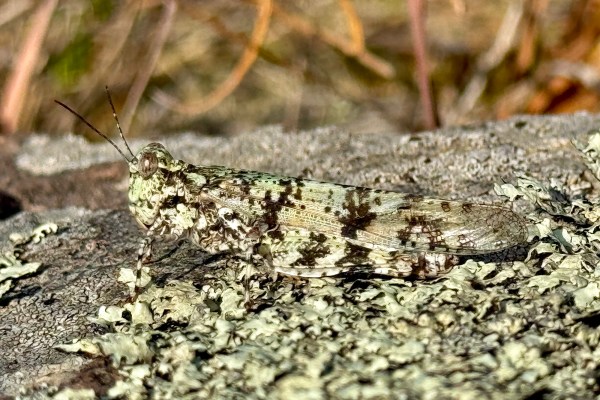
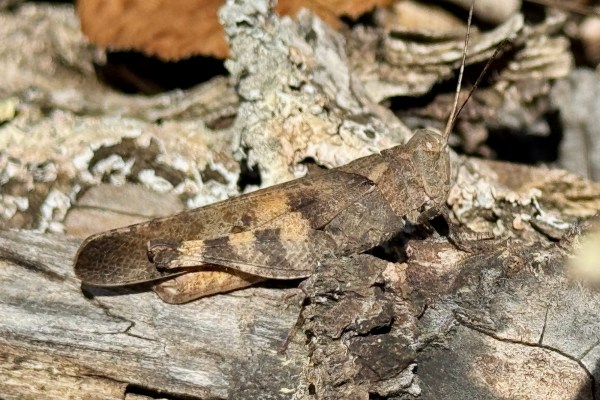
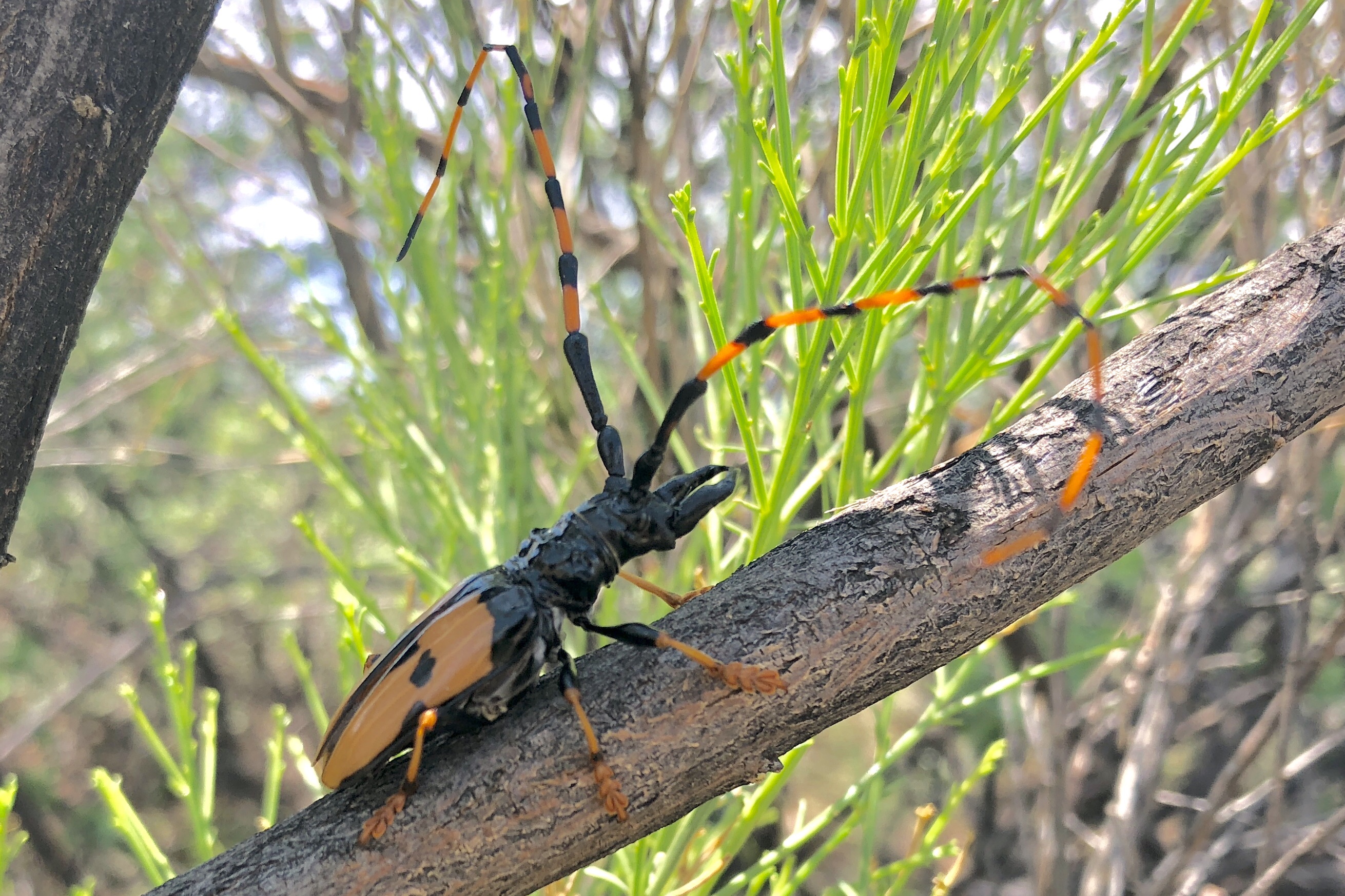
On two previous visits, the group has been fortunate to see one of Missouri’s rarest and most beautiful longhorned beetles—Tragidion coquus. Velvety black with vivid orange elytra, this charismatic species is usually seen during fall, and we hoped to be fortunate enough to see it again. Two species of fall tiger beetles—Cicindela limbalis (claybank tiger beetle) and Cicindela splendida (splendid tiger beetle), both colored iridescent green and brick red—were additional possibilities. A clear consensus quickly became apparent, however, when most participants voiced a desire to see Trimerotropis saxatilis—the famously and colorfully cryptic lichen grasshopper! It didn’t take long to see the first ones as soon as we began reaching the swathes of exposed rhyolite with their coverings of green and black lichens. Sitting motionless on the lichen-encrusted rocks, the grasshoppers were almost impossible to see, so perfectly colored and patterned was their camouflage.
The abundance of lichen grasshoppers on the glades was somewhat expected, but what was not was the diversity of other grasshoppers also present at the margins of the glades and in the surrounding dry woodlands. Four such species were documented, including Hippiscus ocelete (wrinkled grasshopper), Melanoplus ponderosus (ponderous spur-throat grasshopper), Melanoplus rusticus (obovate-winged grasshopper), and Spharagemon bolli (Boll’s grasshopper)—all possessing their own forms of cryptic coloration that made relocating them after they jumped difficult.
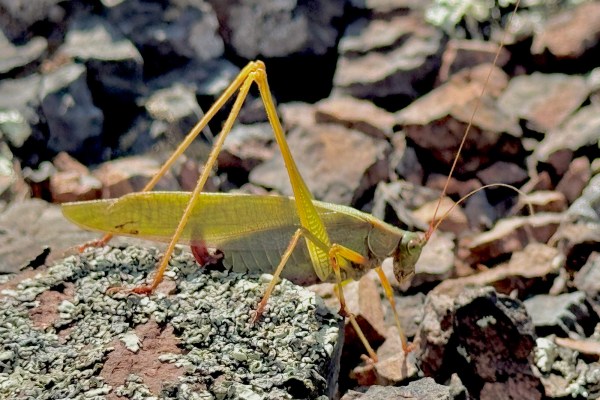
Two non-grasshopper orthopterans as well were found—several Scudderia furcata (fork-tailed bush katydid), ranging from green to tan to almost pinkish(!), were seen in the glades and woodlands, and an unusually cooperative Ceuthophilus sp. cave cricket (family Rhaphidophoridae) was also seen.
Scudderia furcata (fork-tailed bush katydid—family Tettigoniidae).
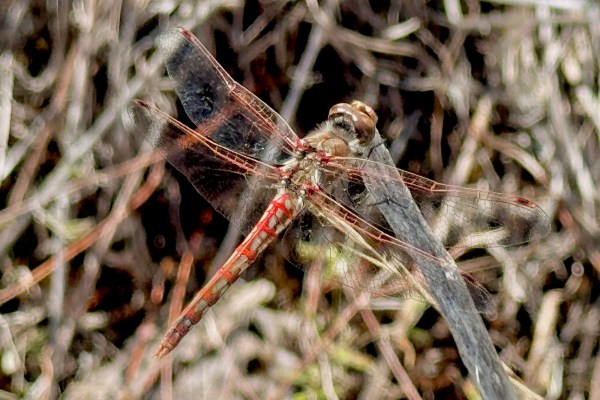
The group fanned out across the glades as they worked their way up towards the summit. Of special interest were flowers that might host pollinating insects (and possibly even T. coquus). Few flowers would be found, however—a consequence of abnormally dry conditions since late July, and we found ourselves looking for other targets. Ted managed to photograph a beautiful red-marked variegated meadowhawk dragonfly (Sympetrum corruptum), while David “captured” (through the viewfinder) a male black swallowtail butterfly (Papilio polyxenes).
Eventually the group reached the summit, where the “Devil’s Honeycomb” and a spectacular vista awaited us. An unexpected feature at the summit was white splotches on the tops of many of the projecting columns of rock, which the group surmised to indicate use of the summit as a roosting site by turkey vultures.
“Devil’s Honeycomb” at summit of Hughes Mountain.
The group lingered to take in the crisp air, blue skies, and spectacular view created by 1200’ of elevation before turning back to begin the descent back down the mountain.
Buford Mountain (2nd highest point in Missouri) in the distance.
Descending the mountain, however, did not mean an end of things to see. Even before getting off the summit, Lisa noticed Chelinidea vittiger (cactus leaffooted bug) on pads of Opuntia cespitosa (eastern prickly pear). This species feeds and develops almost exclusively on the pads, fruits, and young growth of prickly pear cacti (Opuntia spp.), thus, its range coincides with the distribution of these cacti.
Further down the mountain, another “variegated” species was seen—this time a variegated fritillary (Euptoieta claudia) butterfly. This well-worn individual was only the third butterfly species seen on the day, the aforementioned black swallowtail and a particularly fresh common buckeye (Junonia coenia) being the other two. This one was probably making its way south to overwinter in the southern U.S., where the species is a year-round resident.
Along the way, the lichen grasshoppers continued to attract our attention due to their abundance and striking diversity of coloration. We were treated to a particularly obvious example of this when we encountered a mating pair with the much smaller male exhibiting shades of brown instead of the greens exhibited by the much larger female.
It had been a leisurely descent off the main glade, and once clearing the woodland to emerge into the last glade fragments before the final descent, Chris and Ted were further delayed by a trio of observations in rapid succession. A large, impressively marked Neoscona crucifera (spotted orbweaver) spider hunkered down on a twig first caught Chris’ attention. Photographing it turned into an adventure when an effort to manipulate the twig on which it was resting ended up alarming the spider and causing it to drop down to the ground. They returned the spider to the twig using other twigs and leaves, but invariably it dropped again. Eventually, they learned they could “reel” the spider back up to the twig by its silk line if they acted quickly enough, and with repeated efforts both succeeded in getting photographs of the spider back up on the twig.
While this was going on, the unmistakable droning buzz of Milesia virginiensis (yellowjacket hover fly or Virginia flower fly) caught their attention. The resemblance of the adults of this species to wasps is remarkable, and they are often seen hovering in midair, making erratic shifting movements, and then suddenly flying away. This particular fly, however, cooperated by landing on a rock (briefly) and allowing a few photographs before it abruptly departed.
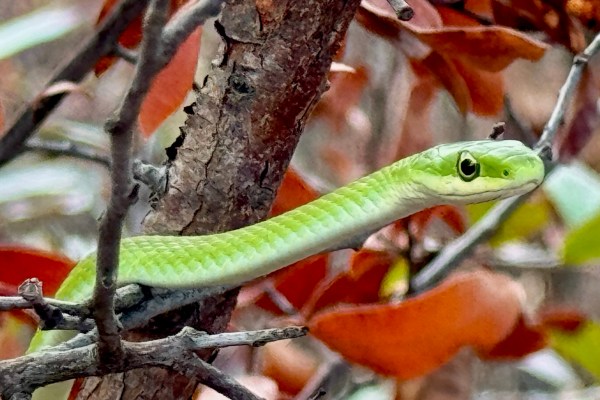
Spider and fly photographs in hand, Ted and Chris resumed their descent but took only a few steps before another sighting demanded photographs—a rough green tree snake (Opheodrys aestivus) peering quizzically from amongst the rust-red leaves of a stunted blackjack oak. The snake cooperated at first, allowing a few closeup photographs before making a run for it. Fortunately, this is a very docile species that rarely (if ever) bites when handled, so Chris and Ted were able to corral it for additional photos before returning it back to the tree from whence it came.
Opheodrys aestivus (rough green snake—family Colubridae).
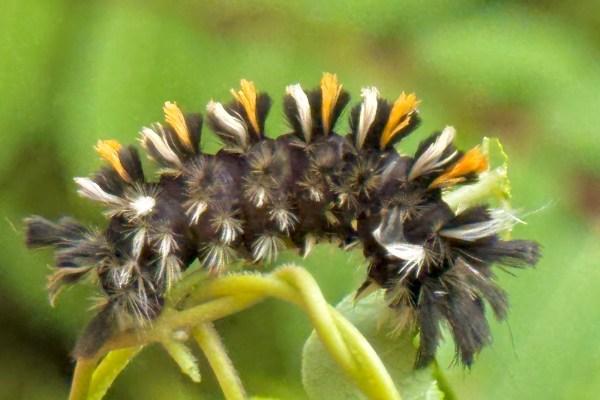
At last, they were able to complete the descent and join the rest of the group in the parking lot, but not before making one last interesting find—the bizarrely beautiful caterpillar of Isa textula (crown slug moth). Like many members of the family Limacodidae (slug moths), the pale green, flattened caterpillars bear stinging spines/-in this case on lobes that radiate out from around the edge of the body. The caterpillar was found on the ground (it is probably mature and was looking for a protected place to spin a cocoon in which to spend the winter) and coaxed onto a leaf to bring it to the parking lot so everyone could have a chance to photograph it (it looked particularly stunning when set on a bright red sumac leaf).
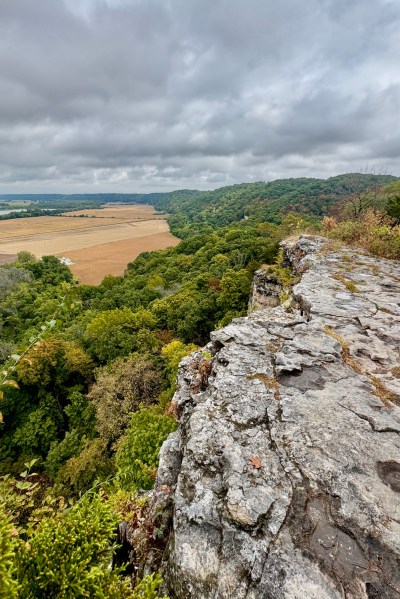
After missing the last three weeks, I was happy to rejoin the WGNSS botanists on their regular weekly outing this past Monday. This week’s destination—Salt Lick Point Land & Water Reserve in western Monroe Co., Illinois—features a mosaic of loess hill prairie and limestone glades amidst dry to dry-mesic upland forest atop limestone bluffs towering up to 400 feet above the Mississippi River valley below.
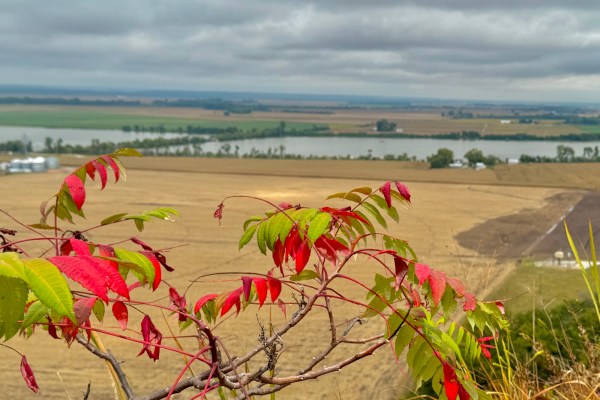
View from the Newman Trail at Salt Lick Point.
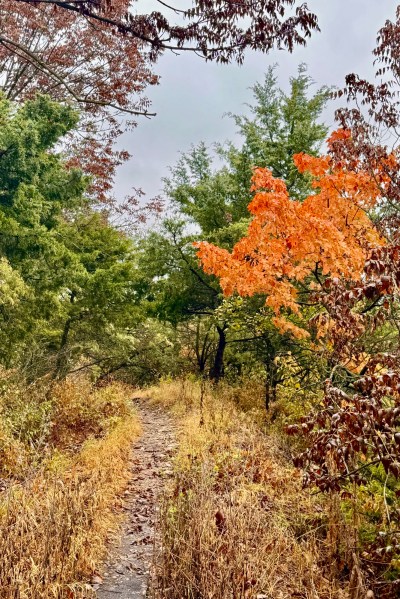
It has been an exceptionally dry August and September, so much that fall blooming plants are noticeably delayed and sparse in their blooms. Nevertheless, welcome rains just in the past few days have breathed some “fall life” into the woods and brought with them the pungent, earthy aromas that one expects to accompany a landscaping morphing from the dull greens of summer to the vibrant ambers, tawnies, and golds of fall.
View from the Salt Lick Trail at Salt Lick Point.
The group first explored the upland and blufftop habitats along the challenging terrain of the Salt Lick and Newman Trails, then returned through flat lowlands along the bluff bottoms via the Johnson Trail. Although still just beginning to bloom, a diverse palette of “fall asters” gave us an opportunity to reacquaint ourselves with the characters that distinguish these often “easy-to-identify-to-genus but difficult-to-identify-to-species” plants. The bulk of these fell into one of two groups—the true asters (genus Symphyotrichum) and the goldenrods (genus Solidago).
Salt Lick Trail at Salt Lick Point.
Symphyotrichum patens (late purple aster) was the first true aster that we noticed, a rather common species distinguished by its purple (of course) flowers with loose but not recurved phyllaries and leaves broadly clasping the stem. It wasn’t long before we had a chance to test our knowledge when we encountered the similar appearing Symphyotrichum anomalum (manyray aster), also with purple flowers but distinguished from S. patens by its distinctly recurved phyllaries and petiolate rather than clasping leaves. Eventually, we would encounter a third species of the genus—Symphyotrichum lateriflorum (calico aster), distinguished by its numerous small white flowers at the tips of numerous lateral branches rather than the terminus of the stem.
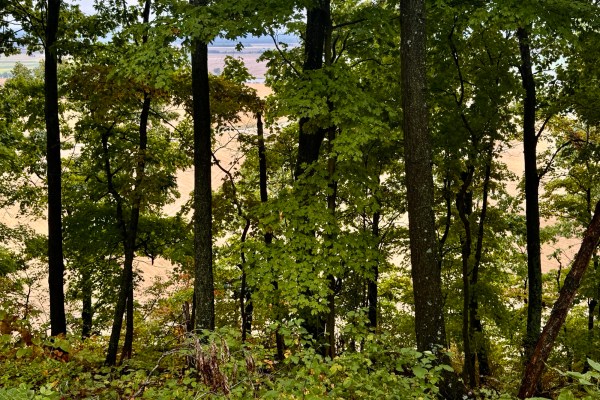
View from the Newman Trail at Salt Lick Point.
Goldenrods, on the other hand, were not only more diverse but also comprised some quite conservative species. The first of these was Solidago drummondii (Drummond’s goldenrod). This near-endemic species is restricted to eastern Missouri and adjacent parts of Illinois and Arkansas and grows almost exclusively on limestone or dolomite bluffs. However, we found it growing on limestone boulders placed at the trailhead next to the parking lot. Its wide, toothed leaves on short petioles (along with habitat) make this species easy to identify. Another quite conservative goldenrod was found as we entered the dry to dry-mesic forest further up the trail—Solidago buckleyi (Buckley’s goldenrod). Restricted to the Ozarks and adjacent areas, it is a showy species with relatively large flowers and spready phyllaries. In this and other respects, it greatly resembles the much more common Soldago petiolaris (downy goldenrod); however, it differs from that species by its narrower leaves that lack distinct teeth. A third species was seen as we approached one of the larger loess hilltop prairie remnants—Solidago altissima (tall goldenrod). Unlike the previous two species, this is one of the commonest and weediest species of goldenrod in the region. Relatively tall and with pyramidal inflorescences, this species often aggressively monopolizes roadsides and fallow fields. It greatly resembles another fairly common species—Solidago gigantea (late goldenrod), which we would later see during the return hike along the edge of the river valley. Leaf texture, however, differs between these two species—S. altissima has leaves with rough surfaces (caused by stiff, unidirectionally recurved hairs that cause the leaf to move only one direction when rubbed between the thumb and forefinger), while S. gigantea has smooth leaves (that move in any direction when rubbed).
The group not only spent its time with its eyes down, but also out—across the vast Mississippi River valley spread out below the several lookout points dotting the trails. Tawny fields of near-ready-to-harvest corn provided a beautiful backdrop against the resplendent red sumacs and brilliant orange maples lining the blufftops.
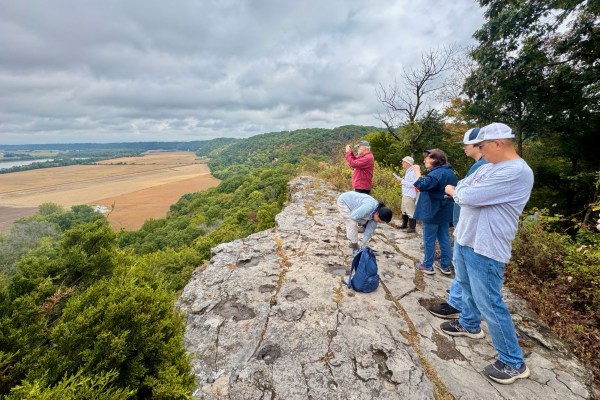
Members of the WGNSS Botany Group admire the view from the Newman Trail at Salt Lick Point.
View from the Newman Trail at Salt Lick Point.
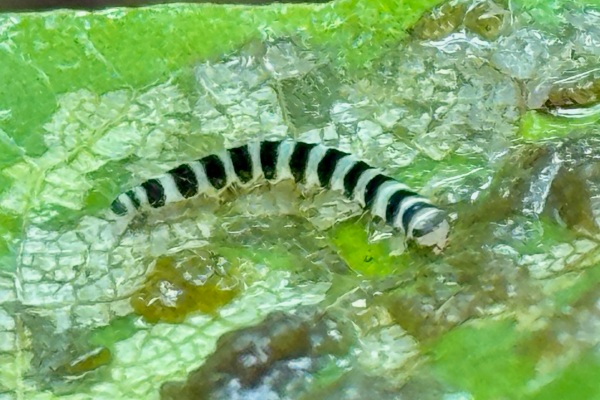
As the group’s lone entomologist/botanist (“entomotanist”?), I also kept an eye out for insects and was richly rewarded. A tiny “thorn” on the stem of S. buckleyi proved to be Enchenopa latipes (wide-footed treehopper), and unfolding the “folded” leaves of Cercis canadensis (eastern redbud) revealed the culprits—zebra-striped caterpillars of Fascista cercerisella (redbud leaffolder moth).
Enchenopa latipes (wide-footed treehopper—family Membracidae) on stem of Solidago buckleyi (Buckley’s goldenrod).
Fascista cercerisella (redbud leaffolder—family Gelechiidae) on Cercis canadensis (eastern redbud).
A spectacular earth boring beetle, Geotrupes splendidus, was seen lumbering clumsily along the trail in its endless quest for mammal dung to bury and lay an egg upon, while Bombus impatiens (common eastern bumble bee) worked the flowers of Eupatorium altissimum (tall boneset) and Eupatorium serotinum (late boneset).
Geotrupes splendidus (splendid earth-boring beetle—family Geotrupidae) on trail through dry-mesic loess woodland.
Bombus impatiens (common eastern bumblebee—family Apidae) on flower of Eupatorium altissimum (tall boneset).
A nearly mature Euchaetes egle (milkweed tussock moth) consumed the dwindling foliage of Cynanchum laeve (climbing milkweed), and Piezogaster calcarator (leaf-footed bugs) congregated on the inflorescences of Verbesina alternifolia (yellow ironweed).
Piezogaster calcarator (leaf-footed bug—family Coreidae) on flower of Verbesina alternifolia (yellow ironweed).
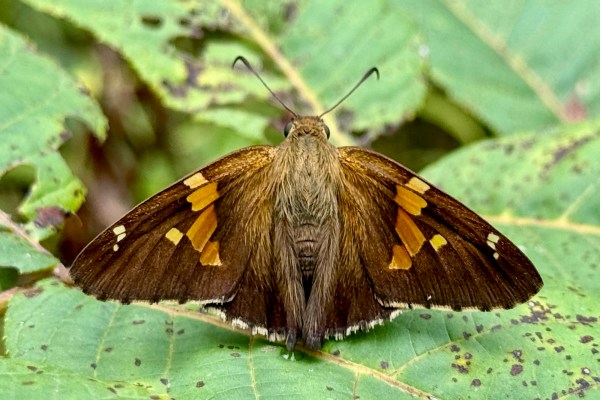
Nowhere, however, was insect activity more abundant than on the goldenrods, particularly the abundant stands of S. altissima in the uplands and S. gigantea below. Overwhelming numbers of Chauliognathus pennsylvanicus (goldenrod soldier beetles) and Lycomorpha pholus (black and yellow lichen moths) were accompanied by a cacophony of bees, wasps, and flies—a situation tailor made for Phymata sp. (jagged ambush bugs) to lay in wait while Epargyreus clarus (silver-spotted skipper) flew erratically overhead.
Phymata sp. (jagged ambush bug—family Reduviidae) mating pair on flower of Solidago altissima (tall goldenrod).
Epargyreus clarus (silver-spotted skipper—family Hesperiidae) perched on Solidago altissima (tall goldenrod).
Even in the deeply shaded mesic forest, Cyllopsis gemma (eastern gemmed satyrs) flitted deftly through the undergrowth.
Cyllopsis gemma (eastern gemmed satyr—family Nymphalidae) in mesic riparian forest.
The most unusual find, however, was a bizarre, green, jewel of a caterpillar found crawling on the forest floor—Isa textula (crowned slug moth or skiff moth), fringed with lacy projections that make it look more like a sea slug than an insect!
Isa textula (crowned slug moth, skiff moth—family Limacodidae) in leaf litter of mesic riparian forest.
Of course, a Monday WGNSS Botany Group outing isn’t truly consummated until it has enjoyed lunch at a local establishment—the choice this time being Tequila Mexican Restaurant in nearby Waterloo (best fish tacos I’ve ever had!).
This past Tuesday was my birthday, and as I have done for my entire adult life I took the day off and went on my traditional “Season-Opener-Bug-Collecting-Trip”. In the past I’ve usually just had one friend go with me, but today I had three—Rich, Chris, and Bill!
We started off by heading south about 3½ hours to Tingler Prairie Natural Area in Howell Co.. I wanted to come here because: 1) it was a place I’d never visited before, and 2) there is a population here of the endemic Ozark trillium (Trillium viridescens) that I thought might be in bloom. Rain in the forecast and a patch of the real thing on the way down had us a little worried, but the day turned out spectacular with temps climbing to 80°F and skies partly to mostly sunny.
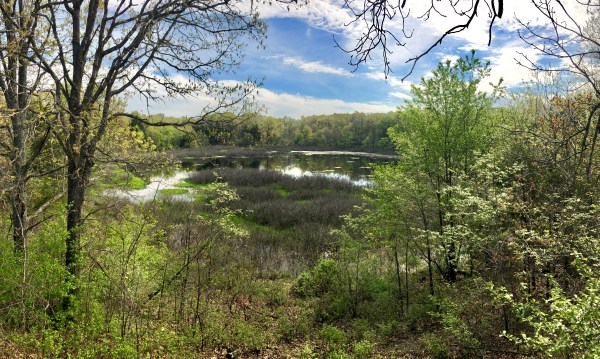
Tingler Lake – the centerpiece of Tingler Prairie Natural Area.
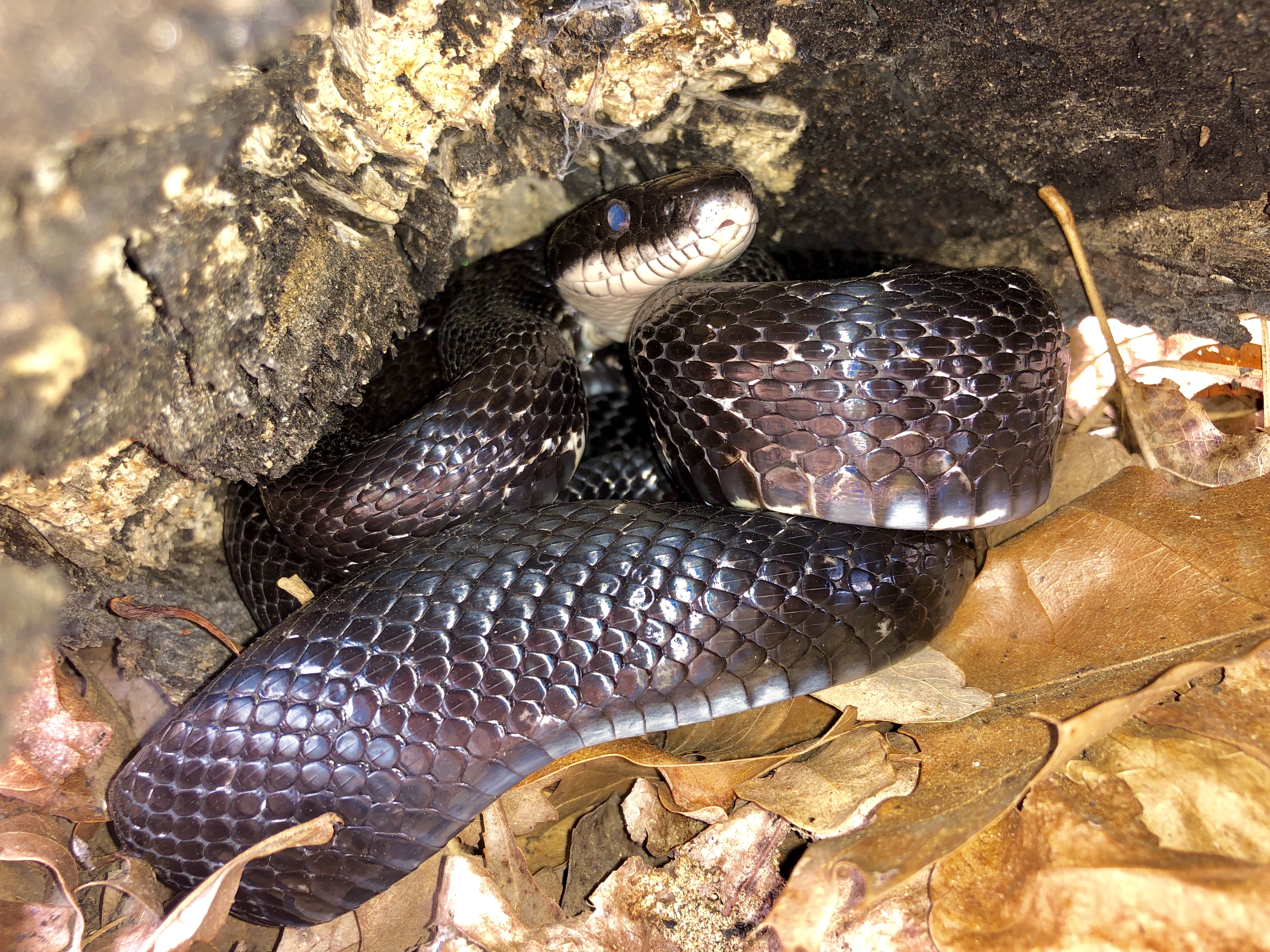
We never did find the trillium—even calling another friend (Casey), who had seen them here before to find out exactly where he saw them. Turns out we hit the right spot, but apparently we were too early, especially given how late spring has been moving along this year. Nevertheless, we still found much to capture our interest, including a yellow-bellied racer (Coluber constrictor flaviventris)—too quick for photos—and a black rat snake (Pantherophis obsoletus) that coiled up nicely under the end of a fallen log and tolerated my prodding and “cleaning” of the scene around him to get some good photos (albeit, only with the iPhone).
Black rat snake (Pantherophis obsoletus).
The “cloudy” eye is actually an artifact of the flash lighting reflected by the retina.
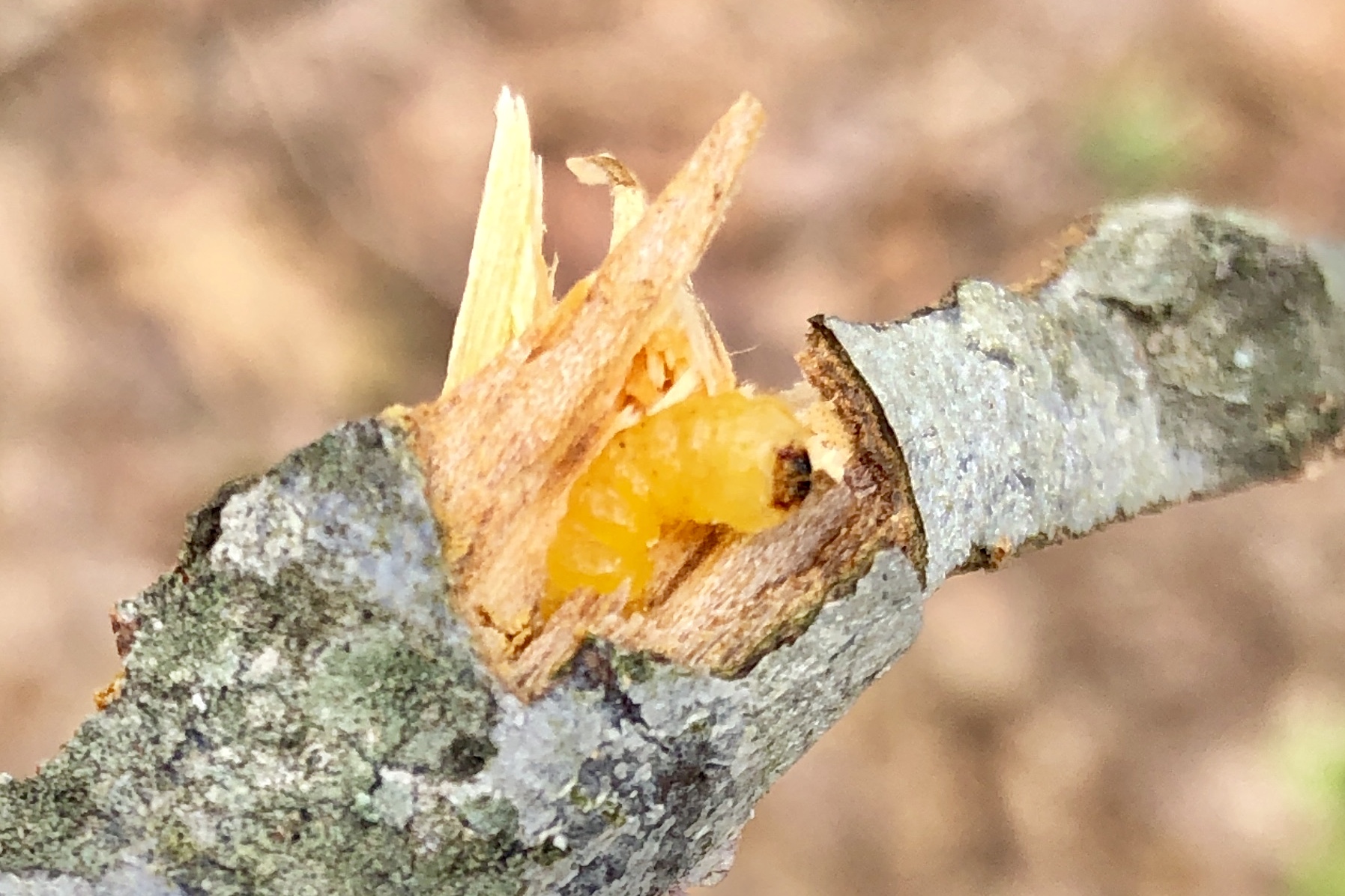
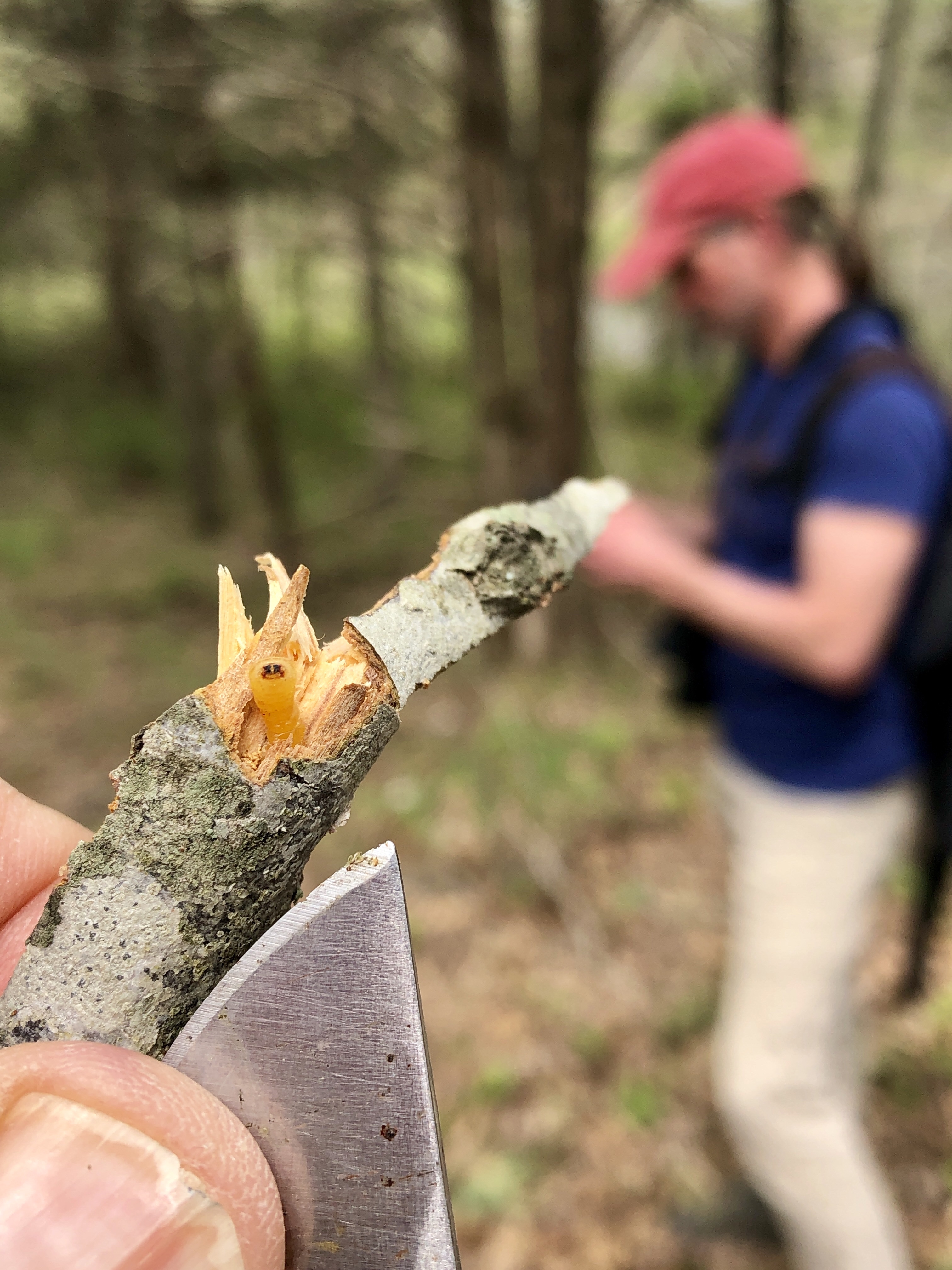
Unfortunately, insect activity was very light. We saw no tiger beetles and only the earliest spring forms of most other insects. I took about 10 specimens each of the early-spring jewel beetles Acmaeodera tubulus and Pachyschelus purpureus, which I found on flowers and foliage (respectively) of wild geranium, Geranium maculatum. It was the first time that I’d found the latter as abundant as this, so the series of specimens will be a welcome addition to my cabinet. I also took a couple of A. tubulus on a flower of violet wood sorrel, Oxalis violacea and showed the others the characteristic end of an oak twig pruned by a twig pruner (Anelaphus parallelus) larvae (and revealed the culprit for them to see). Despite the paucity of insects, it was a beautiful and high-quality spot, and I look forward to collecting here again sometime when the season is more advanced.
Several adult Acmaeodera tubulus feeding on petals of wild geranium (Geranium maculatum) flowers.
Twig pruner, Anelaphus parallelus, larva cut from its gallery near the base of a pruned oak twig.
Revealing the culprit while Chris takes notes on some of the birds he’s been hearing.
Redspotted purple butterfly, Limnetis arthemis astyanax (family Nymphalidae), caterpillar on black cherry (Prunus serotina), one of its favorite host plants. The caterpillar mimics bird droppings for protection.
Fire pink, Silene virginica (family Caryophyllaceae) thrives on a dry, cherty hillside.
Mayapple, Podophyllum peltatum (family Berberidaceae) prefers the rich, more mesic hillsides (this is where we expected Trillium viridescens to occur).
After finishing up at Tingler Prairie, we drove east an hour and bushwhacked over rough Forest Service 2-track to Bald Hill Glade Natural Area in Ripley Co. It had been close to 10 years since my previous visit, but I remembered the roads well. We had to park, however, about a mile from the entrance to the glade due to fallen trees across the final stretch 2-track. The landscape had changed considerably since my last visit—gone was the dense, close forest lining the 2-track, and in its place stood open woodland brought to this condition by active management that included the use of prescribed burning apparently as recently as the past season.
Dwarf iris (Iris cristata).
These diminutive plants are distinguished from other members of the genus by their short stature and sepals with midline beards.
Bald Knob Glade Natural Area.
After hoofing through the forest we reached the glade and found a beautiful—if somewhat sterile—scene before us. The recent burn included not only the woodland but also the glade itself, and no unburned refugia could be found anywhere. Floristically, this is beneficial for the glade, which needs periodic fire to prevent woody encroachment, but in my experience such burns also result in severely depressed insect populations for years afterwards. It takes time for the insects to find and recolonize the glade, and in this case the lack of unburned refugia will only increase the amount of time that will be needed for the insect populations to recover.
Nevertheless, we enjoyed our hike through the area, watched and listened to the calls and songs of a number of cool birds, including summer tanagers, indigo buntings, blue-gray gnatcatchers, and—a first for me—the splendidly yellow prairie warbler. We also took photographs of the glade and some of its plants (with the big camera), and on the way back to the car we found several of the Polistes wasp-mimicking light flies, Pyrgota undata (family Pyrgotidae). Interestingly, all were mating pairs, and the ones we observed closely (as we photographed them with the big camera) were engaged in a most curious “French kissing” behavior. I can’t wait to read up more on this when I prepare to post the photos of this behavior.
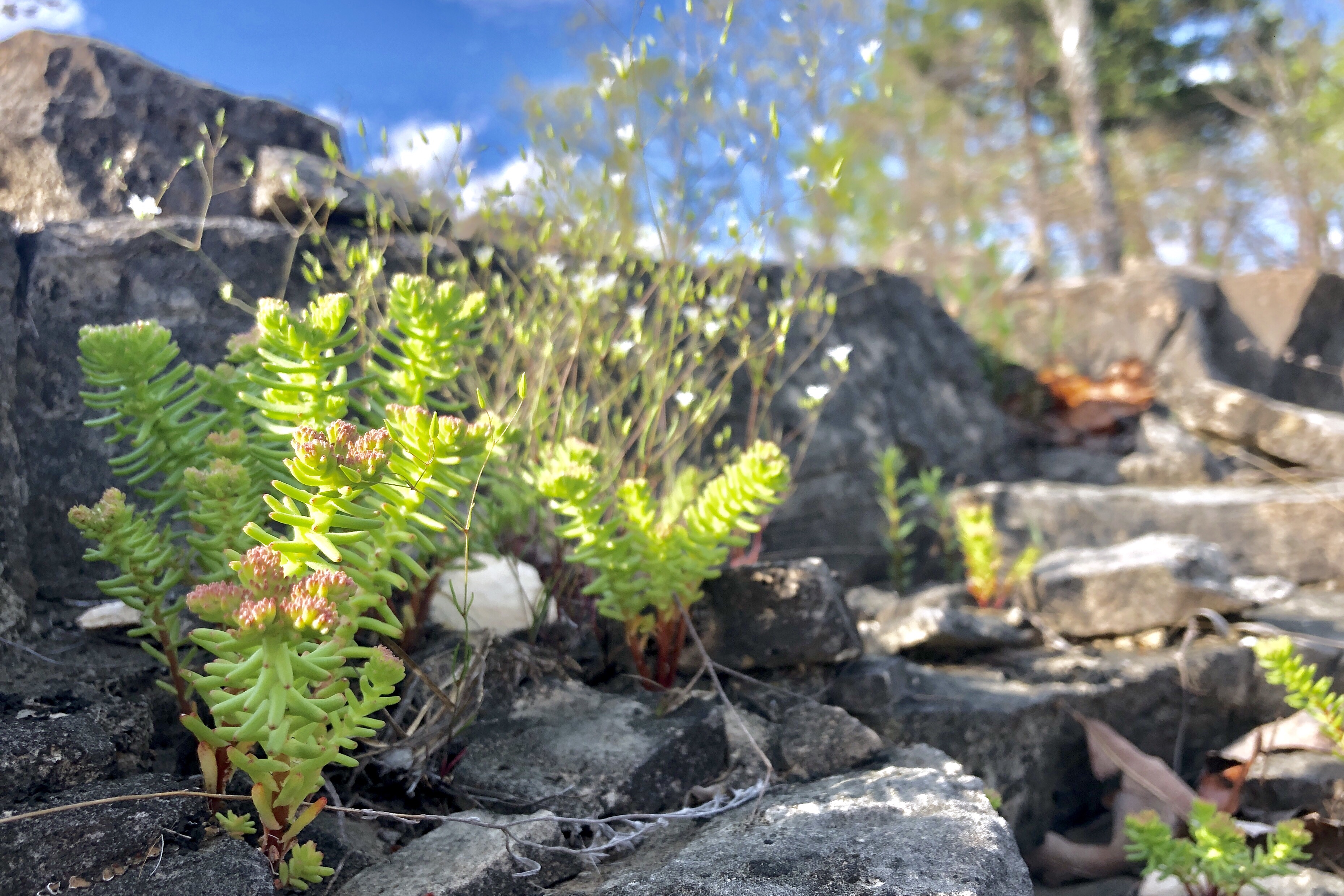
Widow’s cross (Sedum pulchellum).
Me, Rich, Bill, and Chris.
Eventually, impending dusk signaled a close to the day, and after driving east another 1½ hours to have pizza dinner in Poplar Bluff we made the long drive back to St. Louis (arriving at my home at 12:30 a.m.!).
NOTE: All photos in this post were taken and processed with an iPhone X. The “real” photos taken with our “real” cameras will be shared as they become available.
Hot on the heels of the previous installment in this series, I present the sixth “Collecting Trip iReport”; this one covering a trip to Arizona during July/August 2018 with Art Evans and—like the previous installments in this series—illustrated exclusively with iPhone photographs (see previous installments for 2013 Oklahoma, 2013 Great Basin, 2014 Great Plains, 2015 Texas, and 2018 New Mexico/Texas).
This trip was a reunion of sorts—not only had it been 20 years since I’d collected in Arizona, it had also been 20 years since I’d spent time in the field with Art Evans—which just happened to be in southeast Arizona! For years I looked forward to our next opportunity, and when he told me of his plans for an extended trip to take photographs of his forthcoming Beetles of the Western United States, I couldn’t pass up the chance. Art had already been out west for five weeks by the time I landed in Phoenix on July 28th, and together we drove to Cave Creek Canyon in the Chiricahua Mountains and spent the night before beginning a 7-day adventure in and around the “Sky Islands” of southeastern Arizona.
As with the recent New Mexico/Texas post, the material collected still has not been completely processed and curated, so I don’t have final numbers of taxa collected, but there were a number of species—some highly desirable—that I managed to find and collect for the first time, e.g., the buprestids Acmaeodera yuccavora, Agrilus restrictus, Agr. arizonicus, Chrysobothris chiricauhua, Mastogenius puncticollis, and Lampetis webbii and the cerambycids Tetraopes discoideus and Stenaspis verticalis. Who knows what as-yet-unrecognized goodies await my discovery in the still unprocessed material?!
Day 1 – Chiricahua Mountains, Cave Creek Canyon
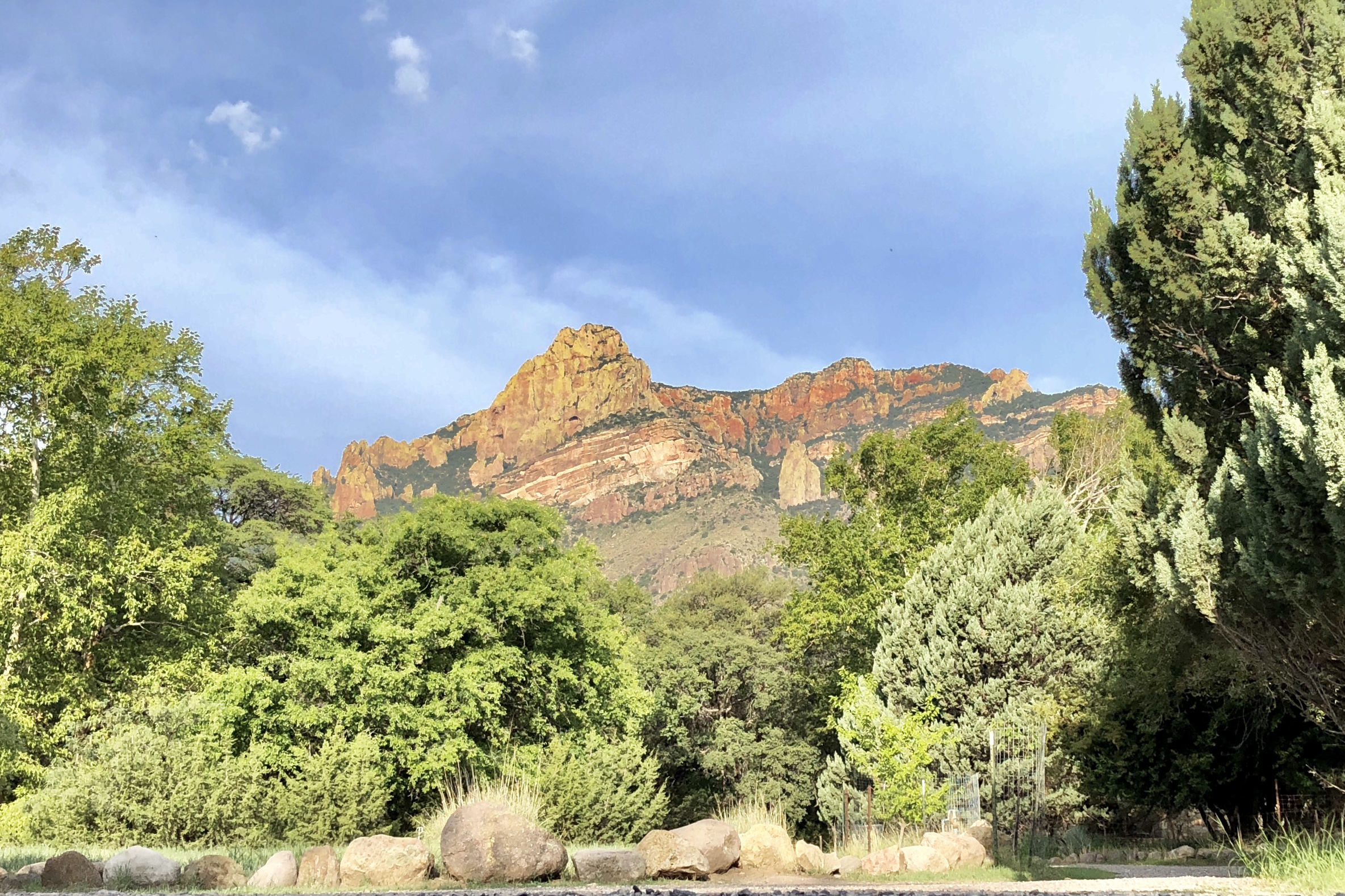
After arriving at Cave Creek Ranch late last night, we awoke to some stunning views right outside our room!
View of Cave Creek Canyon at Cave Creek Ranch, Chiricahua Mountains.
Cave Creek Ranch, Cave Creek Canyon, Chiricahua Mountains.
Cave Creek Ranch, Cave Creek Canyon, Chiricahua Mountains.
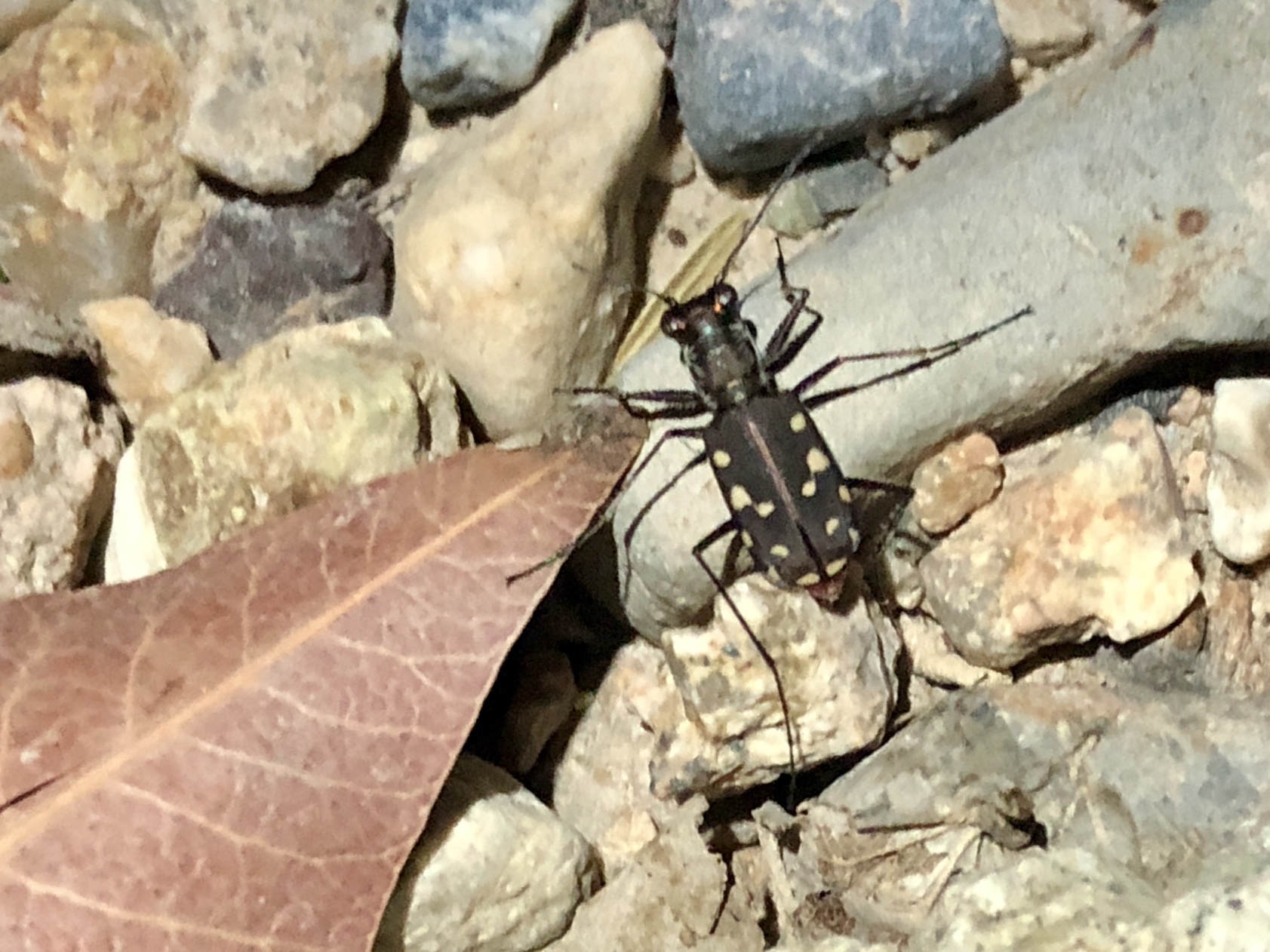
The first buprestid of the trip was a series of Pachyschelus secedens on Desmodium near Stewart Campground. We beat the oaks and acacia along the way to Sunny Flat Campground but didn’t find much. Once we got near Sunny Flat I did some sweeping in an area with new growth of Helianthus sp. and got a series of Agrilus huachucae, a few lycids, and one Leptinotarsa rubiginosa. I beat one Acmaeodera cazieri from Acacia greggii and found another on flower of prickly poppy (Argemone sp.). On the roadside at Sunny Flat I found several Acmaeodera spp. on a yellow-flowered composite – one A. rubronotata, one A. solitaria(?), and three A. cazieri. Also collected one A. cazieri on a rain gauge, Mecas rotundicollis and one as yet undetermined acanthocinine cerambycid on miscellaneous foliage, one tiger beetle (Cicindela sedecimpunctata?) on the roadside, and two orange lycids in flight.
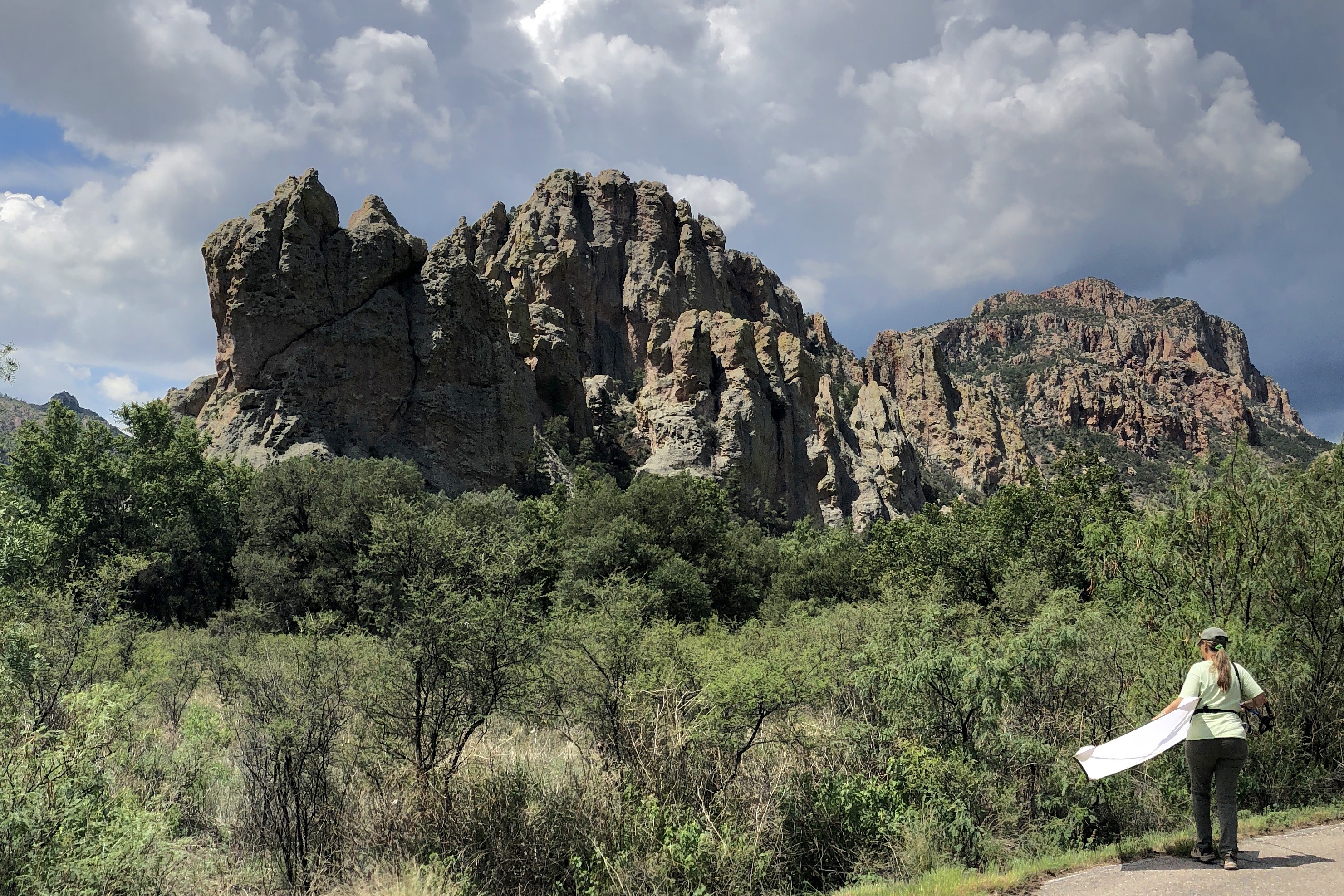
Majestic peaks loom over the canyon.
Blue pleasing fungus beetle (Gibbifer californicus) – family Erotylidae.
Me with Margarethe Brummermann.
Reddish potato beetle (Leptinotarsa rubiginosa) is an uncommon relative of the much more well known (and despised) Colorado potato beetle (L. decemlineata).
Margarethe Brummermann searches for beetles in Sunny Flat Campground.
Bordered patch (Chlosyne lacinia) – family Nymphalidae.
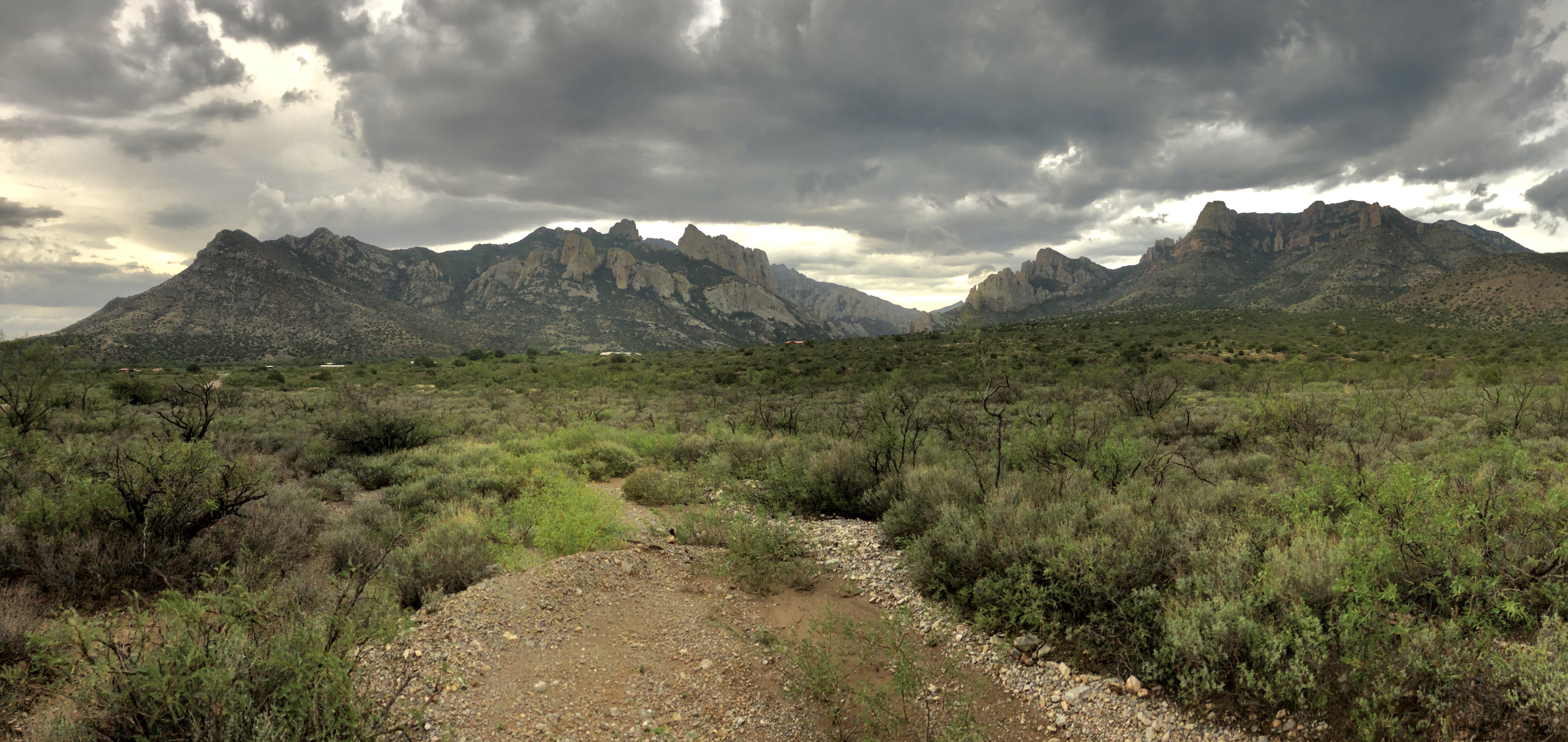
Desert flats east of Portal, Arizona
We came to this spot to look for Sphaerobothris ulkei on joint-fir (Ephedra trifurca), but after not finding any for awhile I got distracted by some big buprestids flying around. Caught several Hippomelas sphenicus, one Gyascutus caelatus, and two Acmaeodera gibbula on Acacia rigida, and the first and third were also on Prosopis glandulosa along with Plionoma suturalis. We finally found S. ulkei – searched the area for almost three hours, and Art and I each caught two and Margarethe caught one – also one each of P. suturalis and A. gibbula. I also got a mating pair of A. gibbula on Acacia greggii. After dinner, we went back and placed an ultraviolet light – checked it a couple hours later and got a nice series of Cylindera lemniscata and a few meloids (for Jeff).
Art Evans photographing Hippomelas planicauda in the ‘studio’ afterwards.
Sphaerobothris ulkei, collected on Ephedra trifurca.
Day 1 of the trip ended in typical monsoon fashion – heavy, thunderous rainstorms moved into the area during late afternoon, dimming prospects for blacklighting. Still, we set them up anyway at several spots and checked them later in the evening (flood waters preventing us from going to all the spots we wanted to). Not surprisingly, the one trap that yielded interesting specimens was in the lowest (warmest) area and received the least amount of rain. For me it was a nice series of Cylindera lemniscata.
Day 2 – Southwestern Research Station, Chiricahua Mountains, Arizona
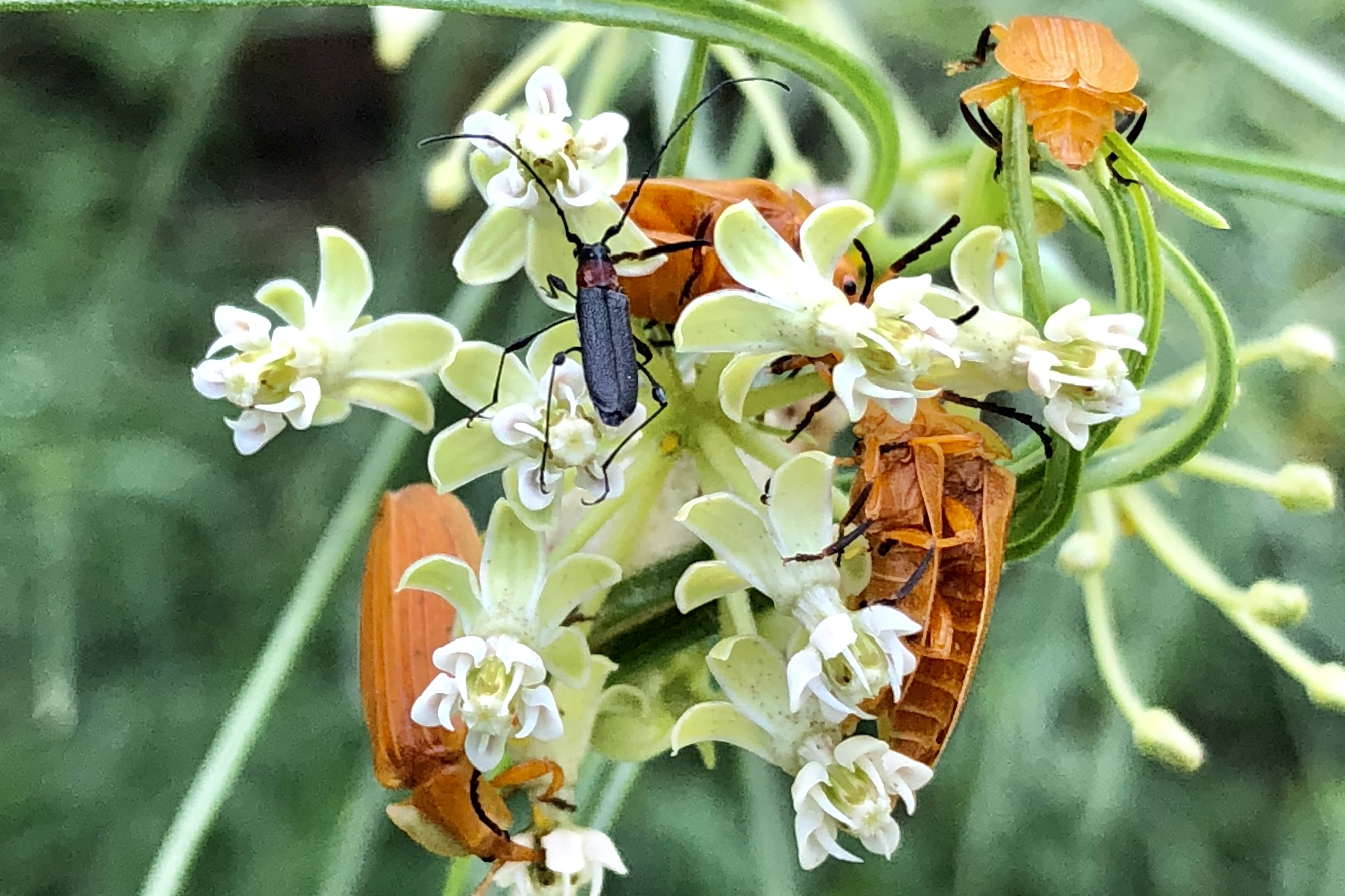
There is a large stand of a narrow-leaved milkweed (Asclepias sp.) at the station, so we stopped by in our way up the mountain to check it for beetles. Got a nice little series of Tetraopes discoideus (tiny little guys!) on the stems as well as a few Rhopalophora meeskei, two Lycus spp., and one Pelonides humeralis on the flowers.
Tetraopes discoideus (family Cerambycidae).
Rhopalophora meeskei and Lycus sp. on Asclepias sp.
At the Southwestern Research Station with Barbara Roth, Art Evans, and Margarethe Brummermann.
Road from Southwestern Research Station to Ruster Park After leaving the SWRS on our way up to Rustler Park, we stopped to check a couple of bushes of New Mexico raspberry (Rubus neomexicanus). Margarethe thought there might be lepturines on the flowers, but instead we found a few Acmaeodera spp. and some Rhopalophora meeskei.
New Mexico raspberry (Rubus neomexicanus).
Further up the road we made another quick stop to check roadside flowers – just a single A. rubronotata on a yellow-flowered composite, but spectacular views of the valley below.
Looking west from the Chiricahua Mountains, Arizona.
Gayle Nelson once told me about finding Chrysobothris chiricahuae on pine slash at Rustler Park, so I was pleased to see several fresh slash piles when we arrived. I saw a Chrysobothris (presumably this species) on the very first branch in the very first pile that I looked at, but I missed it (damn!) and didn’t see any more in that pile. However, in the next pile I visited I saw two and got them both. I looked at a third pile and didn’t see any, nor did I see any more on the two previous piles that I looked at. Still, two is better than none (assuming this is, indeed, what they are!).
Rustler Park, Chiricahua Mountains, Arizona.
Chiricahua National Monument
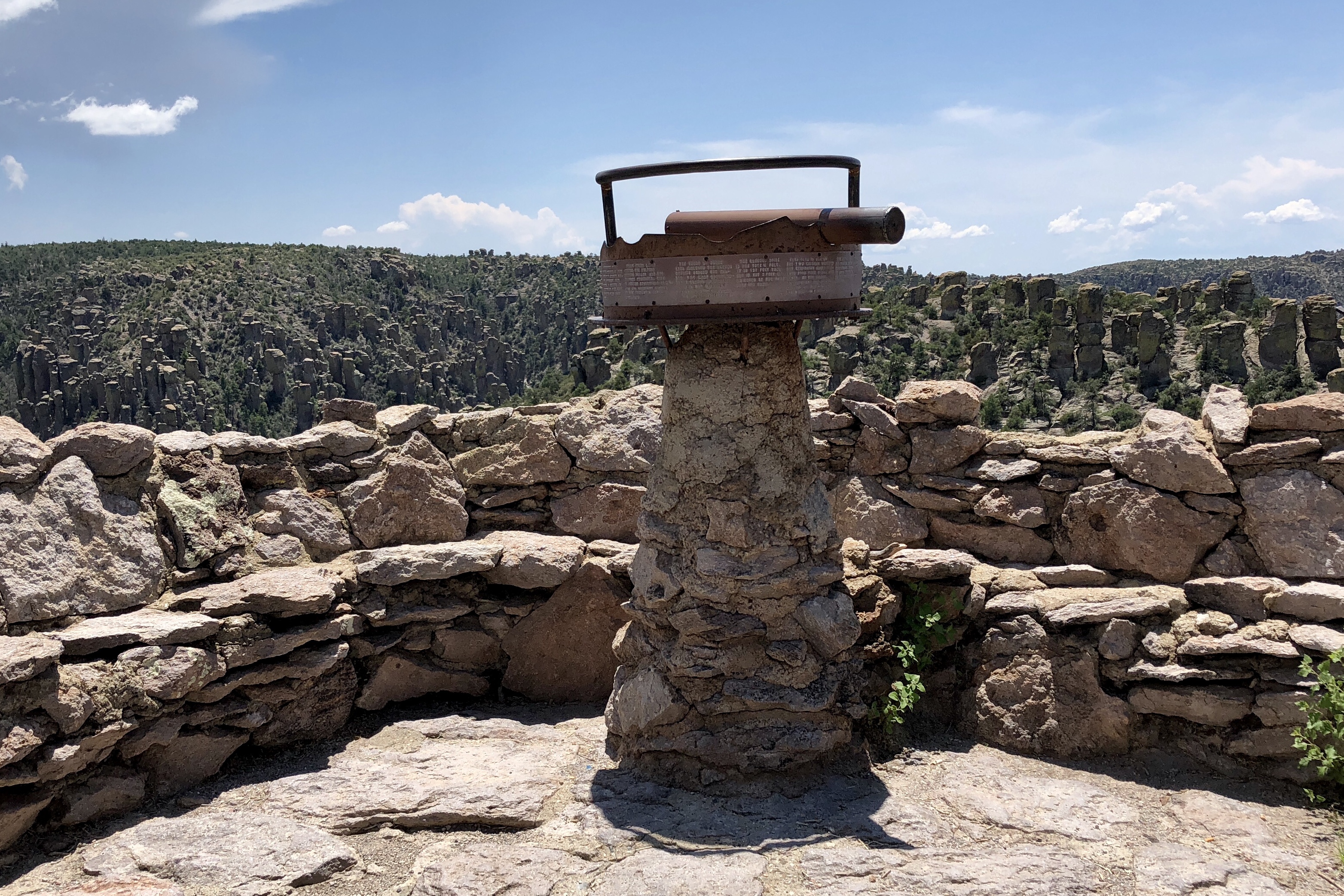
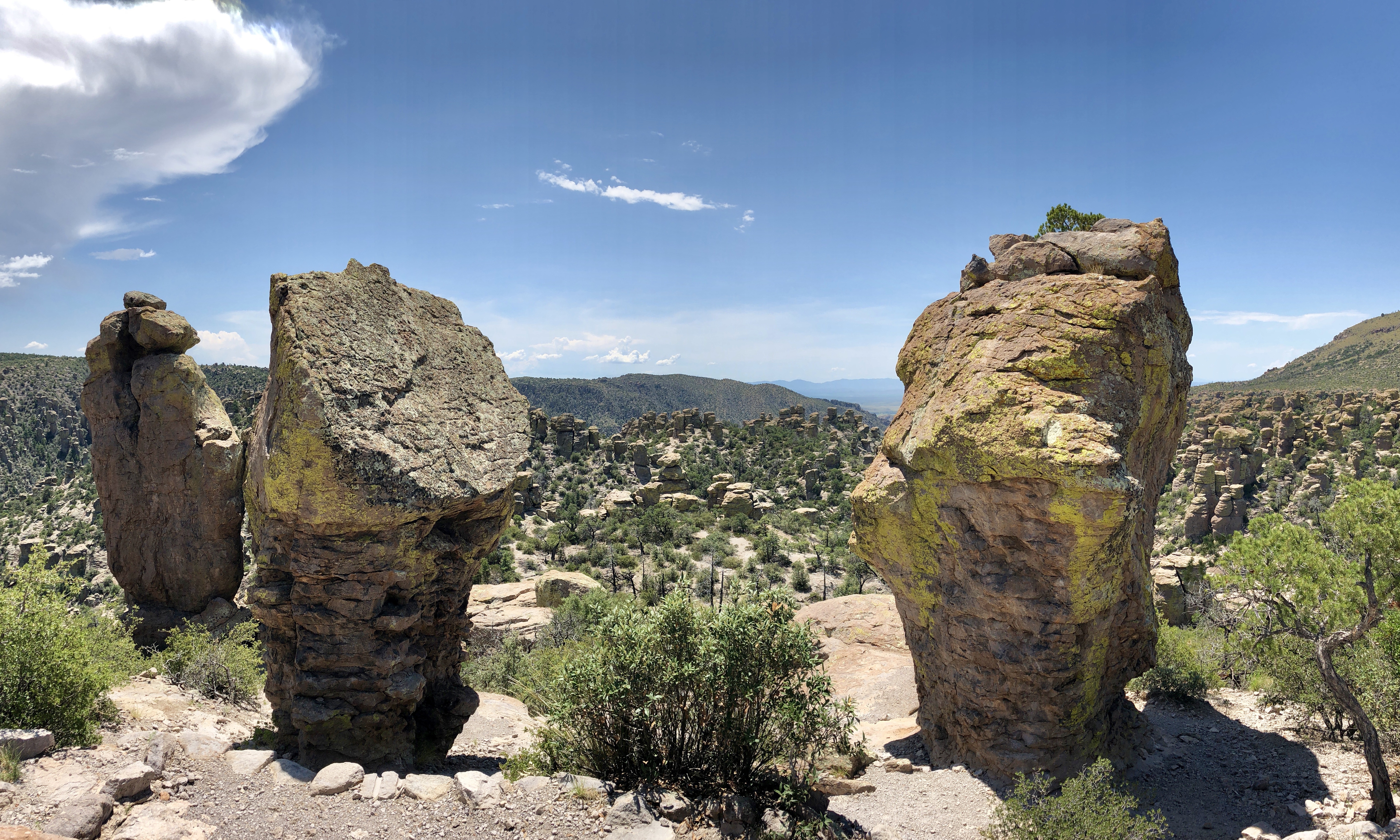
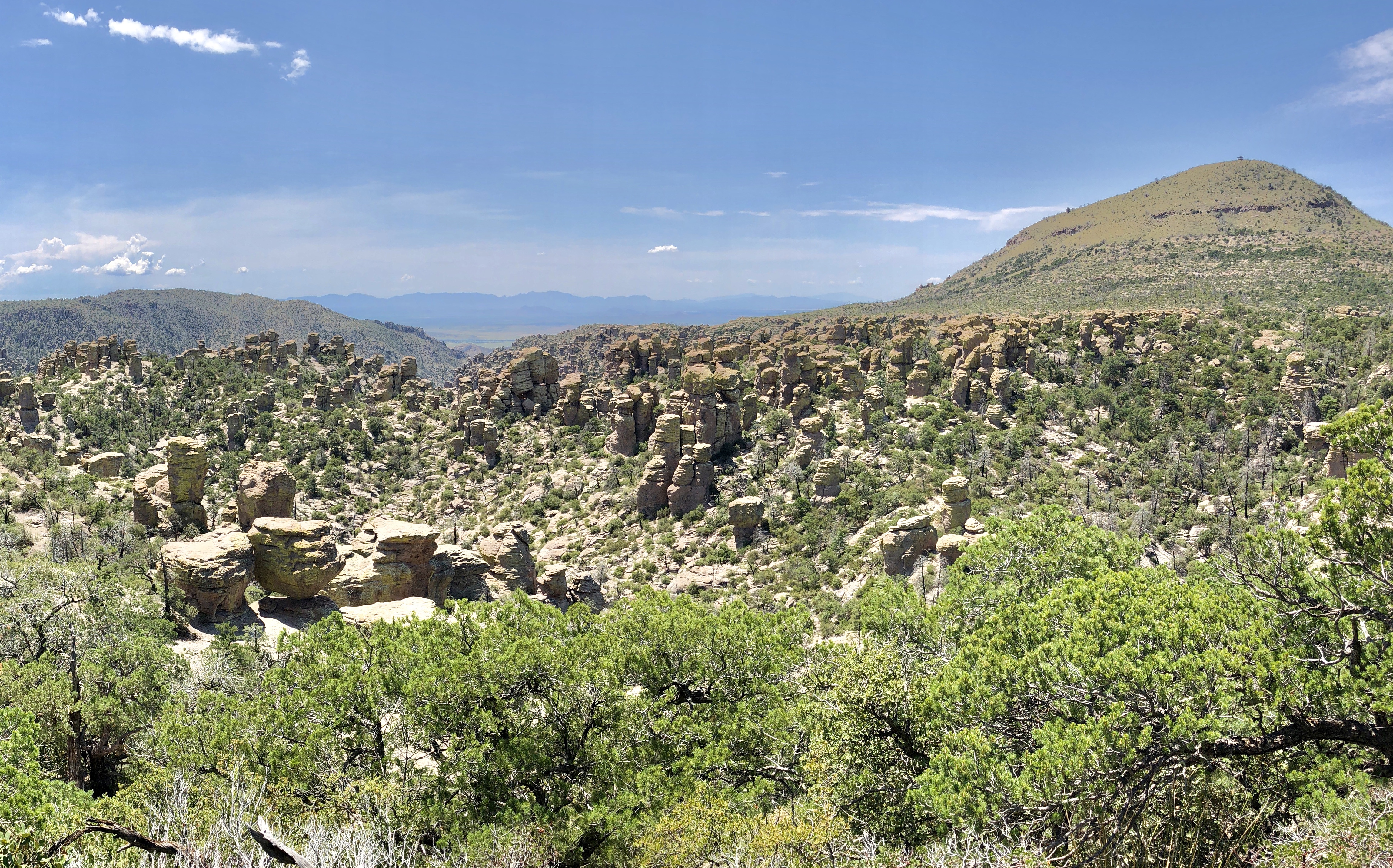
Not a bug collecting stop, but we wanted to drive into the monument and see the incredible rock formations which are best appreciated by driving through Bonita Canyon and then up to Massai Point. The unusual spires, columns, and balancing rocks are a result of erosion through vertical cracks in the compressed volcanic ash which was laid down in layers 25 million years ago and then uplifted. Tilting during uplift caused vertical fractures and slippage, into which water then worked its way to create today’s formations. One of the columns I saw is 143 feet tall and only 3 feet in diameter at one point near the base! Mexican jays were our constant, close companions as we hiked through the pinyon pine/oak/juniper woodland.
Vicinity Gleeson, Arizona
There is a wash across N Ghosttown Trail with stands of Baccharis sarothroides growing along the sides. Art previously collected a single Cotinis impia on one of the plants, so we came back to check them. We didn’t find any, but we did find two fine males and one female Trachyderes mandibularis on a couple of the plants. I also found a dead Polycestaaruensis.
Vicinity Tombstone, Arizona
Art saw Gyascutus caelatus here previously, so we came back and found them abundantly in sweet acacia (Acacia rigidula), which was in full bloom. They were extremely flighty and hard to catch, so we each got only four. I also collected one Stenaspis solitaria on the same and a Trachyderes mandibularis female in flight.
Trachyderes mandibularis female
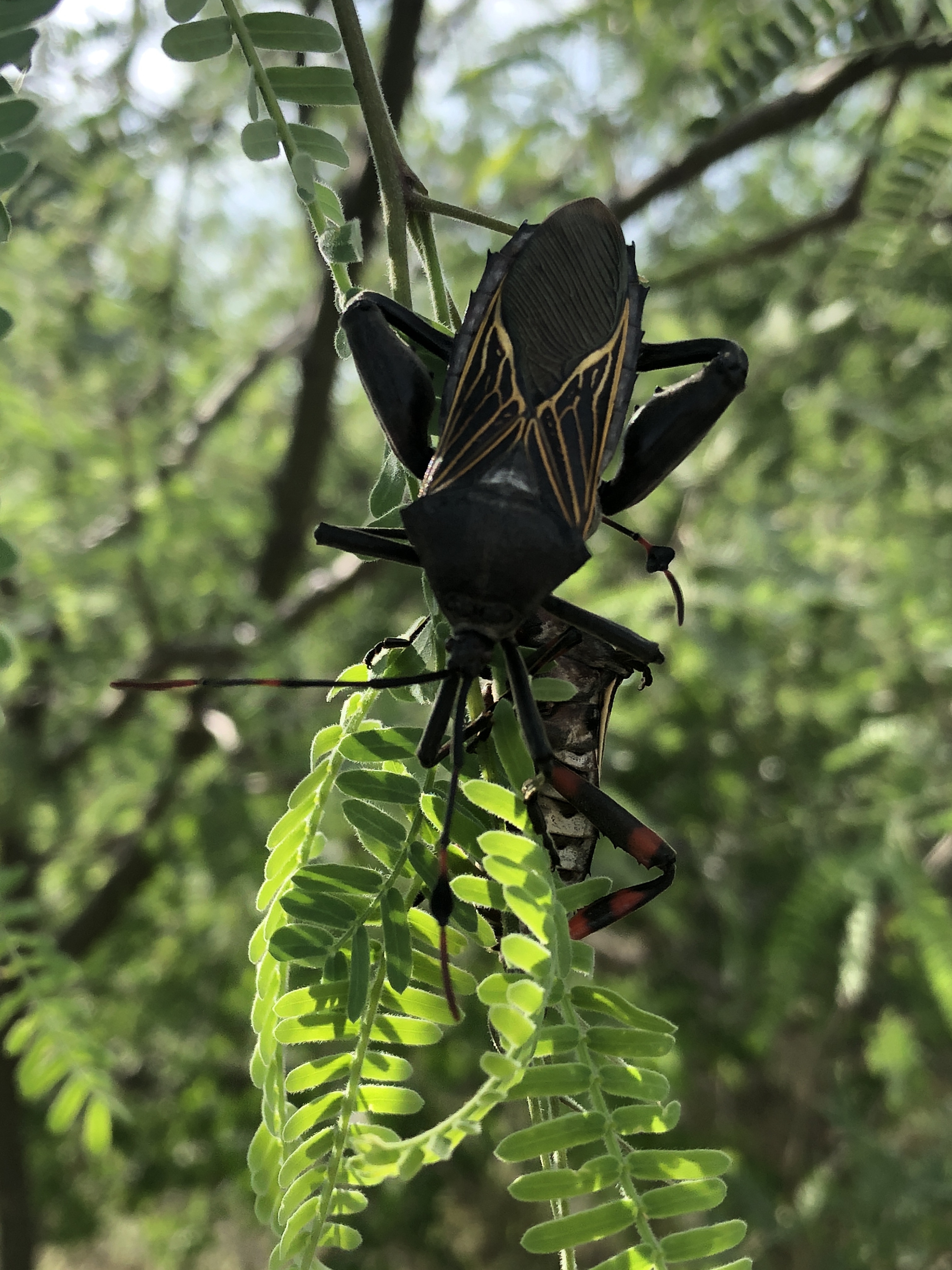
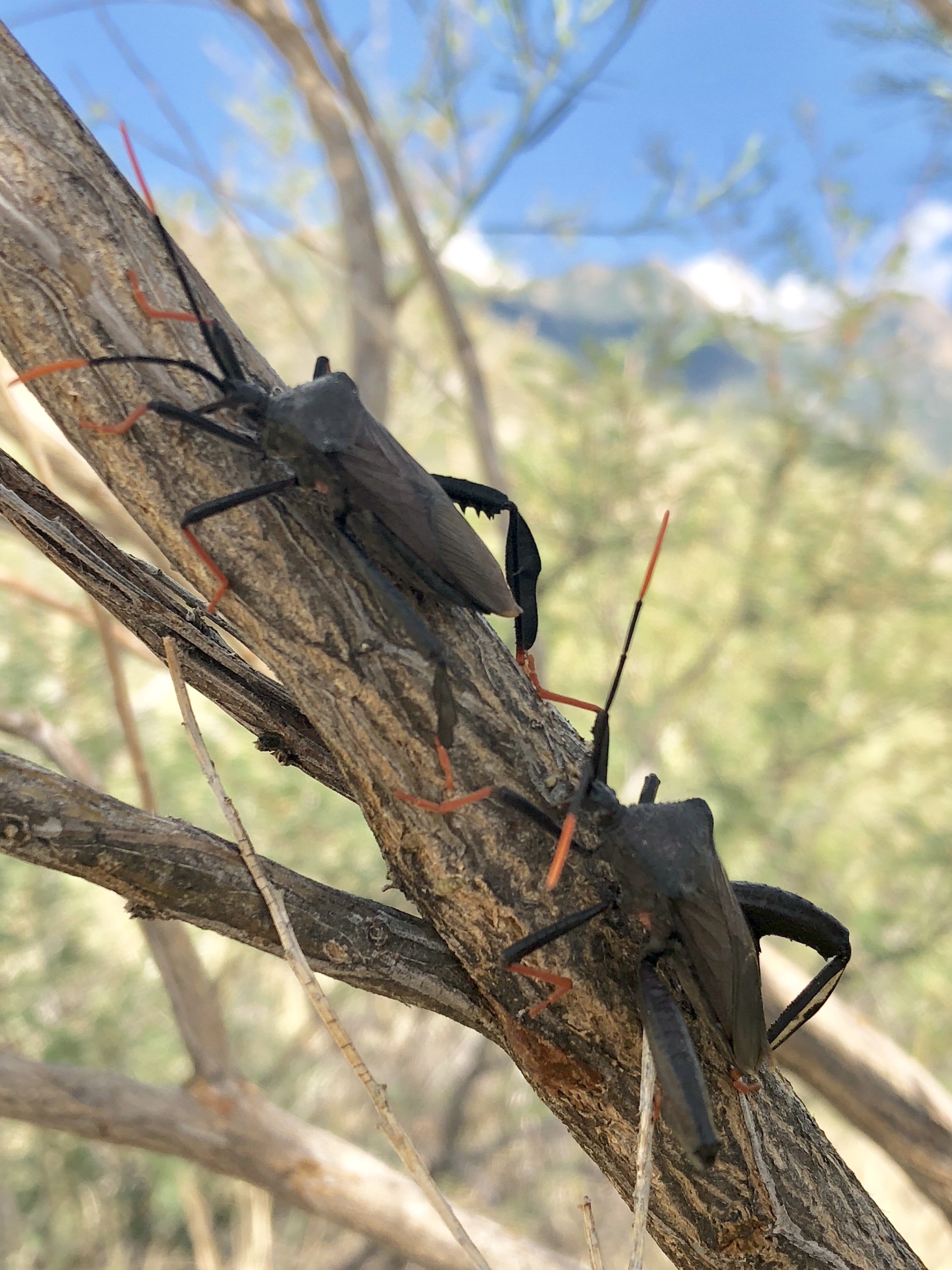
At another spot nearby, we stopped to look for Lampetus webbii, which Art had seen but not been able to collect when he was here a couple of weeks ago. We did not see any (but read on…), and I saw but did not collect a Trachyderes mandibularis and two Stenaspis solitaria. I also saw and photographed some giant mesquite bugs (Thasus neocalifornicus).
Giant mesquite bugs (Thasus neocalifornicus).
Note the heavily armed and thickened hind legs of the male (L) versus the more slender and red/black banded hind legs of the female (R).
Not sure of the ID (other than ‘DYC’ – damned yellow composite).
The day ended enjoying steaks, Malbec, and Jameson with two of the best hosts ever!
Day 3 – Box Canyon, Santa Rita Mountains, Arizona
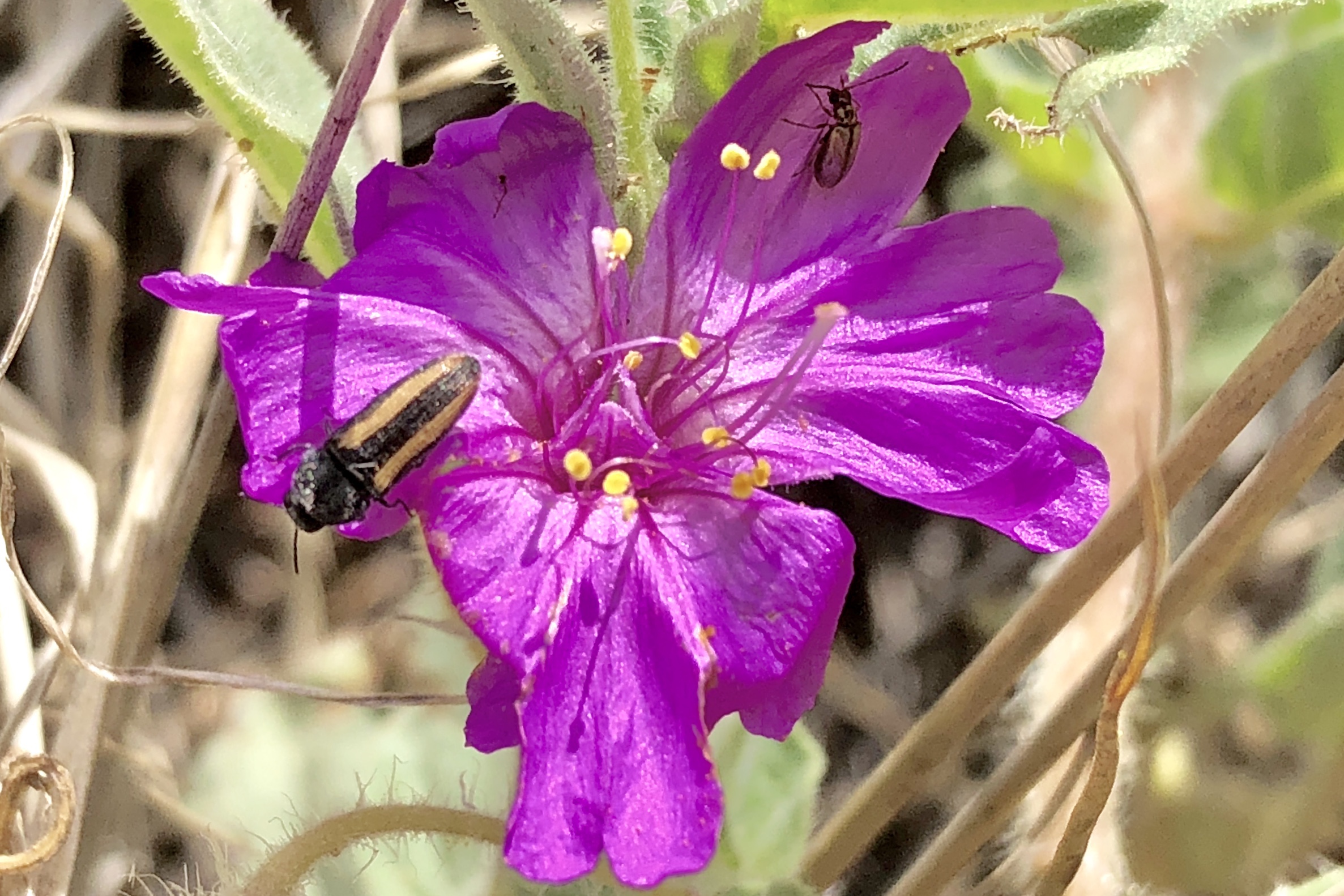
Our first stop of the day was Box Canyon, a gorgeous, rugged canyon on the east side of the range. Mimosa dysocarpa was in bloom, off which I beat two Agrilus aeneocephalus, several Hippomelas planicauda, and one Stenaspis solitaria. Norm gave me an Acmaeodera cazieri that he’d collected on an unidentified yellow-flowered composite, and right afterwards I found some small, low-growing plants with purple flowers and sticky leaves (eventually ID’d as Allionia incarnata, or trailing four o’clock) to which Acmaeodera yuccavora and A. cazieri were flying in numbers. After that I crawled up top and beat the mesquites, getting one Chrysobothris sp., a mating pair of S. solitaria, and a couple of large clytrine leaf beetles.
Box Canyon from just above the dry falls. Prickly poppy (Argemone mexicana) blooming along the roadside.
Hippomelas planicauda mating pair on Mimosa dysocarpa.
Allionia incarnata, flower host for Acmaeodera cazieri and Acm. yuccavora.
Acmaeodera cazieri (left-center).
Acmaeodera yuccavora.
Lubber grasshopper (Taenipoda eques). The striking coloration warns potential predators that it is chemically protected.
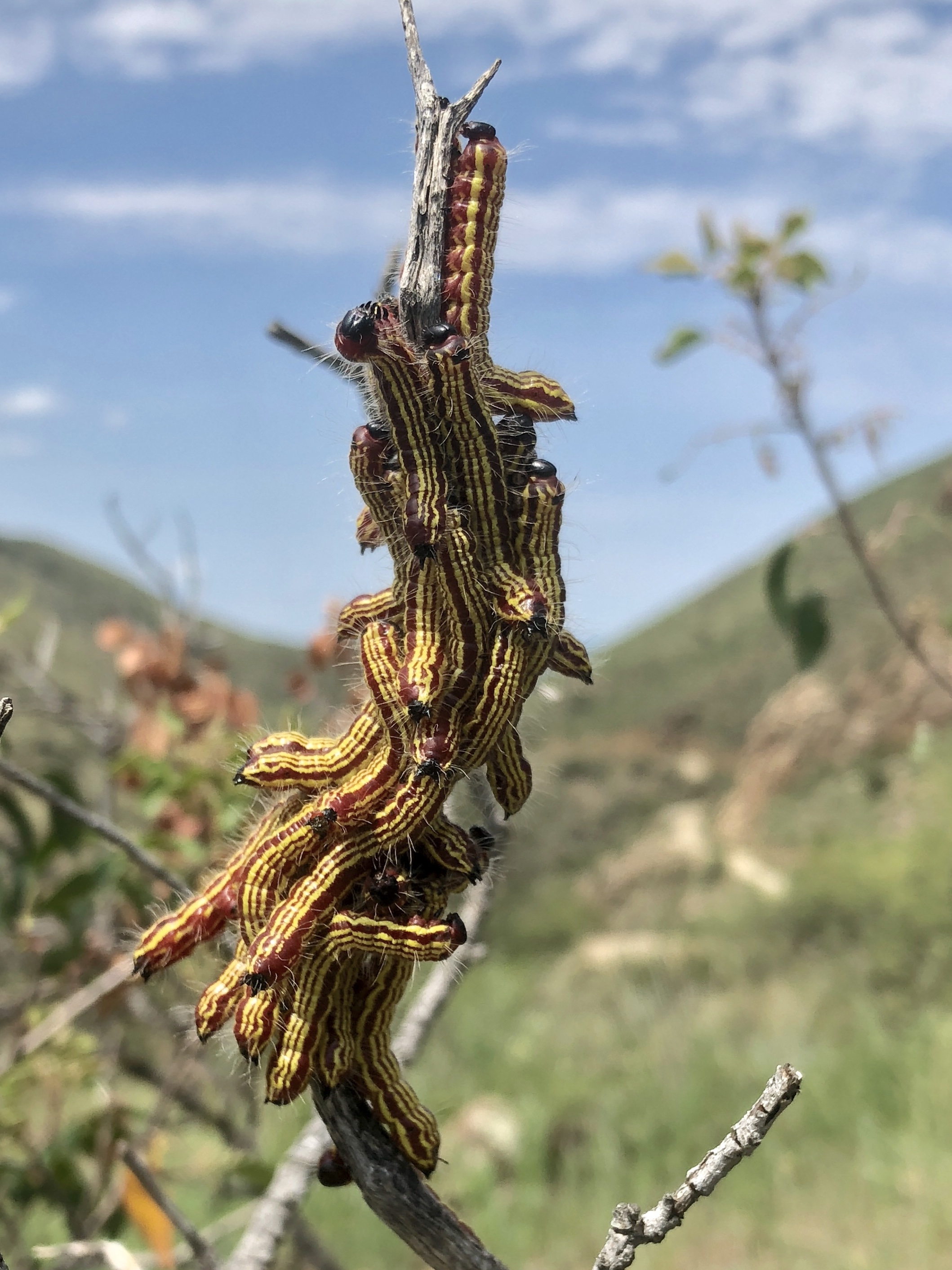
Datana sp. caterpillars.
Vicinity Duquesne, Arizona
We came here to look for Tetraopes skillmani (this is the type locality). We found the host plant (Sarcostemma sp.), but there were no beetles to be seen anywhere. Maybe another location nearby…
Sarcostemma sp. (family Asclepiadaceae).
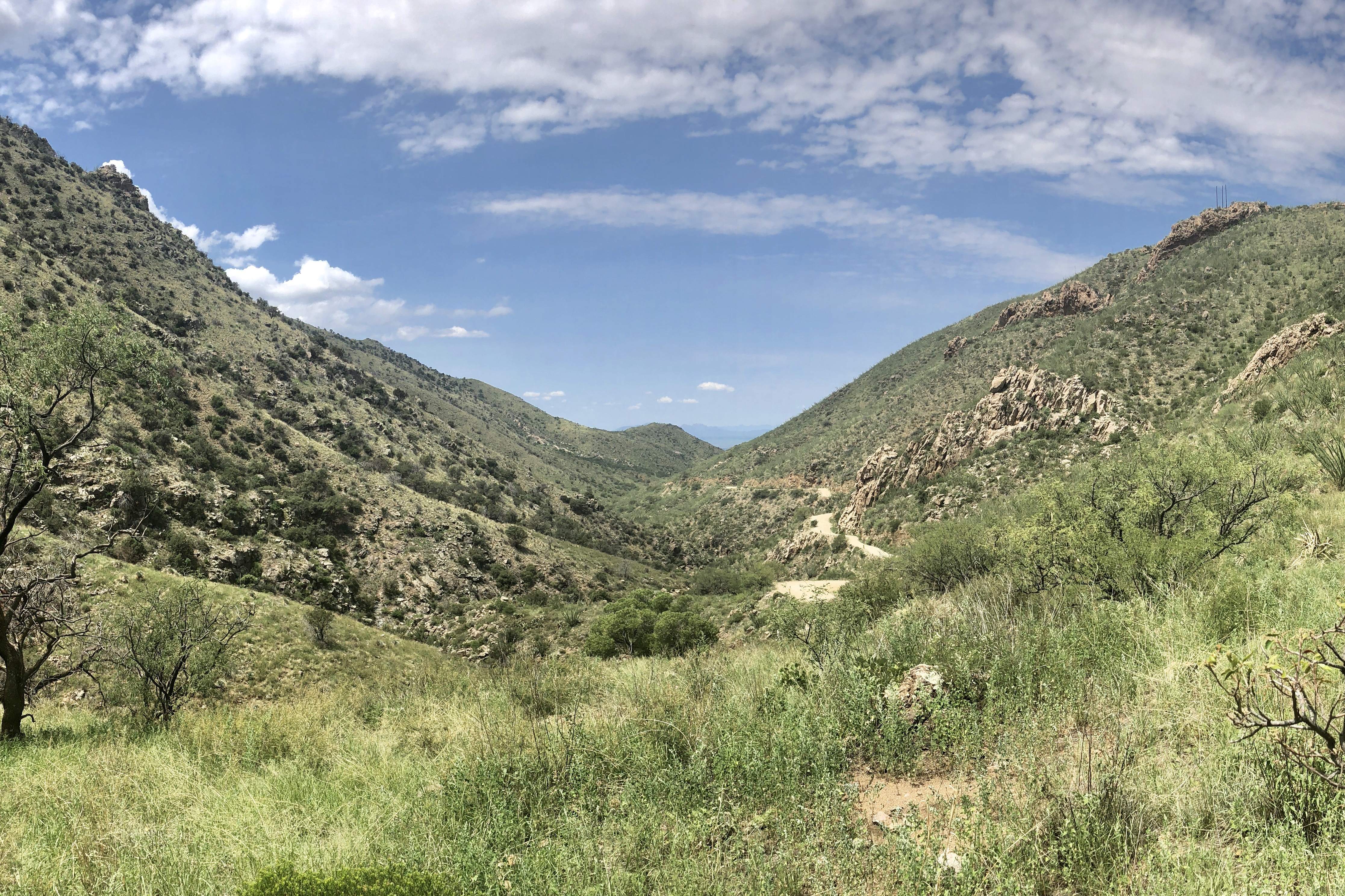
Patagonia Pass, Patagonia Mountains, Arizona We went up higher into the mountains to get into the oak woodland, where I hoped to find some of the harder-to-collect oak-associated Agrilus spp. Right away I beat one Agrilus restrictus off of Emory oak (Quercus emoryi), but no amount of beating produced anything more than a single Enoclerus sp.. I also beat the Arizona oak (Q. arizonica) and got only a single Macrosaigon sp. On Desmodium sp. I collected not only Pachyschelus secedens but a nice series of Agrilus arizonicus. For me it is the first time I’ve collected either A. restrictus and A. arizonicus, the former being quite uncommon as well, so all-in-all not a bad stop.
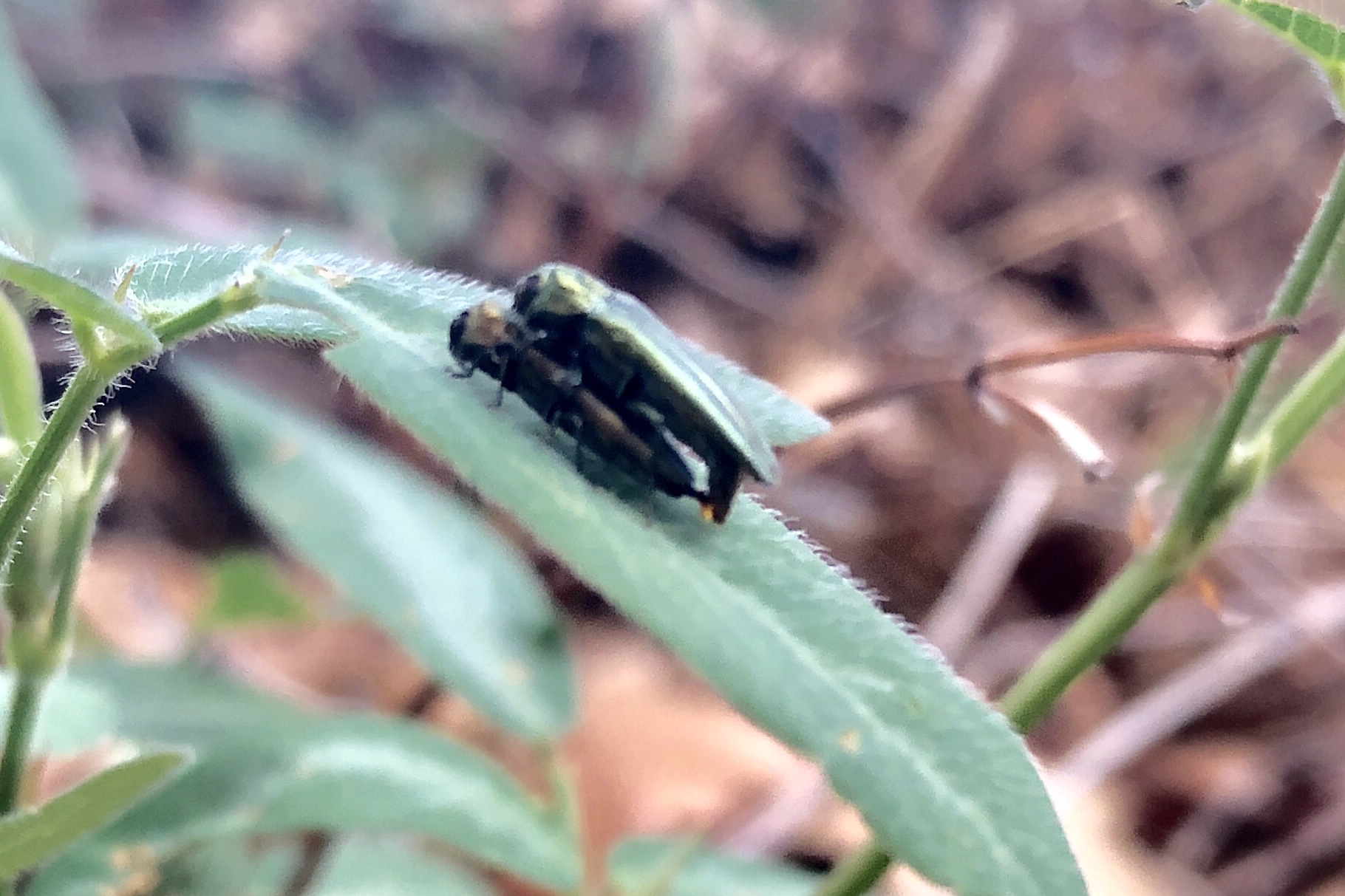
Agrilus arizonicus mating pair – the males are brighter green than the females, which are more coppery.
Unidentified plant.
Me, Art Evans, and Norm Woodley.
Sycamore Canyon, Santa Cruz Mountains, Arizona
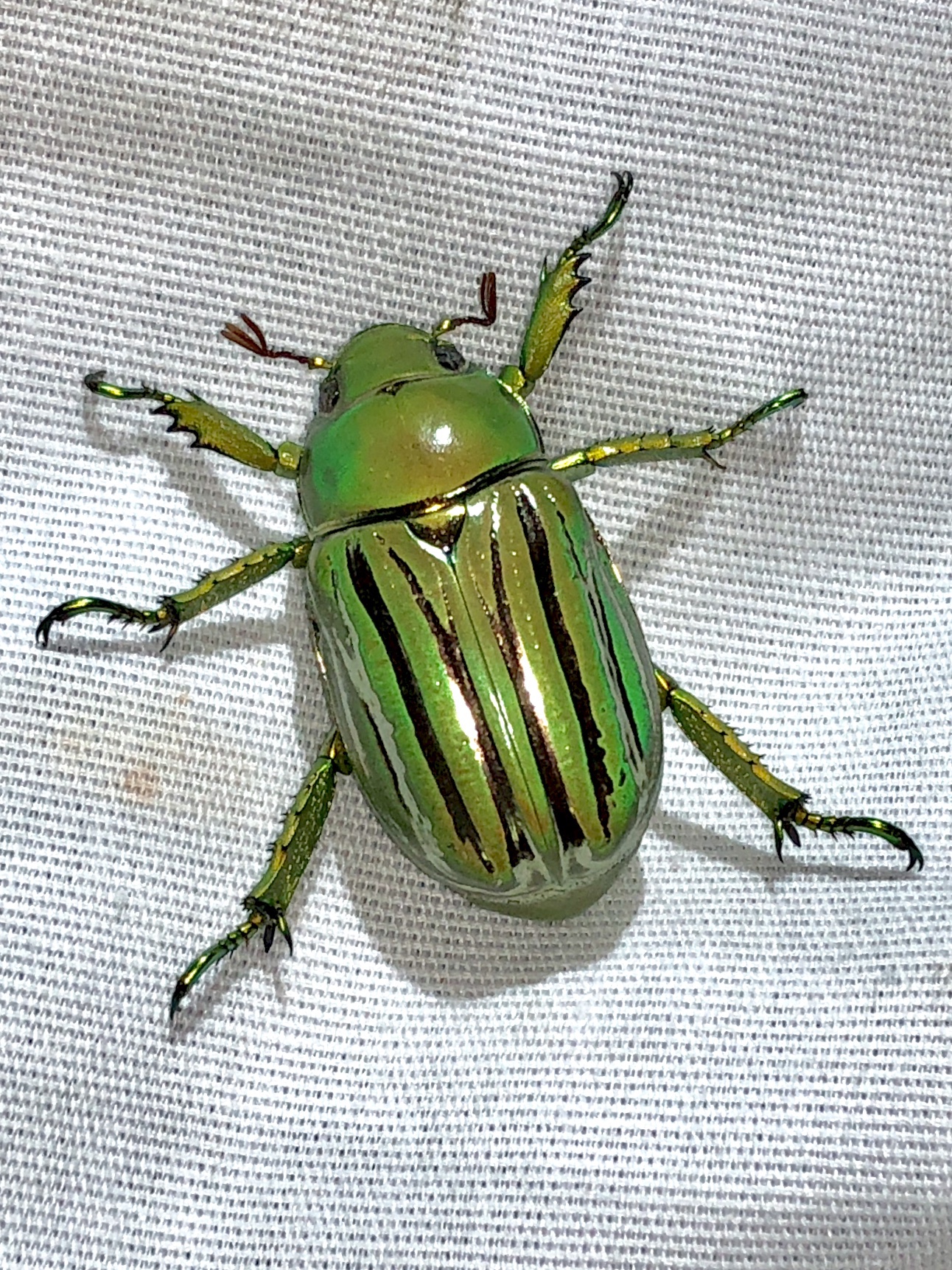
We came here for night lighting, but while we still had light I did some sweeping in the low vegetation and collected a mixed series of Agrilus arizonicus (on Desmodium sp.) and Agrilus pulchellus – the latter a first for me, along with two small cerambyids that could be Anopliomorpha rinconia. Conditions were perfect (warm, humid, and no moon), and we had lots of lights (Art’s five LED units, Steve’s MV/UV combo setup, and my UV setup), but longhorned beetles were scarce – just one Prionus heroicus and one Lepturges sp. for me, and Steve got a few others including a nice Aegomorphus sp. I did also collect a few scarabs – Chrysina gloriosa and Strategus alous – because they’re just so irresistible!
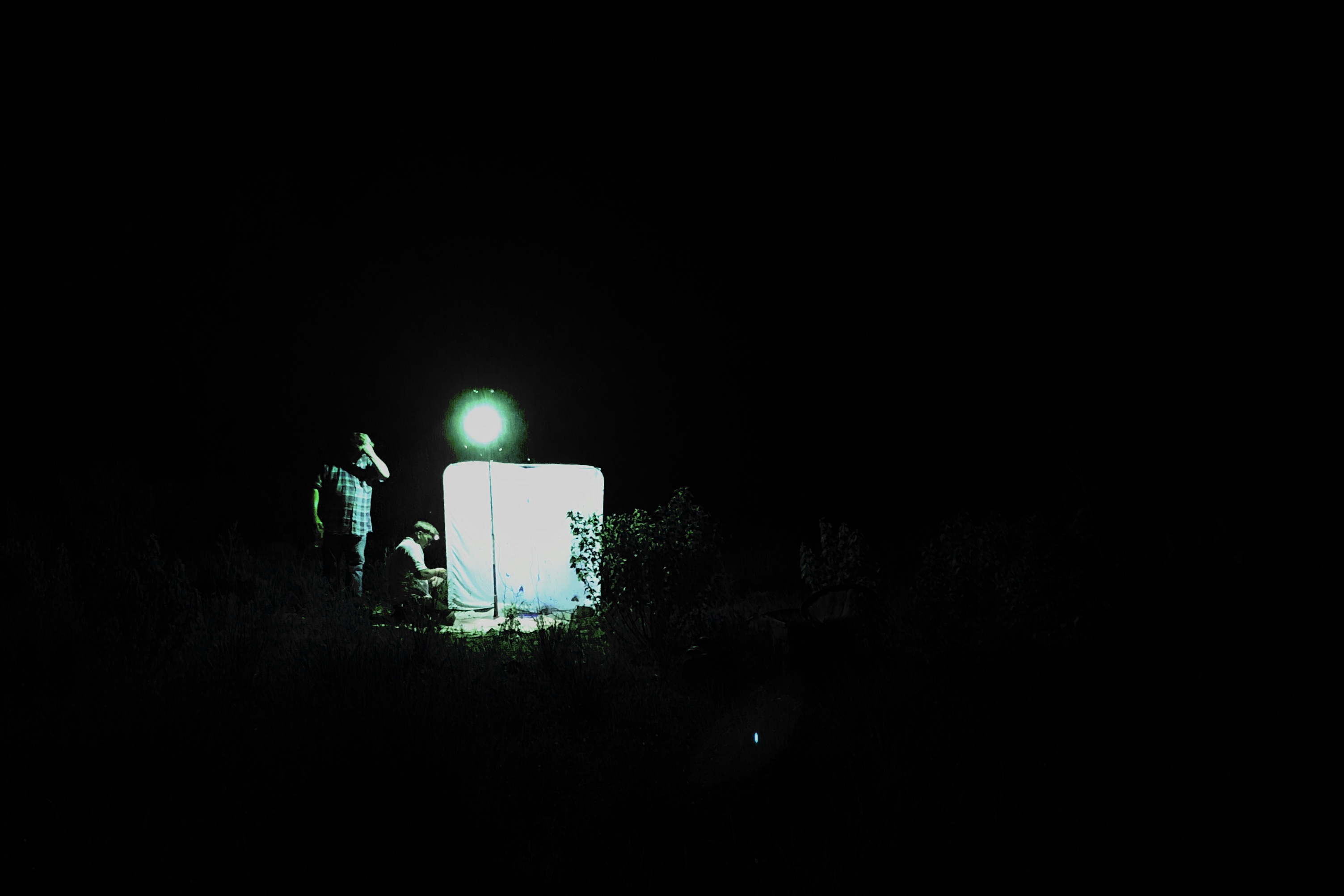
A beacon in the night!
Art, Steve, and Norm checking the lights.
Chrysina gloriosa.
A male oz beetle (Strategus aloeus).
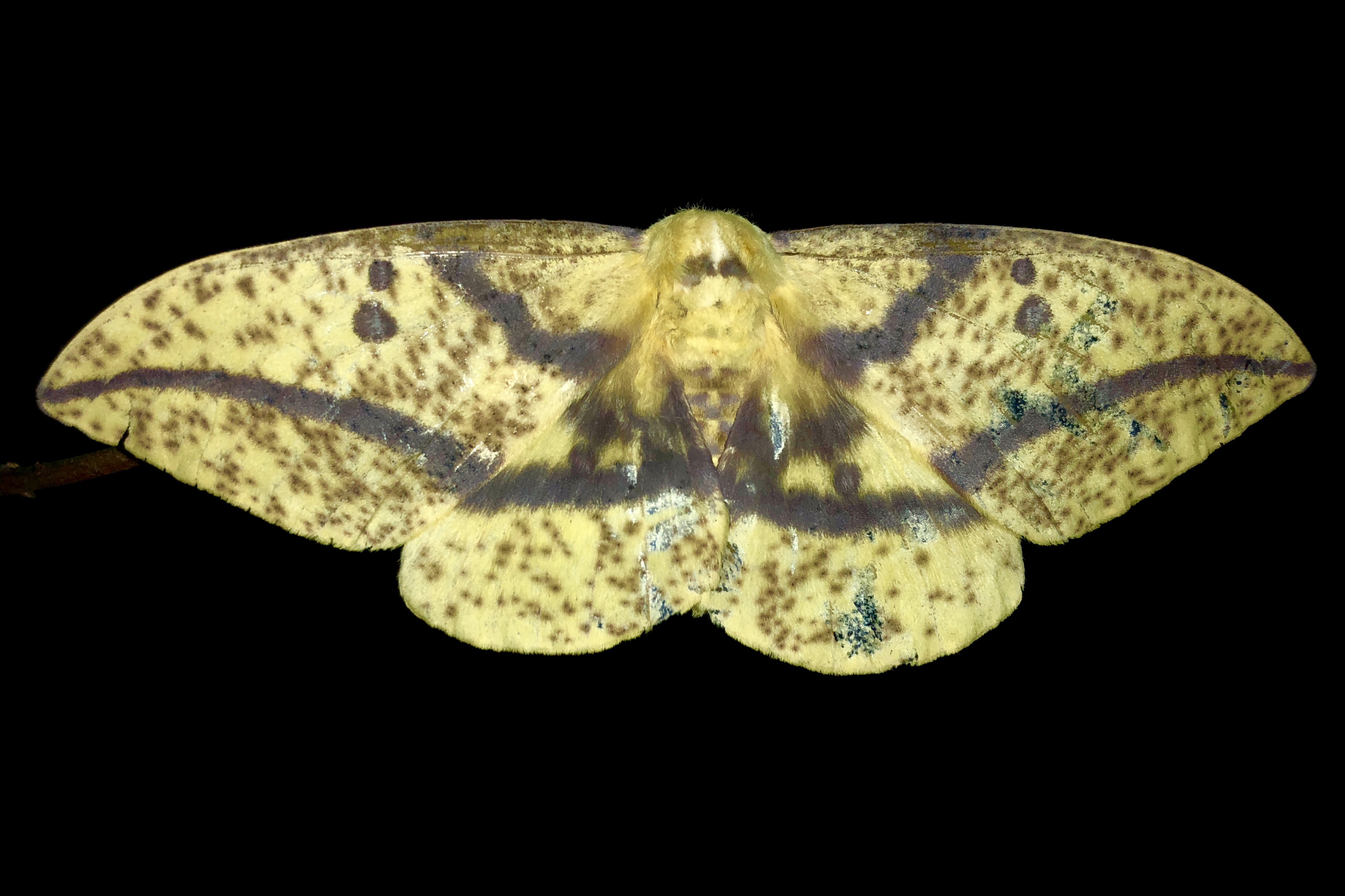
Eacles oslari is a western U.S. relative of the imperial moth (E. imperialis).
Insects whirring around my head!
Day 4 – Prologue One of the downsides (if you can call it that) of having great collecting is the need to take periodic “breaks” to process all the specimens and make my field containers available for even more specimens. Thanks to Steve and Norm for making their place available to Art and I so we can do this before heading out to our next set of localities.
Copper Canyon, Huachuca Mountains, Arizona
Copper Canyon is the classic spot for finding the charismatic Agrilus cavatus (see photo), but first we did some sweeping in the low vegetation near the parking area, where Norm got one Agrilus arizonicus and two Agrilus latifrons – and gave them to me! (Thanks, Norm!) I did some beating of the oaks, and after much work I ended up with a single Agrilaxia sp. and pogonocherine cerambycid on Emory oak (Quercus emoryi) and a couple of giant clytrines on the Arizona oak (Q. arizonicus). I then started sweeping the low-growing Acaciella angustissima – right away I got two A. cavatus. They were in the area past the cattle guard on the right where lots of dead stems were sticking up, and although I continued to sweep the plants more broadly in the area I never saw another one. Finally, Norm called me up to a small Mimosa dysocarpa near the car off which he collected three Agrilus elenorae – and gave them to me! (Thanks, Norm!) I gave the tree a tap and got one more, and in my last round of sweeping I came up with a Taphrocerus sp. (must be some sedges growing amongst the grasses).
Copper Canyon to the northwest.
Copper Canyon to the north.
Agrilus cavatus on its host plant, prairie acacia (Acaciella angustissima).
Robber fly (family Asilidae) with prey (a ladybird beetle).
Bear Canyon Crossing, Huachuca Mountains, Arizona
There was quite a bit of Mimosa dysocarpa in bloom along the roadsides on the west side of the Bear Canyon crossing, which I beat hoping to find some more Agrilus elenorae. I didn’t find any, but I did get several more Hippomelas planicauda, which is a nice consolation prize – and a great photo of the last one! Other than that I did a lot of sweeping and found only a single Acmaeodera cazieri.
Bear Canyon to the south.
Bear Canyon to the north.
Hippomelas planicauda on one of its hosts, velvetpod mimosa (Mimosa dysocarpa).
Appleton-Whittell Research Ranch of the National Audubon Society, Elgin, Arizona
Cool temperatures and a blustery wind discouraged most insects from finding our blacklights. However, our blacklight did find some other interesting local residents. These two individuals could be the stripe-tailed scorpion, Paravaejovis (Hoffmannius) spinigerus, a common species in Arizona and southwestern New Mexico.
Day 5 – Miller Canyon Recreation Area, Huachuca Mountains, Arizona
There was a lot of Baccharis sarothroides growing in the lower canyon near the parking area, so I checked it all out hoping to find Tragidion annulatum. None were seen, and in fact there was very little insect life in general. I did pick up a couple of Acmaeodera solitaria by sweeping – not anything significant but the 15th species buprestid of the trip and found a dead Cotinis mutabilis, and Art got a nice series of Chalcolepidius click beetles on B. sarothroides and Prosopis glandulosa. Puzzling the lack of insect activity, given how green all the plants were and how fresh the growth looked. I guess we’ll have to look elsewhere.
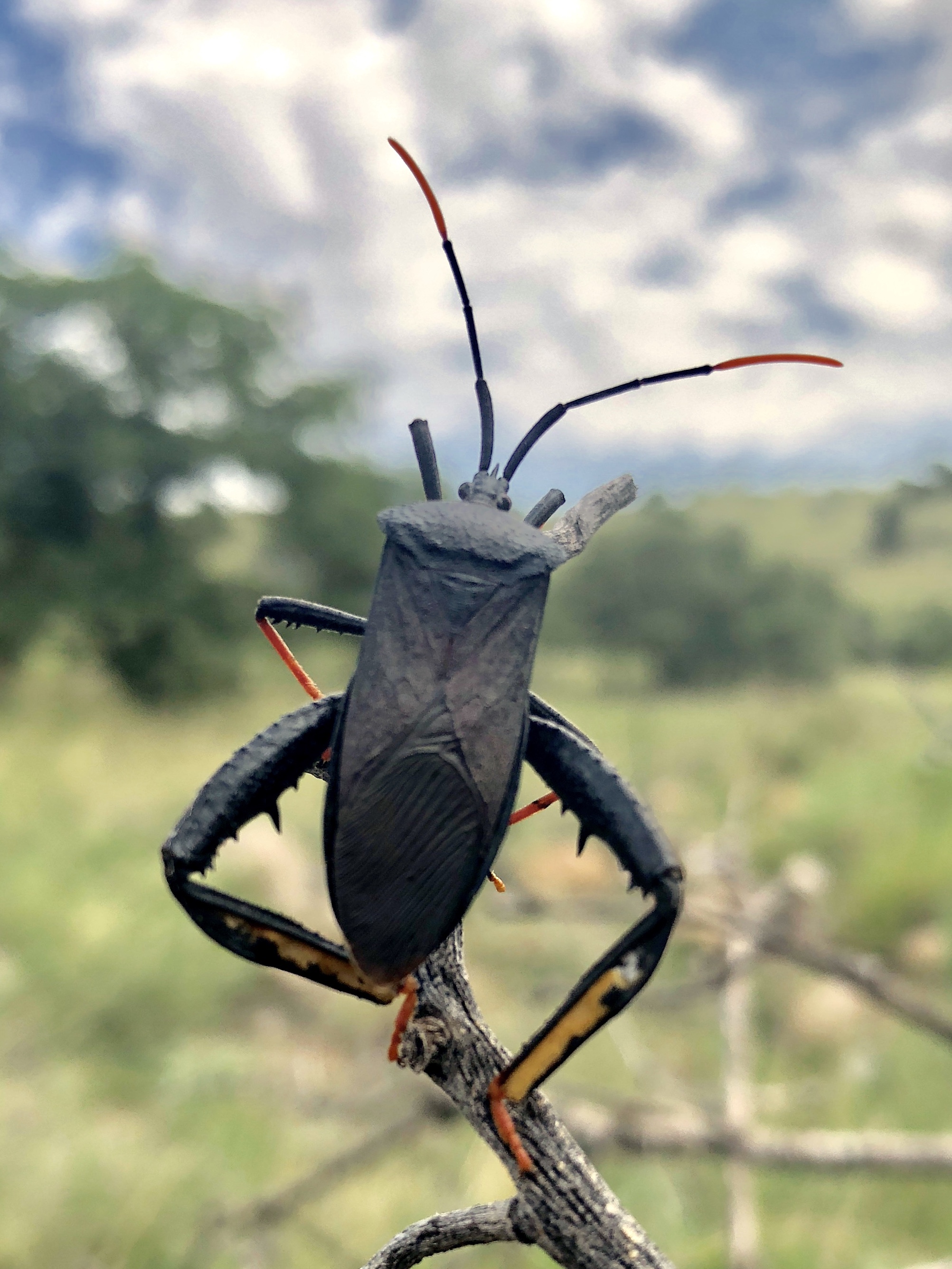
Acanthocephala thomasi, a leaf-footed bug (family Coridae).
I was all lined up for a side shot of the bug when suddenly he took flight.
Turkey vultures hanging out waiting for me to die!
Actually they were all hanging out around a dead cat, some of which I scared up as they were feeding on it.
Vicinity Naco, Arizona
We decided to try some desert thorn-scrub habitat so headed east towards Bisbee. Just north of Naco we saw some habitat where it had rained recently – everything was green with the sweet acacia (Acacia rigidula) and creosote (Larrea tridentata) in full bloom. Immediately out of the car I found a Dendrobias mandibularis on Baccharis sarothroides (and when I came back to it later I found a big, major male on it – see photos). On the sweet acacia we found a handful of Gyascutus caelatus (one of which I got a nice photo of), a mating pair of Sphaenothecus bivittatus, and a Cymatodera sp. Finally, out along the roadsides a riot of different yellow composites were in full bloom, including Heliomeris longifolia off which Art got a couple of Acmaeodera solitaria and I got two specimens of a large Acmaeodera sp. (blue-black with numerous small irregular yellow spots).
Dendrobias mandibularis – major male.
Them’s some mandibles!
Gyascutus caelatus on Acacia rigidula.
A blister beetle (family Meloidae) in the genus Zonitis – either sayi or dunnianus – on Heliomeris longifolia.
Heliomeris longifolia – host flower for both the Zonitis blister beetle and Acmaeodera sp. jewel beetle.
Vicinity Tombstone, Arizona
We decided to go back to the spot north of Tombstone where Art had earlier seen Lampetis webbii and give that species another shot. We looked at the Rhus sp. tree that he’d seen them on, and then we each followed the wash in opposite directions looking at the Rhus trees along them, which growing above the banks but never further away than about 25 feet. Along the way I collected several more Gyascutus caelatus on sweet acacia (Acacia rigida), which were more abundant this time than last and also easier to catch. After walking about 1/4-mile down the wash I saw something fly from a Rhus tree and land low on the bushes nearby. I quickly netted it, pulled it out, and was elated to see that it was, indeed, Lampetis webbii! I searched the Rhus in the area more carefully but didn’t find any more, then found some Rhus growing up along the road. At one point, I saw a large buprestid fly and land high in the top of another Rhus tree. I couldn’t tell for sure if it was L. webbii, but I extended my net as far as I could, positioned it beneath the beetle, and tapped the branch hoping it would fall in. Unfortunately, it flew away instead of dropping, so I can’t say for sure whether it was L. webbii or just a wayward G. caelatus. At any rate, L. webbii is yet another species that I have not collected before now and the 17th buprestid species of the trip.
Lampetis webbii, collected on Rhus sp.
Stenaspis solitaria on Acacia rigidula.
Ramsey Canyon, Huachuca Mountains, Arizona
After returning from Tombstone, we visited Pat & Lisa Sullivan at their home at the end of Ramsey Canyon. Pat is a scarab collector who runs lights at his home nightly, and after a delicious dinner we spent the rest of the evening checking the lights. I was hoping to collect Prionus heroicus, and I got my wish. Also got Prionus californicus and several other non-cerambycid beetles such as Chrysina beyeri, C. gloriosa, Lucanus mazama, and Parabyrsopolis chihuahuae (the latter a first for me). I also placed a prionic acid lure (thanks Steve!) and got three more male P. heroicus. We also hunted around the rocks and roadsides hoping to find Amblycheila baroni but didn’t find any. Art did, however, find a female P. californicus and gave it to me (thanks!).
Meeting Pat Sullivan!
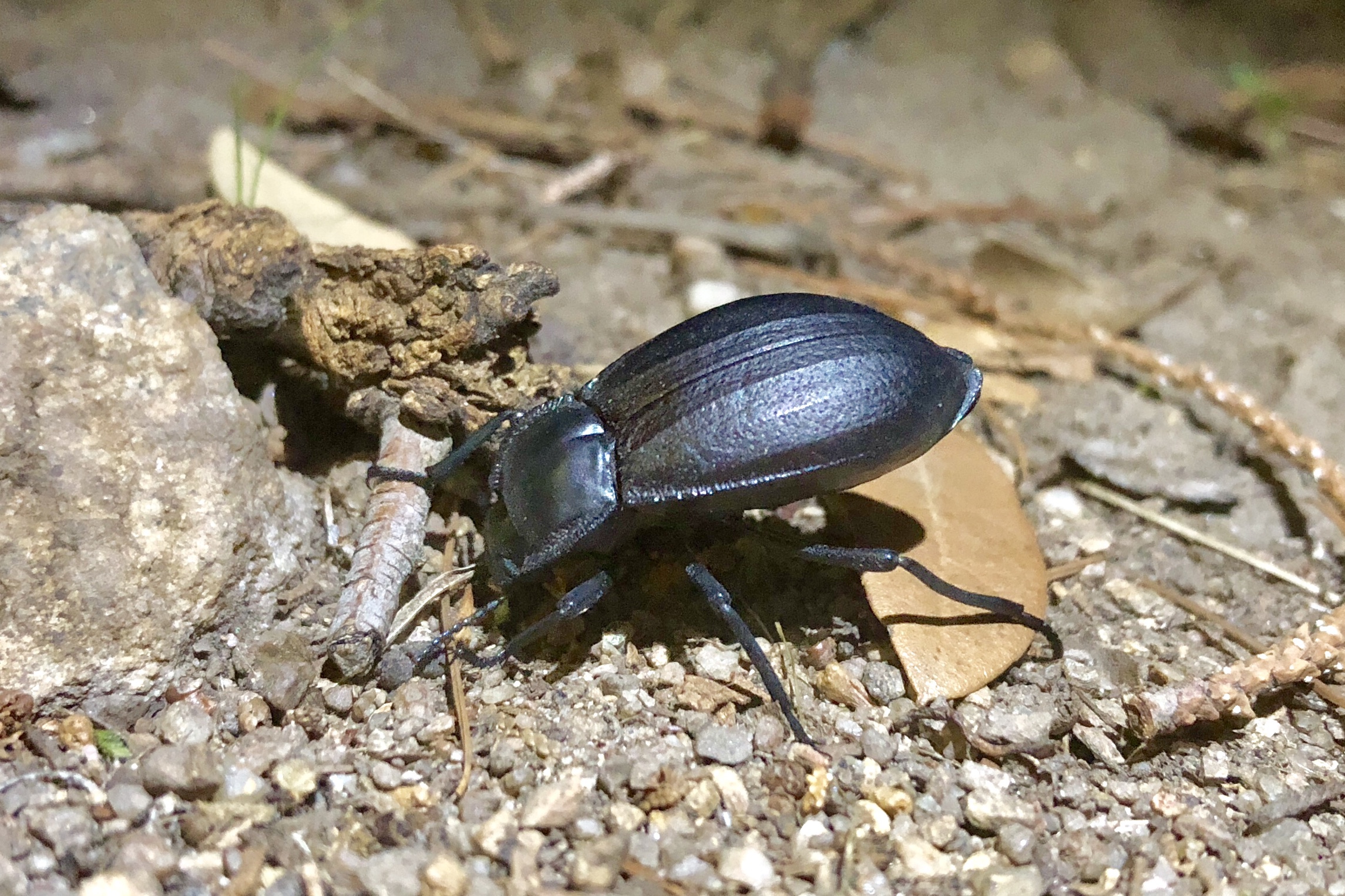
Darkling beetles (family Tenebrionidae) such as this one come out at night to feed on decaying vegetation.
Chrysina beyeri (family Scarabaeidae) is one of three species in the genus occurring in Ramsey Canyon.
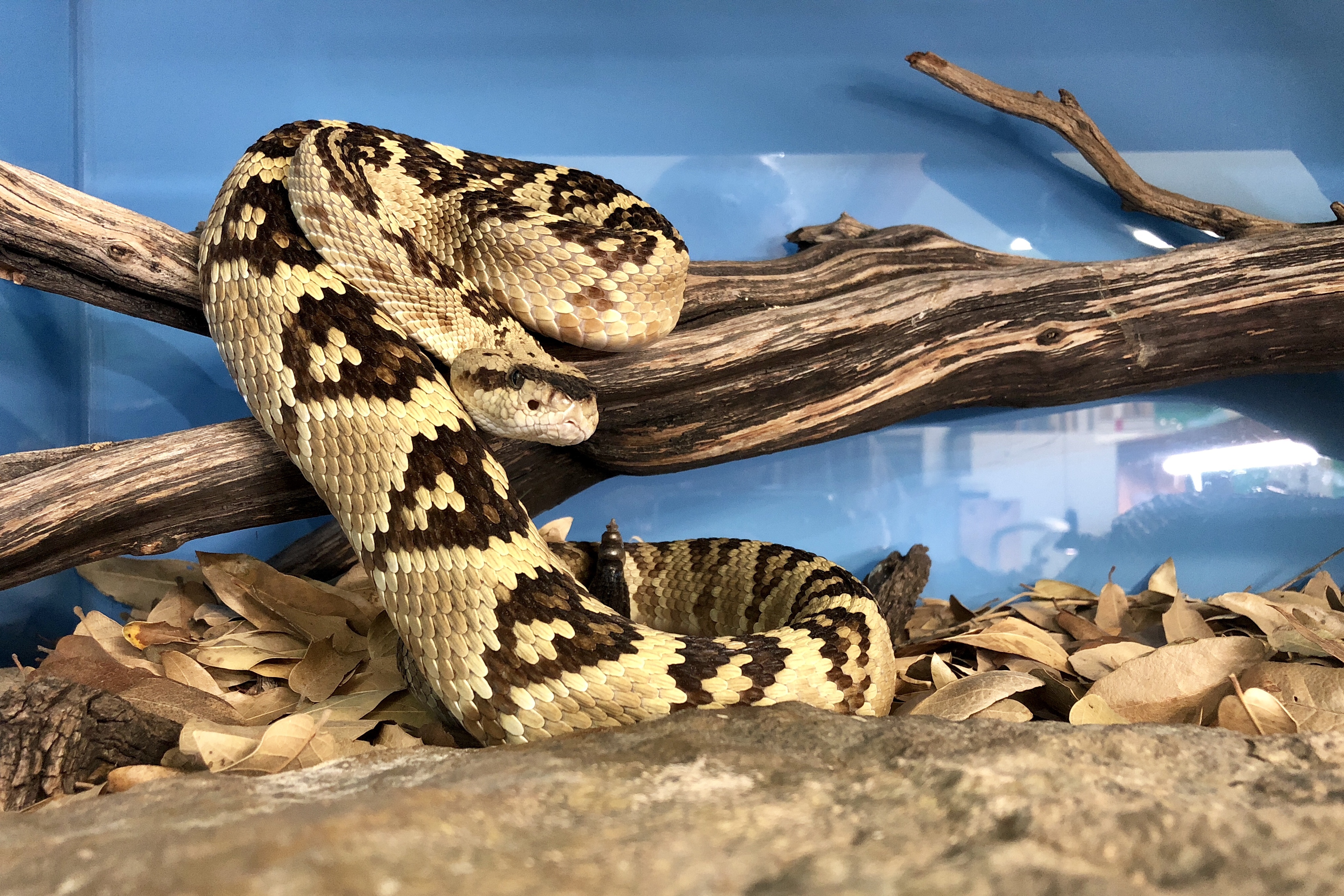
Black-tailed rattlesnake (Crotalus molossus), collected by Pat in Ramsey Canyon.
Sidewinder (Crotalus cerastes lateropens), collected by Pat in Yuma County.
“Sometimes the best collecting is inside!”
Day 6 – Vicinity Sonoita, Arizona
Unsuccessful attempt to collect Hippomelas martini, only recently described (Bellamy & Nelson, 1998) and part of the type series taken somewhere near this spot (“20 mi NE Patagonia, Hwy 82”) by “sweeping roadside vegetation”. At other locations it had been recorded on Calliandra sp., and I found patches of the plant here along and on top of the road cuts. This gives me confidence that I found the right spot, but I didn’t encounter this or any other beetles by sweeping the patches or visually inspecting them.
Box Canyon, Santa Rita Mountains, Arizona
We decided to come back to Box Canyon since we’d had such good luck last time. I started at the spot above the dry falls where I collected so many Acmaeodera cazieri and A. yuccavora on flowers of Allionia incarnata. This time it was hotter, drier, and windier, and the flowers were semi-closed. Still I found a few of each. I then started walking down the road towards the lower canyon crossing where I would meet up with Art. Things were really hopping on the Mimosa dysocarpa, with Hippomelas planicauda abundant (finally collected my fill) and several other Buprestidae also beaten from the plants: Agrilus aeneocepahlus, Acmaeodera scalaris, Acmaeodera cazieri, Chrysobothris sp., and a species of Spectralia! (seven species of Buprestidae at one location I think is the high for the trip.) I checked other plants and flowers along the way down but didn’t find much.
Halfway down from the “dry falls”.
The “dry falls” about halfway up the canyon.
Pseudovates arizonae – the aptly named Arizona unicorn mantis.
Lower Madera Canyon, Santa Rita Mountains, Arizona
Madera Canyon is perhaps the most famous insect collecting locality in Arizona – maybe in the country, and it is hard to make a visit to Arizona without stopping by here. We elected to work the lower canyon first in an area where Chrysobothris chalcophoroides has been taken on Arizona oaks (Quercus arizonicus). Hiking towards the oaks I found some Stenaspis solitaria in a Baccharis sarothroides and marveled at the variety of other insects active on the plants (see photos) – later I would also collect an elaphidiine cerambycid on the plant. Next I started working the oaks, beating every branch I could reach with my net handle. With one whack of the stick a single Paratyndaris sp. and a single Brachys sp. landed on my sheet – those would be the only buprestids I would collect off the oaks! Other than that I collected one Hippomelas planicauda on Mimosa dysocarpa for the record. While I was working the oaks up in the knoll, the weather started turning with blustery winds, and I could see the rain coming in the distance. By the time I got down from the knoll the rain had arrived, and I walked back to the car in a sunny downpour using my beating sheet as an umbrella!
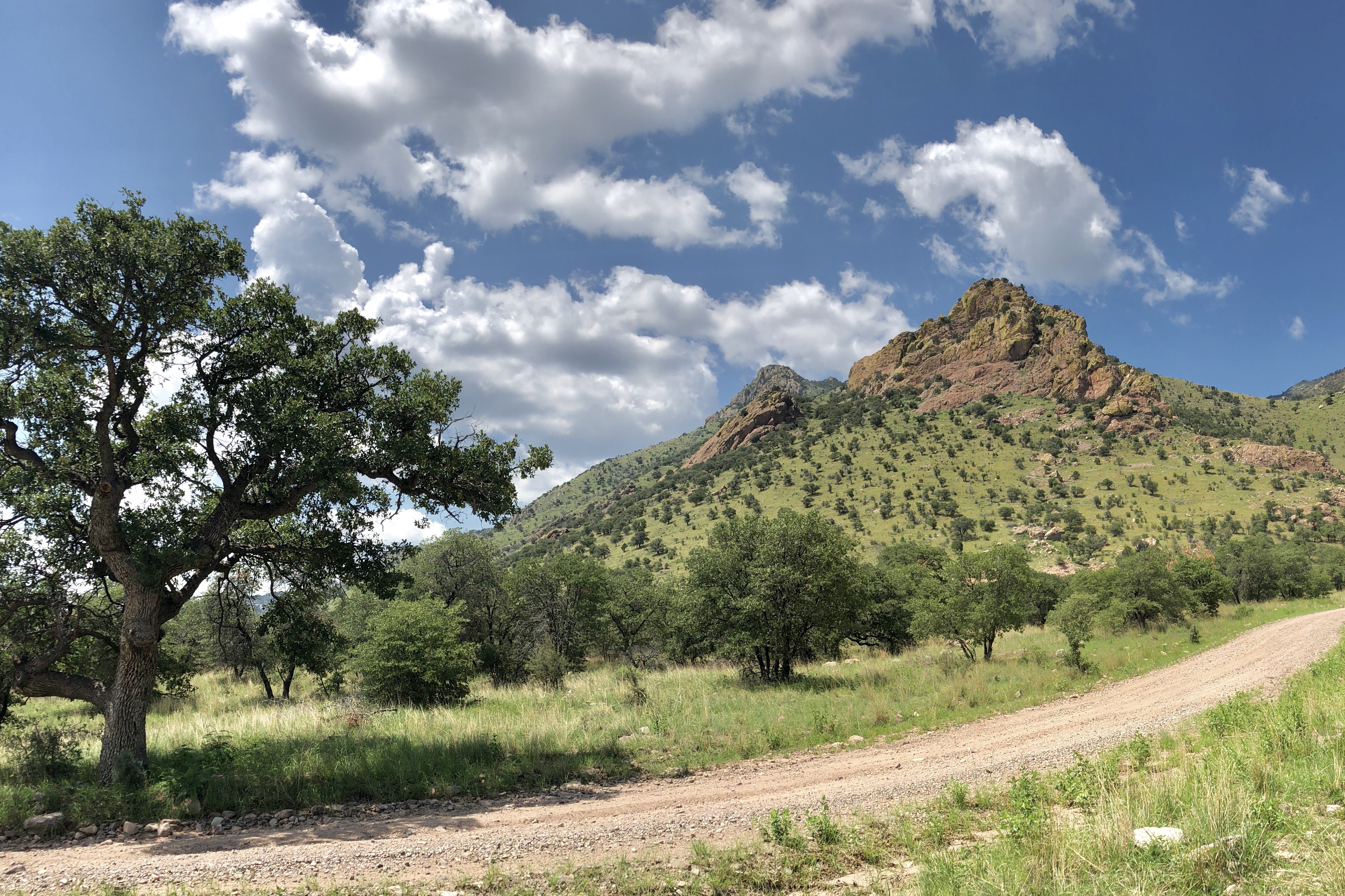
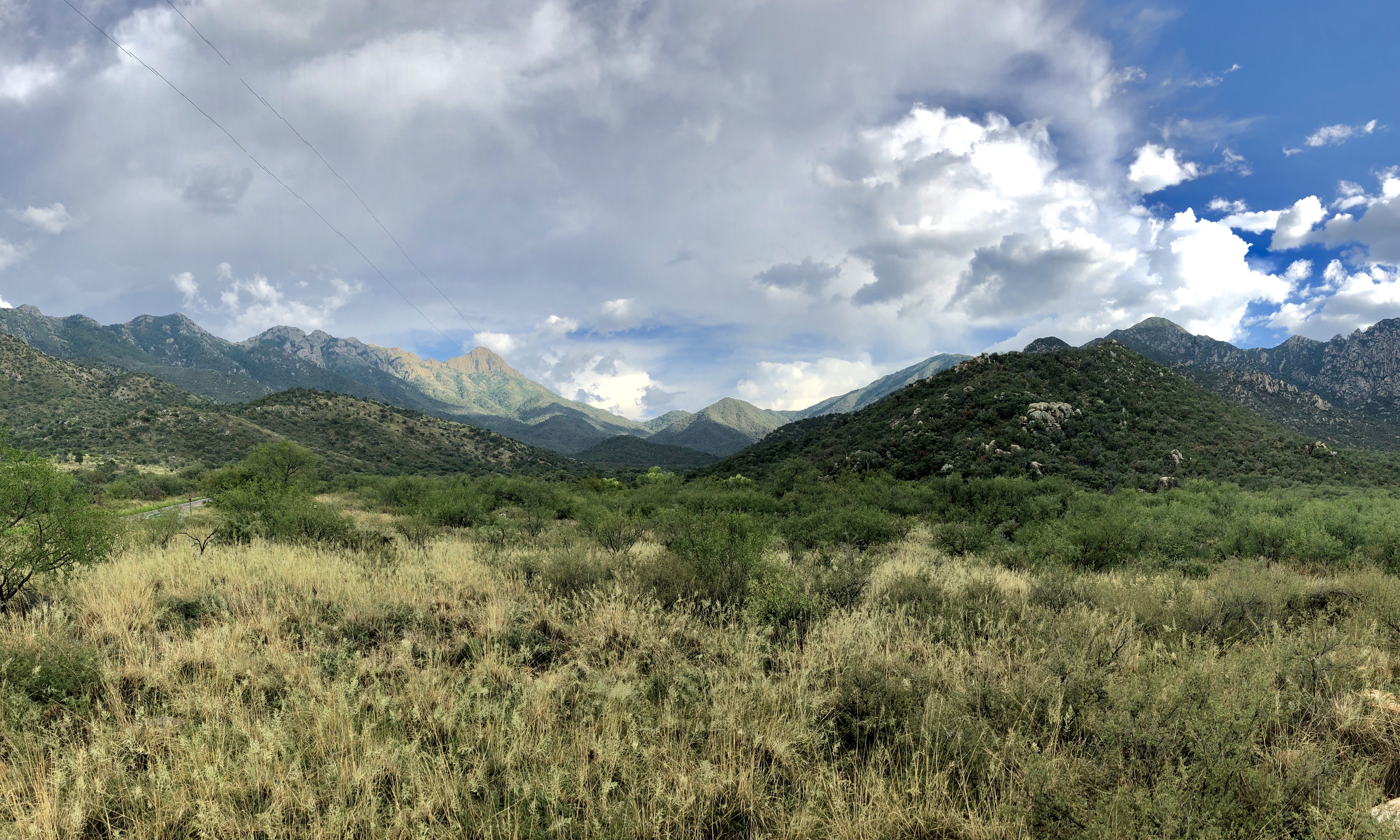
Madera Canyon in the Santa Rita Mountains.
Acanthocephala thomasi on Baccharis sarothroides.
What appears to be a so-called “cricket killer” wasp (Chlorion aerarium) also feeds on sap on Baccharis sarothroides.
A longhorned beetle, probably in the genus Aneflus, rests on the foliage of Baccharis sarothroides.
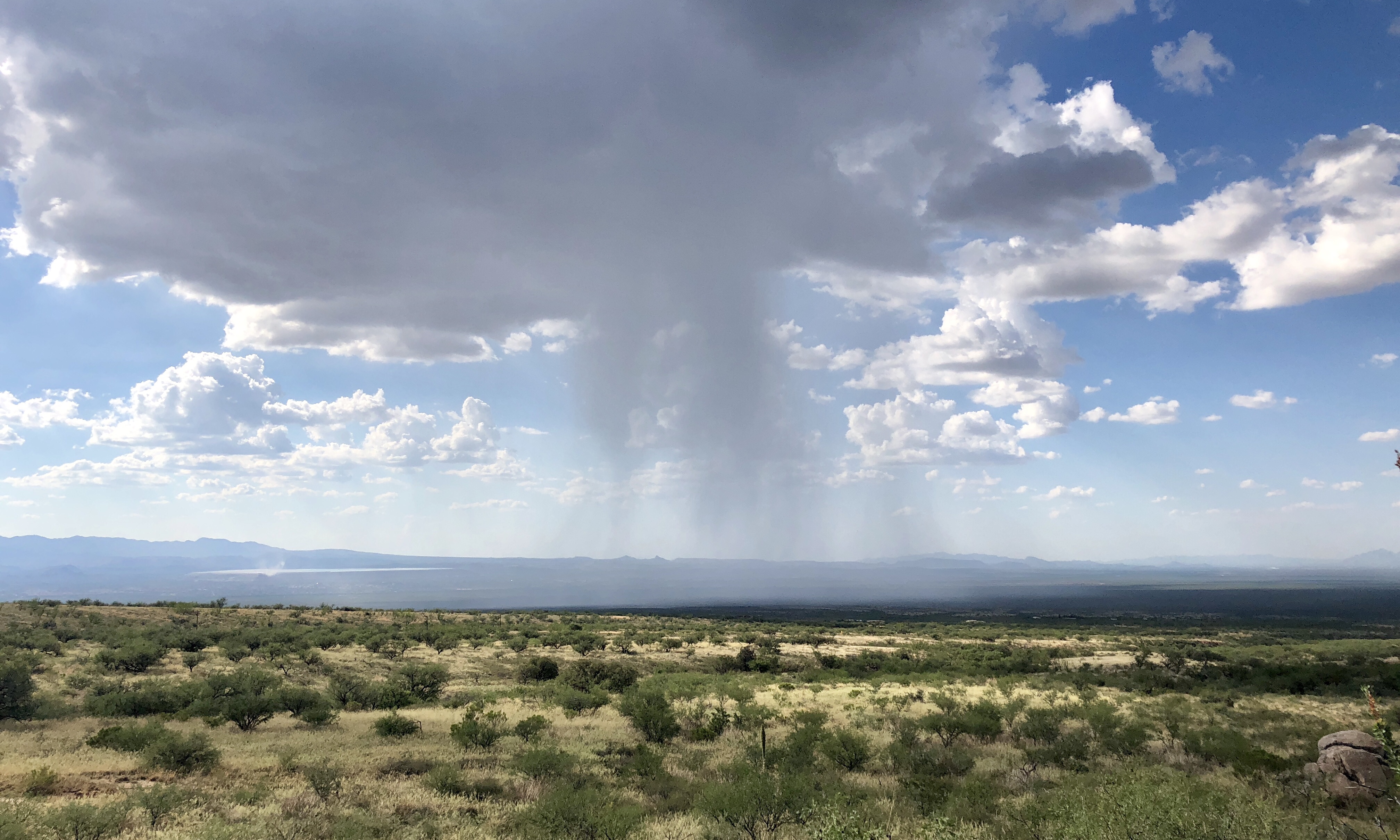
Rain headed my way!
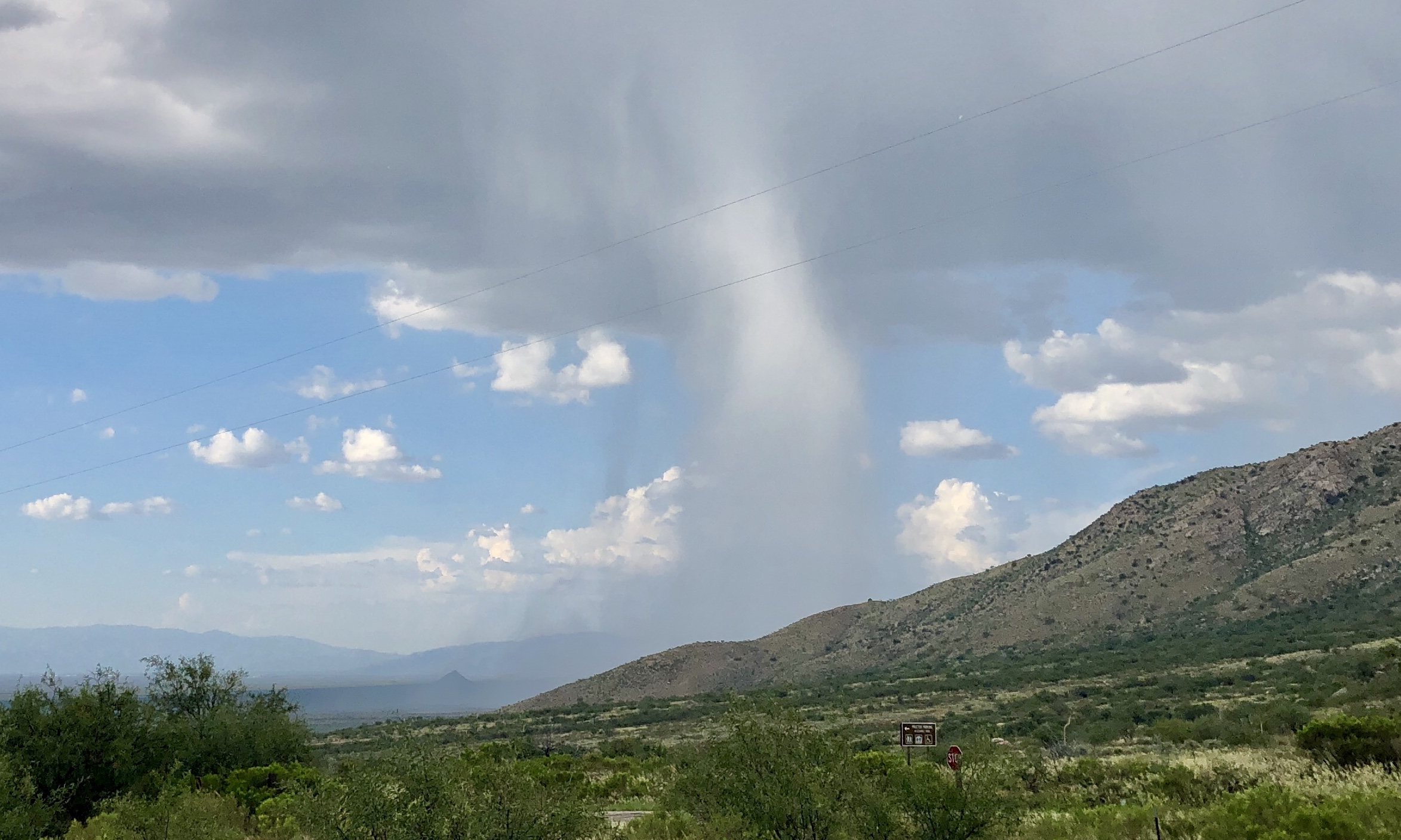
Rain passing into neighboring Florida Canyon.
Montosa Canyon, Santa Rita Mountains, Arizona
Just to try something different, we went to Montosa Canyon – the next canyon south of Madera Canyon – for tonight’s blacklighting. We set my sheet up just E of the crossing and Arts ground units back to the west along a gravel road on the south side of the crossing. Moths came in numbers, but the beetles were light – I collected only blister beetles (Epicauta sp.) and a Cymatodera sp. checkered beetle at the sheet, a series of tiger beetles and a female Strategus cessus at the second ground unit, and a male Strategus aloeus and two Stenelaphus alienus at the third ground unit.
A gorgeous sunset to start the evening.
A deepening dusk brings the promise of insects at the lights.
A bee assassin bug, Apiomerus flaviventris.
An ocotillo, or calleta, silkmoth – Eupackardia calleta.
One of the western riparian tiger beetles.
Day 7 (last day) – Vicinity Continental, Arizona
There was a photo posted on BugGuide of Stenaspis verticalis taken last week, so we decided to give it a shot and see if we could get lucky and find it ourselves. We checked all the Baccharis sarothroides within ½-mile if the spot but didn’t find it. I did, however, collect four Euphoria leucographa, two Chalcolepidius smaragdula, two Aneflus spp., and singletons of Stenaspis solitaria and Dendrobias mandibularis. I also took a couple of Hippomelas planicauda on Mimosadysocarpa – just for the record!
Euphoria leucographa on Baccharis sarothroides.
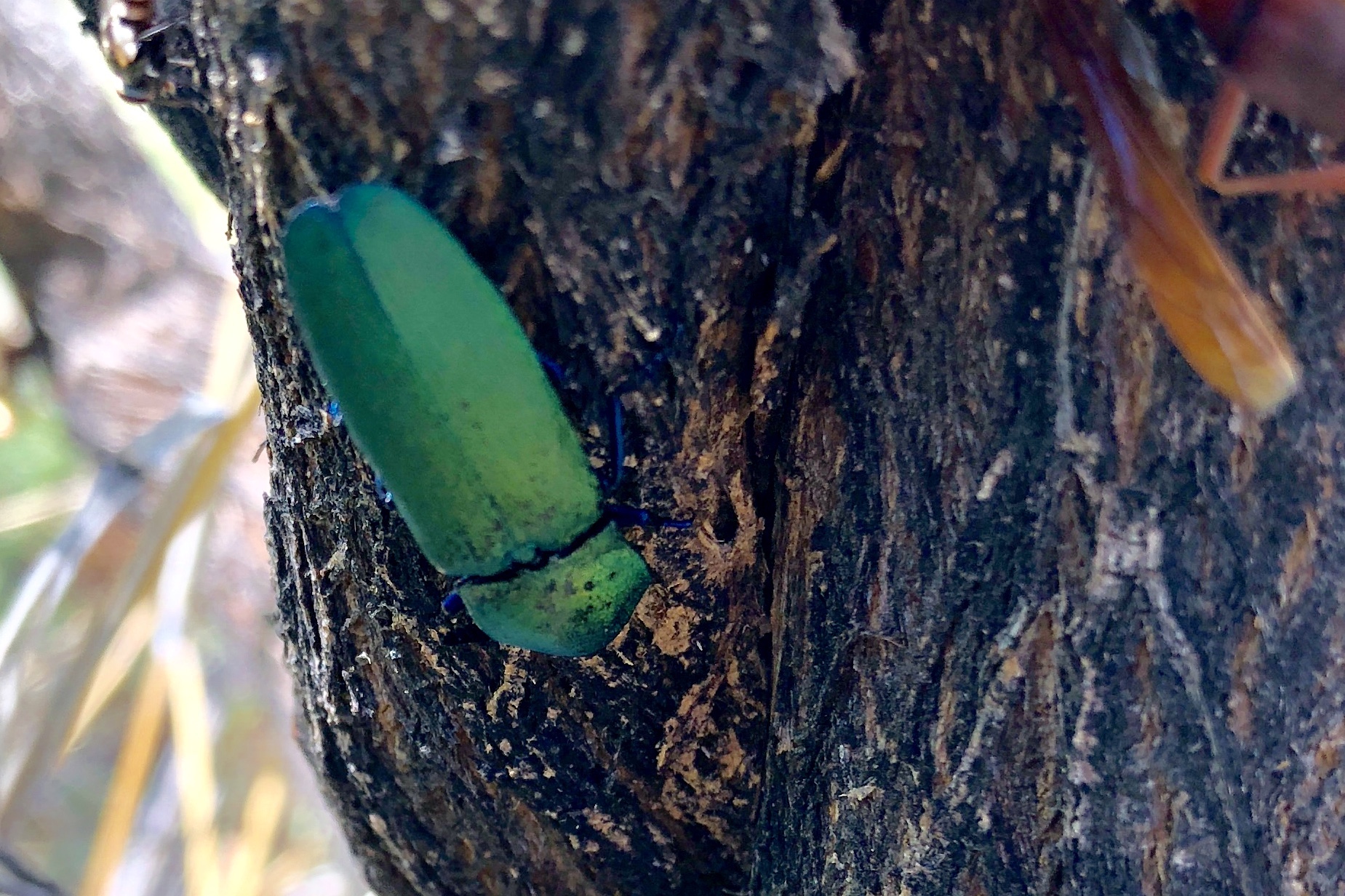
Chalcolepidius smaragdinus on Baccharis sarothroides.
Lower Madera Canyon, Santa Rita Mountains, Arizona
We returned to work the lower canyon area. I’d heard that the tiger beetle Cicindelidia obsoleta santaclarae has been taken in the area last week so was hoping to run into it. While Art worked the east side of the road I worked the west, initially following FR-781 into what looked like grassland areas where the tiger beetle might occur. I didn’t see any but took Acmaeodera scalaris on Heterotheca sp. flowers and Acmaeodera solitaria on Argemone mexicana flowers. There was also a fresh wind-thrown mesquite (Prosopis glandulosa) with a bunch of Chrysobothris octocola and one Chrysobothris rossi on it. Still the area looked abused from grazing and was uninteresting, so I looked for another area to explore.
Northwest of the parking lot I spotted another grassy area that was dotted with Baccharis sarothroides, so I decided to give that area a look. After clambering several times through barbed wire fence, I reached the area and began to give it a look. Still no tiger beetles, but every time I passed a B. sarothroides I inspected it closely. I’d looked at several plants when I came upon one with a Stenaspis solitaria sitting in the foliage, and when I looked down on one of the stems and saw a big male Tragidion sp. on the underside of the stem. After securing it, I looked closer at the plant and saw a pair of annulated antennae crawling up another stem – I knew right away it was a mating pair of Stenaspis verticalis! After carefully moving to the other side to confirm, I dared to take a few photos in situ (see below) and then secured the couple. Of course, this gave me newfound motivation to work the entire area to look for more. It was very hot by then, and I was already quite thirsty, but I summoned up all the stamina that I could and worked as many plants as I could, ending up with six Tragidion spp. and three Stenaspis verticalis. The latter was one of my top priority targets for this trips, and the only thing more satisfying than getting it is doing so on my last day on the field.
View to south edge of Madera Canyon – Elephant Head is at the right.
Chrysobothris octocola female ovipositing on freshly killed mesquite (Prosopis glandulosa).
Tragidion sp. mating pair on Baccharis sarothroides.
Mating pair of Stenaspis verticalisarizonensis on Baccharis sarothroides.
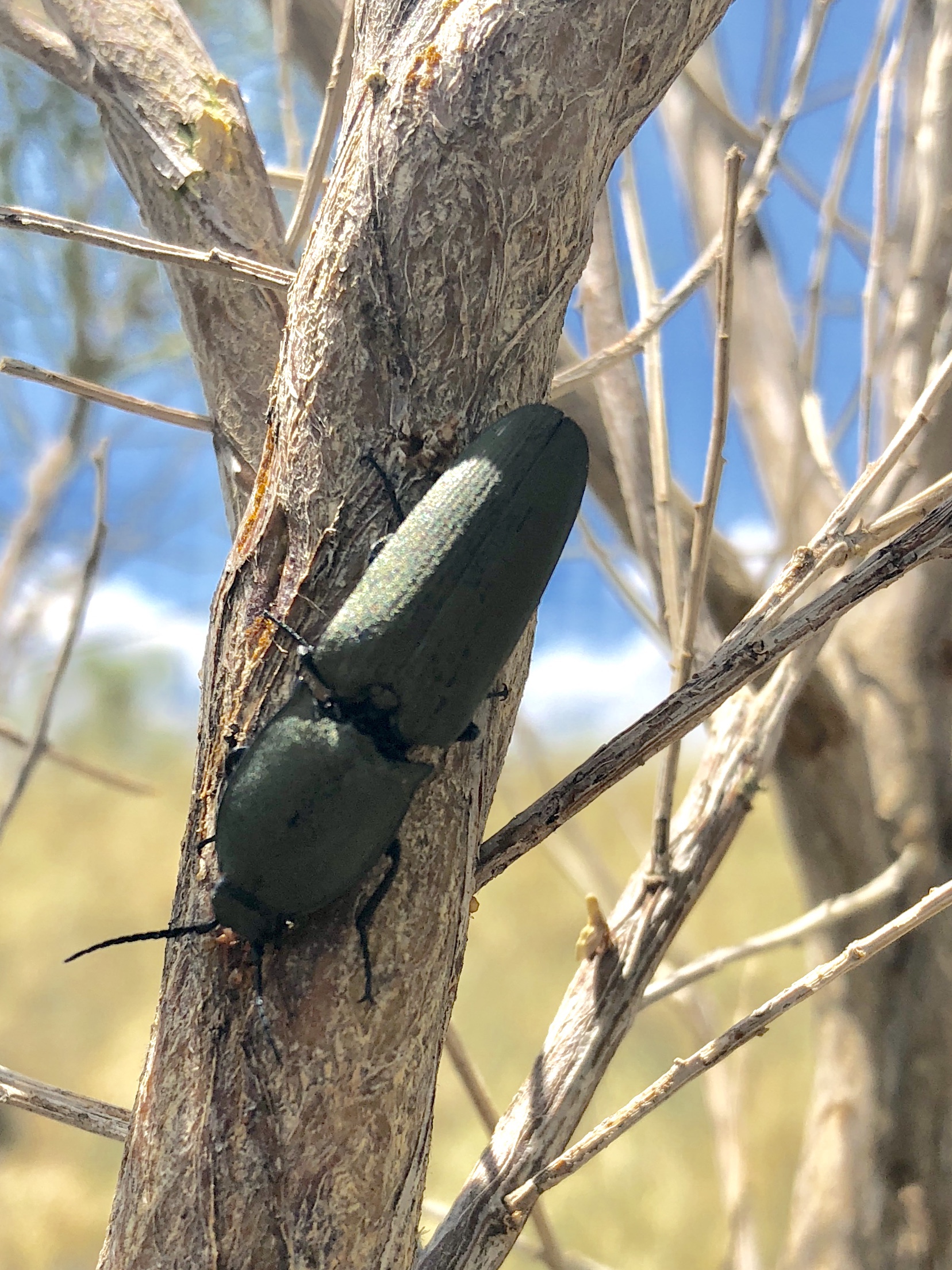
Chalcolepidius lenzi at a sap flow on Baccharis sarothroides.
Lateral view of Chalcolepidius lenzi.
Barrel cactus in bloom.
Montosa Canyon, Santa Rita Mountains, Arizona
We returned to Montosa Canyon and stopped at the Astronomy Vista partway up. It was hotter than bejeebuz! There was not an insect to be seen except giant cactus bugs and a single Euphoria leucographa that Art found on a sapping Baccharis sarothroides. Temp was 103°F even at this elevation!
Stunning vista during the day!
We needed to escape the heat, and I wanted to see oaks for one more crack at Mastogenius, so we drove up to the 13-km marker and I collected on the way back down to below the 12-km marker. Conditions were much more agreeable (temps in the 80s), and near the top there was a Ceanothus sp. bush in bloom, off which I collected Rhopalophora meeskei and Stenosphenus sp. – both genera represented by individuals with black versus red pronotum. Then I started beating the (Mexican blue, I believe) oaks, and right away I got a Mastogenius sp.! Kinda small, so I’m thinking not M. robusta and, thus, probably M. puncticollis (another species new to my collection). I also beat a largish Agrilus sp. that I don’t recognize, a few clerids, two R. meeskei, one Stenosphenus sp., and a couple of leaf beetles. There was also another type of oak there – Arizona white, I believe, which I beat as well but only got one clerid.
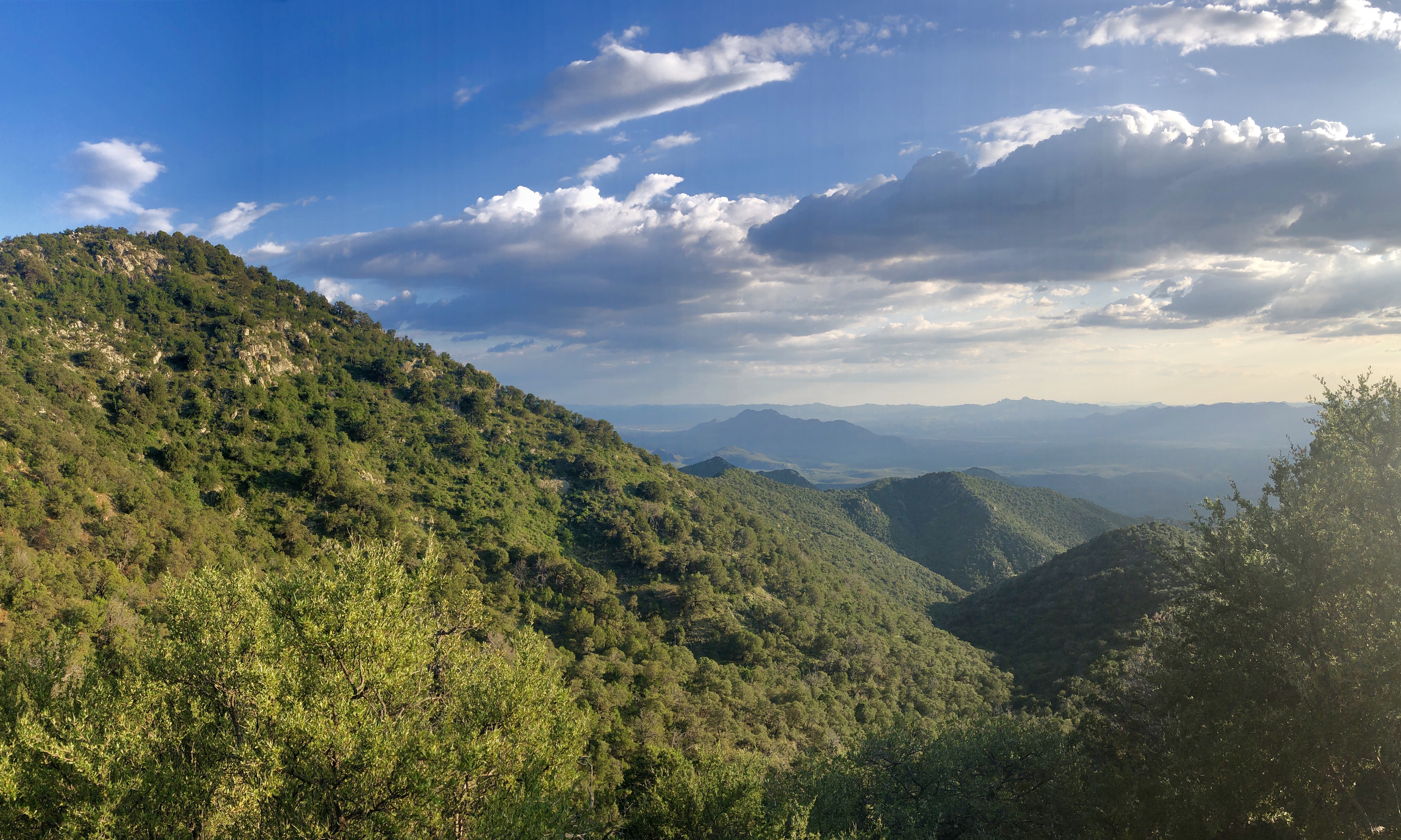
Spectacular views from 7000 ft!
A lichen moth on flowers of Ceanothus sp.
The biggest, fattest, bristliest tachinid fly I have ever seen!
The spectacular vistas just keep on coming!
An ancient alligator juniper stares down yet another sunset (perhaps its 50 thousandth!).
We stopped by the Astronomy Vista again on our way back down the canyon, and I found a pair of Moneilema gigas on cholla (Opuntia imbricata).
Obligatory dusk shot of Moneilema gigas on Opuntia imbricata.
Another individual on the same plant.
Sunset over “Las Cuatro Hermanas”.
It was a fantastic seven days in the field with Arthur, and it was a great pleasure to (in some cases, finally) meet Margarethe, Barbara, Steven, Norm, and Pat. I appreciate the warmth, generosity, and hospitality that all of them displayed to me and look forward to our next encounter, hopefully in the near future. Now, for some light reading during the plane ride home!
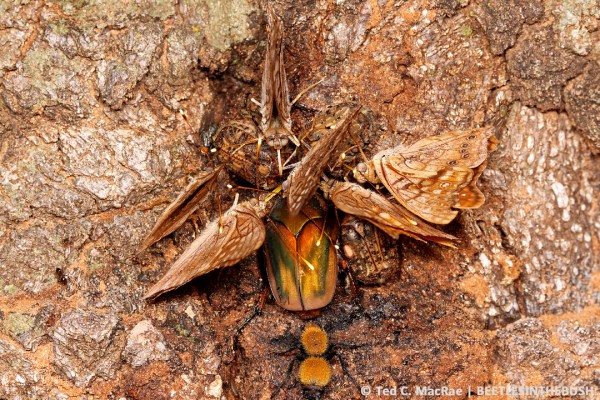
In September 2012 while collecting in western Oklahoma (Weatherford) I came across this interesting scene. It had been exceedingly dry in the area, and because of this few insects were out and about in the small city park that I stopped by to check for the presence of tiger beetles. I had nearly completed my circuit of the park when I came upon a moderate-sized pin oak (Quercus palustris) tree and noticed something on the lower trunk:
Six insect species representing five families in four orders share a sap flow on the trunk of a pin oak.
No less than six insect species representing four orders were seen all huddled together at a darkly stained sap flow. This could be the result of slime flux, a bacterial disease that usually affects deciduous hardwoods that are under stress and results in darkly stained weeps on the trunk that are known to be attractive to a variety of insects. At the center sat a green June beetle (Cotinis nitida) and three bumble flower beetles (Euphoria inda)—all in the family Scarabaeidae (subfamily Cetoniinae). Covering the scarab beetles were half a dozen Texas Tawny Emperor (Asterocampa clyton texana) butterflies (family Nymphalidae, or Brushfooted Butterflies), and milling around the perimeter was a velvet ant (Dasymutilla creusa, I believe) in the family Mutillidae, an apparent flesh fly (family Sarcophagidae), and a true ant (family Formicidae). I guess this would be the equivalent to a watering hole in Africa with a lion, a hyena, a baboon, three vervet monkeys and six zebras all crouched shoulder-to-shoulder at its edge.
Euphoria sepulchralis feeds on a sap flow higher up on the trunk.
Further up on the trunk, yet another species of scarab beetle, a dark flower scarab (Euphoria sepulchralis) was found feeding on a smaller sap ooze. Unlike the diverse aggregation of insects on the lower ooze, this guy had managed to keep the ooze all to himself.
Cotinis nitida | Weatherford, Oklahoma
Green June beetles, especially, are known for their feeding on sap oozes. The beetles are actually attracted to the odors caused by fermentation of the sap rather than the sap itself. It has been reported that the presence of alcohol in fermenting sap can affect the behaviour of insects that feed upon it, causing them to act “stupid and lethargic.” I did not see any such behavior, but I did notice that the insects were not at all skittish and loath to leave the sap.
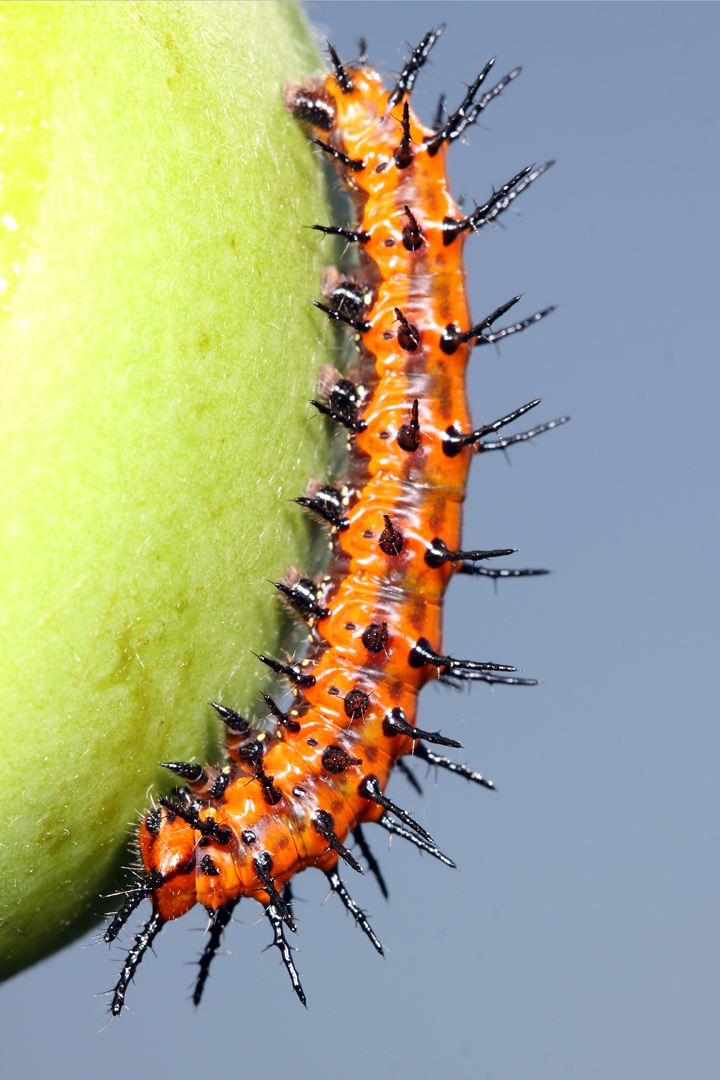
I’m not sure, but I think this might be the first time I’ve photographed a butterfly caterpillar. Not a bad subject to start with, as few butterflies have caterpillars that are more colorful than the Gulf Fritillary, Agraulis vanillae. A common resident in the southern states and further south, this member of the nymphalid subfamily Heliconiinae is less commonly encountered in Missouri—in fact, I had never seen (or at least noticed) these caterpillars before encountering a few feeding hungrily on the foliage of maypop (Passiflora incarnata) growing in a city park in Missouri’s southeastern lowlands. While the stunning colors of these caterpillars are a delight to human eyes, their function, as in most butterfly caterpillars, is to advertise the unpalatability of their toxin-laced bodies. In the case of this species, the toxins include cyanogenic glycosides that the larvae sequester from the tissues of their host plants (ironically these compounds are supposed to serve the same protective function for the plant that produces them, but butterflies have become master specialists at evolving mechanisms to sidestep toxic impacts).
According to my friends Richard & Joan Heitzman, long-time students of Missouri Lepidoptera, this species is a sporadic migrant that occasionally forms summer colonies in Missouri, especially in the western half of the state, until the first hard freeze destroys the colony (Heitzman & Heitzman 1987).
REFERENCE:
Heitzman, J. R. & J. E. Heitzman. 1987.Butterflies and Moths of Missouri. Missouri Department of Conservation, Jefferson City, 385 pp.








































































 Beetles In The Bush