Done with dung, meat please!

ResearchBlogging.orgNo feces for this species.” “Carnivorous dung beetle shuns dung and decapitates millipede.” “Little dung beetle is big chopper.” “Dung beetle mistakes millipede for dung.” These were some of the clever headlines that I had to compete with in coming up with my own opener for a remarkable beetle that titillated the science blogosphere last week. At the risk of being redundant, I’d like to revisit that beetle and offer a few (hopefully novel) thoughts of my own. I can say that I have a unique and special treat for those willing to read further.

First the background. Deltochilum valgum is a so-called “dung beetle” in the family Scarabaeidae that lives in the lowland rain forests of Peru. As suggested by its common name, it belongs to a group of beetles that are well known for their dung feeding habits. Over 5,000 species of dung beetles are known throughout the world, all of which carve out balls of dung and bury them as provisions for larval development – or so it was thought.  As reported by Trond Larsen of Princeton University and colleagues in Biology Letters, D. valgum has apparently abandoned its ancestral dung ball-rolling behavior in favor of a predatory lifestyle. Its prey – millipedes! Moreover, the species exhibits several distinct morphological traits that appear to have evolved as a direct result of their predatory behavior. Adult beetles were repeatedly observed killing and eating millipedes, and their disdain for dung was rather conclusively demonstrated by an exhaustive, year-long trapping program in which pit-traps were baited with a variety of bait types known to attract dung beetles (e.g., various kinds of dung, carrion, fungus and fruit) – and millipedes.  In all, over 100,000 dung beetles representing 132 species were trapped (what a nice collection!), 35 of which were found to scavenge on dead millipedes, but only five of these dared tackle live millipedes.  Of these, only D. valgum ignored all other foods – it only came to traps baited with live millipedes.

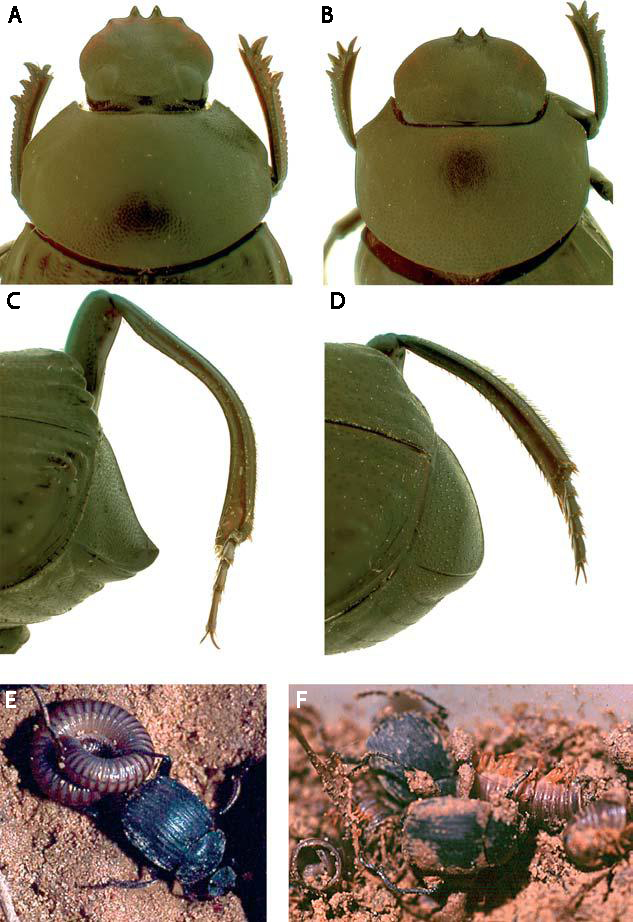
Larsen et al. determined that adults of D. valgum are opportunistic hunters and were much more likely to attack injured millipedes than healthy ones, even those weighing 14 times as much as the beetle.  Ball rolling behavior was never observed by D. valgum.  Most dung beetles have wide, shovel-shaped heads used to scoop and mold dung balls, but D. valgum has a much narrower head with sharp “teeth” on its clypeus (Fig. 1A vs. 1B).  The teeth apparently aid in killing the millipede by piercing the ventral surface behind the head and prying upwards (decapitating it), and the narrow, elongate head facilitates insertion into the millipede body for feeding.  Further, the hind tibia are elongate and curved, which are used to “grip” millipedes by holding them up against the dorsally reflexed pygidium (Fig. 1C vs. 1D).  This allows the beetle to drag its coiled up victim with one hind leg while walking forward on the other five (Fig. 1E).  Once killed, the beetles proceeded to break their prey into pieces and consume their meaty innards, leaving the disarticulated millipede exoskeletons licked clean (Fig. 1F).  One of these “attack” episodes was filmed (using infrared lighting so as not to affect their nocturnal behavior) and can be seen in this BBC News video.
Deltochilum valgum

Figure 1. (a) Dorsal view of D. valgum head. Sharp clypeal teeth and angled clypeus act as a lever to disarticulate millipede. Narrow, elongate head permits feeding inside millipede; (b) dorsal view of Deltochilum peruanum head, lacking characters described in (a), head used to mould dung balls; (c) lateral view of D. valgum pygidium and hind tibia. Dorsally reflexed pygidial lip is used to support millipede during transport. Elongate, strongly curved hind tibia is used to grip millipede. (d ) Lateral view of D. peruanum pygidium and hind tibia, lacking characters described in (c), hind tibia used for rolling dung balls. (e, f ). Predation strategy by D. valgum. (e) Dragging live, coiled millipede with one hind leg, walking forwards; ( f ) feeding on killed millipede with head inside
segments; disarticulated empty millipede pieces nearby.
Credit: Larsen et al. (2009).

Much has been made about this remarkable shift from coprophagy to predation, which Larsen et al. speculate was driven by competition for limited resources with the many other dung beetle species that occur in the Peruvian rainforests. In fact, adult dung beetles are known to feed on a variety of resources besides dung, as exemplified by the range of baits used in their survey. Thus, my first thought after reading the coverage was actually a question: “Has this species abandoned dung provisioning completely as a reproductive strategy?” Everything I had read focused exclusively (quite understandably) on the bizarre feeding habits of the adults, but there was no mention of what the species’ larval provisioning strategies were. Wanting more information about this, I contacted Trond Larsen, who graciously sent me a PDF of the paper. Unfortunately (though not a criticism of the paper), no further insight about this was found in the paper either. Indeed, in all of the observations recorded by Larsen et al., millipedes killed by D. valgum were consumed entirely by the adults, and no mention was made of how or whether millipedes were utilized for larval provisioning. I wondered if D. valgum had truly abandoned dung provisioning for larval development (a remarkable adaptive switch), or if in fact the species might still utilize the strategy for reproduction (perhaps having specialized on a dung type not included in their survey), while also exploiting millipede predation as adults for a nutritional advantage. I asked Trond about this, to which he replied with this juicy tidbit (I told you I had a special treat!):

Yes, I would very much like to know what the reproductive/nesting behavior of D. valgum is. My best guess is that they also use millipedes as a larval food source, but as you say, we haven’t observed that behavior yet. I have observed other generalist dung beetle species rolling balls out of dead millipedes, presumably to bury for the larvae, so I certainly think it would be an adequate food source. Many dung beetle species use carrion for their larvae.

I am quite confident that D. valgum does not use any kind of dung. I have sampled these dung beetle communities very thoroughly, with many dung types and other bait types, and also with passive flight intercept traps that catch all beetles. Every dung beetle species that feeds on dung is at least sometimes attracted to human dung (this is not the case in African savannahs though, but is in neotropical forests – that is a whole different story). There are still a small handful of species we catch in flight intercept traps that we don’t know what they eat, although some of these mysteries have recently been solved – many of them live in leaf-cutter ant nests for example.

While predation of millipedes by a dung beetle is itself a fascinating observation, demonstrating the abandonment of dung provisioning in favor of captured prey for larval development would be a truly remarkable example of an ecological transition to exploit a dramatically atypical niche. I hope Trond (or anybody for that matter) actually succeeds in observing millipede/prey utilization for larval provisioning by this species.

Many thanks to Trond Larsen for his delightful correspondence.

SOURCE:
Larsen, T. H., A. Lopera, A. Forsyth and F. Génier. 2009. From coprophagy to predation: a dung beetle that kills millipedes. Biology Letters DOI: 10.1098/rsbl.2008.0654.

Copyright © Ted C. MacRae 2009

Add to FacebookAdd to NewsvineAdd to DiggAdd to Del.icio.usAdd to StumbleuponAdd to RedditAdd to BlinklistAdd to Ma.gnoliaAdd to TechnoratiAdd to Furl

The “buzzard signal fly”

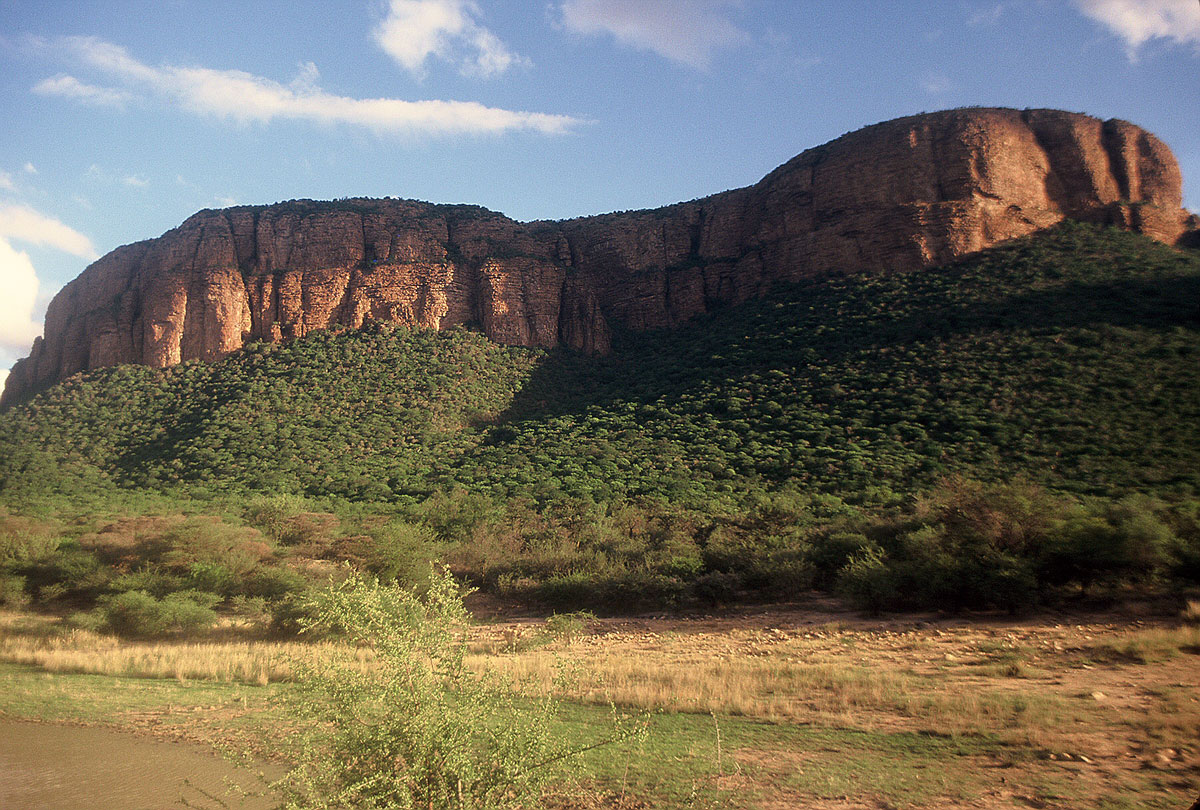
Waterberg RangeDuring our time at Geelhoutbos farm in South Africa’s Northern (now Limpopo) Province, we spent most of our time in the foothills below a magnificent north-facing escarpment of the Waterberg Mountain Range. We were here to collect Buprestidae (including the magnificent Evides, featured previously in this post), and it was in the low bushveld woodland where the greatest diversity of buprestids would be found. Many of the buprestids we encountered were associated with the acacias that abundantly dotted the landscape – especially the iconic “umbrella thorn” (Acacia tortilis) and “sweet thorn” (Acacia karoo), providing sustenance for everything from bitsy beetles (including our beloved buprestids) to giant giraffes. Still, I kept eyeing the mountains, yearning to clamber up on top of the billion year old massif for no other reason than because it was there. Chuck had the good sense to stay down below amongst the acacias and buprestids while I spent an afternoon winding my way up the escarpment in the company of our hostess, Susan Strauss. I didn’t collect many buprestids during that trek, and if success is measured solely by numbers of buprestids collected then Chuck won. But if success also includes the chance to see spectacularly endless vistas from an otherworldly landscape on a once in a lifetime trip, then I didn’t do too badly.

Bromophila caffra

While I didn’t see many buprestids during that afternoon, I did see a few other insects interesting enough to attract my attention and maybe an attempt at a photo. This stunning fly was one of those insects. Even though it exceeded a full inch in length, it still wasn’t the largest fly I had ever seen. However, with its black body, metallic blue wings and large, round, wax-red head it was certainly among the most impressive. A quick scan through my recently acquired Field Guide to Insects of South Africa (Picker et al. 2002) has at last identified this fly as Bromophila caffra. It is a member of the family Platystomatidae, commonly known as signal flies and part of the great superfamily Tephritoidea of fruit fly fame (i.e., true fruit flies – not “the” fruit fly which belongs to the family Drosophilidae and which are more properly called vinegar flies).

Signal flies are interesting on several fronts, firstly because of their catholic tastes – Sivinski (1999) records rotting tree trunks, bulbs, roots and fruit, dried flowers and dead grass stems, dung and fungus as breeding sites, and notes – gruesomely – that mass graves dug in World War II sometimes produced huge numbers of the species Platystoma lugubre. It is some of the Australasian species, however, that have truly made a name for this family. In the tropical rainforests of Guinea and Queensland, males of many species exhibit modifications of their heads that are used in agonistic interactions with sexual rivals. These vary from broadening of the face into a surface used to push against the face of another male, to extremely well-developed stalk eyes used to gauge rival male’s size and strength in face to face combat.

But what about Bromophila caffra? Aside from being one of the most recognizable of flies in Africa, it’s sluggish disposition and apparent noxiousness were obvious even to early naturalists. Marshall (1902) noted the similarity of its coloration (black body, blue wings, red or yellow head) to that of two Pompilus spp. and one sphecid wasp with which it occurred sympatrically. Regarding its habits, he also noted:

The Bromophila fly is very plentiful; it is the most sluggish fly known to me, and settles about on trees and bushes in a very conspicuous manner. It ejects a yellow liquid from the mouth when handled, and was refused when offered to my baboons and Cercopithecus monkey.

Andrew Whittington, commenting on a photo of this species posted on DipteraInfo.com, provides further clues that seem to confirm the noxious qualities of this species, explaining not only its striking color and brazen habits but also the ease with which I obtained the above photograph:

Our knowledge of larval habits is very rudimentary. There appears to be an association with the roots of Terminalia trees (Combretaceae), from which the larvae sequester various toxic compounds (probably cyclic triterpenes) possibly for defense. This may render the adults toxic too, as a defense against predation – not a thoroughly tested hypothesis.
Adults are slow moving and ponderous … and photogenic!

I find it surprising that a large, strikingly distinctive, abundant insect such as Bromophila caffra should lack a common name, but it appears this is the case. None was given in Field Guide to Insects of South Africa, nor amongst the several South African wildlife and dipteran websites which I encountered featuring photos of this insect. In thinking about what common name Bromophila caffra could have, I can’t help but draw comparisons between this insect and the turkey vulture (Cathartes aura), or “buzzard,” of North America (despite their belonging to entirely separate phyla). Both species are among the larger members of their respective orders and make their living eating repulsive foodstuffs. Hulking black with naked, red, plastic-like heads, most predators regard them as too vile and noxious to bother with, leaving them free to pass their lives in unmolested disdain. With this in mind, I hereby propose “buzzard signal fly” as the official common name for this insect 😉

Additional photographs of Bromophila caffra can be seen at Joan Young’s fine blog, South African Photographs, and at Biodiversty Explorer, the web of life in Southern Africa. This is the fifth in a series of posts covering a natural history excursion to South Africa in November/December 1999. Click on “South Africa” under “Tags” to see links and summaries for other posts in this series.

REFERENCES:

Marshall, G. A. K. 1902. Five year’s observations and experiments (1896-1901) on the bionomics of South African insects, chiefly directed to the investigation of mimicry and warning colours. Transactions of the Entomological Society of London, 1902:287-584.

Picker, M., C. Griffiths and A. Weaving. 2002. Field Guide to Insects of South Africa. Struik Publishers, Cape Town, 444 pp.

Sivinski, J. 1999. Breeding habits and sex in families closely related to Tephritidae: Opportunities for comparative studies of the evolution of fruit fly behavior, pp. 23-39. In: M. Aluja and A. L. Norrbom [eds.], Fruit Flies (Tephritidae): Phylogeny and Evolution of Behavior, CRC Press, Boca Raton, 984 pp.

Tyrant ground beetles

I return to my Afrikaans theme with a distinctive group of ground beetles (family Carabidae) called tyrant ground beetles or spotted ground beetles (tribe Anthiini). I think I prefer the former. This tribe is largely restricted to Africa and is especially diverse and abundant in the arid, sandy Karoo and Kalahari regions of southern Africa (Scholtz & Holm 1985). These beetles are large, powerful predators that rely on speed and agility for capturing prey, and since they are also flightless these characteristics come in handy for avoiding becoming prey themselves. Failing that, they employ chemical defense in the form of secretions from a pygidial gland located in the area of the ninth abdominal segment. The chemical cocktail within these secretions contains concentrated organic acids or quinone that can be squirted at potential predators in a strong jet. This is an effective deterrent to small mammalian and avian predators, and I suppose a careless beetle collector might also regret handling these beetles without due respect. These defensive spray capabilities give rise to another common name for the group, “oogpister” – an Afrikaner word that literally translates to (ahem) “eye pisser.”

Anthia (s. str.) thoracicaDuring my time in Africa, Chuck Bellamy and I were primarily focused on collecting buprestids. However, we still couldn’t resist hanging an ultraviolet light in front of a sheet and searching the ground with flashlights at night to see what diversity of other African insects we might encounter. Truth be told, one of the non-buprestid groups that I’d really hoped to encounter was a near relative of these beetles – the so-called “monster tiger beetles” of the genus Manticora (family Cicindelidae1). We never did see any monsters, but we did encounter several species of anthiine ground beetles around our encampment at Geelhoutbos farm near the Waterberg Range in Limpopo Provice. Anthia (s. str.) thoracica, the giant African ground beetle (above), was the most impressive of these. Click on the photo to see a larger version – only then will it begin to convey how truly appropriate such a common name is for this species. It is certainly the largest ground beetle that I have ever seen – a full 50 mm in length! That’s 2 inches, folks! This species is easily recognized by the depressed lateral expansions of the pronotum covered with dense white/yellow pubescence, and the slightly smaller male that I caught exhibits more elongated mandibles (though not so incredibly as in Manticora) and marvelous lobes extending backward from the pronotum.

1 Increasingly placed within the Carabidae as subfamily Cicindelinae on the basis of molecular phylogenetic analysis, along with Paussinae and Rhysodinae (e.g., Beutel et al. 2008).

Anthia (Termophilum) omoplataIn addition to true Anthia, we saw two species of the subgenus Anthia (Termophilum)2. The species shown right is A. (T.) omoplata3, with the common name “two-spotted ground beetle” (Picker et al. 2002). It was almost as large as its giant brother above, measuring 47 mm in length. Of this species, I only saw this one individual, but I did also find two individuals of a related species, T. fornasinii. Unfortunately I was unable to photograph the latter species, which is equally large but with the elytral white markings limited to a thin marginal band and the surface of the elytra bearing strong longitudinal intervals – a handsome beast, indeed! Picker et al. (2002) mention T. homoplatum being a diurnal hunter, but we found all of our anthiines active nocturnally.

2 Treated variously in the literature as either a full genus or as a subgenus of Anthia. I follow Carabidae of the World, in which it is given subgeneric status. The name is often cited as “Thermophilum” in the literature, but this is an incorrect subsequent spelling according to Alexandre Anischenko (in litt.), coordinator/editor of Carabidae of the World.

3 Usually cited as “homoplatum” or “homoplata” in the literature, but this is an incorrect subsequent spelling (Anischenko in litt.).

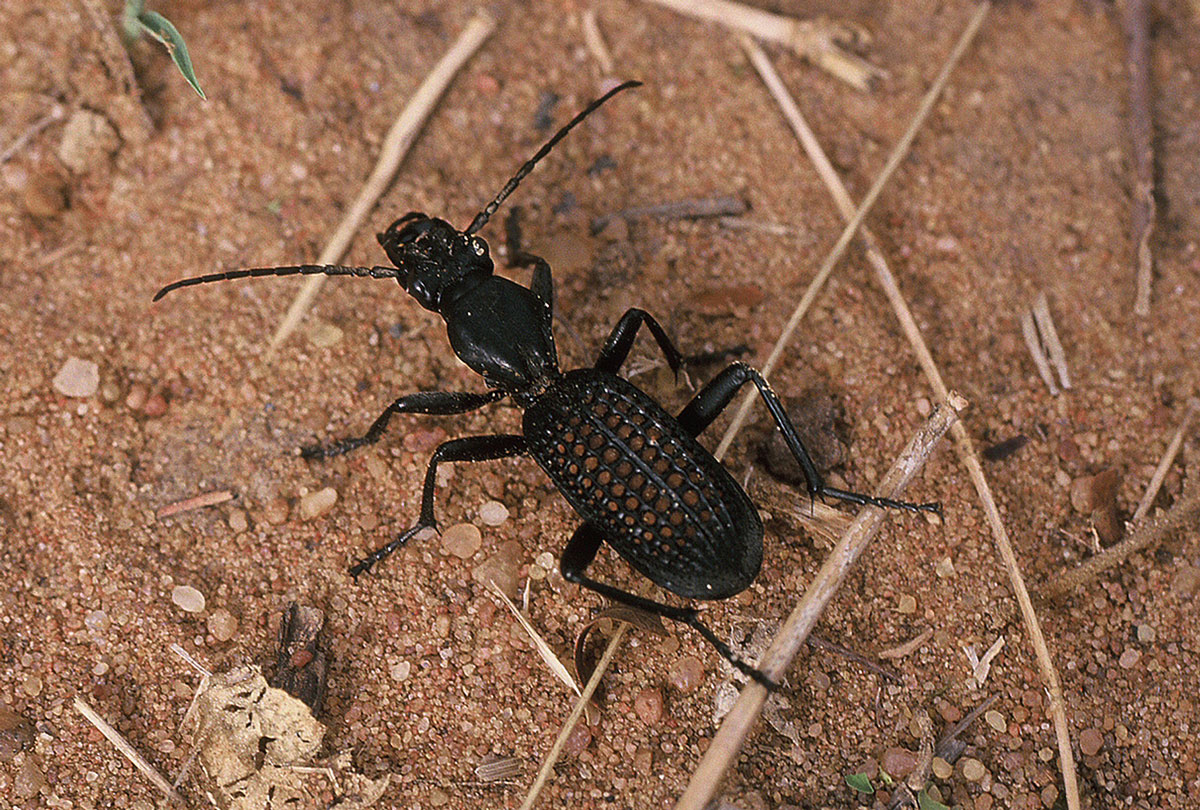
cypholoba-alveolataA second genus in the tribe is Cypholoba, represented here by C. alveolata. As far as I can tell it lacks a common name, which is not surprising since it is somewhat smaller than the Anthia species mentioned above. Still, my two specimens measure 38 and 35 mm in length – not puny by any standard. There can be no doubt as to the origin of the specific epithet of this species’ scientific name, with its marvelously alveolate elytra. I don’t think I’ve seen such an extraordinary example of this type of surface sculpturing on a beetle of this size, making the species every bit as spectacular as the larger anthiines.

A truly fascinating aspect of Africa’s tyrant ground beetles is their role as models in Batesian mimicry systems. That these beetles should serve as models is not at all surprising due to their chemical defensive capabilities and obviously aposematic coloration. What is surprising is the mimic – juveniles of the lizard species, Eremias lugubris, in what is believed to be the first reported case of a terrestrial vertebrate mimicking an invertebrate (Huey & Pianka 1977). The juveniles not only copy (roughly) the black and white coloration of anthiine beetles but also mimic their rapid, skitty movements – foraging actively with “jerky” motions and arched backs. Their tails remain somber colored, however, allowing them to blend into the sand. These adaptations combine to give the harmless little lizard the size, color, profile, and gait of the beetles. As the lizards reach adulthood (and their greater size makes them less prone to predation), they take on a more typical cryptic coloration and move in a slower, more deliberately lizard-like manner. This mimicry association effectively reduces predation of the juveniles by potential predators, who quickly learn to avoid the noxious, and more frequently encountered, anthiine models.

REFERENCES:

Beutela, R. G., I. Riberab and O. R. P. Bininda-Emonds. 2008. A genus-level supertree of Adephaga (Coleoptera). Organisms, Diversity & Evolution, 7:255–269.

Huey, R. B. and B. R. Pianka. 1977. Natural selection for juvenile lizards mimicking noxious beetles. Science, 195 (4274):201-203.

Picker, M., C. Griffiths and A. Weaving. 2002. Field Guide to Insects of South Africa. Struik Publishers, Cape Town, 444 pp.

Scholtz, C. H. and E. Holm (eds.). 1985. Insects of Southern Africa. Butterworths, Durbin, 502 pp.